Filings as a structured signal.
53,660 companies, 28.0 million filings, 48 markets — indexed in < 60 s, webhook fires in < 90 s. Stop maintaining scrapers. Start trading the wire.
What's broken in the current stack.
Most funds we talk to are paying analysts to babysit scrapers. The work that doesn't show up in a backtest.
Seven scrapers, one outage.
Every regulator changes its site. Every change breaks a scraper. Quants end up running a data engineering team they didn't hire for.
Hours late on small caps.
Vendors index the index members fast. The long tail — where dispersion is — lags. By the time you see the filing, the move is priced.
PDFs are not a feature.
A 412-page PDF is ~120k tokens of noise. Tables shred, footnotes detach, identifiers vanish. NLP runs on whatever survives.
A signal, not a scraper farm.
Four primitives. Every filing in the index, callable in production, in the format your model actually consumes.
Push, don't poll.
A new filing fires a webhook in < 90 s. Your strategy runs on the event, not on the cron.
Clean text in, alpha out.
A 412-page PDF becomes ~3,200 tokens of Markdown. Tables intact, footnotes attached, ~70 % token reduction.
Beyond the index.
53,660 companies — small and mid-caps included. Where dispersion lives and consensus hasn't formed yet.
Structured fundamentals.
Extracted KPIs pulled directly from the filing. Skip the parser, feed the model.
From the wire to your model.
Four steps, end-to-end. Continuous polling on the regulators, push to your stack on each new event.
Watch the regulators.
Continuous polling of every regulator and exchange in coverage. New filings detected within seconds of publication.
Pull, dedupe, store.
Fetch the original document, deduplicate against the index, store the canonical PDF with audit trail.
Normalise to Markdown.
Tables, footnotes, headings, identifiers extracted into one canonical record. JSON, Markdown, original PDF served from the same record.
Push to your stack.
REST + GraphQL pull. Webhook push. S3 mirror, Snowflake, or Databricks share for bulk consumers.
Subscribe to the wire in two files.
A webhook handler that receives the filing event and pulls the Markdown for the model. Sample payload on the right.
"We were maintaining seven scrapers across regulators. We now maintain zero. Filings hit our model the same minute they're published."
The Alpha List · free download.
A pre-screened set of under-covered small caps with their next filing dates. Use it while you evaluate the API.
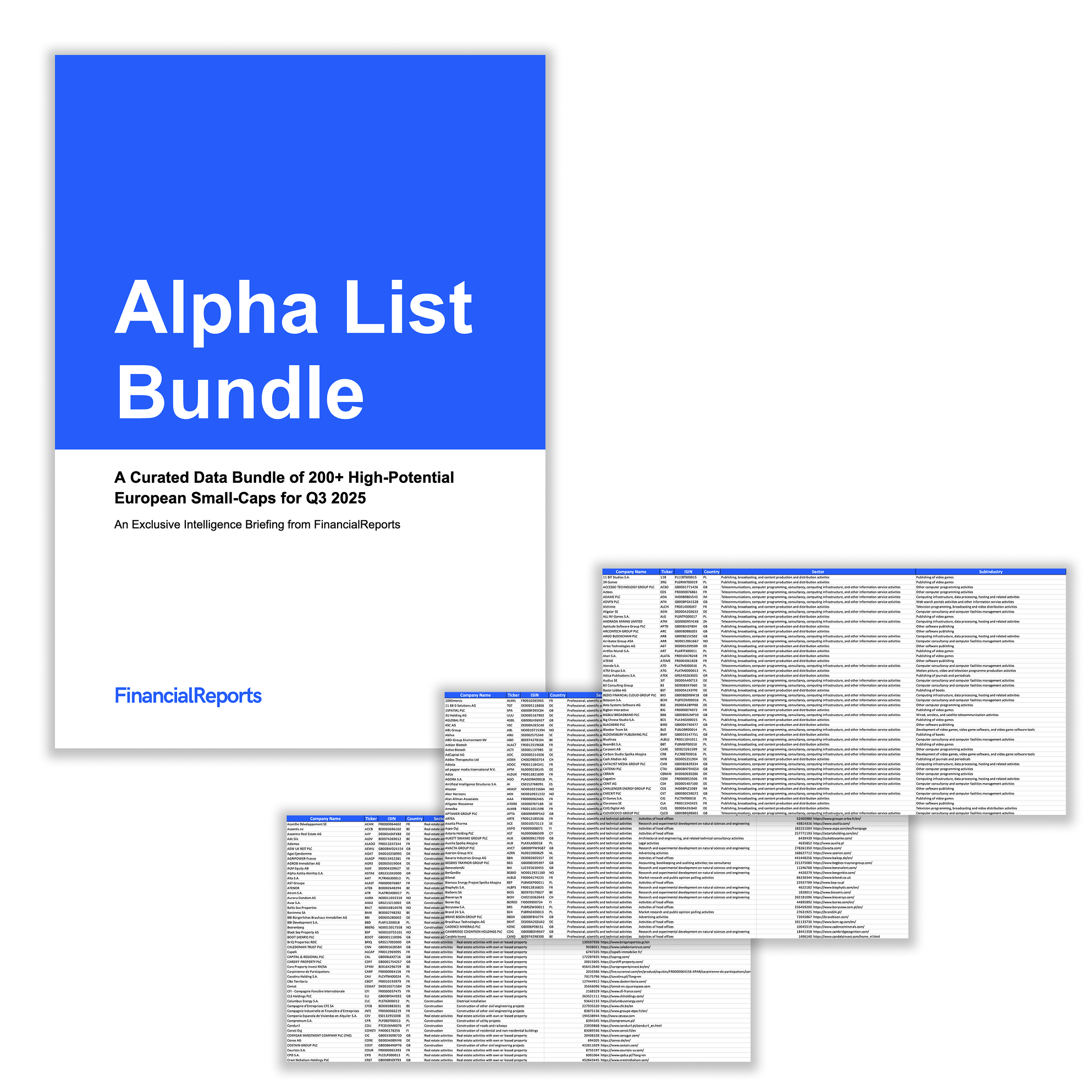
A curated CSV of small and mid-cap names not on the typical sell-side rotation, with each company's next expected filing date and ISIN.
Skip the discovery phase — go straight to deep-dive on names where consensus is thin and dispersion is real.
Not a recommendation. Not investment advice. A starting universe, sourced from the same index that powers the API.
Download the bundle.
Five fields. The CSV arrives on the next page.
Asked by quants.
If yours isn't here, the form above goes straight to a data engineer.
Filings on the wire, in your stack.
Talk to a data engineer about volume, regions, and integration. We reply within 24 hours.