AI assistant
ARBUTHNOT BANKING GROUP PLC Earnings Release 2025
7492_10-k_2026-03-26_df966b2e-9889-4313-ba11-2279e1c3271e.html
Earnings Release
Open in viewerOpens in your device viewer
National Storage Mechanism | Additional information 
RNS Number : 1713Y
Arbuthnot Banking Group PLC
26 March 2026
26 March 2026
For immediate release
ARBUTHNOT BANKING GROUP ("Arbuthnot", "the Group" or "ABG")
Audited Final Results for the year to 31 December 2025
Resilient performance in line with expectations
Arbuthnot Banking Group today announces its audited results for the year ended 31 December 2025.
Arbuthnot Banking Group PLC is the holding company for Arbuthnot Latham & Co., Limited ("Arbuthnot Latham").
FINANCIAL HIGHLIGHTS
· Profit Before Tax of £24.2m (2024: £35.1m)
· Operating income of £169.5m (2024: £179.5m)
· Average net margin of 4.7% (2024: 5.1%)
· Earnings per share of 109.1p (2024: 152.3p)
· Final dividend declared increased by 2p to 31p (2024: 29p)
· Total dividend per share for the year of 53p (2024: 69p, including special dividend of 20p per share); ordinary dividend per share increased by 4p
· Year-end net assets per share of 1694p (2024: 1636p)
· Total net assets of £276.4m (2024: £267.0m)
· Strong capital ratios maintained with a CET1 ratio of 13.3% (2024: 13.2%) and a total capital ratio of 15.4% (2024: 15.3%)
· Substantial surplus liquidity at the year-end of £1.42bn above the regulatory minimum (2024: £896m)
OPERATIONAL HIGHLIGHTS
· Continued growth in customer deposits to £4.57bn (2024: £4.13bn), up 11% year-on-year, driven by the success of the Group's relationship-based approach across both Private & Commercial Banking
· Customer loans reduced 6% to £2.25bn (2024: £2.38bn)* as the Group maintained tight credit discipline, preserving capital in the face of market driven suboptimal rates
· Funds under management and administration ("FUMA") increased 21% to £2.68bn (2024: £2.21bn), driven by very strong inflows which represented 22% of FUMA at the start of the year
· Continued growth in the Group's target markets, with 1,200 new banking clients and over 200 new investment management clients
Commenting on the results, Sir Henry Angest, Chairman and Chief Executive of Arbuthnot, said: "The Group performed resiliently in what continues to be an uncertain and low-growth economic environment. We are encouraged by the double-digit growth in customer deposits and the inflows-driven growth in funds under management. The Group remains conservatively managed with a robust balance sheet and continues to see client growth opportunities."
Note: * This balance includes both Customer loans and assets available for lease.
The Directors of the Company accept responsibility for the contents of this announcement.
| ENQUIRIES: | |
| Arbuthnot Banking Group | 0207 012 2400 |
| Sir Henry Angest, Chairman and Chief Executive | |
| Andrew Salmon, Group Chief Operating Officer | |
| James Cobb, Group Finance Director | |
| Grant Thornton UK LLP (Nominated Adviser and AQSE Corporate Adviser) | 0207 383 5100 |
| Colin Aaronson | |
| Samantha Harrison | |
| Ciara Donnelly | |
| Shore Capital (Broker) | 0207 408 4090 |
| Daniel Bush | |
| David Coaten | |
| Tom Knibbs | |
| H/Advisors (Financial PR) | 0207 379 5151 |
| Sam Cartwright |
The 2025 Annual Report and Notice of Meeting will be available on the Arbuthnot Banking Group website http://www.arbuthnotgroup.com on or around 15 April 2026. Copies will then be available from the Company Secretary, Arbuthnot Banking Group PLC, Arbuthnot House, 20 Finsbury Circus, London, EC2M 7EA.
Consolidated statement of comprehensive income
| Year ended 31 December | ||||
| 2025 | 2024 | |||
| Note | £000 | £000 | ||
| Income from banking activities | ||||
| Interest income calculated using the effective interest method | 8 | 247,248 | 263,435 | |
| Interest expense | (129,122) | (137,568) | ||
| Net interest income | 118,126 | 125,867 | ||
| Fee and commission income | 9 | 31,689 | 29,142 | |
| Fee and commission expense | (1,444) | (1,029) | ||
| Net fee and commission income | 30,245 | 28,113 | ||
| Operating income from banking activities | 148,371 | 153,980 | ||
| Income from leasing activities | ||||
| Revenue | 10 | 118,569 | 110,832 | |
| Cost of goods sold | 10 | (97,466) | (85,301) | |
| Gross profit from leasing activities | 10 | 21,103 | 25,531 | |
| Total group operating income | 169,474 | 179,511 | ||
| Net impairment loss on financial assets | 11 | (2,501) | (6,275) | |
| Other income | 12 | 4,419 | 1,660 | |
| Operating expenses | 13 | (147,208) | (139,806) | |
| Profit before tax | 24,184 | 35,090 | ||
| Income tax expense | 14 | (6,374) | (10,236) | |
| Profit after tax | 17,810 | 24,854 | ||
| Other comprehensive income | ||||
| Items that will not be reclassified to profit or loss | ||||
| Changes in fair value of equity investments at fair value through other comprehensive income | (59) | 778 | ||
| Tax on other comprehensive income | 15 | (182) | ||
| Other comprehensive income for the period, net of tax | (44) | 596 | ||
| Total comprehensive income for the period | 17,766 | 25,450 | ||
| Earnings per share for profit attributable to the equity holders of the Company during the year | ||||
| (expressed in pence per share): | ||||
| Basic earnings per share | 16 | 109.1 | 152.3 | |
| Diluted earnings per share | 16 | 109.1 | 152.3 |
Consolidated statement of financial position
| At 31 December | ||||
| 2025 | 2024 | |||
| Note | £000 | £000 | ||
| ASSETS | ||||
| Cash and balances at central banks | 17 | 437,548 | 911,887 | |
| Loans and advances to banks | 18 | 117,497 | 66,971 | |
| Debt securities at amortised cost | 19 | 2,033,158 | 1,199,847 | |
| Derivative financial instruments | 20 | 1,398 | 2,970 | |
| Loans and advances to customers | 22 | 1,960,542 | 2,094,212 | |
| Current tax assets | 1,619 | - | ||
| Other assets | 24 | 50,247 | 51,701 | |
| Financial investments | 25 | 2,061 | 4,947 | |
| Intangible assets | 27 | 33,448 | 30,565 | |
| Property, plant and equipment | 28 | 310,569 | 313,366 | |
| Right-of-use assets | 29 | 44,501 | 47,511 | |
| Investment property | 30 | 5,250 | 5,250 | |
| Total assets | 4,997,838 | 4,729,227 | ||
| EQUITY AND LIABILITIES | ||||
| Equity attributable to owners of the parent | ||||
| Share capital | 37 | 167 | 167 | |
| Share premium | 37 | 11,606 | 11,606 | |
| Retained earnings | 38 | 265,738 | 254,575 | |
| Other reserves | 38 | (1,113) | 608 | |
| Total equity | 276,398 | 266,956 | ||
| LIABILITIES | ||||
| Deposits from banks | 31 | 1,389 | 192,911 | |
| Deposits from customers | 32 | 4,570,365 | 4,132,493 | |
| Current tax liability | - | 3,001 | ||
| Other liabilities | 33 | 42,489 | 35,384 | |
| Deferred tax liability | 26 | 10,258 | 5,671 | |
| Lease liabilities | 34 | 58,267 | 54,829 | |
| Debt securities in issue | 35 | 38,672 | 37,982 | |
| Total liabilities | 4,721,440 | 4,462,271 | ||
| Total equity and liabilities | 4,997,838 | 4,729,227 | ||
Chairman's statement
Arbuthnot Banking Group ("ABG" or "The Group" or "The Bank") is pleased to report a profit before tax of £24.2m for the year ended 31 December 2025.
During 2025 the Bank of England reduced its base rate with four separate cuts of 25 basis points each time, to end the year at 3.75%. As we have previously indicated, the Group maintains very high levels of surplus liquidity, which is deposited at the Bank of England. This means that along with investments in other treasury assets, any reduction in revenue from these reserves will directly impact the Group's profitability.
We had anticipated that we were nearing the end of the cycle of interest rate reductions, and the base rate would come to the normal neutral resting rate in 2026. However, the Middle East conflict has created much uncertainty around the near term interest rate policy. Expectations are now that the base rate may not fall this year as expected and may increase if further inflation becomes embedded in the economy.
The Bank continued to develop its strategic plan with the loan portfolios growing in both our asset finance division ("RAF") and our commercial vehicle leasing business ("AAG"). However, this growth was offset by reductions in the lending balances in the core bank and our Asset based lending division "ACABL". These reductions were as a result of market conditions and the decision taken not to invest at suboptimal rates and to preserve capital ahead of the implementation of Basel 3.1.
The return to a more normal interest rate environment after the historic lows that followed the global financial crisis and continued into the covid pandemic, has meant that banks can once again develop a balanced business with deposits also providing a good contribution to the revenue stream. Thus, we have in recent years focussed on building out our deposit raising franchise within the Private and Commercial bank. This deposit raising activity maintained its momentum in 2025, with balances increasing by £437.9m at a growth rate of 11%. This is despite deposits being transferred into our Wealth Management division via the Direct Gilt service which is proving popular with clients who provided further inflows of £139.7m in the year.
In addition to the inflows into the Direct Gilt service, the Wealth Management division continued its good progress in 2025. Having achieved funds under management growth rates of approximately 30% during the two previous years, the business managed growth of 21% in 2025 to close at £2.7bn.
As previously indicated, the division has been focussing on an optimisation project and much of the planned implementation steps should be put in place during 2026. The most important part of this is the launch of Arbuthnot unitised funds which will provide an alternative to the discretionary management service that invests directly into the market. These funds are expected to be launched early in the second quarter of this year.
With all the actions complete, it is anticipated that the Wealth Management division will reach a profitable run rate towards the end of 2026. This would represent a very satisfactory turnaround for a business that was finding it difficult to reach scale and profitability given the industry's ever increasing compliance and regulatory burdens.
Our commercial vehicle leasing business has found the current market extremely challenging. Many of the major fleets that operate in the logistics market have delayed investment which has led to a lack of demand, particularly in the second hand truck market. As a result, the business experienced an overall loss on the sale of trucks for the first time in its history. This is despite its conservative policy in terms of setting residual values.
The business responded well to the adverse market conditions and has managed to reduce its stock of used vehicles to very low levels. Whilst market conditions resulted in the business posting a loss in 2025, subsequently, market conditions have returned to a normalised state and the business has made profits on the sale of assets in line with expectations in the first two months of the year.
Market Conditions
One of the most important requirements, when making business investment decisions, is some degree of certainty. During 2025, the economy found increasing levels of uncertainty particularly in the levels of taxation and in changes to legislation, such as the new Employment Rights Act.
As a result, lower levels of investment have resulted in an economy that is not growing and seeing increasing levels of unemployment. These conditions have filtered into the markets that the Group operates in, leading to increased competition with lenders competing for lower volumes.
As ever, this increased competition has led to lower prices offered to customers. In some cases, we have seen asset finance deals being offered at rates more akin to the residential secured market. Market price dislocation will inevitably lead to sub optimal returns on capital. This is something that we remain vigilant to, as capital allocation and maintaining acceptable returns is one of our most important principles. These cycles usually reverse and we expect the market will return in due course to allow us to increase our volumes once again in all our lending businesses.
Capital Framework
Early in 2025, the PRA announced it was delaying the introduction of the new Basel 3.1 capital rules until 2027, so that it could see how the new administration in the United States would develop its position in regard to bank regulation, particularly the implementation of Basel 3.1.
The Group has made good progress to be ready to implement the new rules. The Board is now minded to remain on the Basel rule book rather than adopt the Small Domestic Deposit Takers ("SDDT") regime. Although the Bank would qualify for these new simplified rules, they would result in a higher capital requirement. Both of these new rule books will see the withdrawal of the "Refined approach" which was designed to level the playing field between the large Internal Ratings Based ("IRB") banks and the smaller banks such as ourselves. This withdrawal will result in an increase in our capital requirement of approximately £20m, for which we had been planning and which was also a factor in our decision not to deploy capital at suboptimal rates.
As this is further developed, we will continue to adjust our business models to ensure that we achieve acceptable returns on capital after the adoption of the new regulations.
Board Changes and Personnel
In line with the Board's commitment to maintaining appropriate independence, Ian Dewar and Sir Alan Yarrow retired at the AGM having served the recommended maximum tenure. I would like to thank them for their significant contributions to both the Board and the Group. In July we welcomed Charlotte Crosswell to the Board, and I look forward to continue working with her.
As ever, the continued success of the Group reflects the hard work and commitment of our members of staff. On behalf of the Board, I extend our thanks to all of them for their contribution in 2025. Finally, I would like to thank my fellow Directors on both the Board of Arbuthnot Banking Group PLC and Arbuthnot Latham and Co., Ltd for their valuable help and advice during the year.
Dividend
The Board is recommending a final dividend in respect of 2025 of 31p per ordinary and ordinary non-voting share. This is an increase of 2p compared to the final dividend of 2024.
The final dividend, if approved at the 2026 AGM, will be paid on 29th May 2026 to shareholders on the register at the close of business on 17th April 2026.
Together with the interim dividend, this gives a total dividend of 53p per ordinary share and ordinary non-voting share, which compares to total dividend of 69p per share paid in 2024. However, the prior year dividend included a special dividend of 20p per share which gave a normal dividend in 2024 of 49p per share. Thus, in 2025 the total normal dividend has increased by 4p per share.
Outlook
It is clear that, despite the manifesto promises of the current Government, rather than seeing economic growth, which was the way the Country could afford to pay for the increased spending in public services, the economy has in fact ground to halt. In addition, the future direction of the economy has become more uncertain given recent events in the Middle East.
Despite this, our balance sheet remains robust and conservatively managed, and our business still sees good client growth opportunities. We remain positive that we can find ways to develop our business in the new regulatory environment. This is founded on our belief that we can continue to differentiate ourselves, due to the personal service we offer to our clients.
Strategic Report - Business Review
| Group Key Metrics | 2025 | 2024 | |
| Operating income | £169.5m | £179.5m | |
| Other income | £4.4m | £1.7m | |
| Operating expenses | £147.2m | £139.8m | |
| Profit before tax | £24.2m | £35.1m | |
| Customer loans1 | £2.2bn | £2.4bn | |
| Customer deposits | £4.6bn | £4.1bn | |
| Total assets | £5.0bn | £4.7bn | |
| Key Performance Indicators | |||
| Funds under management and administration | £2.7bn | £2.2bn | |
| Average net margin 2 | 4.7% | 5.1% | |
| Loan to deposit ratio 3 | 49.1% | 57.6% | |
| 1 This balance includes both customer loans and assets available for lease. | |||
| 2 Average net margin: Gross interest income yield less average interest rate on customer deposits | |||
| 3 Loan to deposit ratio: Customer loans (including both customer loans and assets available for lease) divided by customer deposits |
The Group reported a profit of £24.2m compared to £35.1m for the prior year. The reduction in reported profit was expected, partly due to a lower base rate than the prior period resulting in reduced interest income from the Bank's liquidity balances held at the Bank of England. However, the Group continued to make good strategic progress, allocating capital to the lending proposals that offer the best returns on capital rather than using lending volumes themselves as an indicator of success.
The Group has continued to pursue its long-term strategic initiatives to attract profitable relationship-driven deposits whilst maintaining and diversifying its lending proposition throughout 2025. Despite a reduction in lending balances, significant progress was made in the Group's Deposit and Wealth Management balances which saw strong growth in the year. This was against a backdrop of continued geo-political turmoil and low economic growth with only a gradual easing of inflation in the UK economy.
Deposits grew steadily throughout 2025 to finish the year with balances of £4.6bn. The Wealth Management division continued to perform strongly with growth of over 20% in Funds under Management and Administration (FUMA), finishing the year at £2.7bn. Lending balances reduced during 2025 with the Group continuing to operate to a tightened credit appetite and reduced LTVs for new lending below the Bank's previous guidance of 60%.
In August 2025, after an uncertain period, the Supreme Court judgment with regard to unfair motor finance commissions was published. The Supreme Court overturned much of the lower court ruling on car loan sale practices. The Group noted the subsequent consultation by the Financial Conduct Authority ("FCA") with regard to compensation for customers who were unfairly treated as part of their regulated motor finance agreements. The Group however does not and has not provided regulated motor finance and therefore will not be within scope of any FCA compensation schemes.
Banking
2025 saw continued growth in client numbers across private and commercial banking. Over 1,000 new clients joined the Bank, which given our entry criteria increased along with monthly fee increases, proves client advocacy is high for our human-scale relationship approach. These achievements reflect the collective effort and hard work of our teams, and the value and trust clients place in us to guide their financial journey.
Client satisfaction remained top quartile with an overall net promoter score of 68%, and 94% of our clients are delighted with the service from Arbuthnot Latham. This is as a result of the Bank's commitment to employing quality staff, and providing accessibility to expert advice, combined with our full service offering across Private and Commercial Banking.
Deposits grew in 2025 despite low growth in the deposit market for households and SMEs which resulted in a more competitive landscape. Total deposits grew by £437.9m, equating to growth of 10.6% year on year to finish the year with balances of £4.57bn and an average cost of deposits of 2.65% compared to 3.15% for the prior year.
Lending reduced by £183.2m during the year to finish at £1.36bn. Pricing pressure and increased competition resulted in limited opportunities for achieving desirable returns aligned to our risk appetite. We have always considered ourselves to be counter cyclical lenders and therefore refuse to be drawn into competing on price alone, so we remain content to preserve our capital for the future (including the changes from Basel 3.1), when these markets become firmer and the prices produce acceptable returns on our capital deployed.
The number of watchlist cases materially reduced in the year with a small number of legacy cases remaining, with a loss rate of 10bps for the year.
Wealth Management
Market repercussions resulting from the threats of a global trade war along with geo-political instability resulted in high levels of market volatility throughout 2025. However, despite the turbulence, Funds Under Management and Administration (FUMA) increased by 21% during 2025, reaching £2.68bn at the year end (2024: £2.21bn). The business received gross inflows totalling £501.4m, representing 23% of balances at the start of the year, offset by outflows of £238.9m, resulting in net inflows of £262.5m. The majority of inflows were allocated to our flagship Global Investment Service and the recently launched Direct Gilt Service which continues to perform strongly.
Wealth Planning issued advice on £324.3m of new assets, compared to £321.4m the prior year, representing 65% of discretionary asset inflows. A total of 218 clients were onboarded compared to 210 clients in 2024. Advice income of £566.1k was more than 67% higher than the prior year, supported by a broadening of advice mix including protection.
The business is progressing well with its optimisation project and will launch a new unitised fund range which is designed to offer greater accessibility and flexibility aligned to clients' needs whilst ensuring a platform for the sustainable growth of the business.
Arbuthnot Commercial Asset Based Lending ("ACABL")
ACABL reported a profit before tax for the year of £8.9m (2024: £11.9m) with a loan book at the year-end of £219.4m, a small reduction compared to the prior year-end balance of £228.2m. Despite lower lending volumes, a higher percentage of service based fees was generated from both current and exited clients.
The challenging macro-economic environment led to a reduced number of event-driven transactions and fewer Private Equity backed buy-outs in 2025. The business continues to focus on SME and lower mid-market transactional lending, secured on invoices, assets or stock of the borrower. Accredited by the British Business Bank, the business also provides loans under the Growth Guarantee Scheme. The amount extended to clients under this scheme represents a small proportion of overall lending but allows the business to support existing clients and to create innovative lending structures for new clients.
In the full year ACABL completed new lending facilities of £118m across 36 transactions to both new and existing clients (2024: £122m across 22 transactions)
In a challenging macro-economic environment the business continued to lend against high quality realisable assets with the expected credit provision on the book remaining low at 7bps.
Facility limits totalled £527.7m at the year end (2024: £542m) across a client base of 106 (2024: 112) operating across a broad range of sectors and the business processed £2.3 billion of invoices in the year, a reduction of £200m compared to the prior year.
Renaissance Asset Finance ("RAF")
RAF reported a record profit before tax for the year of £7.2m (2024: £5.6m) driven by an increase in margins on new business coupled with improved operational efficiencies and a low bad debt expense. The loan book finished the year at £285.8m equating to an increase of 16% compared to the prior year balance of £248.8m.
The now established Block Discounting business which launched in late 2021 grew its loan book by 36% in 2025 and is now making a significant contribution to the profitability of the business.
RAF provides non-regulated asset finance facilities to SMEs and high net worth individuals. RAF does not and has not provided regulated facilities and so is out of scope of the current FCA Regulated Motor Finance Redress Scheme proposals which was confirmed in the FCA response to the Supreme Court's judgment.
Asset Alliance Group ("AAG")
AAG reported a loss in the year of £2.3m compared to a profit of £28k in the prior year.
The market for commercial vehicles was subdued throughout 2025, with registrations of new vehicles down 14% year on year and lead times for the procurement of new assets reduced significantly. Customers, facing the impact of tax increases and low economic growth, showed hesitancy in growing or renewing their fleets.
Conversely, the bus and coach market continued to perform well with strong demand for both shorter term rentals and longer-term operating leases. As nominated advisors to a number of the key operators within the Transport for London ("TfL") network, AAG continue to support the transition from diesel to electric buses.
At 31 December 2025, the business had assets available for lease and finance leases totalling £382.8m (2024: £363.0m), with growth in new lending equating to an increase of 5% over the year.
The market for end of lease commercial vehicles was particularly challenging, resulting in the company recording a loss on its residual value portfolio for the first time. The company took a strategic decision mid-year to accelerate the sale of assets and reduce both the volume and value of units held. By the end of the year this had been successfully accomplished, with the volume of assets reduced by circa 60%. This reduction was achieved, in part, by an increased use of trade and auction disposal channels, impacting margins.
Owned Properties
The Bank retains four assets in its property portfolio of which one is overseas. The Bank's property portfolio has performed in line with expectation, with limited movement in valuations when compared with the prior year.
Operations
The Bank's operations have continued to support growth in our target markets. 1,220 new banking clients were onboarded in 2025, of which 56% were non-personal clients, and over 200 new investment management clients, with an associated 375 portfolios opened. Growth has been underpinned by increased automation and process simplification delivered as part of the ongoing digital transformation programme.
The Bank successfully implemented PSR3 & ISO 20022 across the core banking and payments landscape. This milestone represents a major step forward in modernising and standardising how payments are processed. With the migration of CHAPS, SEPA and SWIFT transactions complete, the focus is now on extending ISO 20022 to Faster Payments which will further strengthen the Bank's payments capabilities. The Bank also installed a new financial crime platform for sanctions, AML, and fraud transaction monitoring, a significant step to improve resilience to financial crime risk.
Investment management has benefitted from the implementation of an electronic transfer platform to reduce onboarding times for the transfer of assets. Trading volumes continued to rise, with a 6.85% increase in the number of trades executed and a value of £2.64bn. Automation of trade flow has supported the increased volumes and ensured continued accurate, timely and efficient execution.
The Bank's digital programme is expected to run through 2027 with continued incremental deliveries in 2026 including client onboarding enhancements, operational and trading process improvements and upgrades to online and mobile banking and investment management services. These planned enhancements will improve operational efficiency, enable further operational scaling and provide enhanced client functionality.
The Bank continues to consider and respond to changing technologies, with specific focus on system stability and resilience, cyber risk and artificial intelligence. Service provision is subject to ongoing stress testing, with business and service continuity plans central to relationships with cloud and other technology partners. The use of artificial intelligence is being progressively tested and integrated into operational and servicing processes with benefits to service provision and delivery along with operational efficiency.
Strategic Report - Financial Review
Arbuthnot Banking Group adopts a pragmatic approach to risk taking and seeks to maximise long term revenues and returns on capital deployed. Given its relative size, it is nimble and able to remain entrepreneurial and capable of taking advantage of favourable market opportunities when they arise.
The Group provides a range of financial services to clients and customers in its chosen markets of Banking, Wealth Management, Asset Finance, Asset Based Lending, Specialist Lending and Commercial Vehicle Finance. The Group's revenues are derived from a combination of net interest income from lending, deposit taking and treasury activities, fees for services provided and commission earned on the sale of financial products. The Group also generates revenue from the sale of commercial vehicles and earns rental income on its properties and holds financial investments for income.
| Highlights | ||
| 2025 | 2024 | |
| Summarised Income Statement | £000 | £000 |
| Net interest income | 118,126 | 125,867 |
| Net fee and commission income | 30,245 | 28,113 |
| Operating income from banking activities | 148,371 | 153,980 |
| Revenue | 118,569 | 110,832 |
| Cost of goods sold | (97,466) | (85,301) |
| Operating income from leasing activities | 21,103 | 25,531 |
| Total group operating income | 169,474 | 179,511 |
| Other income | 4,419 | 1,660 |
| Operating expenses | (147,208) | (139,806) |
| Impairment losses - loans and advances to customers | (2,501) | (6,275) |
| Profit before tax | 24,184 | 35,090 |
| Income tax expense | (6,374) | (10,236) |
| Profit after tax | 17,810 | 24,854 |
| Basic earnings per share (pence) | 109.1 | 152.3 |
The Group has reported a profit before tax of £24.2m (2024: £35.1m).
Net interest income reduced by £7.7m from the prior year as the Bank of England base rate was reduced by four separate cuts of 25 bps each during the year. As a result of the reducing interest rate environment, we continued to invest excess liquidity into short dated treasury assets such as gilts. By investing in these short-dated securities, the impact from reducing interest rates is reduced and delayed by 3 to 12 months. Net fee and commission income increased by £2.1m, as a result of an increase of £463m in FUMA in the Wealth Management division. Operating income from AAG leased assets decreased from £25.5m to £21.1m, mainly due to the subdued market for second hand commercial trucks.
The average net margin on client lending was 4.7% (2024: 5.1%).
Other income increased as a result of a settlement of £3.25m due to a property valuation issue on a property loan that was previously impaired.
The Group's operating expenses increased to £147.2m compared to £139.8m for the prior year, mainly due to higher inflationary staff costs.
| Balance Sheet Strength | ||
| 2025 | 2024 | |
| Summarised Balance Sheet | £000 | £000 |
| Assets | ||
| Loans and advances to customers | 1,960,542 | 2,094,212 |
| Assets available for lease | 285,327 | 285,953 |
| Liquid assets | 2,588,203 | 2,178,705 |
| Other assets | 163,766 | 170,357 |
| Total assets | 4,997,838 | 4,729,227 |
| Liabilities | ||
| Customer deposits | 4,570,365 | 4,132,493 |
| Other liabilities | 151,075 | 329,778 |
| Total liabilities | 4,721,440 | 4,462,271 |
| Equity | 276,398 | 266,956 |
| Total equity and liabilities | 4,997,838 | 4,729,227 |
Total assets increased by £0.3bn to £5.0bn (2024: £4.7bn). Loans and advances to customers together with assets available for lease decreased by 6% from the prior year. Customer deposits increased by 11% in the year and contributed to the 19% increase in liquid assets.
The net assets of the Group now stand at £16.94 per share (2024: £16.36).
Segmental Analysis
The segmental analysis is shown in more detail in Note 44. The Group is organised into seven operating segments as disclosed below:
1) Banking - Includes Private and Commercial Banking and the acquired mortgage portfolio. Private Banking - Provides
traditional private banking services. Commercial Banking - Provides bespoke commercial banking services and tailored
secured lending against property investments and other assets.
2) Wealth Management - Financial planning and investment management services.
3) RAF - Specialist asset finance lender mainly in high value cars but also business assets.
4) ACABL - Provides finance secured on either invoices, assets or stock of the borrower.
5) AAG - Provides vehicle finance and related services, predominantly in the truck & trailer and bus & coach markets.
6) All Other Divisions - All other smaller divisions and central costs in Arbuthnot Latham & Co., Ltd (Investment property,
Central costs and Arbuthnot Specialist Finance Ltd)
7) Group Centre - ABG Group management.
The analysis presented below, and in the business review, is before any consolidation adjustments to reverse the impact of the intergroup operating activities and also intergroup recharges and is a fair reflection of the way the Directors manage the Group.
| Banking | ||
| 2025 | 2024 | |
| Summarised Income Statement | £000 | £000 |
| Net interest income | 98,673 | 97,410 |
| Net fee and commission income | 5,107 | 3,799 |
| Operating income | 103,780 | 101,209 |
| Operating expenses - direct costs | (22,074) | (19,614) |
| Operating expenses - indirect costs | (51,905) | (47,901) |
| Impairment losses - loans and advances to customers | (1,275) | (5,571) |
| Profit before tax | 28,526 | 28,123 |
Banking reported a profit before tax of £28.5m (2024: £28.1m). Net interest income increased by £1.3m. The Bank refused to be drawn into a pricing war, as the Bank of England base rate reduced during the year and competition in the market increased. Lending balances therefore reduced by 12% in the year as capital was preserved for future deployment at acceptable returns. The growth of deposits as a valuable revenue source continued in the year as balances increased by 11%, despite low growth in the deposit market for households and SMEs and the transfer of funds into our Wealth Management division.
There was a net impairment charge of £1.3m compared to £5.6m for the prior year. The prior year included provisions on a small number of exposures in Stage 3.
Direct costs increased by £2.5m mainly as a result of higher staff costs. Indirectly allocated operating costs also increased by £4.0m, largely as a result of inflationary increases in staff costs in support departments and the higher costs relating to the new office building.
Customer loan balances reduced by £183m to close the year at £1.36bn and customer deposits increased to £4.57bn (2024: £4.13bn). The strategic decision was taken to deploy capital into the subsidiaries for higher returns and to further conserve capital until the Basel 3.1 rules are finalised. The average loan to value was 49.5% (2024: 48.9%).
| Wealth Management | ||
| 2025 | 2024 | |
| Summarised Income Statement | £000 | £000 |
| Net interest income | 674 | - |
| Net fee and commission income | 16,498 | 13,665 |
| Operating income | 17,172 | 13,665 |
| Operating expenses - direct costs | (11,744) | (11,368) |
| Operating expenses - indirect costs | (8,441) | (7,190) |
| Loss before tax | (3,013) | (4,893) |
Wealth Management reported a loss of £3.0m (2024: loss of £4.9m). Net fee and commission income increased by £2.8m. Directly allocated costs increased by £0.4m, mainly due to an increase in professional fees. The contribution from the division before indirectly allocated costs increased from £2.3m to £5.4m. However, indirectly allocated costs from the support departments increased by £1.2m from the prior year. Despite high levels of market volatility throughout 2025, FUMA increased by £0.46bn to £2.68bn. The Direct Gilt Service launched in the prior year continued to perform well. The full year impact on income from the growth in FUMA will be seen in future years.
| RAF | ||
| 2025 | 2024 | |
| Summarised Income Statement | £000 | £000 |
| Net interest income | 15,638 | 12,872 |
| Net fee and commission income | 92 | 239 |
| Operating income | 15,730 | 13,111 |
| Operating expenses - direct costs | (7,612) | (6,981) |
| Impairment losses - loans and advances | (922) | (554) |
| Profit before tax | 7,196 | 5,576 |
Renaissance Asset Finance returned a profit of £7.2m (2024: £5.6m). Interest income increased by £4.0m from higher balances, which was partly offset by higher funding costs of £1.2m. Operating expenses were £0.6m higher than in 2024, mainly due to higher inflationary staff costs.
Customer loan balances increased by 16% to £288.2m (2024: £248.8m), with the Block Discounting business growing by 36% in the year. The average yield for 2025 was 8.6% (2024: 8.7%).
| ACABL | ||
| 2025 | 2024 | |
| Summarised Income Statement | £000 | £000 |
| Net interest income | 8,920 | 10,043 |
| Net fee and commission income | 7,182 | 9,922 |
| Operating income | 16,102 | 19,965 |
| Operating expenses - direct costs | (7,241) | (7,993) |
| Impairment losses - loans and advances to customers | (3) | (32) |
| Profit before tax | 8,858 | 11,940 |
ACABL recorded a profit before tax of £8.9m (2024: £11.9m).
Lower originations together with expected client attrition resulted in loan balances of £219.4m at the end of the year (2024: £228.2m). The business had issued facilities of £528m (2024: £542m). The challenging macro-economic environment resulted in a reduced number of transactions and lending volume. The lower balances resulted in lower interest income of £6.2m that was partially offset by lower internal funding costs of £5.1m, while fee and commission income also decreased by £2.7m. Operating expenses decreased by £0.8m, mainly due to a reduction in staff costs with lower variable remuneration awards as a result of the reduced profits.
| AAG | ||
| 2025 | 2024 | |
| Summarised Income Statement | £000 | £000 |
| Net interest expense | (7,108) | (10,208) |
| Net fee and commission expense | 425 | (15) |
| Revenue | 118,569 | 110,832 |
| Cost of goods sold | (97,466) | (85,301) |
| Operating income | 14,420 | 15,308 |
| Other income | - | 88 |
| Operating expenses - direct costs | (16,758) | (15,308) |
| Impairment losses - loans and advances to customers | 86 | (60) |
| Profit / (loss) before tax | (2,252) | 28 |
The business made a loss of £2.3m (2024: profit of £28k). Interest income increased by £1.2m, while funding costs reduced by £1.9m as interest rates continued to fall. The reduction in revenue less cost of goods sold, was mainly due to the subdued market for second hand commercial trucks resulting in a £4.5m reduction in profits on sale.
Operating expenses increased by £1.4m from the prior year, mainly due to higher inflationary staff costs and the replacement of the operating platform by modernised technology. There was a write back on credit provisions of £0.1m (2024: provision of £0.1m).
As at 31 December 2025 the business had a total of £382.8m (2024: £363.0m) of assets available for lease and finance leases, which is a 5% increase on the prior year.
| Other Divisions | ||
| 2025 | 2024 | |
| Summarised Income Statement | £000 | £000 |
| Net interest income | 1,325 | 15,755 |
| Net fee and commission income | 941 | 503 |
| Operating income | 2,266 | 16,258 |
| Other income | 5,536 | 2,473 |
| Operating expenses - direct costs | (10,598) | (12,948) |
| Impairment losses - loans and advances to customers | (387) | (58) |
| Profit / (loss) before tax | (3,183) | 5,725 |
The aggregated loss before tax of other divisions was £3.2m (2024: profit of £5.7m).
Operating income decreased by £14.0m to £2.3m (2024: £16.3m). Reported within the other divisions in other income was rental income on our property portfolio of £1.1m (2024: £1.0m). Other income also included the settlement of £3.25m due to a property valuation issue on a property loan that was previously impaired.
Operating expenses reduced £2.5m.
| Group Centre | ||
| 2025 | 2024 | |
| Summarised Income Statement | £000 | £000 |
| Net interest income | 3,755 | 4,174 |
| Subordinated loan stock interest | (3,751) | (4,179) |
| Operating income | 4 | (5) |
| Other income | - | 39 |
| Operating expenses | (11,952) | (11,443) |
| Loss before tax | (11,948) | (11,409) |
The Group costs increased by £0.5m to £11.9m (2024: £11.4m). Subordinated loan interest reduced by £0.4m due to interest rates falling in the year.
The increase in operating expenses of £0.5m is mainly due to higher staff costs.
Capital
The Group's capital management policy is focused on optimising shareholder value over the long term. There is a clear focus on delivering organic growth and ensuring capital resources are sufficient to support planned levels of growth. The Board regularly reviews the capital position.
The Group and the individual banking operation are authorised by the Prudential Regulation Authority ("PRA") and regulated by the Financial Conduct Authority and the Prudential Regulation Authority. One of the requirements for the Group and the individual banking operation is that capital resources must be in excess of capital requirements at all times.
In accordance with the parameters set out in the PRA Rulebook, the Internal Capital Adequacy Assessment Process ("ICAAP") is embedded in the risk management framework of the Group. The ICAAP identifies and assesses the risks to the Group, considers how these risks can be mitigated and demonstrates that the Group has sufficient resources, after mitigating actions, to withstand all reasonable scenarios.
The Board determines the level of capital the Group needs to hold. The Group holds Pillar 1 capital for credit, market and operational risk as a starting point, and then considers whether each of the calculations delivers a sufficient amount of capital to cover risks to which the Group is, or could be, exposed. Where the Board considers that the Pillar 1 calculations do not adequately cover the risks, an additional Pillar 2A capital requirement is applied. The PRA will set a Pillar 2A capital requirement in light of the calculations included within the ICAAP. The Group's Total Capital Requirement, as issued by the PRA, is the sum of the Pillar 1 and the Pillar 2A capital requirements. The current Total Capital Requirement of the Group is 8.05%.
The ICAAP document is updated at least annually, or more frequently if changes in the business, strategy, nature or scale of the Group's activities or operational environment suggest that the current level of capital resources is no longer adequate. The ICAAP brings together the management framework (i.e. the policies, procedures, strategies, and systems that the Group has implemented to identify, manage and mitigate its risks) and the financial disciplines of business planning and capital management. The Group's PRA regulated entity is also the principal trading subsidiary as detailed in Note 43.
The Group's regulatory capital is divided into two tiers:
· Common equity Tier 1 ("CET1"), which comprises shareholder funds less regulatory deductions for intangible assets, including Goodwill and deferred tax assets that do not arise from temporary differences.
· Tier 2 comprises qualifying subordinated loans.
Capital ratios are reviewed on a monthly basis to ensure that external requirements are adhered to. All regulated entities have complied with all of the externally imposed capital requirements to which they are subject.
| 2025 | 2024 | |
| Capital ratios | £000 | £000 |
| CET1 Capital Instruments* | 276,398 | 267,027 |
| Deductions | (34,800) | (32,550) |
| CET1 Capital after Deductions | 241,598 | 234,477 |
| Tier 2 Capital | 38,672 | 37,982 |
| Own Funds | 280,270 | 272,459 |
| CET1 Capital Ratio (CET1 Capital/Total Risk Exposure) | 13.3% | 13.2% |
| Total Capital Ratio (Own Funds/Total Risk Exposure) | 15.4% | 15.3% |
| * Includes year-end audited result. |
Risks and Uncertainties
The Group regards the monitoring and controlling of risks and uncertainties as a fundamental part of the management process. Consequently, senior management are involved in the development of risk management policies and in monitoring their application. A detailed description of the risk management framework and associated policies is set out in Note 6.
The principal risks inherent in the Group's business are reputational, macroeconomic and competitive environment, strategic, credit, market, liquidity, operational, cyber, residual value, conduct and, regulatory and capital.
Reputational risk
Reputational risk is the risk to the Group from a failure to meet reasonable stakeholder expectations as a result of any event, behaviour, action or inaction by ABG itself, its employees or those with whom it is associated. This includes the associated risk to earnings, capital or liquidity.
ABG seeks to ensure that all of its businesses act consistently with the seven corporate principles as laid out on page 3 of the Annual Report and Accounts. This is achieved through a central Risk Management framework and supporting policies, the application of a three-lines of defence model across the Group and oversight by various committees. Employees are supported in training, studies and other ways and encouraged to live out the cultural values within the Group of integrity, energy and drive, respect, collaboration and empowerment. In applying the seven corporate principles, the risk of reputational damage is minimised as the Group serves its shareholders, customers and employees with integrity and high ethical standards.
Macroeconomic and competitive environment
The Group is exposed to risks that may arise from the macroeconomic and competitive environment.
In recent years there have been a number of global and domestic events which have had significant implications for the Group's operating environment, namely: The US-Israeli war with Iran, Russia's war in the Ukraine, the Israel-Hamas war in Gaza and Coronavirus. The culmination of these events has led to significant turmoil in both global and domestic markets. Geo-political volatility and uncertainty remains high with the potential to adversely affect the UK economy, as well as the Group's customers and assets.
Strategic risk
Strategic risk is the risk that the Group's ability to achieve its corporate and strategic objectives may be compromised. This risk is particularly important to the Group as it continues its growth strategy. However, the Group seeks to mitigate strategic risk by focusing on a sustainable business model which is aligned to the Group's business strategy. Also, the Directors normally meet once a year to ensure that the Group's strategy is appropriate for the market and economy.
Credit risk
Credit risk is the risk that a counterparty (borrower) will be unable to pay amounts in full when due. This risk exists in Arbuthnot Latham, which currently has a loan book of £2.0bn (2024: £2.1bn). The lending portfolio in Arbuthnot Latham is extended to clients, the majority of which is secured against cash, property or other high-quality assets. Credit risk is managed through the Credit Committee of Arbuthnot Latham.
Market risk
Market risk arises in relation to movements in interest rates, currencies, property and equity markets.
Interest rate and currency risk
The Group's treasury function operates mainly to provide a service to clients and does not take significant unmatched positions in any market for its own account. As a result, the Group's exposure to adverse movements in interest rates and currencies is limited to interest earnings on its free cash and interest rate re-pricing mismatches. The Group actively monitors its exposure to future changes in interest rates. However, at the current time the Group does not hedge the earnings from the free cash which currently totals £437m (2024: £912m). The cost of hedging is prohibitive. Normally the majority of cash is held at the Bank of England, but during 2025 with the general consensus in the market that rates were expected to fall, the Group shifted its focus to invest some of the excess liquidity into high quality short dated fixed income assets, such as gilts. As a result, these treasury assets increased by £920m in the year. By investing in these short-dated securities, the impact from reducing interest rates is delayed by 3 to 12 months.
Property and equity market risk
The Group is exposed to changes in the market value of its properties. The current carrying value of Investment Property is £5.3m (2024: £5.3m) and properties classified as inventory is £16m (2024: £17.4m). Any changes in the market value of the property will be accounted for in the Income Statement for the Investment Property and could also impact the carrying value of inventory, which is at the lower of cost and net realisable value. As a result, it could have a significant impact on the profit or loss of the Group. The Group is also exposed to changes in the value of equity investments. The current carrying value of financial investments is £2.1m (2024: £4.9m). Any changes in the value of financial investments will be accounted for in Other Comprehensive Income.
Liquidity risk
Liquidity risk is the risk that the Group, although solvent, either does not have sufficient financial resources to enable it to meet its obligations as they fall due, or can only secure such resources at an excessive cost. The Group takes a conservative approach to managing its liquidity profile. The Bank is funded by retail deposits and capital. Additionally, Arbuthnot Latham maintains access to the Bank of England's Sterling Monetary Framework, including reserves account. The loan to deposit ratio is maintained at a prudent level, and consequently the Group maintains a high level of liquidity. The Arbuthnot Latham Board Risk Committee annually approves the Internal Liquidity Adequacy Assessment Process ("ILAAP"). The Directors model various stress scenarios and assess the resultant cash flows in order to evaluate the Group's potential liquidity requirements. The Directors firmly believe that sufficient liquid assets are held to enable the Group to meet its liabilities in a stressed environment.
Operational risk
Operational risk is the risk that the Group may be exposed to financial losses from conducting its business. The Group's exposure to operational risk include its Information Technology ("IT") and Operating platforms. There are additional internal controls in these processes that are designed to protect the Group from these risks. The Group's overall approach to managing internal control and financial reporting is described in the Corporate Governance section of the Annual Report.
In line with guidance issued by the Regulator, the Bank has continued to focus on ensuring that the design of systems and operational plans are robust to maintain operational resilience in the face of unexpected incidents.
Cyber risk
Cyber risk is an increasing risk for the Group within its operational processes. It is the risk that the Group is subject to some form of disruption arising from an interruption to its IT and data infrastructure. The Group regularly tests the infrastructure to ensure that it remains robust to a range of threats and has continuity of business plans in place including a disaster recovery plan.
Residual value risk
Residual value risk equals the difference in the residual value of a leased asset set at lease inception and the lower salvage value realised upon its disposal or re-lease at the end of the lease term. The Group is exposed to residual value risk in its AAG business. Normal residual value risk is managed through the process set out below, and it should be noted that the transition to greener technology may further impact residual values in two ways. Firstly, residual values could decrease due to assets becoming obsolete; climate related regulations might change, which could result in legal restrictions on the use of assets or technological advances could lead to preferred environmental technologies. Secondly, the lack of historical information on green vehicles could lead to inaccurate measurement of residual values at inception of leases.
The AAG business manages Residual Value setting through its Residual Value Committee that comprises representatives from its Asset Management, Procurement, Sales and Leasing divisions and is chaired by the Residual Value Manager. Assets are valued using either an approved Residual Value matrix or individually, dependent upon the nature of the asset and current market conditions. The strategy for Residual Value setting and oversight of the Residual Value Committee is conducted by the AAG Residual Risk Committee, which in turn reports into the Asset Alliance Group Holdings Limited board. The Residual Risk Committee, chaired by the AAG Group Risk Director, includes AAG CEO, AL Group Risk Director, AAG Managing Director, AAG Finance Director and heads of Asset Management, Sales and Leasing divisions in AAG.
Conduct risk
As a financial services provider the Group faces conduct risk, including selling products to customers which do not meet their needs, failing to deal with clients' complaints effectively, not meeting clients' expectations, and exhibiting behaviours which do not meet market or regulatory standards.
The Group adopts a low risk appetite for any unfair customer outcomes. It maintains clear compliance guidelines and provides ongoing training to all employees. Periodic spot checks, compliance monitoring and internal audits are performed to ensure these guidelines are followed. The Group also has insurance policies in place to provide some cover for any claims that may arise.
Financial Crime
The Group is exposed to risk due to financial crime including money laundering, sanctions evasion, bribery and corruption, market abuse, tax evasion and fraud. The Group operates policies and controls which are designed to ensure that financial crime risks are identified, appropriately mitigated and managed.
Regulatory and capital risk
Regulatory and capital risk includes the risk that the Group will have insufficient capital resources to support the business and/or does not comply with regulatory requirements. The Group adopts a conservative approach to managing its capital. The Board of Arbuthnot Latham approves an ICAAP annually, which includes the performance of stringent stress tests to ensure that capital resources are adequate over a three year horizon. Capital and liquidity ratios are regularly monitored against the Board's approved risk appetite as part of the risk management framework.
Regulatory change also exists as a risk to the Group's business. Notwithstanding the assessments carried out by the Group to manage regulatory risk, it is not possible to predict how regulatory and legislative changes may alter and impact the business. Significant and unforeseen regulatory changes may reduce the Group's competitive situation and lower its profitability.
Strategic Report - Non-Financial and Sustainability Statement
| The table below sets out where stakeholders can find information on non-financial matters, as required by Sections 414CA and 414CB of the Companies Act 2006, enabling them to understand the impact of the Group's key policies and activities. | |||
| Reporting Requirement | Policies and Standards | Information Necessary to Understand Impact of Activities and Outcome of Policies |
|
| Environmental Matters | • Credit Policy • Managing Financial Risks of Climate Change Framework • Environmental Management Policy |
• Stakeholder Engagement and S. 172 (1) Statement, pages 20 and 21 • Sustainability Report, pages 23 to 35 • Corporate Governance Report page 46 |
|
| Employees | • Agile Working Policy • Board Suitability & Diversity Policy • Flexible Working Policy • Health and Safety Policy • Inclusivity and Respect Policy • Long Service Awards Policy • Parental Leave Policy • Personal Appearance Policy • Remuneration Policy • Training & Development Policy • Whistleblowing Policy |
• Stakeholder Engagement and S. 172 (1), pages 22 and 21 • Sustainability Report, pages 23 to 35 • Directors Report, page 40 • Corporate Governance Report, page 45 |
|
| Social Matters | • Complaints Handling Policy • Fraud Policy • Tax Strategy • Vulnerable Clients Policy |
• Arbuthnot Principles, page 3 • Stakeholder Engagement and S. 172 (1) Statement, pages 20 and 21 • Sustainability Report, pages 23, 26 and 27 |
|
| Respect for Human Rights |
• Anti-Modern Slavery Policy • Dignity at Work Policy • Inclusivity and Respect Policy • Personal Data Protection Policy |
• Stakeholder Engagement and s.172 (1) Statement, pages 20 and 21 • Sustainability Report, pages 23 to 35 |
|
| Anti-Corruption and Anti-Bribery |
• Anti-Bribery and Corruption Policy • Anti-Money Laundering Policy • Client Acceptance policy • Cyber Strategy • Group Market Abuse and Insider Dealing Policy • Physical Security Policy |
• Sustainability Report, pages 23 and 26 | |
| Description of Principal Risks and Impact of Business Activity | • Strategic Report, pages 15 to 18 | ||
| Description of the Business Model | • Business Overview | ||
| Non-Financial Key Performance Indicators | • Sustainability Report, page 23 |
Strategic Report - Stakeholder Engagement and s.172 Report
Stakeholder Engagement and S. 172 (1) Statement
This section of the Strategic Report describes how the Directors have had regard to the matters set out in section 172 (1) (a) to (f) of the Companies Act 2006 when making decisions. It forms the Directors' statement required by ABG as a large-sized company under section 414CZA of the Act.
The Directors have acted in a way that they considered, in good faith, to be most likely to promote the success of the Company for the benefit of its members as a whole, and in doing so had regard, amongst other matters, to:
• the likely consequences of any decision in the long term;
• the interests of the Company's employees;
• the need to foster the Company's business relationships with suppliers, customers and others;
• the impact of the Company's operations on the community and the environment;
• the desirability of the Company maintaining a reputation for high standards of business conduct; and
• the need to act fairly as between members of the Company.
The Arbuthnot Principles and Values set out on page 3 explain the Board's approach to its stakeholders. Details of how the Directors had regard to the interests of its key stakeholders during the year are set out below, in the Group Directors Report on page 40 and in the Corporate Governance Report on page 46.
The Board has regard to the interests of all its key stakeholders in its decision making since the Directors are conscious that their decisions and actions have an impact on them. The stakeholders we consider in this regard are our shareholders, employees, customers, suppliers, regulators and the environment in which we operate.
Likely consequences of any decision in the long term
The Directors make their decisions to ensure that long-term prospects are not sacrificed for short term gain, reflecting the values and support of Sir Henry Angest, Chairman and Chief Executive and majority shareholder, which have proved successful in creating and maintaining value for all shareholders for over 40 years. This was demonstrated in the year by a number of Board decisions including investment in a number of major projects.
In February 2025, the Board reviewed the concept of Commitment to Clients and Colleague Promises, i.e. what the business aims to deliver to clients and to employees, built on Arbuthnot's Seven Principles and five cultural values, which was launched to the business. These Principles are central to the way the Company works, summarising its corporate philosophy and ethics, and it seeks to ensure that all of its businesses act consistently with them.
During the year, the Board appointed Charlotte Crosswell as a new non-executive Director, subject to completion of regulatory and compliance requirements which were subsequently met. The Board was also kept fully informed of a number of senior management retirements with the respective roles of the MD Specialist Finance and Head of HR being transferred to two existing AL executive directors. This approach will help to empower existing employees as well as reducing costs.
Interests of the Company's employees
Overall the Board's intention is to hire the best people and to provide the right environment for them to perform to the best of their ability.
The Board receives an update on human resource matters at each of its meetings. It is also kept informed of the results of employee surveys. In November 2025 it considered the results of the engagement survey, launched in October 2025 to assess how engaged employees felt with the business, obtaining feedback on key areas that affect engagement. The engagement survey received an 87% response rate from employees, with an 83% engagement score including 92% agreeing with the statement of being proud to work for the Group and 85% would recommend the Group as a great place to work. There were also increases in scores for external client and employee experience, as well as inclusive culture and wellbeing. The Board agreed that this was a good overall result considering the prevailing economic climate and employment market. It regards the maintenance of a high level of employee engagement as key to the Company's future success as an organisation on every level and each business will be analysing its results and establishing action plans to address key issues raised.
Executive Directors and senior management are fully engaged with the workforce, most of whom interact on a daily basis. Employees are also able to raise concerns in confidence with the AL HR Team, with grievances followed up in line with a specified process which satisfies all legal requirements. As explained in the section 172 (1) Statement of Arbuthnot Latham, the Company's banking subsidiary, Jayne Almond one of its non-executive directors, has been designated by its board as the director to engage with Arbuthnot Latham group's workforce whereas the Company itself has fewer than 20 employees, all of whom have direct access to Board members.
As set out in the Whistleblowing Policy, Richard Gabbertas is the Company's Whistleblowing Champion is available at all times in this role. There is an anonymous whistleblowing service via an external provider. There is also protection for employees deriving from the Public Interest Disclosure Act 1998. Any material whistleblowing events are notified to the Board and to the applicable regulator.
Company's business relationships with suppliers, customers and others
The Directors attach great importance to good relations with customers and business partners. In particular, our clients are integral to our business and forging and maintaining client relationships are core to AL's business and crucial for client retention. As regards customers, the Directors considered the formal submission of a Consumer Duty annual assurance report from the Chief Compliance Officer.
The Company is committed to following agreed supplier payment terms. There is a Supplier Management Framework in place covering governance around the Company's procurement and supplier management activities. For due diligence and compliance purposes, suppliers are assessed through an external registration system. The Modern Slavery Statement, approved by the Board in March as part of its annual review of the Company's stance and approach to the Modern Slavery Act, explains the risk-based approach that the Company has taken to give assurance that slavery and human trafficking are not taking place in its supply chains or any part of its business. The Board requires that AL implements an Anti-Modern Slavery Policy, procedures and processes in relation to the AL Group, which reflects the commitment to act ethically and with integrity, in all their respective business relationships and additionally, to ensure that slavery and human trafficking are not taking place anywhere in the AL Group or in the AL Group's supply chain.
Balancing stakeholder interests
An illustration of the balancing of the interests of our stakeholders in their long-term interest was the Board's decision in July 2025 to continue its progressive dividend policy, resolving to pay an interim dividend of 22p per Ordinary share and Ordinary Non-Voting share to shareholders. This was an increase of 2p per share from the interim dividend paid in 2024. The Board has decided to recommend a final dividend of 31p per share; this is an increase of 2p per Ordinary share and Ordinary Non-Voting share compared to the final dividend of 2024. This represents total dividends for the year of 53p per Ordinary share and Ordinary Non-Voting share. It compares with 69p per Ordinary share and Ordinary Non-Voting share which also included a special dividend of 20p per Ordinary share and Ordinary Non-Voting share.
Impact of the Company's operations on the community and the environment
As part of the management information reviewed at its regular meetings, the Board receives a Risk Management report, containing a report on Sustainability / Environmental, Social and Governance ("ESG") matters which includes a Climate Change Dashboard, monitoring climate change measures in place including Scope 1, 2 and 3 GHG emissions. This dashboard sets out climate-change measures and actions.
The Board is updated on the steps the Group is taking to become more sustainable, given its exposure to climate change transition risk as the UK evolves to a low carbon economy. It is also kept informed of the formal approach to ESG established to develop over time, which will underpin the Arbuthnot Principles and Values within the workplace under five 'pillars of sustainability' - governance, clients, employees, community and environment (ESG Pillars). The ESG actions taken are in recognition of the Group's responsibility to make a positive societal impact and the political, regulatory and legal pressure with clients and investors interested in the Group's ESG stance.
In September 2025 the Board approved the enterprise-wide climate change risk appetite, risk assessments, and stress test scenarios and results. It has also approved an energy and carbon report meeting the requirements of the Streamlined Energy and Carbon Reporting standards, as set out in the Sustainability Report on pages 34 to 36.
Desirability of the Company maintaining a reputation for high standards of business conduct
The Directors believe that the Arbuthnot culture set out in the Arbuthnot Principles and Values manifests itself at Board level and in the external view of the Group as a whole. The importance of the Group's reputation is considered at each Board meeting. These Principles are encapsulated in five Group cultural values, embedded into day-to-day activities. These values are integrity, respect, empowerment, energy and drive, and collaboration.
Acting fairly as between members of the Company
The majority shareholder, Sir Henry Angest, is the Company's Chairman and Chief Executive. There is continuing engagement with other major shareholders and the Directors make their decisions on behalf of all shareholders. The Board welcomes engagement with them and will continue to maintain communications via one-to-one meetings as appropriate. The Directors treat all shareholders equally, albeit that holders of non-voting shares do not have the right to vote in shareholder meetings.
Strategic Report - Sustainability Report
Introduction
The Group has continued to embed sustainable practices across its business and remains committed to ensuring that its activities have a positive impact on clients, shareholders, employees, society and the environment. Two of our key business principles, reciprocity and stability, rely on recognising our responsibility to make a positive societal impact.
Climate change is an important topic for consumers and investors alike. In parallel, inclusive growth and the impact organisations have on society are increasingly a focus. Organisations are being held accountable for their impact. We focus on how we can improve to build a future that delivers growth, sustainability and inclusion.
Our responsible business initiatives enable us to monitor and measure our social impact by considering the impact of our practices and outputs across five pillars: governance, clients, community, environment and employees as explained on pages 26 to 28 below.
Governance
The Group has a solid system of governance in place, endorsing the principles of openness, integrity, and accountability that underpin good corporate governance. The Group operates to high standards of corporate accountability with an effective Board and Board committees. This, together with the role and overall holding of Sir Henry Angest, the ultimate majority shareholder, and compliance with PRA and FCA regulations and with those of the London Stock Exchange Alternative Investment Market and the Aquis Exchange, is fundamental to our success as a business.
Policies
The Group has adopted a wide range of policies that straddle the five pillars to ensure that employees and management are aware of their responsibilities towards our clients and comply with all regulatory requirements. Some of the key policies are set out below and in the Non-Financial and Sustainability Statement on page 19.
Human Rights commitments
The Group is committed to operating in an ethical manner and ensuring the relationships we have with all our stakeholders adhere to high standards. These are reflected in both our Anti-Modern Slavery Policy and in our Supplier Code of Conduct.
The Group is committed to finding and reducing the risk of slavery or human trafficking in every part of our supply chain.
Clients
Relationships with our clients are at the heart of what we do. In June 2025, 625 clients across private and commercial banking shared their views through our internal client feedback survey. With 13% of invited clients responding, this encouraging level of engagement reflects both the dedication of our frontline teams and the benefit of a more streamlined survey. Overall, client sentiment remains strong with 94% of respondents saying they are satisfied or very satisfied with Arbuthnot Latham. Our new Net Promoter Score stands at 68, similar to that in the last survey in 2024.
Client support
As a relationship-led bank, our purpose is to help our clients go further. This means ensuring that they receive a bespoke service, tailored to their needs, helping them achieve their financial goals. As part of our focus on excellent service, we increased the minimum banking criteria and account tariff charges from February 2025. Higher minimum levels allow us to limit the number of relationships each banker manages, ensuring that the level of advice and access that every client receives is not diluted as we grow. This decision has enabled us to maintain our high quality of service, leading to better long-term outcomes for our clients.
Vulnerable clients
The term 'vulnerability' captures a range of circumstances our clients can face. To ensure we are treating vulnerable clients fairly, we have implemented vulnerable client guidance focused on identifying and supporting vulnerable clients.
We have a Vulnerable Client Committee to support our staff with vulnerable clients. In 2025, we welcomed the British Dyslexia Association and hosted a session on the legal and financial implications of divorce.
Employees
We continue to focus on maintaining an outstanding culture and workplace for all our employees. Once again our high engagement scores are a testament to this. We achieved an 87% response rate in our latest employee engagement survey (Non-Financial Key Performance Indicator), conducted by WorkBuzz in October 2025, and an overall engagement score of 83. These strong scores remain well above external benchmarks. Standout results include: 92% of employees are proud to work here and 85% would recommend Arbuthnot Latham as a great place to work. We also saw increases in scores for external client and colleague experience, inclusive culture and wellbeing: "I would feel proud to recommend our products and services to clients (+2%), I feel comfortable to be my true self at work (+3%), and Speak up and challenge processes (+3%)".
Employees were recently informed of a change in the Group's agile working policy whereby all full time staff will be required five years on from the pandemic to work a minimum of four days a week in the office, up from three days. Working together in the office enables the Group to fulfil its objective of being a service and relationship-led business. Having the advantage of human scale and concentrating on building relationships is enhanced by interacting regularly and frequently.
Wellbeing
Our wellbeing strategy focuses on mental, physical, social and financial pillars. Through these pillars, we provide our employees with a range of resources and tools to support their wellbeing, including resources provided by BUPA, Hargreaves Lansdown, ActiveHub, and our Employee Assistance Programme.
Initiatives include the AL Run Club to encourage staff to meet up and become active, weekly fruit baskets, free mortgage services for employees, Macmillan Coffee Morning, and the 721 programme culminating in 20 Arbuthnot Latham employees conquering the Brecon Beacons as part of the Atlantic Team Challenge inspired by world-renowned adventurer Nick Hollis.
Early Careers and Young Professionals
During 2025 47 young adults participated in work experience events, 70 A-level students attended our annual female student event, ten summer interns and 29 more young adults joined across our 2025 1-year placements and graduate and apprentice programmes. Additionally, in partnership with Young Professionals, we provided a six-week mentoring programme for 13 A-level students. Throughout 2025 we delivered 105 training sessions attended by 2,253 individuals. Our Learning at Work weeks saw us travelling across the country to Exeter, Basildon, Manchester and Wolverhampton, as well as hosting sessions in London linked to our 2025 theme of communication and collaboration.
The Group offers five different Early Careers Programmes, including work experience, summer internships, one-year placements, graduate placements, and apprenticeships.
We partner with Young Professionals, an organisation which works with schools across the UK from different socio-economic backgrounds to provide an insight and introduction to different industries, in order to grow the quality and diversity of our Early Careers talent pool.
Employee development
As a business with growth ambition, we encourage career progression and seek to develop our people's skills to help them grow within the organisation.
Mentoring
We support our employees' continued development through our internal mentoring programme. We partner with Pushfar, an internal mentoring platform to ensure mentees can find a suitable mentor to assist them in their careers.
Benefits
We offer eligible employees an annual opportunity to enhance an array of benefits at favourable rates including life assurance. In 2025, we introduced Salary Extras, our benefits platform designed to give access to a wide range of benefits and options.
Workplace pension scheme
The Group offers all eligible employees membership of a contributory defined contribution plan, which is operated by Hargreaves Lansdown who present annually to the Pension Scheme Governance Committee. The matters discussed at this Committee's meetings are communicated to employees, continuing the focus on their financial wellbeing.
Employee networking forum: Connect
Our colleague network, Connect, launched a new strategy with agency Flying Iguana. We introduced the Listening Lounge podcast series, hearing from employees on topics like mental health, retirement, cancer, and domestic abuse. We also hosted lunch and learn events and panels on discovering your superstrength and finding balance.
The purpose of Connect is to:
· To promote an environment which enables everyone to perform to the best of their potential.
· Encourage behaviours aligned with our values, particularly our value of respect. To create a long-term sustainable approach to ensure Connect remains at the heart of our organisation.
Inclusivity
In 2025, we continued to strengthen our commitment to inclusivity by embedding our cultural values of respect and collaboration into everyday behaviour and leadership practices. Throughout the year we enhanced integration of our cultural values into our performance management processes and conversations to drive accountability and reinforce a culture of respect. A new Inclusivity and Respect Policy came into effect in November 2025, aligning our former Equity, Diversity & Inclusion and Dignity at Work policies into a single framework to simplify our approach and expectations for all employees. We also introduced Tell Jane, a confidential external platform for raising concerns about inappropriate behaviour in the workplace, providing employees with a safe and anonymous way to seek support. In Q4 2025 we began interactive workshops for senior leaders and team briefings for all employees, ensuring that respect and inclusivity remain at the heart of our culture and are translated into everyday actions and behaviour. We will continue to provide workplace demographic data to support transparency and inclusive workforce planning and host Connect events to deepen understanding and mutual respect across the organisation.
Community
The Group recognises that we need to commit to driving positive community impact within the communities in which we exist and operate, and connecting the dots between the charities we support and the social initiatives we run.
In 2025, we continued to support communities and charities through our expanded corporate responsibility strategy. Through our CSR Steering Committee we ensured that our activities remained aligned with the Group's goals. Our strategy continued to focus on quality education and eradicating poverty, reinforcing our commitment to making a positive societal impact.
Volunteering and Philanthropy
Over 250 volunteers engaged across teams, supporting Hackney City Farm, Hackney Foodbank, Bow Food Bank, The Switch, Trees for Cities, and Hospiscare. This represents approximately 30% of all employees.
To assist with our skills-based volunteering and to ensure we support education and financial education, The Switch, offers our employees the opportunity to volunteer in schools in Tower Hamlets. Sessions here included CV-writing workshops, Money Matter workshops and interview preparation.
We donated 60 laptops to Halley Primary School, which will enhance students' learning and technology access.
Pound for Pound and Payroll giving
In 2025, we supported 46 colleague fundraising activities through pound-for-pound matching and payroll giving, including £3,500 raised for the Chief Operating Office Trio Masters Challenge.
We also offer our employees the opportunity to donate regularly from their gross pay to charities of their choice.
Environment
We have made a commitment to reduce our environmental impact and to improve our environmental performance as an integral part of our business strategy. We are committed to achieving net-zero by 2050 and effective management of our carbon footprint is an important part of our strategy.
As a consequence, we have in place an Environmental Management policy which sets out our high-level approach to managing environmental issues and provides requirements to help the Bank to achieve its commitments. Enhancing transparency within our own supply chains is part of our mission to work closely with our third-party relationships. In doing so, working together will help us establish how we can better engage and be held accountable.
Due to the nature of the Group's business, we are primarily a consumer of services rather than goods and materials. However, we are still committed to reducing the impact of our supply chain. As a minimum, we expect our suppliers to provide evidence towards their environmental status, where relevant and appropriate.
The Bank's Credit Policy sets out the Group's limited appetite for financial and reputational risk emanating from climate change, which includes physical risk (extreme weather, flooding etc.) and transitional risk (changes to law, policy, regulation and culture). The Bank adopts a favourable stance towards a low carbon economy and lending propositions that have a neutral or positive impact on the environment/climate. The Bank will also consider the impact on public perception and potential impact on continuing demand for clients' products and services, as well as any impact on its underlying security. These factors are assessed as part of the credit application and on-going review processes.
In December 2025, we submitted an action plan under the Energy Savings Opportunity Scheme (ESOS), a Government-mandated requirement to identify tailored and cost-effective measures to save energy and achieve carbon and cost savings. We continue to build employee awareness on environmental matters and energy efficiencies.
20 Finsbury Circus
At 20 Finsbury Circus, our BREEAM-rated Excellent office into which we moved in the summer of 2024, we continue to focus on sustainability and operational efficiency, sourcing renewable energy and implementing recycling initiatives to reduce our carbon footprint.
By investing in technologies like building management systems and LED lighting, we significantly reduce energy consumption and improve our Energy Performance Certificate (EPC) ratings. At 20 Finsbury Circus, we source renewable energy to power our operations, which further reduces our carbon footprint and supports sustainable energy practices. Additionally, we have implemented efficient air conditioning systems to optimise energy use and enhance the comfort of our building occupants. Using onsite shredders and compactors to compress waste reduces transport costs and further reduces our carbon footprint.
We are continuously working to reduce our Scope 1 and Scope 2 emissions by decarbonising our buildings and increasing their energy efficiency. These efforts are essential steps towards our sustainability goals.
Summary across our five pillars
We are taking steps, guided by our five pillars of governance, clients, community, environment and employees, to help us become more sustainable.
| Governance | Current status |
| Ensure responsible and transparent corporate governance which aligns to business goals while making a positive societal impact. | We have been embedding sustainability into our business practices by recording, monitoring, and publishing performance. |
| We have policies in place, such as our: Anti-Money Laundering Policy Board Suitability & Diversity Policy Anti-Bribery and Corruption Policy Client Acceptance Policy Group Market Abuse and Insider Dealing Policy Whistleblowing Policy Anti-Modern Slavery Policy |
|
| We have a published Tax Strategy, which sets out the Group's commitment to compliance with tax law and practice in the UK, which includes paying the correct amount of tax at the right place and right time and having a transparent and constructive relationship with the tax authority. | |
| We have effective risk management which underpins our strong risk culture supporting the Group's vision. | |
| We have a Supplier Code of Conduct that promotes equal opportunities and diversity, acting with integrity, endorsement of sustainable procurement within the supply chain, safe working practices, and data, cyber and privacy protection. | |
| Clients | Current status |
| Ensuring best outcomes for our clients. | We seek regular feedback from our clients to reinforce our proposition and service. |
| We also have a new complaints team and take dissatisfaction seriously, remediating issues promptly. | |
| We take the protection of our client data seriously and have robust measures in place to protect client data in line with our legal and regulatory requirements. | |
| We make regular anti-fraud communications to clients, alerting them to the different techniques used by criminals to unlawfully obtain people's data and money. | |
| We have continued to invest in the Bank's core banking system, demonstrating that operational resilience and the ability to make services available to our clients is of the utmost importance. | |
| We continue to invest in our risk management capabilities across Credit, Compliance, Operational Risk and Financial Crime with a view to ensuring good client outcomes through the continuing stability of the Bank. | |
| We continue to embed the FCA's Consumer Duty requirements for all relevant products and services. We continue to consider ways that we can improve outcomes for our customers. | |
| We have initiated a Digital Transformation Project to further enhance the Bank's services to clients. | |
| We have policies in place, such as our: Complaints Handling Policy Fraud Policy Personal Data Protection Policy Physical Security Policy Vulnerable Clients Policy |
|
| We seek regular feedback from our clients to reinforce our proposition and service. | |
| We also have a new complaints team and take dissatisfaction seriously, remediating issues promptly. | |
| We take the protection of our client data seriously and have robust measures in place to protect client data in line with our legal and regulatory requirements. | |
| Community | Current status |
| Having a positive impact on the community in which we operate. | We support philanthropy through matching charity donations, payroll giving, and volunteer days. In 2025 we supported The Felix Project, The Switch, Bow Foodbank, Hackney Foodbank and Surrey Docks Farm. |
| We will continue to encourage skills-based and team-based volunteering, increasing our focus on education and financial literacy. | |
| We continue to encourage employees fundraising and challenges. | |
| We donated 157 laptops to schools in Tower Hamlets through Business2Schools. | |
| Our regional offices supported charities. Our Exeter office supported YMCA and our Manchester office supported The Seashell Trust and The Christie. | |
| Environment | Current status |
| Ensuring that our business practices have a positive impact on the environment. | We will set goals and progress against these with a view to reaching net-zero carbon emissions as a business by 2050. |
| We have reported in line with the requirements of the Companies (Strategic Report) (Climate-related Financial Disclosure) Regulations 2022. | |
| We assess both direct and indirect climate-related risks and opportunities. | |
| We incorporate annual sustainability reporting into our annual report and accounts. | |
| We have an Environmental Management Policy to help us achieve our commitments. | |
| We have established a Sustainable investment Service (SPS). | |
| Energy and Waste · We have moved the London head office to 20 Finsbury which is a BREEAM-rated excellent office · Invested in building management systems and LED lighting to reduce energy consumption and improve EPC ratings. · Implemented efficient air conditioning systems to optimize energy use and enhance occupant comfort. · Sourced renewable energy at 20 Finsbury Circus to power operations, reducing carbon footprint and supporting sustainable energy practices. · Shredded waste materials onsite to cut down on emissions from transportation. · Introduced new recycling bins and signage. · Used compactors onsite to compress waste, reducing the number of collections needed and saving on transport costs. |
|
| We have a Supplier Management Framework which reflects the Environmental Management Policy. | |
| We ensure the responsible disposal of computer equipment and have a waste recycling programme in place. | |
| Transport Our benefits include a cycle to work scheme and season ticket loan. We continue to finance and lease electric vehicles through our RAF and AAG subsidiaries. |
|
| We will set goals and progress against these with a view to reaching net-zero carbon emissions as a business by 2050. | |
| Employees | Current status |
| Creating a supportive and diverse workplace in which employees can thrive. | We promote a working environment that seeks to develop employee skills, and ensures employees are treated fairly and supports their wellbeing. Policies to support this include: Agile Working Policy Flexible Working Policy Health and Safety Policy Parental Leave Policy Remuneration Policy Training & Development Policy Dignity at Work Policy Inclusivity & Respect Policy |
| We have invested in new offices and working environments in Bristol and in our London headquarters. | |
| We operate an internal recognition scheme: Arbuthnot Achievers. | |
| We conduct annual employee surveys (conducted anonymously) with 91% response rate and employee engagement scores of 85%. | |
| We have adopted agile and flexible working policies. | |
| We pay all employees a living wage and have market aligned job families. | |
| All eligible employees may receive a bonus, in addition to pension contribution, absence pay and other core and flex benefits. We also offered eligible employees the opportunity to enhance at favourable rates their cover for life assurance and related cover. | |
| We publish details of our gender pay gap annually. | |
| We have an internal staff networking forum: Connect. | |
| We have an internal colleague wellbeing programme and wellbeing support resources. | |
| We provide all our staff access to our extensive Learning and Development Programme. We also have a Leadership Development Academy and Early Careers Programme. | |
| We have a Pension Governance Committee to manage and communicate our workplace pension scheme. |
Metrics
Disclosures around metrics are given in the section on Climate-related Financial Disclosures below.
Climate-related Financial Disclosures
This section of the Strategic Report describes how the Directors have implemented the requirements of the Companies (Strategic Report) (Climate-related Financial Disclosure) Regulations 2022 which amended the Companies Act 2006 to introduce Task Force on Climate-related Financial Disclosures' ("TCFD") aligned disclosure requirements into the existing non-financial information requirements.
This report covers how climate related risks and opportunities are managed; and on the performance measures and targets applied in managing these issues.
The Board considers the Group's business model to be resilient to the financial risks from climate-related risks based on the risk assessments and stress test scenario results.
| Area | Our Response | |
| Governance Describe the board's oversight of climate-related risks and opportunities. Describe management's role in assessing and managing climate-related risks and opportunities. |
The Board Risk Committee annually review and approve the enterprise-wide climate change • Risk appetite, • Risk assessments, and • Stress test scenarios and results. The Executive Risk Committee review the ESG dashboard (that includes Climate Change) at each meeting. This dashboard details climate-change measures and actions. The tolerances are partly based on the climate change stress test scenarios outputs. Climate change risk is considered as falling within two categories: · Physical Risk: Arising from longer-term changes in the climate and weather-related events, rising average temperatures, heatwaves, droughts, floods, storms, sea-level rise, coastal erosion and subsidence. · Transition Risk: Arising from the adjustment towards a low-carbon economy and could lead to changes in risk appetite, strategy, policy, technology and sentiment. The Board also consider climate change risk in major change decisions, most recently in the case of the 2024 London premises relocation. The Senior Management Function ("SMF") accountability for the financial risks of climate change sits with Stephen Kelly, the AL CRO. Climate change is managed within the Group's governance and risk management frameworks which includes the consideration of both current and emerging risks. |
|
| Strategy Describe the climate-related risks and opportunities the organisation has identified over the short, medium, and long term. Describe the impact of climate-related risks and opportunities on the organisation's businesses, strategy, and financial planning. Describe the resilience of the organisation's strategy, taking into consideration different climate-related scenarios, including a 2°C or lower scenario. |
The Board considers the Group's business model to be resilient to the financial risks from climate-related risks based on the risk assessments and stress test scenario results. The existing income streams are not materially impacted by either transitional or physical risks. The business strategy is also positioned to capture opportunities and support the transition to a low carbon economy. The key risks and opportunities are: Short and medium term (0-5 years) • Growing investor, client, and employee preference to work with, or for companies promoting a low-carbon economy • AL Core transition risk and opportunity on the rising EPC expectations for buy to let residential property • RAF transition risk and opportunity from the demise of combustion engines and switch to electric engines. • AAG transition risk and opportunity from the demise of combustion engines and switch to alternatives. Long term (5-30 years) • AL Core physical risk (flood risk) on residential property. These risks are mitigated and the financial impact is not considered significant in relation to AL's revenue • Residential property loan risks are mitigated by the loan durations (typically less than 5 years) and strong loan to values. • RAF combustion engine risks are mitigated by the short loan durations (typically less than five years). • AAG heavy goods vehicles combustion engine risks are mitigated by the short leasing durations (typically less than five years), lack of viable alternate technologies and by the strategic objective to keep the fleet focused on latest Euro 6 models and as young as possible. Asset residual values and lifespans are monitored considering possible technology changes. • The Group exposure to the Energy or Utility sectors is less than 1% of the portfolio. The Group is positively minded toward supporting the transition to a low carbon economy and seeks to capitalise on opportunities as follows: • For new lending, AL requires considerations on how properties can get to EPC C (unless exempt/RMC). For existing client portfolios, AL finance EPCs improvements. • RAF is supporting clients by financing leases on electric and hybrid vehicles. It has had success in financing hybrid London taxis and smaller electric vehicles. • AAG finances electric buses and is working with the industry on transition pathways to cleaner technology alternatives for heavy goods vehicles. • AL has offered clients the option to invest funds in a Sustainable Investment Service since 2021. This service seeks to incorporate environmental, social and governance ("ESG") factors to achieve a positive impact without sacrificing long-term financial returns. |
|
| Risk Management Describe the organisation's processes for identifying and assessing climate-related risks. Describe the organisation's processes for managing climate-related risks. Describe how processes for identifying, assessing, and managing climate-related risks are integrated into the organisation's overall risk management. |
The Board Risk Committee annually review and approve the enterprise-wide climate change • Risk appetite, • Risk assessments, and • Stress test scenarios and results. The Board Risk Committee consider climate change within the Enterprise and Strategic risk category of the approved Risk Appetite Framework. The risk assessments identify and assesses the transition and physicals risk to the business model and lending book. They consider the existing and emerging regulatory requirements and other relevant factors, as well as the potential size and scope of climate-related risks. The stress test scenarios are refreshed annually and inform the risk assessments. The scenarios are tailored versions of the 2021 Climate Biennial Exploratory Scenario ("CBES") as outlined in the BOE "Key elements of the 2021 Biennial Exploratory Scenario: Financial risks from climate change". Three scenarios are considered which are plausible representations of what might happen based on different future paths of governments' climate policies. They cover the period to 2050 and assume either early action (in current year), late action (ten years' time) or no additional action. Two scenarios consider routes to net-zero carbon dioxide emissions globally by 2050: an Early Action scenario and a Late Action scenario. These scenarios primarily explore transition risks from climate change: • Early Action: Under this scenario, climate policy is ambitious from the beginning, with a gradual intensification of carbon taxes and other policies over time. Global carbon dioxide emissions are reduced to net-zero by around 2050 and global warming (relative to pre-industrial levels) is successfully limited to 1.8°C by the end of the scenario, falling to around 1.5°C by the end of century. The required adjustment in the economy creates a temporary headwind to growth but this dissipates in the latter half of the scenario once a significant portion of the required transition has occurred, and the productivity benefits of green technology investments begin to be realised. • Late Action: The implementation of policy to drive the transition to a net-zero economy is assumed to be delayed by a decade under this scenario. Policy measures are then more sudden and disorderly because of the delay. Global warming is limited to 1.8°C by the end of the scenario (2050) relative to pre-industrial levels, but then remains around this level at the end of the century. The more compressed nature of the reduction in emissions also results in material short-term macroeconomic and financial markets disruption. UK unemployment rises to 8.5% and the economy goes into recession for a short period. Falls in output are particularly concentrated in emissions-intensive sectors. The third scenario is based on the physical risks that would begin to materialise if governments around the world fail to enact policy responses to global warming and no additional action is taken to address climate change. This is considered a severe scenario, being based on climate outcomes that would only occur later this century under the assumption that no additional action is taken to address climate change, and represents a worse than expected outcome even under such conditions. The absence of transition policies in this scenario leads to a growing concentration of greenhouse gas emissions in the atmosphere and, as a result, global temperature levels continue to increase, reaching 3.3°C higher relative to pre-industrial levels by the end of the scenario. This leads to chronic changes in precipitation, ecosystems and sea-levels, which are unevenly distributed globally, and in some cases irreversible. There is also a rise in the frequency and severity of extreme weather events. There are permanent impacts on living and working conditions, buildings and infrastructure. As a result, UK and global GDP growth is permanently lower and macroeconomic uncertainty increases. Reflecting the fact that the future looks materially worse at the end of the scenario, with the adverse effects of climate change set to worsen further, UK and US equity prices are respectively just under 20 and 25% lower than they might otherwise be. Climate change is managed within the Group's governance and risk management frameworks. Specifically, the • AL Board Risk Committee oversees ESG and the financial risks of climate change. • AL Credit Committee considers implications of climate change on new and existing lending. • AL Investment Committee considers implications of climate change on investment decisions. • AL Product Governance Committee considers climate change on propositions. Reference to Climate Change is made in key documents including the: • ICAAP, • Risk Appetite Framework, • AL Risk Hierarchy, • Credit policy. |
|
| Metrics and Targets Describe the targets used by the organisation to manage climate-related risks and opportunities and performance against targets. Disclose the metrics used by the organisation to assess climate-related risks and opportunities in line with its strategy and risk management process. Disclose Scope 1, Scope 2 and, if appropriate, Scope 3 greenhouse gas ("GHG") emissions and the related risks. |
Aspirations All Buy to Let lending properties to be either EPC C or have valid exemption by 2035. AL lend against high quality residential collateral. Typically these properties are EPC C. AL also support Landlords to improve the quality of their collateral, including EPC gradings, where they are currently beneath C. |
Metrics • Buy to Let Lending EPC C (as % BTL Lending). |
| All leases to be for electric, or clean alternative, vehicles by 2050 with exception of classic and high value cars. AL want to support clients as they transition to the low carbon economy and recognise the transition will occur at different speeds. However, AL will cease providing financing on petrol and diesel cars and vans from 2030/2025, and non-zero emission heavy goods vehicles from 2040. |
• RAF electric/hybrid vehicle financing as % of RAF vehicle financing (excluding classic and supercars). | |
| Energy & utility exposure to be maintained at less than 1% of AL lending portfolio (0.51%, December 2025). | • Energy and Utility Exposure (% of future state AL lending portfolio). | |
| Be operationally Net Zero by 2050 By reducing carbon emissions and minimising waste • AL switched to a new London building in 2024. The building is Breeam rated "Excellent" • Company car fleet to be fully electric or hybrid by 2035 • Company heavy goods fleet (AAG) to be powered by zero emission engines by 2040 Improve recycling rates to 60%. |
• Scope 1 and 2 intensity ratios • % General waste recycled • % Electric / hybrid company cars (as % of total company cars) |
|
| Scope 1,2 and 3 emissions are reported on page 34 below. (Scope 3 emissions will remain as per 2024. We have investigated and decided against extending Scope 3 emissions reporting to the lending and investment portfolios. The Scope 3 emissions methodology and data would not be reliable and would give an illusion of accuracy that would not help decision making.) |
Streamlined Energy & Carbon Reporting (SECR)
The Group continues to work with a specialist energy management consultancy, Carbon Decoded, to gather the information required to be reported by large unquoted companies under the Companies (Directors' Report) and Limited Liability Partnerships (Energy and Carbon Report) Regulations 2018, which includes:
· All energy in line with Greenhouse Gas Reporting (GHG) Scope One - gas and owned transport, Scope Two - electricity and Scope Three - non-owned transport.
· Intensity metrics to enable year on year improvements to be tracked.
The report covers data from 1 January to 31 December 2025. The Group has reported all sources of environmental impact, as required in SECR, over which it has financial control, being the Company and its subsidiaries.
Base Year
The Base Year for the organisation is a rolling annual comparison.
Reporting Methodology
· Data has been collected for electricity, gas and transport. Data was collected specifically for the purpose of SECR.
· GHG Protocol Corporate Accounting and Reporting Standard has been followed where relevant.
· Data was collected specifically for the purpose of SECR.
· The 2024 and 2025 UK Government Conversion Factors for Company Reporting were used for all calculations of Carbon emissions.
· Data was estimated where necessary, as set out below.
Methodology changes in 2025
Transport calculations for the AAG HGV fleet have historically been based on vehicle mileage. In 2025 more accurate litre data was collected for the majority of the fleet, this change has impacted on the tCO2e and the intensity metric. This improvement to the methodology will now be applied moving forward.
Portfolio changes in 2025
The figures for 2025 show improvement on the previous year in natural gas and electricity. This is because in 2024 there were three offices in the City of London operating concurrently up until September 2024 after operations moved over from 7 Wilson Street and 10 Dominion Street to the new head office at 20 Finsbury Circus from July 2024.
Estimated Data
The following data was estimated in 2025:
| HGV Fleet | The change in the source data from mileage to litres could not be applied to all vehicles. Where mileage has been used this has been considered an estimate. |
| Bristol and Gatwick | Energy is included in the rent and sub-metering for the office is not available, calculated estimates are therefore based on floor area using industry recognised benchmarks. |
Operational Scopes
The report contains all Scope One and Two energy use and Scope Three Grey Fleet for the whole Group as required by SECR.
| Reporting Summary | ||||||||||
| 2025 | 2024 | |||||||||
| Measure | kWh | Carbon Tonnes tCO2e | Intensity Ratio tCO2e | Measure | kWh | Carbon Tonnes tCO2e | Intensity Ratio tCO2e | % Change on Previous Year | ||
| Scope One | Scope One | |||||||||
| Natural Gas - Intensity Ratio tCO2e/m2 | 8,612 | 66,373 | 12 | 0.0014 | 14,391 | 340,896 | 62 | 0.0040 | -81% | |
| Kerosene - Intensity Ratio tCO2e/m2 | 1,545 | 54,772 | 14 | 0.0088 | 1,545 | 31,910 | 8 | 0.0050 | 75% | |
| Diesel - Mixed Onsite Use No Metric Available | 265,345 | 65 | 230,379 | 55 | 18% | |||||
| Company HGVs Intensity Ratio tCO2e/miles | 69,450 | 430,521 | 105 | 0.0015 | 69,926 | 294,331 | 70 | 0.0010 | 50% | |
| Company Cars Intensity Ratio tCO2e/miles | 347,512 | 203,504 | 47 | 0.0001 | 348,117 | 254,935 | 59 | 0.0002 | -20% | |
| Total Scope One | 1,020,515 | 243 | 1,152,451 | 254 | -4% | |||||
| Scope Two | Scope Two | |||||||||
| Electricity - Intensity Ratio tCO2e/m2 | 15,886 | 1,733,302 | 307 | 0.0193 | 19,422 | 2,235,188 | 463 | 0.0240 | -34% | |
| Company Cars Intensity Ratio tCO2e/miles | 167,935 | 59,127 | 11 | 0.0001 | 93,508 | 31,778 | 7 | 0.0001 | 57% | |
| Total Scope Two | 1,792,429 | 318 | 2,266,966 | 470 | -32% | |||||
| Scope Three | Scope Three | |||||||||
| Grey Fleet Vehicles Intensity Ratio tCO2e/miles | 223,371 | 226,413 | 52 | 0.0002 | 247,558 | 277,450 | 64 | 0.0003 | -19% | |
| Total Scope Three | 223,371 | 226,413 | 52 | 0.0002 | 247,558 | 277,450 | 64 | 0.0003 | -19% | |
| Total of all Scopes | 3,039,357 | 613 | 3,696,867 | 788 | ||||||
| Estimated Data | 3% | 6% |
Corrective Actions
There are no corrective actions for 2025.
Intensity Ratios
Intensity ratios are used to enable year on year comparison. As Arbuthnot is an office-based business the recognised standard measure is kilowatt-hour per square metre (kWh/m2). This enables the energy use to be compared to industry standard benchmarks. Similarly for transport, the metric is kilowatt-hour per mile (kWh/mile). The metrics have been reported as required by the Regulations.
Energy Efficiency Actions
To summarise the energy efficiency actions for 2025:
· The AAG fleet has increased in numbers with the growth in the sales force. AAG remain committed to investing in plug-in hybrid vehicles. 2025 saw higher fleet mileage but vehicle changes have seen Scope One tCO2e emissions fall by 11.5 tCO2e compared to 2024, this is balanced with an increase in Scope Two emissions of 4 tCO2e.
· Optimisation work has been undertaken at Finsbury Circus and ESOS audits undertaken to ensure further efficiencies can be identified and planned for the building.
Group Directors' Report
The Directors present their report for the year ended 31 December 2025.
Business Activities
The principal activities of the Group are banking and financial services. The business review and information about future developments, key performance indicators and principal risks are contained in the Strategic Report on pages 7 to 35.
Corporate Governance
The Corporate Governance report on pages 43 to 50 contains information about the Group's corporate governance arrangements, including in relation to the Board's application of the UK Corporate Governance Code.
Results and Dividends
The results for the year are shown on page 62 of the financial statements. The profit after tax for the year of £17.8m (2024: £24.9m) is included in reserves. The Directors recommend the payment of a final dividend of 31p (2024: 29p) per Ordinary share and Ordinary Non-Voting share which, together with the interim dividend of 22p (2024: 20p) per Ordinary share and Ordinary Non-Voting share paid on 30 May 2025 represents total dividends for the year of 53p (2024: 69p which also included a special dividend of 20p) per Ordinary share and Ordinary Non-Voting share. The final dividend, if approved by Ordinary shareholders at the 2026 Annual General Meeting ("AGM"), will be paid on 29 May 2026 to shareholders on the register at close of business on 17 April 2026.
Directors
The names of the Directors of the Company at the date of this report, together with biographical details, are given on pages 36 and 37 of this Annual Report. Ms C.L.B Crosswell was appointed to the Board on 16 July 2025. All the other Directors listed on those pages were directors of the Company throughout the year. Mr. I.A. Dewar and Sir Alan Yarrow were also Directors during the year prior to their retirement from the Board on 21 May 2025.
Ms Crosswell offers herself for election under Article 75 of the Articles of Association. Sir Nigel Boardman, Mr. F.A. H. Angest and Ms A.A. Knight being eligible, offer themselves for re-election under Article 78 of the Articles of Association. Sir Nigel, Ms Almond and Mr. Angest each has a letter of appointment terminable on three months' notice. Mr. Angest also has a service agreement as an employee terminable on three months' notice.
Articles of Association
The Company's articles of association may only be amended by a special resolution of the Ordinary shareholders. They were last amended at the AGM in May 2017 and can be viewed at www.arbuthnotlatham.co.uk/group/investor-relations/announcements.
Viability Statement
In accordance with the UK Corporate Governance Code, the Directors confirm that there is a reasonable expectation that the Group will continue to operate and meet its liabilities, as they fall due, for the three-year period up to 31 December 2028. A period of three years has been chosen because it is the period covered by the Group's strategic planning cycle and also incorporated in the Individual Capital Adequacy Assessment Process ("ICAAP"), which forecasts key capital requirements, expected changes in capital resources and applies stress testing over that period.
The Directors' assessment has been made with reference to:
• the Group's current position and prospects - please see the Financial Review on pages 10 to 18;
• the Group's key principles - please see Corporate Philosophy on page 3; and
• the Group's risk management framework and associated policies, as explained in Note 6 to the financial statements.
The Group's strategy and three-year plan are evaluated and approved by the Directors annually. The plan considers the Group's future projections of profitability, cash flows, capital requirements and resources, and other key financial and regulatory ratios over the period. The ICAAP is embedded in the risk management framework of the Group and is subject to continuing updates and revisions when necessary. The ICAAP process is used to stress the capital position of the Group over the three-year planning period. It is updated at least annually as part of the business planning process.
Going Concern
In assessing the Company's and the Group's Going Concern position, the Directors have made appropriate enquiries which assessed the following factors:
• the Group's strategy, profitability and funding;
• the Group's risk management (see Note 6 to the financial statements) and capital resources (see Note 7);
• the results of the Group's capital and liquidity stress testing;
• the results of the Group's reverse stress testing and the stress levels that have the potential to cause its business plan failure; and
• the Group's recovery plan and potential management actions to mitigate stress impacts on capital and liquidity.
The key Macro-Economic Risks for the stress testing included:
• Property market falls of up to 35% in property values;
• Stock market falls of up to 28% in UK equity prices;
• Interest rate rise/fall; and
• Regulation change.
The key Idiosyncratic Risks for the stress testing included:
• Credit losses;
• Operational events (i.e. fraud, cyber event, etc.);
• Decline in profitability; and
• Liquidity event (i.e. significant deposit outflow).
As a result of the assessment, the Directors are satisfied that the Company and the Group have adequate resources to continue in operation for a period of at least twelve months from when the financial statements are authorised for issue. The financial statements are therefore prepared on the going concern basis.
Share Capital
The Company has in issue two classes of shares, Ordinary shares and Ordinary Non-Voting shares, each with a nominal value of 1p. The Non-Voting shares rank pari passu with the Ordinary shares, including the right to receive the same dividends as the Ordinary shares, except that they do not have the right to vote in shareholder meetings.
Authority to Purchase Shares
Shareholders will be asked to approve a Special Resolution renewing the authority of the Directors to make market purchases of shares not exceeding 10% of the issued Ordinary and Ordinary Non-Voting share capital. The Directors will keep the position under review in order to maximise the Company's resources in the best interests of shareholders. Details of the resolutions renewing this authority are included in the Notice of Meeting on pages 156 and 157. No shares were purchased during the year. The maximum number of Treasury shares held at any time during the year was 390,274 Ordinary shares and 19,040 Ordinary Non-Voting shares of 1p each.
Financial Risk Management
Details of how the Group manages risk are set out in in the Strategic Report and in Note 6 to the financial statements.
Directors' Interests
The interests of current Directors and their families in the shares of the Company at the dates shown, together with the percentage of the current issued share capital held (excluding treasury shares), were as follows:
| Beneficial Interests - Ordinary shares | 1 January 2025 | 31 December 2025 | 3 March 2026 | % |
| Sir Henry Angest | 9,392,185 | 9,392,185 | 9,392,185 | 58.0 |
| Sir Nigel Boardman | 26,062 | 26,062 | 26,062 | 0.2 |
| J.D. Almond | 11,617 | 11,617 | 11,617 | 0.1 |
| J.R. Cobb | 6,000 | 6,000 | 6,000 | - |
| A.A. Salmon | 51,699 | 51,699 | 51,699 | 0.3 |
| Beneficial Interests - Ordinary Non-Voting shares | 1 January 2025 | 31 December 2025 | 3 March 2026 | % |
| Sir Henry Angest | 86,674 | 86,674 | 86,674 | 64.9 |
| J.R. Cobb | 60 | 60 | 60 | - |
| A.A. Salmon | 516 | 516 | 516 | 0.4 |
Substantial Shareholders
The Company was aware at 3 March 2026 of the following substantial holdings in the Ordinary shares of the Company, other than those held by one director shown above:
| Holder | Ordinary Shares | % | |
| Liontrust Asset Management | 1,375,156 | 8.5 | |
| Slater Investments | 825,919 | 5.1 |
Significant Contracts
No Director, either during or at the end of the financial year, was materially interested in any contract with the Company or any of its subsidiaries, which was significant in relation to the Group's business. At 31 December 2025, one director had loans from Arbuthnot Latham & Co., Limited amounting to £0.9m (2024: £2.8m) and four directors had deposits amounting to £5.6m (2024: £3.9m), all on normal commercial terms as disclosed in Note 42 of the financial statements.
Directors' Indemnities
The Company's Articles of Association provide that, subject to the provisions of the Companies Act 2006, the Company may indemnify any Director or former Director in respect of liabilities (and associated costs and expenses) incurred in connection with the performance of their duties as a Director of the Company or any subsidiary and may purchase and maintain insurance against any such liability. The Company maintained directors and officers liability insurance throughout the year.
Employee Engagement
The Company gives due consideration to the employment of disabled persons and is an equal opportunities employer. It also regularly provides employees with information on matters of concern to them, consults on decisions likely to affect their interests and encourages their involvement in the performance of the Company through regular communications and in other ways. Further information on employee engagement is given in the Strategic Report on pages 23 to 25.
The Company has a policy in place to ensure that it applies the Equality Act 2010 which makes it unlawful to discriminate inter alia on the grounds of disability. At the recruitment stage, reasonable adjustments are made to ensure that no candidate is put at a disadvantage because of their disability. Should existing employees become disabled, every effort is made to retain them within the workforce wherever reasonable and practicable. The Group also endeavours to provide equal opportunities in the training, promotion and general career development of disabled employees.
Engagement with Suppliers, Customers and Others
Information on engagement with suppliers, customers and other stakeholders is given in the Strategic Report on page 21.
Streamlined Energy & Carbon Reporting
The information required by the Companies (Directors' Report) and Limited Liability Partnerships (Energy and Carbon Report) Regulations 2018 is set out in the Sustainability Report on page 34. These Regulations implement the Government's policy on Streamlined Energy and Carbon Reporting (SECR) to support business in understanding its responsibility for carbon emissions and to help establish plans to become Net Zero by 2050.
Political Donations
The Company made political donations of £23,000 during the year (2024: £16,000), being principally payment for attendance at political functions, as permitted by the Ordinary Resolution of Ordinary shareholders passed on 22 May 2024.
Events after the Balance Sheet Date
There were no material post balance sheet events.
AGM
The Company's AGM will be held on Tuesday 19 May 2026 at which Ordinary Shareholders will be asked to vote on a number of resolutions. Shareholders are encouraged to submit their votes in respect of the business to be discussed via proxy, appointing the Chairman of the meeting as their proxy. This will ensure that votes will be counted if shareholders are unable to attend the meeting in person. The resolutions, together with explanatory notes about voting arrangements, are set out on pages 156 to 159.
Auditor
A resolution for the re-appointment of Forvis Mazars LLP as auditor will be proposed at the forthcoming AGM in accordance with section 489 of the Companies Act 2006.
Disclosure of Information to the Auditor
Each of the persons who are Directors at the date of approval of this Annual Report confirm that:
• so far as each director is aware, there is no relevant audit information of which the Company's auditor is unaware; and
• they have taken all the steps they ought to have taken as a director to make themselves aware of any relevant audit
• information and to establish that the Company's auditor is aware of that information.
This confirmation is given and should be interpreted in accordance with the provisions of section 418 of the Companies Act 2006.
Statement of Directors' Responsibilities in Respect of the Strategic Report and the Directors' Report and the Financial Statements
The Directors are responsible for preparing the Strategic Report, the Directors' Report and the Financial Statements in accordance with applicable law and regulations. Company Law requires the Directors to prepare Group and Parent Company Financial Statements for each financial year. As required by the AIM Rules for Companies and in accordance with the Rules of the AQSE Growth Market, they are required to prepare the Group Financial Statements in accordance with UK-adopted international accounting standards in conformity with the requirements of the Companies Act 2006 and have elected to prepare the Parent Company Financial Statements on the same basis.
Financial Statements
Under Company Law the Directors must not approve the Financial Statements unless they are satisfied that they give a true and fair view of the state of affairs of the Group and the Company and of the Group profit or loss for that period. In preparing each of the Group and Parent Company Financial Statements, the Directors are required to:
· select suitable accounting policies and then apply them consistently;
· make judgements and estimates that are reasonable, relevant and reliable;
· state whether they have been prepared in accordance with UK-adopted International Accounting Standards in conformity with the requirements of the Companies Act 2006;
· assess the Group and Parent Company's ability to continue as a going concern, disclosing, as applicable, matters related to going concern; and
· use the going concern basis of accounting unless they intend either to liquidate the Group or the Parent Company or to cease operations, or have no realistic alternative but to do so.
The Directors are responsible for keeping adequate accounting records that are sufficient to show and explain the Group and Parent Company's transactions and disclose with reasonable accuracy at any time the financial position of the Group and Parent Company and enable them to ensure that its Financial Statements comply with the Companies Act 2006. They are responsible for such internal control as they determine is necessary to enable the preparation of financial statements that are free from material misstatement, whether due to fraud or error, and have general responsibility for taking such steps as are reasonably open to them to safeguard the assets of the Group and Parent Company and to prevent and detect fraud and other irregularities.
The Directors are responsible for the maintenance and integrity of the corporate and financial information included on the Company's website. Legislation in the UK governing the preparation and dissemination of Financial Statements may differ from legislation in other jurisdictions.
The Directors confirm that the Annual Report and financial statements, taken as a whole, are fair, balanced and understandable and provide the information necessary for shareholders to assess the Group and Parent Company's position, performance, business model and strategy.
Corporate Governance
Introduction and Overview
The Company has a strong and effective corporate governance framework. The Board endorses the principles of openness, integrity and accountability which underlie good governance and applies the principles of the UK Corporate Governance Code, published by the Financial Reporting Council ("the FRC Code"), and complies with its provisions in so far as they are considered appropriate for the Company, given its size and circumstances, and the role and overall shareholding of its majority shareholder. The Group operates to the high standards of corporate accountability and regulatory compliance. The Company has been approved by the Prudential Regulation Authority (PRA) as a parent financial holding company of its banking subsidiary, Arbuthnot Latham & Co., Limited. Arbuthnot Latham is authorised by the PRA and regulated by the Financial Conduct Authority (FCA) and by the PRA. One of its subsidiaries, Asset Alliance Leasing Limited, is authorised and regulated by the FCA.
The Board decided in 2018 to report against the FRC Code. This decision was made in light of the requirement in the AIM Rules for Companies that AIM listed companies state which corporate governance code they have decided to apply, how the company complies with that code, and where it departs from its chosen code an explanation of the reasons for doing so. The Rules of the AQSE Growth Market also require the Company to adopt, as far as possible, the principles and standards set down in a recognised UK corporate governance code. This information is published on the Company's website and the Company reviews it each year as part of its annual reporting cycle.
In January 2024 the FRC made limited revisions to its 2018 Code, publishing a UK Corporate Governance Code 2024 ("the 2024 Code"). The 2024 Code has been applicable to the Company throughout its year ended 31 December 2025 other than for one provision, number 29. This provision amends that concerning the monitoring of the risk management and internal control framework, which is not applicable until its year beginning 1 January 2026 with the provision from the 2018 Code continuing to apply until then. This section of the Annual Report summarises how the Company applies the FRC Code and in broad terms how it has complied with its provisions throughout the 2025 financial year, giving explanations where it has chosen not to do so.
Leadership and Purpose
The Company is led by the Board which comprises ten members: Sir Henry Angest, the Chairman and Chief Executive; two other executive directors, Andrew Salmon and James Cobb; six independent non-executive directors, Jayne Almond, Sir Nigel Boardman, Charlotte Crosswell, Angela Knight, Richard Gabbertas and Lord Sassoon; and one non-independent non-executive Director, Frederick Angest. This means that more than half of the Board, excluding the Chairman, comprises independent non-executive directors.
The Board sets the long-term focus and customer-oriented culture of the Group. The responsibilities of Sir Henry Angest as Chairman include leading the Board, ensuring its effectiveness in all aspects of its role, ensuring effective communication with shareholders, setting the Board's agenda and ensuring that all Directors are encouraged to participate fully in the activities and decision-making process of the Board.
The Board has for many years led a company which focuses on sustainable growth over the longer-term with a culture to match. Investment in resources has been strong and has continued where and as appropriate, with the focus on the benefit this will bring to bear for stakeholders over time. The aim continues to be for a culture of openness among the workforce which combines with the prudent and effective technological and individual controls in place across the business to ensure strong risk management in the Company's continued long-term success.
The Group's cultural values are reflected in a brand values document linking the Arbuthnot Principles to the Group's culture as a way of communicating culture across the business. These cultural Principles are encapsulated in five Group values which are fully embedded into day-to-day activities. These are integrity, respect, empowerment, energy and drive, and collaboration. A formal approach to Environmental, Social and Governance (ESG) is in place to develop over time under five 'pillars of sustainability' - governance, employees, community, environment and clients.
The Board
The Board held seven scheduled meetings during the year, six of which were held jointly with the Board of Arbuthnot Latham with the other one being held to approve the Interim Report. The Directors also held a separate strategy meeting, together with the AL Directors, in September. Substantive agenda items have briefing papers, which are circulated in a timely manner before each meeting. The Board ensures that it is supplied with all the information that it requires and requests in a form and of a quality to fulfil its duties.
In addition to overseeing the management of the Group, the Board has determined certain items which are reserved for decision by itself, as set out in the Schedule of Matters Reserved to the Board which is reviewed annually and is published on the Company's website at https://www.arbuthnotlatham.co.uk/group/about/corporate-governance. These matters include approval of the Group's long-term objectives and commercial strategy, ensuring a sound system of internal control, risk management strategy, approval of major investments, acquisitions and disposals, any changes to the capital structure and the overall review of corporate governance.
The Company Secretary is responsible for ensuring that the Board processes and procedures are appropriately followed and support effective decision making. All directors have access to the Company Secretary's advice and services. There is an agreed procedure for directors to obtain independent professional advice in the course of their duties, if necessary, at the Company's expense.
New directors receive induction training upon joining the Board, with individual listed company training provided by the Company's AIM Nominated Adviser and AQSE Corporate Adviser. Regulatory and compliance training is provided by the AL Chief Compliance Officer or by an external firm of lawyers, accountants and other subject matter experts. Risk management training is provided, including that in relation to the ICAAP and ILAAP, by the AL Chief Risk Officer with an overview of credit and its associated risks and mitigation by the AL Chief Credit Officer and a session with the MLRO and Enterprise Risk covering Financial Crime Prevention.
Review of Board Effectiveness
The annual Board Effectiveness Review was conducted internally. In March 2025, the Board considered an action plan, arising from the review conducted in November 2024 and agreed to implement a number of changes in terms of management information and business presentations, arising from the various comments and observations received from Directors. The 2025 evaluation took the form of a communication, seeking any comments Directors might have on the Effectiveness of the Board and its Committees and any ways in which they thought the Board process could be improved further. A summary was discussed by the Board in November 2025 with responses positive, confirming that the Board was of the view that it receives the correct level of insight into and oversight of the Company, both directly to it and in terms of management information and oral updates provided during meetings. Directors also agreed that the Arbuthnot culture set out in the Arbuthnot Principles and Values manifests itself at Board level and in the external view of the Group as a whole.
Overview of Compliance with the FRC Code, together with Exceptions
The Board focuses not only on the provisions of the Code but on its principles, ensuring as follows:
• The Company's purpose, values and strategy as a prudently managed organisation align with its culture, with a focus on fairness and long-term shareholder returns.
• The Board has an appropriate combination of executive and non-executive directors, who have both requisite knowledge and understanding of the business and the time to commit to their specific roles.
• The Board comprises directors with the necessary combination of skills to ensure the effective discharge of its obligations, with an annual evaluation of the capability and effectiveness of each director as well as the Board as a whole; appropriate succession plans are also in place and reviewed annually, or more frequently if appropriate.
• The Board and Audit Committee monitor the procedures in place to ensure the independence and effectiveness of both external and internal auditors, and the risk governance framework of the Company, with all material matters highlighted to the relevant forum (Board/Committee).
• Remuneration policies and practices are designed to support strategy and promote long-term sustainable success, with a Remuneration Committee in place to oversee director and senior management pay.
In respect of the Code's specific provisions, an annual review is carried out, comparing the Company's governance arrangements and practices against them. Any divergences are noted, with relevant rationale considered carefully to determine whether it is appropriate. Consideration is also given to guidance issued. In line with the FRC's Guidance on Board Effectiveness, the Board additionally takes into account its suggestions of good practice when applying the Code focusing on the five key principles specified in the Code.
Where the Company's governance does not align completely with the Code, it is generally as a result of the role of its overall majority shareholder, itself adding a level of protection to long-term shareholder interests, which has had a positive impact on the Company.
All divergences from the Code, with an explanation of the reasons for doing so are set out below:
Provision 5 - The Board has regard to the interests of all its key stakeholders in its decision making. Executive Directors and senior management are fully engaged with the workforce, all of whom interact on a daily basis. Mr. Gabbertas is the Company's Whistleblowing Champion and is available at all times in this role. It has not been deemed necessary to appoint an employee representative to the Board since the Company has fewer than 20 employees, each of whom has direct access to the Board including its Non-Executive Directors. Given its size, as stated in the s.172 Statement on page 21, Jayne Almond, a non-executive director of Arbuthnot Latham, has been designated by its board as the director to engage with the Arbuthnot Latham Group's workforce.
Provision 9 - The Chairman was not independent on appointment, though he was appointed prior to the introduction of the provision. Sir Henry Angest carries out the role of Chairman and Chief Executive, given his long-term interest as majority shareholder, itself aligning with the interests of other shareholders. The Company follows the US model that is successful in ensuring commercial success with strong corporate governance and stakeholder awareness, having a shared Chairman and CEO, with a separate, empowered, Chief Operating Officer. In his role as CEO, Sir Henry Angest is responsible for the effective operation and delivery of the business and ensures that he is surrounded by an exceptional management team which ensures the strong leadership required. In particular, ABG has a strong Group Chief Operating Officer and Group Finance Director ensuring challenge and independence from a business perspective, against the stakeholder focus of the Chairman carrying out his Chairman's role.
Provision 10 - The Board considers Ms Knight, who joined the Board in September 2023, to be independent, notwithstanding the fact that she has served on the Board of Arbuthnot Latham for more than nine years since October 2016, since her views and any challenge to executive management remain firmly independent.
Provision 12 - The Board has not appointed a Senior Independent Director, as the main shareholder is the Chairman and other large independent shareholders communicate frequently with the Chairman, the Group Chief Operating Officer and the Group Finance Director and with the Company's stockbroker, Shore Capital.
Provision 14 - Attendance at meetings is not reported. In the event that a Director is unable to attend a meeting, that Director receives relevant papers in the normal manner and relays any comments in advance of the meeting to the Chairman. The same process applies in respect of the Board Committees.
Provision 18 - Directors retire by rotation every three years in accordance with the Company's Articles of Association and company law. The Directors seeking re-election at the 2026 AGM are Sir Nigel Boardman, Frederick Angest and Angela Knight who have served on the Board for almost seven, 3½ and 2½ years respectively. The contribution of each of them has been invaluable in the successful development of the Company. Charlotte Crosswell, appointed to the Board by the Directors on 16 July 2025, will be seeking election by Ordinary shareholders. The Board fully supports the resolutions for the respective reappointment and appointment of these Directors.
Provision 19 - Sir Henry Angest's role as Chairman is critical to and reflective of the overall group structure. It is through the responsibilities that derive from this role that he is able to consider and protect not only the interests of other shareholders, but also his own interests as a majority shareholder as their interests are aligned. It is for this reason that he surrounds himself with notably strong directors who individually, and as a group, ensure the protection of not only his investments, but also those of other shareholders. As such, he remains as Chairman notwithstanding the length of his tenure.
Provision 23 - The Nomination Committee takes into account the provisions of the Board Suitability & Diversity Policy and, in terms of succession planning, the Inclusivity & Respect Policy which promotes equality of opportunity for all staff. Further information on diversity and inclusion is given in the Sustainability Report on pages 24, 25 and 28, though the gender balance of senior management and their direct reports has not been given.
Provision 32 - Sir Henry Angest is Chairman of the Remuneration Committee, as is appropriate in the context of his majority shareholding.
Provisions 37 and 38 - Directors' contracts do not include malus and clawback provisions which would enable the Company to recover and/or withhold sums or share awards. This is because, as explained in the Remuneration Report on page 51, the Company's Remuneration Policy reflects the proportionality thresholds set by the FCA and PRA in their joint policy statement on remuneration and enhancing proportionality for level 3 firms (small firms), published in December 2023. These changes exempted firms that meet these thresholds from requirements relating inter alia to malus and clawback.
Internal Control and Financial Reporting
The Board of directors has overall responsibility for the Group's system of internal control and for reviewing its effectiveness. Such a system is designed to manage rather than eliminate risk of failure to achieve business objectives and can only provide reasonable, but not absolute, assurance against the risk of material misstatement or loss.
The Directors and senior management of the Group review and approve the Group's Risk Management Policy and Risk Appetite framework. The Risk Management Policy describes and articulates the risk management and risk governance framework, methodologies, processes and infrastructure required to ensure due attention to all material risks for the Group, including compliance with relevant regulatory requirements.
The Risk Appetite framework sets out the Board's risk attitude for the principal risks through a series of qualitative statements and quantitative risk tolerance metrics. These guide decision-making at all levels of the organisation and form the basis of risk reporting. The key business risks and emerging risks are continuously identified, evaluated and managed by means of limits and controls at an operational level by management, and are governed through AL committees.
There are well-established budgeting procedures in place and reports are presented regularly to the Board detailing the results, results of each principal business unit, variances against budget and prior year, and other performance data.
Any risk matters are reported to the Board by the Chair of the AL Board Risk Committee, Mr. Gabbertas, at each of its regular meetings, held jointly with the board of AL since the AL Board Risk Committee is responsible for monitoring the status of the AL group against its principal risks. Furthermore, each of the Directors either attends or, in the case of each of the independent Non-Executive Directors, is a member of the AL Board Risk Committee, in their role as a Non-Executive Director or in the case of Sir Nigel Boardman Chair of AL, which meets five times a year. Material items are presented to the AL Board Risk Committee in the Risk Report, which includes a risk dashboard, from the AL Chief Risk Officer. Significant risks identified in connection with the development of new activities are subject to consideration by the Directors. The risk dashboard covers key management actions which have included the climate change agenda and its potential longer-term impact on property and other asset classes and on management's approach to sustainability.
In November 2025, the Board received a separate report from the AL CRO who attends the Board meetings held concurrently with those of AL enabling it to monitor the company's risk management and internal control systems and to carry out its annual review of the effectiveness of the Group's risk management and internal control systems. The report explained the Risk Management Policy, together with principal risks, risk appetite, policies, three lines of defence, systems, processes, procedures and controls and the risk board dashboard. Following its review, the Board confirms the effectiveness of the Company's risk management and internal control systems.
The Board also reviewed the analysis and consideration of material controls, set out in the report, in place at the year end. This will enable the Company to report against the new element of Provision 29 in the 2024 Code, regarding the monitoring of the risk management and internal control framework, in its next Annual Report for the year ending 31 December 2026.
Shareholder Communications
The majority shareholder is Sir Henry Angest, Chairman and Chief Executive. The Company maintains communications with its major external shareholders via one-to-one meetings, as appropriate, by the Chairman and Chief Executive, the Group Chief Operating Officer or the Group Finance Director on governance and other matters. When practicable it also makes use of the AGM to communicate with shareholders in person. The Company aims to present a balanced and understandable assessment in all its reports to shareholders, its regulators, other stakeholders and the wider public. Key announcements and other information can be found at www.arbuthnotgroup.com.
Board Committees
The Board has Audit, Nomination, Remuneration, Donations and Policy Committees, each with formally delegated duties and responsibilities and with written terms of reference, which require consideration of the committee's effectiveness. The Board keeps the governance arrangements under review. Further information in relation to these committees is set out below and the terms of reference of the Audit, Nomination and Remuneration Committees are published on the Company's website. The Board maintains direct responsibility for issues of Risk without the need for its own Risk Committee, since responsibility for large lending proposals is a direct responsibility of its subsidiary, AL.
Audit Committee
Membership and meetings
Membership of the Audit Committee comprises Lord Sassoon (as Chairman), Jayne Almond, Sir Nigel Boardman, Charlotte Crosswell (since 16 July 2025), Angela Knight and Richard Gabbertas. All of the Committee's members are independent non-executive Directors. Ian Dewar and Sir Alan Yarrow were members until their retirement as Directors on 21 May 2025. Lord Sassoon and Mr. Gabbertas have recent and relevant financial experience and the Committee as a whole has competence relevant to the financial sector in which the Company operates. The Company Secretary acts as its Secretary.
The Audit Committee oversees, on behalf of the Board, financial reporting, the appropriateness and effectiveness of systems and controls, the work of Internal Audit and the arrangements for and effectiveness of the external audit. The ultimate responsibility for reviewing and approving the Annual Report and Accounts and the Interim Report lies with the Board. The Committee also reviews procedures for detecting fraud and preventing bribery, reviews whistleblowing arrangements for employees to raise concerns in confidence, and reviews, as necessary, arrangements for outsourcing significant operations.
External Audit
The external auditors, Forvis Mazars LLP, have held office since their appointment in 2019 following a competitive tender. The Committee assesses the independence and objectivity, qualifications and effectiveness of the external auditors on an annual basis as well as making a recommendation to the Board on their reappointment. The Committee received a report showing the level of non-audit services provided by the external auditors during the year and members were satisfied that the extent and nature of these did not compromise auditor independence. The Committee has concluded that Forvis Mazars are independent and that their audit is effective.
Activity in 2025
The Audit Committee held four meetings during the year, each of which was held jointly with the Audit Committee of Arbuthnot Latham.
Internal Audit
On behalf of the Board, the Audit Committee monitors the effectiveness of systems and controls. To this end, Internal Audit provides the Committee and the Board with detailed independent and objective assurance on the effectiveness of governance, risk management and internal controls. It additionally provides assurance to the Board that the culture throughout the business is aligned with the Group's values, incorporating within each internal audit an assessment of culture in the area under review.
The Audit Committee approves the Internal Audit risk-based programme of work and monitors progress against the annual plan. The Committee reviews Internal Audit resources and the arrangements that: ensure Internal Audit faces no restrictions or limitations to conducting its work; that it continues to have unrestricted access to all personnel and information; and that Internal Audit remains objective and independent from business management.
The Head of Internal Audit, who was appointed in 2023, reports directly to the Chairman of the Audit Committee, Lord Sassoon. He provides reports on the outcomes of Internal Audit work directly to the Committee which monitors progress against actions identified in these reports.
The Committee received a self-assessment report on Internal Audit from the Head of Internal Audit in November 2025 and is satisfied with Internal Audit arrangements during the year.
Integrity of Financial Statements and oversight of external audit
The Committee:
• Received and agreed the Audit Plan prepared by the external auditors;
• Considered and formed a conclusion on the critical judgements underpinning the Financial Statements, as presented in papers prepared by management. In respect of all of these critical judgements, the Committee concluded that the treatment in the Financial Statements was appropriate.
• Received reports from the external auditors on the matters arising from their work, the key issues and conclusions they had reached; and
• Reviewed closely the detailed work carried out by management in respect of Going Concern and Viability.
The reports from the external auditors include details of internal control matters that they have identified as part of the annual statutory financial statements audit. Certain aspects of the system of internal control are also subject to regulatory supervision, the results of which are monitored closely by the Committee and the Board. In addition, the Committee receives by exception reports on the ICAAP and ILAAP which are key control documents that receive detailed consideration by the board of Arbuthnot Latham.
The Committee approved the terms of engagement and made a recommendation to the Board on the remuneration to be paid to the external auditors in respect of their audit services.
Significant areas of judgement and estimation
The Audit Committee considered the following significant issues and accounting judgements and estimates in relation to the Financial Statements:
Impairment of financial assets
The Committee reviewed presentations from management detailing the provisioning methodology across the Group as part of the full year results process. The Committee considered and challenged the provisioning methodology applied by management, including timing of cash flows, valuation and recoverability of supporting collateral on impaired assets. The Committee concluded that the impairment provisions, including management's judgements and estimates, were appropriate.
The charge for impaired financial assets totalled £6.3m for the year ended 31 December 2025. The disclosures relating to impairment provisions are set out in Note 4.2(a) to the financial statements.
Property Portfolio
The Group owns two commercial office properties and two repossessed properties. Of these properties, three are held as inventory and one as an investment property. The properties held as inventory are valued at the lower of cost and net realisable value on the basis of internal discounted cash flow models and external valuation reports. The investment property is valued at fair value on the basis of an external valuation report. The Committee discussed the bases of valuation with management and with the auditors who had engaged an internal expert to review management's valuations.
As at 31 December 2025, the Group's total property portfolio totalled £21.2m. The disclosures relating to the carrying value of the investment property and the properties held as inventory and for sale are set out in Notes 4.2(c), 4.2(d), 24 and 30 to the financial statements.
Residual Value Risk
The Committee discussed the annual review of the residual values across the portfolio of leased assets of Asset Alliance Group, taking comfort from the management oversight of its Residual Value Committee, chaired by the AAG Group Risk Director, which is attended by the Group's Chief Risk Officer.
Going Concern and Viability Statement
The financial statements are prepared on the basis that the Group and Company are each a going concern for a period of at least twelve months from when the financial statements are authorised for issue. The Audit Committee reviewed management's assessment, which incorporated analysis of the ICAAP and ILAAP approved by the Board of Arbuthnot Latham and of relevant metrics, focusing on liquidity, capital, and the stress scenarios. It is satisfied that the going concern basis and assessment of the Group's longer-term viability is appropriate.
Other Committee activities
The Audit Committee reviewed and discussed a summary of the minutes of meetings of the Financial Regulatory Reporting Committee whose main responsibility is to ensure that the Group meets the PRA's regulatory reporting expectations. The Committee performs this role since it is concerned with financial reporting as well as with external reporting. During the year, it also carried out an assessment of External Auditor Performance and a review of all work being performed by potential audit firms in accordance with the FRC Publication: Audit Committees and the External Audit: Minimum Standard which is included in the Committee terms of reference. In November 2025, the Committee considered a report from the FRC, setting out their findings following an inspection of the quality of Forvis Mazars LLP's audit of the financial statements of Arbuthnot Latham for the year ended 31 December 2024. The FRC's audit quality assessment was good and there were no key or other findings arising from the inspection.
In November 2025, the Committee also reviewed its performance and agreed that it continued to operate effectively. In March 2026, the Committee met separately with each of the Head of Internal Audit and the Senior Statutory Auditor without any other executives present. There were no concerns raised by them in regard to discharging their responsibilities.
On behalf of the Board, the Audit Committee reviewed the financial statements as a whole in order to assess whether they were fair, balanced and understandable. The Committee discussed and challenged the balance and fairness of the overall report with the executive directors and also considered the views of the external auditor. The Committee was satisfied that the Annual Report could be regarded as fair, balanced and understandable and that it provides the information necessary for shareholders to assess the Company's position and performance, business model and strategy. It proposed that the Board approve the Annual Report in that respect.
Nomination Committee
Membership and meetings
The Nomination Committee is chaired by Sir Henry Angest and its other members are Sir Nigel Boardman and since 31 March 2025 Ms Knight and Mr. Gabbertas. A majority of the Committee's members are therefore independent non-executive Directors. Sir Alan Yarrow was a member until his retirement as a Director. The Company Secretary acts as its Secretary. The Committee meets once a year and otherwise as required.
The Nomination Committee assists the Board in discharging its responsibilities relating to the composition of the Board. The Nomination Committee is responsible for and evaluates on a regular basis the balance of skills, experience, independence and knowledge on the Board, its size, structure and composition, retirements and appointments of additional and replacement directors and will make appropriate recommendations to the Board on such matters. The Nomination Committee also considers performance, training requirements and succession planning, taking into account the skills and expertise that will be needed on and beneficial to the Board in the future.
Activity in 2025
The Nomination Committee met three times during the year including in March 2025 to recommend to the Board changes in membership of certain Board Committees as a consequence of the impending retirement of Sir Alan Yarrow. In May 2025, it met to assess and recommend the appointment of Charlotte Crosswell as a new independent Non-Executive Director of the Company, Ms Crosswell is an experienced executive and non-executive director within the financial services sector. She has a breadth of experience from roles in high growth sectors including financial technology, life sciences as well as financial services. It was not considered appropriate to widen the search to include other banking and financial services experts for this role, given that Ms Crosswell's knowledge and skillset covered many of the necessary bases expected of a potential Board appointee, including financial markets, the regulatory framework, risk management and remuneration and legal and governance requirements. She also has extensive technology experience. It was also regarded that, from her meetings with Directors and past experience, Ms Crosswell seemed a good cultural fit with the Group and its Principles, Values and ESG Pillars. For all of these reasons, she was approached directly, and so neither advertising nor an external consultancy was used for this appointment.
The Nomination Committee also met to assess and confirm the collective and individual suitability of the existing Board members. In terms of individual performance, the Chairman confirmed that his assessment of all Directors was that they were performing well, with the Executive Directors additionally being formally reviewed in the context of the Senior Managers' Regime applicable to Arbuthnot Latham which confirmed continued strong performance. The Committee agreed with this assessment individually in relation to all members of the Board. Collectively, it was agreed that the Board has operated effectively with a wide range of experience and knowledge. The Committee also agreed that the Executive had performed well and the Non-Executive Directors had provided appropriate challenge and guidance.
In terms of the performance of the Company's Board generally, the Committee noted that it takes into account the provisions of the Board Suitability & Diversity Policy. It reviewed the summary of training carried out by each Director during the year and noted that Directors had been able to carry out sufficient training. In terms of diversity and inclusion, the Committee noted this had been considered by the AL HR department during the year with a view to understanding and addressing the gender balance of senior management and their direct reports. The current mix continues to emphasise the need for the Group to develop internal talent to enable internal progression, whilst continuing to attract diverse talent into roles at all levels. The Committee agreed that the key strategy of the business is to appoint the best person for the position into a role to take into account their experience, expertise in line with the company's strategy. The Nomination Committee takes into account the provisions of the Board Suitability & Diversity Policy and the Inclusivity and Respect Policy which promotes equality of opportunity for all staff with the objective of creating a working environment in which there is no unlawful discrimination and where all decisions are based on merit.
In November 2025, the Nomination Committee confirmed that the Board's current composition provides the Company with a balanced, knowledgeable, diverse and informed group of directors, bringing strategic acumen, foresight and challenge to the executive, commensurate with the size of the business. The Committee reviewed succession planning and agreed that a sensible and strong plan remained in place. It also agreed that it continued to operate effectively and, as such, no further changes to its membership, composition or activities were proposed to the Board. It also agreed to recommend the appointment and re-appointment of Directors due to stand for respective election and re-election at the forthcoming AGM.
Remuneration Committee
Membership and meetings
Membership is detailed in the Remuneration Report on page 51. The Committee meets once a year and otherwise as required. The Remuneration Report on pages 51 to 53 gives information on the Committee's responsibilities, together with details of each Director's remuneration.
Donations Committee
Membership and meetings
The Donations Committee is chaired by Sir Henry Angest and its other members are Andrew Salmon and since 31 March 2025 Ms Knight and Mr. Gabbertas. Sir Alan Yarrow was a member until his retirement as a Director. The Company Secretary acts as its Secretary. The Committee considers any political donation or expenditure as defined within sections 366 and 367 of the Companies Act 2006. It meets as necessary.
Activity in 2025
The Donations Committee met once during the year. It agreed that the Committee was constituted and continued to operate efficiently with its overall performance and the performance of its individual members effective throughout the year. As such, no changes to its membership or activities were proposed to the Board.
Policy Committee
Membership and meetings
The Policy Committee, which is a joint Committee with Arbuthnot Latham, is chaired by Andrew Salmon. Its other members are James Cobb, Sir Nigel Boardman, the AL Chief Risk Officer, and the AL Chief Compliance Officer. A member of the AL Operational Risk team acts as its Secretary. Amongst its responsibilities, the Committee reviews the content of policy documentation (other than credit policy documentation which is reviewed by the AL Credit Committee) to ensure that it meets legal and regulatory requirements and approves it on behalf of the Board. The Committee met five times during the year. Going forward, it is expected normally to meet three times a year.
Remuneration Report
Remuneration Committee
Membership of the Remuneration Committee is limited to independent non-executive directors together with Sir Henry Angest as Chairman. The other members of the Committee are Sir Nigel Boardman and since 31 March 2025 Ms Knight and Mr. Gabbertas. As such, a majority of the Committee's members are independent non-executive Directors. Sir Alan Yarrow was a member until his retirement as a Director. The Company Secretary acts as its Secretary. The Committee normally meets twice a year and otherwise, as required.
The Remuneration Committee has responsibility for approving the overall remuneration policy for directors for review by the Board. The Committee is also responsible for remuneration more generally including, inter alia, in relation to the Company's policy on executive remuneration determining, the individual remuneration and benefits package of each of the Executive Directors and the fees for Non-Executive Directors. Members of the Committee do not vote on their own remuneration.
The Committee also deals with remuneration-related issues, taking into account the requirements established by the PRA and the FCA.
Remuneration Policy
The Remuneration Committee determines the remuneration of individual directors having regard to the size and nature of the business; the importance of attracting, retaining and motivating management of the appropriate calibre without paying more than is necessary for this purpose; remuneration data for comparable positions, in particular at challenger banks; the need to align the interests of executives with those of shareholders; and an appropriate balance between current remuneration and longer-term performance-related rewards. The remuneration package can comprise a combination of basic annual salary and benefits (including pension), a discretionary annual bonus award related to the Committee's assessment of the contribution made by the executive during the year and longer-term incentives, including executive share options. Pension benefits take the form of contributions paid by the Company to individuals in the form of cash allowances, and, where applicable, to individual money purchase schemes. The Committee reviews salary levels each year based on the performance of the Group during the preceding financial period. This review does not necessarily lead to increases in salary levels. For the purposes of the requirements established by the PRA and the FCA, the Company and its subsidiaries are all considered to be Tier 3 institutions.
The Remuneration Policy reflects the changes made to proportionality thresholds by the FCA and PRA in the joint policy statement on remuneration and enhancing proportionality for level 3 firms (small firms), published in December 2023. These changes exempted firms that meet these thresholds from requirements relating to malus, clawback and buyout (i.e. firms buying out outstanding deferred bonus awards for staff that have been cancelled by their previous employer). The Company continues to meet the criteria relating to firms in Proportionality Level 3 of the remuneration rules. Moreover, variable remuneration awards are conditional, discretionary, and contingent upon a sustainable and risk-adjusted performance, in excess of that required to fulfil the employees job description as part of the terms of employment. The Group reserves the discretionary right to pay no variable remuneration at all where appropriate.
The Remuneration Policy retains the internal requirement that all bonuses in excess of 33% of total remuneration and/or any annual remuneration package in excess of £660,000 (increased from £500,000) in relation to the Company must be specifically approved in advance by the Ultimate Majority Shareholder who has an express right of veto in relation to all such remuneration packages. Current regulatory remuneration requirements also establish that the Company must report to the PRA any material changes to its remuneration structure. This includes disclosing changes to: the ratio of the maximum payout of bonus and executive incentive schemes when compared to fixed remuneration; and the performance measures and the risk adjustment used to determine whether and how much these bonus schemes and executive incentive schemes will pay out.
Activity in 2025
The Remuneration Committee met three times during the year. It undertook its regular activities including reviewing the operation of the Remuneration Policy, having regard to the performance of the Company during the year. It reviewed the level of fees for non-executive Directors which reflect the appropriate level of fee to continue to secure the services of a high level non-executive director, increasing the fee for the additional fee payable for chairing the Audit Committee. It also reviewed and approved the Executive Directors' remuneration.
In November 2025, the Committee reviewed the joint policy statement on remuneration for dual-regulated firms published by the PRA and the FCA, the rules for which came into effect on 16 October 2025. The implications for the Company as a Small Capital Requirement Regulation Firm concern the Material Risk Takers (MRT) Identification Process where the Committee noted the need for the Remuneration Policy and the MRT identification methodology to be reviewed in due course.
In November 2025, the Committee also reviewed its own performance and agreed that it had continued to operate effectively.
Since the year end, the Committee has met to review Directors' remuneration. It approved the award of bonuses to Messrs Salmon and Cobb for exceptional performance in the year. It also determined not to increase the salaries of the executive Directors. This decision was made after due consideration of comparable market rates and in view of an average salary rise in low single digits for employees, due to the cost pressures on the business. As in previous years, Sir Henry Angest waived his right to be considered for receipt of a bonus. The Committee decided not to increase the fees for acting as a non-executive director.
Directors' Service Contracts
Sir Henry Angest, Mr. Salmon and Mr. Cobb each have service contracts terminable at any time on 12 months' notice in writing by either party.
Long Term Incentive Schemes
Grants were made to Messrs Salmon and Cobb on 23 July 2021 under the Phantom Option Scheme to subscribe for 200,000 and 100,000 ordinary 1p shares respectively in ABG at 990p. 50% of each director's individual holding of phantom options is exercisable at any time since 23 July 2024 and the other 50% is exercisable at any time after 23 July 2026 when a cash payment would be made equal to any increase in market value. All share options awarded on 23 July 2021, regardless of first exercise date, may not be exercised later than 23 July 2028, being the day before the seventh anniversary of the date of grant. The fair value of the options as at 31 December 2025 was £0.3m (2024: £0.2m). As at 31 December 2025 the initial 50% of each director's holding had reached the strike date of 24 July 2024 but have not been exercised.
Details of outstanding options are set out below.
| Phantom Options | At 1 January 2025 | At 31 December 2025 | Exercise Price £ | Date from which exercisable | Expiry |
| AA Salmon | 100,000 | 100,000 | £9.90 | 23-Jul-24 | 23-Jul-28 |
| 100,000 | 100,000 | £9.90 | 23-Jul-26 | 23-Jul-28 | |
| 200,000 | 200,000 | ||||
| JR Cobb | 50,000 | 50,000 | £9.90 | 23-Jul-24 | 23-Jul-28 |
| 50,000 | 50,000 | £9.90 | 23-Jul-26 | 23-Jul-28 | |
| 100,000 | 100,000 | ||||
| 300,000 | 300,000 |
| Directors' Emoluments | ||
| 2025 | 2024 | |
| £000 | £000 | |
| Fees (including benefits in kind) | 638 | 600 |
| Salary payments (including benefits in kind) | 6,452 | 6,309 |
| Pension contributions | 77 | 74 |
| 7,167 | 6,983 |
| Total | Total | ||||||
| Salary | Bonus | Benefits | Pension | Fees | 2025 | 2024 | |
| £000 | £000 | £000 | £000 | £000 | £000 | £000 | |
| Sir Henry Angest | 1,300 | - | 72 | - | - | 1,372 | 1,327 |
| JR Cobb | 1,000 | 1,000 | 18 | 35 | - | 2,053 | 1,980 |
| AA Salmon | 1,500 | 1,400 | 25 | 35 | - | 2,960 | 2,935 |
| JD Almond | - | - | - | - | 70 | 70 | 70 |
| FAH Angest* | 96 | 40 | 1 | 7 | 50 | 194 | 152 |
| The Hon Sir Nigel Boardman | - | - | - | - | 175 | 175 | 171 |
| CLB Crosswell (appointed 16 July 2025) | - | - | - | - | 32 | 32 | - |
| IA Dewar | - | - | - | - | 29 | 29 | 76 |
| RK Gabbertas | - | - | - | - | 90 | 90 | 45 |
| AA Knight | - | - | - | - | 73 | 73 | 75 |
| Lord Sassoon | - | - | - | - | 90 | 90 | 82 |
| Sir Alan Yarrow | - | - | - | - | 29 | 29 | 70 |
| 3,896 | 2,440 | 116 | 77 | 638 | 7,167 | 6,983 |
* Mr. F. Angest received a bonus as an employee of the Company and not in his role as a non-executive director.
Details of any shares or options held by directors are presented above.
The emoluments reported above for Mr Gabbertas in the prior year were pro-rated from the date he became a Directors of the Company.
Retirement benefits are accruing under money purchase schemes for three directors who served during the year (2024: three directors).
Independent Auditor's Report
Opinion
We have audited the financial statements of Arbuthnot Banking Group PLC (the 'Parent Company') and its subsidiaries (the 'Group') for the year ended 31 December 2025 which comprise the Consolidated Statement of Comprehensive Income, the Consolidated Statement of Financial Position, the Company Statement of Financial Position, the Consolidated Statement of Changes in Equity, the Company Statement of Changes in Equity, the Consolidated Statement of Cash Flows, the Company Statement of Cash Flows, and notes to the financial statements, including material accounting policy information.
The financial reporting framework that has been applied in their preparation is applicable law and UK-adopted international accounting standards and, as regards the parent company financial statements, as applied in accordance with the provisions of the Companies Act 2006.
In our opinion, the financial statements:
· give a true and fair view of the state of the Group's and of the Parent Company's affairs as at 31 December 2025 and of the Group's profit for the year then ended;
· have been properly prepared in accordance with UK-adopted international accounting standards and, as regards the parent company financial statements, as applied in accordance with the provisions of the Companies Act 2006; and
· have been prepared in accordance with the requirements of the Companies Act 2006.
Basis for opinion
We conducted our audit in accordance with International Standards on Auditing (UK) (ISAs (UK)) and applicable law. Our responsibilities under those standards are further described in the "Auditor's responsibilities for the audit of the financial statements" section of our report. We are independent of the Group and the Parent Company in accordance with the ethical requirements that are relevant to our audit of the financial statements in the UK, including the Financial Reporting Council's ("FRC") Ethical Standard as applied to listed entities and we have fulfilled our other ethical responsibilities in accordance with these requirements. We believe that the audit evidence we have obtained is sufficient and appropriate to provide a basis for our opinion.
Conclusions relating to going concern
In auditing the financial statements, we have concluded that the directors' use of the going concern basis of accounting in the preparation of the financial statements is appropriate.
Our audit procedures to evaluate the directors' assessment of the Group's and the Parent Company's ability to continue to adopt the going concern basis of accounting included but were not limited to:
· Undertaking an initial assessment at the planning stage of the audit to identify events or conditions that may cast significant doubt on the Group's and the Parent Company's ability to continue as a going concern;
· Obtaining an understanding of the relevant controls relating to the directors' going concern assessment;
· Obtaining the directors' going concern assessment including the cash flow forecast for the going concern period covering 12 months from the date of signing this audit opinion;
· Making enquiries of the directors to understand the period of assessment considered by them, the assumptions they considered and the implication of those when assessing the Group's and the Parent Company's future financial performance;
· Evaluating management's going concern assessment of the Group and the Parent Company and challenging the appropriateness of the key assumptions used in and mathematical accuracy of management's forecasts, including assessing the historical accuracy of management's forecasting and budgeting;
· Reviewing the relevant period within management forecasts for the following three periods of account;
· Assessing the sufficiency of the Group's and Parent Company's capital and liquidity taking into consideration the most recent Internal Capital Adequacy Assessment Process ('ICAAP') and Internal Liquidity Assessment Process ('ILAAP') performed by Arbuthnot Latham & Co., Ltd, a wholly owned subsidiary within the Group which is a bank regulated by the Prudential Regulation Authority ('PRA'), and evaluating the results of management's scenarios and reverse stress testing which includes sensitivity analysis, and including consideration of principal and emerging risks on liquidity and regulatory capital;
· Assessing the accuracy of management's forecast through a review of post year-end performance;
· Evaluating the Group's Resolution and Recovery plans which include possible cost saving measures that could be taken in the event circumstances prevent the forecast results from being achieved;
· Reading regulatory correspondence, minutes of meetings of the Audit Committee and the Board of Directors up to the date of signing the financial statements;
· Considering whether there are events subsequent to the balance sheet date which could have an impact on the Group's and the Parent Company's ability to continue as a going concern;
· Considering the consistency of management's forecasts with other areas of the financial statements and our audit; and
· Evaluating the adequacy and appropriateness of the disclosures in the financial statements related to going concern.
Based on the work we have performed, we have not identified any material uncertainties relating to events or conditions that, individually or collectively, may cast significant doubt on the Group's and the Parent Company's ability to continue as a going concern for a period of at least twelve months from when the financial statements are authorised for issue.
Our responsibilities and the responsibilities of the directors with respect to going concern are described in the relevant sections of this report.
In relation to Arbuthnot Banking Group PLC's reporting on how it has applied the UK Corporate Governance Code, we have nothing material to add or draw attention to in relation to the directors' statement in the financial statements about whether the directors considered it appropriate to adopt the going concern basis of accounting.
Key Audit Matters
Key audit matters are those matters that, in our professional judgement, were of most significance in our audit of the financial statements of the current period and include the most significant assessed risks of material misstatement (whether or not due to fraud) we identified, including those which had the greatest effect on: the overall audit strategy; the allocation of resources in the audit; and directing the efforts of the engagement team. This matter was addressed in the context of our audit of the financial statements as a whole, and in forming our opinion thereon, and we do not provide a separate opinion on this matter.
We summarise below the key audit matter in forming our opinion above, together with an overview of the principal audit procedures performed to address the matter and our key observations arising from those procedures.
This matter, together with our findings, were communicated to those charged with governance through our Audit Completion Report.
| Key Audit Matter | How our scope addressed this matter |
| Valuation of allowance for impairment of loans and advances As at the reporting date, the Group had £1,983m (2024: £2,094m) gross exposure to loans and advances held at amortised cost with an allowance for Expected Credit Loss (ECL') of £12.7m (2024: £11.6m). Refer to notes 4, 22, and 23. The determination of Expected Credit Loss ('ECL') under IFRS 9 is an inherently judgmental area due to the use of subjective assumptions and a high degree of estimation. The allowance for ECL relating to the Group's loans and advances requires the Directors to make judgements over the ability of the Groups' counterparties to make future loan repayments. ECL is measured using a three-stage model. For loans with no significant deterioration in credit risk since origination (stage l), ECL is determined through the use of a model and collective portfolio assumptions. For loans that have experienced a significant deterioration in credit risk since origination (stage 2) or have defaulted (stage 3), key assumptions are determined on a case-by-case basis. The model used by the Group to determine the ECL allowance requires judgement to be applied to the input parameters and assumptions. The most significant areas where we identified greater levels of management judgement and estimation are: • Staging of loans and advances to customers and the identification of significant increase in credit risk ("SICR") over the Renaissance Asset Finance ("RAF") portfolio; • Stage 3 impairment assessments within the Core AL and RAF models; and • Adjustments to security valuations within the LGD calculation, including collateral haircuts within the Core AL model and the RAF portfolio. Further detail on the key judgements and estimates involved are set out within the critical accounting estimates and judgements in applying accounting policies note 4 and in notes 22 and 23 to the financial statements. |
Our audit procedures included but were not limited to: Staging of loans We have: · Assessed the methodology of identifying significant increase in credit risk to ensure compliance with IFRS 9; · Tested the design and implementation and tested the operating effectiveness of the key controls in relation to credit monitoring and missed payments monitoring; · Tested management's controls to allocate loans to the respective staging categories; · Tested the appropriateness of staging classifications and movements; · Back tested the staging criteria to assess previous effectiveness of the criteria; and · Assessed loans that have cured during the year, including ensuring the curing is in line with management's SICR policy and IFRS 9. Stage 3 impairment assessments We have: · Performed credit file reviews to verify data and evaluate key assumptions used in the determination of LGD assumptions; · Recalculated the ECL provision for a sample of loans, including consideration of multiple economic recovery scenarios and alternative scenarios; · Developed a point estimate based on independent assumptions for certain material stage 3 exposures; and · Involved our in-house valuation specialists to independently assess the underlying collateral used in the ECL calculations for a sample of collateral selected on a risk assessment basis. For a number of cases sampled we relied on management's external valuation experts, and, in these cases, we assessed the capabilities, professional competence, and objectivity of the experts. Adjustments to security valuations within LGD We have: · Tested and challenged the key assumptions applied by management when calculating LGD; · Reviewed and challenged key LGD assumptions and collateral valuations with the assistance of internal valuation experts; · Challenged the appropriateness of key data used when calculating LGD; and · Back tested key assumptions to assess appropriateness. Stand back assessment We have performed a qualitative and quantitative stand back analysis to assess the overall adequacy of the ECL coverage. In performing this procedure, we considered the credit quality of the portfolio and performed benchmarking across similar banks considering both staging percentages and provision coverage ratios. We have also performed univariate and multivariate analysis for the risk parameters to assess further risk of material misstatement. Disclosures We have assessed the adequacy and appropriateness of the disclosures in the financial statements in relation to ECL. Our observations We found management's approach taken in respect to ECL is in accordance with the requirements of IFRS 9 and determined that the allowance for impairment of loans and advances is not materially misstated at 31 December 2025. |
Our application of materiality and an overview of the scope of our audit
The scope of our audit was influenced by our application of materiality. We set certain quantitative thresholds for materiality. These, together with qualitative considerations, helped us to determine the scope of our audit and the nature, timing and extent of our audit procedures on the individual financial statement line items and disclosures and in evaluating the effect of misstatements, both individually and on the financial statements as a whole. Based on our professional judgement, we determined materiality for the financial statements as a whole as follows:
Group materiality
| Overall materiality | £2.2m (2024: £1.8m) |
| How we determined it | 0.8% of net assets (2024: 5% of profit before tax) |
| Rationale for benchmark applied | For the Group, the materiality benchmark has been revised to Net Assets in the period. This change reflects the Group's strategic focus on preserving capital for the future rather than maximizing short-term profit. Additionally, the regulator's primary focus is the Group's ability to meet capital requirements. |
| Performance materiality | Performance materiality is set to reduce, to an appropriately low level, the probability that the aggregate of uncorrected and undetected misstatements in the financial statements exceeds materiality for the financial statements as a whole. We set performance materiality at £1.5m (2024: £1.2m), which represents 70% of overall materiality (2024: 70%). In determining the performance materiality, we considered a number of factors, including the level and nature of uncorrected and corrected misstatements in the prior year and the robustness of the control environment, and concluded that an amount toward the upper end of our normal range was appropriate. |
| Reporting threshold | We agreed with the Audit Committee that we would report to them misstatements identified during our audit above £65k (2024: £53k) as well as misstatements below that amount that, in our view, warranted reporting for qualitative reasons. |
Parent company materiality
| Overall materiality | £1.3m (2024: £1.6m) |
| How we determined it | 0.8% of net assets - aligned with the group thresholds (2024: 1% of net assets) |
| Rationale for benchmark applied | Given that the Parent Company's primary purpose is to be an investment holding entity, we consider net assets to be the most appropriate benchmark to apply in our determination of materiality. The Parent Company does not have significant revenue generating activities and therefore a profit-based measure was not considered to be appropriate. |
| Performance materiality | Performance materiality is set to reduce, to an appropriately low level, the probability that the aggregate of uncorrected and undetected misstatements in the financial statements exceeds materiality for the financial statements as a whole. We set performance materiality at £0.7m - capped at component aggregate materiality thresholds (2024: £0.7m), which represents 70% of overall materiality (2024: 70%). In determining the performance materiality, we considered a number of factors, including the level and nature of uncorrected and corrected misstatements in the prior year and the robustness of the control environment, and concluded that an amount toward the upper end of our normal range was appropriate. |
| Reporting threshold | We agreed with the Audit Committee that we would report to them misstatements identified during our audit above £39k (2024: £50k) as well as misstatements below that amount that, in our view, warranted reporting for qualitative reasons. |
As part of designing our audit, we assessed the risk of material misstatement in the financial statements, whether due to fraud or error, and then designed and performed audit procedures responsive to those risks. In particular, we looked at where the directors made subjective judgements, such as assumptions on significant accounting estimates.
We tailored the scope of our audit to ensure that we performed sufficient work to be able to give an opinion on the financial statements as a whole. We used the outputs of our risk assessment, our understanding of the Group and the Parent Company, their environment, controls and critical business processes, to consider qualitative factors to ensure that we obtained sufficient coverage across all financial statement line items.
Our Group audit scope included an audit of the Group and the Parent Company financial statements. Based on our risk assessment, six components of the Group, including the Parent Company, were subject to full scope audit. We used a Forvis Mazars UK component audit team as component auditor for one component (2024: one component). All other components were audited by the Group audit team.
Our component performance materiality ranged from £0.01m to £1.5m (2024: £0.01m to £1.2m). Full scope audits carried out on five components (2024: five components), including the Parent Company, account for 100% of interest income (2024: 100%), 100% of profit before tax (2024: 100%), 100% of net assets (2024: 100%) and 100% of total assets (2024: 100%).
At the Parent Company level, the Group audit team also tested the consolidation process and carried out analytical procedures to confirm our conclusion that there were no significant risks of material misstatement of the aggregated financial information.
Working with our component audit team
We determined the level of involvement we needed as the Group team in the work of the component audit team to be able to conclude whether sufficient and appropriate audit evidence was obtained to provide a basis for our opinion on the financial statements as a whole. We maintained oversight of the component audit team, directing and supervising their activities related to our audit of the Group. The Group team maintained frequent communications to monitor progress. The Senior Statutory Auditor and senior members of the Group team attended component meetings, which were held via video conference. We issued instructions to our component audit team and interacted with them throughout the audit process. In the absence of component visits, we reviewed electronic work papers remotely which were prepared by the component audit team and held meetings with component management.
Other information
The other information comprises the information included in the Annual report & Accounts, other than the financial statements and our auditor's report thereon. The directors are responsible for the other information. Our opinion on the financial statements does not cover the other information and, except to the extent otherwise explicitly stated in our report, we do not express any form of assurance conclusion thereon.
Our responsibility is to read the other information and, in doing so, consider whether the other information is materially inconsistent with the financial statements or our knowledge obtained in the course of audit or otherwise appears to be materially misstated. If we identify such material inconsistencies or apparent material misstatements, we are required to determine whether this gives rise to a material misstatement in the financial statements themselves. If, based on the work we have performed, we conclude that there is a material misstatement of this other information, we are required to report that fact.
We have nothing to report in this regard.
Opinions on other matters prescribed by the Companies Act 2006
In our opinion, the part of the directors' remuneration report to be audited has been properly prepared in accordance with the Companies Act 2006.
In our opinion, based on the work undertaken in the course of the audit:
· the information given in the Strategic report and the Directors' report for the financial year for which the financial statements are prepared is consistent with the financial statements; and
· the Strategic report and the Directors' report have been prepared in accordance with applicable legal requirements.
Matters on which we are required to report by exception
In light of the knowledge and understanding of the Group and the Parent Company and their environment obtained in the course of the audit, we have not identified material misstatements in the Strategic report or the Directors' report.
We have nothing to report in respect of the following matters in relation to which the Companies Act 2006 requires us to report to you if, in our opinion:
· adequate accounting records have not been kept by the Parent Company, or returns adequate for our audit have not been received from branches not visited by us; or
· the Parent Company financial statements and the part of the Directors' remuneration report to be audited are not in agreement with the accounting records and returns; or
· certain disclosures of directors' remuneration specified by law are not made; or
· we have not received all the information and explanations we require for our audit; or
· a corporate governance statement has not been prepared by the parent company.
Corporate governance statement
We have reviewed the directors' statement in relation to going concern, longer term viability and that part of the Corporate Governance Statement relating to the Group and the Parent Company's voluntary compliance with the provisions of the UK Corporate Governance Code.
Based on the work undertaken as part of our audit, we have concluded that each of the following elements of the Corporate Governance Statement is materially consistent with the financial statements or our knowledge obtained during the audit:
· Directors' statement with regards the appropriateness of adopting the going concern basis of accounting and any material uncertainties identified, set out on pages 38 and 39;
· Directors' explanation as to its assessment of the entity's prospects, the period this assessment covers and why they period is appropriate, set out on page 38;
· Directors' statement on whether it has reasonable expectation that the group will be able to continue operations and meet its liabilities, set out on pages 38 and 39;
· Directors' statement on fair, balanced and understandable, set out on page 42;
· Board's confirmation that it has carried out a robust assessment of the emerging and principal risks, set out on page 46;
· The section of the annual report that describes the review of effectiveness of risk management and internal control systems, set out on page 46; and;
· The section describing the work of the audit committee, set out on page 47.
Responsibilities of Directors
As explained more fully in the 'Statement of Directors' Responsibilities in Respect of the Strategic report and the Directors' report and the Financial Statements' set out on page 42, the directors are responsible for the preparation of the financial statements and for being satisfied that they give a true and fair view, and for such internal control as the directors determine is necessary to enable the preparation of financial statements that are free from material misstatement, whether due to fraud or error.
In preparing the financial statements, the directors are responsible for assessing the Group's and the Parent Company's ability to continue as a going concern, disclosing, as applicable, matters related to going concern and using the going concern basis of accounting unless the directors either intend to liquidate the Group or the Parent Company or to cease operations, or have no realistic alternative but to do so.
Auditor's responsibilities for the audit of the financial statements
Our objectives are to obtain reasonable assurance about whether the financial statements as a whole are free from material misstatement, whether due to fraud or error, and to issue an auditor's report that includes our opinion. Reasonable assurance is a high level of assurance but is not a guarantee that an audit conducted in accordance with ISAs (UK) will always detect a material misstatement when it exists. Misstatements can arise from fraud or error and are considered material if, individually or in the aggregate, they could reasonably be expected to influence the economic decisions of users taken on the basis of these financial statements.
The extent to which our procedures are capable of detecting irregularities, including fraud is detailed below.
Irregularities, including fraud, are instances of non-compliance with laws and regulations. We design procedures in line with our responsibilities, outlined above, to detect material misstatements in respect of irregularities, including fraud.
Based on our understanding of the Group and the Parent Company and their industry, we considered that non-compliance with the following laws and regulations might have a material effect on the financial statements: regulations and supervisory requirements of the PRA and the Financial Conduct Authority ('FCA'), Alternative Investment Market ('AIM') rules, Aquis Stock Exchange ('AQSE') rules, Streamlined Energy and Carbon Reporting ('SECR') requirements, Anti Money Laundering regulations ('AML'), General Data Protection Regulation ('GDPR') and the UK Corporate Governance Code.
To help us identify instances of non-compliance with these laws and regulations, and in identifying and assessing the risks of material misstatement in respect to non-compliance, our procedures included, but were not limited to:
· Gaining an understanding of the legal and regulatory framework applicable to the Group and the Parent Company, the industry in which they operate, and the structure of the Group, and considering the risk of acts by the Group and the Parent Company which were contrary to the applicable laws and regulations, including fraud;
· Inquiring of the directors, management and, where appropriate, those charged with governance, as to whether the Group and the Parent Company are in compliance with laws and regulations, and discussing their policies and procedures regarding compliance with laws and regulations;
· Inspecting correspondence with relevant licensing or regulatory authorities including the PRA and FCA, in addition to holding a bilateral meeting with the Group's PRA supervisor;
· Reviewing minutes of meetings of the Board of Directors and the Audit Committee held during the year and up until the date of approval of the financial statements;
· Discussing amongst the engagement team the laws and regulations listed above, and remaining alert to any indications of non-compliance throughout the audit; and
· Focusing on areas of laws and regulations that could reasonably be expected to have a material effect on the financial statements from our general commercial and sector experience and through discussions with those charged with governance and senior management, review of regulatory and legal correspondence, and review of minutes of meetings of the Board of Directors and the Audit Committee during the year and up until the date of the approval of the financial statements.
We also considered those laws and regulations that have a direct effect on the preparation of the financial statements, such as UK tax legislation, pension legislation and the Companies Act 2006.
In addition, we evaluated the directors' and management's incentives and opportunities for fraudulent manipulation of the financial statements, including the risk of management override of controls, and determined that the principal risks related to posting manual journal entries to manipulate financial performance, management bias through judgements and assumptions in significant accounting estimates, cut-off in revenue recognition at Asset Alliance Group, and significant one-off or unusual transactions.
Our procedures in relation to fraud included but were not limited to:
· Making enquiries of the Directors and management on whether they had knowledge of any actual, suspected or alleged fraud;
· Inspecting the regulatory and legal correspondence and reviewing the minutes of the Board of Directors meeting in the year;
· Gaining an understanding of the internal controls established to mitigate risks related to fraud;
· Discussing amongst the engagement team the risks of fraud;
· Addressing the risks of fraud through management override of controls by performing journal entry testing on a sample basis; and
· Being sceptical to the potential of management bias through judgements and assumptions in significant accounting estimates.
The primary responsibility for the prevention and detection of irregularities, including fraud, rests with both those charged with governance and management. As with any audit, there remained a risk of non-detection of irregularities, as these may involve collusion, forgery, intentional omissions, misrepresentations or the override of internal controls.
The risks of material misstatement that had the greatest effect on our audit are discussed in the "Key Audit Matters" section of this report.
A further description of our responsibilities is available on the FRC's website at www.frc.org.uk/auditorsresponsibilities. This description forms part of our auditor's report.
Other matters which we are required to address
Following the recommendation of the Audit Committee, we were appointed by the Board of Directors on 6 December 2019 to audit the financial statements for the year ended 31 December 2019 and subsequent financial periods. The period of total uninterrupted engagement is seven years, covering the years ended 31 December 2019 to 31 December 2025.
The non-audit services prohibited by the FRC's Ethical Standard were not provided to the Group or the Parent Company and we remain independent of the Group and the Parent Company in conducting our audit.
Our audit opinion is consistent with our additional report to the Audit Committee.
Use of the audit report
This report is made solely to the Company's members as a body in accordance with Chapter 3 of Part 16 of the Companies Act 2006. Our audit work has been undertaken so that we might state to the Company's members those matters we are required to state to them in an auditor's report and for no other purpose. To the fullest extent permitted by law, we do not accept or assume responsibility to anyone other than the Company and the Company's members as a body for our audit work, for this report, or for the opinions we have formed.
Tim Hudson (Senior Statutory Auditor)
for and on behalf of Forvis Mazars LLP Chartered Accountants and Statutory Auditor
30 Old Bailey
London
EC4M 7AU
25 March 2026
Company statement of financial position
| At 31 December | ||||
| 2025 | 2024 | |||
| Note | £000 | £000 | ||
| ASSETS | ||||
| Loans and advances to banks | 18 | 4,760 | 920 | |
| Debt securities at amortised cost | 19 | 38,781 | 38,103 | |
| Deferred tax assets | 26 | 486 | 515 | |
| Property, plant and equipment | 28 | 194 | 221 | |
| Other assets | 24 | 1,739 | 3,355 | |
| Interests in subsidiaries | 43 | 164,354 | 164,354 | |
| Total assets | 210,314 | 207,468 | ||
| EQUITY AND LIABILITIES | ||||
| Equity | ||||
| Share capital | 37 | 167 | 167 | |
| Share premium account | 37 | 11,606 | 11,606 | |
| Other reserves | 38 | (1,280) | (1,280) | |
| Retained earnings* | 38 | 150,006 | 149,238 | |
| Total equity | 160,499 | 159,731 | ||
| LIABILITIES | ||||
| Current tax liability | 5,391 | 4,288 | ||
| Other liabilities | 33 | 5,752 | 5,467 | |
| Debt securities in issue | 35 | 38,672 | 37,982 | |
| Total liabilities | 49,815 | 47,737 | ||
| Total equity and liabilities | 210,314 | 207,468 | ||
| *The Company has elected to take the exemption under section 408 of the Companies Act 2006 not to present the Parent Company profit and loss account. The Parent Company recorded a profit after tax for the year of £9,091k (2024: £11,363k). |
Consolidated statement of changes in equity
| Attributable to equity holders of the Group | |||||||
| Share capital | Share premium | Capital redemption reserve | Fair value reserve | Treasury shares | Retained earnings | Total | |
| £000 | £000 | £000 | £000 | £000 | £000 | £000 | |
| Balance at 31 December 2024 | 167 | 11,606 | 19 | 1,888 | (1,299) | 254,575 | 266,956 |
| Total comprehensive income for the period | |||||||
| Profit for 2025 | - | - | - | - | - | 17,810 | 17,810 |
| Other comprehensive income, net of tax | |||||||
| Changes in fair value of equity investments at fair value through other comprehensive income (FVOCI) | - | - | - | (59) | - | - | (59) |
| Sale of financial assets carried at FVOCI | - | - | - | (1,677) | - | 1,677 | - |
| Tax on other comprehensive income | - | - | - | 15 | - | - | 15 |
| Total other comprehensive income | - | - | - | (1,721) | - | 1,677 | (44) |
| Total comprehensive income for the period | - | - | - | (1,721) | - | 19,487 | 17,766 |
| Transactions with owners, recorded directly in equity | |||||||
| Contributions by and distributions to owners | |||||||
| Final dividend relating to 2024 | - | - | - | - | - | (4,734) | (4,734) |
| Interim dividend relating to 2025 | - | - | - | - | - | (3,590) | (3,590) |
| Total contributions by and distributions to owners | - | - | - | - | - | (8,324) | (8,324) |
| Balance at 31 December 2025 | 167 | 11,606 | 19 | 167 | (1,299) | 265,738 | 276,398 |
| Attributable to equity holders of the Group | |||||||
| Share capital | Share Premium | Capital redemption reserve | Fair value reserve | Treasury shares | Retained earnings | Total | |
| £000 | £000 | £000 | £000 | £000 | £000 | £000 | |
| Balance at 31 December 2023 | 167 | 11,606 | 19 | 1,341 | (1,299) | 240,606 | 252,440 |
| Total comprehensive income for the period | |||||||
| Profit for 2024 | - | - | - | - | - | 24,854 | 24,854 |
| Other comprehensive income, net of tax | |||||||
| Changes in fair value of equity investments at fair value through other comprehensive income (FVOCI) |
- | - | - | 778 | - | - | 778 |
| Sale of financial assets carried at FVOCI | (49) | 49 | |||||
| Tax on other comprehensive income | - | - | - | (182) | - | - | (182) |
| Total other comprehensive income | - | - | - | 547 | - | 49 | 596 |
| Total comprehensive income for the period | - | - | - | 547 | - | 24,903 | 25,450 |
| Transactions with owners, recorded directly in equity | |||||||
| Contributions by and distributions to owners | |||||||
| Final dividend relating to 2023 | - | - | - | - | - | (4,406) | (4,406) |
| Special dividend relating to 2024 | - | - | - | - | - | (3,264) | (3,264) |
| Interim dividend relating to 2024 | - | - | - | - | - | (3,264) | (3,264) |
| Total contributions by and distributions to owners | - | - | - | - | - | (10,934) | (10,934) |
| Balance at 31 December 2024 | 167 | 11,606 | 19 | 1,888 | (1,299) | 254,575 | 266,956 |
Company statement of changes in equity
| Attributable to equity holders of the Company | ||||||
| Share capital | Share premium | Capital redemption reserve | Treasury shares | Retained earnings | Total | |
| £000 | £000 | £000 | £000 | £000 | £000 | |
| Balance at 1 January 2024 | 167 | 11,606 | 19 | (1,299) | 148,809 | 159,302 |
| Total comprehensive income for the period | ||||||
| Profit for 2024 | - | - | - | - | 11,363 | 11,363 |
| Other comprehensive income, net of income tax | ||||||
| Total comprehensive income for the period | - | - | - | - | 11,363 | 11,363 |
| Transactions with owners, recorded directly in equity | ||||||
| Contributions by and distributions to owners | ||||||
| Final dividend relating to 2023 | - | - | - | - | (4,406) | (4,406) |
| Special dividend relating to 2024 | - | - | - | - | (3,264) | (3,264) |
| Interim dividend relating to 2024 | - | - | - | - | (3,264) | (3,264) |
| Total contributions by and distributions to owners | - | - | - | - | (10,934) | (10,934) |
| Balance at 31 December 2024 | 167 | 11,606 | 19 | (1,299) | 149,238 | 159,731 |
| Total comprehensive income for the period | ||||||
| Profit for 2025 | - | - | - | - | 9,091 | 9,091 |
| Other comprehensive income, net of income tax | ||||||
| Total comprehensive income for the period | - | - | - | - | 9,091 | 9,091 |
| Transactions with owners, recorded directly in equity | ||||||
| Contributions by and distributions to owners | ||||||
| Final dividend relating to 2024 | - | - | - | - | (4,734) | (4,734) |
| Interim dividend relating to 2025 | - | - | - | - | (3,589) | (3,589) |
| Total contributions by and distributions to owners | - | - | - | - | (8,323) | (8,323) |
| Balance at 31 December 2025 | 167 | 11,606 | 19 | (1,299) | 150,006 | 160,499 |
Consolidated statement of cash flows
| Year ended 31 December | Year ended 31 December | |||
| 2025 | 2024 | |||
| Note | £000 | £000 | ||
| Cash flows from operating activities | ||||
| Profit before tax | 24,184 | 35,090 | ||
| Adjustments for: | ||||
| - Depreciation and amortisation | 28,27,29 | 10,843 | 11,834 | |
| - Impairment loss on loans and advances | 23 | 1,576 | 4,782 | |
| - Net interest expense | 3,205 | 598 | ||
| - Elimination of exchange differences on debt securities | 11,349 | (3,157) | ||
| - Other non-cash or non-operating items included in profit before tax | 31 | (79) | ||
| - Tax paid | (6,377) | (6,976) | ||
| Cash flows from operating profits before changes in operating assets and liabilities | 44,811 | 42,092 | ||
| Changes in operating assets and liabilities: | ||||
| - net decrease in derivative financial instruments | 1,572 | 212 | ||
| - net decrease/(increase) in loans and advances to customers | 132,094 | (34,777) | ||
| - net decrease/(increase) in assets held for leasing | 626 | (18,362) | ||
| - net decrease in other assets | 1,454 | 9,430 | ||
| - net increase in amounts due to customers | 437,872 | 372,926 | ||
| - net increase/(decrease) in other liabilities | 7,105 | (2,362) | ||
| Net cash inflow from operating activities | 625,534 | 369,159 | ||
| Cash flows from investing activities | ||||
| Acquisition of financial investments | (131) | (215) | ||
| Disposal of financial investments | 2,958 | 84 | ||
| Purchase of intangible assets | 27 | (6,425) | (4,739) | |
| Purchase of property, plant and equipment | 28 | (1,102) | (23,204) | |
| Proceeds from sale of property, plant and equipment | 28 | - | 53 | |
| Purchase of debt securities | (3,273,055) | (1,621,196) | ||
| Proceeds from redemption of debt securities | 2,428,998 | 1,366,350 | ||
| Dividends received | 18 | - | ||
| Net cash outflow from investing activities | (848,739) | (282,867) | ||
| Cash flows from financing activities | ||||
| Decrease in borrowings | (191,522) | (238) | ||
| Repayment of principal portions of lease liabilities | (762) | (2,202) | ||
| Dividends paid | (8,324) | (10,934) | ||
| Net cash outflow from financing activities | (200,608) | (13,374) | ||
| Net (decrease)/increase in cash and cash equivalents | (423,813) | 72,918 | ||
| Cash and cash equivalents at 1 January | 978,858 | 905,940 | ||
| Cash and cash equivalents at 31 December | 41 | 555,045 | 978,858 | |
| Interest received was £249.1m (2024: £266.2m) and interest paid was £133.8m (2024: £144.8m). |
Company statement of cash flows
| Year ended 31 December | Year ended 31 December | |||
| 2025 | 2024 | |||
| Note | £000 | £000 | ||
| Cash flows from operating activities | ||||
| Profit before tax | 13,346 | 16,260 | ||
| Adjustments for: | ||||
| - Depreciation and amortisation | 27, 28 | 30 | 27 | |
| - Net interest (income) | - | (1) | ||
| - Other non-cash or non-operating items included in profit before tax | (13) | (25) | ||
| - Tax paid | (3,101) | (2,826) | ||
| Cash flows from operating profits before changes in operating assets and liabilities | 10,262 | 13,435 | ||
| Changes in operating assets and liabilities: | ||||
| - net decrease/(increase) in group company balances | 1,612 | (1,889) | ||
| - net decrease/(increase) in other assets | 4 | (12) | ||
| - net increase/(decrease) in other liabilities | 285 | (493) | ||
| Net cash inflow from operating activities | 12,163 | 11,041 | ||
| Cash flows from investing activities | ||||
| Issue of subordinated debt to Arbuthnot Latham | - | (545) | ||
| Disposal of property, plant and equipment | - | 39 | ||
| Purchase of property, plant and equipment | 28 | - | (118) | |
| Net cash outflow from investing activities | - | (624) | ||
| Cash flows from financing activities | ||||
| Issue subordinated debt | - | 814 | ||
| Dividends paid | (8,323) | (10,934) | ||
| Net cash (outflow)/inflow from financing activities | (8,323) | (10,120) | ||
| Net increase in cash and cash equivalents | 3,840 | 297 | ||
| Cash and cash equivalents at 1 January | 920 | 623 | ||
| Cash and cash equivalents at 31 December | 41 | 4,760 | 920 | |
Notes to the Consolidated Financial Statements
1. Reporting entity
Arbuthnot Banking Group PLC is a company domiciled in the United Kingdom. The registered address of Arbuthnot Banking Group PLC is 20 Finsbury Circus, London, EC2M 7EA. The consolidated financial statements of Arbuthnot Banking Group PLC as at and for the year ended 31 December 2025 comprise Arbuthnot Banking Group PLC and its subsidiaries (together referred to as the "Group" and individually as "subsidiaries"). The Company is the holding company of a group primarily involved in banking and financial services.
2. Basis of preparation
(a) Statement of compliance
The Group's consolidated financial statements and the Company's financial statements have been prepared in accordance with UK-adopted international accounting standards in conformity with the requirements of the Companies Act 2006.
The consolidated financial statements were authorised for issue by the Board of Directors on 25 March 2026.
(b) Basis of measurement
The consolidated and company financial statements have been prepared under the historical cost convention, as modified by investment property and derivatives, financial assets and financial liabilities at fair value through profit or loss or other comprehensive income.
(c) Functional and presentational currency
Items included in the financial statements of each of the Group's entities are measured using the currency of the primary economic environment in which the entity operates ("the functional currency"). The consolidated financial statements are presented in Pounds Sterling, which is the Company's functional and the Group's presentational currency.
(d) Use of estimates and judgements
The preparation of financial statements in conformity with IFRS requires the use of certain critical accounting estimates. It also requires management to exercise its judgement in the process of applying the Group's accounting policies. The areas involving a higher degree of judgement or complexity, or areas where assumptions and estimates are significant to the consolidated financial statements are disclosed in Note 4.
(e) Going concern
After making appropriate enquiries which assessed strategy, profitability, funding, risk management (see Note 6), capital resources (see Note 7) and the potential impact of climate-related risks, the directors are satisfied that the Company and the Group have adequate resources to continue as a going concern for a period of at least twelve months from when the financial statements are authorised for issue. The Audit Committee reviewed management's assessment, which incorporated analysis of the ICAAP and ILAAP approved by the Board of AL and of relevant metrics, focusing on liquidity, capital, and the stress scenarios. It is satisfied that the going concern basis and assessment of the Group's longer-term viability is appropriate. The financial statements are therefore prepared on the going concern basis.
(f) Accounting developments
The accounting policies adopted are consistent with those of the previous financial year.
3. Material accounting policies
The accounting policies applied in the preparation of these consolidated financial statements are set out below. These policies have been consistently applied to all the years presented, unless otherwise stated.
3.1. Consolidation
(a) Subsidiaries
Subsidiaries are all investees (including special purpose entities) controlled by the Group. The Group controls an investee when it is exposed, or has rights, to variable returns from its involvement with the investee and has the ability to affect those returns through its power over the investee. Subsidiaries are fully consolidated from the date on which control is transferred to the Group. They are de-consolidated from the date that control ceases.
The acquisition method of accounting is used to account for the acquisition of subsidiaries by the Group. The cost of an acquisition is measured as the fair value of the assets given, equity instruments issued and liabilities incurred or assumed at the date of exchange. Identifiable assets acquired, liabilities and contingent liabilities assumed in a business combination are measured initially at their fair values at the acquisition date, irrespective of the extent of any non-controlling interest. The excess of the cost of acquisition over the fair value of the Group's shares of the identifiable net assets acquired is recorded as goodwill. If the cost of acquisition is less than the fair value of the net assets of the subsidiary acquired, the difference is recognised directly in the Statement of Comprehensive Income as a gain on bargain purchase. Contingent consideration related to an acquisition is initially recognised at the date of acquisition as part of the consideration transferred, measured at its acquisition date fair value and recognised as a liability. The fair value of a contingent consideration liability recognised on acquisition is remeasured at key reporting dates until it is settled, changes in fair value are recognised in the profit or loss.
The Company's investments in subsidiaries are recorded at cost less, where appropriate, provisions for impairment in value.
Inter-company transactions, balances and unrealised gains on transactions between Group companies are eliminated. Unrealised losses are also eliminated. Accounting policies of subsidiaries have been changed where necessary to ensure consistency with the policies adopted by the Group.
(b) Special purpose entities
Special purpose entities ("SPEs") are entities that are created to accomplish a narrow and well-defined objective such as the securitisation of particular assets or the execution of a specific borrowing or lending transaction. SPEs are consolidated when the investor controls the investee. The investor would only control the investee if it had all of the following:
• power over the investee;
• exposure, or rights, to variable returns from its involvement with the investee; and
• the ability to use its power over the investee to affect the amount of the investor's returns.
The assessment of whether the Group has control over an SPE is carried out at inception and the initial assessment is only reconsidered at a later date if there were any changes to the structure or terms of the SPE, or there were additional transactions between the Group and the SPE.
3.2. Foreign currency translation
Foreign currency transactions are translated into the functional currency using the spot exchange rates prevailing at the dates of the transactions or valuation where items are remeasured. Foreign exchange gains and losses resulting from the settlement of such transactions and from the translation at year end exchange rates of monetary assets and liabilities denominated in foreign currencies are recognised in the Statement of Comprehensive Income. Foreign exchange differences arising from translation of equity instruments, where an election has been made to present subsequent fair value changes in Other Comprehensive Income ("OCI"), will also be recognised in OCI.
3.3. Financial assets and financial liabilities
IFRS 9 requires financial assets and liabilities to be measured at amortised cost, fair value through other comprehensive income ("FVOCI") or fair value through the profit and loss ("FVPL"). Liabilities are measured at amortised cost or FVPL. The Group classifies financial assets and financial liabilities in the following categories: financial assets and financial liabilities at FVPL; FVOCI, financial assets and liabilities at amortised cost and other financial liabilities. Management determines the classification of its financial instruments at initial recognition.
A financial asset or financial liability is measured initially at fair value plus, transaction costs that are directly attributable to its acquisition or issue with the exception of financial assets at FVPL where these costs are debited to the income statement.
(a) Financial assets measured at amortised cost
Financial assets that are held to collect contractual cash flows where those cash flows represent solely payments of principal and interest are measured at amortised cost. A basic lending arrangement results in contractual cash flows that are solely payments of principal and interest ("SPPI") on the principal amount outstanding. Financial assets measured at amortised cost are predominantly loans and advances and debt securities.
Loans and advances
Loans and advances are non-derivative financial assets with fixed or determinable payments that are not quoted in an active market. They arise when the Group provides money, goods or services directly to a debtor with no intention of trading the receivable and the business model assessment and SPPI criteria are met. Loans are recognised when cash is advanced to the borrowers inclusive of transaction costs. Loans and advances, are carried at amortised cost using the effective interest rate method.
Debt securities at amortised cost
Debt securities at amortised cost are non-derivative financial assets with fixed or determinable payments and fixed maturities that the Group has determined meets the SPPI criteria. Certain debt securities are held by the Group Central Treasury in a separate portfolio for long-term yield. These securities may be sold, but such sales are not expected to be more than infrequent. The Group considers that these securities are held within a business model whose objective is to hold assets to collect the contractual cash flows. Debt security investments are carried at amortised cost using the effective interest rate method, less any impairment loss.
(b) Financial assets and financial liabilities at FVPL
Financial assets and liabilities are classified at FVPL where they do not meet the criteria to be measured at amortised cost or FVOCI or where financial assets are designated at FVPL to reduce an accounting mismatch. They are measured at fair value in the statement of financial position, with fair value gains/losses recognised in the income statement.
Financial assets that are held for trading or managed within a business model that is evaluated on a fair value basis are measured at FVPL, because the business objective is neither hold-to-collect contractual cash flows nor hold-to-collect-and-sell contractual cash flows.
This category comprises derivative financial instruments and financial investments. Derivative financial instruments utilised by the Group include structured notes and derivatives used for hedging purposes.
Financial assets and liabilities at FVPL are initially recognised on the date from which the Group becomes a party to the contractual provisions of the instrument, including any acquisition costs. Subsequent measurement of financial assets and financial liabilities held in this category are carried at FVPL until the investment is sold.
(c) Financial assets at FVOCI
These include investments in special purpose vehicles and equity investments. They may be sold in response to liquidity requirements, interest rate, exchange rate or equity price movements. Financial investments are initially recognised at cost, which is considered as the fair value of the investment including any acquisition costs. The securities are subsequently measured at fair value in the statement of financial position.
Fair value changes in the securities are recognised directly in equity (OCI).
There is a rebuttable presumption that all equity investments are FVPL, however on initial recognition the Group may make an irrevocable election to present the fair value movement of equity investments that are not held for trading within OCI. The election can be made on an instrument by instrument basis.
For equity instruments, there are no reclassifications of gains and losses to the profit or loss statement on derecognition and no impairment recognised in the profit or loss. Equity fair value movements are not reclassified from OCI under any circumstances.
(d) Financial guarantees and loan commitments
Financial guarantees represent undertakings that the Group will meet a customer's obligation to third parties if the customer fails to do so. Commitments to extend credit represent unused portions of authorisations to extend credit in the form of loans, guarantees or letters of credit. The Group is exposed to loss in an amount equal to the total guarantees or unused commitments, however, the likely amount of loss is expected to be significantly less; most commitments to extend credit are contingent upon customers maintaining specific credit standards, where the amount of loss exceeds the total unused commitments an ECL is recognised. Liabilities under financial guarantee contracts are initially recorded at their fair value, and the initial fair value is amortised over the life of the financial guarantee. Subsequently, the financial guarantee liabilities are measured at the higher of the initial fair value, less cumulative amortisation, and the ECL of the obligations.
(e) Financial liabilities at amortised cost
Financial liabilities at amortised cost are non-derivative financial liabilities with fixed or determinable payments. These liabilities are recognised when cash is received from the depositors and carried at amortised cost using the effective interest rate method. The fair value of these liabilities repayable on demand is assumed to be the amount payable on demand at the Statement of Financial Position date.
Basis of measurement for financial assets and liabilities
Amortised cost measurement
The amortised cost of a financial asset or financial liability is the amount at which the financial asset or financial liability is measured at initial recognition, minus principal payments, plus or minus the cumulative amortisation using the effective interest rate method of any difference between the initial amount recognised and the maturity amount, less any reduction for impairment.
Fair value measurement
Fair value is the price that would be received to sell an asset or paid to transfer a liability in an orderly transaction between market participants at the measurement date.
When available, the Group measures the fair value of an instrument using quoted prices in an active market for that instrument. A market is regarded as active if quoted prices are readily and regularly available and represent actual and regularly occurring market transactions on an arm's length basis.
If a market for a financial instrument is not active, the Group establishes fair value using a valuation technique. These include the use of recent arm's length transactions, reference to other instruments that are substantially the same for which market observable prices exist, net present value and discounted cash flow analysis.
Derecognition
Financial assets are derecognised when the rights to receive cash flows from the financial assets have expired or when the Group has transferred substantially all risks and rewards of ownership. Any interest in transferred financial assets that qualify for derecognition that is created or retained by the Group is recognised as a separate asset or liability in the Statement of Financial Position. In transactions in which the Group neither retains nor transfers substantially all the risks and rewards of ownership of a financial asset and it retains control over the asset, the Group continues to recognise the asset to the extent of its continuing involvement, determined by the extent to which it is exposed to changes in the value of the transferred asset. There have not been any instances where assets have only been partially derecognised.
The Group derecognises a financial liability when its contractual obligations are discharged, cancelled, expire, are modified or exchanged.
Offsetting
Financial assets and financial liabilities are offset and the net amount presented in the Statement of Financial Position when, and only when, the Group currently has a legally enforceable right to set off the amounts and it intends either to settle them on a net basis or to realise the asset and settle the liability simultaneously.
Income and expenses are presented on a net basis only when permitted under IFRS, or for gains and losses arising from a group of similar transactions such as the Group's trading activity.
Modification of financial assets
If the terms of financial assets are modified, then the Group evaluates whether the cash flow of the modified asset are substantially different.
If the cash flows are substantially different, then the contractual rights to cash flows from the original financial asset are deemed to have expired. In this case, the original financial asset is derecognised and a new financial asset is recognised at fair value plus any eligible transaction costs. Any fees received as part of the modification are accounted as follows:
• fees that are considered in determining the fair value of the new asset and fees that represent reimbursement of eligible transaction costs are included in the initial measurement of the asset; and
• other fees are included in profit or loss as part of gain or loss on derecognition.
3.4 Impairment for financial assets at amortised cost and lease receivables
IFRS 9 impairment model adopts a three stage expected credit loss approach ("ECL") based on the extent of credit deterioration since origination.
The three stages under IFRS 9 are as follows:
• Stage 1 - if, at the reporting date, the credit risk on a financial instrument has not increased significantly since initial recognition, an entity shall measure the loss allowance for that financial instrument at an amount equal to 12-month expected credit losses.
• Stage 2 - a lifetime loss allowance is held for financial assets where a significant increase in credit risk has been identified since initial recognition for financial assets that are not credit impaired. The assessment of whether credit risk has increased significantly since initial recognition is performed for each reporting period for the life of the loan.
• Stage 3 - a lifetime ECL allowance is required for financial assets that are credit impaired at the reporting date.
Measurement of ECL
The assessment of credit risk and the estimation of ECL are unbiased and probability weighted. ECL is measured on either a 12 month (Stage 1) or lifetime (Stage 2) basis depending on whether a significant increase in credit risk has occurred since initial recognition or where an account meets the Group's definition of default (Stage 3).
The ECL calculation is a product of an individual loan's probability of default ('PD'), exposure at default ('EAD') and loss given default ('LGD') discounted at the effective interest rate ('EIR').
Significant increase in credit risk ("SICR") (movement to Stage 2)
The Group's transfer criteria determines what constitutes a significant increase in credit risk, which results in a financial asset being moved from Stage 1 to Stage 2. The Group has determined that a significant increase in credit risk arises when an individual borrower is more than 30 days past due or in other circumstances such as forbearance measures.
The Group monitors the ongoing appropriateness of the transfer criteria, where any proposed amendments will be reviewed and approved by the Group's Credit Committees at least annually and more frequently if required.
A borrower will move back into Stage 1 conditional upon a period of good account conduct and the improvement of the Client's situation to the extent that the probability of default has receded sufficiently and a full repayment of the loan, without recourse to the collateral, is likely.
Definition of default (movement to Stage 3)
The Group uses a number of qualitative and quantitative criteria to determine whether an account meets the definition of default and as a result moves into Stage 3. The criteria are as follows:
• The rebuttable assumption that more than 90 days past due is an indicator of default. The Group therefore deems more than 90 days past due as an indicator of default except for cases where the customer is already within forbearance. This will ensure that the policy is aligned with the Basel/Regulatory definition of default.
• The Group has also deemed it appropriate to classify accounts into Stage 3 where there has been a breach in agreed forbearance arrangements, recovery action is in hand or bankruptcy proceedings or a similar insolvency process of a client, or director of a company have been initiated.
A borrower will move out of Stage 3 when their credit risk improves such that they are no longer past due and remain up to date for a minimum period of six months and the improvement in the borrower's situation to the extent that credit risk has receded sufficiently and a full repayment of the loan, without recourse to the collateral, is likely.
Forward looking macroeconomic scenarios
IFRS 9 requires the entity to consider the risk of default and impairment loss taking into account expectations of economic changes that are reasonable.
The Group uses bespoke macroeconomic models to determine the most significant factors which may influence the likelihood of an exposure defaulting in the future. At present, the most significant macroeconomic factors relate to property prices, UK real GDP growth and unemployment rate. The Group currently consider five probability weighted scenarios: baseline; extreme downside; downside 2; downside 1 and upside. The Group has derived an approach for factoring probability weighted macroeconomic forecasts into ECL calculations, adjusting PD and LGD estimates.
Expected life
IFRS 9 requires lifetime expected credit losses to be measured over the expected life. Currently the Group considers the loans' contractual term as the maximum period to consider credit losses. This approach will continue to be monitored and enhanced if and when deemed appropriate.
Government guarantees
During March and April 2020, the UK government launched a series of temporary schemes designed to support businesses and deal with the impact of Covid-19. The BBLS, CBILS, CLBILS and RLS lending products were originated by the Group but are covered by government guarantees. These are to be set against the outstanding balance of a defaulted facility after the proceeds of the business assets have been applied. The government guarantee is 80% for CBILS, CLBILS and RLS and 100% for BBLS. Arbuthnot Latham recognises lower LGDs for these lending products as a result, with 0% applied to the government guaranteed part of the exposure.
3.5 Derivatives held for risk management purposes and hedge accounting
The Group has elected, as an accounting policy choice permitted under IFRS 9 'Financial Instruments', to continue to apply the hedge accounting rules set out in IAS 39 'Financial Instruments - Recognition and measurement'. However, additional hedge accounting disclosures introduced by IFRS 9's consequential amendments to IFRS 7 are provided.
Derivatives held for risk management purposes include all derivative assets and liabilities that are not classified as trading assets or liabilities. All derivatives are measured at fair value in the Statement of Financial Position.
The Group designates certain derivatives held for risk management as hedging instruments in qualifying hedging relationships.
Policy applicable generally to hedging relationships
On initial designation of the hedge, the Group formally documents the relationship between the hedging instrument(s) and hedged item(s), including the risk management objective and strategy in undertaking the hedge, together with the method that will be used to assess the effectiveness of the hedging relationship. The Group makes an assessment, both on inception of the hedging relationship and on an ongoing basis, of whether the hedging instrument(s) is (are) expected to be highly effective in offsetting the changes in the fair value of the respective hedged item(s) during the period for which the hedge is designated, and whether the actual results of each hedge are within a range of 80-125%.
Fair value hedges
When a derivative is designated as the hedging instrument in a hedge of the change in fair value of a recognised asset or liability or a firm commitment that could affect profit or loss, changes in the fair value of the derivative are recognised immediately in profit or loss. The change in fair value of the hedged item attributable to the hedged risk is recognised in profit or loss. If the hedged item would otherwise be measured at cost or amortised cost, then its carrying amount is adjusted accordingly.
If the hedging derivative expires or is sold, terminated or exercised, or the hedge no longer meets the criteria for fair value hedge accounting, or the hedge designation is revoked, then hedge accounting is discontinued prospectively. However, if the derivative is novated to a central counterparty by both parties as a consequence of laws or regulations without changes in its terms except for those that are necessary for the novation, then the derivative is not considered expired or terminated.
Any adjustment up to the point of discontinuation to a hedged item for which the effective interest method is used is amortised to profit or loss as an adjustment to the recalculated effective interest rate of the item over its remaining life.
On hedge discontinuation, any hedging adjustment made previously to a hedged financial instrument for which the effective interest method is used is amortised to profit or loss by adjusting the effective interest rate of the hedged item from the date on which amortisation begins. If the hedged item is derecognised, then the adjustment is recognised immediately in profit or loss when the item is derecognised.
3.6. Impairment of non-financial assets
The carrying amounts of the Group's non-financial assets, other than inventories and deferred tax assets, are reviewed at each reporting date to determine whether there is any indication of impairment. If any such indication exists, then the asset's recoverable amount is estimated. Impairment for goodwill is discussed in more detail under Note 27.
3.7. Fiduciary activities
The Group commonly acts as trustee and in other fiduciary capacities that result in the holding or placing of assets on behalf of individuals, trusts, retirement benefit plans and other institutions. These assets and income arising thereon are excluded from these financial statements, as they are not assets of the Group.
3.8. Standards issued but not yet effective
A number of new standards and amendments to standards are effective for annual periods beginning after 1 January 2025 and earlier application is permitted; however, the Group has not early adopted the new and amended standards in preparing these consolidated financial statements.
IFRS 18 will replace IAS 1 Presentation of Financial Statements and applies for annual reporting periods beginning on or after 1 January 2027. The new accounting standard introduces the following key new requirements.
• Entities are required to classify all income and expenses into 5 categories in the statement of comprehensive income, namely the operating, investing, financing, discontinued operations and income tax categories. Entities are also required to present a newly defined operating profit subtotal. Entities' net profit will not change.
• Management-defined performance measures (MPMs) are disclosed in a single note in the financial statements.
• Enhanced guidance is provided on how to group information in the financial statements.
In addition, all entities are required to use the operating profit subtotal as the starting point for the statement of cash flows when presenting operating cash flows under the indirect method.
The Group is still in the process of assessing the impact of the new accounting standard, particularly with respect to the Group's statement of comprehensive income, the statement of cash flows and the additional disclosures required for MPM's. The Group is also assessing the impact of how information is grouped in the financial statements, including for items currently labelled as 'other'.
Other standards
The following new and amended standards are not expected to have a significant impact on the Group's consolidated financial statements.
• Classification and Measurement of Financial Instruments (Amendments to IFRS 9 and IFRS 7) (effective for annual periods beginning on or after 1 January 2026).
• IFRS 18 Presentation and Disclosures in Financial Statements (effective for annual periods beginning on or after 1 January 2027).
• IFRS 19 Subsidiaries without Public Accountability: Disclosures (effective for annual periods beginning on or after 1 January 2027).
• Contracts Referencing Nature-dependent Electricity (Amendments to IFRS 9 and IFRS 7); and
• Annual Improvements to IFRS Accounting Standards - Volume 11.
The Group is currently assessing the impact of these amendments.
4. Critical accounting estimates and judgements in applying accounting policies
The Group makes estimates and assumptions that affect the reported amounts of assets and liabilities within the next financial year. Estimates and judgements are continually evaluated and are based on historical experience and other factors, including expectations of future events that are believed to be reasonable under the circumstances.
4.1 Critical accounting judgements
Information about judgements made in applying accounting policies that have the most significant effects on the amounts recognised in the consolidated financial statements is included in the following notes:
• Notes 3.4 and 6(a): establishing the criteria for determining whether credit risk on a financial asset has increased significantly since initial recognition.
• Notes 3.4 and 6(a): establishing the criteria to determine whether an account meets the definition of default and as a result moves into Stage 3.
• Notes 3.3 and 6(f): classification of financial assets: assessment of the business model within which the assets are held and assessment of whether the contractual terms of financial assets are SPPI on the principal amount outstanding.
4.2 Estimation uncertainty
(a) Expected credit losses ("ECL") on financial assets
The Group reviews its loan portfolios and debt security investments to assess impairment at least on a quarterly basis. The basis for evaluating impairment losses is described in Note 11. The measurement of ECL required by the implementation of IFRS 9, necessitates a number of significant judgements. Specifically, judgements and estimation uncertainties relate to assessment of whether credit risk on the financial asset has increased significantly since initial recognition, incorporation of forward-looking information ("FLI") in the measurement of ECLs and key assumptions used in estimating recoverable cash flows. These estimates are driven by a number of factors that are subject to change which may result in different levels of ECL allowances.
The Group incorporates FLI into the assessment of whether there has been a significant increase in credit risk. Forecasts for key macroeconomic variables that most closely correlate with the Bank's portfolio are used to produce five economic scenarios, comprising of a base case, which is the central scenario, developed internally based on consensus forecast, and four less likely scenarios, one upside and three downside scenarios (downside 1, downside 2 and extreme downside), and the impacts of these scenarios are then probability weighted. The estimation and application of this FLI will require significant judgement supported by the use of external information.
12-month ECLs on loans and advances (loans within Stage 1) are calculated using a statistical model on a collective basis, grouped together by product and geographical location. The key assumptions are the probability of default, the economic scenarios and loss given default having consideration to collateral. Lifetime ECLs on loans and advances (loans within Stage 2 and 3) are calculated based on an individual valuation of the underlying asset and other expected cash flows.
For financial assets in Stage 2 and 3, ECL is calculated on an individual basis and all relevant factors that have a bearing on the expected future cash flows are taken into account. These factors can be subjective and can include the individual circumstances of the borrower, the realisable value of collateral, the Group's position relative to other claimants, and the likely cost to sell and duration of the time to collect. The level of ECL is the difference between the value of the recoverable amount (which is equal to the expected future cash flows discounted at the loan's original effective interest rate), and its carrying amount.
Five economic scenarios were modelled. A probability was assigned to each scenario to arrive at an overall weighted impact on ECL. Management judgment is required in the application of the probability weighting for each scenario.
The Group considered the impact of various assumptions on the calculation of ECL (changes in GDP, unemployment rates, inflation, exchange rates, equity prices, wages and collateral values/property prices) and concluded that collateral values/property prices, UK GDP and UK unemployment rate are key drivers of credit risk and credit losses for each portfolio of financial instruments.
Using an analysis of historical data, management has estimated relationships between macro-economic variables and credit risk and credit losses. The Group estimates each key driver for credit risk over the active forecast period of between two and five years. This is followed by a period of mean reversion of five years.
The five macroeconomic scenarios modelled on future property prices and macroeconomic variables were as follows:
• Baseline
• Upside
• Downside 1
• Downside 2
• Extreme downside
The table below reflect the expected probability weightings applied for each macroeconomic scenario:
| Probability weighting | |||||
| Group | 2025 | 2024 | |||
| Economic Scenarios | |||||
| Baseline | 49.0% | 46.0% | |||
| Upside | 19.0% | 21.0% | |||
| Downside 1 | 15.0% | 15.0% | |||
| Downside 2 | 9.0% | 9.0% | |||
| Extreme downside | 8.0% | 9.0% | |||
The tables below show the five-year forecasted average growth for property prices, the UK unemployment rate and UK real GDP:
| 31 December 2025 | ||||||
| Base | Upside | Downside 1 | Downside 2 | Extreme downside | ||
| Five-year summary | ||||||
| UK House price index - average growth | 3.2% | 5.4% | 1.1% | -1.0% | -3.1% | |
| UK Commercial real estate price - average growth | 1.3% | 2.7% | -0.3% | -2.0% | -3.7% | |
| UK Unemployment rate - average | 4.8% | 4.2% | 5.6% | 6.4% | 7.2% | |
| UK GDP - average growth | 1.3% | 2.0% | 0.9% | 0.4% | 0.0% | |
| 31 December 2024 | ||||||
| Base | Upside | Downside 1 | Downside 2 | Extreme downside | ||
| Five-year summary | ||||||
| UK House price index - average growth | 3.0% | 4.2% | 0.8% | -1.4% | -3.6% | |
| UK Commercial real estate price - average growth | 1.4% | 3.4% | -0.4% | -2.3% | -4.2% | |
| UK Unemployment rate - average | 4.4% | 3.9% | 5.3% | 6.2% | 7.1% | |
| UK GDP - average growth | 1.4% | 2.0% | 0.9% | 0.5% | 0.1% | |
The tables below list the macroeconomic assumptions at 31 December 2025 used in the base, upside and downside scenarios over the five-year forecast period. The assumptions represent the absolute percentage unemployment rates and year-on-year percentage change for GDP and property prices.
| UK House price index - four quarter growth | |||||
| Year | Baseline | Upside | Downside 1 | Downside 2 | Extreme downside |
| 2026 | 2.8% | 6.0% | (0.2%) | (3.1%) | (6.0%) |
| 2027 | 2.6% | 4.6% | (2.5%) | (7.6%) | (12.8%) |
| 2028 | 3.1% | 5.1% | (1.6%) | (6.3%) | (11.0%) |
| 2029 | 3.8% | 5.9% | 5.0% | 6.2% | 7.4% |
| 2030 | 3.7% | 5.4% | 4.8% | 5.8% | 6.9% |
| 5 year average | 3.2% | 5.4% | 1.1% | (1.0%) | (3.1%) |
| UK Commercial real estate price - four quarter growth | |||||
| Year | Baseline | Upside | Downside 1 | Downside 2 | Extreme downside |
| 2026 | 1.7% | 6.3% | (5.5%) | (12.8%) | (20.0%) |
| 2027 | 2.0% | 3.8% | (5.0%) | (11.9%) | (18.8%) |
| 2028 | 0.9% | 1.1% | 2.9% | 4.8% | 6.8% |
| 2029 | 0.8% | 0.8% | 2.8% | 4.8% | 6.9% |
| 2030 | 1.3% | 1.3% | 3.1% | 4.8% | 6.6% |
| 5 year average | 1.3% | 2.7% | (0.3%) | (2.0%) | (3.7%) |
| UK Unemployment rate - annual average | |||||
| Year | Baseline | Upside | Downside 1 | Downside 2 | Extreme downside |
| 2026 | 5.0% | 4.3% | 5.2% | 5.4% | 5.6% |
| 2027 | 4.8% | 4.2% | 5.7% | 6.6% | 7.5% |
| 2028 | 4.7% | 4.2% | 5.9% | 7.1% | 8.4% |
| 2029 | 4.7% | 4.1% | 5.7% | 6.6% | 7.6% |
| 2030 | 4.7% | 4.2% | 5.4% | 6.1% | 6.8% |
| 5 year average | 4.8% | 4.2% | 5.6% | 6.4% | 7.2% |
| UK GDP - annual growth | |||||
| Year | Baseline | Upside | Downside 1 | Downside 2 | Extreme downside |
| 2026 | 1.1% | 2.5% | (0.7%) | (2.5%) | (4.3%) |
| 2027 | 1.4% | 2.4% | 0.9% | 0.5% | - |
| 2028 | 1.4% | 1.8% | 1.4% | 1.4% | 1.4% |
| 2029 | 1.4% | 1.7% | 1.4% | 1.4% | 1.4% |
| 2030 | 1.4% | 1.6% | 1.4% | 1.4% | 1.4% |
| 5 year average | 1.3% | 2.0% | 0.9% | 0.4% | 0.0% |
The graphs below plot the historical data for HPI, Commercial real estate price, unemployment rate and GDP growth rate in the UK as well as the forecasted data under each of the five scenarios.
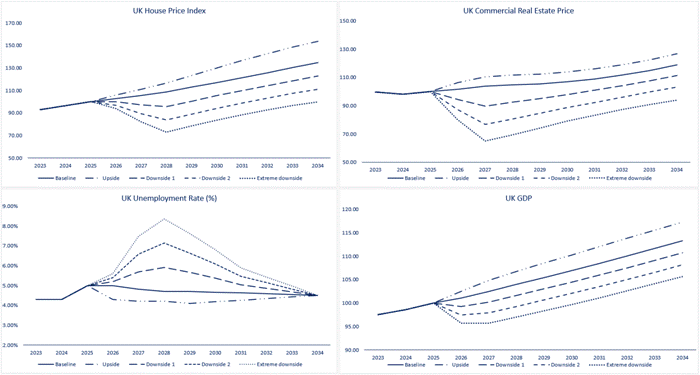
The table below compares the 31 December 2025 ECL provision derived using the 2025 and 2024 economic scenarios.
| Economic scenarios as at | ||
| 2025 | 2024 | |
| Group | £000 | £000 |
| ECL Provision | ||
| Stage 1 | 708 | 887 |
| Stage 2 | 172 | 174 |
| Stage 3 | 12,284 | 12,430 |
| At 31 December 2025 | 13,163 | 13,491 |
| Additionally, management have assessed the impact of assigning a 100% probability to each of the economic scenarios, which would have the following impact on the Profit or Loss of the Group: | ||
| 2025 | 2024 | |
| Group | £m | £m |
| Impact of 100% scenario probability | ||
| Baseline | 0.4 | 0.5 |
| Upside | 2.6 | 1.8 |
| Downside 1 | (1.1) | (1.9) |
| Downside 2 | (5.4) | (5.2) |
| Extreme downside | (19.6) | (21.4) |
(b) Effective Interest Rate
Loans and advances to customers are initially recognised at fair value. The fair value of a loan on initial recognition is generally its transaction price. Subsequently, they are measured under the effective interest rate method. Management review the expected cash flows against actual cash flows to ensure future assumptions on customer behaviour and future cash flows remain valid. If the estimates of future cash flows are revised, the gross carrying value of the financial asset is recalculated as the present value of the estimated future contractual cash flows discounted at the original effective interest rate. The adjustment to the carrying value of the loan book is recognised in the Statement of Comprehensive Income.
The accuracy of the effective interest rate is affected by unexpected market movements resulting in altered customer behaviour, inaccuracies in the models used compared to actual outcomes and incorrect assumptions.
In 2025 the Group recognised £42k (2024: £325k) additional interest income to reflect a revision in the timing of expected cash flows on the originated book, reflecting a shortening of the expected life of originated loan book.
If customer loans repaid 6 months earlier than anticipated on the originated loan book, interest income would increase by £0.6m (2024: £0.5m), due to acceleration of fee income.
In 2025 the Group recognised £33k additional (2024: £45k additional) interest income to reflect actual cash flows received on the acquired mortgage book being less than forecast cash flows.
The key judgements in relation to calculating the net present value of the acquired mortgage book relate to the timing of future cash flows on principal repayments. Management have considered an early and delayed 6-month sensitivity on the timing of repayment and a 10% increase and decrease of principal repayments to be reasonably possible.
If the acquired loan book was modelled to accelerate cash flows by 6 months, it would increase interest income in 2025 by £0.14m (2024: £0.18m) while a 10% increase in principal repayments will increase interest income in 2025 by £0.3m (2024: £0.4m) through a cash flow reset adjustment.
(c) Investment property
The valuation that the Group places on its investment property is subject to a degree of uncertainty and is calculated on the basis of assumptions in relation to prevailing market rents and effective yields. These assumptions may not prove to be accurate, particularly in periods of market volatility.
The uncertainty in current market conditions has resulted in less market evidence being available for Management in making its judgement on the key assumptions of property yield and market rent. The Group currently owns one (2024: one) investment property, as outlined in Note 30.
Management valued the investment property utilising externally sourced market information and property specific knowledge.
Crescent Office Park in Bath with value of £5.3m (2024: £5.3m)
In December 2017, the office building was acquired with the intention to be included within a new property fund initiative that the Group had planned to start-up. The property had tenants in situ with the Fund recognising rental income.
The property was initially recognised as held for sale under IFRS 5. In 2018 the launch of the property fund was placed on hold and as a result it was reclassified as an investment property as the property no longer met the IFRS 5 criteria. The property remained occupied as at 31 December 2025 with the Group receiving rental income.
In accordance with IAS 40, the property is measured at fair value, with its carrying value at year end of £5.25m equal to its fair value.
The valuation of the property has the following key inputs:
• yield: 8.5%
• total rental income per annum: £0.48m
The external valuation that the Group places on its investment property is subject to a degree of uncertainty and is calculated on the basis of assumptions in relation to prevailing market conditions and subject to comparable properties for sale. This valuation is therefore susceptible to uncertainty particularly where there is a limited level of activity in the property market.
Management have assessed that should the fair value of the investment property reduce by 5% this would impact profit or loss by a reduction of £0.3m (2024: £0.3m) and a reduction of 10% would impact profit or loss by a reduction of £0.5m (2024: £0.5m).
(d) Inventory
The Group owns one commercial property (2024: one property) and two repossessed properties (2024: two repossessed properties), classified as inventory and presented as part of other assets in the Statement of Financial Position. The properties are assessed at the reporting date for impairment.
The valuations for the Group's properties are subject to a degree of uncertainty and are calculated on the basis of assumptions in relation to prevailing market conditions, including effective yields and comparable properties for sale. These valuations are therefore susceptible to uncertainty particularly where there is a limited level of activity in the property market and may not prove to be accurate, particularly in periods of market volatility.
Similarly to investment property, the uncertainty in current market conditions resulted in less market evidence being available for Management in making its judgement on the key assumptions of property yield and market rent.
Management have assessed that should the net realisable value less cost to sell of each of the combined property inventory reduce by 5% this would impact profit or loss by a reduction of £0.8m (2024: £0.9m) and a reduction of 10% would impact profit or loss by a reduction of £1.6m (2024: £1.7m) (or 10% of cost).
(e) Residual value
At the end of lease terms, assets may be sold to third parties or leased for further terms. Rentals are calculated to recover the cost of assets less their residual value ("RV"), and earn finance income. RV's represent the estimated value of the leased asset at the end of lease period. Residual values are calculated after analysing the market place and the company's own historical experience in the market. Expected residual values of leased assets are prospectively adjusted for through the depreciation adjustments which are charged to the income statement each year. The key estimates and judgements that arise in relation to RV's are timing of lease terminations and expected residual value of returned vehicles.
The profitability of the Group's operating lease contracts is highly dependent on the RV of the vehicle at the end of the agreement. On inception of the lease, the Group uses its knowledge and experience of the market and industry to estimate the final RV of the vehicle. The Group is exposed to the risk that the RV of the vehicle may be less than anticipated at the outset of the contract impacting profitability. The Group manages the risk through effective and robust procedures by continually monitoring historic, current and forecast RV performance.
Management have assessed that a residual value decrease of 5% as at 31 December 2025 would impact profit or loss by a reduction of £2.3m (2024: £2.4m) and a residual value decrease of 10% would impact profit or loss by reduction of £4.6m (2024: £4.9m). Expected residual values underlying the calculation of depreciation of leased assets are kept under review to take account of any change in circumstances. Refer to Note 28 for further detail.
| 5. Maturity analysis of assets and liabilities | |||
| The table below shows the maturity analysis by expected maturity date of assets and liabilities of the Group as at 31 December 2025: | |||
| Due within one year | Due after more than one year | Total | |
| At 31 December 2025 | £000 | £000 | £000 |
| ASSETS | |||
| Cash and balances at central banks | 437,548 | - | 437,548 |
| Loans and advances to banks | 117,497 | - | 117,497 |
| Debt securities at amortised cost | 1,745,794 | 287,364 | 2,033,158 |
| Derivative financial instruments | - | 1,398 | 1,398 |
| Current tax asset | 1,619 | - | 1,619 |
| Loans and advances to customers | 560,072 | 1,400,470 | 1,960,542 |
| Other assets | 34,254 | 15,993 | 50,247 |
| Financial investments | - | 2,061 | 2,061 |
| Intangible assets | 3,388 | 30,060 | 33,448 |
| Property, plant and equipment | 136,354 | 174,215 | 310,569 |
| Right-of-use assets | 4,074 | 40,427 | 44,501 |
| Investment property | - | 5,250 | 5,250 |
| 3,040,600 | 1,957,238 | 4,997,838 | |
| LIABILITIES | |||
| Deposits from banks | 1,389 | - | 1,389 |
| Deposits from customers | 4,534,879 | 35,486 | 4,570,365 |
| Other liabilities | 42,489 | - | 42,489 |
| Deferred tax liability | - | 10,258 | 10,258 |
| Lease liabilities | 3,964 | 54,303 | 58,267 |
| Debt securities in issue | - | 38,672 | 38,672 |
| 4,582,721 | 138,719 | 4,721,440 |
| The table below shows the maturity analysis by expected maturity date of assets and liabilities of the Group as at 31 December 2024: | |||
| Due within one year | Due after more than one year | Total | |
| At 31 December 2024 | £000 | £000 | £000 |
| ASSETS | |||
| Cash and balances at central banks | 911,887 | - | 911,887 |
| Loans and advances to banks | 66,971 | - | 66,971 |
| Debt securities at amortised cost | 1,037,497 | 162,350 | 1,199,847 |
| Derivative financial instruments | - | 2,970 | 2,970 |
| Loans and advances to customers | 537,467 | 1,556,745 | 2,094,212 |
| Other assets | 26,380 | 25,321 | 51,701 |
| Financial investments | - | 4,947 | 4,947 |
| Intangible assets | 2,590 | 27,975 | 30,565 |
| Property, plant and equipment | 156,997 | 156,369 | 313,366 |
| Right-of-use assets | 4,385 | 43,126 | 47,511 |
| Investment property | - | 5,250 | 5,250 |
| 2,744,174 | 1,985,053 | 4,729,227 | |
| LIABILITIES | |||
| Deposits from banks | 180,511 | 12,400 | 192,911 |
| Deposits from customers | 4,087,650 | 44,843 | 4,132,493 |
| Current tax liability | 3,001 | - | 3,001 |
| Other liabilities | 35,384 | - | 35,384 |
| Deferred tax liability | - | 5,671 | 5,671 |
| Lease Liabilities | 1,086 | 53,743 | 54,829 |
| Debt securities in issue | - | 37,982 | 37,982 |
| 4,307,632 | 154,639 | 4,462,271 |
| The table below shows the maturity analysis by expected maturity date of assets and liabilities of the Company as at 31 December 2025: | |||
| Due within one year | Due after more than one year | Total | |
| At 31 December 2025 | £000 | £000 | £000 |
| ASSETS | |||
| Loans and advances to banks | 7 | - | 7 |
| Loans and advances to banks - due from subsidiary undertakings | 4,753 | - | 4,753 |
| Debt securities at amortised cost | - | 38,781 | 38,781 |
| Deferred tax asset | - | 486 | 486 |
| Property, plant and equipment | - | 194 | 194 |
| Other assets | 1,739 | - | 1,739 |
| Interests in subsidiaries | - | 164,354 | 164,354 |
| 6,499 | 203,815 | 210,314 | |
| LIABILITIES | |||
| Current tax liability | 5,391 | - | 5,391 |
| Other liabilities | 5,752 | - | 5,752 |
| Debt securities in issue | - | 38,672 | 38,672 |
| 11,143 | 38,672 | 49,815 | |
| The table below shows the maturity analysis by expected maturity date of assets and liabilities of the Company as at 31 December 2024: | |||
| Due within one year | Due after more than one year | Total | |
| At 31 December 2024 | £000 | £000 | £000 |
| ASSETS | |||
| Loans and advances to banks | 7 | - | 7 |
| Loans and advances to banks - due from subsidiary undertakings | 913 | - | 913 |
| Debt securities at amortised cost | - | 38,103 | 38,103 |
| Deferred tax asset | - | 515 | 515 |
| Property, plant and equipment | - | 221 | 221 |
| Other assets | 3,355 | - | 3,355 |
| Interests in subsidiaries | - | 164,354 | 164,354 |
| 4,275 | 203,193 | 207,468 | |
| LIABILITIES | |||
| Current tax liability | 4,288 | - | 4,288 |
| Other liabilities | 5,467 | - | 5,467 |
| Debt securities in issue | - | 37,982 | 37,982 |
| 9,755 | 37,982 | 47,737 |
6. Financial risk management
Strategy
By their nature, the Group's activities are principally related to the use of financial instruments. The Directors and senior management of the Group have formally adopted a Group Risk and Controls Policy which sets out the Board's attitude to risk and internal controls. Key risks identified by the Directors are formally reviewed and assessed at least once a year by the Board, in addition to which key business risks are identified, evaluated and managed by operating management on an ongoing basis by means of procedures such as physical controls, credit and other authorisation limits and segregation of duties. The Board also receives regular reports on any risk matters that need to be brought to its attention. Significant risks identified in connection with the development of new activities are subject to consideration by the Board. There are budgeting procedures in place and reports are presented regularly to the Board detailing the results of each principal business unit, variances against budget and prior year, and other performance data.
The principal non-operational risks inherent in the Group's business are credit, macroeconomic, market, liquidity and capital.
(a) Credit risk
The Company and Group take on exposure to credit risk, which is the risk that a counterparty will be unable to pay amounts in full when due. Significant changes in the economy, or in the health of a particular industry segment that represents a concentration in the Company and Group's portfolio, could result in losses that are different from those provided for at the balance sheet date. Credit risk is managed through the Credit Committee of the banking subsidiary.
The Committee regularly reviews the credit risk profile of the Group, with a clear focus on performance against risk appetite statements and risk metrics. The Committee considered credit conditions during the year, and in particular the impact of the high interest rates on performance against both credit risk appetite and a range of key credit risk metrics.
The Company and Group structure the levels of credit risk it undertakes by placing limits on the amount of risk accepted in relation to products, and one borrower or groups of borrowers. Such risks are monitored on a revolving basis and subject to an annual or more frequent review. The limits are approved periodically by the Board of Directors and actual exposures against limits are monitored daily.
Exposure to credit risk is managed through regular analysis of the ability of borrowers and potential borrowers to meet interest and capital repayment obligations and by changing these lending limits where appropriate. Exposure to credit risk is also managed in part by obtaining collateral, and corporate and personal guarantees.
The economic environment remains uncertain and future impairment charges may be subject to further volatility (including from changes to macroeconomic variable forecasts).
Uncertainty in current market conditions has created a challenge for ECL modelling, given the severity of economic shock and associated uncertainty for the future economic path coupled with the scale of government and central bank intervention that have altered the relationships between economic drivers and default.
The Group has attempted to leverage stress test modelling insights to inform ECL model refinements to enable reasonable estimates. Management review of modelling approaches and outcomes continues to inform any necessary adjustments to the ECL estimates through the form of in-model adjustments, based on expert judgement including the use of available information. Management considerations included the potential severity and duration of the economic shock, including the mitigating effects of government support actions, as well the potential trajectory of the subsequent recovery.
The Group employs a range of policies and practices to mitigate credit risk. The most traditional of these is the taking of collateral to secure advances, which is common practice. The principal collateral types for loans and advances include, but are not limited to:
• Charges over residential and commercial properties;
• Charges over business assets such as premises, inventory and accounts receivable;
• Charges over financial instruments such as debt securities and equities;
• Charges over other chattels; and
• Personal guarantees
Upon initial recognition of loans and advances, the fair value of collateral is based on valuation techniques commonly used for the corresponding assets. In order to minimise any potential credit loss the Group will seek additional collateral from the counterparty as soon as impairment indicators are noticed for the relevant individual loans and advances. Repossessed collateral, not readily convertible into cash, is made available for sale in an orderly fashion, with the proceeds used to reduce or repay the outstanding indebtedness, or held as inventory where the Group intends to develop and sell in the future. Where excess funds are available after the debt has been repaid, they are available either for other secured lenders with lower priority or are returned to the customer.
Commitments to extend credit represent unused portions of authorisations to extend credit in the form of loans, guarantees or letters of credit. With respect to credit risk on commitments to extend credit, the Group is potentially exposed to loss in an amount equal to the total unused commitments. However, the likely amount of loss is less than the total unused commitments, as most commitments to extend credit are contingent upon customers maintaining specific credit standards.
The Group incorporates forward-looking information into both its assessment of whether the credit risk of an instrument has increased significantly since its initial recognition and its measurement of ECL. The key inputs into the measurement of the ECL are:
• assessment of significant increase in credit risk
• future economic scenarios (see Note 4.2 (a))
• probability of default
• loss given default
• exposure at default
The IFRS 9 impairment model adopts a three stage approach based on the extent of credit deterioration since origination, see Note 11.
The Group's maximum exposure to credit risk before collateral held or other credit enhancements is as follows:
| 2025 | ||||||
| Group | Banking | RAF | ACABL | AAG | All Other Divisions | Total |
| Credit risk exposures (all stage 1, unless otherwise stated) | £000 | £000 | £000 | £000 | £000 | £000 |
| On-balance sheet: | ||||||
| Cash and balances at central banks | - | - | - | - | 437,548 | 437,548 |
| Loans and advances to banks | - | - | - | - | 117,497 | 117,497 |
| Debt securities at amortised cost | - | - | - | - | 2,033,158 | 2,033,158 |
| Derivative financial instruments | - | - | - | - | 1,398 | 1,398 |
| Loans and advances to customers (Gross of ECL) | 1,367,125 | 288,308 | 219,536 | 97,586 | 1,148 | 1,973,703 |
| Stage 1 | 1,288,927 | 280,720 | 189,554 | 97,454 | (12) | 1,856,643 |
| Stage 2 | 18,413 | 4,888 | 29,982 | 100 | - | 53,383 |
| Stage 3 | 59,785 | 2,700 | - | 32 | 1,160 | 63,677 |
| Other assets | - | - | - | - | 7,011 | 7,011 |
| Financial investments | - | - | - | - | 2,061 | 2,061 |
| Off-balance sheet: | ||||||
| Guarantees | 3,059 | - | - | - | - | 3,059 |
| Loan commitments and other credit related liabilities | 74,457 | - | 300,835 | - | - | 375,292 |
| At 31 December | 1,444,641 | 288,308 | 520,371 | 97,586 | 2,599,821 | 4,950,727 |
| 2024 | ||||||
| Group | Banking | RAF | ACABL | AAG | All Other Divisions | Total |
| Credit risk exposures (all stage 1, unless otherwise stated) | £000 | £000 | £000 | £000 | £000 | £000 |
| On-balance sheet: | ||||||
| Cash and balances at central banks | - | - | - | - | 911,699 | 911,699 |
| Loans and advances to banks | - | - | - | - | 66,971 | 66,971 |
| Debt securities at amortised cost | - | - | - | - | 1,199,847 | 1,199,847 |
| Derivative financial instruments | - | - | - | - | 2,970 | 2,970 |
| Loans and advances to customers (Gross of ECL) | 1,549,071 | 249,789 | 228,507 | 77,305 | 1,129 | 2,105,801 |
| Stage 1 | 1,420,547 | 242,482 | 189,097 | 77,065 | (14) | 1,929,177 |
| Stage 2 | 60,379 | 4,407 | 38,249 | 240 | - | 103,275 |
| Stage 3 | 68,145 | 2,900 | 1,161 | - | 1,143 | 73,349 |
| Other assets | - | - | - | - | 7,758 | 7,758 |
| Financial investments | - | - | - | - | 4,947 | 4,947 |
| Off-balance sheet: | ||||||
| Guarantees | 2,500 | - | - | - | - | 2,500 |
| Loan commitments and other credit related liabilities | 101,412 | - | 324,119 | - | - | 425,531 |
| At 31 December | 1,652,983 | 249,789 | 552,626 | 77,305 | 2,195,321 | 4,728,024 |
| The Company's maximum exposure to credit risk (all stage 1) before collateral held or other credit enhancements is as follows: | ||
| 2025 | 2024 | |
| £000 | £000 | |
| Credit risk exposures relating to on-balance sheet assets are as follows: | ||
| Loans and advances to banks | 4,760 | 920 |
| Debt securities at amortised cost | 38,781 | 38,103 |
| Other assets | 1,676 | 3,280 |
| At 31 December | 45,217 | 42,303 |
The above tables represent the maximum credit risk exposure (before impairment) to the Group and Company at 31 December 2025 and 2024 without taking account of any collateral held or other credit enhancements attached. For financial assets, the balances are based on carrying amounts as reported in the Statement of Financial Position. For guarantees and loan commitments, the amounts in the table represent the amounts for which the Group is contractually committed.
| The table below represents an analysis of the loan to values of the exposures secured by property for the Group: | ||||||
| 2025 | ||||||
| Total | ||||||
| Loan Balance | Collateral | |||||
| Group | £000 | £000 | ||||
| Less than 60% | 1,106,535 | 2,353,498 | ||||
| Stage 1 | 1,079,543 | 2,296,152 | ||||
| Stage 2 | 7,379 | 16,005 | ||||
| Stage 3 | 19,613 | 41,341 | ||||
| 60%-80% | 203,944 | 322,419 | ||||
| Stage 1 | 184,841 | 294,386 | ||||
| Stage 2 | 10,746 | 15,898 | ||||
| Stage 3 | 8,357 | 12,135 | ||||
| 80%-100% | 20,219 | 22,220 | ||||
| Stage 1 | 3,106 | 4,107 | ||||
| Stage 2 | 60 | 109 | ||||
| Stage 3 | 17,053 | 18,004 | ||||
| Greater than 100% | 8,882 | 8,061 | ||||
| Stage 1 | 2,667 | 3,004 | ||||
| Stage 2 | 69 | 112 | ||||
| Stage 3 | 6,146 | 4,945 | ||||
| Total | 1,339,580 | 2,706,198 |
| The table below represents an analysis of the loan to values of the exposures secured by property for the Group: | ||||||
| 2024 | ||||||
| Total | ||||||
| Loan Balance | Collateral | |||||
| Group | £000 | £000 | ||||
| Less than 60% | 1,113,713 | 2,455,910 | ||||
| Stage 1 | 1,058,577 | 2,334,164 | ||||
| Stage 2 | 31,121 | 72,836 | ||||
| Stage 3 | 24,015 | 48,910 | ||||
| 60%-80% | 348,701 | 569,311 | ||||
| Stage 1 | 304,176 | 497,360 | ||||
| Stage 2 | 26,322 | 41,414 | ||||
| Stage 3 | 18,203 | 30,537 | ||||
| 80%-100% | 22,304 | 31,581 | ||||
| Stage 1 | 12,594 | 18,683 | ||||
| Stage 2 | 659 | 1,008 | ||||
| Stage 3 | 9,051 | 11,890 | ||||
| Greater than 100%* | 17,130 | 17,574 | ||||
| Stage 1 | 6,577 | 7,789 | ||||
| Stage 2 | 1,986 | 482 | ||||
| Stage 3 | 8,567 | 9,303 | ||||
| Total | 1,501,848 | 3,074,376 |
*In addition to property, other security is taken, including charges over Arbuthnot Latham Investment Management portfolios, other chattels and personal guarantees. Additionally under the government scheme for BBLs, collateral is not required as the loans are 100% backed by the government.
Loans with a loan to value of greater than 100% have no additional collateral (2024: £1.0m) in the form of cash deposits and security over Arbuthnot Latham Investment Management Portfolios and personal guarantees of £2.2m (2024: £7.0m). Non-property collateral reduces loan to value below 100% for all such exposures.
| The table below represents an analysis of loan commitments compared to the values of property collateral for the Group (all Stage 1): | |||||||
| 2025 | |||||||
| Loan commitments | Collateral | ||||||
| Group | £000 | £000 | |||||
| Less than 60% | 37,496 | 94,693 | |||||
| 60%-80% | 1,697 | 2,425 | |||||
| Total | 39,193 | 97,118 | |||||
| 2024 | |||||||
| Loan commitments | Collateral | ||||||
| Group | £000 | £000 | |||||
| Less than 60% | 44,584 | 93,125 | |||||
| 60%-80% | 981 | 1,550 | |||||
| 80%-100% | 2,296 | 2,717 | |||||
| Total | 47,861 | 97,392 |
Renegotiated loans and forbearance
The contractual terms of a loan may be modified due to factors that are not related to the current or potential credit deterioration of the customer (changing market conditions, customer retention, etc.). In such cases, the modified loan may be derecognised and the renegotiated loan recognised as a new loan at fair value.
When modification results in derecognition, a new loan is recognised and allocated to Stage 1 (assuming it is not credit-impaired at that time).
The Group renegotiates loans to customers in financial difficulties (referred to as 'forbearance') to maximise collection opportunities and minimise the risk of default. Under the Group's forbearance policy, loan forbearance is granted on a selective basis if the debtor is currently in default on its debt, or if there is a high risk of default, there is evidence that the debtor made all reasonable efforts to pay under the original contractual terms and the debtor is expected to be able to meet the revised terms.
The revised terms can include changing the timing of interest payments, extending the date of repayment of the loan, transferring a loan to interest only payments and a payment holiday. Both retail and corporate loans are subject to the forbearance policy. The Group Credit Committee regularly reviews reports on forbearance.
For financial assets modified as part of the Group's forbearance policy, the estimate of PD (probability of default) reflects whether the modification has improved or restored the Group's ability to collect interest and principal and the Group's previous experience of similar forbearance action. As part of this process, the Group evaluates the borrower's payment performance against the modified contractual terms and considers various behavioural indicators. Whilst the customer is under forbearance, the customer will be classified as Stage 2 and the Group recognise a lifetime ECL. The customer will transfer to Stage 1 and revert to a 12 month ECL when they exit forbearance. This is conditional upon both a minimum six months' good account conduct and the improvement to the client's situation to the extent the probability of default has receded sufficiently and full repayment of the loan, without recourse to the collateral, is likely.
Forbearance is a qualitative indicator of a SICR (see Note 3.4)
As at 31 December 2025, loans for which forbearance measures were in place totalled 0.86% (2024: 1.86%) of total value of loans to customers for the Group. These are set out in the following table:
| 2025 | |||||||||||
| Stage 1 | Stage 2 | Stage 3 | Total | ||||||||
| Number | Loan Balance | Number | Loan Balance | Number | Loan Balance | Number | Loan Balance | ||||
| Group | £000 | £000 | £000 | £000 | |||||||
| Term extension | - | - | 3 | 271 | 1 | 463 | 4 | 734 | |||
| Payment holiday | - | - | 3 | 897 | - | - | 3 | 897 | |||
| Modification in terms and conditions | - | - | 36 | 9,061 | 35 | 6,124 | 71 | 15,185 | |||
| Total forbearance | - | - | 42 | 10,229 | 36 | 6,587 | 78 | 16,816 |
| 2024 | |||||||||||
| Stage 1 | Stage 2 | Stage 3 | Total | ||||||||
| Number | Loan Balance | Number | Loan Balance | Number | Loan Balance | Number | Loan Balance | ||||
| Group | £000 | £000 | £000 | £000 | |||||||
| Time for asset sale | - | - | - | - | 1 | 35 | 1 | 35 | |||
| Term extension | - | - | 7 | 1,911 | 1 | 118 | 8 | 2,029 | |||
| Time for refinance with third party | - | - | 1 | 2,440 | - | - | 1 | 2,440 | |||
| Payment holiday | - | - | 7 | 8,560 | 5 | 4,964 | 12 | 13,524 | |||
| Covenant waived | - | - | 1 | 752 | - | - | 1 | 752 | |||
| Modification in term and conditions | - | - | 39 | 10,617 | 40 | 8,637 | 79 | 19,254 | |||
| Restructure | - | - | 5 | 392 | 1 | 285 | 6 | 677 | |||
| Total forbearance | - | - | 60 | 24,672 | 48 | 14,039 | 108 | 38,711 |
Concentration risk
The table below show the concentration in the loan book based on the most significant type of collateral held for each loan.
| Loans and advances to customers | Loan Commitments | ||||
| 2025 | 2024 | 2025 | 2024 | ||
| £000 | £000 | £000 | £000 | ||
| Concentration by product | |||||
| Asset based lending | 219,362 | 228,196 | 300,835 | 324,119 | |
| Asset finance | 385,254 | 325,191 | - | - | |
| Cash collateralised | 6,894 | 7,034 | 529 | 1,946 | |
| Commercial lending | 48,287 | 72,504 | 1,370 | 6,380 | |
| Investment portfolio secured | 23,473 | 23,088 | 2,144 | 2,219 | |
| Residential mortgages | 1,235,645 | 1,311,158 | 36,631 | 40,590 | |
| Mixed collateral* | 32,893 | 108,232 | 1,144 | 1,416 | |
| Unsecured** | 8,734 | 18,809 | 32,639 | 48,861 | |
| At 31 December | 1,960,542 | 2,094,212 | 375,292 | 425,531 | |
| Concentration by location | |||||
| East Anglia | 28,900 | 34,335 | 4,226 | 1,642 | |
| London | 658,972 | 731,280 | 19,093 | 27,693 | |
| Midlands | 108,963 | 117,749 | 466 | 3,322 | |
| North East | 68,017 | 111,818 | 28 | 404 | |
| North West | 69,315 | 80,403 | 3,912 | 4,673 | |
| Northern Ireland | 2,571 | 2,956 | - | - | |
| Scotland | 10,364 | 24,405 | - | 500 | |
| South East | 254,434 | 257,244 | 10,035 | 6,611 | |
| South West | 98,221 | 127,112 | 1,686 | 2,615 | |
| Wales | 8,984 | 10,452 | 196 | - | |
| Non-property collateral | 651,801 | 596,458 | 335,650 | 378,071 | |
| At 31 December | 1,960,542 | 2,094,212 | 375,292 | 425,531 |
* Mixed collateral is where there is no single, overall majority collateral type.
** Included within unsecured are £3.4m (2024: £4.5m) of loans which are backed by the government guarantee scheme for BBLs.
(b) Operational risk
Operational risk is the risk that the Group may be exposed to financial losses from conducting its business. The Group's exposure to operational risk include its Information Technology ("IT") and Operating platforms. There are additional internal controls in these processes that are designed to protect the Group from these risks. The Group's overall approach to managing internal control and financial reporting is described in the Corporate Governance section of the Annual Report.
In line with guidance issued by the Regulator, the Bank has continued to focus on ensuring that the design of systems and operational plans are robust to maintain operational resilience in the face of unexpected incidents.
Cyber risk
Cyber risk is an increasing risk for the Group within its operational processes. It is the risk that the Group is subject to some form of disruption arising from an interruption to its IT and data infrastructure. The Group regularly tests the infrastructure to ensure that it remains robust to a range of threats and has continuity of business plans in place including a disaster recovery plan.
Residual value risk
Residual value risk equals the difference in the residual value of a leased asset set at lease inception and the lower salvage value realised upon its disposal or re-lease at the end of the lease term. The Group is exposed to residual value risk in its AAG business. Normal residual value risk is managed through the process set out below, and it should be noted that the transition to greener technology may further impact residual values in two ways. Firstly, residual values could decrease due to assets becoming obsolete; climate related regulations might change, which could result in legal restrictions on the use of assets or technological advances could lead to preferred environmental technologies. Secondly, the lack of historical information on green vehicles could lead to inaccurate measurement of residual values at inception of leases.
The AAG business manage Residual Value setting through its Residual Value Committee that comprises representatives from its Asset Management, Procurement, Sales and Leasing divisions and is chaired by the Residual Value Manager. Assets are valued using either an approved Residual Value matrix or individually, dependent upon the nature of the asset and current market conditions. The strategy for Residual Value setting and oversight of the Residual Value Committee is conducted by the AAG Residual Risk Committee, which in turn reports into the Asset Alliance Group Holdings Limited board. The Residual Risk Committee, chaired by the AAG Group Risk Director, includes AAG CEO, AL Group Risk Director, AAG Managing Director, AAG Finance Director and heads of Asset Management, Sales and Leasing divisions in AAG.
Conduct risk
As a financial services provider the Group faces conduct risk, including selling products to customers which do not meet their needs, failing to deal with clients' complaints effectively, not meeting clients' expectations, and exhibiting behaviours which do not meet market or regulatory standards.
The Group adopts a low risk appetite for any unfair customer outcomes. It maintains clear compliance guidelines and provides ongoing training to all employees. Periodic spot checks, compliance monitoring and internal audits are performed to ensure these guidelines are followed. The Group also has insurance policies in place to provide some cover for any claims that may arise.
Financial Crime
The Group is exposed to risk due to financial crime including money laundering, sanctions evasion, bribery and corruption, market abuse, tax evasion and fraud. The Group operates policies and controls which are designed to ensure that financial crime risks are identified, appropriately mitigated and managed.
Regulatory and capital risk
Regulatory and capital risk includes the risk that the Group will have insufficient capital resources to support the business and/or does not comply with regulatory requirements. The Group adopts a conservative approach to managing its capital. The Board of Arbuthnot Latham approves an ICAAP annually, which includes the performance of stringent stress tests to ensure that capital resources are adequate over a three year horizon. Capital and liquidity ratios are regularly monitored against the Board's approved risk appetite as part of the risk management framework.
Regulatory change also exists as a risk to the Group's business. Notwithstanding the assessments carried out by the Group to manage regulatory risk, it is not possible to predict how regulatory and legislative changes may alter and impact the business. Significant and unforeseen regulatory changes may reduce the Group's competitive situation and lower its profitability.
(c) Macroeconomic and competitive environment
The Group is exposed to risks that may arise from the macroeconomic and competitive environment.
In recent years there have been a number of global and domestic events which have had significant implications for the Group's operating environment, namely: The US-Israeli war with Iran, Russia's war in the Ukraine, the Israel-Hamas war in Gaza and Coronavirus. The culmination of these events has led to significant turmoil in both global and domestic markets. Geo-political volatility and uncertainty remains high with the potential to adversely affect the UK economy, as well as the Group's customers and assets.
(d) Market risk
Price risk
The Group is exposed to price risk from equity investments and derivatives held by the Group. The Group is not exposed to commodity price risk.
Based upon the financial investment exposure in Note 25, a stress test scenario of a 10% (2024: 10%) decline in market prices, would result in a £Nil (2024: £Nil) decrease in the Group's income and a decrease of £0.2m (2024: £0.5m) in the Group's equity. The Group considers a 10% stress test scenario appropriate after taking the current values and historic data into account.
Currency risk
The Company and Group take on exposure to the effects of fluctuations in the prevailing foreign currency exchange rates on its financial position and cash flows. This is managed through the Group entering into forward foreign exchange contracts. The Board sets limits on the level of exposure for both overnight and intra-day positions, which are monitored daily. The table below summarises the Group's exposure to foreign currency exchange rate risk at 31 December 2025. Included in the table below are the Group's assets and liabilities at carrying amounts, categorised by currency.
| GBP (£) | USD ($) | Euro (€) | Other | Total | |
| At 31 December 2025 | £000 | £000 | £000 | £000 | £000 |
| ASSETS | |||||
| Cash and balances at central banks | 437,475 | 30 | 42 | 1 | 437,548 |
| Loans and advances to banks | 13,337 | 20,607 | 73,215 | 10,338 | 117,497 |
| Debt securities at amortised cost | 1,648,808 | 305,402 | 78,947 | 1 | 2,033,158 |
| Derivative financial instruments | 1,398 | - | - | - | 1,398 |
| Loans and advances to customers | 1,946,864 | 2,741 | 9,999 | 938 | 1,960,542 |
| Other assets | 7,011 | - | 3,267 | - | 10,278 |
| Financial investments | - | 1,865 | 196 | - | 2,061 |
| 4,054,893 | 330,645 | 165,666 | 11,278 | 4,562,482 | |
| LIABILITIES | |||||
| Deposits from banks | 1,389 | - | - | - | 1,389 |
| Deposits from customers | 4,079,131 | 330,130 | 149,700 | 11,404 | 4,570,365 |
| Other liabilities | 17,220 | 916 | 2,357 | - | 20,493 |
| Debt securities in issue | 25,605 | - | 13,067 | - | 38,672 |
| 4,123,345 | 331,046 | 165,124 | 11,404 | 4,630,919 | |
| Net on-balance sheet position | (68,452) | (401) | 542 | (126) | (68,437) |
| Credit commitments | 375,292 | - | - | - | 375,292 |
| The table below summarises the Group's exposure to foreign currency exchange risk at 31 December 2024: | |||||
| GBP (£) | USD ($) | Euro (€) | Other | Total | |
| At 31 December 2024 | £000 | £000 | £000 | £000 | £000 |
| ASSETS | |||||
| Cash and balances at central banks | 911,754 | 76 | - | 57 | 911,887 |
| Loans and advances to banks | 10,882 | 26,209 | 23,004 | 6,876 | 66,971 |
| Debt securities at amortised cost | 888,567 | 237,474 | 73,805 | 1 | 1,199,847 |
| Derivative financial instruments | 2,970 | - | - | - | 2,970 |
| Loans and advances to customers | 2,090,263 | (1,558) | 4,632 | 874 | 2,094,211 |
| Other assets | 7,758 | - | 2,960 | - | 10,718 |
| Financial investments | - | 4,787 | 160 | - | 4,947 |
| 3,912,194 | 266,988 | 104,561 | 7,808 | 4,291,551 | |
| LIABILITIES | |||||
| Deposits from banks | 192,911 | - | - | - | 192,911 |
| Deposits from customers | 3,767,984 | 264,095 | 92,735 | 7,680 | 4,132,494 |
| Other liabilities | 6,229 | - | - | - | 6,229 |
| Debt securities in issue | 26,209 | - | 11,773 | - | 37,982 |
| 3,993,333 | 264,095 | 104,508 | 7,680 | 4,369,616 | |
| Net on-balance sheet position | (81,139) | 2,893 | 53 | 128 | (78,065) |
| Credit commitments | 425,531 | - | - | - | 425,531 |
Derivative financial instruments (see Note 20) are in place to mitigate foreign currency risk on net exposures for each currency. A 10% strengthening of the pound against the US dollar would lead to a £40k decrease (2024: £289k increase) in Group profits and equity, while a 10% weakening of the pound against the US dollar would lead to the same increase (2024: decrease) in Group profits and equity. Additionally, the Group holds a property classified as inventory of £3.3m (2024: £3.0m). The property is located in the EU and relates to a Euro denominated loan where the property was repossessed. Including this Euro asset, the net Euro exposure is positive £0.5m (2024: positive £0.1m).
| The table below summarises the Company's exposure to foreign currency exchange rate risk at 31 December 2025: | |||
| GBP (£) | Euro (€) | Total | |
| At 31 December 2025 | £000 | £000 | £000 |
| ASSETS | |||
| Loans and advances to banks | 4,760 | - | 4,760 |
| Debt securities at amortised cost | 25,613 | 13,168 | 38,781 |
| Other assets | 1,676 | - | 1,676 |
| 32,049 | 13,168 | 45,217 | |
| LIABILITIES | |||
| Other liabilities | 1,824 | - | 1,824 |
| Debt securities in issue | 25,613 | 13,059 | 38,672 |
| 27,437 | 13,059 | 40,496 | |
| Net on-balance sheet position | 4,612 | 109 | 4,721 |
| The table below summarises the Company's exposure to foreign currency exchange rate risk at 31 December 2024: | |||
| GBP (£) | Euro (€) | Total | |
| At 31 December 2024 | £000 | £000 | £000 |
| ASSETS | |||
| Loans and advances to banks | 920 | - | 920 |
| Debt securities at amortised cost | 25,575 | 12,528 | 38,103 |
| Other assets | 3,280 | - | 3,280 |
| 29,775 | 12,528 | 42,303 | |
| LIABILITIES | |||
| Other liabilities | 1,812 | - | 1,812 |
| Debt securities in issue | 25,575 | 12,407 | 37,982 |
| 27,387 | 12,407 | 39,794 | |
| Net on-balance sheet position | 2,388 | 121 | 2,509 |
A 10% strengthening of the pound against the Euro would lead to £10k increase (2024: £11k increase) in the Company profits and equity, conversely a 10% weakening of the pound against the Euro would lead to a £12k decrease (2024: £13k decrease) in the Company profits and equity.
Interest rate risk
Interest rate risk is the potential adverse impact on the Company and Group's future cash flows from changes in interest rates, and arises from the differing interest rate risk characteristics of the Company and Group's assets and liabilities. In particular, fixed rate savings and borrowing products expose the Group to the risk that a change in interest rates could cause either a reduction in interest income or an increase in interest expense relative to variable rate interest flows. The Group seeks to "match" interest rate risk on both assets and liabilities. However, this is not a perfect match and interest rate risk is present in: Money market transactions of a fixed rate nature, fixed rate loans, fixed rate savings accounts and floating rate products dependent on when they re-price at a future date.
Interest rate risk is measured throughout the maturity bandings of the book on a parallel shift scenario for a 200 basis points movement. The current position of the balance sheet is such that it results in an favourable impact on the economic value of equity of £5.4m (2024: favourable impact of £1.8m) for a positive 200bps shift and an adverse impact of £5.8m (2024: adverse impact of £2.0m) for a negative 200bps movement.
The following tables summarise the re-pricing periods for the assets and liabilities in the Company and Group, including derivative financial instruments which are principally used to reduce exposure to interest rate risk. Items are allocated to time bands by reference to the earlier of the next contractual interest rate re-price and the maturity date.
| Group | Within 3 months | More than 3 months but less than 6 months | More than 6 months but less than 1 year | More than 1 year but less than 5 years | More than 5 years | Non interest bearing | Total |
| As at 31 December 2025 | £000 | £000 | £000 | £000 | £000 | £000 | £000 |
| ASSETS | |||||||
| Cash and balances at central banks | 437,548 | - | - | - | - | - | 437,548 |
| Loans and advances to banks | 117,497 | - | - | - | - | - | 117,497 |
| Debt securities at amortised cost | 1,158,566 | 513,422 | 286,170 | 75,000 | - | - | 2,033,158 |
| Derivative financial instruments | 1,398 | - | - | - | - | - | 1,398 |
| Loans and advances to customers | 1,280,198 | 34,211 | 84,411 | 509,875 | 1,904 | 49,943 | 1,960,542 |
| Other assets* | - | - | - | - | - | 445,634 | 445,634 |
| Financial investments | - | - | - | - | - | 2,061 | 2,061 |
| 2,995,207 | 547,633 | 370,581 | 584,875 | 1,904 | 497,638 | 4,997,838 | |
| LIABILITIES AND EQUITY | |||||||
| Deposits from banks | 1,389 | - | - | - | - | - | 1,389 |
| Deposits from customers | 3,219,973 | 396,462 | 537,257 | 414,778 | 1,895 | - | 4,570,365 |
| Other liabilities** | 54,340 | - | - | - | - | 56,674 | 111,014 |
| Debt securities in issue | 38,672 | - | - | - | - | - | 38,672 |
| Equity | - | - | - | - | - | 276,398 | 276,398 |
| 3,314,374 | 396,462 | 537,257 | 414,778 | 1,895 | 333,072 | 4,997,838 | |
| Impact of derivative instruments | 33,750 | - | - | (33,750) | - | - | |
| Interest rate sensitivity gap | (285,417) | 151,171 | (166,676) | 136,347 | 9 | 164,566 | |
| Cumulative gap | (285,417) | (134,246) | (300,922) | (164,575) | (164,566) | - | |
| * Other assets include all remaining assets in the Statement of Financial Position, which are not shown separately above. | |||||||
| ** Other liabilities include all remaining liabilities in the Statement of Financial Position, which are not shown separately above. |
| Group | Within 3 months | More than 3 months but less than 6 months | More than 6 months but less than 1 year | More than 1 year but less than 5 years | More than 5 years | Non interest bearing | Total |
| As at 31 December 2024 | £000 | £000 | £000 | £000 | £000 | £000 | £000 |
| ASSETS | |||||||
| Cash and balances at central banks | 911,887 | - | - | - | - | - | 911,887 |
| Loans and advances to banks | 66,971 | - | - | - | - | - | 66,971 |
| Debt securities at amortised cost | 567,847 | 295,895 | 173,755 | 162,350 | - | - | 1,199,847 |
| Derivative financial instruments | 2,970 | - | - | - | - | - | 2,970 |
| Loans and advances to customers | 1,495,051 | 23,589 | 67,855 | 489,688 | 6,238 | 11,791 | 2,094,212 |
| Other assets | - | - | - | - | - | 448,393 | 448,393 |
| Financial investments | - | - | - | - | - | 4,947 | 4,947 |
| 3,044,726 | 319,484 | 241,610 | 652,038 | 6,238 | 465,131 | 4,729,227 | |
| LIABILITIES AND EQUITY | |||||||
| Deposits from banks | 192,911 | - | - | - | - | - | 192,911 |
| Deposits from customers | 3,384,011 | 285,670 | 417,969 | 38,793 | 6,050 | - | 4,132,493 |
| Other liabilities | 56,130 | - | - | - | - | 42,755 | 98,885 |
| Debt securities in issue | (121) | - | - | - | 38,103 | - | 37,982 |
| Equity | (6,817) | - | - | 226,488 | 3,850 | 43,435 | 266,956 |
| 3,626,114 | 285,670 | 417,969 | 265,281 | 48,003 | 86,190 | 4,729,227 | |
| Impact of derivative instruments | 33,750 | - | - | (33,750) | - | - | |
| Interest rate sensitivity gap | (547,638) | 33,814 | (176,359) | 353,007 | (41,765) | 378,941 | |
| Cumulative gap | (547,638) | (513,824) | (690,183) | (337,176) | (378,941) | - | |
| * Other assets include all remaining assets in the Statement of Financial Position, which are not shown separately above. | |||||||
| ** Other liabilities include all remaining liabilities in the Statement of Financial Position, which are not shown separately above. |
| Company | Within 3 months | More than 3 months but less than 6 months | More than 6 months but less than 1 year | More than 1 year but less than 5 years | More than 5 years | Non interest bearing | Total |
| As at 31 December 2025 | £000 | £000 | £000 | £000 | £000 | £000 | £000 |
| ASSETS | |||||||
| Loans and advances to banks | 7 | - | - | - | - | - | 7 |
| Loans and advances to banks - due from subsidiary | 4,740 | - | - | - | - | 13 | 4,753 |
| Debt securities at amortised cost | 38,781 | - | - | - | - | - | 38,781 |
| Other assets* | - | - | - | - | - | 166,773 | 166,773 |
| 43,528 | - | - | - | - | 166,786 | 210,314 | |
| LIABILITIES AND EQUITY | |||||||
| Other liabilities** | - | - | - | - | - | 11,143 | 11,143 |
| Debt securities in issue | 38,672 | - | - | - | - | - | 38,672 |
| Equity | - | - | - | - | - | 160,499 | 160,499 |
| 38,672 | - | - | - | - | 171,642 | 210,314 | |
| Interest rate sensitivity gap | 4,856 | - | - | - | - | (4,856) | |
| Cumulative gap | 4,856 | 4,856 | 4,856 | 4,856 | 4,856 | - | |
| * Other assets include all remaining assets in the Statement of Financial Position, which are not shown separately above. | |||||||
| ** Other liabilities include all remaining liabilities in the Statement of Financial Position, which are not shown separately above. | |||||||
| Company | Within 3 months | More than 3 months but less than 6 months | More than 6 months but less than 1 year | More than 1 year but less than 5 years | More than 5 years | Non interest bearing | Total |
| As at 31 December 2024 | £000 | £000 | £000 | £000 | £000 | £000 | £000 |
| ASSETS | |||||||
| Loans and advances to banks | 7 | 7 | |||||
| Loans and advances to banks - due from subsidiary | 877 | - | - | - | - | 36 | 913 |
| Debt securities at amortised cost | 38,103 | - | - | - | - | - | 38,103 |
| Other assets* | - | - | - | - | - | 168,445 | 168,445 |
| 38,987 | - | - | - | - | 168,481 | 207,468 | |
| LIABILITIES AND EQUITY | |||||||
| Other liabilities** | - | - | - | - | - | 9,754 | 9,754 |
| Debt securities in issue | 37,982 | - | - | - | - | - | 37,982 |
| Equity | - | - | - | - | - | 159,732 | 159,732 |
| 37,982 | - | - | - | - | 169,486 | 207,468 | |
| Interest rate sensitivity gap | 1,005 | - | - | - | - | (1,005) | |
| Cumulative gap | 1,005 | 1,005 | 1,005 | 1,005 | 1,005 | - | |
| * Other assets include all remaining assets in the Statement of Financial Position, which are not shown separately above. | |||||||
| ** Other liabilities include all remaining liabilities in the Statement of Financial Position, which are not shown separately above. |
(e) Liquidity risk
Liquidity risk is the risk that the Group, although solvent, either does not have sufficient financial resources to enable it to meet its obligations as they fall due, or can only secure such resources at excessive cost.
The Group's approach to managing liquidity is to ensure, as far as possible, that it will always have sufficient liquidity to meet its liabilities when due, under both normal and stressed conditions, without incurring unacceptable losses or risking damage to the Group's reputation. The liquidity requirements of the Group are met through withdrawing funds from its Bank of England Reserve Account to cover any short-term fluctuations and longer term funding to address any structural liquidity requirements.
The Group has formal governance structures in place to manage and mitigate liquidity risk on a day to day basis. The Board of AL sets and approves the liquidity risk management strategy. The Assets and Liabilities Committee ("ALCO"), comprising senior executives of the Group, monitors liquidity risk. Key liquidity risk management information is reported by the finance teams and monitored by the Chief Executive Officer, Finance Director and Deputy CEO on a daily basis. The ALCO meets monthly to review liquidity risk against set thresholds and risk indicators including early warning indicators, liquidity risk tolerance levels and Internal Liquidity Adequacy Assessment Process ("ILAAP") metrics.
The PRA requires the Board to ensure that the Group has adequate levels of liquidity resources and a prudent funding profile, and that it comprehensively manages and controls liquidity and funding risks. The Group maintains deposits placed at the Bank of England and highly liquid unencumbered assets that can be called upon to create sufficient liquidity to meet liabilities on demand, particularly in a period of liquidity stress.
Arbuthnot Latham & Co., Limited ("AL") has a Board approved ILAAP, and maintains liquidity buffers in excess of the minimum requirements. The ILAAP is embedded in the risk management framework of the Group and is subject to ongoing updates and revisions when necessary. At a minimum, the ILAAP is updated annually. The Liquidity Coverage Ratio ("LCR") regime has applied to the Group from 1 October 2015, requiring management of net 30 day cash outflows as a proportion of high quality liquid assets. The LCR has exceeded the regulatory minimum of 100% throughout the year. There has been an increase in deposits of 20%, which has accordingly improved the Bank's liquidity.
The Group is exposed to daily calls on its available cash resources from current accounts, maturing deposits and loan draw-downs. The Group maintains significant cash resources to meet all of these needs as they fall due. The matching and controlled mismatching of the maturities and interest rates of assets and liabilities is fundamental to the management of the Group. It is unusual for banks to be completely matched, as transacted business is often of uncertain term and of different types.
The maturities of assets and liabilities and the ability to replace, at an acceptable cost, interest bearing liabilities as they mature are important factors in assessing the liquidity of the Group and its exposure to changes in interest rates.
| The tables below show the undiscounted contractual cash flows of the Group's financial liabilities and assets as at 31 December 2025: | ||||||
| Carrying amount | Gross inflow/ (outflow) | Not more than 3 months | More than 3 months but less than 1 year | More than 1 year but less than 5 years | More than 5 years | |
| At 31 December 2025 | £000 | £000 | £000 | £000 | £000 | £000 |
| Financial liability by type | ||||||
| Non-derivative liabilities | ||||||
| Deposits from banks | 1,389 | (1,389) | (1,389) | - | - | - |
| Deposits from customers | 4,570,365 | (4,630,216) | (3,873,093) | (721,265) | (33,957) | (1,901) |
| Other liabilities | 20,493 | (20,493) | (18,953) | - | - | (1,540) |
| Debt securities in issue | 38,672 | (71,298) | (901) | (2,745) | (14,595) | (53,057) |
| Issued financial guarantee contracts | - | (3,059) | (3,059) | - | - | - |
| Unrecognised loan commitments | - | (375,292) | (375,292) | - | - | - |
| 4,630,919 | (5,101,747) | (4,272,687) | (724,010) | (48,552) | (56,498) | |
| Carrying amount | Gross inflow/ (outflow) | Not more than 3 months | More than 3 months but less than 1 year | More than 1 year but less than 5 years | More than 5 years | |
| At 31 December 2025 | £000 | £000 | £000 | £000 | £000 | £000 |
| Financial asset by type | ||||||
| Non-derivative assets | ||||||
| Cash and balances at central banks | 437,548 | 437,548 | 437,548 | - | - | - |
| Loans and advances to banks | 117,497 | 117,497 | 117,497 | - | - | - |
| Debt securities at amortised cost | 2,033,158 | 2,044,425 | 1,198,496 | 804,682 | 41,247 | - |
| Loans and advances to customers | 1,960,542 | 2,272,721 | 303,063 | 314,447 | 1,526,480 | 128,731 |
| Other assets | 7,011 | 7,011 | 7,011 | - | - | - |
| Financial investments | 2,061 | 2,061 | 2,061 | - | - | - |
| 4,557,817 | 4,881,263 | 2,065,676 | 1,119,129 | 1,567,727 | 128,731 | |
| Derivative assets | ||||||
| Risk management: | ||||||
| - Inflows | 1,398 | 1,398 | - | - | 1,398 | - |
| 1,398 | 1,398 | - | - | 1,398 | - |
| The tables below show the undiscounted contractual cash flows of the Group's financial liabilities and assets as at 31 December 2024: | ||||||
| Carrying amount | Gross inflow/ (outflow) | Not more than 3 months | More than 3 months but less than 1 year | More than 1 year but less than 5 years | More than 5 years | |
| At 31 December 2024 | £000 | £000 | £000 | £000 | £000 | £000 |
| Financial liability by type | ||||||
| Non-derivative liabilities | ||||||
| Deposits from banks | 192,911 | (195,453) | - | (182,357) | (13,096) | - |
| Deposits from customers | 4,132,493 | (4,190,738) | (3,529,962) | (614,451) | (40,017) | (6,308) |
| Other liabilities | 6,229 | (6,229) | (4,689) | - | - | (1,540) |
| Debt securities in issue | 37,982 | (76,656) | (985) | (2,956) | (15,805) | (56,910) |
| Issued financial guarantee contracts | - | (2,500) | (2,500) | - | - | - |
| Unrecognised loan commitments | - | (425,531) | (425,531) | - | - | - |
| 4,369,615 | (4,897,107) | (3,963,667) | (799,764) | (68,918) | (64,758) | |
| Carrying amount | Gross inflow/ (outflow) | Not more than 3 months | More than 3 months but less than 1 year | More than 1 year but less than 5 years | More than 5 years | |
| At 31 December 2024 | £000 | £000 | £000 | £000 | £000 | £000 |
| Financial asset by type | ||||||
| Non-derivative assets | ||||||
| Cash and balances at central banks | 911,887 | 911,887 | 911,887 | - | - | - |
| Loans and advances to banks | 66,971 | 66,971 | 66,971 | - | - | - |
| Debt securities at amortised cost | 1,199,847 | 1,211,748 | 572,701 | 474,364 | 164,684 | - |
| Loans and advances to customers | 2,094,212 | 2,472,304 | 387,219 | 314,263 | 1,658,699 | 112,123 |
| Other assets | 7,758 | 7,758 | 7,758 | - | - | - |
| Financial investments | 4,947 | 4,947 | 4,947 | - | - | - |
| 4,285,622 | 4,675,615 | 1,951,483 | 788,627 | 1,823,383 | 112,123 | |
| Derivative assets | ||||||
| Risk management: | ||||||
| - Inflows | 2,970 | 2,970 | - | - | 2,970 | - |
| 2,970 | 2,970 | - | - | 2,970 | - |
| The table below sets out the components of the Group's liquidity reserves: | ||||||
| 31 December 2025 | 31 December 2024 | |||||
| Amount | Fair value | Amount | Fair value | |||
| Liquidity reserves | £000 | £000 | £000 | £000 | ||
| Cash and balances at central banks | 437,548 | 437,548 | 911,887 | 911,887 | ||
| Loans and advances to banks | 117,497 | 117,497 | 66,971 | 66,971 | ||
| Debt securities at amortised cost | 2,033,158 | 2,034,512 | 1,199,847 | 1,199,963 | ||
| 2,588,203 | 2,589,557 | 2,178,705 | 2,178,821 |
Assets pledged as collateral or encumbered
The total financial assets recognised in the statement of financial position that had been pledged as collateral for liabilities at 31 December 2025 were £Nil (2024: £237m). Assets are encumbered due to the Term Funding Scheme (Note 31).
Financial assets can be pledged as collateral as part of repurchases transactions under terms that are usual and customary for such activities.
| The table below analyses the contractual cash flows of the Company's financial liabilities and assets as at 31 December 2025: | ||||||
| Carrying amount | Gross inflow/ (outflow) | Not more than 3 months | More than 3 months but less than 1 year | More than 1 year but less than 5 years | More than 5 years | |
| At 31 December 2025 | £000 | £000 | £000 | £000 | £000 | £000 |
| Financial liability by type | ||||||
| Non-derivative liabilities | ||||||
| Other liabilities | 1,824 | (1,824) | (284) | - | - | (1,540) |
| Debt securities in issue | 38,672 | (71,298) | (901) | (2,745) | (14,595) | (53,057) |
| 40,496 | (73,122) | (1,185) | (2,745) | (14,595) | (54,597) | |
| Carrying amount | Gross inflow/ (outflow) | Not more than 3 months | More than 3 months but less than 1 year | More than 1 year but less than 5 years | More than 5 years | |
| At 31 December 2025 | £000 | £000 | £000 | £000 | £000 | £000 |
| Financial asset by type | ||||||
| Non-derivative assets | ||||||
| Loans and advances to banks | 4,760 | 4,760 | 4,760 | - | - | - |
| Debt securities at amortised cost | 38,781 | 71,298 | 901 | 2,745 | 14,595 | 53,057 |
| Other assets | 1,676 | 1,676 | 1,676 | - | - | - |
| 45,217 | 77,734 | 7,337 | 2,745 | 14,595 | 53,057 |
| The table below analyses the contractual cash flows of the Company's financial liabilities and assets as at 31 December 2024: | ||||||
| Carrying amount | Gross inflow/ (outflow) | Not more than 3 months | More than 3 months but less than 1 year | More than 1 year but less than 5 years | More than 5 years | |
| At 31 December 2024 | £000 | £000 | £000 | £000 | £000 | £000 |
| Financial liability by type | ||||||
| Non-derivative liabilities | ||||||
| Other liabilities | 1,812 | (1,812) | (272) | - | - | (1,540) |
| Debt securities in issue | 37,982 | (76,656) | (985) | (2,956) | (15,805) | (56,910) |
| 39,794 | (78,468) | (1,257) | (2,956) | (15,805) | (58,450) | |
| Carrying amount | Gross inflow/ (outflow) | Not more than 3 months | More than 3 months but less than 1 year | More than 1 year but less than 5 years | More than 5 years | |
| At 31 December 2024 | £000 | £000 | £000 | £000 | £000 | £000 |
| Financial asset by type | ||||||
| Non-derivative assets | ||||||
| Loans and advances to banks | 920 | 920 | 920 | - | - | - |
| Debt securities at amortised cost | 38,103 | 76,778 | 988 | 2,965 | 15,851 | 56,975 |
| Other assets | 3,280 | 3,280 | 3,280 | - | - | - |
| 42,303 | 80,978 | 5,188 | 2,965 | 15,851 | 56,975 |
The maturities of assets and liabilities and the ability to replace, at an acceptable cost, interest-bearing liabilities as they mature are important factors in assessing the liquidity of the Group and its exposure to changes in interest rates and exchange rates.
Fiduciary activities
The Group provides investment management and advisory services to third parties, which involve the Group making allocation and purchase and sale decisions in relation to a wide range of financial instruments. Those assets that are held in a fiduciary capacity are not included in these financial statements, because the assets do not meet the recognition criteria. These services give rise to the risk that the Group may be accused of maladministration or underperformance. At the balance sheet date, the Group had investment management accounts amounting to approximately £2.7bn (2024: £2.2bn). Additionally, the Group provides investment advisory services.
| (f) Financial assets and liabilities | |||||||||
| The tables below set out the Group's financial assets and financial liabilities into their respective classifications: | |||||||||
| FVPL | FVOCI | Amortised cost | Total carrying amount | Fair value | |||||
| At 31 December 2025 | £000 | £000 | £000 | £000 | £000 | ||||
| ASSETS | |||||||||
| Cash and balances at central banks | - | - | 437,548 | 437,548 | 437,548 | ||||
| Loans and advances to banks | - | - | 117,497 | 117,497 | 117,497 | ||||
| Debt securities at amortised cost | - | - | 2,033,158 | 2,033,158 | 2,034,512 | ||||
| Derivative financial instruments | 1,398 | - | - | 1,398 | 1,398 | ||||
| Loans and advances to customers | - | - | 1,960,542 | 1,960,542 | 1,963,911 | ||||
| Other assets | - | - | 7,011 | 7,011 | 7,011 | ||||
| Financial investments | - | 2,061 | - | 2,061 | 2,061 | ||||
| 1,398 | 2,061 | 4,555,756 | 4,559,215 | 4,563,938 | |||||
| LIABILITIES | |||||||||
| Deposits from banks | - | - | 1,389 | 1,389 | 1,389 | ||||
| Deposits from customers | - | - | 4,570,365 | 4,570,365 | 4,570,365 | ||||
| Other liabilities | - | - | 20,493 | 20,493 | 20,493 | ||||
| Debt securities in issue | - | - | 38,672 | 38,672 | 38,672 | ||||
| - | - | 4,630,919 | 4,630,919 | 4,630,919 | |||||
| FVPL | FVOCI | Amortised cost | Total carrying amount | Fair value | |||||
| At 31 December 2024 | £000 | £000 | £000 | £000 | £000 | ||||
| ASSETS | |||||||||
| Cash and balances at central banks | - | - | 911,887 | 911,887 | 911,887 | ||||
| Loans and advances to banks | - | - | 66,971 | 66,971 | 66,971 | ||||
| Debt securities at amortised cost | - | - | 1,199,847 | 1,199,847 | 1,199,963 | ||||
| Derivative financial instruments | 2,970 | - | - | 2,970 | 2,970 | ||||
| Loans and advances to customers | - | - | 2,094,212 | 2,094,212 | 2,088,933 | ||||
| Other assets | - | - | 7,758 | 7,758 | 7,758 | ||||
| Financial investments | 4,947 | - | 4,947 | 4,947 | |||||
| 2,970 | 4,947 | 4,280,675 | 4,288,592 | 4,283,429 | |||||
| LIABILITIES | |||||||||
| Deposits from banks | - | - | 192,911 | 192,911 | 192,911 | ||||
| Deposits from customers | - | - | 4,132,493 | 4,132,493 | 4,132,493 | ||||
| Other liabilities | - | - | 6,229 | 6,229 | 6,229 | ||||
| Debt securities in issue | - | - | 37,982 | 37,982 | 37,982 | ||||
| - | - | 4,369,615 | 4,369,615 | 4,369,615 |
| The tables below set out the Company's financial assets and financial liabilities into their respective classifications: | |||||||||
| FVPL | FVOCI | Amortised cost | Total carrying amount | Fair value | |||||
| At 31 December 2025 | £000 | £000 | £000 | £000 | £000 | ||||
| ASSETS | |||||||||
| Loans and advances to banks | - | - | 4,760 | 4,760 | 4,760 | ||||
| Debt securities at amortised cost | - | - | 38,781 | 38,781 | 38,781 | ||||
| Other assets | - | - | 1,676 | 1,676 | 1,676 | ||||
| - | - | 45,217 | 45,217 | 45,217 | |||||
| LIABILITIES | |||||||||
| Other liabilities | - | - | 1,824 | 1,824 | 1,824 | ||||
| Debt securities in issue | - | - | 38,672 | 38,672 | 38,672 | ||||
| - | - | 40,496 | 40,496 | 40,496 | |||||
| FVPL | FVOCI | Amortised cost | Total carrying amount | Fair value | |||||
| At 31 December 2024 | £000 | £000 | £000 | £000 | £000 | ||||
| ASSETS | |||||||||
| Loans and advances to banks | - | - | 920 | 920 | 920 | ||||
| Debt securities at amortised cost | - | - | 38,103 | 38,103 | 38,103 | ||||
| Other assets | - | - | 1 | 1 | 1 | ||||
| - | - | 39,024 | 39,024 | 39,024 | |||||
| LIABILITIES | |||||||||
| Other liabilities | - | - | 1,812 | 1,812 | 1,812 | ||||
| Debt securities in issue | - | - | 37,982 | 37,982 | 37,982 | ||||
| - | - | 39,794 | 39,794 | 39,794 |
Valuation of financial instruments
The Group measures the fair value of an instrument using quoted prices in an active market for that instrument. A market is regarded as active if quoted prices are readily and regularly available and represent actual and regularly occurring market transactions. If a market for a financial instrument is not active, the Group establishes fair value using a valuation technique. These include the use of recent arm's length transactions, reference to other instruments that are substantially the same for which market observable prices exist, net present value and discounted cash flow analysis. The objective of valuation techniques is to determine the fair value of the financial instrument at the reporting date as the price that would be received to sell an asset or paid to transfer a liability in an orderly transaction between market participants.
The Group measures fair value using the following fair value hierarchy that reflects the significance of the inputs used in making measurements:
• Level 1: Quoted prices in active markets for identical assets or liabilities.
• Level 2: Inputs other than quoted prices included within Level 1 that are observable for the asset or liability, either directly (i.e. as prices) or indirectly (i.e. derived from prices). This category includes instruments valued using: quoted market prices in active markets for similar instruments; quoted prices for identical or similar instruments in markets that are considered less than active; or other valuation techniques in which all significant inputs are directly or indirectly observable from market data.
• Level 3: Inputs that are unobservable. This category includes all instruments for which the valuation technique includes inputs not based on observable data and the unobservable inputs have a significant effect on the instrument's valuation. This category includes instruments that are valued based on quoted prices for similar instruments for which significant unobservable adjustments or assumptions are required to reflect differences between the instruments.
The consideration of factors such as the magnitude and frequency of trading activity, the availability of prices and the size of bid/offer spreads assists in the judgement as to whether a market is active. If, in the opinion of management, a significant proportion of the instrument's carrying amount is driven by unobservable inputs, the instrument in its entirety is classified as valued using significant unobservable inputs. 'Unobservable' in this context means that there is little or no current market data available from which to determine the level at which an arm's length transaction would be likely to occur. It generally does not mean that there is no market data available at all upon which to base a determination of fair value (consensus pricing data may, for example, be used).
The tables below analyses assets and liabilities measured at fair value by the level in the fair value hierarchy into which the measurement is categorised:
| Level 1 | Level 2 | Level 3 | Total | |
| At 31 December 2025 | £000 | £000 | £000 | £000 |
| ASSETS | ||||
| Derivative financial instruments | - | 1,398 | - | 1,398 |
| Financial investments | - | - | 2,061 | 2,061 |
| - | 1,398 | 2,061 | 3,459 |
| Level 1 | Level 2 | Level 3 | Total | |
| At 31 December 2024 | £000 | £000 | £000 | £000 |
| ASSETS | ||||
| Derivative financial instruments | - | 2,970 | - | 2,970 |
| Financial investments | - | - | 4,947 | 4,947 |
| - | 2,970 | 4,947 | 7,917 |
| There were no transfers between level 1 and level 2 during the year. | ||||
| For assets which are accounted at fair value under Level 3 the valuations are primarily based on Fund Manager valuations and are based on reasonable estimates. Changing one or more of the unobservable inputs to reflect reasonably possible alternative assumptions would not lead to a significantly different fair value. The following table reconciles the movement in level 3 financial instruments measured at fair value during the year: | ||||
| Group | 2025 | 2024 | ||
| Movement in level 3 | £000 | £000 | ||
| At 1 January | 4,947 | 3,942 | ||
| Purchases | 131 | 294 | ||
| Disposals | (2,958) | (84) | ||
| Movements recognised in Other Comprehensive Income | (59) | 795 | ||
| At 31 December | 2,061 | 4,947 |
The valuation technique used for the fair value calculation, the unobservable inputs and sensitivities are discussed below.
Hetz Ventures, L.P.
Arbuthnot Latham currently holds an equity investment in Hetz Ventures, L.P. which was launched in January 2018. The primary objective was to generate attractive risk-adjusted returns for its Partners, principally through long-term capital appreciation, by making, holding and disposing of equity and equity-related investments in early stage revenue generating Israeli technology companies, primarily in cyber, fin-tech and the disruptive software sectors. The company has committed to a capital contribution of USD2.5m of the total closing fund capital of USD132.5m. At 31 December 2025 Arbuthnot Latham & Co., Ltd had made capital contributions into the Fund of USD2.4m (2024: USD2.2m).
The investment is classified as FVOCI and is valued at fair value by Hetz Ventures, L.P. at £1.7m (2024: £1.7m). As at year end the fair value is deemed to be the Group's share of the fund based on what a third party would pay for the underlying investments.
The fair values provided by the Hetz Ventures funds are classified as significant unobservable inputs. Management have assessed that should the fund valuation decrease by 5% this would impact equity by a reduction of £84k and a reduction of 10% would impact equity by a reduction of £167k.
The tables below show the fair value of financial instruments carried at amortised cost by the level in the fair value hierarchy:
| Group | Level 1 | Level 2 | Level 3 | Total |
| At 31 December 2025 | £000 | £000 | £000 | £000 |
| ASSETS | ||||
| Cash and balances at central banks | - | 437,548 | - | 437,548 |
| Loans and advances to banks | - | 117,497 | - | 117,497 |
| Debt securities at amortised cost | - | 2,034,512 | - | 2,034,512 |
| Loans and advances to customers | - | - | 1,963,911 | 1,963,911 |
| Other assets | - | - | 7,011 | 7,011 |
| - | 2,589,557 | 1,970,922 | 4,560,479 | |
| LIABILITIES | ||||
| Deposits from banks | - | 1,389 | - | 1,389 |
| Deposits from customers | - | 4,570,365 | - | 4,570,365 |
| Other liabilities | - | - | 20,493 | 20,493 |
| Debt securities in issue | - | - | 38,672 | 38,672 |
| - | 4,571,754 | 59,165 | 4,630,919 |
| Group | Level 1 | Level 2 | Level 3 | Total |
| At 31 December 2024 | £000 | £000 | £000 | £000 |
| ASSETS | ||||
| Cash and balances at central banks | - | 911,887 | - | 911,887 |
| Loans and advances to banks | - | 66,971 | - | 66,971 |
| Debt securities at amortised cost | - | 1,199,963 | - | 1,199,963 |
| Loans and advances to customers | - | - | 2,088,933 | 2,088,933 |
| Other assets | - | - | 7,758 | 7,758 |
| - | 2,178,821 | 2,096,691 | 4,275,512 | |
| LIABILITIES | ||||
| Deposits from banks | - | 192,911 | - | 192,911 |
| Deposits from customers | - | 4,132,493 | - | 4,132,493 |
| Other liabilities | - | - | 6,229 | 6,229 |
| Debt securities in issue | - | - | 37,982 | 37,982 |
| - | 4,325,404 | 44,211 | 4,369,615 |
| Company | Level 1 | Level 2 | Level 3 | Total |
| At 31 December 2025 | £000 | £000 | £000 | £000 |
| ASSETS | ||||
| Loans and advances to banks | - | 7 | 4,753 | 4,760 |
| Debt securities at amortised cost | - | 38,781 | - | 38,781 |
| - | 38,788 | 4,753 | 43,541 | |
| LIABILITIES | ||||
| Other liabilities | - | - | 1,824 | 1,824 |
| Debt securities in issue | - | - | 38,672 | 38,672 |
| - | - | 40,496 | 40,496 |
| Company | Level 1 | Level 2 | Level 3 | Total |
| At 31 December 2024 | £000 | £000 | £000 | £000 |
| ASSETS | ||||
| Loans and advances to banks | - | 7 | 913 | 920 |
| Debt securities at amortised cost | - | 38,103 | - | 38,103 |
| - | 38,110 | 913 | 39,023 | |
| LIABILITIES | ||||
| Other liabilities | - | - | 1,812 | 1,812 |
| Debt securities in issue | - | - | 37,982 | 37,982 |
| - | - | 39,794 | 39,794 |
All above assets and liabilities are carried at amortised cost. Therefore for these assets, the fair value hierarchy noted above relates to the disclosure in this note only.
Cash and balances at central banks
The fair value of cash and balances at central banks was calculated based upon the present value of the expected future principal and interest cash flows. The rate used to discount the cash flows was the market rate of interest at the balance sheet date.
At the end of each year, the fair value of cash and balances at central banks was calculated to be equivalent to their carrying value.
Loans and advances to banks
The fair value of loans and advances to banks was calculated based upon the present value of the expected future principal and interest cash flows. The rate used to discount the cash flows was the market rate of interest at the balance sheet date.
Loans and advances to customers
The fair value of loans and advances to customers was calculated based upon the present value of the expected future principal and interest cash flows. The rate used to discount the cash flows was the market rate of interest at the balance sheet date, and the same assumptions regarding the risk of default were applied as those used to derive the carrying value.
The Group provides loans and advances to commercial, corporate and personal customers at both fixed and variable rates. To determine the fair value of loans and advances to customers, loans are segregated into portfolios of similar characteristics. A number of techniques are used to estimate the fair value of fixed rate lending; these take account of expected credit losses based on historic trends and expected future cash flows.
For the acquired loan book, the discount on acquisition is used to determine the fair value in addition to the expected credit losses and expected future cash flows.
Debt securities at amortised cost
The fair value of debt securities is based on the quoted mid-market share price.
Derivatives
Where derivatives are traded on an exchange, the fair value is based on prices from the exchange.
Deposits from banks
The fair value of amounts due to banks was calculated based upon the present value of the expected future principal and interest cash flows. The rate used to discount the cash flows was the market rate of interest at the balance sheet date.
At the end of each year, the fair value of amounts due to banks was calculated to be equivalent to their carrying value due to the short maturity term of the amounts due.
Deposits from customers
The fair value of deposits from customers was calculated based upon the present value of the expected future principal and interest cash flows. The rate used to discount the cash flows was the market rate of interest at the balance sheet date for the notice deposits and deposit bonds. The fair value of instant access deposits is equal to book value as they are repayable on demand.
Financial liabilities
The fair value of other financial liabilities was calculated based upon the present value of the expected future principal cash flows.
At the end of each year, the fair value of other financial liabilities was calculated to be equivalent to their carrying value due to their short maturity. The other financial liabilities include all other liabilities other than non-interest accruals.
Debt Securities in Issue
The fair value of debt securities in issue was calculated based upon the present value of the expected future principal cash flows.
7. Capital management (unaudited)
The Group's capital management policy is focused on optimising shareholder value over the long term. There is a clear focus on delivering organic growth and ensuring capital resources are sufficient to support planned levels of growth. The Board regularly reviews the capital position.
The Group and the individual banking operation, are authorised by the Prudential Regulation Authority ("PRA") and regulated by the Financial Conduct Authority and the Prudential Regulation Authority. One of the requirements for the Group and the individual banking operation is that capital resources must be in excess of capital requirements at all times.
In accordance with the parameters set out in the PRA Rulebook, the Internal Capital Adequacy Assessment Process ("ICAAP") is embedded in the risk management framework of the Group. The ICAAP identifies and assesses the risks to the Group, considers how these risks can be mitigated and demonstrates that the Group has sufficient resources, after mitigating actions, to withstand all reasonable scenarios.
The Board determines the level of capital the Group needs to hold. The Group holds Pillar 1 capital for credit, market and operational risk as a starting point, and then considers whether each of the calculations delivers a sufficient amount of capital to cover risks to which the Group is, or could be, exposed. Where the Board considers that the Pillar 1 calculations do not adequately cover the risks, an additional Pillar 2A capital requirement is applied. The PRA will set a Pillar 2A capital requirement in light of the calculations included within the ICAAP. The Group's Total Capital Requirement, as issued by the PRA, is the sum of the Pillar 1 and the Pillar 2A capital requirements. The current Total Capital Requirement of the Group is 8.05%.
The Group's regulatory capital is divided into two tiers:
· Common equity Tier 1 which comprises shareholder funds less regulatory deductions for intangible assets, including goodwill, and deferred tax assets that do not arise from temporary differences.
· Tier 2 comprises qualifying subordinated loans.
| The following table shows the regulatory capital resources as managed by the Group: | ||
| 2025 | 2024 | |
| £000 | £000 | |
| CET1 Capital | ||
| Share capital | 167 | 167 |
| Share premium | 11,606 | 11,606 |
| Capital redemption reserve | 19 | 19 |
| Treasury shares | (1,299) | (1,299) |
| Retained earnings* | 265,738 | 254,575 |
| IFRS 9 - Transitional add back | - | 71 |
| Fair value reserve | 167 | 1,888 |
| Deduction for goodwill | (5,202) | (5,202) |
| Deduction for other intangibles | (28,246) | (25,363) |
| Deduction for deferred tax asset that do not arise from temporary differences | (1,349) | (1,977) |
| Deduction for Prudent valuation | (3) | (8) |
| CET1 capital resources | 241,598 | 234,477 |
| Tier 2 Capital | ||
| Debt securities in issue | 38,672 | 37,982 |
| Total Tier 2 capital resources | 38,672 | 37,982 |
| Own Funds (sum of Tier 1 and Tier 2) | 280,270 | 272,459 |
| CET1 Capital Ratio (CET1 Capital/Total Risk Exposure)* | 13.3% | 13.2% |
| Total Capital Ratio (Own Funds/Total Risk Exposure)* | 15.4% | 15.3% |
* Includes current year audited profit.
Capital ratios are reviewed on a monthly basis to ensure that external requirements are adhered to. During the period all regulated entities have complied with all of the externally imposed capital requirements to which they are subject.
Pillar 3 complements the minimum capital requirements (Pillar 1) and the supervisory review process (Pillar 2). Its aim is to encourage market discipline by developing a set of disclosure requirements which will allow market participants to assess key pieces of information on a firm's capital resources, risk exposures and risk assessment processes. Our Pillar 3 disclosures for the year ended 31 December 2025 are published as a separate document on the Group's website under Investor Relations. These disclosures are prepared in accordance with the PRA rules for Small Domestic Deposit Takers.
8. Net interest income
Interest income and expense are recognised in the Statement of Comprehensive Income for all instruments measured at amortised cost using the effective interest rate ("EIR") method.
The effective interest rate is the rate that exactly discounts estimated future cash payments or receipts through the expected life of the financial instrument to:
• the gross carrying amount of the financial asset; or
• the amortised cost of the financial liability.
The 'gross carrying amount of a financial asset' is the amortised cost of a financial asset before adjusting for any expected credit loss allowance. When calculating the effective interest rate, the Group takes into account all contractual terms of the financial instrument but does not consider expected credit losses.
The calculation includes all fees paid or received between parties to the contract that are an integral part of the effective interest rate, transaction costs and all other premiums or discounts. The carrying amount of the financial asset or financial liability is adjusted if the Group revises its estimates of payments or receipts. The adjusted carrying amount is calculated based on the original effective interest rate and the change in carrying amount is recorded as interest income or expense.
For financial assets that have become credit impaired following initial recognition, interest income is calculated by applying the effective interest rate to the amortised cost of the financial asset. If the asset is no longer credit impaired, then the calculation of interest income reverts to the gross basis.
The Group monitors the actual cash flows for each acquired book and where they diverge significantly from expectation, the future cash flows are reset. Expectation may diverge due to factors such as one-off payments or expected credit losses. In assessing whether to adjust future cash flows on an acquired portfolio, the Group considers the cash variance on an absolute and percentage basis. The Group also considers the total variance across all acquired portfolios. Where cash flows for an acquired portfolio are reset, they are discounted at the EIR to derive a new carrying value, with changes taken to the Statement of Comprehensive Income as interest income. The EIR rate is adjusted for events where there is a change to the reference interest rate (e.g. Bank of England base rate) affecting portfolios with a variable interest rate which will impact future cash flows. The revised EIR is the rate which exactly discounts the revised cash flows to the net carrying value of the loan portfolio.
Net interest income is analysed as follows.
| 2025 | 2024 | |||
| £000 | £000 | |||
| Cash and balances at central banks | 33,114 | 33,099 | ||
| Loans and advances to banks | 3,211 | 4,907 | ||
| Debt securities at amortised cost | 67,927 | 57,025 | ||
| Loans and advances to customers | 142,996 | 168,404 | ||
| Total interest income | 247,248 | 263,435 | ||
| Deposits from banks | (6,628) | (9,566) | ||
| Deposits from customers | (115,465) | (120,692) | ||
| Debt securities in issue | (3,751) | (4,179) | ||
| Interest on lease liabilities | (3,278) | (3,131) | ||
| Total interest expense | (129,122) | (137,568) | ||
| Net interest income | 118,126 | 125,867 | ||
9. Fee and commission income
Fee and commission income which is integral to the EIR of a financial asset are included in the effective interest rate (see Note 8).
All other fee and commission income is recognised as the related services are performed, under IFRS 15, revenues from Contracts with Customers. Fee and commission income is reported in the below segments.
| Types of fee | Description |
| Banking commissions | - Banking Tariffs are charged monthly for services provided. |
| Investment management fees | - Annual asset management fees relate to a single performance obligation that is continuously provided over an extended period of time. |
| Wealth planning fees | - Provision of bespoke, independent Wealth Planning solutions to Arbuthnot Latham's clients. Fees are recognised as the service is performed. |
| Foreign exchange fees | - Provides foreign currencies for our clients to purchase/sell. |
The principles in applying IFRS 15 to fee and commission use the following 5 step model:
• identify the contract(s) with a customer;
• identify the performance obligations in the contract;
• determine the transaction price;
• allocate the transaction price to the performance obligations in the contract; and
• recognise revenue when or as the Group satisfies its performance obligations.
Asset and other management, advisory and service fees are recognised, under IFRS 15, as the related services are performed. The same principle is applied for wealth planning services that are continuously provided over an extended period of time.
The Group includes the transaction price of variable consideration only when it is highly probable that a significant reversal in the amount recognised will not occur or when the variable element becomes certain.
| Fee and commission income is disaggregated below and includes a total for fees in scope of IFRS 15: | |||||||
| Group | Banking | Wealth Management | RAF | ACABL | AAG | All other divisions | Total |
| At 31 December 2025 | £000 | £000 | £000 | £000 | £000 | £000 | £000 |
| Banking commissions | 3,871 | - | 14 | 7,182 | - | - | 11,067 |
| Foreign exchange fees | 1,700 | - | - | - | - | 1,819 | 3,519 |
| Investment management fees | - | 15,919 | - | - | - | - | 15,919 |
| Wealth planning fees | - | 596 | - | - | - | - | 596 |
| Broker commissions | - | - | - | - | 588 | - | 588 |
| Total fee and commission income | 5,571 | 16,515 | 14 | 7,182 | 588 | 1,819 | 31,689 |
| Group | Banking | Wealth Management | RAF | ACABL | All other divisions | Total |
| At 31 December 2024 | £000 | £000 | £000 | £000 | £000 | £000 |
| Banking and services fees | 2,988 | - | 169 | 9,922 | 1 | 13,080 |
| Foreign exchange fees | 1,509 | - | - | - | 1,013 | 2,522 |
| Investment management fees | - | 13,183 | - | - | - | 13,183 |
| Wealth planning fees | - | 357 | - | - | - | 357 |
| Total fee and commission income | 4,497 | 13,540 | 169 | 9,922 | 1,014 | 29,141 |
10. Gross profit from leasing activities
Accounting for operating lease and related income:
The statement of comprehensive income is credited with:
• Income from operating leases recognised on a straight-line basis over the period of the lease.
• The sales proceeds from the sale of vehicles at the end of operating lease agreements, when a vehicle is transferred to a buyer, and the buyer obtains control of the vehicle.
• Income from service and maintenance contracts recognised on a straight-line method.
Revenue from service and maintenance contracts is recognised in accordance with the principles of IFRS 15, Revenue from contracts with customers. Payments from customers for service and maintenance contracts are deferred on the balance sheet until the point they are recognised and when the performance obligations are met. For these contracts the obligation or part of the obligation is satisfied at the point the costs for service and maintenance are incurred.
Revenue is the aggregate of operating lease income and service and maintenance contracts. Revenue also includes the sales proceeds from the sale of vehicles at the end of operating lease agreements and other returned vehicles. Amounts recognised within gross profit from leasing activities in the statement of comprehensive income are set out below:
| 2025 | 2024 | |
| Group | £000 | £000 |
| Income from lease or rental of commercial vehicles | 79,114 | 72,981 |
| Sale of commercial vehicles | 25,971 | 27,003 |
| Income from service and maintenance contracts | 13,237 | 10,183 |
| Other income | 247 | 665 |
| Revenue | 118,569 | 110,832 |
| Depreciation and rental costs of commercial vehicles held for lease or rent | (57,036) | (51,339) |
| Carrying amount of vehicles disposed | (27,439) | (24,009) |
| Service & maintenance cost | (12,682) | (9,744) |
| Other expenditure | (309) | (209) |
| Cost of goods sold | (97,466) | (85,301) |
| Gross profit from leasing activities | 21,103 | 25,531 |
11. Net impairment loss on financial assets
(a) Assets carried at amortised cost
The Group recognises loss allowances on an expected credit loss basis for all financial assets measured at amortised cost, including loans and advances, debt securities and loan commitments.
Credit loss allowances are measured as an amount equal to lifetime ECL, except for the following assets, for which they are measured as 12 month ECL:
• Financial assets determined to have a low credit risk at the reporting date. The assets, to which the low credit risk exemption applies, include cash and balances at central banks (Note 17), loans and advances to banks (Note 18) and debt securities at amortised cost (Note 19). These assets are all considered investment grade.
• Financial assets which have not experienced a significant increase in credit risk since their initial recognition.
Impairment model
The IFRS 9 impairment model adopts a three stage approach based on the extent of credit deterioration since origination:
• Stage 1: 12‐month ECL applies to all financial assets that have not experienced a significant increase in credit risk ("SICR") since origination and are not credit impaired. The ECL will be computed based on the probability of default events occurring over the next 12 months. Stage 1 includes the current performing loans (up to date and in arrears of less than 10 days) and those within Heightened Business Monitoring ("HBM"). Accounts requiring HBM are classified as a short-term deterioration in financial circumstances and are tightly monitored with additional proactive client engagement, but not deemed SICR.
• Stage 2: When a financial asset experiences a SICR subsequent to origination, but is not in default, it is considered to be in Stage 2. This requires the computation of ECL based on the probability of all possible default events occurring over the remaining life of the financial asset. Provisions are higher in this stage (except where the value of charge against the financial asset is sufficient to enable recovery in full) because of an increase in credit risk and the impact of a longer time horizon being considered (compared to 12 months in Stage 1).
Evidence that a financial asset has experienced a SICR includes, but is not limited to, the following considerations:
• A loan is in arrears between 31 and 90 days;
• Forbearance action has been undertaken;
• Any additional reasons whereby the Probability of Default is considered to have increased significantly since inception of the facility.
• Stage 3: Financial assets that are credit impaired are included in this stage. Similar to Stage 2, the allowance for credit losses will continue to capture the lifetime expected credit losses. At each reporting date, the Group will assess whether financial assets carried at amortised cost are in default. A financial asset will be considered to be in default when an event(s) that has a detrimental impact on estimated future cash flows have occurred.
Evidence that a financial asset is within Stage 3 includes, but is not limited to, the following data:
• A loan is in arrears in excess of 90 days;
• Breach of terms of forbearance;
• Recovery action is in hand;
• Bankruptcy proceedings or similar insolvency process of a client, or director of a company;
• Any additional reasons where default and/or recovery action is considered inevitable.
The credit risk of financial assets that become credit impaired are not expected to improve, beyond the extent that they are no longer considered to be credit impaired.
A borrower will move back into Stage 1 conditional upon both a minimum of six months' good account conduct and the improvement of the Client's situation to the extent that the credit risk has receded sufficiently and a full repayment of the loan, without recourse to the collateral, is likely.
Presentation of allowance for ECL in the statement of financial position
For financial assets measured at amortised cost, these are presented as the gross carrying amount of the assets minus a deduction for the ECL.
Write-off
Loans and debt securities are written off (either partially or in full) when there is no realistic prospect of recovery. This is the case when the Group determines that the borrower does not have assets or sources of income that could generate sufficient cash flows to repay the outstanding amount due.
(b) Renegotiated loans
Renegotiated loans are derecognised if the new terms are significantly different to the original agreement. Loans that have been modified to such an extent the renegotiated loan is a substantially different to the original loan, are no longer considered to be past due and are treated as new loans.
(c) Forbearance
Under certain circumstances, the Group may use forbearance measures to assist borrowers who are experiencing significant financial hardship. Any forbearance support is assessed on a case by case basis in line with best practice and subject to regular monitoring and review. The Group seeks to ensure that any forbearance results in a fair outcome for both the customer and the Group.
(d) Assets classified as financial investments
Equity instruments at fair value through other comprehensive income
Equity investments are not subject to impairment charges recognised in the income statement. Any fair value gains and losses are recognised in OCI which are not subject to reclassification to the income statement on derecognition.
| 2025 | 2024 | |
| £000 | £000 | |
| Net Impairment losses / (reversals) on financial assets | 2,501 | 6,275 |
| Of which: | ||
| Loans and advances to customers | ||
| Stage 1 | 82 | (242) |
| Stage 2 | (1,450) | 1,192 |
| Stage 3 | 3,812 | 5,331 |
| Treasury assets (Balances at central banks, Loans and advances to banks and Debt securities at amortised cost) | ||
| Stage 1 | 57 | (6) |
| 2,501 | 6,275 | |
| During the year, the Group recovered £94k (2024: £17k) of loans which had previously been written off. |
12. Other income
Other income includes £3.25m in relation to a settled claim related to a negligent property valuation.
Other items reflected in other income include rental income from the investment property of £0.5m (2024: £0.5m).
Accounting for rental income
Rental income is recognised on a straight line basis over the term of the lease. Lease incentives granted are recognised as an integral part of the total rental income over the term of the lease.
| 13. Operating expenses | ||
| 2025 | 2024 | |
| Operating expenses comprise: | £000 | £000 |
| Staff costs, including Directors: | ||
| Wages, salaries and bonuses | 80,518 | 77,940 |
| Social security costs | 10,120 | 8,875 |
| Pension costs | 3,961 | 3,825 |
| Share based payment transactions (Note 39) | 29 | (132) |
| Depreciation (Note 28, 29) | 7,060 | 6,119 |
| Amortisation of intangibles (Note 27) | 3,680 | 3,018 |
| Premises and equipment* | 20,918 | 16,959 |
| Consultancy, legal and professional fees | 9,059 | 11,051 |
| Marketing and advertising* | 1,839 | 1,700 |
| Financial Services Compensation Scheme Levy | 894 | 721 |
| Expenses relating to short-term leases | 791 | 1,066 |
| Write down of repossessed and commercial properties | - | 1,359 |
| Charitable donations | 42 | 162 |
| Loss/(profit) on disposals of property, plant and equipment | 3 | (37) |
| Other administrative expenses* | 8,294 | 7,180 |
| Total operating expenses from continuing operations | 147,208 | 139,806 |
| *Prior year expenses have been re-presented to better reflect internal cost categories |
Details on Directors remuneration are disclosed in the Remuneration Report on page 53.
| 2025 | 2024 | |
| Remuneration of the auditor and its associates, excluding VAT, was as follows: | £000 | £000 |
| Fees payable to the Company's auditor for the audit of the Company's annual accounts | 79 | 138 |
| Audit of the accounts of subsidiaries | 710 | 638 |
| Audit related assurance services | 155 | 155 |
| Total fees payable | 944 | 931 |
14. Income tax expense
Current income tax which is payable on taxable profits is recognised as an expense in the period in which the profits arise. Income tax recoverable on tax allowable losses is recognised as an asset only to the extent that it is regarded as recoverable by offset against current or future taxable profits.
| 2025 | 2024 | |
| United Kingdom corporation tax at 25% (2024: 25%) | £000 | £000 |
| Current taxation | ||
| Corporation tax charge - current year | 7,299 | 7,490 |
| Corporation tax charge - adjustments in respect of prior years | (221) | 1,496 |
| 7,078 | 8,986 | |
| Deferred taxation | ||
| Origination and reversal of temporary differences | (996) | 1,790 |
| Adjustments in respect of prior years | 292 | (540) |
| (704) | 1,250 | |
| Income tax expense | 6,374 | 10,236 |
| Tax reconciliation | ||
| Profit before tax | 24,184 | 35,089 |
| Tax at 25% (2024: 25%) | 6,046 | 8,773 |
| Other permanent differences | 256 | 236 |
| Tax rate change | - | 272 |
| Prior period adjustments | 72 | 955 |
| Corporation tax charge for the year | 6,374 | 10,236 |
| The effective tax rate for the year is 26.36% |
| 15. Average number of employees | ||
| 2025 | 2024 | |
| Banking | 291 | 286 |
| RAF | 66 | 59 |
| ACABL | 37 | 35 |
| AAG | 149 | 146 |
| All Other Divisions | 393 | 369 |
| Group Centre | 18 | 19 |
| 954 | 914 |
Accounting for employee benefits
(a) Post-retirement obligations
The Group contributes to a defined contribution scheme and to individual defined contribution schemes for the benefit of certain employees. The schemes are funded through payments to insurance companies or trustee-administered funds at the contribution rates agreed with individual employees.
The Group has no further payment obligations once the contributions have been paid. The contributions are recognised as an employee benefit expense when they are due. Prepaid contributions are recognised as an asset to the extent that a cash refund or a reduction in the future payments is available.
There are no post-retirement benefits other than pensions.
(b) Share-based compensation - cash settled
The Group adopts a Black-Scholes valuation model in calculating the fair value of the share options as adjusted for an attrition rate for members of the scheme and a probability of pay-out reflecting the risk of not meeting the terms of the scheme over the vesting period. The number of share options that are expected to vest are reviewed at least annually.
The fair value of cash settled share-based payments is recognised as personnel expenses in the profit or loss with a corresponding increase in liabilities over the vesting period. The liability is remeasured at each reporting date and at settlement date based on the fair value of the options granted, with a corresponding adjustment to personnel expenses.
(c) Deferred cash bonus scheme
The Bank has a deferred cash bonus scheme for senior employees. The cost of the award is recognized in the income statement over the period to which the performance relates.
(d) Short-term incentive plan
The Group has a short-term incentive plan payable to employees of one of its subsidiary companies. The award of a profit share is based on a percentage of the net profit of a Group subsidiary.
16. Earnings per ordinary share
Basic
Basic earnings per ordinary share are calculated by dividing the profit after tax attributable to equity holders of the Company by the weighted average number of ordinary shares of 16,319,926 (2024: 16,319,926) in issue during the year (this includes Ordinary shares and Ordinary Non-Voting shares).
Diluted
There are no convertible instruments, conditional ordinary shares or options or warrants that would create diluted earnings per share. Therefore, the diluted earnings per share is equal to basic earnings per share.
| 2025 | 2024 | |
| £000 | £000 | |
| Profit after tax attributable to equity holders of the Company | 17,810 | 24,854 |
| 2025 | 2024 | |
| p | p | |
| Basic Earnings per share | 109.1 | 152.3 |
| 17. Cash and balances at central banks | ||
| 2025 | 2024 | |
| Group | £000 | £000 |
| Cash and balances at central banks | 437,548 | 911,887 |
ECL has been assessed to be immaterial.
Surplus funds are mainly held in the Bank of England reserve account, with the remainder held in certificates of deposit and fixed and floating rate notes in investment grade banks.
| 18. Loans and advances to banks | ||
| 2025 | 2024 | |
| Group | £000 | £000 |
| Placements with banks included in cash and cash equivalents (Note 41) | 117,497 | 66,971 |
| The table below presents an analysis of loans and advances to banks by rating agency designation as at 31 December, based on Moody's short and long term ratings: | ||
| 2025 | 2024 | |
| Group | £000 | £000 |
| A1 | 117,497 | 66,971 |
| 117,497 | 66,971 | |
| None of the loans and advances to banks are past due (2024: nil). ECL has been assessed as immaterial. | ||
| 2025 | 2024 | |
| Company | £000 | £000 |
| Placements with banks included in cash and cash equivalents (Note 41) | 4,760 | 920 |
| Loans and advances to banks include bank balances of £Nil (2024: £Nil) with Arbuthnot Latham & Co., Ltd. ECL has been assessed as insignificant. |
19. Debt securities at amortised cost
Debt securities represent certificates of deposit.
| The movement in debt securities may be summarised as follows: | ||
| 2025 | 2024 | |
| Group | £000 | £000 |
| At 1 January | 1,199,847 | 942,437 |
| Exchange difference | (10,747) | 2,564 |
| Additions | 3,273,056 | 1,621,196 |
| Redemptions | (2,428,998) | (1,366,350) |
| At 31 December | 2,033,158 | 1,199,847 |
| The table below presents an analysis of debt securities by rating agency designation at 31 December, based on Moody's long term ratings: | ||
| 2025 | 2024 | |
| Group | £000 | £000 |
| Aaa | 554,058 | 476,103 |
| Aa1 | 106,986 | 151,619 |
| Aa2 | 241,133 | 126,533 |
| Aa3 | 1,096,188 | 413,252 |
| A1 | 34,793 | 32,340 |
| 2,033,158 | 1,199,847 | |
| None of the debt securities are past due (2024: nil). ECL has been assessed as immaterial. | ||
| The movement in debt securities for the Company may be summarised as follows: | ||
| 2025 | 2024 | |
| Company | £000 | £000 |
| At 1 January | 38,103 | 38,129 |
| Exchange difference on monetary assets | 649 | (593) |
| Additions | 29 | 28,834 |
| Redemptions | - | (28,267) |
| At 31 December | 38,781 | 38,103 |
| The exposure relates to Arbuthnot Latham & Co., Limited, which is unrated. A new facility of £26m subordinated loan notes were issued on 3 June 2024 and are denominated in Pound Sterling. The principal amount outstanding at 31 December 2025 was £26m (2024: £26m). The notes carry interest at 7.25% over 3 month average SONIA and are repayable at par in June 2034 unless redeemed or repurchased earlier by the Arbuthnot Latham & Co., Limited. On 24 May 2023 an additional €15m subordinated loan notes were issued and denominated in EURO. The principal amount outstanding at 31 December 2025 was €15m / £13.1m (2024: €15m / £13m). The notes carry interest at 3% over 3 Month EURIBOR and are repayable at par in August 2035. ECL has been assessed as immaterial. |
20. Derivative financial instruments
All derivatives are recognised at their fair value. Fair values are obtained using recent arm's length transactions or calculated using valuation techniques such as discounted cash flow models at the prevailing interest rates, and for structured notes classified as financial instruments fair values are obtained from quoted market prices in active markets. Derivatives are shown in the Statement of Financial Position as assets when their fair value is positive and as liabilities when their fair value is negative.
| 2025 | 2024 | ||||||
| Contract/ notional amount | Fair value assets | Fair value liabilities | Contract/ notional amount | Fair value assets | Fair value liabilities | ||
| Group | £000 | £000 | £000 | £000 | £000 | £000 | |
| Interest rate swaps | 33,750 | 1,398 | - | 33,750 | 2,970 | - | |
| 33,750 | 1,398 | - | 33,750 | 2,970 | - |
The principal derivatives used by the Group are over the counter exchange rate contracts. Exchange rate related contracts include currency swaps and interest rate swaps.
A forward foreign exchange contract is an agreement to buy or sell a specified amount of foreign currency on a specified future date at an agreed rate. Currency swaps generally involve the exchange of interest payment obligations denominated in different currencies; exchange of principal can be notional or actual. The currency swaps are settled net and therefore the fair value is small in comparison to the contract/notional amount. Interest rate swaps are used to hedge against the Profit or Loss impact resulting from the movement in interest rates, due to some exposures having fixed rate terms.
The Group primarily uses investment graded banks as counterparties for derivative financial instruments.
| The table below presents an analysis of derivative financial instruments contract/notional amounts by rating agency designation of | ||
| counterparty bank at 31 December, based on Moody's long term ratings: | ||
| 2025 | 2024 | |
| Group | £000 | £000 |
| A1 | 33,750 | 33,750 |
| 33,750 | 33,750 |
21. Derivatives held for risk management and hedge accounting
See accounting policy in Note 3.
Derivatives held for risk management
The following table describes the fair values of derivatives held for risk management purposes by type of risk exposure.
| 2025 | 2024 | ||||
| Fair value assets | Fair value liabilities | Fair value assets | Fair value liabilities | ||
| Group | £000 | £000 | £000 | £000 | |
| Interest rate - Designated fair value hedges | 1,398 | - | 2,970 | - | |
| Total interest rate derivatives | 1,398 | - | 2,970 | - |
Details of derivatives designated as hedging instruments in qualifying hedging relationships are provided in the hedge accounting section below. The instruments used principally include interest rate swaps.
For more information about how the Group manages its market risks, see Note 6.
Hedge accounting
Fair value hedges of interest rate risk
The Group uses interest rate swaps to hedge its exposure to changes in the fair values of fixed rate pound sterling loans to customers in respect of the SONIA (The Sterling Overnight Index Average) benchmark interest rate. Pay-fixed/receive-floating interest rate swaps are matched to specific fixed-rate loans and advances with terms that closely align with the critical terms of the hedged item.
The Group's approach to managing market risk, including interest rate risk, is discussed in Note 6. The Group's exposure to interest rate risk is disclosed in Note 6. Interest rate risk to which the Group applies hedge accounting arises from fixed-rate loans and advances, whose fair value fluctuates when benchmark interest rates change. The Group hedges interest rate risk only to the extent of benchmark interest rates because the changes in fair value of a fixed-rate loan are significantly influenced by changes in the benchmark interest rate (SONIA). Hedge accounting is applied where economic hedging relationships meet the hedge accounting criteria.
By using derivative financial instruments to hedge exposures to changes in interest rates, the Group also exposes itself to credit risk of the derivative counterparty, which is not offset by the hedged item. The Group minimises counterparty credit risk in derivative instruments by entering into transactions with high-quality counterparties whose credit rating is not lower than A.
Before fair value hedge accounting is applied by the Group, the Group determines whether an economic relationship between the hedged item and the hedging instrument exists based on an evaluation of the qualitative characteristics of these items and the hedged risk that is supported by quantitative analysis. The Group considers whether the critical terms of the hedged item and hedging instrument closely align when assessing the presence of an economic relationship. The Group evaluates whether the fair value of the hedged item and the hedging instrument respond similarly to similar risks. The Group further supports this qualitative assessment by using regression analysis to assess whether the hedging instrument is expected to be and has been highly effective in offsetting changes in the fair value of the hedged item.
The Group establishes a hedge ratio by aligning the par amount of the fixed-rate loan and the notional amount of the interest rate swap designated as a hedging instrument. Under the Group policy, in order to conclude that a hedging relationship is effective, all of the following criteria should be met.
• The regression co-efficient (R squared), which measures the correlation between the variables in the regression, is at least 0.8.
• The slope of the regression line is within a 0.8-1.25 range.
• The confidence level of the slope is at least 95%.
In these hedging relationships, the main sources of ineffectiveness are:
• the effect of the counterparty and the Group's own credit risk on the fair value of the interest rate swap, which is not reflected in the fair value of the hedged item attributable to the change in interest rate; and
• differences in payable/receivable fixed rates of the interest rate swap and the loans.
There were no other sources of ineffectiveness in these hedging relationships.
The effective portion of fair value gains on derivatives held in qualifying fair value hedging relationships and the hedging gain or loss on the hedged items are included in net interest income.
At 31 December 2025 and 31 December 2024, the Group held the following interest rate swaps as hedging instruments in fair value hedges of interest risk.
| Maturity 2025 | Maturity 2024 | ||||||
| Group | Less than 1 year | 1-5 years | More than 5 years | Less than 1 year | 1-5 years | More than 5 years | |
| Risk category: Interest rate risk - Hedge of loans and advances | |||||||
| Nominal amount (in £000) | - | 33,750 | - | - | 33,750 | - | |
| Average fixed interest rate | - | 0.09% | - | - | 0.09% | - | |
| The amounts relating to items designated as hedging instruments and hedge ineffectiveness at 31 December 2025 were as follows: | |||||||
| 2025 | |||||||
| Nominal amount | Carrying amount | ||||||
| Assets | Liabilities | ||||||
| Group | £000 | £000 | £000 | ||||
| Interest rate risk | |||||||
| Interest rate swaps - hedge of loans and advances | 33,750 | 1,398 | - | ||||
| The amounts relating to items designated as hedging instruments and hedge ineffectiveness at 31 December 2024 were as follows: | |||||||
| 2024 | |||||||
| Nominal amount | Carrying amount | ||||||
| Assets | Liabilities | ||||||
| Group | £000 | £000 | £000 | ||||
| Interest rate risk | |||||||
| Interest rate swaps - hedge of loans and advances | 33,750 | 2,970 | - |
| The amounts relating to items designated as hedged items at 31 December 2025 were as follows: | |||||||
| 2025 | |||||||
| Carrying amount | |||||||
| Assets | Liabilities | ||||||
| Group | £000 | £000 | |||||
| Loans and advances | 32,682 | - | |||||
| The amounts relating to items designated as hedged items at 31 December 2024 were as follows: | |||||||
| 2024 | |||||||
| Carrying amount | |||||||
| Assets | Liabilities | ||||||
| Group | £000 | £000 | |||||
| Loans and advances | 31,189 | - |
| Group | 2025 | |
| Line item in the statement of financial position where the hedging instrument is included | Change in fair value used for calculating hedge ineffectiveness | Ineffectiveness recognised in profit or loss |
| £000 | £000 | |
| Derivative financial instruments | (1,573) | (80) |
| Group | 2024 | |
| Line item in the statement of financial position where the hedging instrument is included | Change in fair value used for calculating hedge ineffectiveness | Ineffectiveness recognised in profit or loss |
| £000 | £000 | |
| Derivative financial instruments | (2,740) | 62 |
| Group | 2025 | |||
| Change in value used for calculating hedge ineffectiveness | Accumulated amount of fair value hedge adjustments on the hedged item included in the carrying amount of the hedged item | |||
| Line item in the statement of financial position in which the hedged item is included | Assets | Liabilities | ||
| £000 | £000 | £000 | ||
| Loans and advances to customers | 1,493 | (1,068) | - |
| Group | 2024 | |||||||||
| Change in value used for calculating hedge ineffectiveness | Accumulated amount of fair value hedge adjustments on the hedged item included in the carrying amount of the hedged item | |||||||||
| Line item in the statement of financial position in which the hedged item is included | Assets | Liabilities | ||||||||
| £000 | £000 | £000 | ||||||||
| Loans and advances to customers | 3,360 | (3,169) | 608 | |||||||
| 22. Loans and advances to customers | ||||||||||
| Analyses of loans and advances to customers: | ||||||||||
| 2025 | ||||||||||
| Stage 1 | Stage 2 | Stage 3 | Total | |||||||
| Group | £000 | £000 | £000 | £000 | ||||||
| Gross loans and advances at 1 January 2025 | 1,929,178 | 103,276 | 73,347 | 2,105,801 | ||||||
| Originations and repayments | (78,388) | (20,873) | (31,905) | (131,166) | ||||||
| Write-offs | - | - | (930) | (930) | ||||||
| Transfer to Stage 1 | 23,554 | (21,430) | (2,124) | - | ||||||
| Transfer to Stage 2 | (8,221) | 10,241 | (2,020) | - | ||||||
| Transfer to Stage 3 | (9,477) | (17,832) | 27,309 | - | ||||||
| Gross loans and advances at 31 December 2025 | 1,856,646 | 53,382 | 63,677 | 1,973,705 | ||||||
| Less allowances for ECLs (see Note 23) | (707) | (172) | (12,284) | (13,163) | ||||||
| Net loans and advances at 31 December 2025 | 1,855,939 | 53,210 | 51,393 | 1,960,542 | ||||||
| 2024 | ||||||||||
| Stage 1 | Stage 2 | Stage 3 | Total | |||||||
| Group | £000 | £000 | £000 | £000 | ||||||
| Gross loans and advances at 1 January 2024 | 1,908,942 | 82,752 | 79,331 | 2,071,025 | ||||||
| Originations | 110,716 | (33,647) | (40,769) | 36,300 | ||||||
| Repayments and write-offs | - | - | (1,524) | (1,524) | ||||||
| Transfer to Stage 1 | 12,379 | (11,717) | (662) | - | ||||||
| Transfer to Stage 2 | (83,360) | 84,328 | (968) | - | ||||||
| Transfer to Stage 3 | (19,499) | (18,440) | 37,939 | - | ||||||
| Gross loans and advances at 31 December 2024 | 1,929,178 | 103,276 | 73,347 | 2,105,801 | ||||||
| Less allowances for ECLs (see Note 23) | (665) | (1,623) | (9,301) | (11,589) | ||||||
| Net loans and advances at 31 December 2024 | 1,928,513 | 101,653 | 64,046 | 2,094,212 | ||||||
| *Originations include further advances and drawdowns on existing commitments. | ||||||||||
For a maturity profile of loans and advances to customers, refer to Note 6.
| Loans and advances to customers by division (net of ECL): | ||||||
| 2025 | ||||||
| Banking | RAF | ACABL | AAG | All Other Divisions | Total | |
| Group | £000 | £000 | £000 | £000 | £000 | £000 |
| Stage 1 | 1,288,476 | 280,674 | 189,461 | 97,326 | - | 1,855,937 |
| Stage 2 | 18,410 | 4,801 | 29,901 | 100 | - | 53,212 |
| Stage 3 | 49,761 | 1,604 | - | 28 | - | 51,393 |
| At 31 December 2025 | 1,356,647 | 287,079 | 219,362 | 97,454 | - | 1,960,542 |
| 2024 | ||||||
| Banking | RAF | ACABL | AAG | All Other Divisions | Total | |
| Group | £000 | £000 | £000 | £000 | £000 | £000 |
| Stage 1 | 1,420,274 | 242,417 | 189,011 | 76,811 | - | 1,928,513 |
| Stage 2 | 59,035 | 4,355 | 38,023 | 240 | - | 101,653 |
| Stage 3 | 60,867 | 2,018 | 1,161 | - | - | 64,046 |
| At 31 December 2024 | 1,540,176 | 248,790 | 228,195 | 77,051 | - | 2,094,212 |
| Analyses of past due loans and advances to customers by division: | ||||||
| 2025 | ||||||
| Banking | RAF | ACABL | All Other Divisions | Total | ||
| Group | £000 | £000 | £000 | £000 | £000 | |
| Up to 30 days | 7,626 | 5,140 | - | - | 12,766 | |
| Stage 1 | 7,183 | 3,455 | - | - | 10,638 | |
| Stage 2 | 443 | 1,510 | - | - | 1,953 | |
| Stage 3 | - | 175 | - | - | 175 | |
| 30 - 60 days | 1,603 | 1,745 | - | - | 3,348 | |
| Stage 2 | 1,494 | 1,206 | - | - | 2,700 | |
| Stage 3 | 109 | 539 | - | - | 648 | |
| 60 - 90 days | 2,528 | 192 | - | - | 2,720 | |
| Stage 2 | 2,528 | 168 | - | - | 2,696 | |
| Stage 3 | - | 24 | - | - | 24 | |
| Over 90 days | 53,526 | 1,271 | - | 721 | 55,518 | |
| Stage 2* | 1,189 | - | - | - | 1,189 | |
| Stage 3 | 52,337 | 1,271 | - | 721 | 54,329 | |
| At 31 December 2025 | 65,283 | 8,348 | - | 721 | 74,352 | |
| * These represent forborne customers | ||||||
| Analyses of past due loans and advances to customers by division: | ||||||
| 2024 | ||||||
| Banking | RAF | ACABL | All Other Divisions | Total | ||
| Group | £000 | £000 | £000 | £000 | £000 | |
| Up to 30 days | 10,966 | 4,214 | - | - | 15,180 | |
| Stage 1 | 8,782 | 1,632 | - | - | 10,414 | |
| Stage 2 | 1,971 | 1,989 | - | - | 3,960 | |
| Stage 3 | 213 | 593 | - | - | 806 | |
| 30 - 60 days | 15,867 | 211 | - | - | 16,078 | |
| Stage 2 | 5,347 | 137 | - | - | 5,484 | |
| Stage 3 | 10,520 | 74 | - | - | 10,594 | |
| 60 - 90 days | 12,759 | 53 | - | 368 | 13,180 | |
| Stage 2 | 10,470 | - | - | - | 10,470 | |
| Stage 3 | 2,289 | 53 | - | 368 | 2,710 | |
| Over 90 days | 58,485 | 1,411 | - | 144 | 60,040 | |
| Stage 2 | 4,702 | - | - | 144 | 4,846 | |
| Stage 3 | 53,783 | 1,411 | - | - | 55,194 | |
| At 31 December 2024 | 98,077 | 5,889 | - | 512 | 104,478 | |
| Loans and advances to customers include finance lease receivables as follows: | ||
| 2025 | 2024 | |
| Group | £000 | £000 |
| Gross investment in finance lease receivables: | ||
| - No later than 1 year | 162,460 | 142,107 |
| - Later than 1 year and no later than 5 years | 263,237 | 229,630 |
| - Later than 5 years | 17,654 | 958 |
| 443,351 | 372,695 | |
| Unearned future finance income on finance leases | (58,686) | (46,856) |
| Net investment in finance leases | 384,665 | 325,839 |
| The net investment in finance leases may be analysed as follows: | ||
| - No later than 1 year | 137,588 | 103,719 |
| - Later than 1 year and no later than 5 years | 233,699 | 221,316 |
| - Later than 5 years | 13,378 | 804 |
| 384,665 | 325,839 |
(b) Loans and advances renegotiated
Restructuring activities include external payment arrangements, modification and deferral of payments. Following restructuring, a previously overdue customer account is reset to a normal status and managed together with other similar accounts. Restructuring policies and practices are based on indicators or criteria which, in the judgement of management, indicate that payment will most likely continue. These policies are kept under continuous review. Renegotiated loans that would otherwise be past due or impaired totalled £Nil (2024: £Nil).
(c) Collateral held
Collateral is measured at fair value less costs to sell. Most of the loans are secured by property. The fair value of the collateral held against loans and advances in Stage 3 is £89m (2024: £106m), against loans of £63.5m (2024: £73.3m). The weighted average loan-to-value of loans and advances in Stage 3 is 71.2% (2024: 69.1%).
| 23. Allowances for impairment of loans and advances | |||||
| An analysis of movements in the allowance for ECLs (2025): | |||||
| Stage 1 | Stage 2 | Stage 3 | Total | ||
| Group | £000 | £000 | £000 | £000 | |
| At 1 January 2025 | 665 | 1,623 | 9,301 | 11,589 | |
| Transfer to Stage 1 | 2 | (2) | - | - | |
| Transfer to Stage 2 | (6) | 6 | - | - | |
| Transfer to Stage 3 | (3) | (1,609) | 1,612 | - | |
| Current year charge | 237 | 157 | 2,347 | 2,741 | |
| Change in assumptions | (188) | (2) | (148) | (338) | |
| Repayments and write-offs | - | - | (829) | (829) | |
| At 31 December 2025 | 707 | 173 | 12,283 | 13,163 |
| An analysis of movements in the allowance for ECLs (2024): | ||||||||
| Stage 1 | Stage 2 | Stage 3 | Total | |||||
| Group | £000 | £000 | £000 | £000 | ||||
| At 1 January 2024 | 902 | 427 | 5,479 | 6,808 | ||||
| Transfer to Stage 2 | (17) | 17 | - | - | ||||
| Transfer to Stage 3 | (43) | (1) | 44 | - | ||||
| Current year charge | (127) | 1,207 | 5,593 | 6,673 | ||||
| Change in assumptions | (50) | (27) | (291) | (368) | ||||
| Repayments and write-offs | - | - | (1,524) | (1,524) | ||||
| At 31 December 2024 | 665 | 1,623 | 9,301 | 11,589 | ||||
| 24. Other assets | ||||||||
| 2025 | 2024 | |||||||
| Group | £000 | £000 | ||||||
| Trade receivables | 7,011 | 7,758 | ||||||
| Inventory | 20,644 | 27,349 | ||||||
| Prepayments and accrued income | 22,592 | 16,594 | ||||||
| 50,247 | 51,701 | |||||||
| Trade receivables | ||||||||
| Gross balance | 7,127 | 7,818 | ||||||
| Allowance for bad debts | (116) | (60) | ||||||
| Net receivables | 7,011 | 7,758 | ||||||
Inventory
Inventory is measured at the lower of cost or net realisable value. The cost of inventories comprises all costs of purchase, costs of conversion and other costs incurred in bringing the inventories to their present location and condition. Net realisable value is the estimated selling price in the ordinary course of business less the estimated costs of completion and the estimated costs necessary to make the sale.
As at 31 December 2025 inventory included the following 3 properties:
- Pinnacle Universal is a special purpose vehicle, 100% owned by the Bank, which owns land that is currently in the process of being redeveloped with a view to selling off as individual residential plots. The value of the property at 31 December 2025 is £3.4m (2024: £5.0m).
- In 2019 a property was reclassified from investment property to inventory due to being under development with a view to sell. The property was still owned at 31 December 2025 when it was valued at net realisable value less costs to sell of £9.3m (2024: cost of £9.5m).
- The Group holds a property classified as inventory of £3.3m (2024: £3.0m). The property is located in the EU and relates to a Euro denominated loan where the property was repossessed.
| 2025 | 2024 | |
| Company | £000 | £000 |
| Trade receivables | 1,676 | 3,280 |
| Prepayments and accrued income | 63 | 75 |
| 1,739 | 3,355 | |
| 25. Financial investments | ||
| 2025 | 2024 | |
| Group | £000 | £000 |
| Designated at fair value through other comprehensive income | ||
| - Unlisted securities | 2,061 | 4,947 |
| Total financial investments | 2,061 | 4,947 |
Unlisted securities
All unlisted securities have been designated as FVOCI as they are held for strategic reasons. These securities are measured at fair value in the Statement of Financial Position with fair value gains/losses recognised in OCI.
Dividends received during the year amounted to £18k (2024: £19k).
An additional investment in an unlisted investment vehicle was made in 2025. The Group received a distribution of £0.1m (2024: £0.1m) which included a gain of £0.05m (2024: £0.1m) in the year.
26. Deferred taxation
Accounting for deferred tax
Deferred tax is provided in full on temporary differences arising between the tax bases of assets and liabilities and their carrying amounts in the consolidated financial statements. However, deferred tax is not accounted for if it arises from the initial recognition of goodwill, the initial recognition of an asset or liability in a transaction other than a business combination that at the time of the transaction affects neither accounting nor taxable profit or loss, and differences relating to investments in subsidiaries to the extent that they probably will not reverse in the foreseeable future. Deferred tax is determined using tax rates (and laws) that have been enacted or substantively enacted by the Statement of Financial Position date and are expected to apply when the related deferred tax asset is realised or the deferred tax liability is settled.
Deferred tax assets and liabilities are offset if there is a legally enforceable right to offset current tax liabilities and assets, and they relate to taxes levied by the same tax authority on the same taxable entity, or on different tax entities, when they intend to settle current tax liabilities and assets on a net basis or the tax assets and liabilities will be realised simultaneously.
Deferred tax assets are recognised where it is probable that future taxable profits will be available against which the temporary differences can be utilised.
| The deferred tax liability comprises: | ||
| 2025 | 2024 | |
| Group | £000 | £000 |
| Accelerated capital allowances and other short-term timing differences | (11,656) | (7,306) |
| Movement in fair value of financial investments FVOCI | (56) | (499) |
| Unutilised tax losses | 1,349 | 1,977 |
| IFRS 9 adjustment* | 105 | 157 |
| Deferred tax liability | (10,258) | (5,671) |
| At 1 January | (5,671) | (4,910) |
| Other Comprehensive Income - FVOCI | 590 | (199) |
| Profit and loss account - accelerated capital allowances and other short-term timing differences | (4,495) | (1,666) |
| Profit and loss account - tax losses | (629) | 1,158 |
| IFRS 9 adjustment* | (53) | (54) |
| Deferred tax liability at 31 December | (10,258) | (5,671) |
| * This relates to the timing difference on the adoption of IFRS 9 spread over 10 years for tax purposes. |
| 2025 | 2024 | |
| Company | £000 | £000 |
| Accelerated capital allowances and other short-term timing differences | 120 | 2 |
| Movement in fair value of financial investments | - | 147 |
| Unutilised tax losses | 366 | 366 |
| Deferred tax asset | 486 | 515 |
| At 1 January | 515 | 520 |
| Profit and loss account - accelerated capital allowances and other short-term timing differences | (29) | (5) |
| Deferred tax asset at 31 December | 486 | 515 |
Deferred tax assets are recognised for tax losses to the extent that the realisation of the related tax benefit through future taxable profits is probable.
27. Intangible assets
(a) Goodwill
Goodwill represents the excess of the cost of an acquisition over the fair value of the Group's share of the net identifiable assets of the acquired subsidiary at the date of acquisition. Goodwill on acquisitions of subsidiaries is included in 'intangible assets'. Gains and losses on the disposal of an entity include the carrying amount of goodwill relating to the entity sold.
The Group reviews the goodwill for impairment at least annually or more frequently when events or changes in economic circumstances indicate that impairment may have taken place and carries goodwill at cost less accumulated impairment losses. Assets are grouped together in the smallest group of assets that generates cash inflows from continuing use that are largely independent of the cash inflows of other assets or groups of assets (the "cash-generating unit" or "CGU"). For impairment testing purposes goodwill cannot be allocated to a CGU that is greater than a reported operating segment. CGUs to which goodwill has been allocated are aggregated so that the level at which impairment is tested reflects the lowest level at which goodwill is monitored for internal reporting purposes. Goodwill acquired in a business combination is allocated to groups of CGUs that are expected to benefit from the synergies of the combination. The test for impairment involves comparing the carrying value of goodwill with the present value of pre-tax cash flows, discounted at a rate of interest that reflects the inherent risks of the CGU to which the goodwill relates, or the CGU's fair value if this is higher.
(b) Computer software
Acquired computer software licences are capitalised on the basis of the costs incurred to acquire and bring to use the specific software. These costs are amortised on a straight line basis over the expected useful lives (three to fifteen years).
Costs associated with maintaining computer software programs are recognised as an expense as incurred.
Costs associated with developing computer software which are assets in the course of construction, which management has assessed to not be available for use, are not amortised.
Expenditure on internally developed software is recognised as an asset when the Group is able to demonstrate: that the product is technically and commercially feasible, its intention and ability to complete the development and use the software in a manner that will generate future economic benefits, and that it can reliably measure the costs to complete the development. The capitalised costs of internally developed software include all costs directly attributable to developing the software, and are amortised over its useful life.
(c) Other intangibles
Other intangibles include trademarks, customer relationships, broker relationships, technology and banking licences acquired. These costs are amortised on a straight line basis over the expected useful lives (three to fourteen years).
(d) SaaS (Software as a Service) costs
The Group assesses its SaaS arrangements to determine whether the arrangement results in any resources controlled by the Group. Where the arrangement provides the Group with control over the software asset, and the criteria for recognition as an intangible asset are met, the related costs are capitalised. Where the arrangement does not convey control over the software asset, the SaaS costs are expensed when the Group receives the configuration and customisation services.
| Goodwill | Computer software | Other intangibles | Total | |
| Group | £000 | £000 | £000 | £000 |
| Cost | ||||
| At 1 January 2024 | 5,202 | 37,995 | 6,829 | 50,026 |
| Additions | - | 4,739 | - | 4,739 |
| Transfers | - | 742 | (742) | - |
| At 31 December 2024 | 5,202 | 43,476 | 6,087 | 54,765 |
| Additions | - | 6,427 | - | 6,427 |
| Disposals and write-off of fully amortised assets | - | (962) | - | (962) |
| At 31 December 2025 | 5,202 | 48,941 | 6,087 | 60,230 |
| Accumulated amortisation | ||||
| At 1 January 2024 | - | (17,973) | (2,466) | (20,439) |
| Amortisation charge | - | (3,024) | (737) | (3,761) |
| At 31 December 2024 | - | (20,997) | (3,203) | (24,200) |
| Amortisation charge | - | (3,073) | (471) | (3,544) |
| Disposals and write-off of fully amortised assets | - | 962 | - | 962 |
| At 31 December 2025 | - | (23,108) | (3,674) | (26,782) |
| Net book amount | ||||
| At 31 December 2024 | 5,202 | 22,479 | 2,884 | 30,565 |
| At 31 December 2025 | 5,202 | 25,833 | 2,413 | 33,448 |
Significant management judgements are made in estimations, to evaluate whether an impairment of goodwill is necessary. Impairment testing is performed at CGU level and the following two items, with judgements surrounding them, have a significant impact on the estimations used in determining the necessity of an impairment charge:
• Future cash flows - Cash flow forecasts reflect management's view of future business forecasts at the time of the assessment. A detailed three year budget is done every year and management also uses judgement in applying a growth rate. The accuracy of future cash flows is subject to a high degree of uncertainty in volatile market conditions. During such conditions, management would perform impairment testing more frequently than annually to ensure that the assumptions applied are still valid in the current market conditions.
• Discount rate - Management also apply judgement in determining the discount rate used to discount future expected cash flows. The discount rate is derived from the cost of capital for each CGU.
The recoverable amount of an asset or CGU is the greater of its value in use and its fair value less costs to sell. There are currently two CGUs (2024: two) with goodwill attached; the core Arbuthnot Latham CGU (£1.7m) and RAF CGU (£3.5m).
Management considers the value in use for the Arbuthnot Latham CGU to be the discounted cash flows over 3 years with a terminal value (2024: 3 years with a terminal value). The 3 year discounted cash flows with a terminal value are considered to be appropriate as the goodwill relates to an ongoing well established business and not underlying assets with finite lives. The terminal value is calculated by applying a discounted perpetual growth model to the profit expected in 2024 as per the approved 3 year plan. A growth rate of 4.9% (2024: 2.2%) was used for income and 6.3% (2024: 6.3%) for expenditure from 2025 to 2027 (these rates were the best estimate of future forecasted performance), while a 3% (2024: 3%) percent growth rate for income and expenditure was used for cash flows after the approved 3 year plan.
Management considers the value in use for the RAF CGU to be the discounted cash flows over 3 years with a terminal value. The 3 year discounted cash flows with a terminal value are considered to be appropriate as the goodwill relates to an ongoing, well established, business and not underlying assets with finite lives. The terminal value is calculated by applying a discounted perpetual growth model to the profit expected in 2027 as per the approved budget. A growth rate of 3% (2024: 3%) was used (this rate was the best estimate of future forecasted performance).
Cash flows were discounted at a pre-tax rate of 14.8% (2024: 14.9%) to their net present value. The discount rate of 14.8% is considered to be appropriate after evaluating current market assessments of the time value of money and the risks specific to the assets or CGUs.
Currently, the value in use and fair value less costs to sell of both CGUs exceed the carrying values of the associated goodwill and as a result no sensitivity analysis was performed.
| Computer software | |
| Company | £000 |
| Cost | |
| At 1 January 2024 | 7 |
| At 31 December 2024 | 7 |
| At 31 December 2025 | 7 |
| Accumulated amortisation | |
| At 1 January 2024 | (7) |
| At 31 December 2024 | (7) |
| At 31 December 2025 | (7) |
| Net book amount | |
| At 31 December 2024 | - |
| At 31 December 2025 | - |
28. Property, plant and equipment
Land and buildings comprise mainly branches and offices and are stated at the latest valuation, with subsequent additions at cost less depreciation. Plant and equipment are stated at historical cost less depreciation. Historical cost includes expenditure that is directly attributable to the acquisition of the items.
Land is not depreciated. Depreciation on other assets is calculated using the straight-line method to allocate their cost to their residual values over their estimated useful lives, applying the following annual rates, which are subject to regular review:
| Leasehold improvements | 3 to 20 years |
| Commercial vehicles | 2 to 7 years |
| Plant and machinery | 5 years |
| Computer and other equipment | 3 to 10 years |
| Motor vehicles | 4 years |
Leasehold improvements are depreciated over the term of the lease (until the first break clause). Gains and losses on disposals are determined by deducting carrying amount from proceeds. These are included in the Statement of Comprehensive Income.
Commercial vehicles are subject to operating leases. The other assets are owned and used by the Group.
| Leasehold improvements | Commercial vehicles | Plant and machinery | Computer and other equipment | Motor Vehicles | Total | |
| Group | £000 | £000 | £000 | £000 | £000 | £000 |
| Cost or valuation | ||||||
| At 1 January 2024 | 11,727 | 309,623 | 17 | 6,873 | 848 | 329,088 |
| Additions | 20,581 | 90,472 | - | 2,216 | 407 | 113,676 |
| Disposals and write-off of fully depreciated assets | - | (50,471) | - | - | (247) | (50,718) |
| At 31 December 2024 | 32,308 | 349,624 | 17 | 9,089 | 1,008 | 392,046 |
| Additions | 310 | 79,340 | - | 674 | 118 | 80,442 |
| Disposals of assets acquired through acquisition* | - | 33,102 | - | - | - | 33,102 |
| Disposals and write-off of fully depreciated assets | (5,471) | (46,588) | - | (2,133) | (98) | (54,290) |
| At 31 December 2025 | 27,147 | 415,478 | 17 | 7,630 | 1,028 | 451,300 |
| Accumulated depreciation | ||||||
| At 1 January 2024 | (6,644) | (42,032) | (12) | (5,814) | (280) | (54,782) |
| Depreciation charge | (1,405) | (51,337) | (8) | (899) | (141) | (53,790) |
| Disposals and write-off of fully depreciated assets | - | 29,698 | 10 | - | 184 | 29,892 |
| At 31 December 2024 | (8,049) | (63,671) | (10) | (6,713) | (237) | (78,680) |
| Depreciation charge | (1,857) | (57,013) | (4) | (1,175) | (170) | (60,219) |
| Disposals of assets acquired through acquisition* | - | (33,102) | - | - | - | (33,102) |
| Disposals and write-off of fully depreciated assets | 5,471 | 23,635 | - | 2,132 | 32 | 31,270 |
| At 31 December 2025 | (4,435) | (130,151) | (14) | (5,756) | (375) | (140,731) |
| Net book amount | ||||||
| At 31 December 2024 | 24,259 | 285,953 | 7 | 2,376 | 771 | 313,366 |
| At 31 December 2025 | 22,712 | 285,327 | 3 | 1,874 | 653 | 310,569 |
| *Elimination of consolidation adjustment on disposal of assets acquired through a subsidiary and previously measured at acquisition date fair value in the Group accounts |
| Leasehold improvement | Motor Vehicles | Total | |
| Company | £000 | £000 | £000 |
| Cost or valuation | |||
| At 1 January 2024 | 217 | 91 | 308 |
| Additions | (1) | 118 | 117 |
| Disposals and write-off of fully amortised assets | - | (91) | (91) |
| At 31 December 2024 | 216 | 118 | 334 |
| At 31 December 2025 | 216 | 118 | 334 |
| Accumulated depreciation | |||
| At 1 January 2024 | (88) | (90) | (178) |
| Depreciation charge | - | (26) | (26) |
| Disposals and write-off of fully amortised assets | - | 91 | 91 |
| At 31 December 2024 | (88) | (25) | (113) |
| Depreciation charge | - | (27) | (27) |
| At 31 December 2025 | (88) | (52) | (140) |
| Net book amount | |||
| At 31 December 2024 | 128 | 93 | 221 |
| At 31 December 2025 | 128 | 66 | 194 |
| Minimum lease payments receivable under operating and contract hire leases fall due as follows: | ||
| 2025 | 2024 | |
| Group | £000 | £000 |
| Maturity analysis for operating lease receivables: | ||
| - No later than 1 year | 56,615 | 55,825 |
| - Later than 1 year and no later than 5 years | 98,961 | 76,293 |
| - Later than 5 years | 7,051 | 3,722 |
| 162,627 | 135,840 |
29. Right-of-use assets
At inception or on reassessment of a contract, the Group assesses whether a contract is, or contains, a lease. A contract is, or contains a lease if the contract conveys the right to control the use of an identified asset for a period of time in exchange for consideration. To assess whether a contract conveys the right to control the use of an identified asset, the Group assesses whether:
· the contract involves the use of an identified asset. This may be specified explicitly or implicitly, and should be physically distinct or represent substantially all of the capacity of a physically distinct asset. If the supplier has a substantive substitution right, then the asset is not identified;
· the Group has the right to obtain substantially all of the economic benefits from use of the asset throughout the period of use; and
· the Group has the right to direct the use of the asset. The Group has this right when it has the decision-making rights that are most relevant to changing how and for what purpose the asset is used.
At inception or on reassessment of a contract that contains a lease component, the Group allocates the consideration in the contract to each lease component on the basis of their relative stand-alone prices.
(a) As a lessee
The Group recognises a right-of-use asset and a lease liability at the lease commencement date. The right-of-use asset is initially measured at cost, which comprises the initial amount of the lease liability adjusted for any lease payments made at or before the commencement date, plus any initial direct costs incurred and an estimate of costs to dismantle and remove the underlying asset or to restore it or its site, less any lease incentives received.
The right-of-use asset is subsequently depreciated using the straight-line method from the commencement date to the earlier of the end of the useful life of the right-of-use asset or the end of the lease term. The estimated useful lives of right-of-use assets are determined on the same basis as those of property and equipment. In addition, the right-of-use asset is periodically reduced by impairment losses, if any, and adjusted for certain remeasurements of the lease liability.
Practical exemptions
The Group has elected not to recognise right-of-use assets and lease liabilities for short-term leases of machinery that have a lease term of 12 months or less and leases of low value assets. The Group recognises the lease payments associated with these leases as an expense on a straight-line basis over the lease term.
(b) As a lessor
Assets leased to customers under agreements which transfer substantially all the risks and rewards of ownership, with or without ultimate legal title, are classified as finance leases. When assets are held subject to finance leases, the present value of the lease payments is recognised as a receivable. The difference between the gross receivable and the present value of the receivable is recognised as unearned finance income. Lease income is recognised over the term of the lease using the net investment method, which reflects a constant periodic rate of return.
Assets leased to customers under agreements which do not transfer substantially all the risks and rewards of ownership are classified as operating leases. When assets are held subject to operating leases, the underlying assets are held at cost less accumulated depreciation. The assets are depreciated down to their estimated residual values on a straight-line basis over the lease term. Lease rental income is recognised on a straight line basis over the lease term.
| Breakdown of right-of-use assets: | |||
| Properties | Equipment | Total | |
| Group | £000 | £000 | £000 |
| At 1 January 2024 | 52,637 | 177 | 52,816 |
| Additions | 181 | 134 | 315 |
| Amortisation | (5,452) | (168) | (5,620) |
| At 31 December 2024 | 47,368 | 143 | 47,511 |
| Additions | 690 | 393 | 1,083 |
| Amortisation | (3,909) | (184) | (4,093) |
| At 31 December 2025 | 44,149 | 352 | 44,501 |
| In the year, the Group received £Nil (2024: £Nil) of rental income from subleasing right-of-use assets through operating leases. | |||
| The Group recognised £3.3m (2024: £3.1m) of interest expense related to lease liabilities. The Group also recognised £0.8m (2024: £0.7m) of expense in relation to leases with a duration of less than 12 months. |
30. Investment property
Investment property is initially measured at cost. Transaction costs are included in the initial measurement. Subsequently, investment property is measured at fair value, with any change therein recognised in profit and loss within other income.
| 2025 | 2024 | |
| Group | £000 | £000 |
| Opening balance | 5,250 | 5,950 |
| Fair value adjustment | - | (700) |
| At 31 December 2025 | 5,250 | 5,250 |
Crescent Office Park, Bath
The property represents a freehold office building in Bath and comprises 25,528 square ft. over ground and two upper floors with parking spaces. The property was acquired for £6.35m. On the date of acquisition, the property was being multi-let to tenants and was at full capacity.
The Group has elected to apply the fair value model (see Note 4.2 (c)). The fair value of the investment property was determined by an external, independent property valuer, having appropriate recognised professional qualifications and recent experience in the location and category of property being valued.
The fair value measurements for the investment property have been categorised as Level 3 fair value measurement.
The Group recognised £0.5m (2024: £0.5m) rental income during the year and incurred £0.4m (2024: £0.5m) of direct operating expenses. The property remained tenanted during 2025.
| 31. Deposits from banks | ||
| 2025 | 2024 | |
| Group | £000 | £000 |
| 1,389 | 192,911 | |
| Deposits from banks include £Nil (2024: £190m) obtained through the Bank of England Term Funding Scheme with additional incentives for small and medium-sized enterprises (TFSME). |
| 32. Deposits from customers | ||
| 2025 | 2024 | |
| Group | £000 | £000 |
| Current/demand accounts | 3,155,647 | 2,754,141 |
| Notice accounts | 145,808 | 158,537 |
| Term deposits | 1,268,910 | 1,219,815 |
| 4,570,365 | 4,132,493 |
Included in customer accounts are deposits of £20.8m (2024: £24.8m) held as collateral for loans and advances. The fair value of these deposits approximates their carrying value.
For a maturity profile of deposits from customers, refer to Note 6.
| 33. Other liabilities | ||
| 2025 | 2024 | |
| Group | £000 | £000 |
| Trade payables | 20,493 | 6,229 |
| Accruals and deferred income | 21,996 | 29,155 |
| 42,489 | 35,384 |
| 2025 | 2024 | |
| Company | £000 | £000 |
| Trade payables | 1,824 | 1,812 |
| Accruals and deferred income | 3,928 | 3,655 |
| 5,752 | 5,467 |
34. Lease liabilities
The lease liability is initially measured at the present value of the lease payments that are not paid at the commencement date, discounted using the interest rate implicit in the lease or, if that rate cannot be readily determined, the Group's incremental borrowing rate. Primarily, the Group uses its incremental borrowing rate as the discount rate.
Lease payments included in the measurement of the lease liability comprise the following:
· fixed payments, including in-substance payments;
· variable lease payments that depend on an index or a rate, initially measured using the index or rates as at the commencement date;
· amounts expected to be payable under a residual value guarantee.
The lease liability is measured at amortised cost using the effective interest method. It is remeasured when there is a change in future lease payments arising from a change in index or rate, if there is a change in the Group's estimate of the amount expected to be payable under a residual value guarantee.
When the lease liability is remeasured in this way, a corresponding adjustment is made to the carrying amount of the right-of-use asset, or is recorded in the statement of comprehensive income if the carrying amount of the right-of-use asset has been reduced to zero.
| Properties | Equipment | Total | ||
| Group | £000 | £000 | £000 | |
| At 1 January 2024 | 53,602 | 159 | 53,761 | |
| Additions | 197 | 134 | 331 | |
| Interest expense | 3,125 | 7 | 3,132 | |
| Lease payments | (2,215) | (180) | (2,395) | |
| At 31 December 2024 | 54,709 | 120 | 54,829 | |
| Additions | 689 | 393 | 1,082 | |
| Interest expense | 3,258 | 20 | 3,278 | |
| Lease payments | (752) | (170) | (922) | |
| At 31 December 2025 | 57,904 | 363 | 58,267 | |
| Maturity analysis | ||||
| 2025 | 2024 | |||
| Group | £000 | £000 | ||
| Less than one year | 7,022 | 1,216 | ||
| One to five years | 26,780 | 26,121 | ||
| More than five years | 54,702 | 61,099 | ||
| Total undiscounted lease liabilities at 31 December | 88,504 | 88,436 | ||
| Lease liabilities included in the statement of financial position at 31 December | 58,267 | 54,829 | ||
| Current | 3,963 | 1,087 | ||
| Non-current | 54,303 | 53,742 |
35. Debt securities in issue
Issued financial instruments or their components are classified as liabilities where the contractual arrangement results in the Group having a present obligation to either deliver cash or another financial asset to the holder.
Financial liabilities, other than trading liabilities at fair value, are carried at amortised cost using the effective interest rate method as set out in the policy in Note 8.
| 2025 | 2024 | |
| Group and Company | £000 | £000 |
| Subordinated loan notes | 38,672 | 37,982 |
Euro subordinated loan notes
The subordinated loan notes 2035 were issued on 7 November 2005 and are denominated in Euros. The principal amount outstanding at 31 December 2025 was €15.0m / £13.1m (2024: €15.0m / £12.4m). The notes carry interest at 3% over the interbank rate for three month deposits in euros and are repayable at par in August 2035 unless redeemed or repurchased earlier by the Company.
The contractual amount that will be required to be paid at maturity of the above debt securities is €15.0m.
The fair value of these Euro subordinated loan notes approximates their carrying value.
Pounds Sterling subordinated loan notes
£26m subordinated loan notes were issued on 3 June 2024 and are denominated in Pound Sterling. The principal amount outstanding at 31 December 2025 was £26m (2024: £26m). The notes carry interest at 7.25% over 3 month average SONIA and are repayable at par in June 2034 unless redeemed or repurchased earlier by the Arbuthnot Latham & Co., Limited.
The contractual amount that will be required to be paid at maturity of the above debit securities is £26.0m.
The fair value of these subordinated loan notes approximates their carrying value.
36. Contingent liabilities and commitments
Financial guarantees and loan commitments policy
Financial guarantees represent undertakings that the Group will meet a customer's obligation to third parties if the customer fails to do so. Commitments to extend credit represent unused portions of authorisations to extend credit in the form of loans, guarantees or letters of credit. The Group is theoretically exposed to loss in an amount equal to the total guarantees or unused commitments. However, the likely amount of loss is expected to be significantly less; most commitments to extend credit are contingent upon customers maintaining specific credit standards. Liabilities under financial guarantee contracts are initially recorded at their fair value, and the initial fair value is amortised over the life of the financial guarantee. Subsequently, the financial guarantee liabilities are measured at the higher of the initial fair value, less cumulative amortisation, and the best estimate of the expenditure to settle obligations.
Provisions and contingent liabilities policy
Provisions are recognised when the Group has a present legal or constructive obligation as a result of a past event, it is probable that an outflow of economic resources will be required from the Group and amounts can be reliably measured.
Onerous contract provisions are recognised for losses on contracts where the forecast costs of fulfilling the contract throughout the contract period exceed the forecast income receivable. In assessing the amount of the loss to provide on any contract, account is taken of the Group's forecast results which the contract is servicing. The provision is calculated based on discounted cash flows to the end of the contract.
Contingent liabilities are disclosed when the Group has a present obligation as a result of a past event, but the probability that it will be required to settle that obligation is more than remote, but not probable.
Contingent liabilities
The Group is subject to extensive regulation in the conduct of its business. A failure to comply with applicable regulations could result in regulatory investigations, fines and restrictions on some of the Group's business activities or other sanctions. The Group seeks to minimise this risk through the adoption and compliance with policies and procedures, continuing to refine controls over business practices and behaviour, employee training, the use of appropriate documentation, and the involvement of outside legal counsel where appropriate.
No material contingent liabilities existed as at 31 December 2025 and 2024.
Capital commitments
At 31 December 2025 the Group had capital commitments of £11.9m (2024: £14.3m). Of this total, AAG fleet purchases amounted to £11.8m (2024: £14.1m).
Credit commitments
The contractual amounts of the Group's off-balance sheet financial instruments that commit it to extend credit to customers are as follows:
| 2025 | 2024 | |
| Group | £000 | £000 |
| Guarantees and other contingent liabilities | 3,059 | 2,500 |
| Commitments to extend credit: | ||
| - Original term to maturity of one year or less | 375,292 | 425,531 |
| 378,351 | 428,031 |
| 37. Share capital and share premium | |||
| 31 December 2025 | 31 December 2024 | ||
| Group and Company | £000 | £000 | |
| Share capital | 167 | 167 | |
| Share premium | 11,606 | 11,606 | |
| Share capital and share premium | 11,773 | 11,773 | |
| Ordinary share capital | |||
| Number of shares |
Share Capital |
||
| Group and Company | £000 | ||
| At 1 January 2025 | 16,576,619 | 166 | |
| At 31 December 2025 | 16,576,619 | 166 | |
| Ordinary non-voting share capital | |||
| Number of shares |
Share Capital |
||
| Group and Company | £000 | ||
| At 1 January 2025 | 152,621 | 1 | |
| At 31 December 2025 | 152,621 | 1 | |
| Total share capital | |||
| Number of shares |
Share Capital |
||
| Group and Company | £000 | ||
| At 1 January 2025 | 16,729,240 | 167 | |
| At 31 December 2025 | 16,729,240 | 167 |
(a) Share issue costs
Incremental costs directly attributable to the issue of new shares or options by Company are shown in equity as a deduction, net of tax, from the proceeds.
(b) Dividends on ordinary shares
Dividends on ordinary shares are recognised in equity in the period in which they are approved.
(c) Share buybacks
Where any Group company purchases the Company's equity share capital (treasury shares), the consideration paid, including any directly attributable incremental costs (net of income taxes) is deducted from equity attributable to the Company's equity holders until the shares are cancelled or reissued.
The Ordinary shares have a par value of 1p per share (2024: 1p per share). At 31 December 2025 the Company held 409,314 shares (2024: 409,314) in treasury. This includes 390,274 (2024: 390,274) Ordinary shares and 19,040 (2024: 19,040) Ordinary Non-Voting shares.
| 38. Reserves and retained earnings | ||
| 2025 | 2024 | |
| Group | £000 | £000 |
| Capital redemption reserve | 19 | 19 |
| Fair value reserve | 167 | 1,888 |
| Treasury shares | (1,299) | (1,299) |
| Retained earnings | 265,738 | 254,575 |
| Total reserves at 31 December | 264,625 | 255,183 |
The capital redemption reserve represents a reserve created after the Company purchased its own shares which resulted in a reduction of share capital.
The fair value reserve relates to gains or losses on assets which have been recognised through other comprehensive income.
| 2025 | 2024 | |
| Company | £000 | £000 |
| Capital redemption reserve | 19 | 19 |
| Treasury shares | (1,299) | (1,299) |
| Retained earnings | 150,006 | 149,238 |
| Total reserves as 31 December | 148,726 | 147,958 |
39. Share-based payment options
Company - cash settled
Grants were made to Messrs Salmon and Cobb on 23 July 2021 under the Phantom Option Scheme to subscribe for 200,000 and 100,000 ordinary 1p shares respectively in ABG at 990p. 50% of each director's individual holding of phantom options is exercisable at any time since 23 July 2024 and the other 50% is exercisable at any time after 23 July 2026 when a cash payment would be made equal to any increase in market value. All share options awarded on 23 July 2021, regardless of first exercise date, may not be exercised later than 23 July 2028, being the day before the seventh anniversary of the date of grant. The valuation of the share options are considered as level 2 within the fair value hierarchy, with the Group adopting a Black-Scholes valuation model as adjusted for an attrition rate for members of the scheme and a probability of pay-out reflecting the risk of not meeting the terms of the scheme over the vesting period. The number of share options that are expected to vest is reviewed at least annually. The fair value of the options as at 31 December 2025 was a liability of £0.3m (2024: £0.2m). As at 31 December 2025 the initial 50% of each director's holding had reached the strike date of 24 July 2024 but have not been exercised.
The performance conditions of the Scheme are that, from the grant date to the date the Option is exercised, there must be no public criticism by any regulatory authority on the operation of the Company or any of its subsidiaries which has a material impact on the business of Group and for the duration of the vesting period, there has been satisfactory growth in the dividends paid by the Company.
Options are forfeited if they remain unexercised after a period of more than 7 years from the date of grant. If the participant ceases to be employed by the Group by reason of injury, disability, ill-health or redundancy; or because his employing company ceases to be a shareholder of the Group; or because his employing business is being transferred out of the Group, his option may be exercised within 6 months after such cessation. In the event of the death of a participant, the personal representatives of a participant may exercise an option, to the extent exercisable at the date of death, within 6 months after the death of the participant.
On cessation of employment for any other reason (or when a participant serves, or has been served with, notice of termination of such employment), the option will lapse although the Remuneration Committee has discretion to allow the exercise of the option for a period not exceeding 6 months from the date of such cessation.
In such circumstances, the performance conditions may be modified or waived as the Remuneration Committee, acting fairly and reasonably and taking due consideration of the circumstances, thinks fit. The number of Ordinary Shares which can be acquired on exercise will be pro-rated on a time elapsed basis, unless the Remuneration Committee, acting fairly and reasonably and taking due consideration of the circumstances, decides otherwise. In determining whether to exercise its discretion in these respects, the Remuneration Committee must satisfy itself that the early exercise of an option does not constitute a reward for failure.
The probability of payout has been assigned based on the likelihood of meeting the performance criteria, which is 100%. The Directors consider that there is some uncertainty surrounding whether the participants will all still be in situ and eligible at the vesting date. Therefore the directors have assumed a 15% attrition rate for the share options vesting in July 2026. The attrition rate will increase by 3% per year until the vesting date. ABG had a credit of £0.03m in relation to share based payments during 2025 (2024: £0.13m cost), as disclosed in Note 13.
| Measurement inputs and assumptions used in the Black-Scholes model are as follows: | ||
| 2025 | 2024 | |
| Expected Stock Price Volatility | 27.0% | 23.2% |
| Risk Free Interest Rate | 1.1% | 2.1% |
| Average Expected Life (in years) | 0.28 | 0.78 |
40. Dividends per share
The Directors recommend the payment of a final dividend of 31p (2024: 29p) per Ordinary share and Ordinary Non-Voting share. This represents total dividends for the year of 53p (2024: 69p which also included a special dividend of 20p) per Ordinary share and Ordinary Non-Voting share. The final dividend is not recognised at 31 December 2025. If approved by members at the forthcoming AGM, the final dividend will be paid on 29 May 2026 to shareholders on the register at close of business on 17 April 2026.
41. Cash and cash equivalents
For the purposes of the Statement of Cash Flows, cash and cash equivalents comprises cash on hand and demand deposits, and cash equivalents are deemed highly liquid investments that are convertible into cash with an insignificant risk of changes in value with a maturity of three months or less at the date of acquisition.
| 2025 | 2024 | |
| Group | £000 | £000 |
| Cash and balances at central banks (Note 17) | 437,548 | 911,887 |
| Loans and advances to banks (Note 18) | 117,497 | 66,971 |
| 555,045 | 978,858 | |
| 2025 | 2024 | |
| Company | £000 | £000 |
| Loans and advances to banks | 4,760 | 920 |
42. Related party transactions
Related parties of the Company and Group include subsidiaries, directors, Key Management Personnel, close family members of Key Management Personnel and entities which are controlled, jointly controlled or significantly influenced, or for which significant voting power is held, by Key Management Personnel or their close family members.
A number of banking transactions are entered into with related parties in the normal course of business on normal commercial terms. These include loans and deposits. Directors and Key Management includes solely Executive and Non-Executive Directors.
| 2025 | 2024 | |
| Group - Directors and close family members | £000 | £000 |
| Loans | ||
| Loans outstanding at 1 January | 2,783 | 1,450 |
| Loans advanced during the year | 241 | 1,540 |
| Loan repayments during the year | (1,999) | (105) |
| Transfer to deposits during the year | - | (102) |
| Loans outstanding at 31 December | 1,025 | 2,783 |
| Interest income earned | 74 | 61 |
The loans to directors are mainly secured on property, shares or cash and bear interest at rates linked to base rate. No provisions have been recognised in respect of loans given to related parties (2024: £nil). During the year, Arbuthnot Latham made available facilities of £0.2m and £0.9m. The facilities are guaranteed by Sir Henry Angest, with the £0.9m facility also supported by a charge over cash. No fees or benefits were provided to the director in connection with these transactions.
| 2025 | 2024 | |||
| Highest balance during the year | Balance at 31 December | Highest balance during the year | Balance at 31 December | |
| Group - Directors and close family members | £000 | £000 | £000 | £000 |
| Deposits | 5,741 | 5,630 | 3,901 | 3,887 |
| Interest expense on deposits | 130 | 106 |
Details of directors' remuneration are given in the Remuneration Report on pages 52 and 53. The Directors do not believe that there were any other transactions with key management or their close family members that require disclosure.
| Details of principal subsidiaries are given in Note 43. Transactions and balances with subsidiaries are shown below: | ||||
| 2025 | 2024 | |||
| Highest balance during the year | Balance at 31 December | Highest balance during the year | Balance at 31 December | |
| £000 | £000 | £000 | £000 | |
| ASSETS | ||||
| Due from subsidiary undertakings - Loans and advances to banks | 9,179 | 4,753 | 6,231 | 913 |
| Due from subsidiary undertakings - Debt securities at amortised cost | 39,253 | 38,781 | 38,776 | 38,103 |
| Shares in subsidiary undertakings | 164,354 | 164,354 | 164,354 | 164,354 |
| 212,786 | 207,888 | 209,361 | 203,370 | |
| Interest income | 3,755 | 4,180 | ||
| LIABILITIES | ||||
| Due to subsidiary undertakings | 2,597 | 128 | 7,014 | 1,406 |
| 2,597 | 128 | 7,014 | 1,406 |
The disclosure of the year end balance and the highest balance during the year is considered the most meaningful information to represent the transactions during the year. The above transactions arose during the normal course of business and are on substantially the same terms as for comparable transactions with third parties.
| The Company undertook the following transactions with other companies in the Group during the year: | ||
| 2025 | 2024 | |
| £000 | £000 | |
| Arbuthnot Latham & Co., Ltd - Recharge of property and IT costs | 1,142 | 995 |
| Arbuthnot Latham & Co., Ltd - Recharge for costs paid on the Company's behalf | 9,720 | 5,279 |
| Arbuthnot Latham & Co., Ltd - Recharge of costs paid on behalf of Arbuthnot Latham & Co., Ltd | (25) | (44) |
| Arbuthnot Latham & Co., Ltd - Group recharges for shared services | (9,878) | (10,058) |
| Arbuthnot Latham & Co., Ltd - Group recharges for liquidity | (2,047) | (1,349) |
| Total | (1,088) | (5,177) |
| 43. Interests in subsidiaries | |||
| Investment at cost | Impairment provisions | Net | |
| Company | £000 | £000 | £000 |
| At 1 January 2025 | 164,354 | - | 164,354 |
| At 31 December 2025 | 164,354 | - | 164,354 |
| 2025 | 2024 | |
| Company | £000 | £000 |
| Subsidiary undertakings: | ||
| Bank | 162,814 | 162,814 |
| Other | 1,540 | 1,540 |
| Total | 164,354 | 164,354 |
(a) List of subsidiaries
Arbuthnot Latham & Co., Limited is the only significant subsidiary of Arbuthnot Banking Group. Arbuthnot Latham is incorporated in the United Kingdom, has a principal activity of Private and Commercial Banking and is 100% owned by the Group.
| % shareholding | Country of incorporation | ||||
| Principal activity | |||||
| Direct shareholding | |||||
| Arbuthnot Fund Managers Limited | 100.0% | UK | Dormant | ||
| Arbuthnot Investments Limited | 100.0% | UK | Dormant | ||
| Arbuthnot Limited | 100.0% | UK | Dormant | ||
| Arbuthnot Properties Limited | 100.0% | UK | Dormant | ||
| Arbuthnot Unit Trust Management Limited | 100.0% | UK | Dormant | ||
| Gilliat Financial Solutions Limited | 100.0% | UK | Dormant | ||
| Indirect shareholding via intermediate holding companies | |||||
| Arbuthnot Commercial Asset Based Lending Limited | 100.0% | UK | Asset Finance | ||
| Arbuthnot Latham (Nominees) Limited | 100.0% | UK | Dormant | ||
| Arbuthnot Latham Real Estate PropCo 1 Limited | 100.0% | Jersey | Property Investment | ||
| Arbuthnot Securities Limited | 100.0% | UK | Dormant | ||
| Arbuthnot Specialist Finance Limited | 100.0% | UK | Specialist Finance | ||
| Asset Alliance Group Holdings Limited | 100.0% | UK | Commercial Vehicle Financing | ||
| Asset Alliance Leasing Limited | 100.0% | UK | Commercial Vehicle Financing | ||
| Asset Alliance Limited | 100.0% | UK | Commercial Vehicle Financing | ||
| ATE Truck & Trailer Sales Limited | 100.0% | UK | Dormant | ||
| Forest Asset Finance Limited | 100.0% | UK | Commercial Vehicle Financing | ||
| Hanbury Riverside Limited | 100.0% | UK | Dormant | ||
| John K Gilliat & Co., Limited | 100.0% | UK | Dormant | ||
| Pinnacle Universal Limited | 100.0% | UK | Property Development | ||
| Renaissance Asset Finance Limited | 100.0% | UK | Asset Finance | ||
| AAG Traffic Management Limited | 100.0% | UK | Dormant | ||
| The Peacocks Management Company Limited | 100.0% | UK | Property Management | ||
| Valley Finance Limited | 100.0% | UK | Dormant |
All the subsidiaries above were 100% owned during the current and prior year and are unlisted and none are banking institutions. All entities are included in the consolidated financial statements and have an accounting reference date of 31 December.
The Jersey entity's registered office is 26 New Street, St Helier, Jersey, JE2 3RA. All other entities listed above have their registered office as 20 Finsbury Circus, London, EC2M 7EA.
Arbuthnot Specialist Finance Limited is exempt from the requirement to prepare audited accounts under section 479A of the Companies Act 2006.
The following entities were dissolved during the current year:
· Asset Alliance Group Finance No.2 Limited was dissolved on 25 November 2025
· Asset Alliance Finance Limited was dissolved on 9 December 2025.
(b) Non-controlling interests in subsidiaries
There were no non-controlling interests at the end of 2025 or 2024.
(c) Significant restrictions
The Group does not have significant restrictions on its ability to access or use its assets and settle its liabilities other than those resulting from the supervisory frameworks within which banking subsidiaries operate. The supervisory frameworks require banking subsidiaries to keep certain levels of regulatory capital and liquid assets, limit their exposure to other parts of the Group and comply with other ratios. The carrying amounts of the banking subsidiary's assets and liabilities are £5.0bn and £4.7bn respectively (2024: £4.7bn and £4.4bn respectively).
(d) Risks associated with interests
During the year Arbuthnot Banking Group PLC did not make capital contributions to Arbuthnot Latham & Co., Ltd.
44. Operating segments
The Group is organised into seven operating segments as disclosed below:
1) Banking - Includes Private and Commercial Banking. Private Banking - Provides traditional private banking services.
Commercial Banking - Provides bespoke commercial banking services and tailored secured lending against property
investments and other assets.
2) Wealth Management - Offering financial planning and investment management services.
3) RAF - Specialist asset finance lender mainly in high value cars but also business assets.
4) ACABL - Provides finance secured on either invoices, assets or stock of the borrower.
5) AAG - Provides vehicle finance and related services, predominantly in the truck & trailer and bus & coach markets.
6) All Other Divisions - All other smaller divisions and central costs in Arbuthnot Latham & Co., Ltd (Investment property and
Central costs)
7) Group Centre - ABG Group management.
Transactions between the operating segments are on normal commercial terms. Centrally incurred expenses are charged to operating segments on an appropriate pro-rata basis. Segment assets and liabilities comprise loans and advances to customers and customer deposits, being the majority of the balance sheet.
| Banking | Wealth Management | RAF | ACABL | AAG | All Other Divisions | Group Centre | Total | |
| Year ended 31 December 2025 | £000 | £000 | £000 | £000 | £000 | £000 | £000 | £000 |
| Interest revenue | 94,002 | - | 23,305 | 19,196 | 6,298 | 104,447 | 3,755 | 251,003 |
| Inter-segment revenue | - | - | - | - | - | - | (3,755) | (3,755) |
| Interest revenue from external customers | 94,002 | - | 23,305 | 19,196 | 6,298 | 104,447 | - | 247,248 |
| Fee and commission income | 5,410 | 16,678 | 112 | 7,182 | 588 | 1,719 | - | 31,689 |
| Revenue | - | - | - | - | 118,569 | - | - | 118,569 |
| Revenue from external customers | 99,412 | 16,678 | 23,417 | 26,378 | 125,455 | 106,166 | - | 397,506 |
| Interest expense | 4,671 | 674 | (7,667) | (10,276) | (13,406) | (103,122) | - | (129,126) |
| Cost of goods sold | - | - | - | - | (97,466) | - | - | (97,466) |
| Add back inter-segment revenue | - | - | - | - | - | - | 3,755 | 3,755 |
| Subordinated loan note interest | - | - | - | - | - | - | (3,751) | (3,751) |
| Fee and commission expense | (303) | (180) | (20) | - | (163) | (778) | - | (1,444) |
| Segment operating income | 103,780 | 17,172 | 15,730 | 16,102 | 14,420 | 2,266 | 4 | 169,474 |
| Impairment losses | (1,275) | - | (922) | (3) | 86 | (387) | - | (2,501) |
| Other income | - | - | - | - | - | 5,536 | (1,117) | 4,419 |
| Operating expenses | (73,979) | (20,185) | (7,612) | (7,241) | (16,758) | (10,598) | (10,835) | (147,208) |
| Segment profit / (loss) before tax | 28,526 | (3,013) | 7,196 | 8,858 | (2,252) | (3,183) | (11,948) | 24,184 |
| Income tax (expense) / income | - | - | (1,824) | (2,230) | 503 | 1,432 | (4,255) | (6,374) |
| Segment profit / (loss) after tax | 28,526 | (3,013) | 5,372 | 6,628 | (1,749) | (1,751) | (16,203) | 17,810 |
| Loans and advances to customers | 1,355,936 | - | 287,079 | 219,362 | 97,454 | 721 | (10) | 1,960,542 |
| Assets available for lease | - | - | - | - | 285,327 | - | - | 285,327 |
| Other assets | - | - | - | - | - | 2,760,821 | (8,852) | 2,751,969 |
| Segment total assets | 1,355,936 | - | 287,079 | 219,362 | 382,781 | 2,761,542 | (8,862) | 4,997,838 |
| Customer deposits | 4,575,114 | - | - | - | - | - | (4,749) | 4,570,365 |
| Other liabilities | - | - | - | - | - | 149,142 | 1,933 | 151,075 |
| Segment total liabilities | 4,575,114 | - | - | - | - | 149,142 | (2,816) | 4,721,440 |
| Other segment items: | ||||||||
| Capital expenditure | - | - | (558) | - | (82,077) | (4,232) | - | (86,867) |
| Depreciation and amortisation | - | - | (26) | - | (57,714) | (6,022) | (27) | (63,789) |
| The "Group Centre" segment above includes the parent entity and all intercompany eliminations. |
| Banking | Wealth Management | RAF | ACABL | AAG | All Other Divisions | Group Centre | Total | |
| Year ended 31 December 2024 | £000 | £000 | £000 | £000 | £000 | £000 | £000 | £000 |
| Interest revenue | 117,660 | - | 19,340 | 25,456 | 5,119 | 95,860 | 4,180 | 267,615 |
| Inter-segment revenue | - | - | - | - | - | - | (4,180) | (4,180) |
| Interest revenue from external customers | 117,660 | - | 19,340 | 25,456 | 5,119 | 95,860 | - | 263,435 |
| Fee and commission income | 4,695 | 13,779 | 256 | 9,922 | - | 490 | - | 29,142 |
| Revenue | - | - | - | - | 110,832 | - | - | 110,832 |
| Revenue from external customers | 122,355 | 13,779 | 19,596 | 35,378 | 115,951 | 96,350 | - | 403,409 |
| Interest expense | (20,250) | - | (6,468) | (15,413) | (15,327) | (80,105) | (7) | (137,570) |
| Cost of goods sold | - | - | - | - | (85,301) | - | - | (85,301) |
| Add back inter-segment revenue | - | - | - | - | - | - | 4,180 | 4,180 |
| Subordinated loan note interest | - | - | - | - | - | - | (4,178) | (4,178) |
| Fee and commission expense | (896) | (114) | (17) | - | (15) | 13 | - | (1,029) |
| Segment operating income | 101,209 | 13,665 | 13,111 | 19,965 | 15,308 | 16,258 | (5) | 179,511 |
| Impairment losses | (5,571) | - | (554) | (32) | (60) | (58) | - | (6,275) |
| Other income | - | - | - | - | 88 | 2,473 | (901) | 1,660 |
| Operating expenses | (67,515) | (18,558) | (6,981) | (7,993) | (15,308) | (12,948) | (10,503) | (139,806) |
| Segment profit / (loss) before tax | 28,123 | (4,893) | 5,576 | 11,940 | 28 | 5,725 | (11,409) | 35,090 |
| Income tax (expense) / income | - | - | (1,397) | (2,998) | (1,358) | 414 | (4,897) | (10,236) |
| Segment profit / (loss) after tax | 28,123 | (4,893) | 4,179 | 8,942 | (1,330) | 6,139 | (16,306) | 24,854 |
| Loans and advances to customers | 1,539,155 | - | 248,790 | 228,195 | 77,051 | 1,035 | (14) | 2,094,212 |
| Assets available for lease | - | - | - | - | 285,953 | - | - | 285,953 |
| Other assets | - | - | - | - | - | 2,353,779 | (4,717) | 2,349,062 |
| Segment total assets | 1,539,155 | - | 248,790 | 228,195 | 363,004 | 2,354,814 | (4,731) | 4,729,227 |
| Customer deposits | 4,133,406 | - | - | - | - | - | (913) | 4,132,493 |
| Other liabilities | - | - | - | - | - | 326,779 | 2,999 | 329,778 |
| Segment total liabilities | 4,133,406 | - | - | - | - | 326,779 | 2,086 | 4,462,271 |
| Other segment items: | ||||||||
| Capital expenditure | - | - | - | - | - | (118,298) | (117) | (118,415) |
| Depreciation and amortisation | - | - | - | - | - | (57,525) | (26) | (57,551) |
Segment profit is shown prior to any intra-group eliminations.
All operations of the Group are conducted wholly within the United Kingdom and geographical information is therefore not presented.
45. Country by Country Reporting
Article 89 of the EU Directive 2013/36/EU otherwise known as the Capital Requirements Directive IV ('CRD IV') was implemented into UK domestic legislation through statutory instrument 2013 No. 3118, the Capital Requirements (Country-by-Country Reporting) Regulations 2013 (the Regulations), which were laid before the UK Parliament on 10 December 2013 and which came into force on 1 January 2014.
Article 89 requires credit institutions and investment firms in the EU to disclose annually, specifying, by Member State and by third country in which it has an establishment, the following information on a consolidated basis for the financial year: name, nature of activities, geographical location, turnover, number of employees, profit or loss before tax, tax on profit or loss and public subsidies received.
| FTE | Profit/(loss) | |||
| 31 December 2025 | Turnover | employees | before tax | Tax paid |
| Location | £m | Number | £m | £m |
| UK | 169.5 | 890 | 24.2 | 6.4 |
| FTE | Profit/(loss) | |||
| 31 December 2024 | Turnover | employees | before tax | Tax paid |
| Location | £m | Number | £m | £m |
| UK | 179.5 | 883 | 35.1 | 10.2 |
| No public subsidies were received during 2025 or 2024. |
46. Ultimate controlling party
The Company regards Sir Henry Angest, the Group Chairman and Chief Executive Officer, who has a beneficial interest in 58.0% of the issued Ordinary share capital of the Company, as the ultimate controlling party. Details of his remuneration are given in the Remuneration Report and Note 42 of the consolidated financial statements includes related party transactions with Sir Henry Angest.
47. Events after the balance sheet date
There were no material post balance sheet events to report.
Five Year Summary
| 2021 | 2022 | 2023 | 2024 | 2025 | ||
| £000 | £000 | £000 | £000 | £000 | ||
| Profit / (loss) for the year after tax | 6,786 | 16,458 | 35,379 | 24,854 | 17,810 | |
| Profit / (loss) before tax from continuing operations | 4,638 | 20,009 | 47,117 | 35,090 | 24,184 | |
| Total Earnings per share | ||||||
| Basic (p) | 45.2 | 109.6 | 222.8 | 152.3 | 109.1 | |
| Earnings per share from continuing operations | ||||||
| Basic (p) | 45.2 | 109.6 | 222.8 | 152.3 | 109.1 | |
| Dividends per share (p) | - ordinary | 38.0 | 42.0 | 46.0 | 49.0 | 53.0 |
| - special | 21.0 | - | - | 20.0 | - | |
| 2021 | 2022 | 2022 | 2024 | 2025 | ||
| Other KPI: | ||||||
| Net asset value per share (p) | 1,337.2 | 1,411.1 | 1,546.8 | 1,635.8 | 1,693.6 | |
This information is provided by RNS, the news service of the London Stock Exchange. RNS is approved by the Financial Conduct Authority to act as a Primary Information Provider in the United Kingdom. Terms and conditions relating to the use and distribution of this information may apply. For further information, please contact [email protected] or visit www.rns.com.
RNS may use your IP address to confirm compliance with the terms and conditions, to analyse how you engage with the information contained in this communication, and to share such analysis on an anonymised basis with others as part of our commercial services. For further information about how RNS and the London Stock Exchange use the personal data you provide us, please see our Privacy Policy.
END
FR LELLLQXLXBBB