Uncover Insights from Data Patterns with Pattern in a Chart
Data analysis is key for making business decisions. Finding patterns in charts can reveal important insights. This helps drive innovation. By using data science, companies can find valuable information in big datasets.
Data visualization is vital for showing complex data in a clear way. It uses charts, graphs, and dashboards to spot trends. This makes it easier to understand data.
Pattern in a chart is useful for finance and investing. It helps find hidden trends and connections. This leads to better investment choices. Data scientists use advanced methods to uncover these insights.
These insights are useful for many areas, like finance, healthcare, and marketing. They help make better decisions and spark new ideas.
Key Takeaways
- Data analysis is key for business decisions and finding patterns in charts can drive innovation.
- Data science techniques can extract valuable insights from large datasets.
- Data visualization is essential for presenting complex data visually and intuitively.
- Pattern in a chart can help financial professionals and investors uncover hidden trends and relationships in data.
- Statistical techniques and advanced algorithms can inform decision-making and drive innovation in various domains.
- Data visualization tools, such as charts and graphs, can help identify patterns and trends in data.
- Identifying patterns in a chart can enable organizations to adopt a data-driven approach to decision-making.
Introduction to Data Patterns in Charts
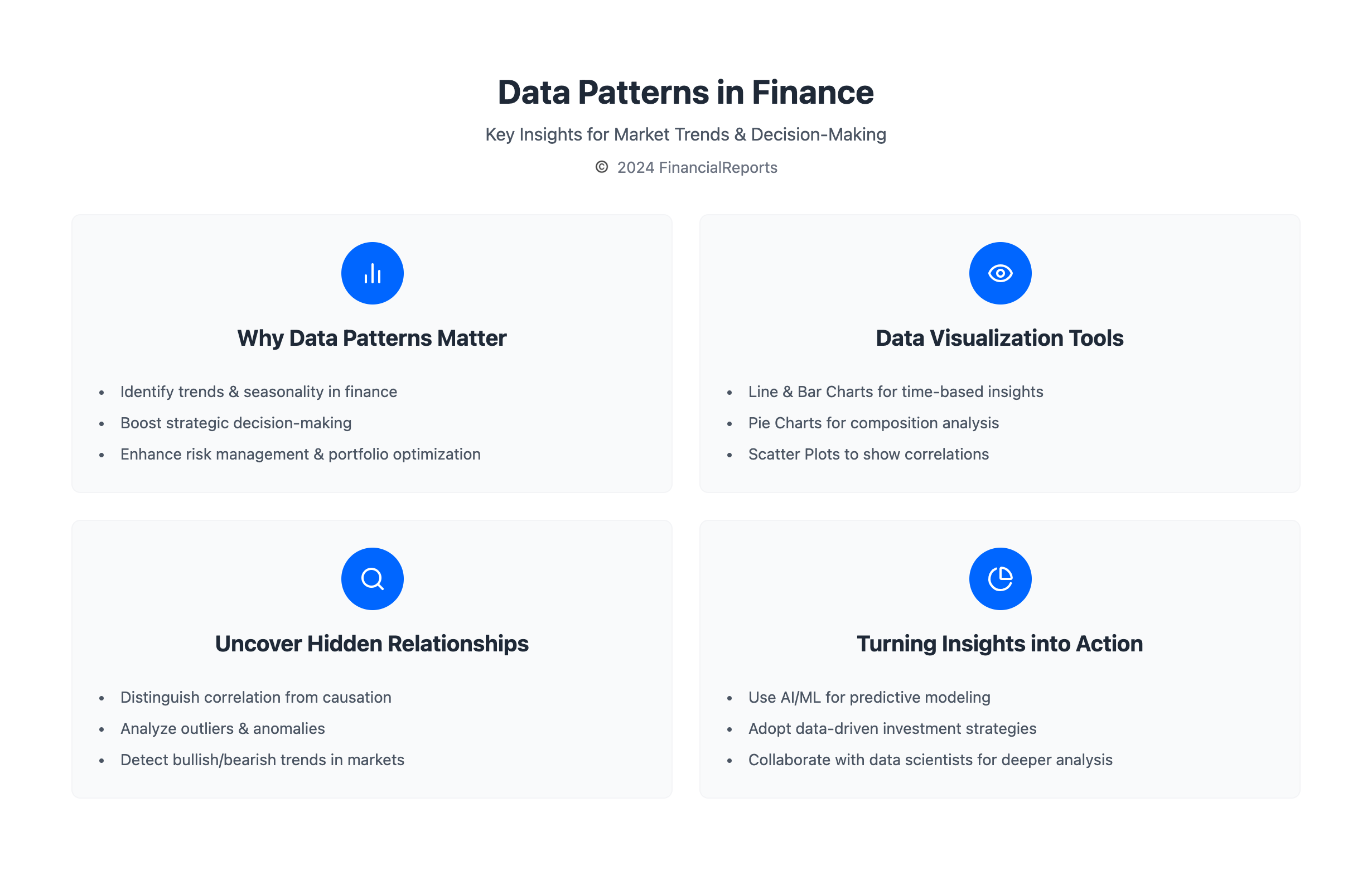
Data patterns are key in finance, helping experts spot trends and make smart choices. By looking at trade patterns and using data visualization, investors can understand market shifts. This part will explore what data patterns are, why they matter in finance, and how they guide decisions.
Spotting patterns in financial data is vital for predicting market trends. Trade patterns help analyze market moves, spot trends, and guide investment choices. Data visualization tools, like charts and graphs, make complex data easier to see and understand.
What Are Data Patterns?
Data patterns are the recognizable shapes of price changes in financial markets. They help predict future price changes and spot trends. There are many types, including trends, seasonality, and correlations.
Importance of Identifying Patterns
Finding patterns in financial data is key for smart investment decisions. By studying trade patterns and using data visualization, experts gain insights into market trends. This helps them spot opportunities and risks, leading to better choices.
Some common data patterns include:
- Trends: upward or downward price movements over time
- Seasonality: regular price changes at specific times of the year
- Correlations: links between different financial items or markets
Understanding these patterns lets professionals use data visualization to better see complex data. This approach improves decision-making and investment results.
Types of Charts for Analyzing Patterns
Choosing the right chart is key to spotting patterns in data. Each chart type is best for certain kinds of data. They help uncover trends and insights that might be hard to see.
For example, line charts are great for showing trends over time. They're perfect for tracking stock prices or website traffic. Bar charts, on the other hand, are good for comparing different groups side by side. This helps highlight differences between them.
Line Charts
Line charts are excellent for tracking changes over time. They let you see trends and shifts in data clearly. They're often used in finance to display stock prices or trading volumes.
Bar Charts
Bar charts are great for comparing groups or tracking changes over time for more than one group. They make it easy to see how different categories relate to each other.
Pie Charts
Pie charts are best for showing how different parts contribute to a whole. They're useful for analyzing market share or customer demographics. But, they're not as good for comparing multiple categories side by side.
Scatter Plots
Scatter plots are perfect for finding the relationship between two variables. They're a powerful tool in data analysis. By spotting patterns in a chart, analysts can get valuable insights. These insights can help make business decisions and shape strategies.
How to Identify Patterns in a Chart
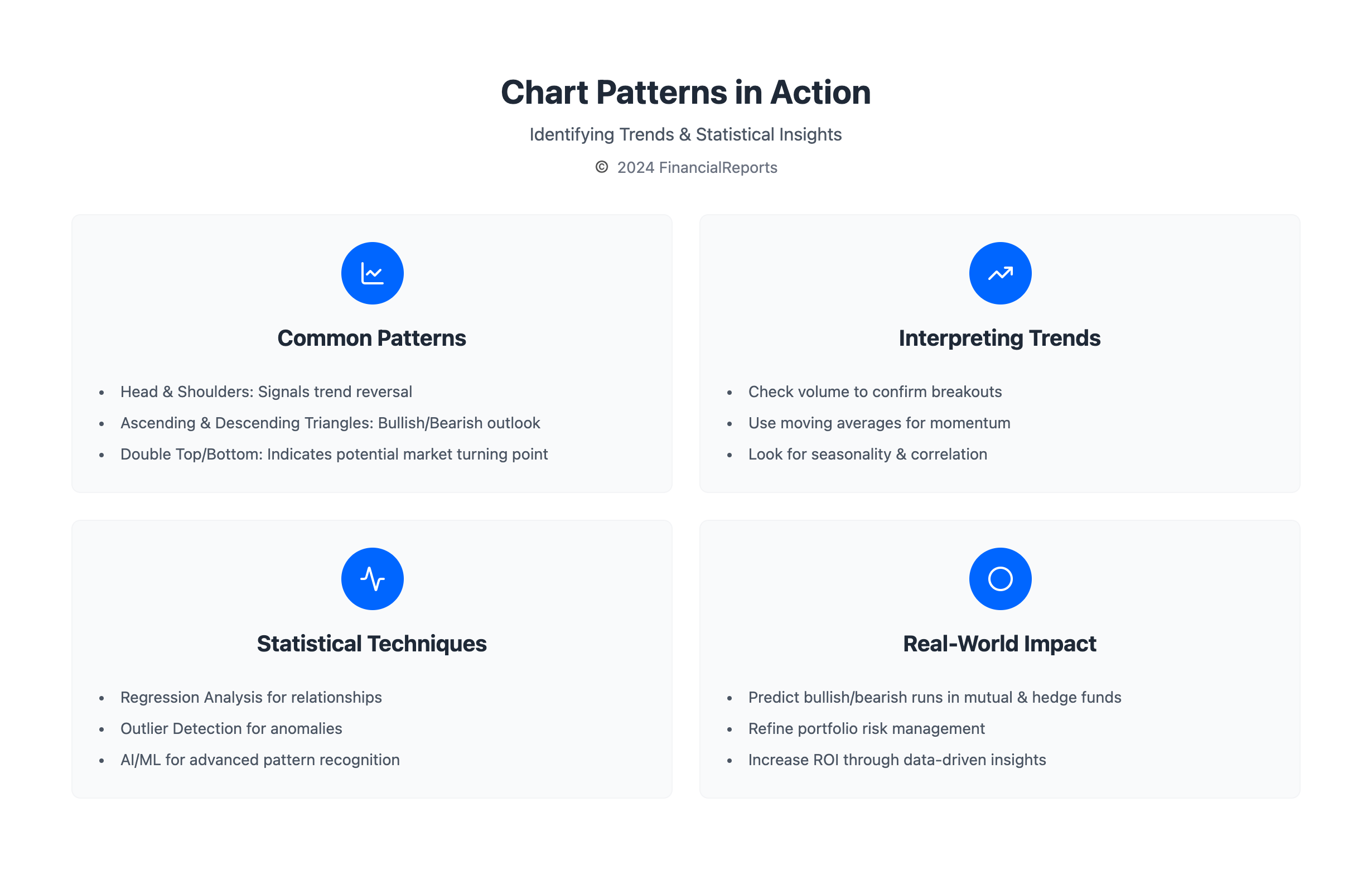
Spotting patterns in charts is key for smart financial decisions. By looking at trade patterns and using data visualization, traders can understand market trends better. They can then make more precise predictions. Techniques like spotting ascending or descending triangles help spot trends.
Statistical methods, like regression analysis, also help find patterns. These methods help traders spot trends and predict market moves. By mixing visual checks with stats, traders can boost their prediction accuracy and make better choices.
Some common chart patterns include:
- Ascending and descending triangles
- Flag and wedge patterns
- Double top and double bottom patterns
- Head and shoulders patterns
These patterns help identify trends and predict market moves. By using data visualization and analyzing trade patterns, traders can better understand markets. This leads to more informed decisions.
| Pattern | Description |
|---|---|
| Ascending Triangle | A bullish reversal pattern that indicates a possible uptrend |
| Descending Triangle | A bearish reversal pattern that suggests a possible downtrend |
Using these methods and patterns can boost traders' success in financial markets. Remember, no single method is perfect. Mixing different techniques can lead to more accurate predictions.
Tools for Charting Data Patterns
Identifying patterns in data is key. The right tools are essential for this. There are many tools for charting data patterns, each with its own strengths and weaknesses.
Popular Data Visualization Software
Flourish, Tableau, and Power BI are top choices for data visualization. They offer interactive and dynamic charts. For instance, Flourish lets users create scatter plots and bar charts to spot data patterns.
Excel for Pattern Analysis
Excel is also great for pattern analysis. It has many features, like charts and graphs, to find data patterns. By making a pattern in a chart in Excel, users can quickly see trends and patterns.
- Line charts
- Bar charts
- Scatter plots
- Box plots
Using these tools helps users understand their data better. Whether it's popular software or Excel, the goal is to pick the best tool. This way, users can spot data patterns and do thorough analysis.
| Tool | Features | Benefits |
|---|---|---|
| Flourish | Interactive and dynamic charts | Easy to use, customizable |
| Tableau | Data visualization, business intelligence | Powerful, flexible |
| Excel | Charts and graphs, data analysis | Widely available, easy to use |
Interpreting Patterns in Graphs
Understanding trends in financial data is key for smart decisions. Data visualization helps spot patterns and trends not seen in raw data. Tools like line charts, bar charts, and scatter plots offer insights into trade patterns.
It's important to know the difference between correlation and causation. This means looking at how variables relate and if one causes the other. For example, a scatter plot might show a strong link between two things, but more study is needed to see if one causes the other.
Recognizing Trends Over Time
To spot trends, analysts use several methods:
- Identifying higher highs and higher lows for uptrends
- Confirming trend reversal by looking for higher highs and higher lows in the opposite direction
- Using breakout patterns, such as triangles and flags, to identify entry and exit points
Distinguishing Between Correlation and Causation
To tell correlation from causation, analysts use:
- Regression analysis to determine the strength of the relationship between variables
- Controlling for other factors that may be influencing the relationship
- Using data visualization tools to identify patterns and trends
By using these methods and data visualization tools, analysts can better understand trade patterns. This knowledge helps make informed choices. As finance evolves, so will the need for good data analysis and interpretation.
| Technique | Description |
|---|---|
| Line Charts | Display a single line connecting closing prices of a stock over a certain time interval |
| Bar Charts | Depict price range for each period, with fluctuating bar sizes indicating market volatility levels |
| Scatter Plots | Reveal associations between two quantitative variables, analyzing direction, form, and strength of the relationships |
Case Studies in Pattern Recognition
Pattern recognition in finance is key for smart investment choices and business growth. By looking at patterns in charts, experts can spot trends and predict market changes. This helps them manage their portfolios better. Data analysis is essential here, helping to find complex patterns in big datasets.
A study on data analysis and pattern recognition shows data science's role in finance. It talks about using data patterns to make decisions and spark innovation. Pattern recognition in finance helps in many ways, like:
- Spotting trends and predicting market moves
- Improving portfolios and reducing risks
- Guiding investment choices and boosting business success
Financial experts can stay ahead by using pattern recognition and data analysis. Technical analysis is a big part of this, using chart patterns and indicators to forecast market trends. Patterns like ascending triangles and double tops help spot trends and predict changes.
For instance, a wedge pattern algorithm can find the main causes of quality problems by looking at process data. This helps experts spot risks and chances, leading to better investment choices. By mixing pattern recognition with data analysis, financial pros can uncover new insights and achieve business success.
Common Mistakes in Pattern Analysis
When we analyze trade patterns, it's key to avoid common mistakes. These mistakes can lead to wrong conclusions and poor choices. Overfitting data is a big error, as it can give us misleading insights. Also, ignoring outliers can mess up our analysis. These points can tell us a lot about market trends.
Good data visualization is vital in spotting trade patterns and avoiding mistakes. By using solid methods and looking at the bigger picture, financial experts can make better choices. Some important things to keep in mind include:
- Avoiding the misuse of technical indicators, which can lead to conflicting signals and decision-making difficulties
- Recognizing the importance of volume analysis in confirming the accuracy of chart patterns
- Integrating fundamental and sentiment analysis with chart pattern analysis to gain a more complete view of market conditions
By knowing these common mistakes and being disciplined in pattern analysis, traders can boost their success. They can make choices based on data, not emotions. This leads to better trade patterns and decisions in the financial markets. It also improves data visualization and trade pattern analysis.
Using Patterns to Drive Decision-Making
Finding a pattern in a chart is key in data analysis. It helps businesses make smart choices. By looking at data patterns, companies can understand market trends, how customers behave, and their financial health. This knowledge guides their planning and helps them predict the future.
Data analysis is vital for making decisions. It gives businesses the insights they need to choose wisely. With data visualization tools, companies can spot patterns and understand complex data. They can see trends, tell the difference between correlation and causation, and find areas to improve.
Some important things to think about when using patterns for decision-making include:
- Understanding the context of the data and the patterns that are emerging
- Identifying the most relevant data points and metrics to track
- Using data visualization tools to communicate insights and trends to stakeholders
By using pattern recognition and data analysis, businesses can innovate and grow. They can make better decisions about their operations and strategy. Whether it's finding new opportunities or improving current processes, data-driven insights can greatly benefit a company's success.
Presenting Data Patterns Effectively
It's key to share data patterns well to get complex insights across to others. Data visualization is a big help here. It makes trade patterns and other data easy to see and understand. With the right tools and methods, we can spot trends and connections in our data. This helps us make better decisions and plans.
To show data patterns well, we need to follow some important steps. We should pick the right chart for our data, use simple language, and keep things straightforward. Here are some tips for good data visualization:
- Use a clear and concise title and labels
- Choose a color scheme and visual elements that are easy to see
- Make sure the data is not too crowded and is easy to follow
By sticking to these tips and using data visualization, we can share trade patterns and data insights clearly. This leads to success in business and better decision-making.
| Best Practice | Description |
|---|---|
| Clear Title and Labels | Use a clear and concise title and labels to ensure easy understanding of the data |
| Suitable Color Scheme | Select a color scheme that is visually appealing and easy to interpret |
| Visual Hierarchy | Ensure a clear visual hierarchy to guide the viewer's attention |
Future Trends in Data Pattern Analysis
Technology is moving fast, and so is data pattern analysis. New trends like artificial intelligence and machine learning are changing how we look at data. Using pattern in a chart is key to spotting trends and predicting the future.
Artificial Intelligence and Machine Learning
AI and ML are making data analysis better. They help find patterns in big data quickly and accurately. Here are some ways AI and ML are used:
- Predictive modeling: They predict future trends and patterns.
- Anomaly detection: They find unusual data that might show errors or oddities.
- Clustering: They group similar data to spot patterns and trends.
Innovations in Data Visualization
New tools in data visualization are also important. They help analysts understand complex data better. Some new tools include:
| Technology | Description |
|---|---|
| Interactive dashboards | Let analysts interact with data live and try different scenarios. |
| Virtual reality | Allows analysts to dive into data and see complex patterns and trends. |
| Augmented reality | Shows data on real-world objects and places to give context and insights. |
These new tools make data analysis easier and more intuitive. They help analysts get deeper insights into data. By using these trends and tools, companies can make the most of their data and make better decisions.
Exploring the World of Trade Patterns
Trade patterns are essential in the global economy, connecting countries and fostering economic growth. These patterns are shaped by various factors, including geographical location, cultural exchange, and technological advancements. By understanding these patterns, we can gain valuable insights into the dynamics of international trade.
Geographical location plays a significant role in shaping trade patterns. Countries with strategic locations, such as ports or border crossings, often become major trade hubs. These locations provide easy access to markets and facilitate the transportation of goods, making them key players in the global economy.
Cultural exchange also influences trade patterns. Different cultures have unique preferences and tastes, leading to the exchange of goods and services. For example, countries with a strong tradition of craftsmanship may export handmade products, while countries with a focus on technology may export high-tech goods.
Technological advancements have revolutionized trade patterns. The rise of e-commerce and digital platforms has made it easier for businesses to connect with customers worldwide. This has opened up new opportunities for trade and has increased the speed and efficiency of transactions.
By exploring trade patterns, we can gain a deeper understanding of the global economy and the interconnectedness of countries. It allows us to identify opportunities for growth and development, as well as challenges that need to be addressed. By analyzing trade patterns, we can make informed decisions and shape the future of international trade.
FAQ
What are data patterns and why are they important in finance?
Data patterns are trends, seasonality, and correlations in financial data. They are key in finance. They help make informed decisions and drive innovation.
What are the different types of charts used for data pattern analysis?
Charts like line, bar, pie, and scatter plots are used. Each has strengths for spotting trends and patterns.
How can I identify patterns in financial data?
You can spot patterns by looking at data and using statistical methods. Techniques like trend and seasonality analysis are helpful.
What tools are available for charting data patterns?
Tools like Excel help create interactive charts for pattern analysis. They offer various features for exploring financial data.
How can I interpret patterns in financial data?
To understand patterns, look for trends and distinguish between correlation and causation. Data visualization helps in identifying and sharing insights.
What are some common mistakes to avoid in data pattern analysis?
Avoid overfitting data and ignoring outliers. Reliable methods ensure accurate pattern identification.
How can I use data patterns to drive decision-making in finance?
Data patterns guide strategic planning and predictive analytics. They help make informed decisions for business success.
What are some best practices for presenting data patterns effectively?
Use clear language and best visualization practices. Tell a compelling story with the data. This makes complex insights easy to understand.
What future trends are shaping data pattern analysis in finance?
Trends include more AI and machine learning, and new data visualization tools. These advancements improve pattern detection and insight sharing.