Trading Definition: Key Concepts Explained
Trading is a key part of the financial world. It's about buying or selling things like stocks and currencies to make money. The global trading market is worth $28.5 trillion, showing how big it is.
To understand trading, you need to know it's about buying and selling different financial things. This includes stocks, commodities, and currencies.
Trading helps countries work better together. It lets them get money from businesses in other countries. Online trading makes it easy for people to join in, helping them learn more about trading.
Introduction to Trading
We'll look at what trading is all about. This includes its definition, types, strategies, and risks. Knowing about trading helps you make smart choices in the financial world.
Trading is more than just buying and selling. It's about understanding the global economy and finding good opportunities.
Key Takeaways
- The trading definition refers to the act of buying or selling financial assets and markets, as well as derivatives, with the hope of making a profit.
- The total value of the global trading market is $28.5 trillion, according to the United Nations Conference on Trade and Development.
- International trade results in increased efficiency and allows countries to benefit from foreign direct investment (FDI) by businesses in other countries.
- There are over 17,000 financial assets and markets available for trading, including shares, forex, commodities, indices, and bonds.
- Retail traders engage in speculative trading, aiming to make profits over the short or medium term, and accounted for 23% of all US equity trading in 2021.
- Financial trading can involve leverage and derivatives to go long or short on various markets, providing advantages like better quality of life and economic growth.
- Understanding the trading definition is essential for making informed decisions in the financial markets and navigating the complexities of the global economy.
What is Trading?
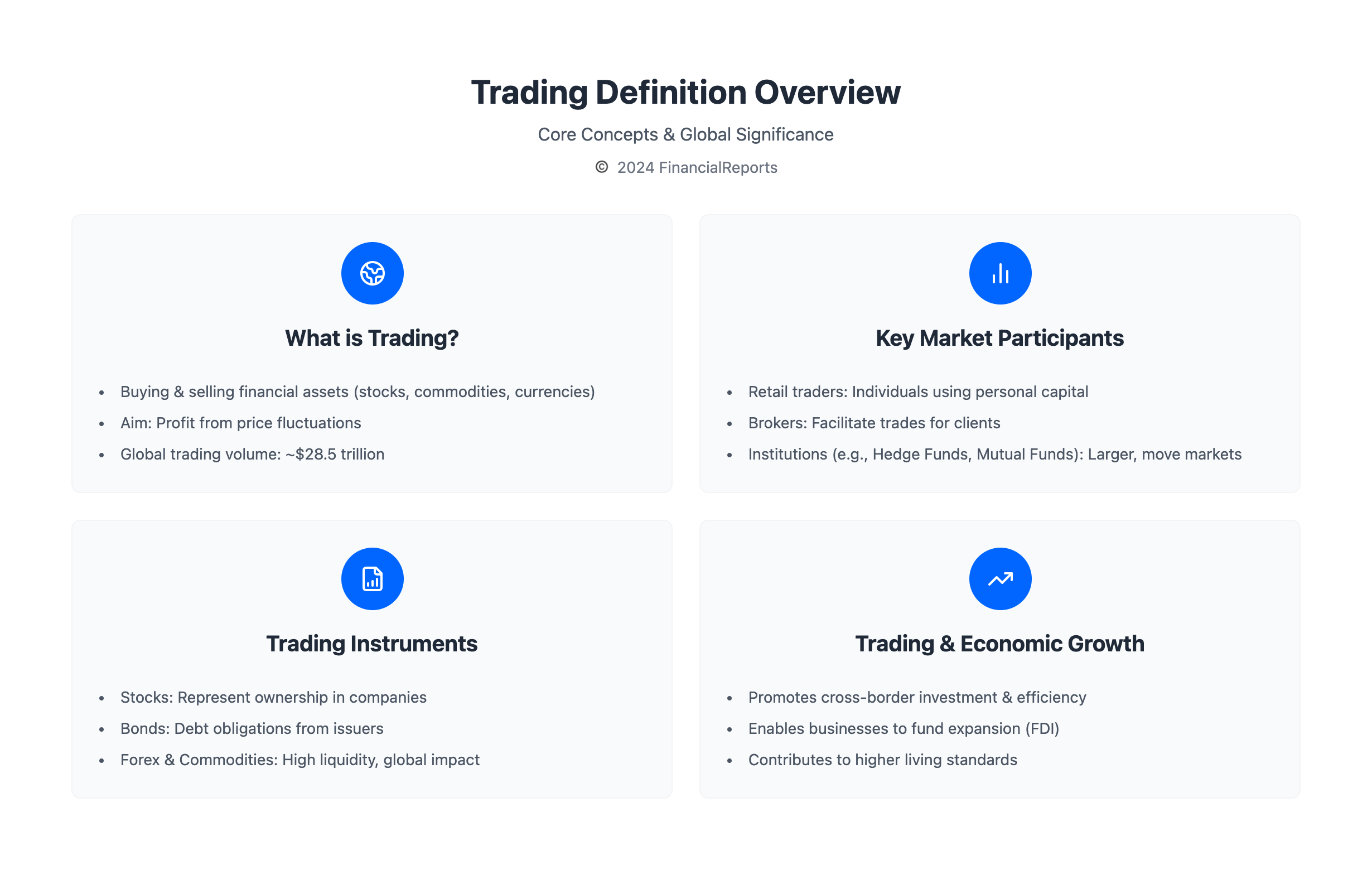 Trading is when people exchange goods or services to make a profit. In finance, it means buying and selling things like stocks and bonds. Knowing what is trading is key for those wanting to get into the markets.
The Amsterdam Stock Exchange started in 1602, marking the beginning of modern trading. Today, trading includes stocks, options, and commodities. For instance, the forex market is huge, with trillions of dollars traded every day.
There are various trading types, like:
- Day trading, which is short-term trading within one day
- Swing trading, which involves trading assets over days to months
- Position trading, which looks for trends to make money and keeps positions until trends change
Grasping the basics of what is trading and its types is vital. It helps in making smart investment choices and understanding the complex financial markets.
| Trading Type | Description |
|---|---|
| Day Trading | Short-term exchanges within the same trading day |
| Swing Trading | Trading specific assets over days to months |
| Position Trading | Identifying trends for profitable entry points and maintaining positions until trends shift |
Key Components of Trading
Understanding the basics of trading is key to doing well in the markets. Trading involves buying and selling financial assets and derivatives. It's about knowing who's involved and what they use to trade.
Market Participants
People like investors, brokers, and big financial groups are vital in trading. They help make the markets work smoothly. This lets traders easily buy and sell what they need.
- Investors: individuals or institutions that buy and sell assets
- Brokers: intermediaries that facilitate trade between buyers and sellers
- Financial institutions: banks, hedge funds, and other organizations that participate in the markets
Trading Instruments
Trading instruments, like stocks, bonds, and currencies, are what traders use to buy and sell. Each one has its own special traits and risks. Knowing these is important for smart trading choices.
Types of Trading Strategies
Knowing what trading is and how it works is key for investors. There are many trading strategies to help reach financial goals. First, it's important to understand the different trading types and how they operate.
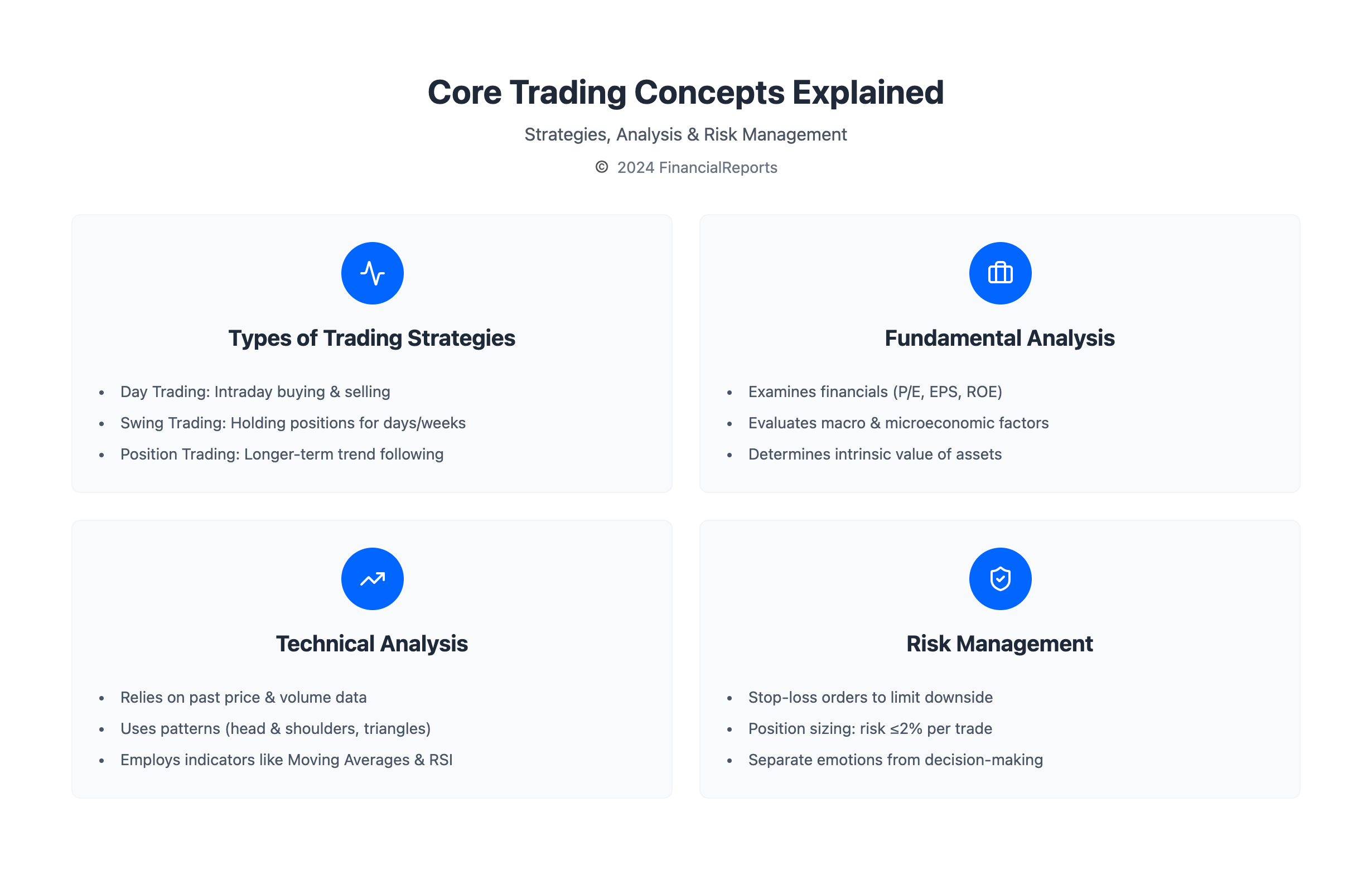
Trading includes day trading, swing trading, and position trading. Day trading aims to make money from quick price changes within a day. Swing trading looks to profit from price swings over days to weeks.
Day Trading
Day trading is a fast-paced strategy. It involves trading during market hours and closing all positions at night. This approach needs a strong grasp of market trends and quick decision-making skills.
Swing Trading
Swing trading focuses on short-term price swings. It requires analyzing charts for technical insights. This method suits those who prefer holding positions longer than day trading but not as long as position trading.
Position Trading
Position trading, or trend following, aims for long-term gains. It involves holding positions for weeks to months. This strategy demands a deep market understanding and trend identification skills.
By grasping the various trading strategies, investors can make better choices. Whether it's day, swing, or position trading, each has its own needs and benefits. Investors should weigh their options carefully before deciding.
The Role of Financial Markets in Trading
Financial markets are key for trading. They offer a place for buyers and sellers to trade financial items. The trading meaning becomes clear when we look at markets like stock, forex, and commodities. Each market has its own traits and risks. Knowing what is trading in these areas is vital for traders and investors.
The stock market lets investors trade shares of companies. The forex market is for currency exchange. The commodities market deals with goods like gold, oil, and food. Here are some interesting facts about these markets:
- The forex market handles more than $7.5 trillion in daily transactions.
- The NYSE trades trillions of dollars in securities daily.
- The commodities market exchanges physical commodities such as agricultural products, energy products, precious metals, and soft commodities.
It's important to understand financial markets for trading meaning and what is trading. By knowing the specifics and risks of each market, traders and investors can make smart choices. This helps them reach their financial goals.
| Market | Daily Transactions | Characteristics |
|---|---|---|
| Forex Market | $7.5 trillion | Currency exchange |
| Stock Market | Trillions of dollars | Securities trading |
| Commodities Market | Varies | Physical commodities exchange |
Fundamental Analysis in Trading
Fundamental analysis is key in trading. It looks at a company's finances, management, and industry to find its value. This helps traders understand the trading definition and trading meaning in financial markets.
Traders use indicators like revenue growth, profit margins, and return on equity. These help them see how well a company is doing. This information helps them decide when to buy or sell financial instruments.
Some important indicators include:
- Price-to-earnings (P/E) ratio
- Earnings per share (EPS)
- Return on equity (ROE)
- Debt-to-equity (D/E) ratio
These indicators show a company's financial health. They help traders find good investment opportunities. Economic events like interest rate changes also affect trading, so they're important to consider.
Key Indicators and Economic Events
Fundamental analysis looks at lots of data, like financial statements and economic indicators. This helps traders understand the trading definition and trading meaning better. They can make smarter investment choices.
Traders use financial statements, industry reports, and economic indicators. These sources give insights into a company's health and the economy. This information helps traders make better investment decisions.
| Indicator | Description |
|---|---|
| Price-to-earnings (P/E) ratio | Measures a company's stock price relative to its earnings per share |
| Earnings per share (EPS) | Measures a company's profit per share of stock |
| Return on equity (ROE) | Measures a company's net income relative to its shareholder equity |
By looking at these indicators and the economy, traders get a better grasp of the trading definition and trading meaning. This helps them make more informed investment choices.
Technical Analysis in Trading
Technical analysis is a key strategy in trading. It uses past market data to guess future prices. It believes that market prices show all the information that affects the market. By looking at charts and indicators, traders spot patterns and trends to guide their buying and selling.
It's important to understand trading and its meaning. This involves looking at past prices and volumes to find patterns and trends. Technical analysis works with any security that has trading history, like stocks, futures, and currencies.
To become a Chartered Market Technician (CMT), one must pass three exams. These cover various technical analysis tools. Analysts think that prices follow trends and history repeats itself. Tools like moving averages help spot these trends.
Some key parts of technical analysis include:
- Chart patterns, like head and shoulders, triangles, and wedges, help predict future prices.
- Trend analysis finds the direction and strength of market trends.
- Statistical indicators, such as moving averages and MACD, spot trends in price data.
| Technical Analysis Tool | Description |
|---|---|
| Moving Averages | Help in spotting trends in market sentiment |
| MACD | Used to identify trends in price data |
| Chart Patterns | Used to predict future price movements |
Risk Management in Trading
Risk management is key in trading. It involves using strategies to cut down losses and boost gains. Knowing the trading definition and what trading is about is vital. This knowledge helps in creating effective risk management plans. Risk management techniques include stop-loss orders and position sizing to manage risks.
Some important risk management strategies are:
- Setting stop-loss and take-profit points
- Diversification across industry sectors, market capitalization, and geographic regions
- Using moving averages to set stop-loss and take-profit levels
- Implementing the one-percent rule to limit exposure to possible losses
Good risk management is essential for long-term trading success. It balances the chance for gains with the risk of losses. By understanding the trading definition and what trading is, traders can mix profitable trades with smart risk management. This combination leads to success in the markets.
| Risk Management Strategy | Description |
|---|---|
| Stop-Loss Orders | Automatically sell a financial instrument when it reaches a certain price to limit possible losses |
| Position Sizing | Adjust the size of a trade to manage risk and maximize possible gains |
Trading Psychology
Understanding the trading meaning and what is trading is key for traders. It helps them create winning strategies. Trading psychology is about managing emotions to make smart choices. Fear and greed are big emotions that can either help or hurt a trade.
Traders deal with many biases that affect their choices. Fear might make them leave trades too soon or skip risky moves. Greed can lead to bad decisions, like buying into unknown companies or holding onto trades too long. To beat these biases, traders should learn, do their homework, and listen to different views.
Here are some ways to boost trading psychology:
- Make a trading plan with clear goals, risk levels, and strategies
- Do deep research before investing in stocks or companies
- Know yourself and set trading rules
- Use risk management tools
By controlling emotions like fear and greed, traders can craft winning strategies. This helps them do better in the market. They truly understandtrading meaningand masterwhat is trading.
The Future of Trading
The trading world is changing fast, thanks to new tech and global trends. Artificial intelligence, machine learning, and blockchain are making trading better. They help cut costs and give traders deeper insights into the market.
Emerging markets like Asia and Africa are becoming key players. Online trading platforms are making it easier for people to access global markets. This opens up new chances for traders everywhere.
The definition of trading is growing to include more types of assets. This includes cryptocurrencies and carbon credits. What is trading is changing, with traders using advanced tools to make smart choices.
Traders will focus more on managing risks and caring for the environment. This shift will help them deal with market ups and downs. It will also make sure their strategies are good for the planet and society.
Traders who keep up with new tech and trends will do well in the future. By adapting and embracing change, they can find new chances and succeed in the ever-changing markets.
FAQ
What is the definition of trading?
Trading means buying and selling financial items like stocks, commodities, and currencies. The goal is to make a profit.
What are the different types of trading?
There are three main types of trading. Day trading, swing trading, and position trading each have their own ways of making money.
Who are the key participants in trading?
Investors, brokers, and financial institutions are key players in trading. They help trade happen and add liquidity to markets.
What are the main trading strategies?
Main strategies include day trading, swing trading, and position trading. Each strategy focuses on different time frames to profit from market movements.
What is the role of financial markets in trading?
Financial markets like the stock and forex markets are vital. They provide a place for buying and selling financial instruments.
How does fundamental analysis influence trading decisions?
Fundamental analysis looks at a company's financial health and industry position. This helps traders decide when to buy or sell.
What is the role of technical analysis in trading?
Technical analysis uses past price and volume data to predict future trends. Traders use this to make informed decisions.
How can traders manage risk in trading?
Traders can manage risk by using stop-loss orders and adjusting their position sizes. This helps limit losses and increase gains.
What is the importance of trading psychology?
Trading psychology is about controlling emotions like fear and greed. It's key for making rational decisions and achieving trading goals.
What are the future trends in trading?
The future of trading will be shaped by tech like AI and blockchain. Global market trends, like the rise of emerging markets, will also play a role.