Profitable Short-Term Trading Techniques for Investors
Short-term trading can be very profitable for investors. It involves holding positions for a short time, from minutes to days. With the right strategy, it can be very rewarding. But, it needs a deep understanding of the markets and quick decision-making.
Techniques like day trading and swing trading help investors in the markets. They can spot and use opportunities quickly. It's key to know the risks and rewards of each trade.
Understanding the common moving average time frames is important. These include 15, 20, 30, 50, 100, and 200 days. By using short-term strategies, investors can see big returns. This makes it a great choice for those looking to make money fast.
Introduction to Short-Term Trading
Short-term trading uses technical and fundamental analysis to find good trades. Investors can use products like spread bets and CFDs to make money from market moves. Knowing the basics and strategies is essential for a successful trading plan.
Key Takeaways
- Short-term trading offers quick profits
- Understanding market trends and analysis is key
- Derivative products like spread bets and CFDs are used
- Technical and fundamental analysis are vital for finding trades
- A good trading plan needs market knowledge and quick decisions
- Strategies like day trading and swing trading help in the markets
Understanding Short-Term Trading
Short-term trading, also known as active trading, is about making quick trades. These trades last from a few seconds to a few days. Traders aim to make money from fast price changes due to news or events.
This type of trading is all about quick gains. It uses tools like CFDs and options. Traders use different strategies to find the best times to buy and sell.
Some common types of short-term trading include:
- Scalping: seeking small profits on short-term trades lasting seconds to minutes
- Day trading: buying and selling assets within a single trading day to exploit small market movements
- Swing trading: capitalizing on medium-term price movements over several days or weeks
Understanding the market is key in short-term trading. It's about knowing how news and volume affect prices. A good risk plan is also essential to avoid big losses.
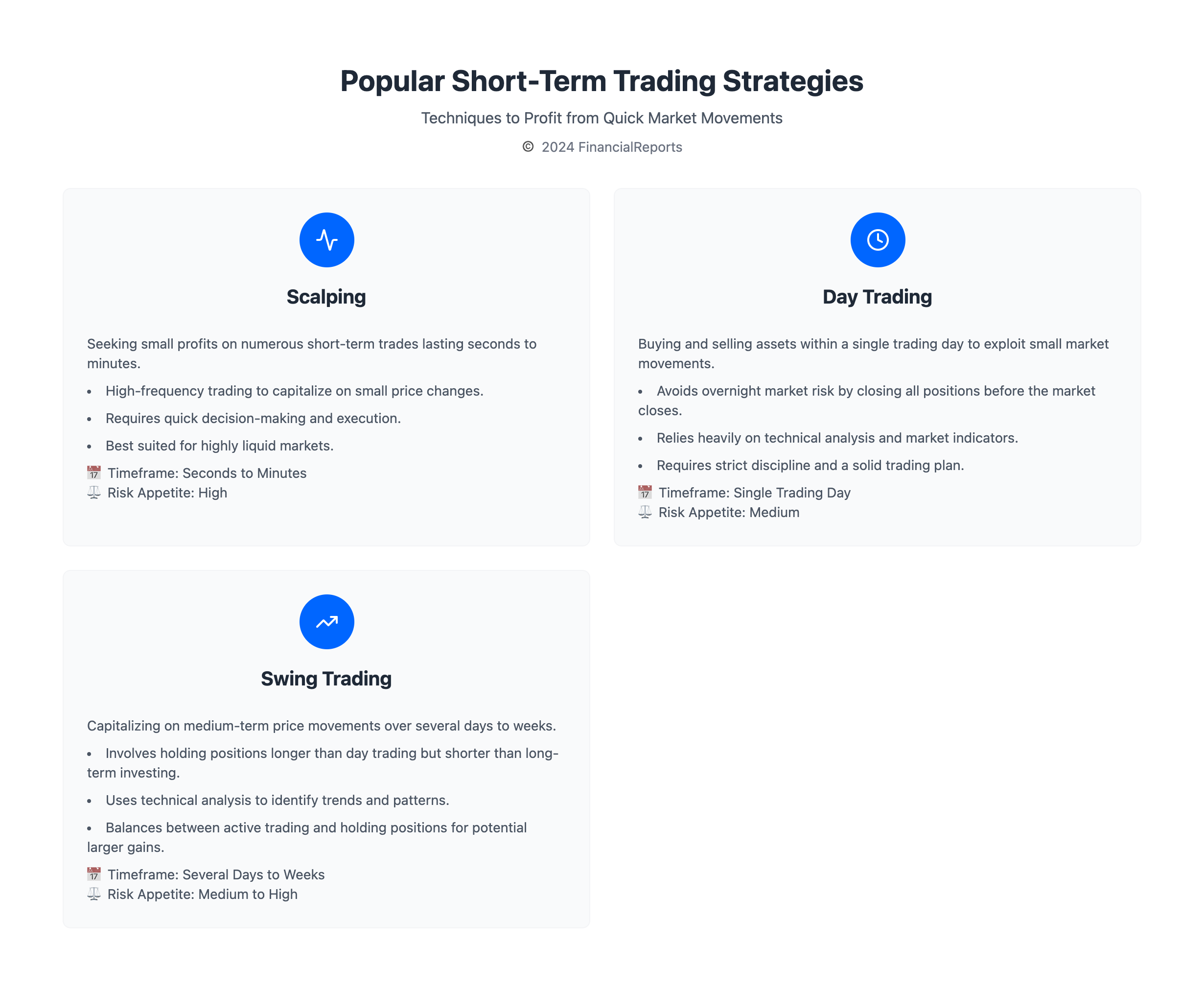
| Trading Style | Timeframe | Risk Appetite |
|---|---|---|
| Scalping | Seconds to minutes | High |
| Day Trading | Single trading day | Medium |
| Swing Trading | Several days to weeks | Medium to High |
Popular Short-Term Trading Strategies
Short term stock trading uses many techniques to make money fast. Traders pick strategies to help them succeed in the market. These strategies are key to a trader's success.
Popular strategies include day trading, swing trading, and scalping. Each has its own way of working. For example, day traders act fast, while swing traders hold onto trades for longer.
Day Trading
Day trading means buying and selling in one day. It needs a good grasp of market trends and quick thinking. Traders use tools like technical indicators to spot good trades.
Swing Trading
Swing trading holds trades for a few days to weeks. It aims for quick gains and needs market trend knowledge. Swing traders use technical setups to guide their decisions.
Scalping
Scalping involves many small trades in a day. It aims to profit from small price changes. Scalpers use technical tools to find and act on trading chances quickly.
In short term stock trading, the right strategy is key. Knowing the different strategies helps traders make smart choices. Whether it's day trading, swing trading, or scalping, each needs special skills and knowledge.
Tools and Platforms for Short-Term Trading
Short term trading needs special tools and platforms to trade well. These platforms offer real-time data, charting tools, and order execution. It's key to pick a platform based on quality, fees, and support.
Popular platforms for short term trading include Interactive Brokers, Charles Schwab, and TradeStation. They provide features like streaming Time & Sales info. This helps traders make better choices. As of Oct. 16, 2024, most brokers executed orders at or better than the National Best Bid and Offer, with a 96.95% average quality.
When picking a platform, think about these things:
- Execution quality: Look for platforms with high execution quality to ensure that your trades are executed efficiently.
- Fees: Consider the fees associated with each platform, including commissions, margin rates, and other charges.
- Customer support: Choose a platform with reliable customer support to help you with any issues that may arise.
Short term traders also use trading software and charting tools. These help analyze market data and make smart decisions. With the right tools and a good platform, traders can do their jobs well.
| Trading Platform | Execution Quality | Fees |
|---|---|---|
| Interactive Brokers | 96.95% | $0.65 per contract |
| Charles Schwab | 96.95% | $0.65 per contract |
| TradeStation | 96.95% | $0.60 per contract |
Essential Market Analysis Techniques
Market analysis is key for short term trading. It helps traders know when to buy or sell. There are two main types: technical and fundamental analysis.
Technical analysis looks at past prices to guess future ones. Fundamental analysis checks economic and financial data to find a company's true value.
Technical analysis is great for short term trading. It spots trends and patterns in prices. Common tools include moving averages and trendlines.
Fundamental analysis is better for long-term investing. But, it's also useful for short term traders. It helps understand what drives price changes.
Important metrics in fundamental analysis are earnings per share (EPS) and the price-to-earnings (P/E) ratio. By mixing technical and fundamental analysis, traders get a full view of the market. This helps them make better trading choices.
| Analysis Type | Description |
|---|---|
| Technical Analysis | Examines historical price data and patterns to predict future price movements |
| Fundamental Analysis | Evaluates economic and financial factors to determine a company's intrinsic value |
Using both technical and fundamental analysis is a strong strategy for short term trading. It's good for both new and experienced traders. Adding market analysis to your trading plan can lead to better decisions and success.
Risk Management in Short-Term Trading
Risk management is key in short-term trading. It helps avoid big losses and keeps investments safe. In this field, it means setting stop-loss orders, managing how much to invest, and spreading out investments. The 1% rule says no more than 1% of your account should go to one trade.
Some important risk management methods include:
- Setting stop-loss orders to limit losses
- Managing how much to invest in each trade
- Spreading investments across different areas to lower risk
Using these methods can protect your investments and help you reach your financial goals. Good risk management is vital for success in short-term trading. It needs technical skills, market knowledge, and discipline.
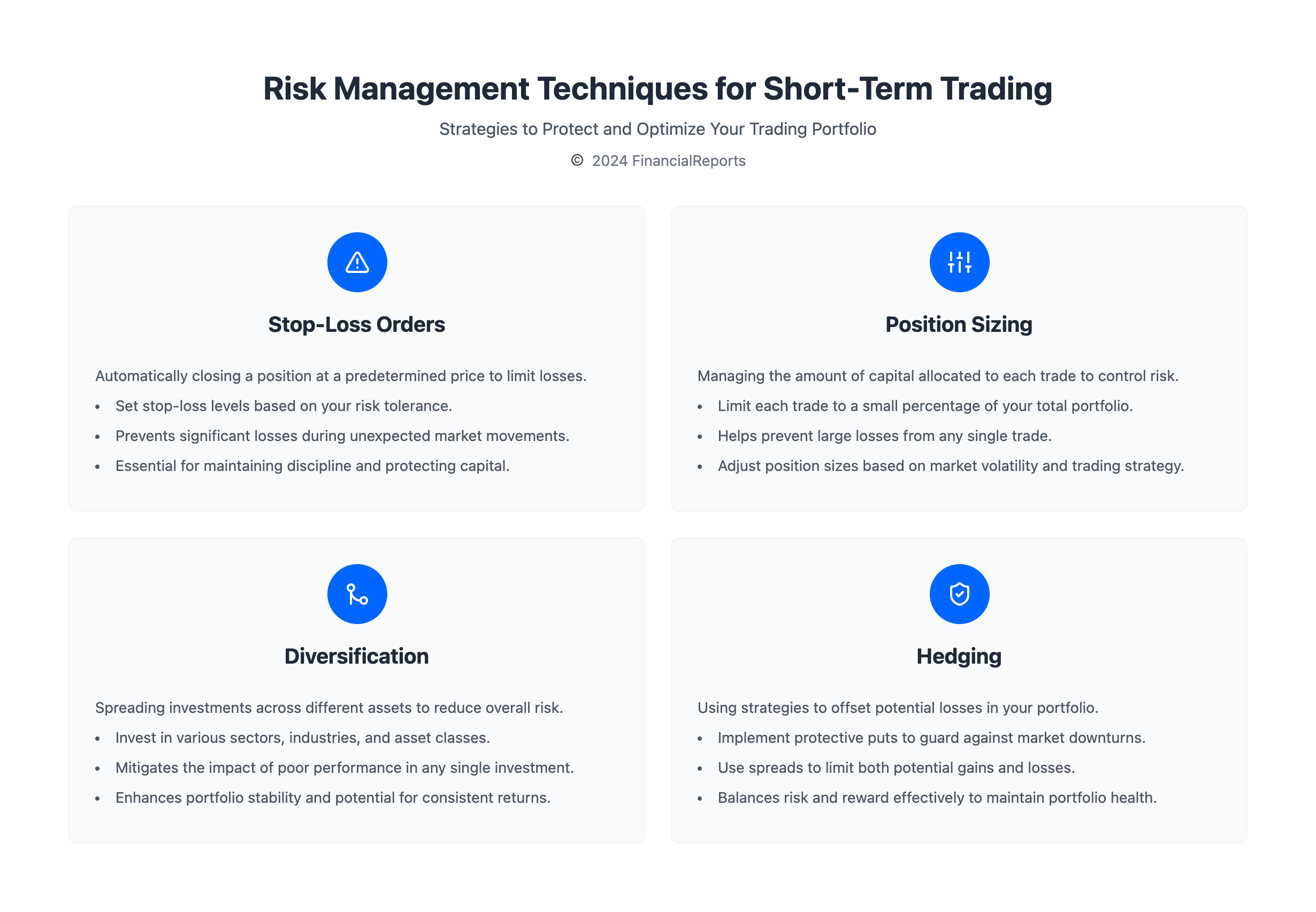
| Risk Management Technique | Description |
|---|---|
| Stop-Loss Orders | Setting a price level at which to sell a stock to limit losses |
| Position Sizing | Managing the amount of capital at risk to minimize losses |
| Diversification | Spreading investments across different areas to reduce risk |
Psychological Aspects of Trading
Short term trading needs a deep grasp of the psychological factors that shape trading choices. Fear and greed are key emotions that guide traders, often leading to quick decisions. Fear can make traders close positions too soon, while greed pushes them to take big risks and hold onto gains too long.
Emotional control is key in short term trading. It helps traders manage their feelings and make smart choices. This means recognizing and handling emotions like fear, greed, and impatience. A solid trading plan, with clear goals, risk management, and rules for making decisions, helps traders stay disciplined.
Key Psychological Factors
- Loss aversion: prioritizing avoiding losses over making gains
- Overconfidence: leading to excessive trading and poor performance
- Anchoring: making decisions based on arbitrary reference points
- Mental accounting: a behavioral bias that influences decision-making
Understanding these psychological factors and finding ways to manage them can improve trading decisions. Good risk management, thorough research, and a trading style that fits you can help navigate market ups and downs. This way, traders can reach their goals in short term trading.
Building a Winning Trading Plan
A well-defined trading plan is key to success in short term trading. It sets clear goals and strategies for buying and selling. It also helps manage risk. A good plan fits your trading style, risk level, and how you analyze the market.
Some important parts of a trading plan are:
- Setting goals, like profit targets and managing risk
- Creating strategies for when to buy and sell
- Controlling risk with things like position size and stop-loss orders
It's also important to review your plan often. This means tracking your trades and adjusting your strategy as needed. A solid trading plan helps you avoid making rash decisions. It boosts your chances of doing well in short term trading.
| Trading Plan Component | Description |
|---|---|
| Goals and Objectives | Define profit targets and risk management |
| Entry and Exit Strategies | Develop rules for buying and selling |
| Risk Management | Include position sizing and stop-loss orders |
Timing the Market Effectively
Timing the market well is key for short term trading success. It means spotting trends and using economic signs to guide investments. Knowing the market trends helps traders adjust their plans, boosting their chances of winning in short term trading.
Charles Schwab Company's research shows that long-term investing is vital. From 1926 to 2011, never investing for 20 years resulted in losses. This shows the value of long-term investing and timing the market in short term trading.
Here are some stats on the challenges of market timing:
- Peter Perfect made $138,044 in 20 years with perfect timing.
- Ashley Action, who invested every year, made $127,506 in 20 years.
- Matthew Monthly, using dollar-cost averaging, made $124,248 in 20 years.
These numbers show that even with imperfect timing, consistent investing beats not investing at all. By using short term trading and timing strategies, investors can boost their returns and reach their financial goals.
Using economic signs like GDP and inflation helps investors decide when to buy or sell. Combining these signs with technical analysis and trends gives a full view of the market. This helps investors make better short term trading choices.
| Investor | Strategy | 20-Year Accumulation |
|---|---|---|
| Peter Perfect | Perfect Market Timing | $138,044 |
| Ashley Action | Immediate Investment | $127,506 |
| Matthew Monthly | Dollar-Cost Averaging | $124,248 |
By grasping the importance of market timing and using effective short term trading strategies, investors can up their game in the market.
Importance of Continuous Learning
Continuous learning is key for success in short term trading. It helps traders keep up with market news and adjust to changes. By seeing losses as chances to get better, traders can improve their skills through regular analysis of past trades.
This approach helps them find areas to get better and create better trading plans. Traders can find many educational resources like webinars, podcasts, and online courses. Staying informed about market developments is vital for making smart trading choices.
By focusing on learning, traders can stay ahead in the fast-changing market. This leads to better trading results.
Some important parts of continuous learning in short term trading are:
- Regularly analyzing past trades to identify areas for improvement
- Staying updated on market news and developments
- Accessing educational resources, such as webinars and online courses
- Embracing a growth mindset to view losses as opportunities for improvement
By adding these to their trading routine, traders can build a culture of ongoing learning. This boosts their chances of success in short term trading.
Common Mistakes in Short-Term Trading
Short term trading can be very profitable, but it has its own challenges. Traders often face big losses due to common mistakes. These mistakes include not understanding the market, making decisions based on emotions, and poor risk management.
Common errors in short term trading include overtrading, ignoring market conditions, and not adjusting strategies. Overtrading can quickly use up a trader's capital. Ignoring market conditions can lead to bad investment choices and big losses. Not adjusting strategies can stop traders from keeping up with market changes.
Key Mistakes to Avoid
- Overtrading: taking on too much risk and depleting capital
- Ignoring market conditions: making poor investment decisions due to a lack of understanding of the market
- Failing to adapt strategies: not responding to changing market conditions
To avoid these mistakes, traders need a solid trading plan. This plan should have clear entry and exit points and a risk management strategy. It should include stop-loss orders, position sizing, and diversification to reduce risk. By avoiding these mistakes and using good risk management, traders can boost their chances of success in short term trading.
| Mistake | Consequence | Solution |
|---|---|---|
| Overtrading | Capital depletion | Implement position sizing and risk management strategies |
| Ignoring market conditions | Poor investment decisions | Stay informed about market conditions and adapt strategies |
| Failing to adapt strategies | Poor response to changing market conditions | Continuously monitor and adjust trading strategies as needed |
Developing a Personal Trading Style
Creating a personal trading style is key to success in short term trading. It means knowing how much risk you can handle and choosing strategies that match your personality. Many traders spend a lot of money searching for the perfect strategy. But, making your own can save time and money and be fun.
Figuring out what kind of trader you are and what you trade is important. Testing your strategy with different indicators and time frames shows how well it works. Backtesting is also vital to see how a strategy performed in the past and how it might do in the future.
Some key things to think about when creating your trading style include:
- Knowing your risk tolerance and goals
- Choosing a trading time frame, like day trading or swing trading
- Using both technical and fundamental analysis to spot trends
- Using tools like limits and stop-loss orders to manage risk
By creating a trading style that fits your goals and risk level, you can boost your chances of success. Always keep learning and adjusting your strategy to stay on top in the market.
| Trading Style | Risk Tolerance | Time Frame |
|---|---|---|
| Day Trading | High | Short-term |
| Swing Trading | Medium | Medium-term |
| Position Trading | Low | Long-term |
Evaluating Trading Performance
For short-term traders, checking how well their strategies work is key. Strategy performance reports help by showing important numbers. These include total net profit, profit factor, and more.
By looking at these numbers, traders can see what needs work. They can then tweak their strategies to meet their goals.
Metrics like profit factor and win ratio show how good a strategy is. A profit factor over 1 means it's profitable. A high win ratio means more wins than losses.
A good risk-reward ratio is when winners are bigger than losers. The Sharpe Ratio, which looks at returns and risk, should be over 0.75 for good performance.
Tracking wins and losses, and the biggest profits and losses, helps too. It shows how consistent and safe a strategy is. Metrics like expected value and maximum drawdown help set goals and manage money well.
By checking these metrics often and making changes, traders can improve their systems. This helps reduce risks and increase profits.
FAQ
What are the benefits of short-term trading?
Short-term trading can be profitable if done right. It needs a deep market understanding and quick decision-making skills.
How does short-term trading differ from long-term trading?
Short-term trading focuses on quick market changes. It's about making money fast. Long-term trading looks at the asset's value over time.
What are the popular short-term trading strategies?
Popular strategies include day trading, swing trading, and scalping. Each has its own benefits and challenges.
What tools and platforms are essential for short-term trading?
Key tools include trading software and charting tools. A reliable broker is also vital for making trades.
What market analysis techniques are important for short-term trading?
Important techniques are technical and fundamental analysis. Technical analysis looks at market patterns. Fundamental analysis examines price influencers.
How can traders effectively manage risk in short-term trading?
Risk management involves setting stop-loss orders and proper position sizing. Diversification is also key to protect capital.
What are the psychological aspects of successful short-term trading?
Success in short-term trading requires emotional control and strategies for dealing with market volatility. Traders must make clear decisions under pressure.
How can traders build a winning trading plan?
A winning plan sets clear goals and strategies. It should adapt to market changes and personal trading styles.
How can traders time the market effectively in short-term trading?
Effective timing involves identifying trends and using economic indicators. This helps traders capitalize on market movements.
Why is continuous learning important in short-term trading?
Continuous learning keeps traders updated on market news. It helps improve trading performance by reflecting on past trades.
What are the common mistakes to avoid in short-term trading?
Avoid overtrading, ignoring market conditions, and not adapting strategies. These mistakes can lead to big losses.
How can traders develop a personal trading style?
Developing a style involves assessing risk appetite and tailoring strategies. It ensures the approach fits the trader's goals and risk tolerance.
How can traders effectively evaluate their trading performance?
Evaluating performance involves tracking trades and making strategy adjustments. This helps improve results and achieve financial goals.