Options Training: Elevate Your Investment Expertise
Investors looking to boost their skills can find great value in options training. It offers a deep dive into options trading, covering everything from pricing to strategies. This education is key for both new and seasoned investors, helping them understand the markets better.
Options training is vital for those aiming to refine their investment tactics and manage risks. It teaches the intricacies of options trading, from the basics to complex strategies. Whether you're new or experienced, this training can help you reach your financial targets.
Introduction to Options Trading
Options trading encompasses various techniques and strategies. By mastering these, investors can make better decisions and see improved results. Options training equips investors with the knowledge and skills to thrive in the markets and meet their financial goals.
Key Takeaways
- Options training provides a thorough education on options trading, including pricing and risk management.
- Learning options helps investors make informed decisions and manage risks effectively.
- Options trading courses cover a wide range of techniques and strategies, from simple to complex.
- Options training is essential for investors aiming to enhance their strategies and achieve financial success.
- With options training, investors can acquire the knowledge and skills needed to excel in the markets.
- Options trading involves a variety of techniques and strategies, including pricing, risk management, and market analysis.
Understanding Options Trading
Options trading is a field full of chances for investors to grow their wealth. It involves buying and selling contracts that let the holder buy or sell an asset at a set price. To do well in options trading, knowing the basics is key.
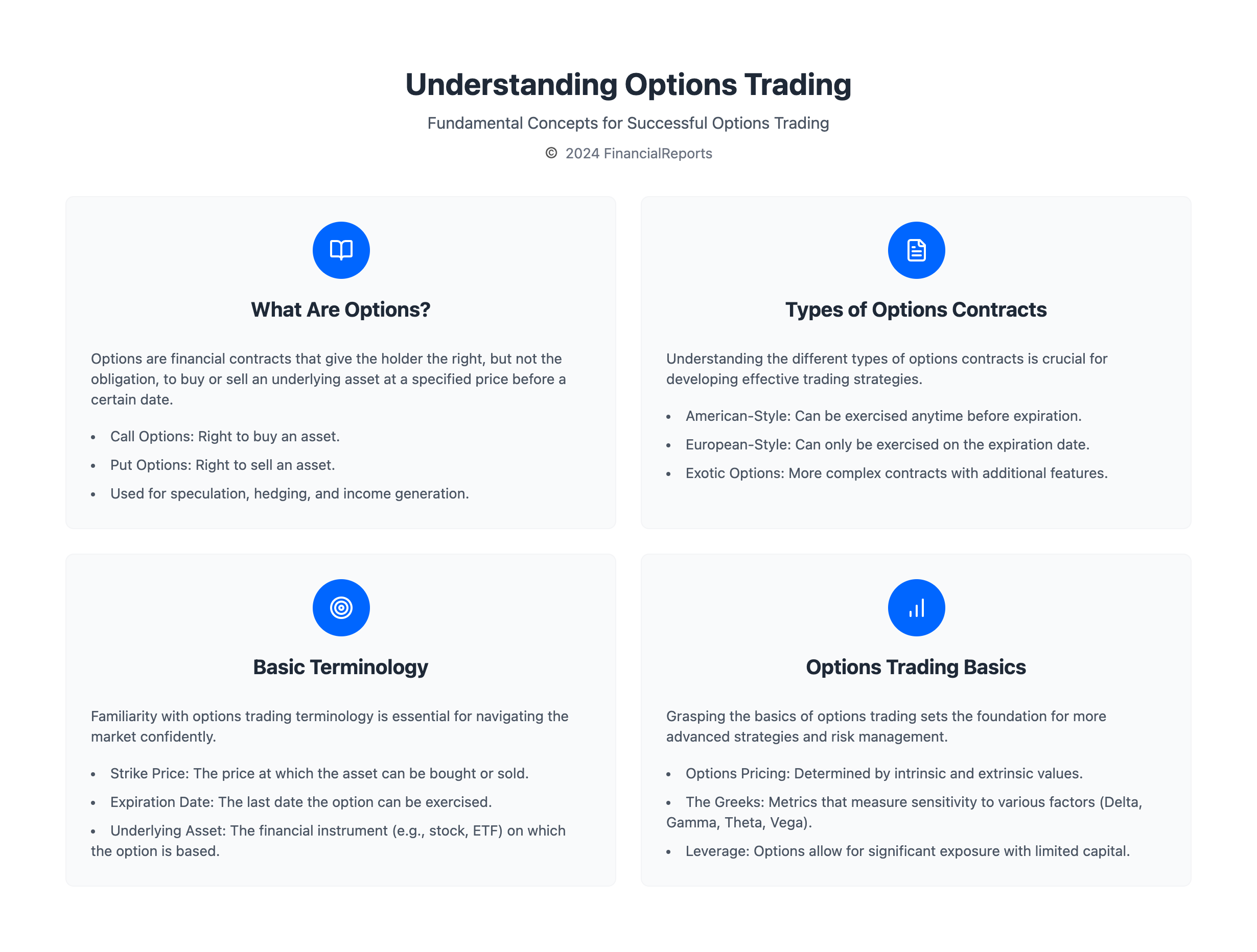 Start by learning the basics of options trading. This means understanding call and put options and how they work. Call options let you buy an asset, while put options let you sell. Knowing this helps investors make smart trading plans.
What Are Options?
Options are contracts that let you buy or sell an asset at a set price. They help you speculate, hedge against losses, or make money. Options trading is appealing because it offers big gains, limited losses, and risk protection.
Types of Options Contracts
There are different types of options contracts, like American-style and European-style. American-style contracts can be exercised anytime before they expire. European-style contracts can only be exercised on their expiration date. Knowing these differences is important for good trading strategies.
Basic Terminology
Options trading has its own set of terms, like strike price, expiration date, and underlying asset. The strike price is the price at which you can buy or sell the asset. The expiration date is when the option can no longer be used. Learning these terms helps investors feel confident and make better trading choices.
The Importance of Options Training
Options training is key for investors looking to manage risk and boost their investment plans. It teaches them how to navigate the complex world of options trading. Learning options and options training are vital for success in this area.
Risk Management in Options Trading
Risk management is a big deal in options trading. It helps investors protect their portfolios and limit losses. They learn to hedge against stock market declines and manage risks.
Some important strategies include:
- Buying put options to hedge against losses
- Selling call options to earn income and cut risk
- Using spreads and other advanced strategies to manage risk
Enhancing Investment Strategies
Options training also boosts investment strategies and performance. It teaches investors to use options for income, protection, and leverage. This way, they can reach their financial goals and boost returns. Options training and learning options are essential for success.
Key Concepts in Options Trading
Options trading has many complex ideas that investors need to grasp. To get started, it's key to learn about intrinsic vs. extrinsic value and the Greeks. These concepts are vital for understanding how options prices work.
In options trading, the intrinsic and time values are key to pricing. The stock price, strike price, and expiration date all play a role. Yet, with the right knowledge, options trading can offer more flexibility and liquidity.
Intrinsic vs. Extrinsic Value
The intrinsic value is the difference between the stock price and the strike price. The extrinsic value, or time value, is how much the option is worth based on time. Knowing the difference between these values helps investors make better choices.
The Greeks: Delta, Gamma, Theta, Vega
The Greeks are financial metrics that show how an option's price changes with different factors. Delta, gamma, theta, and vega are the main Greeks in options trading. Understanding these helps investors manage their portfolios and make smarter decisions.
| Greek | Description |
|---|---|
| Delta | Measures the rate of change of the option's price with respect to the underlying stock price |
| Gamma | Measures the rate of change of the option's delta with respect to the underlying stock price |
| Theta | Measures the rate of change of the option's price with respect to time |
| Vega | Measures the rate of change of the option's price with respect to volatility |
By grasping these key concepts, investors can craft effective trading strategies. The best way to learn options trading is through practice and applying these ideas in real scenarios.
Types of Options Strategies
Options trading gives investors many ways to manage risk and aim for returns. By learning about options and getting training, investors can master these strategies. Single-option strategies, like buying calls or puts, help speculate on price changes or protect against losses.
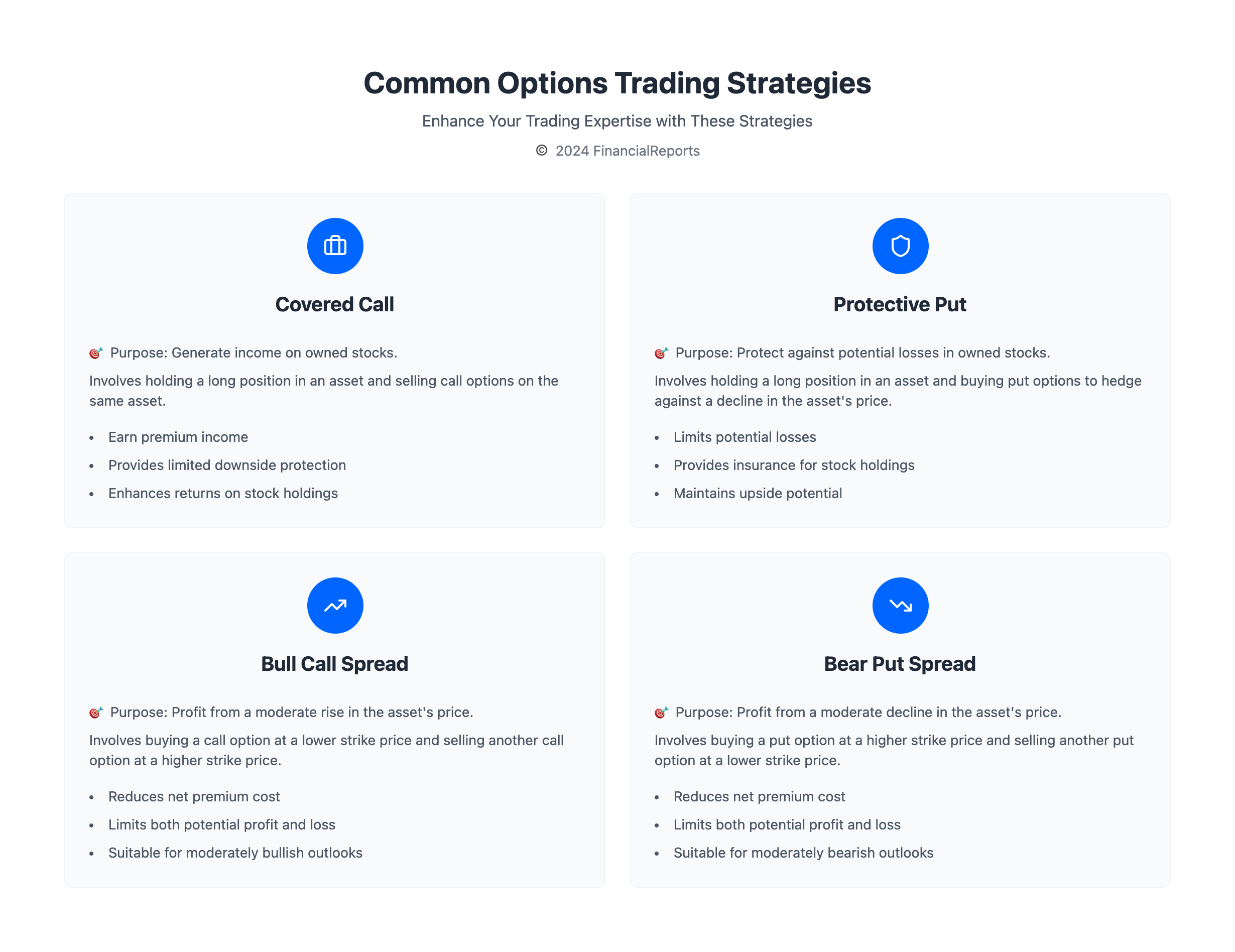
Multi-option strategies, such as spreads and straddles, help manage risk and returns. For instance, a bull call spread involves buying a call option at a lower price and selling one at a higher price. This strategy can profit from price increases while limiting losses. Options training teaches how to use these strategies well.
Some common options strategies include:
- Covered calls: selling call options on owned assets to earn income
- Protective puts: buying put options on owned assets to protect against losses
- Bull call spreads: buying call options at a lower price and selling at a higher price
Understanding these strategies and how to apply them helps investors create a solid options training plan. This plan can help achieve their investment goals.
Analyzing Market Trends for Options Trading
Options trading needs a deep understanding of market trends and analysis. To do well, it's key to learn how to analyze trends and make smart choices. There are two main ways to do this: technical and fundamental analysis.
Utilizing Technical Analysis
Technical analysis looks at charts and patterns to guess future market moves. It uses tools like the Relative Strength Index (RSI) and Money Flow Index (MFI) to spot when prices are too high or too low. For instance, an RSI over 70 means prices are too high, and below 30 means they're too low.
Fundamental Analysis Techniques
Fundamental analysis digs into a company's financials, management, and industry trends to guess its future. This helps traders make better choices by looking at things like revenue growth, profit margins, and how it stacks up against competitors. Mixing technical and fundamental analysis gives traders a full view of the market and helps them make winning trades.
When looking at market trends for options trading, keep these in mind:
- Open interest in options contracts
- Put-call ratio
- Changes in options statistics such as PCR and OI
By looking at these and using both technical and fundamental analysis, traders can boost their success in the market.
| Indicator | Description |
|---|---|
| RSI | Relative Strength Index, used to identify overbought and oversold levels |
| MFI | Money Flow Index, used to identify overbought and oversold levels |
| Put-call ratio | Measure of trading volume using put options vs. call options |
Tools and Resources for Options Training
Investors looking to boost their options trading skills have many tools and resources at their disposal. Online courses and webinars offer in-depth learning. They provide detailed guides and tools, like the Options Strategies Quick Guide and Candlestick Patterns for Day Trading.
There are many learning options for those wanting to understand options trading better. Courses range from beginner to advanced levels. Using these resources, investors can gain a deeper grasp of options trading and enhance their investment strategies.
- Online courses and webinars
- Recommended books and publications
- Options trading guides and tools
By using these tools and resources, investors can sharpen their options trading skills. This leads to better investment decisions. It's important to find resources that match your needs and goals.
| Resource | Description |
|---|---|
| Options Strategies Quick Guide | A detailed guide to options trading strategies |
| Candlestick Patterns for Day Trading | A tool for analyzing candlestick patterns in day trading |
Selecting the Right Broker for Options Trading
Choosing the right broker is key for success in options trading. With so many brokers out there, picking the best one can be tough. It's important to look at important features and compare fees.
Key Features to Look For
Look for low fees, strong trading platforms, and great customer support. For instance, tastytrade has no account minimum and charges $1.00 for stock and ETF options. Charles Schwab offers lots of educational resources and charges $0.65 per contract.
Comparing Commission Structures
Brokers have different fee structures. Here are some popular ones and their fees:
- Charles Schwab: $0.65 per contract
- Interactive Brokers: $0.65 per contract (with discounts for volume)
- Ally Invest: $0.50 per contract
- Webull: no fees for stocks, ETFs, and options
When picking a broker for options trading, these fees are important. They help you find the best way to learn options trading.
| Broker | Commission Rate |
|---|---|
| Charles Schwab | $0.65 per contract |
| Interactive Brokers | $0.65 per contract (with volume discounts) |
| Ally Invest | $0.50 per contract |
| Webull | Zero commission |
Common Mistakes to Avoid in Options Trading
When you trade options, knowing common mistakes is key. Learning options and options training can guide you. They help you avoid big losses.
Some mistakes to steer clear of include:
- Over-leveraging your portfolio, which can lead to significant losses if the market moves against you.
- Neglecting the impact of fees, which can eat into your profits and reduce your overall returns.
- Making emotional trading decisions, which can cloud your judgment and lead to impulsive choices.
To avoid these mistakes, understanding options training and learning options is vital. Stay updated on market trends. Analyze technical and fundamental data. And make a trading plan that fits your goals.
By avoiding these mistakes and staying informed, you can do better in options trading. You'll be more likely to reach your investment goals.
Final Thoughts on Options Training
Learning options trading is a journey that never ends. It's key to mix book smarts with real-world practice. With more people trading options, keeping up with market shifts is vital. In March, the Options Clearing Corporation cleared 1.1 billion contracts, a 12.2% jump from last year.
To excel in options trading, you need to put in the time and effort. Online courses, webinars, and books are great resources. The Benzinga Options course and Selling Options for Income course are popular choices. Options trading courses can help beginners make profits, and day trading options can lead to big gains quickly.
Here are some important tips for options trading:
- Begin with a covered call strategy, selling one call against 100 shares of a stock, set slightly above the current price, and expiring in around a month or two.
- Stay updated with market trends and changes, and be willing to adjust your strategy.
- Continuously learn and develop your skills, and be open to new ideas and strategies.
By following these tips and staying committed to learning, you can boost your chances of success in options trading. This will help you reach your financial goals.
| Course | Cost | Win Rate |
|---|---|---|
| Benzinga Options course | $297/year | N/A |
| Selling Options for Income course | $79 | 91.3% over the last 3 years |
Options Training: Elevate Your Investment Expertise
Investors looking to improve their skills can benefit from options training. It offers a deep dive into options trading. This education is key for those wanting to make smart choices in the financial markets.
With the right training, investors can understand options trading better. They'll learn strategies like bear put spreads and bull call spreads. These help manage risk and boost returns.
Options training also teaches about calls and puts. These are basic to options contracts. Knowing how to use them can give investors an edge in the market.
Key Takeaways
- Options training provides a deep education on options trading.
- Learning options helps investors develop skills for success in options trading.
- Options training covers various strategies, like bear put spreads and bull call spreads.
- Understanding calls and puts is essential in options trading.
- Options training aids in managing risk and increasing returns.
- By learning options, investors can gain a competitive edge in the market.
- Options training is vital for investors aiming to enhance their expertise and make informed decisions in the financial markets.
Understanding Options Trading
Options trading is a field full of chances for investors to grow their wealth. To succeed, it's key to know the basics. Learning the best way to learn options trading starts with understanding what options are and how they work.
Options trading lets you buy and sell contracts that give you the right to buy or sell something at a set price. There are calls and puts, each with its own role. Calls let you buy, while puts let you sell. This way, you can make money without losing too much.
To start trading options, knowing the different strategies is important. It's also vital to keep learning and stay updated on market changes. This helps you make smart choices and handle risks in the options trading world.
| Options Contract Type | Description |
|---|---|
| Call Option | Gives the buyer the right to buy the underlying asset at a specified price |
| Put Option | Gives the buyer the right to sell the underlying asset at a specified price |
By grasping the basics of options trading and staying informed, investors can reach their financial dreams. Whether you're new or experienced, finding the best way to learn options trading is key. Keep up with new strategies and market trends.
The Importance of Options Training
Options training is key for investors looking to manage risk and boost their investment plans. It teaches how to use options to protect against losses and increase profits. Learning options and grasping trading concepts helps investors make smart choices and stay competitive.
Good options training programs give investors the tools to understand the complex options trading world. They cover risk management, strategies, and market analysis. This way, investors can grasp the options market deeply. By joining options training programs, investors can build confidence and skills for success in the options market.
Some main benefits of options training are:
- Improved risk management
- Enhanced investment strategies
- Increased market insight
By using options training programs, investors can get an edge in the options market and reach their investment targets.
| Benefits of Options Training | Description |
|---|---|
| Improved Risk Management | Options training helps investors manage risk and minimize possible losses. |
| Enhanced Investment Strategies | Options training gives investors the knowledge and skills for effective investment strategies. |
| Increased Market Insight | Options training helps investors understand the options market better and make informed investment decisions. |
Key Concepts in Options Trading
Options trading has many key concepts that investors need to know. These include intrinsic vs. extrinsic value, the Greeks, and volatility. Intrinsic value is the option's worth based on its asset. Extrinsic value is the option's worth due to time and volatility.
Intrinsic vs. Extrinsic Value
The intrinsic value of an option is the difference between the strike price and the current market price. For example, if a call option's strike price is $50 and the current price is $60, its intrinsic value is $10. Extrinsic value is the extra value of the option, influenced by time and volatility.
The Greeks
The Greeks, like delta, gamma, theta, and vega, measure how an option's price changes. Delta shows how the option's price changes with the asset's price. Gamma shows how delta changes with the asset's price. Theta shows how the option's price changes with time. Vega shows how the option's price changes with volatility.
Volatility and Its Impact
Volatility is very important in options trading. It affects option prices and profit or loss chances. Higher volatility means higher option prices and more profit chances. Lower volatility means lower option prices and less profit chances. To learn options trading, it's key to find good learning resources, like online courses or webinars.
| Concept | Description |
|---|---|
| Intrinsic Value | The value of an option based on its underlying asset |
| Extrinsic Value | The value of an option based on external factors such as time and volatility |
| The Greeks | Measure the sensitivity of an option's price to changes in the underlying asset and other factors |
| Volatility | Affects the price of options and the chance for profit or loss |
Understanding these concepts helps investors make better choices in options trading. Whether you're new or experienced, learning about options trading can help you reach your investment goals.
Types of Options Strategies
Options trading offers many strategies to reach investment goals. Learning options and options training are key to grasping these strategies. There are single-option, multi-option, and advanced strategies for all levels of traders.
Single-option strategies involve trading one option. Multi-option strategies use more than one option. Advanced strategies, like the bear put spread and bull call spread, combine options for specific goals. For instance, a bear put spread buys a put option and sells a put option with a lower strike price. A bull call spread buys a call option and sells a call option with a higher strike price.
Some common options strategies include:
- Covered call strategy: involves owning the underlying stock and selling a call option
- Married put strategy: involves owning the stock and buying a put option
- Long call option strategy: involves buying a call option and can result in infinite upside until expiration
- Long put option strategy: involves buying a put option and can lead to a maximum profit of $5,000 when the stock is at $0 per share
These strategies help manage risk, generate income, or speculate on price movements. Options training and learning options are vital for understanding these strategies. With a deep understanding, investors can make better decisions and reach their goals.
Analyzing Market Trends for Options Trading
Options trading is all about making smart choices based on market trends. To get better at it, you need to know about technical and fundamental analysis. Technical analysis looks at past market data and trends to guess future prices.
Tools like Simple Moving Averages (SMA), Bollinger Bands, and the Relative Strength Index (RSI) are key in options trading. They help spot trends and when prices might be too high or too low. For instance, SMA shows trends, and Bollinger Bands warn of overbought or oversold conditions.
To learn more, check out books like "Technical Analysis of the Financial Markets" by John J. Murphy. Also, online sites like Investopedia and TradingView are great resources. By using both technical and fundamental analysis, traders can really understand market trends and make better choices.
Key technical analysis tools for options trading include:
- Simple Moving Averages (SMA)
- Bollinger Bands
- Relative Strength Index (RSI)
- Moving Average Convergence Divergence (MACD)
- Fibonacci Retracement
Mastering these tools and techniques can boost your options trading skills. It can also up your chances of success in the market.
Tools and Resources for Options Training
There are many tools and resources for those looking to improve their options trading skills. These include online courses, webinars, books, and publications. Each offers a unique way to learn about options trading.
Online Courses and Webinars
Online courses and webinars are great for learning about options trading. They cover topics like technical and fundamental analysis, and options strategies. You can find these on platforms like Udemy, Coursera, and edX.
Recommended Books and Publications
Books and publications are also valuable for options traders. "Options as a Strategic Investment" by Lawrence G. McMillan and "The Options Course" by George Fontanills are highly recommended. The Wall Street Journal and Forbes also offer the latest market trends and analysis.
Using these tools and resources can help you understand learning options and options training better. This can make you a more confident and successful trader.
| Resource | Description |
|---|---|
| Online Courses | Cover topics such as technical analysis and options strategies |
| Webinars | Provide real-time information and analysis on market trends |
| Recommended Books | Offer in-depth knowledge and insights on options trading |
| Publications | Provide up-to-date information on market trends and analysis |
Selecting the Right Broker for Options Trading
Choosing the right broker for options trading is key. With many brokers out there, picking the best can be tough. Start with a reputable broker that has many trading options and tools.
Look for brokers with low fees, advanced platforms, and good customer support. For example, Charles Schwab has no fees for stocks, ETFs, and options. They also offer four free trading platforms. Other top brokers for 2024 include Robinhood, E*TRADE, Fidelity, and Vanguard.
When comparing brokers, think about these factors:
- Commission structures: Find brokers with low or no fees.
- Trading platforms: Pick a broker with easy-to-use and advanced platforms.
- Customer support: Choose a broker with reliable and quick customer support.
- Tools and research: Look for brokers with many tools and research to help your trading decisions.
By picking the right broker, you can do well in options trading. Do your homework and compare different brokers to find the best fit for you.
| Broker | Commission | Trading Platforms |
|---|---|---|
| Charles Schwab | $0 | 4 free platforms |
| Robinhood | $0 | 1 platform |
| E*TRADE | varies | 2 platforms |
Common Mistakes to Avoid in Options Trading
Options trading can be risky if you don't know the common mistakes. Learning options and options training are key to avoiding these errors. One big mistake is over-leveraging, which can lead to losses bigger than your initial investment.
Over-Leveraging Your Portfolio
To avoid this, start with a number of contracts that match your usual stock trading amounts. It's also important to keep your emotions in check and stick to a solid exit plan. Here are some tips for options traders:
- Understand how fees affect your profits
- Don't misuse the leverage factor in option contracts
- Make sure there's enough liquidity in the options market
Neglecting the Impact of Fees
Fees can cut into your profits if you ignore them. It's vital to factor these costs into your trading choices. Options training helps traders understand the market better. It teaches them to make smart decisions about learning options.
Final Thoughts on Options Training
Starting your options trading journey? Remember, learning and adapting are key to success. Options trading is always changing. Stay updated and keep improving your skills.
Build a strong base in options basics. Use smart risk management and learn new trading methods. This will help you grow as a trader.
Keep an open mind and always be curious. Look for new learning resources like online courses and expert advice. This way, you'll stay ahead and adapt to changes.
Your success in options trading shows your hard work and dedication. With knowledge, smart risk management, and always learning, you can reach your investment goals. Keep exploring, learning, and improving your options trading skills.
FAQ
What are options and how do they work?
Options are financial contracts. They give the holder the right to buy or sell an asset at a set price. This must be done within a certain time. There are two main types: calls and puts.
What are the benefits of options training?
Options training helps investors manage risk and improve their strategies. It deepens their understanding of options trading. This includes various strategies and concepts.
What are the key concepts in options trading?
Key concepts include intrinsic vs. extrinsic value and the Greeks (delta, gamma, theta, vega). Volatility is also important. Knowing these concepts helps in making informed trading decisions.
What are the different types of options strategies?
Options strategies are divided into single-option, multi-option, and advanced strategies. Each has its own benefits and risks. Choosing the right strategy depends on your experience and goals.
How can I analyze market trends for options trading?
To analyze market trends, use technical and fundamental analysis. These methods help traders make better decisions. They also keep them competitive.
What tools and resources are available for options training?
Many resources are available for options training. These include online courses, webinars, and books. They help investors improve their skills and stay updated with market trends.
What should I look for when selecting a broker for options trading?
When choosing a broker, look at commission structures and trading platform features. Customer support is also important. Comparing these can help find the best broker for you.
What are the common mistakes to avoid in options trading?
Avoid over-leveraging your portfolio and neglecting fees. Emotional trading decisions are also a mistake. Staying away from these can lead to successful trading.