Exploring the Different Types of Stock Markets
The stock market is a complex system. It lets companies raise capital and investors buy and sell securities. Over 58,000 companies are publicly traded worldwide. Knowing the different kinds of stock markets is key for investors to make smart choices.
The types of stock markets include primary and secondary markets, over-the-counter (OTC) markets, and exchange-traded markets. Each has its own purpose and offers unique chances for investors.
Investors can join the stock market in many ways. For example, through American depositary receipts, U.S. investors can invest in foreign companies. The stock market's performance is also influenced by a company's profitability, debt, and future outlook. So, it's important for investors to keep up with market trends and news.
Key Takeaways
- There are several types of stock markets, including primary, secondary, and over-the-counter markets.
- Investors can participate in the stock market through various channels, including American depositary receipts.
- The stock market is influenced by factors such as company profitability, debt levels, and changes affecting future profitability.
- Understanding the different kinds of stock market is essential for investors to make informed decisions.
- The types of stock market offer unique opportunities for investors, including growth stocks, value stocks, and dividend stocks.
- Investors can also participate in the stock market through mutual funds, exchange-traded funds, and real estate investment trusts (REITs).
Introduction to Stock Markets
The stock market is a complex place where shares of companies are traded. It's important for investors to know the basics to make smart choices. The stock market helps money flow between investors and companies, playing a big role in today's economies.
Understanding Stock Markets
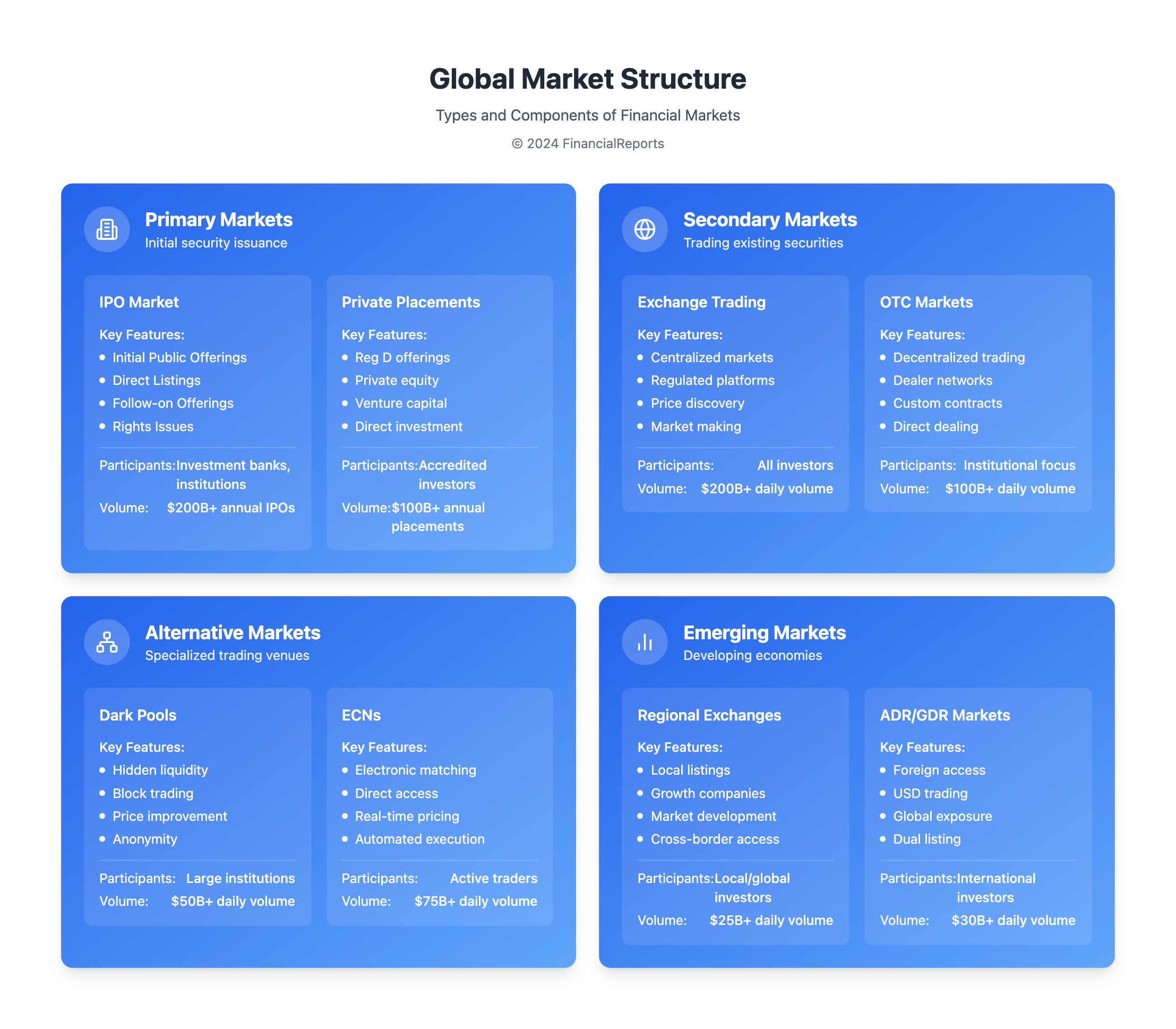
There are different types of stock markets, like primary and secondary markets. Primary markets help companies raise money by selling new shares. Secondary markets let investors trade existing shares with each other. Knowing these basics is key to understanding how the stock market works.
Importance of Stock Markets
The stock market is a place for companies to get capital and for investors to buy and sell. It helps investors grow their wealth and supports companies to grow. It also helps the economy grow. By learning about the stock market, investors can make better choices and handle the challenges of trading.
Some important things to remember when investing in the stock market include:
- Diversification to protect portfolios from market setbacks
- Understanding bull and bear markets and their impact on stock prices
- Using technical analysis and tools to identify trading opportunities and trends
Primary Markets Explained
Primary markets are where companies raise money by selling new securities to investors. This means they issue new stocks and bonds directly. It's key for companies to grow, build new offices, buy equipment, or hire more people.
Functions of Primary Markets
The primary market includes initial public offerings (IPOs), the first time a company sells shares to the public. For example, Facebook's IPO in 2012 raised $104 billion, a huge deal in US history. It also covers private placements, rights offerings, and preferential allotments, giving companies many ways to get equity capital.
IPO Process in Detail
The IPO process has steps like underwriting, pricing, and allocation. Companies use IPOs to get money from many investors. It's a big part of primary markets, helping companies raise funds and list on stock exchanges. Some main benefits include:
- Investors can buy assets at lower prices
- Private placements have less regulation than IPOs
- New securities can only be sold once in primary markets, but can be traded many times in secondary markets
Secondary Markets Overview
The secondary markets are key to the economy. They let investors trade securities among themselves. This market deals with securities like stocks and bonds, without the company's direct involvement. Here, investors trade with each other, not with the company.
This market boosts financial system liquidity. It lets smaller traders join in. It includes various markets, like stock exchanges and over-the-counter (OTC) markets. Famous ones are the National Stock Exchange (NSE), New York Stock Exchange (NYSE), NASDAQ, and London Stock Exchange (LSE).
Role in the Economy
The secondary market makes the economy more efficient. It lets buyers and sellers set prices based on supply and demand. This market also ensures high liquidity, as stocks can be easily traded for cash.
Types of Secondary Markets
There are two main types: exchange-traded markets and over-the-counter (OTC) markets. Exchange-traded markets, like the NYSE and NASDAQ, are safer due to rules. But, they cost more to trade. OTC markets, without a central trading place, compete for more trading volume.
| Market Type | Characteristics |
|---|---|
| Exchange-Traded Markets | Regulatory oversight, higher transaction costs |
| Over-the-Counter (OTC) Markets | No centralized place, competition among providers |
In summary, secondary markets help investors trade among themselves. They make the economy more efficient and liquid. There are two main types: exchange-traded and OTC markets, each with its own benefits.
Over-the-Counter (OTC) Markets
OTC markets offer an alternative to traditional stock exchanges. They let investors buy and sell stocks not listed on major exchanges. These markets are home to a variety of financial instruments, including bonds, ADRs, derivatives, and cryptocurrencies like Bitcoin and Ethereum.
Small investors can find a place in the OTC market. But, OTC stocks often have low trade volume. This leads to less liquidity and wider price spreads.
Investing in OTC markets can be risky. There's less regulation, which means less public information and a higher fraud risk. Stocks in these markets can also be very volatile.
Some key characteristics of OTC markets include:
- Less regulation, leading to less available public information and increased risk of fraud
- Lower trade liquidity and wider bid-ask spreads
- Higher possible volatility and unpredictable price movements
OTC Markets Group runs the OTCQX Best Market, the OTCQB Venture Market, and the Pink Open Market. Each has its own rules and risks. For instance, the OTCQX only lists 4% of OTC stocks and has strict SEC oversight.
On the other hand, the Pink Open Market is the riskiest. It has no financial reporting or SEC registration requirements.
| OTC Market Tier | Requirements | Risks |
|---|---|---|
| OTCQX | High reporting standards, strictest oversight by the SEC | Lower risk, higher transparency |
| OTCQB | Minimum bid price of $0.01, regulatory reporting, audited annual financials | Moderate risk, lower transparency |
| Pink Open Market | No requirements to report financials or register with the SEC | Higher risk, lower transparency |
Exchange-Traded Markets
Exchange-traded markets are key to the global financial system. They let investors buy and sell stocks on a single platform. The stock exchange plays a big role, making sure trading is fair and regulated.
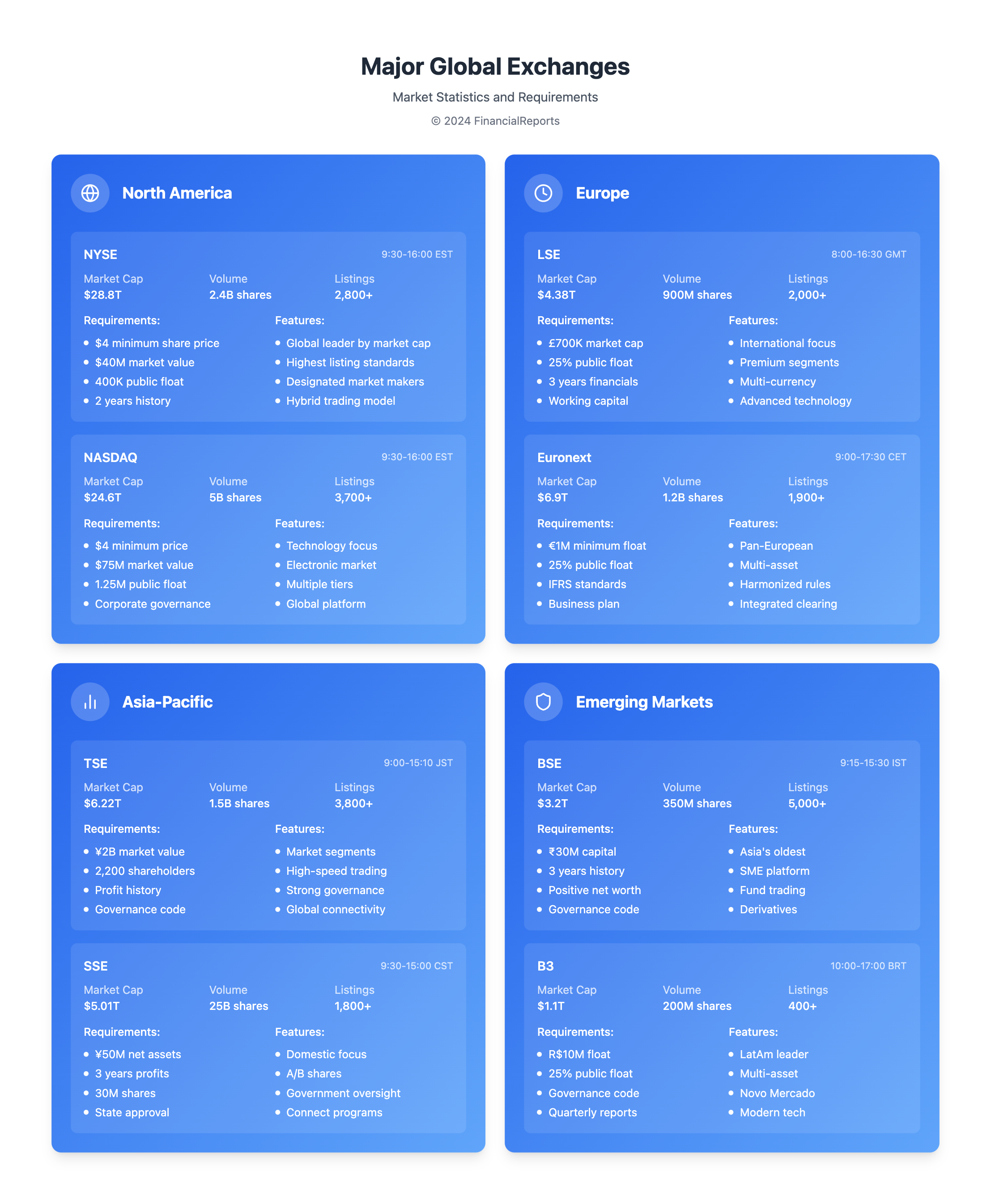
In the U.S., the New York Stock Exchange (NYSE) and Nasdaq are the big players. The NYSE is the largest, with a market value of $28.8 trillion.
Trading on these exchanges is strict. Stocks on the NYSE must cost at least $4 and have a market cap of $4 million. This rule helps keep only good companies listed. It keeps investors trusting the market.
Electronic trading systems have made things faster and cheaper. Over 80% of NYSE trades are now electronic.
Major Stock Exchanges
The U.S. has big stock exchanges like the NYSE, Nasdaq, and American Stock Exchange (AMEX). These places help companies raise money and investors trade. The NYSE, started in 1792, is the oldest and biggest in the U.S.
Trading Process on Exchanges
Trading on exchanges means buying and selling securities. Prices change based on how much people want to buy or sell. This setup makes trading clear and fair for everyone.
Technology has made trading quicker and easier. Now, most trades on the NYSE happen online.
Some interesting facts about the NYSE include:
- Trading happens Monday to Friday, from 9:30 a.m. to 4 p.m., Eastern time.
- More than 80% of NYSE trades are electronic.
- The NYSE's market value is $28.8 trillion.
Regional Stock Markets
Regional stock markets are key for local economic growth. They let local companies raise money and investors put their money into these companies. These markets are smaller and focus on local businesses and investors.
Some big names in these markets are the Boston Stock Exchange, Chicago Stock Exchange, and National Stock Exchange. These places have rules to make sure only strong companies get listed. This includes things like a minimum market value and share price.
Over time, these markets have changed a lot. Some have merged or closed down. Now, there are seven regional exchanges in the U.S. that are recognized by the SEC.
| Exchange | Location | Listing Requirements |
|---|---|---|
| Boston Stock Exchange | Boston | Minimum market capitalization, share price |
| Chicago Stock Exchange | Chicago | Minimum market capitalization, share price |
| National Stock Exchange | Multiple locations | Minimum market capitalization, share price |
In summary, regional stock markets and exchanges are vital for local economies. They offer chances for local companies to get funding and for investors to support them.
Global Stock Markets
Global stock markets are now more connected than ever. What happens in one market can affect others. It's key for investors to understand how these markets interact. The global stock market is complex, with many exchanges and indexes helping with international trade.
Stocks are influenced by many factors, affecting different industries in different ways. For instance, the New York Stock Exchange (NYSE) was worth $23.12 trillion in March 2018. This was about 40% of the world's stock market value. The NASDAQ was the second largest, with a market capitalization of $10.93 trillion, focusing mainly on technology stocks.
Key Players in Global Stock Markets
- New York Stock Exchange (NYSE)
- NASDAQ stock exchange
- Tokyo Stock Exchange (TSE)
- Shanghai Stock Exchange
- London Stock Exchange
These exchanges are essential for global markets and trade. Knowing how they work together helps investors make smart choices in the complex world of global stock markets.
| Exchange | Market Capitalization (March 2018) |
|---|---|
| New York Stock Exchange (NYSE) | $23.12 trillion |
| NASDAQ stock exchange | $10.93 trillion |
| Tokyo Stock Exchange (TSE) | $6.22 trillion |
| Shanghai Stock Exchange | $5.01 trillion |
| London Stock Exchange | $4.38 trillion |
Alternative Trading Systems (ATS)
Alternative trading systems, or ATS, are electronic platforms that connect buyers and sellers. They offer a flexible space for trading securities outside of traditional stock exchanges. This leads to more market liquidity. The Securities and Exchange Commission (SEC) notes that most ATSs are registered as broker-dealers, not exchanges.
There are different types of ATS, like Electronic Communication Networks (ECNs), dark pools, crossing networks, and call markets. ECNs let traders deal directly with each other, attracting high-frequency traders. Dark pools, mainly used by big investors, help trade large amounts of securities without showing their moves.
Some key features of ATS include:
- Lighter regulation compared to traditional exchanges
- Lack of transparency, mainly in dark pools
- Higher risk of breaking rules
- Key role in boosting market liquidity
The SEC in the US watches over ATS, making them register as broker-dealers. They also need to file Form ATS and meet reporting duties. The European Securities and Markets Authority (ESMA) works with national regulators to oversee ATS under MiFID II.
| Type of ATS | Description |
|---|---|
| Electronic Communication Networks (ECNs) | Facilitate direct trading between participants without traditional exchanges |
| Dark Pools | Allow for trades to occur out of the public eye, mainly for block trades by big investors |
| Crossing Networks | Help trades happen away from public channels to avoid price changes |
| Call Markets | Group orders until a specific number is reached before executing a trade, setting market-clearing prices |
Emerging Markets
Emerging markets are growing fast and offer great investment chances. They have a big and growing middle class. This class drives spending and growth. The MSCI Emerging Markets Index (MSCI EM) tracks 23 emerging markets, helping investors.
Investing in these markets can be very profitable. The BRIC countries (Brazil, Russia, India, and China) are key players in the global economy. Other countries like Mexico, Colombia, and Indonesia also offer investment chances.
Some key traits of emerging markets include:
- High growth
- Large and growing middle class
- Increasing consumer spending
- Improving infrastructure
But, there are risks like political instability and infrastructure issues. Investors must weigh these risks against the possible gains. The IMF lists 40 countries as emerging markets, providing many investment options.
| Index | Description |
|---|---|
| MSCI Emerging Markets Index | Measures equity market performance of 23 emerging markets |
| MSCI World Index | Measures global equity market performance of developed markets |
Sectors in the Stock Market
The stock market is split into various sectors, each with its own traits and trends. Knowing these sectors is key for investors to make smart choices. The Global Industry Classification Standard (GICS) lists 11 sectors, like energy, materials, and healthcare.
Some leading companies in each sector are:
- Communication Services: Alphabet, Meta Platforms, Netflix
- Consumer Discretionary: Amazon, Tesla, Home Depot
- Consumer Staples: Walmart, Procter & Gamble, Coca-Cola
- Energy: ExxonMobil, Chevron, ConocoPhillips
- Financials: Berkshire Hathaway, JPMorgan Chase, Visa
Investors can spot trends and chances by understanding sectors. Knowing the sectors and their companies helps investors make better choices. This knowledge is vital for success in the stock market.
| Sector | Top Companies |
|---|---|
| Communication Services | Alphabet, Meta Platforms, Netflix |
| Consumer Discretionary | Amazon, Tesla, Home Depot |
| Consumer Staples | Walmart, Procter & Gamble, Coca-Cola |
| Energy | ExxonMobil, Chevron, ConocoPhillips |
| Financials | Berkshire Hathaway, JPMorgan Chase, Visa |
The Role of Market Makers
Market makers are key in stock trading. They make sure the market works smoothly by buying and selling securities. They also keep the prices stable by setting the bid and ask prices.
The example shows that the bid-ask spread is $0.50. This spread is how market makers make their money.
Market makers are vital for a stable market. They act like wholesalers, making sure stocks are available for sale. In the example, their profit is $50, which helps keep the market liquid.
Some important facts about market makers are:
- They help keep the real estate market liquid.
- They get paid for the risk of holding securities.
- They make sure stocks are available for sale when needed.
In short, market makers are essential for stock trading. They provide liquidity and help the market run smoothly. Their work ensures that stocks are available for sale when investors want to buy.
Future Trends in Stock Markets
The stock market is changing fast, thanks to new tech and how investors act. Knowing the future trends in the stock market helps investors make smart choices. The stock market evolution will be influenced by AI, blockchain, and other digital tech.
Some major trends shaping the stock market's future include:
- More use of artificial intelligence and machine learning in trading and investment decisions
- More people wanting to invest in sustainable and socially responsible ways
- More digital payment systems and online trading platforms
As the stock market keeps evolving, we'll see new chances and challenges. By keeping up with the latest future trends and stock market evolution, investors can thrive in this fast-changing world.
| Trend | Description |
|---|---|
| Artificial Intelligence | Increased use of AI and machine learning in trading and investment decisions |
| Sustainable Investing | Growing demand for sustainable and socially responsible investments |
| Digital Payments | Expansion of digital payment systems and online trading platforms |
Conclusion
The stock market is complex and full of opportunities for investors. It has primary markets for companies to raise capital and secondary markets for trading. This system is key to the global economy.
Investing in the stock market can lead to growth and income over time. But, it also comes with risks like market volatility and economic downturns. With careful research and a long-term view, investors can succeed.
Whether you're new or experienced, knowing the stock market is vital. Stay updated on trends and technology to make better choices. The future of the stock market is promising, and those who learn and adapt will thrive.
FAQ
What are the different types of stock markets?
Stock markets include primary, secondary, over-the-counter (OTC), and exchange-traded markets.
What is the role of primary markets in the stock market?
Primary markets help companies raise capital by issuing new securities. This is done through the initial public offerings (IPOs).
How do secondary markets function in the stock market?
Secondary markets let investors buy and sell securities that have already been issued. This allows for continuous trading of stocks.
What are the characteristics of over-the-counter (OTC) markets?
OTC markets offer an alternative to traditional exchanges. They allow for trading of stocks not listed on major exchanges. But, they also have risks like less liquidity and transparency.
What is the role of exchange-traded markets in the stock market?
Exchange-traded markets are the most common. They provide a place for investors to buy and sell stocks on a regulated exchange. This ensures a transparent trading process.
How do regional stock markets contribute to the overall stock market ecosystem?
Regional markets are key for local economic growth. They help local companies raise capital and allow investors to invest in local businesses.
What are the key differences between global stock markets and how do they interact?
Global markets are more connected than ever. Events in one market can affect others. It's important to understand how global markets interact.
What are alternative trading systems (ATS) in the stock market?
ATS are an alternative to traditional exchanges. They provide a platform for electronic trading of securities.
How do emerging markets differ from developed markets in the stock market?
Emerging markets offer growth opportunities due to rapid growth and a large middle class. But, they also have risks like political instability and lack of infrastructure.
What is the role of market makers in the stock market?
Market makers are vital. They provide liquidity by buying and selling securities. This helps maintain market stability and facilitates trading.
What are the future trends in the stock market?
The stock market is changing fast, driven by tech and changing investor behavior. Understanding these trends is key for making informed investment decisions.