What Financial Markets: A Complete Guide
The financial system is a complex network of institutions, markets, and instruments. It helps money and credit flow in an economy. Knowing about financial markets is key for smart investment choices. The New York Stock Exchange (NYSE) trades trillions daily, showing markets' global importance.
In today's fast-changing financial world, making quick, smart decisions is critical. Financial markets help with capital allocation, risk management, and liquidity. The stock, bond, commodities, and derivatives markets each have their role. They offer a place for trading, setting prices based on market conditions.
Introduction to Financial Markets
Financial markets help put savings to work by lending to individuals and companies. They make finding and trading securities easier. The system is designed to move money and credit, helping businesses grow without debt.
Key Takeaways
- Financial markets facilitate capital allocation, risk management, and market liquidity.
- The stock market, bond market, commodities market, and derivatives market are all part of the financial system.
- Financial markets determine prices of securities based on market factors.
- They provide a platform for buyers and sellers to trade securities, commodities, and currencies.
- Financial markets help businesses raise liquidity without incurring debt through equity sales.
- The financial system is designed to facilitate the flow of money and credit, enabling economic development.
- Understanding what financial markets are and how they function is critical for making informed investment decisions.
Understanding Financial Markets: An Overview
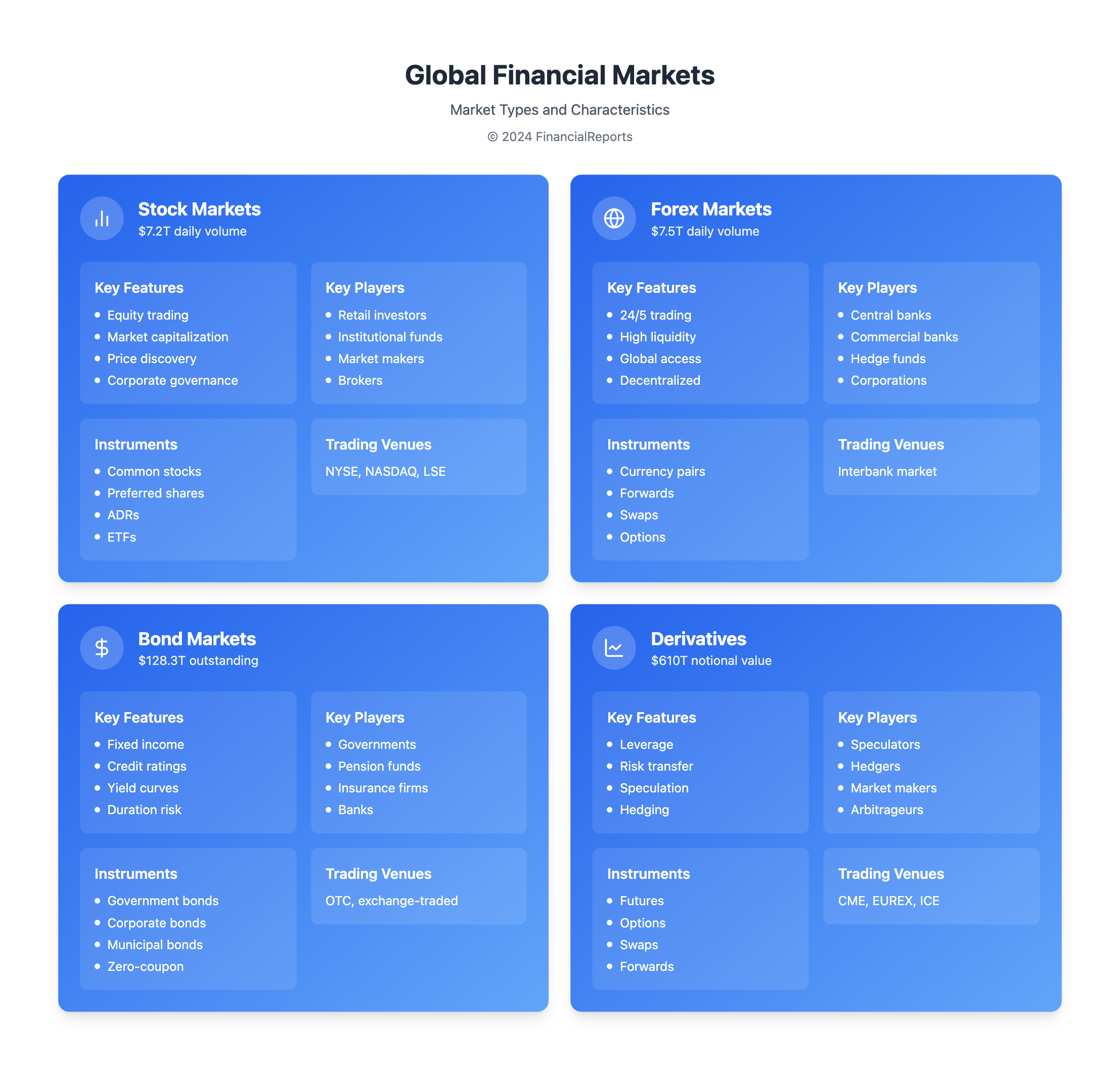
Financial markets are key in moving money and investments around. They are linked to economics, dealing with things like stocks, bonds, and commodities. Knowing about financial markets helps in making smart investment choices.
Studying financial markets and economics is vital today. Debasis Kumar Acharya points out that big data and better technology have changed the game. This has given financial experts a big advantage. Some important parts of financial markets include:
- Stock markets, where companies raise capital by issuing shares to the public
- Bond markets, where companies and governments issue debt securities to raise funds
- Derivatives markets, where investors can hedge against price risks or speculate on price movements
These markets help in spreading out capital, managing risks, and making money available to investors. By grasping the details of financial markets and their tie to economics, investors can make better choices. They can confidently move through the complex world of finance.
| Market Type | Description |
|---|---|
| Stock Markets | Platform for buying and selling company shares |
| Bond Markets | Platform for issuing and trading debt securities |
| Derivatives Markets | Platform for trading contracts based on underlying assets |
The Role of Financial Markets in the Economy
Financial markets are key to the economy. They help with capital allocation, risk management, and hedging. The financial system lets companies get the funds they need and helps investors manage risks. This makes it a vital part of the economy.
The Forbes Finance Council says financial institutions are now dealing with more data than ever. They use data analytics to manage risks, improve operations, and make customers happier.
Financial markets do several important things:
- They help match buyers and sellers of financial assets, making capital allocation easier.
- They offer a place for managing and hedging risks with derivatives and other tools.
- They help companies get the funds they need and let investors manage risks, making them a key part of the financial system.
Financial markets are essential for economic growth and development. As the economy changes, their role in helping with capital, risk, and hedging will grow even more.
Different Types of Financial Markets
Financial markets are key in moving money and investments around. They offer various types, each with its own role. These markets let people buy and sell things like stocks, bonds, and currencies.
Stock markets, like the New York Stock Exchange (NYSE), are where people trade shares. Bond markets are for trading debt securities. Derivatives markets let people manage risk by trading contracts based on other assets.
Foreign exchange markets help with international trade by exchanging currencies. Here are some main features of these markets:
- Stock markets: provide a platform for buying and selling equities
- Bond markets: enable the issuance and trading of debt securities
- Derivatives markets: involve trading contracts that derive their value from underlying assets
- Foreign exchange markets: facilitate the exchange of currencies, enabling international trade and investment
Knowing about these markets is vital for investors and financial experts. They help businesses grow and let money move around the world. These markets are the backbone of capitalist economies.
| Market Type | Description |
|---|---|
| Stock Markets | Provide a platform for buying and selling equities |
| Bond Markets | Enable the issuance and trading of debt securities |
| Derivatives Markets | Involve trading contracts that derive their value from underlying assets |
| Foreign Exchange Markets | Facilitate the exchange of currencies, enabling international trade and investment |
Key Participants in Financial Markets
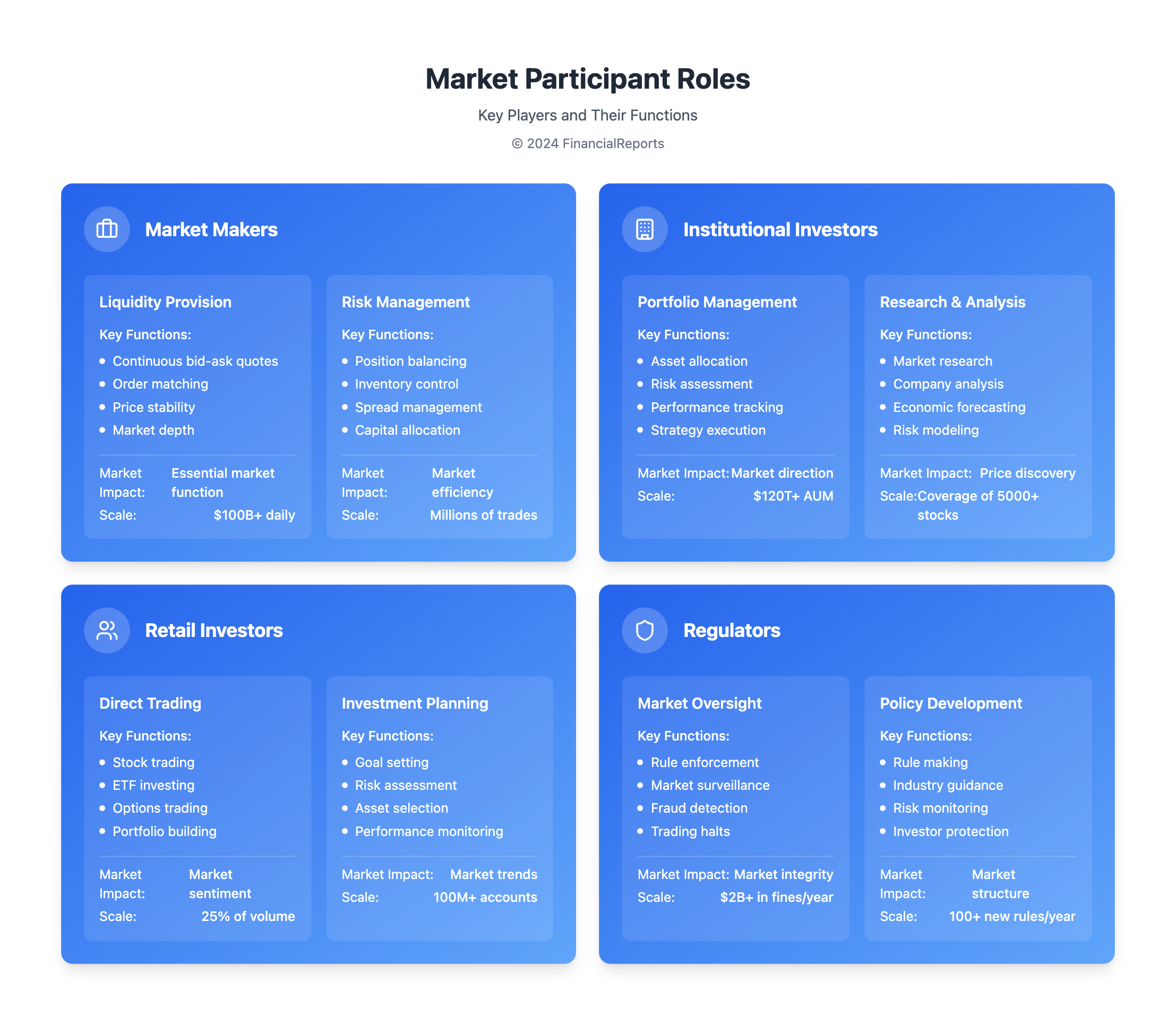
Financial markets have many players, like individual investors, big investors, and brokers. Bilal Surahyo says data analytics are key for managing risk, understanding customers, and making smart investment choices.
Individual investors trade for their own profit. Big investors, like pension funds and mutual funds, act on behalf of their clients. Brokers and market makers help by making it easy to buy and sell securities. Here are the main players in financial markets:
- Individual investors: make up a big part of trading in what financial markets
- Institutional investors: handle big portfolios and invest for their clients
- Market makers and brokers: add liquidity and help with trading in what financial markets
The New York Stock Exchange (NYSE) deals with trillions of dollars every day. The forex market handles over $7.5 trillion daily. Knowing who these players are is key to understanding financial markets and making good investment choices.
| Participant | Role |
|---|---|
| Individual Investors | Buy and sell securities for personal gain |
| Institutional Investors | Invest on behalf of clients |
| Market Makers and Brokers | Provide liquidity and facilitate trading |
Financial Instruments: A Deep Dive
Financial instruments are agreements with a monetary value. They can be traded on financial markets. The financial system uses these instruments for transactions and investments.
The main asset classes include debt, equity, real estate, commodities, and cash. Debt-based instruments, like bonds, help companies raise capital. Equity-based instruments, such as stocks, represent ownership in companies.
Some key types of financial instruments include:
- Debt instruments: Treasury bills, Commercial paper, Government bonds, and Corporate bonds
- Equity instruments: Common stocks and preferred stocks
- Derivative instruments: Futures, Forwards, Options, and Swaps
- Foreign exchange instruments: Forwards and Swaps
Understanding financial instruments is key for smart investments. By studying the markets and different instruments, investors can make better choices.
| Financial Instrument | Description |
|---|---|
| Bonds | Debt instrument with a fixed maturity date |
| Stocks | Equity instrument representing ownership in a company |
| Derivatives | Financial instrument deriving its value from an underlying asset |
Measurement and Indicators of Market Performance
Markets in finance are measured in many ways. This includes stock market indices, economic indicators, and measures of volatility. These tools give us insights into how well the market and economy are doing. For example, the S&P 500 Index tracks 500 stocks from different sectors in the US.
Economic indicators like GDP and inflation rates also play a big role. The GDP shows the total value of goods and services in a country, indicating economic growth. The Consumer Price Index (CPI) tracks the cost of living for most Americans.
Key Indicators
- Stock market indices: S&P 500, Dow Jones Industrial Average (DJIA), NASDAQ
- Economic indicators: GDP, inflation rate, unemployment rate
- Volatility measures: VIX, which provides a measure of market risk and uncertainty
By looking at these indicators, investors and financial experts can understand market trends better. Persefoni points out that data science is key in finance. It helps automate compliance tasks and ensures rules are followed in financial markets.
The Impact of Regulation on Financial Markets
Regulations are key to keeping financial markets stable and honest. The financial system is complex. Rules aim to balance strict oversight with practical compliance to boost market stability and protect consumers.
Regulations in the financial services world have changed a lot from 2015. New rules have been put in place to make things clearer and protect investors. For instance, the EU Markets in Financial Instruments Directive II (MiFID II) started in 2018. The EU General Data Protection Regulation (GDPR) has become the global standard for data privacy. These rules have a big effect on the financial system, making financial institutions follow many rules and increasing their costs.
Some important regulations include:
- EU Markets in Financial Instruments Directive II (MiFID II)
- EU General Data Protection Regulation (GDPR)
- UK Senior Managers and Certification Regime (SM&CR)
- EU Digital Operational Resilience Act (DORA)
These rules aim to make markets more stable, protect consumers, and keep thefinancial system honest.
How to Analyze Financial Markets
Analyzing financial markets uses many techniques. These include fundamental, technical, and sentiment analysis. Bilal Surahyo says data analytics is key for risk assessment, understanding customer behavior, and smart investment choices.
To invest wisely, knowing the types of analysis is vital.
Fundamental Analysis
Fundamental analysis looks at a company's financials and management. It uses ratios like the current and debt ratios to check a company's health.
Technical Analysis
Technical analysis studies charts and patterns to guess future prices. It finds support and resistance levels to track price trends.
Sentiment Analysis
Sentiment analysis looks at market feelings and trends for smart investing. It uses social media and news to see how people feel about a company.
Knowing these analyses helps investors make better choices. Remember, all investing carries risk, including losing money. It's wise to spread investments to reduce risk.
| Type of Analysis | Description |
|---|---|
| Fundamental Analysis | Evaluating a company's financial statements and management team |
| Technical Analysis | Analyzing charts and patterns to predict future price movements |
| Sentiment Analysis | Analyzing market sentiment and trends to make informed investment decisions |
The Influence of Technology on Financial Markets
Technology has changed how financial markets work. It uses data science to find important insights from lots of data. Debasis Kumar Acharya says data science uses special techniques to find these insights, which is key in finance.
Algorithmic trading, blockchain, and cryptocurrencies have changed finance. Santiago Guzman, co-founder of Cap8, says new technologies are now possible. This includes advanced algorithms and software for making and executing investment plans.
Some key fintech areas include:
- Cryptocurrency and digital tokens
- Blockchain technology and smart contracts
- Open banking and regtech
- Robo-advisors and AI chatbots
These innovations have made finance more accessible and efficient. Smartphones and gadgets now share real-time info worldwide.
| Category | Description |
|---|---|
| Fintech | Financial technology, including blockchain, cryptocurrencies, and digital payments |
| Algorithmic Trading | Use of computer programs to execute trades based on predefined rules |
| Blockchain | Distributed ledger technology that enables secure and transparent transactions |
As technology keeps improving, it will deeply affect finance. It will lead to new financial tools and models. With more data analytics and machine learning, finance experts will make better choices. This will drive growth and innovation in finance.
Challenges Facing Financial Markets Today
Financial markets are dealing with many issues. These include market ups and downs, economic downturns, and worries about regulations. Recent reports suggest these problems will keep happening, affecting investors and banks.
Some major challenges in financial markets are:
- Market ups and downs, which can cause big losses for investors
- Economic downturns, affecting the economy's health deeply
- Regulatory worries, like following laws and rules, posing big challenges for banks
In markets in finance, it's vital to keep up with the latest news. This helps investors make smart choices. Knowing the challenges helps them navigate the complex world of finance better.
Persefoni points out that using data science in finance is key. It helps automate tasks and follow rules. This is very important in markets in finance, where following rules is strict and not doing so can have big consequences.
Future Trends in Financial Markets
The financial world is changing fast. Experts see big shifts coming. Sustainability and ESG investing are becoming more popular. People want their money to match their values.
Deloitte's Bilal Surahyo says data analytics are key. They help spot risks, understand customers, and make smart choices.
Automation and AI are changing trading. Now, computers make trades super fast. Patty Danielecki says using generative AI can cut costs by 20%-30%.
Jim Eckenrode adds that AI can also help banks keep customers. This leads to more sales and loyalty.
Global events and market connections are also important. Val Srinivas says banks need to focus on tech and rules. This helps them do better financially.
FAQ
What is the definition and purpose of financial markets?
Financial markets are places where people buy and sell things like stocks and bonds. They help companies get money and investors manage their money. This makes the economy work better.
What are the different types of financial markets?
There are several types of financial markets. These include stock markets, bond markets, and foreign exchange markets. Each one has its own special role.
How do financial markets function and what is their role in the economy?
Financial markets help move money around in the economy. They let companies get money and investors manage risks. Using data analytics is key for financial institutions to do well.
Who are the key participants in financial markets?
Many people are involved in financial markets. This includes individual investors and big groups like pension funds. Brokers and market makers help everything run smoothly.
What are the different types of financial instruments?
Financial instruments include stocks, bonds, and more. Each type is traded on different markets. They all have unique features.
How are financial markets measured and evaluated?
Markets are checked with various tools. Stock market indices show how well the market is doing. Economic indicators like GDP help understand the economy's health. Volatility measures show how risky the market is.
What is the role of regulation in financial markets?
Rules are important for financial markets to stay stable. Bodies like the SEC and the Fed make sure everyone follows the rules. New laws, like the Dodd-Frank Act, aim to keep things safe.
What are the main techniques for analyzing financial markets?
There are several ways to study financial markets. Fundamental analysis looks at a company's financials. Technical analysis uses charts to predict prices. Sentiment analysis checks market feelings to guide investments.
How has technology impacted financial markets?
Technology has changed financial markets a lot. It has led to automated trading and new things like blockchain and cryptocurrencies. It has also made financial services more accessible.
What are the current challenges facing financial markets?
Financial markets face many challenges. Volatility and economic downturns can cause big problems. Following rules is also a big challenge.
What are the future trends in financial markets?
Financial markets will see big changes soon. Sustainability and ESG investing will become more important. Automation and AI will change trading. Global events will also play a big role.