Discover the Importance of EPS: A Comprehensive Guide
Earnings per share (EPS) shows how profitable a company is. It tells us how much of the company's earnings each share gets. Knowing what a good EPS is helps investors and financial experts see a company's health.
A company with a higher EPS is more profitable. To find EPS, you divide the company's net income by the number of shares. This helps investors make smart choices.
EPS is a key way to check how well a company is doing. It helps figure out a company's worth. There are different ways to calculate EPS, like excluding special items or using diluted numbers.
By comparing EPS with other companies or over time, we get a clearer picture. This is important for understanding a company's value and what makes a good EPS.
Key Takeaways
- EPS shows a company's profit per share, showing how profitable it is.
- A higher EPS means a company is more profitable. It's found by dividing net income by shares.
- Knowing a good EPS is key for investors to judge a company's health and make smart choices.
- EPS can be calculated in different ways, like basic and diluted, to fully understand a company's performance.
- Comparing EPS with others or over time helps investors see a company's value and what's good.
- EPS is a key tool for checking companies and figuring out their value, making it vital for investors and experts.
- A company's EPS is affected by its net income and the number of shares, which can change its stock market performance.
What Is EPS and Why Is It Important?
Earnings Per Share (EPS) is a key financial metric. It's found by dividing a company's net income by the number of shares outstanding. A higher EPS means a company is more profitable, which is important for investors.
To figure out what is a good net earnings per share, investors look at several things. These include the industry, the company's growth stage, and the market conditions.
EPS is vital for financial ratios and models. It shows a company's financial health. It helps track changes in profitability over time or compare companies in the same industry.
When looking at what is a good eps for a stock, investors should watch for steady EPS increases. They also compare it to competitors.
Definition of EPS
The Basic EPS formula is EPS = (Net income available to shareholders) / (Weighted average number of shares outstanding). Diluted EPS also considers future dilution from convertible debt and stock options. This gives a more detailed view.
The Role of EPS in Financial Analysis
EPS is essential in financial analysis. It helps investors see a company's profitability and make smart investment choices. Several things can affect EPS, like changes in shares, revenue, and stock splits.
A good EPS can differ by industry. It's often compared year to year or to competitors.
| EPS Type | Calculation | Description |
|---|---|---|
| Basic EPS | Net income / Weighted average number of shares outstanding | Provides a basic measure of a company's profitability |
| Diluted EPS | Net income / Total shares outstanding (including convertible securities) | Takes into account future dilution from convertible debt and stock options |
Understanding EPS and its role in financial analysis helps investors make better choices. It lets them see a company's growth and profitability possibilities.
Types of EPS: Basic vs. Diluted
When looking at a company's financial health, knowing the different EPS types is key. Basic EPS is found by dividing net income by the number of shares out. Diluted EPS, though, includes the effect of shares that could be added by options or convertible securities.
A good earnings per share shows a company's profit growth. But to judge what is a good eps, both basic and diluted EPS must be looked at. Diluted EPS gives a fuller picture of a company's earnings, as it includes shares that could be added in the future.
Basic EPS Explained
Basic EPS uses the average number of shares outstanding. It ignores the effect of options or convertible securities. For instance, with $100,000 net income and 10,000 shares, basic EPS is $10.
Understanding Diluted EPS
Diluted EPS, by contrast, includes all possible share dilution. This gives a clearer view of a company's earnings, as it considers future shares. Important factors for diluted EPS include:
- Potential dilution from convertible securities or employee stock options
- Impact of additional shares on the company's profitability
- Weighted average number of shares outstanding
Knowing both basic and diluted EPS helps investors better understand a company's growth and profit. A higher EPS, whether basic or diluted, shows a company is more profitable. This makes it a critical metric for evaluating investment choices.
How to Calculate EPS: A Step-by-Step Guide
To figure out a good net earnings per share, you need to know how to calculate EPS. The formula is (Net Income – Preferred Dividends) ÷ Weighted Average Common Shares Outstanding. This formula shows how profitable a company is per share.
When figuring out a good eps for a stock, look at the company's net income and preferred dividends. For example, if a company makes $1 million and pays $250,000 in preferred dividends, the net income is $750,000. With 11,000,000 shares, the EPS is $0.068 per share.
Here are the steps to calculate EPS:
- Get the company's net income from the income statement
- Subtract preferred dividends (if any)
- Find the weighted average number of outstanding shares
- Divide the adjusted net income by the weighted average shares outstanding
Knowing how to calculate EPS is key for financial analysis and making decisions. By looking at EPS, investors can see if a stock is cheap or expensive. This makes EPS a critical tool for investment choices.
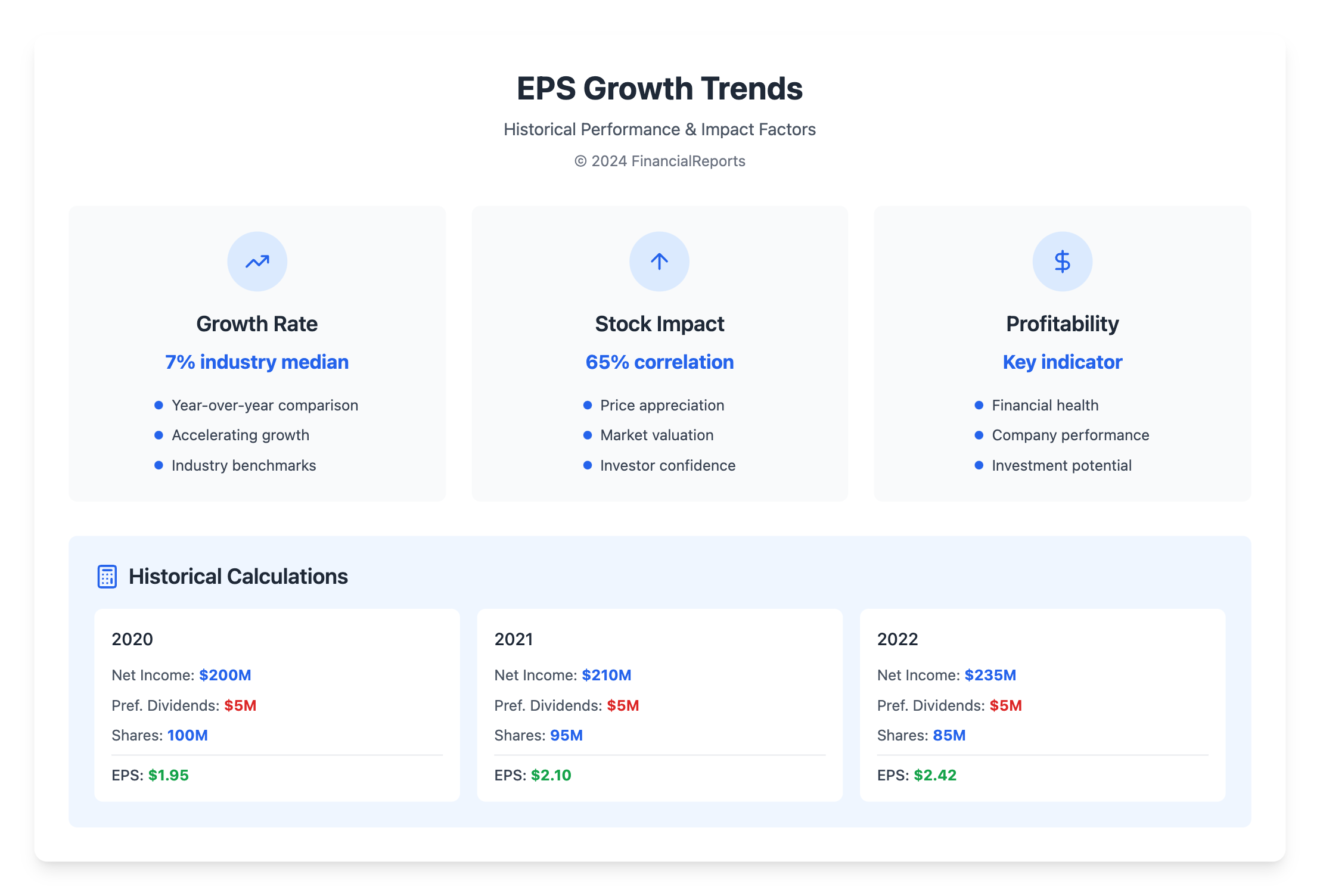
| Year | Net Income | Preferred Dividends | Weighted Average Shares Outstanding | EPS |
|---|---|---|---|---|
| 2020 | $200 million | $5 million | 100 million | $1.95 |
| 2021 | $210 million | $5 million | 95 million | $2.10 |
| 2022 | $235 million | $5 million | 85 million | $2.42 |
The Relevance of EPS in Investment Decisions
Investors often check a company's earnings per share (EPS) to see how profitable it is. A higher EPS means a company is more profitable. This makes investors want to pay more for its shares.
To find a good EPS, investors look at the company's growth rate. A higher growth rate means the company is more attractive to invest in.
The Median Basic EPS growth rate across the industry has been 7% over the last five years. This shows steady profitability trends. Also, 65% of companies in the sector show a positive correlation between EPS growth and stock price appreciation. This highlights the importance of EPS in investment decisions.
Some key factors to consider when evaluating EPS include:
- Year-over-year change in EPS
- Rate of increase in EPS
- Comparison of EPS among competitors or within the same industry
By considering these factors and evaluating what is a good eps, investors can make more informed decisions. A good earnings per share is often determined by its year-over-year change. The rate of increase in EPS also accelerates annually. So, investors should carefully consider a company's EPS when making investment decisions.
Limitations of EPS in Financial Analysis
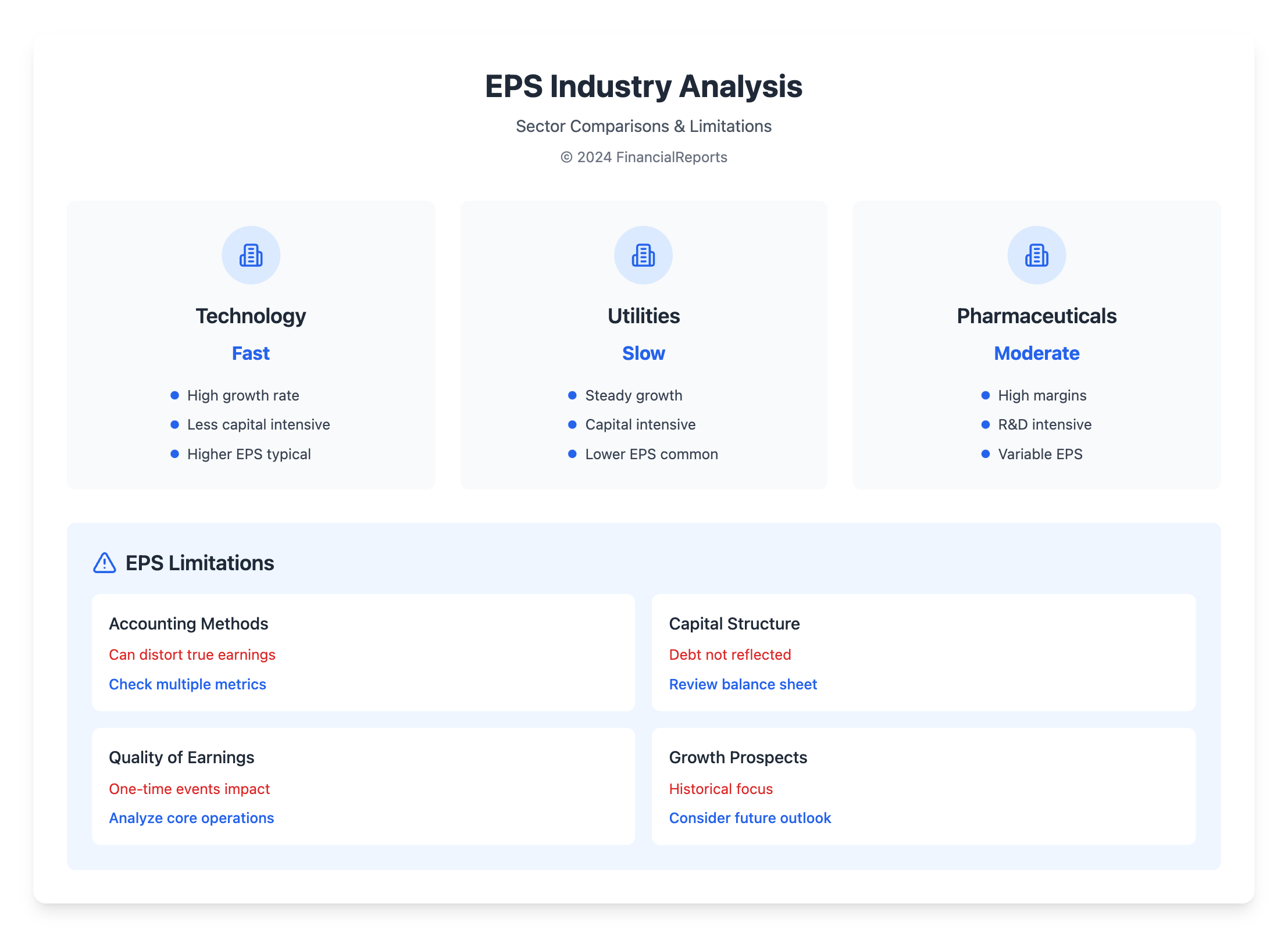
Earnings per share (EPS) is key in checking a company's financial health. Yet, it's not the only thing to look at. A high EPS might not always mean the company is doing well. It could be due to tricks in accounting or special events.
To figure out if a stock's EPS is good, look at more than just the number. Think about the company's industry, how it's growing, and its financial health. A high EPS doesn't always mean a stock is a smart buy. Sometimes, a stock with a lower EPS might be better because it's growing stronger and has a solid base.
For more on EPS, check out this resource. It explains why EPS matters in financial analysis.
Some EPS limits include:
- EPS can be skewed by accounting tricks or one-time events
- EPS doesn't show a company's debt or capital structure
- EPS might not show the quality of earnings or growth chances
In short, EPS is useful but has its downsides. It's best to use it with other financial metrics for a full view of a company's health. Knowing what makes a good EPS helps investors make better choices.
How EPS Influences Stock Prices
Earnings per share (EPS) is key in setting stock prices. It shows how much profit a company makes for each shareholder. A high EPS is often a sign of good financial health. Investors look at many things, like the company's industry and past performance, to judge EPS.
The link between EPS and stock prices is complex. Market conditions and what investors expect can change this link. Generally, a high EPS means a company is doing well financially. This can make the stock price go up. But, a low EPS might make the stock price drop.
To figure out a good EPS, investors compare it to the industry average and the company's past performance.
Several things can affect how EPS and stock prices are related:
- Market conditions: Economic changes can impact EPS and stock prices.
- Investor expectations: If investors think a company will do well, they might pay more for its stock, even with a low EPS.
- Industry trends: Some industries, like tech, might see faster EPS growth than others.
| Company | EPS | Stock Price |
|---|---|---|
| Company A | $5.00 | $50.00 |
| Company B | $10.00 | $100.00 |
In summary, EPS is vital in setting stock prices. Knowing what makes a good EPS is key for investors. By looking at EPS and stock prices, investors can make better choices.
Comparing EPS Across Different Industries
When we look at a company's financial health, we must think about its industry. Each sector has its own needs, growth rates, and profit margins. These factors greatly affect what makes a good net earnings per share.
For example, tech companies often have high EPS because they grow fast and need less money. On the other hand, utilities companies might have lower EPS. This is because they grow slower and need more money.
To figure out if a stock's EPS is good, we should compare it to others in its field. We can use industry benchmarks for EPS as a starting point. It's also important to look at other numbers like revenue growth, profit margins, and return on equity. This gives us a full picture of the company's financial health.
Some important things to think about when comparing EPS across industries include:
- Capital intensity: Companies in industries that need a lot of money, like utilities, might have lower EPS.
- Growth rates: Fast-growing industries, like tech, often have higher EPS because they expand quickly.
- Profit margins: Companies in industries with high profit margins, like pharmaceuticals, might have higher EPS. This is because they can keep prices high.
By looking at these factors and comparing a company's EPS to its peers, we can understand its financial health better. This helps us make smarter investment choices.
The Relationship Between EPS and Other Financial Metrics
Knowing what makes a good EPS is key to judging a company's health. EPS is the foundation for stock valuation models like the P/E ratio and PEG ratio. It's also vital for comparing companies in the same field.
A company's EPS is tied to its revenue growth. More revenue means higher EPS. But, EPS can be affected by things like stock buybacks. These can make EPS look better by reducing the number of shares outstanding. To figure out a good EPS, look at it alongside other financial numbers, like ROE and revenue growth.
When checking out EPS and other financial numbers, keep these points in mind:
- EPS is a big part of the P/E ratio. It shows if a stock is cheap or expensive compared to its earnings.
- The PEG ratio looks at P/E and earnings growth. It helps spot undervalued or overvalued stocks.
- EPS is linked to revenue growth but can be changed by things like stock buybacks.
By thinking about these points and understanding what makes a good EPS, investors can make better choices about their money.
| Financial Metric | Description |
|---|---|
| EPS | Earnings per share, calculated by dividing net income by outstanding shares. |
| P/E Ratio | Price-to-earnings ratio, which compares stock price to EPS. |
| PEG Ratio | Price-to-earnings growth ratio, which compares P/E to future or past earnings growth. |
Future Trends in EPS Reporting
The business world is changing fast, and so is the role of Earnings Per Share (EPS) in financial analysis. EPS is key, but it's not enough to show a company's true value. This is true in today's economy, where knowledge is as important as money.
New accounting rules are changing how we look at EPS. Now, we're paying more attention to non-GAAP financial measures. People want to see more details about earnings. New metrics like Economic Value Added (EVA) and Cash Flow Return on Investment (CFROI) are being used to give a fuller picture.
Technology is also playing a big role in EPS data. Artificial intelligence and big data analytics are making financial reports more detailed and useful. These tools help us understand data better and make smarter choices.
Even with all these changes, EPS remains very important. As the world of business keeps evolving, being able to understand and use EPS data will be key. It helps investors, analysts, and businesses make good decisions in a complex financial world.
FAQ
What is a good EPS?
A "good" EPS depends on many things like the industry, the company's growth, and the market. EPS shows how profitable a company is. Investors look at EPS trends and compare them to others in the industry to see if a company is doing well.
What is a good earnings per share?
A "good" earnings per share (EPS) changes based on the industry, the company's growth, and the market. EPS is key for investors to check if a company is making money and if it might grow more in the future.
What is a good net earnings per share?
What makes a "good" net earnings per share (EPS) varies by industry, company size, and growth stage. EPS shows how profitable a company is. It's a key tool for investors to judge a company's financial health and growth chances.
What is a good EPS for a stock?
A "good" EPS for a stock depends on the company's industry, growth, and the market. Investors compare a company's EPS to others in the industry and its past performance. This helps them see if the company is financially healthy and has growth possibilities.