Balance Sheet Order: A Complete Guide for Accounting
Understanding the financial situation of a business requires looking at the balance sheet. It gives a complete view of a company's money matters at the end of an accounting cycle. Assets, debts, and owner's equity are all shown clearly. This makes sure the company follows strong accounting rules. These rules help show true and fair financial numbers.
GAAP makes financial reports consistent and trustworthy across all sectors. The balance sheet uses the accrual accounting method, a must for US GAAP. This approach gives a real look into a company’s financial wellness. It lists current and long-term assets that are expected to benefit the business in the future. The costs for these assets are accurately recorded. Depreciation, which reduces the value of assets over time, is also factored in.
Balance sheets are tailored to fit different kinds of businesses like shops, manufacturers, and service providers. They feature the company's name, the balance sheet date, and a clear title. For big companies, it shows a combined financial statement. This includes the total wealth and debts of the main company and its smaller companies. Checks are done regularly to make sure the balance sheet is correct. This is especially important during yearly audits.
Key Takeaways
- Core financial statement offering insights into the company's financial status at an accounting period's end.
- Strict adherence to GAAP ensures uniformity in financial representation and industry comparability.
- Accrual accounting methodology delivers a more detailed and accurate depiction of financial conditions.
- Assets span tangible and intangible resources, while depreciatory considerations affect long-term asset valuations.
- Variety in balance sheet templates aids in accommodating an array of business structures.
- Consolidated balance sheets reflect the collective financial outlook for a parent company and its subsidiaries.
- Regular reconciliations are crucial to maintain accuracy and identify discrepancies promptly for correction.
What is a Balance Sheet?
A balance sheet, also called the statement of financial position, is key in financial statements. It shows a company's financial status at a certain time. Based on the accounting equation, Assets = Liabilities + Equity, it provides a detailed look at a company's resources, debts, and owner's equity.
Definition and Purpose
The main goal of a balance sheet is to give important financial data to those inside and outside the company. This information helps with making investment choices, evaluating credit, and planning strategies. It shows how assets are funded by debt or equity. This is key in understanding a company's financial health and balance.
Key Components of a Balance Sheet
The balance sheet breaks down into three main parts: assets, liabilities, and shareholders' equity. Each category is sorted and explained by what it includes and its importance:
| Category | Components | Examples |
|---|---|---|
| Assets | Current Assets | Fixed Assets | Cash, Accounts Receivable, Inventory | Property, Equipment |
| Liabilities | Current Liabilities | Long-term Liabilities | Accounts Payable, Credit Card Bills | Mortgage Loans, Term Loans |
| Shareholders' Equity | Common Stock | Retained Earnings | Paid-in Capital | Earnings Retained within the Company |
Knowing about each part is vital. Investors, creditors, and managers use this info to assess a company's ability to make money in the future, pay its bills, and finance growth. Examining each area, with current and past data, offers insights into the company's financial journey and strategy.
Importance of Balance Sheet Order in Accounting
Learning how a balance sheet works is key for strategic finance decisions. It's about putting things in the right order to show a company's true financial state. This way, everyone involved can make choices based on clear facts.
Impact on Financial Analysis
A well-organized balance sheet makes financial review much easier. It shows assets and debts, both short and long term, clearly. This clarity helps financial experts better understand a company's liquidity and how well it manages its assets.
Looking at Walmart, we see cash amounts and inventory listed alongside shareholder equity. In 2024, cash was $14.8 billion and inventory was $54.9 billion. These numbers are critical for investors. With shareholder equity at over $81.3 billion, it's easy to get a clear picture of Walmart's finances as detailed here.
Role in Decision-Making
How balance sheets are set up can show if a company can handle its debts, now and later. This setup guides plans for investing or paying off debts. It also shows possible financial ups and downs.
This layout helps investors quickly understand a company. Organized balance sheets show financial effects clearly. Walmart's debt-to-equity ratio, for example, was a good 1.84 in 2022. This makes a big difference in investing choices.
In short, the order of a balance sheet's entries is crucial. It greatly improves financial analysis and strategic decision-making.
Structure of a Balance Sheet
The balance sheet shows a company's financial health at a certain moment. It includes assets, liabilities, and equity. These details help stakeholders know the company's resources and obligations.
Assets
Assets are divided into current and long-term. Current assets are things like cash and inventory. Long-term assets include property and equipment, which are vital for business.
This section tells us how well the company uses and manages its resources.
Liabilities
Liabilities are what the company owes, now and later. This includes current liabilities such as accounts payable and long-term debts like loans. It shows the debts a business needs to pay off.
Equity
Equity is about shareholder investments and profits kept in the business. It shows what's left of company assets after paying off debts. This part reflects how well a business uses resources to benefit its owners.
| Category | Description | Examples |
|---|---|---|
| Assets | Resources owned by the company | Cash, Receivables, Inventory, PP&E |
| Liabilities | Future financial obligations | Accounts Payable, Long-term Debt, Lease Obligations |
| Equity | Shareholder's net assets | Common Stock, Retained Earnings |
A balance sheet is built on a basic equation: assets equal liabilities plus equity. This balance is essential for accurate financial reports. It helps tell if a company is doing well financially and operationally.
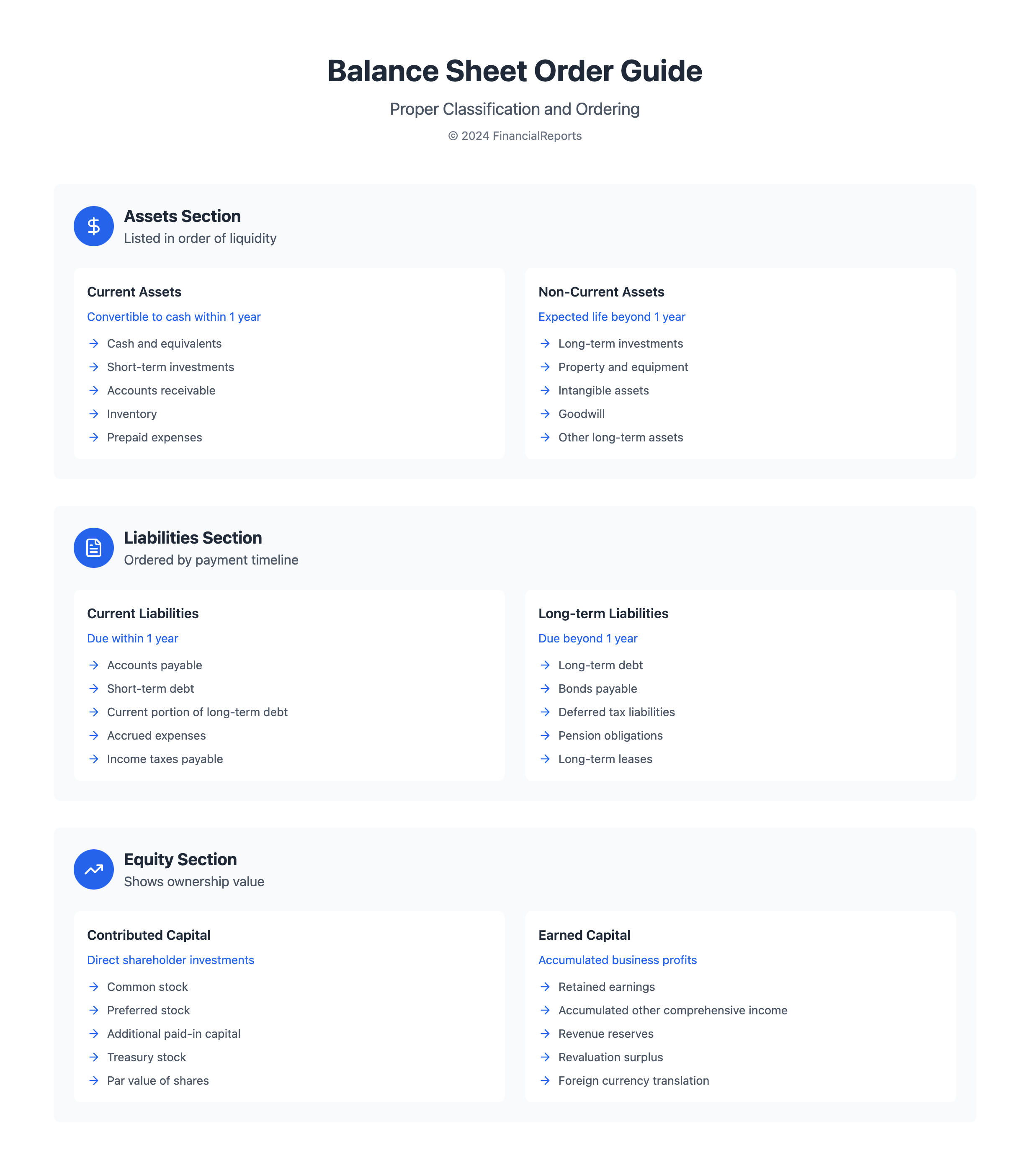
Standard Balance Sheet Formats
Knowing how balance sheet presentation works helps us understand finances better. There are two main types of balance sheets: classified and unclassified. Let's dive into each one's features and how they benefit us.
Classified Balance Sheet
A classified balance sheet organizes things well. It separates assets and liabilities into what's due soon and what's due later. This helps people see how a business is doing right now and in the future. It uses special formats to make financial trends clear.
This setup has a few key benefits:
- It gives a detailed view by separating immediate and long-term assets and debts.
- This helps to better understand a company’s financial health, leading to smarter decisions.
- It makes sure financial reports meet high standards.
Unclassified Balance Sheet
On the other hand, an unclassified balance sheet is simpler. It lists everything in one go without splitting into current and non-current. Smaller companies or internal reports often use this. But, it's not great for deep financial insight.
Here’s how the different formats stack up:
| Format Type | Description | Usage | Better for |
|---|---|---|---|
| Classified | Assets and liabilities divided into current and non-current. | Widely used in external reporting and larger businesses. | Comprehensive financial analysis |
| Unclassified | Assets, liabilities, and equity listed in a single sequence. | Primarily internal use, small businesses. | Simple report purposes |
| Vertical | Information organized in a single column by liquidity order. | Common in both internal and external reports. | Immediate financial overview |
| Horizontal | Assets on the left, liabilities, and equity on the right. | Used for a side-by-side comparative analysis. | Comparative financial studies |
Choosing a balance sheet format depends on your reporting needs and your audience. Each style has its value. They help in making smart business choices and analyzing finances.
Assets in Balance Sheet Order
The way assets are listed on a balance sheet is very detailed. This is to show a company's ability to manage assets and liquidity well. Assets are split into current and non-current categories. Each is key for understanding how liquid a company is and for making smart asset decisions.
Current Assets
Current assets come first on the balance sheet. They are expected to be used or turned into cash within a year. This includes things like cash, stocks that can be sold quickly, money owed by customers, and inventory. How these are listed is very important for analyzing liquidity.
Looking at current assets helps people understand a company's short-term financial health. It shows if the company can pay off debts due soon.
Non-current Assets
After current assets, you find non-current or long-term assets. These are assets like land, buildings, equipment, and even intangible things like patents. They are expected to benefit the company for more than one year. Judging these assets is critical for managing them.
It gives insights into how a company plans on growing and planning financially over time. Listing these assets carefully also shows how financially strong and capable a company is in the long run.
The careful arrangement of assets on a balance sheet follows accounting rules and helps people understand a company's financial and operational strategies. It's key for a detailed review of how a company handles its capital assets, which tells us about its potential for making money and staying stable.
Liabilities in Balance Sheet Order
It's important to know how liabilities are organized on a balance sheet. This helps in managing debts and being correct in financial reports. Liabilities are divided into current and long-term types, which is key for understanding a company's financial situation and its ability to pay off what it owes.
Current Liabilities
Current, or short-term liabilities, must be paid within a year. They include things like what the company owes, upcoming expenses, and short loans. Good management of these liabilities is vital for keeping cash flow positive and the business running smoothly. For example, AT&T had current liabilities of $51,127,000 on December 31, 2023, with $35,852,000 of it being accounts payable.
| Type of Current Liability | Amount ($) |
|---|---|
| Accounts Payable | 35,852,000 |
| Current Debt | 9,477,000 |
| Total Current Liabilities | 51,127,000 |
Long-term Liabilities
Long-term liabilities are debts that are due in more than a year. These can include bonds that need to be repaid, taxes to be paid later, and loans for buildings. Managing these properly supports a company's long-term financial strength and planning. AT&T, for example, reported long-term debts of $127,854,000, showing big financial duties for the future.
| Type of Long-Term Liability | Amount ($) |
|---|---|
| Mortgage Payable | 10,000,000 |
| Deferred Income Taxes | 58,666,000 |
| Total Long-Term Debt | 127,854,000 |
To really understand liabilities and how they impact debt handling and financial strategy, check out this in-depth guide on the balance sheet.
Seeing both current and long-term liabilities clearly helps everyone know how a company is doing financially. This makes it easier for people involved with the company to make smart decisions about its future.
The Equity Section Explained
Understanding corporate finance means grasping the equity section of a balance sheet. This crucial part reveals financial ownership. It shows the investment value through items like common stock and retained earnings. It also shows shareholders' equity, highlighting a company’s funding and financial health.
Common Stock
Common stock is key in shareholders' equity, showing a company's equity structure. It covers shares issued and held by investors or the company. Each share means a bit of ownership, tied to financial ownership.
Retained Earnings
Retained earnings are the profits turned back into the business, not given out as dividends. They are crucial for growth and funding operations. This reinvestment boosts investment value, important for long-term financial health.
Looking into these parts helps assess shareholder’s equity. Hence, knowing the equity section aids in making key investment and governance choices.
Common Mistakes in Balance Sheet Preparation
Preparing a balance sheet is key for financial accuracy in business accounting. Yet, common errors often threaten the balance sheet integrity. This leads to big accounting errors. Knowing these mistakes helps make financial reports more reliable.
Order Discrepancies
Order discrepancies often mess up balance sheets. They happen when the order of assets and liabilities is wrong. This can skew the financial analysis. It's vital to list assets from most to least liquid. Liabilities should go from short-term to long-term.
Misclassification Issues
Wrongly classifying items on the balance sheet can cause issues too. One major mistake is treating short-term debt as long-term. This can give a false picture of the company’s health. It's very important to carefully decide if an item is current or non-current.
- Omitting transactions like petty cash or unlisted inventory can twist the balance sheet's reality.
- Recording transactions incorrectly can lead to errors. For example, mixing up numbers like '54' for '45' affects the balance sheet and profits.
- Forgetting to record inventory changes can mess up asset reports and costs of goods sold.
- Incorrectly classifying data is a big problem in companies with various revenue streams or complex finances. This can falsely represent financial stability.
To keep the balance sheet accurate, it's wise to review and audit it regularly. Carrying out checks like trial balances before finalizing the balance sheet helps avoid errors. Also, continuous training on the latest accounting standards can improve report reliability.
Tools and Software for Balance Sheet Management
In the world of finance technology, using advanced software helps a lot with balance sheet management. This is because it makes accounting tasks quicker and much more accurate. More and more, financial experts are using powerful software to handle complex numbers and maintain precise financial records.
Accounting Software Options
Companies like Moody's, Cube, Oracle NetSuite, QuickBooks, and Sage Intacct are leading the way. They provide special accounting software that meets various business needs. Moody's, for example, offers Asset and Liability Management (ALM) solutions. These solutions help manage risks, making financial systems tougher and decision-making clearer.
- Moody’s ALM Solutions: Helps financial groups measure and control risks, keeping their finances stable.
- Cube Financial Software: Priced from $1500/month, it's great for FP&A teams and fast-growing small businesses, fitting perfectly with financial planning and analysis.
- Oracle NetSuite: Known for its detailed financial reports and making complex finances simpler, it works well for any company size.
- QuickBooks: With a starting price of $30/month, it's an affordable choice for small businesses, offering secure cloud storage and easy integration.
- Sage Intacct: Focuses on the key financial tasks of nonprofits with its cloud-based system, especially in handling accounts and managing cash.
Templates and Forms
Templates and standard forms are key to boosting accounting work. They offer set layouts. These layouts make preparing documents faster and help keep data uniform and accurate.
- Financial Statement Templates: These tools help create important financial documents like balance sheets and income statements, allowing for both customization and standardization.
- Automated Data Consolidation: Softwares from Cube and Quickbooks make mixing data from different sources easy, making financial reports more trustworthy.
Using these software solutions and forms makes managing balance sheets smoother. It gives financial pros the tools they need for precise and efficient financial work. This careful use of technology greatly helps with overall business health and making smart decisions.
Best Practices for Maintaining Balance Sheet Order
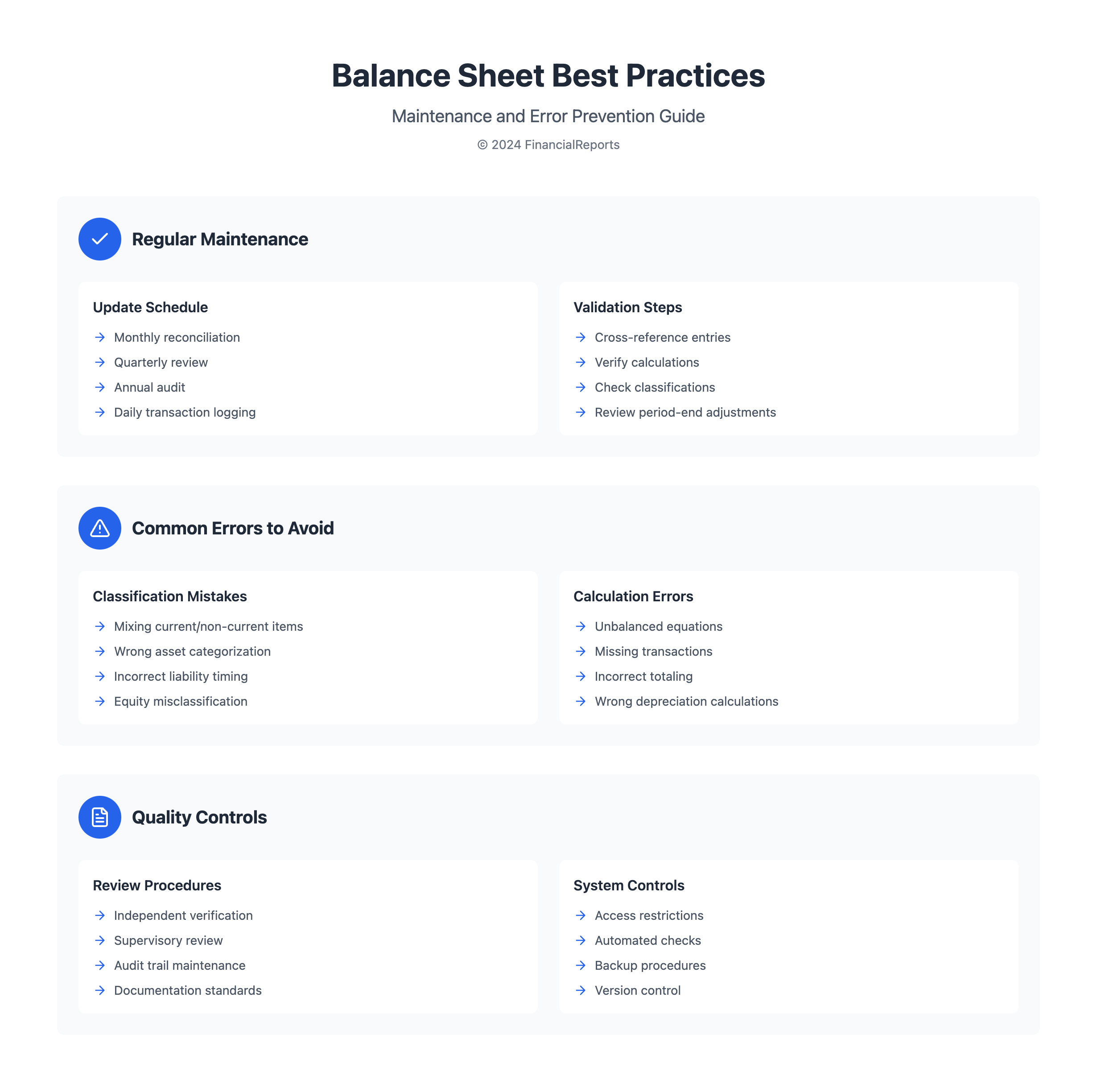
Maintaining an ordered balance sheet is key in today's financial world. It ensures financial responsibility and strong management in organizations. By following best practices, companies can accurately report finances at important times. Automation and oversight help reduce mistakes, boost efficiency, and show accountability.
Regular Updates
Balance sheets need to show current data for good financial decisions. Using accounting software for regular updates helps keep data fresh and correct. This cuts down on errors. Companies using smart matching rules have seen a 90% match rate in transactions. This makes reconciling easier. A month-end checklist can cut closing time by 30%, improving timely reports to stakeholders.
Internal Controls
Good internal controls like routine checks and audits are critical. They ensure financial numbers are right. Balance sheet checks can solve 80% of issues with smart solutions. They also spot possible fraud. Automated processes save time and cut down on manual mistakes. Studies show that 88% of spreadsheets have errors. Strong controls show a company's dedication to accuracy and trustworthiness. They keep balance sheets clear, reflecting true financial health.
FAQ
What Are the Components of a Balance Sheet?
A balance sheet shows assets, liabilities, and equity. It follows the formula: Assets = Liabilities + Equity.
Why Is Proper Asset Categorization Critical on a Balance Sheet?
Putting assets in the right category makes financial statements clear. This helps in analyzing liquidity and managing assets for making decisions.
How Does Balance Sheet Order Impact Financial Analysis?
The order on a balance sheet helps to evaluate a company's liquidity. It shows how well a company manages debt and its financial strength.
What's the Difference Between Current and Non-current Assets?
Current assets are for short-term use, expected to be converted to cash within a year. Non-current assets are held for longer than a year.
What Are the Two Types of Liabilities Presented on a Balance Sheet?
Liabilities are split into current, due within a year, and long-term. Long-term liabilities are dues after one year.
Why Is the Equity Section Important in a Balance Sheet?
Equity shows the value of the owner's or shareholders' investment in the company. It's key to knowing the company's net worth.
What Is a Classified Balance Sheet?
A classified balance sheet groups assets and liabilities as current and non-current. This makes it easier for stakeholders to understand.
How Can Accounting Software Improve Balance Sheet Management?
Accounting software automates entering data and keeps accuracy. It provides standard reports, making financial reporting smoother.
What Are Common Mistakes to Avoid When Preparing a Balance Sheet?
Common errors include wrong classification of assets and liabilities. Also, mistakes in liquidity order can lead to false financial conclusions.
What Are Best Practices for Maintaining Accurate Balance Sheets?
To keep balance sheets correct, update regularly and keep detailed records. Apply strict internal controls for truth and responsibility.