0001804176false2026Q1--12-310.3333http://fasb.org/us-gaap/2025#OtherAssetsNoncurrenthttp://fasb.org/us-gaap/2025#OtherAssetsNoncurrenthttp://fasb.org/us-gaap/2025#AccruedLiabilitiesAndOtherLiabilitieshttp://fasb.org/us-gaap/2025#AccruedLiabilitiesAndOtherLiabilities488xbrli:sharesiso4217:USDiso4217:USDxbrli:sharesxbrli:purebfly:segment00018041762026-01-012026-03-310001804176us-gaap:CommonClassAMember2026-04-200001804176us-gaap:CommonClassBMember2026-04-2000018041762026-03-3100018041762025-12-310001804176us-gaap:CommonClassAMember2025-12-310001804176us-gaap:CommonClassAMember2026-03-310001804176us-gaap:CommonClassBMember2025-12-310001804176us-gaap:CommonClassBMember2026-03-310001804176us-gaap:ProductMember2026-01-012026-03-310001804176us-gaap:ProductMember2025-01-012025-03-310001804176bfly:SoftwareAndOtherServicesMember2026-01-012026-03-310001804176bfly:SoftwareAndOtherServicesMember2025-01-012025-03-3100018041762025-01-012025-03-310001804176us-gaap:CommonClassAMemberus-gaap:CommonStockMember2025-12-310001804176us-gaap:CommonClassBMemberus-gaap:CommonStockMember2025-12-310001804176us-gaap:AdditionalPaidInCapitalMember2025-12-310001804176us-gaap:RetainedEarningsMember2025-12-310001804176us-gaap:RetainedEarningsMember2026-01-012026-03-310001804176us-gaap:CommonClassAMemberus-gaap:CommonStockMember2026-01-012026-03-310001804176us-gaap:AdditionalPaidInCapitalMember2026-01-012026-03-310001804176us-gaap:CommonClassAMemberus-gaap:CommonStockMember2026-03-310001804176us-gaap:CommonClassBMemberus-gaap:CommonStockMember2026-03-310001804176us-gaap:AdditionalPaidInCapitalMember2026-03-310001804176us-gaap:RetainedEarningsMember2026-03-310001804176us-gaap:CommonClassAMemberus-gaap:CommonStockMember2024-12-310001804176us-gaap:CommonClassBMemberus-gaap:CommonStockMember2024-12-310001804176us-gaap:AdditionalPaidInCapitalMember2024-12-310001804176us-gaap:RetainedEarningsMember2024-12-3100018041762024-12-310001804176us-gaap:RetainedEarningsMember2025-01-012025-03-310001804176us-gaap:CommonClassAMemberus-gaap:CommonStockMember2025-01-012025-03-310001804176us-gaap:AdditionalPaidInCapitalMember2025-01-012025-03-310001804176us-gaap:CommonClassAMemberus-gaap:CommonStockMember2025-03-310001804176us-gaap:CommonClassBMemberus-gaap:CommonStockMember2025-03-310001804176us-gaap:AdditionalPaidInCapitalMember2025-03-310001804176us-gaap:RetainedEarningsMember2025-03-3100018041762025-03-310001804176us-gaap:InventoryValuationAndObsolescenceMember2026-01-012026-03-310001804176bfly:CustomerOneMemberus-gaap:CustomerConcentrationRiskMemberus-gaap:SalesRevenueNetMember2026-01-012026-03-310001804176bfly:CustomerOneMemberus-gaap:CustomerConcentrationRiskMemberus-gaap:SalesRevenueNetMember2025-01-012025-12-310001804176bfly:ReportableSegmentMember2026-01-012026-03-310001804176bfly:ReportableSegmentMember2025-01-012025-03-310001804176country:US2026-01-012026-03-310001804176country:US2025-01-012025-03-310001804176us-gaap:NonUsMember2026-01-012026-03-310001804176us-gaap:NonUsMember2025-01-012025-03-310001804176bfly:CoreBusinessMember2026-01-012026-03-310001804176bfly:CoreBusinessMember2025-01-012025-03-310001804176bfly:EmbeddedMember2026-01-012026-03-310001804176bfly:EmbeddedMember2025-01-012025-03-310001804176srt:MinimumMember2026-01-012026-03-310001804176srt:MaximumMember2026-01-012026-03-3100018041762026-04-012026-03-3100018041762027-01-012026-03-310001804176bfly:PublicWarrantsMemberus-gaap:FairValueMeasurementsRecurringMember2025-12-310001804176bfly:PublicWarrantsMemberus-gaap:FairValueMeasurementsRecurringMemberus-gaap:FairValueInputsLevel1Member2025-12-310001804176bfly:PublicWarrantsMemberus-gaap:FairValueMeasurementsRecurringMemberus-gaap:FairValueInputsLevel2Member2025-12-310001804176bfly:PublicWarrantsMemberus-gaap:FairValueMeasurementsRecurringMemberus-gaap:FairValueInputsLevel3Member2025-12-310001804176bfly:PrivateWarrantsMemberus-gaap:FairValueMeasurementsRecurringMember2025-12-310001804176bfly:PrivateWarrantsMemberus-gaap:FairValueMeasurementsRecurringMemberus-gaap:FairValueInputsLevel1Member2025-12-310001804176bfly:PrivateWarrantsMemberus-gaap:FairValueMeasurementsRecurringMemberus-gaap:FairValueInputsLevel2Member2025-12-310001804176bfly:PrivateWarrantsMemberus-gaap:FairValueMeasurementsRecurringMemberus-gaap:FairValueInputsLevel3Member2025-12-310001804176us-gaap:FairValueMeasurementsRecurringMember2025-12-310001804176us-gaap:FairValueMeasurementsRecurringMemberus-gaap:FairValueInputsLevel1Member2025-12-310001804176us-gaap:FairValueMeasurementsRecurringMemberus-gaap:FairValueInputsLevel2Member2025-12-310001804176us-gaap:FairValueMeasurementsRecurringMemberus-gaap:FairValueInputsLevel3Member2025-12-310001804176bfly:PublicWarrantsMember2026-01-012026-03-3100018041762026-01-012026-01-010001804176us-gaap:RestrictedStockUnitsRSUMember2025-12-310001804176us-gaap:RestrictedStockUnitsRSUMember2026-01-012026-03-310001804176us-gaap:RestrictedStockUnitsRSUMember2026-03-310001804176bfly:EmployeeStockPurchasePlan2024Member2026-01-010001804176bfly:EmployeeStockPurchasePlan2024Member2026-01-012026-03-310001804176bfly:EmployeeStockPurchasePlan2024Member2025-01-012025-03-310001804176bfly:SoftwareAndOtherServicesMember2026-01-012026-03-310001804176bfly:SoftwareAndOtherServicesMember2025-01-012025-03-310001804176us-gaap:ResearchAndDevelopmentExpenseMember2026-01-012026-03-310001804176us-gaap:ResearchAndDevelopmentExpenseMember2025-01-012025-03-310001804176us-gaap:SellingAndMarketingExpenseMember2026-01-012026-03-310001804176us-gaap:SellingAndMarketingExpenseMember2025-01-012025-03-310001804176us-gaap:GeneralAndAdministrativeExpenseMember2026-01-012026-03-310001804176us-gaap:GeneralAndAdministrativeExpenseMember2025-01-012025-03-310001804176us-gaap:CommonClassAMember2026-01-012026-03-310001804176us-gaap:CommonClassBMember2026-01-012026-03-310001804176us-gaap:CommonClassAMember2025-01-012025-03-310001804176us-gaap:CommonClassBMember2025-01-012025-03-310001804176us-gaap:EmployeeStockOptionMember2026-01-012026-03-310001804176us-gaap:EmployeeStockOptionMember2025-01-012025-03-310001804176us-gaap:RestrictedStockUnitsRSUMember2026-01-012026-03-310001804176us-gaap:RestrictedStockUnitsRSUMember2025-01-012025-03-310001804176bfly:EmployeeStockPurchasePlanOptionsMember2026-01-012026-03-310001804176bfly:EmployeeStockPurchasePlanOptionsMember2025-01-012025-03-310001804176us-gaap:WarrantMember2026-01-012026-03-310001804176us-gaap:WarrantMember2025-01-012025-03-310001804176us-gaap:InventoriesMember2026-01-012026-03-310001804176us-gaap:InventoriesMember2026-03-310001804176bfly:Dr.JonathanRothbergMember2026-01-012026-03-310001804176bfly:Dr.JonathanRothbergMember2026-03-31
UNITED STATES
SECURITIES AND EXCHANGE COMMISSION
Washington, D.C. 20549
____________________________________________
FORM 10-Q
____________________________________________
(Mark One)
x QUARTERLY REPORT PURSUANT TO SECTION 13 OR 15(d) OF THE SECURITIES
EXCHANGE ACT OF 1934
For the quarterly period ended March 31, 2026
or
o TRANSITION REPORT PURSUANT TO SECTION 13 OR 15(d) OF THE SECURITIES
EXCHANGE ACT OF 1934
For the transition period from __________ to
Commission File Number: 001-39292
____________________________________________
Butterfly Network, Inc.
(Exact name of registrant as specified in its charter)
____________________________________________
| | | | | | | | |
| Delaware | | 84-4618156 |
| (State or other jurisdiction of incorporation or organization) | | (IRS Employer
Identification No.) |
| | |
1600 District Avenue Burlington, Massachusetts | | 01803 |
| (Address of principal executive offices) | | (Zip Code) |
(781) 557-4800
(Registrant’s telephone number, including area code)
| | |
|
| Securities registered pursuant to Section 12(b) of the Act: |
| | | | | | | | | | | | | | |
| Title of each class | | Trading
Symbol(s) | | Name of each exchange
on which registered |
| Class A common stock, par value $0.0001 per share | | BFLY | | The New York Stock Exchange |
____________________________________________
Indicate by check mark whether the registrant (1) has filed all reports required to be filed by Section 13 or 15(d) of the Securities Exchange Act of 1934 during the preceding 12 months (or for such shorter period that the registrant was required to file such reports), and (2) has been subject to such filing requirements for the past 90 days. Yes x No o
Indicate by check mark whether the registrant has submitted electronically every Interactive Data File required to be submitted pursuant to Rule 405 of Regulation S-T (§232.405 of this chapter) during the preceding 12 months (or for such shorter period that the registrant was required to submit such files). Yes x No o
Indicate by check mark whether the registrant is a large accelerated filer, an accelerated filer, a non-accelerated filer, a smaller reporting company, or an emerging growth company. See the definitions of "large accelerated filer," "accelerated filer," "smaller reporting company," and "emerging growth company" in Rule 12b-2 of the Exchange Act.
| | | | | | | | | | | | | | |
| Large accelerated filer | o | Accelerated filer | o |
| | | | |
| Non-accelerated filer | x | Smaller reporting company | x |
| | | | |
| | | Emerging growth company | o |
If an emerging growth company, indicate by check mark if the registrant has elected not to use the extended transition period for complying with any new or revised financial accounting standards provided pursuant to Section 13(a) of the Exchange Act. o
Indicate by check mark whether the registrant is a shell company (as defined in Rule 12b-2 of the Exchange Act). Yes o No x
As of April 20, 2026, the registrant had 234,842,768 shares of Class A common stock outstanding and 26,426,937 shares of Class B common stock outstanding.
TABLE OF CONTENTS
In this Quarterly Report on Form 10-Q, the terms "we," "us," "our," the "Company," and "Butterfly" mean Butterfly Network, Inc. and our subsidiaries.
CAUTIONARY STATEMENT REGARDING FORWARD-LOOKING STATEMENTS
This Quarterly Report on Form 10-Q includes forward-looking statements within the meaning of Section 27A of the Securities Act of 1933, as amended (the "Securities Act"), and Section 21E of the Securities Exchange Act of 1934, as amended (the "Exchange Act"), that relate to future events or our future financial performance regarding, among other things, our plans, strategies, and prospects, both business and financial. These statements are based on the beliefs and assumptions of our management team. Generally, statements that are not historical facts, including statements concerning possible or assumed future actions, business strategies, events, or results of operations, are forward-looking statements. Forward-looking statements contained in this Quarterly Report on Form 10-Q include, but are not limited to, statements about:
•the success, cost, and timing of our product development activities, including the development of additional potential products;
•the potential attributes and benefits of our products and services;
•our ability to obtain and maintain regulatory authorization for our products, and any related restrictions and limitations on the use of any authorized product;
•our ability to identify, in-license, or acquire additional technology;
•our ability to maintain our existing license, manufacturing, and supply agreements;
•the success, cost and timing of our efforts to out-license our intellectual property to third parties;
•our ability to compete with other companies currently marketing or engaged in the development of ultrasound imaging devices, many of which have greater financial and marketing resources than us;
•the size and growth potential of the markets for our products and services, and the ability of each to serve those markets, either alone or in partnership with others;
•our estimates regarding expenses, revenue, capital requirements, and needs for additional financing; and
•our financial performance.
These statements may be preceded by, followed by, or include the words "believes," "estimates," "expects," "projects," "forecasts," "may," "will," "should," "seeks," "plans," "scheduled," "anticipates," or "intends" or similar expressions or phrases, or the negative of those expressions or phrases. The forward-looking statements are based on projections prepared by, and are the responsibility of, our management. Although we believe that our plans, intentions, and expectations reflected in or suggested by these forward-looking statements are reasonable, we cannot assure you that we will achieve or realize these plans, intentions, or expectations. Forward-looking statements are inherently subject to risks, uncertainties, and assumptions relating to, among other things:
•our growth depends on our ability to attract and retain customers;
•our business could be harmed if we fail to manage our growth effectively;
•our current expectations and assumptions are subject to risks, assumptions, estimates, and uncertainties;
•our business is subject to a variety of U.S. and foreign laws, which are subject to change and could adversely affect our business;
•the pricing of our products and services, and reimbursement for medical procedures conducted using our medical products and services;
•changes in applicable laws or regulations;
•our ability to protect or enforce our intellectual property rights; and
•economic downturns and political and market conditions beyond our control.
These and other risks and uncertainties are described in greater detail under the caption "Risk Factors" in Item 1A of Part I of our Annual Report on Form 10-K for the year ended December 31, 2025 (the "2025 Annual Report on Form 10-K"), in Item 1A of Part II of this Quarterly Report on Form 10-Q, and in other filings that we make with the Securities and Exchange Commission ("SEC"). The risks described under the caption "Risk Factors" are not exhaustive. New risk factors emerge from time to time, and it is not possible to predict all such risk factors, nor can we assess the impact of all such risk factors on our business or the extent to which any factor or combination of factors may cause actual results to differ materially from those contained in any forward-looking statements. Forward-looking statements are not guarantees of performance. You should not put undue reliance on these statements, which speak only as of the date hereof. All forward-looking statements attributable to the Company or persons acting on the Company’s behalf are expressly qualified in their entirety by the foregoing cautionary statements. We undertake no obligation to update or revise publicly any forward-looking statements, whether as a result of new information, future events, or otherwise, except as required by law.
PART I — FINANCIAL INFORMATION
Item 1. Financial Statements
BUTTERFLY NETWORK, INC.
CONDENSED CONSOLIDATED BALANCE SHEETS
(In thousands, except share and per share amounts)
(Unaudited)
| | | | | | | | | | | |
| March 31,
2026 | | December 31,
2025 |
| Assets | | | |
| Current assets: | | | |
| Cash and cash equivalents | $ | 137,954 | | | $ | 150,489 | |
Accounts receivable, net of allowance for credit losses of $1,180 and $1,389 at March 31, 2026 and December 31, 2025, respectively | 25,210 | | | 26,744 | |
| Inventories | 59,304 | | | 61,389 | |
| Current portion of vendor advances | 2,908 | | | 2,063 | |
| Prepaid expenses and other current assets | 14,413 | | | 8,418 | |
| Total current assets | 239,789 | | | 249,103 | |
| Property and equipment, net | 16,113 | | | 16,587 | |
| Intangible assets, net | 7,166 | | | 7,516 | |
| Non-current portion of vendor advances | 4,970 | | | 5,008 | |
| Operating lease assets | 12,233 | | | 12,652 | |
| Other non-current assets | 5,651 | | | 5,667 | |
| Total assets | $ | 285,922 | | | $ | 296,533 | |
| Liabilities and stockholders’ equity | | | |
| Current liabilities: | | | |
| Accounts payable | $ | 2,817 | | | $ | 5,442 | |
| Deferred revenue, current | 22,659 | | | 26,909 | |
| Accrued purchase commitments, current | 131 | | | 131 | |
| Warrant liabilities, current | — | | | 413 | |
| Accrued expenses and other current liabilities | 33,973 | | | 32,222 | |
| Total current liabilities | 59,580 | | | 65,117 | |
| Deferred revenue, non-current | 9,631 | | | 9,391 | |
| | | |
| Operating lease liabilities | 17,017 | | | 17,721 | |
| Other non-current liabilities | 8,472 | | | 8,325 | |
| Total liabilities | 94,700 | | | 100,554 | |
Commitments and contingencies (Note 12) | | | |
| Stockholders’ equity: | | | |
Class A common stock $.0001 par value; 600,000,000 shares authorized at March 31, 2026 and December 31, 2025; 234,777,441 and 227,318,426 shares issued and outstanding at March 31, 2026 and December 31, 2025, respectively | 23 | | | 23 | |
Class B common stock $.0001 par value; 27,000,000 shares authorized at March 31, 2026 and December 31, 2025; 26,426,937 shares issued and outstanding at March 31, 2026 and December 31, 2025 | 3 | | | 3 | |
| Additional paid-in capital | 1,083,067 | | | 1,075,147 | |
| Accumulated deficit | (891,871) | | | (879,194) | |
| Total stockholders’ equity | 191,222 | | | 195,979 | |
| Total liabilities and stockholders’ equity | $ | 285,922 | | | $ | 296,533 | |
The accompanying notes are an integral part of these condensed consolidated financial statements.
BUTTERFLY NETWORK, INC.
CONDENSED CONSOLIDATED STATEMENTS OF OPERATIONS AND COMPREHENSIVE LOSS
(In thousands, except share and per share amounts)
(Unaudited)
| | | | | | | | | | | | | | | |
| Three months ended March 31, | | |
| 2026 | | 2025 | | | | |
| Revenue: | | | | | | | |
| Product | $ | 14,653 | | | $ | 14,164 | | | | | |
| Software and other services | 11,877 | | | 7,061 | | | | | |
| Total revenue | 26,530 | | | 21,225 | | | | | |
| Cost of revenue: | | | | | | | |
| Product | 6,355 | | | 5,824 | | | | | |
| Software and other services | 1,890 | | | 2,021 | | | | | |
| Total cost of revenue | 8,245 | | | 7,845 | | | | | |
| Gross profit | 18,285 | | | 13,380 | | | | | |
| Operating expenses: | | | | | | | |
| Research and development | 9,538 | | | 9,924 | | | | | |
| Sales and marketing | 11,417 | | | 11,620 | | | | | |
| General and administrative | 10,818 | | | 9,600 | | | | | |
| Other | 385 | | | 704 | | | | | |
| Total operating expenses | 32,158 | | | 31,848 | | | | | |
| Loss from operations | (13,873) | | | (18,468) | | | | | |
| Interest income | 1,186 | | | 1,651 | | | | | |
| Interest expense | (279) | | | (347) | | | | | |
| Change in fair value of warrant liabilities | 413 | | | 826 | | | | | |
| Other income (expense), net | (124) | | | 2,378 | | | | | |
| Loss before provision for income taxes | (12,677) | | | (13,960) | | | | | |
| Provision for income taxes | — | | | 7 | | | | | |
| Net loss and comprehensive loss | $ | (12,677) | | | $ | (13,967) | | | | | |
| Net loss per common share attributable to Class A and B common stockholders, basic and diluted | $ | (0.05) | | | $ | (0.06) | | | | | |
| Weighted-average shares used to compute net loss per share attributable to Class A and B common stockholders, basic and diluted | 256,516,256 | | 234,923,536 | | | | |
The accompanying notes are an integral part of these condensed consolidated financial statements.
BUTTERFLY NETWORK, INC.
CONDENSED CONSOLIDATED STATEMENTS OF CHANGES IN STOCKHOLDERS’ EQUITY
(In thousands, except share amounts)
(Unaudited)
| | | | | | | | | | | | | | | | | | | | | | | | | | | | | | | | | | | | | | | | | |
| Three months ended March 31, 2026 |
| | | | | | | | | | | | | |
| Class A
Common
Stock | | Class B
Common
Stock | | Additional
Paid-In
Capital | | Accumulated
Deficit | | Total
Stockholders’
Equity |
| Shares | | Amount | | Shares | | Amount | | | |
| December 31, 2025 | 227,318,426 | | $ | 23 | | | 26,426,937 | | $ | 3 | | | $ | 1,075,147 | | | $ | (879,194) | | | $ | 195,979 | |
| Net loss | — | | — | | | — | | — | | | — | | | (12,677) | | | (12,677) | |
| | | | | | | | | | | | | |
| Common stock issued upon exercise of stock options | 910,661 | | — | | | — | | — | | | 2,309 | | | — | | | 2,309 | |
| Common stock issued upon vesting of restricted stock units | 6,548,354 | | — | | | — | | — | | | — | | | — | | | — | |
| | | | | | | | | | | | | |
| Stock-based compensation expense | — | | — | | | — | | — | | | 5,611 | | | — | | | 5,611 | |
| March 31, 2026 | 234,777,441 | | $ | 23 | | | 26,426,937 | | $ | 3 | | | $ | 1,083,067 | | | $ | (891,871) | | | $ | 191,222 | |
| | | | | | | | | | | | | | | | | | | | | | | | | | | | | | | | | | | | | | | | | |
| Three months ended March 31, 2025 |
| | | | | | | | | | | | | |
| Class A
Common
Stock | | Class B
Common
Stock | | Additional
Paid-In
Capital | | Accumulated
Deficit | | Total
Stockholders’
Equity |
| Shares | | Amount | | Shares | | Amount | | | |
| December 31, 2024 | 188,626,154 | | $ | 19 | | | 26,426,937 | | $ | 3 | | | $ | 970,940 | | | $ | (802,130) | | | $ | 168,832 | |
| Net loss | — | | — | | | — | | — | | | — | | | (13,967) | | | (13,967) | |
| Net proceeds from share offering | 27,600,000 | | 3 | | | — | | — | | | 81,106 | | | — | | | 81,109 | |
| Common stock issued upon exercise of stock options | 79,827 | | — | | | — | | — | | | 133 | | | — | | | 133 | |
| Common stock issued upon vesting of restricted stock units, net | 4,512,667 | | — | | | — | | — | | | (2,775) | | | — | | | (2,775) | |
| Stock-based compensation expense | — | | — | | | — | | — | | | 6,364 | | | — | | | 6,364 | |
| March 31, 2025 | 220,818,648 | | $ | 22 | | | 26,426,937 | | $ | 3 | | | $ | 1,055,768 | | | $ | (816,097) | | | $ | 239,696 | |
The accompanying notes are an integral part of these condensed consolidated financial statements.
BUTTERFLY NETWORK, INC.
CONDENSED CONSOLIDATED STATEMENTS OF CASH FLOWS
(In thousands)
(Unaudited)
| | | | | | | | | | | |
| Three months ended March 31, |
| 2026 | | 2025 |
| Cash flows from operating activities: | | | |
| Net loss | $ | (12,677) | | | $ | (13,967) | |
| Adjustments to reconcile net loss to net cash used in operating activities: | | | |
| Depreciation, amortization, and impairments | 1,811 | | | 2,360 | |
| Non-cash interest expense | 280 | | | 346 | |
| Write-down of inventories | — | | | 52 | |
| | | |
| Stock-based compensation expense | 5,542 | | | 6,284 | |
| Change in fair value of warrant liabilities | (413) | | | (826) | |
| | | |
| Other | 137 | | | 56 | |
| Changes in operating assets and liabilities: | | | |
| Accounts receivable | 1,409 | | | 857 | |
| Inventories | 2,085 | | | 1,423 | |
| Prepaid expenses and other assets | (5,979) | | | (570) | |
| Vendor advances | (807) | | | 29 | |
| Accounts payable | (2,643) | | | (1,970) | |
| Deferred revenue | (4,010) | | | (470) | |
| | | |
| Change in operating lease assets and liabilities | (222) | | | (201) | |
| Accrued expenses and other liabilities | 1,593 | | | (5,080) | |
| Net cash used in operating activities | (13,894) | | | (11,677) | |
| | | |
| Cash flows from investing activities: | | | |
| | | |
| | | |
| Purchases of property, equipment, and intangible assets, including capitalized software | (950) | | | (353) | |
| | | |
Net cash used in investing activities | (950) | | | (353) | |
| | | |
| Cash flows from financing activities: | | | |
| Proceeds from exercise of stock options | 2,309 | | | 133 | |
| | | |
Net proceeds from share offering | — | | | 81,109 | |
Payments to tax authorities for restricted stock units withheld | — | | | (2,775) | |
| Net cash provided by financing activities | 2,309 | | | 78,467 | |
Net increase (decrease) in cash, cash equivalents, and restricted cash | (12,535) | | | 66,437 | |
| Cash, cash equivalents, and restricted cash, beginning of period | 154,504 | | | 92,790 | |
| Cash, cash equivalents, and restricted cash, end of period | $ | 141,969 | | | $ | 159,227 | |
The accompanying notes are an integral part of these condensed consolidated financial statements.
BUTTERFLY NETWORK, INC.
NOTES TO CONDENSED CONSOLIDATED FINANCIAL STATEMENTS
(Unaudited)
Note 1. Organization and Description of Business
Butterfly Network, Inc., formerly known as Longview Acquisition Corp. ("Longview"), was incorporated in Delaware on February 4, 2020. Following a business combination between the Company and BFLY Operations, Inc. (formerly Butterfly Network, Inc.) on February 12, 2021 (the "Business Combination"), the Company’s legal name became Butterfly Network, Inc.
The Company is an innovative digital health business transforming care through a unique combination of portable, semiconductor-based ultrasound technology, intuitive software, services and educational offerings that can make medical imaging more accessible than ever before. Butterfly’s solution enables the practical application of ultrasound information into the clinical workflow through affordable hardware that fits in a healthcare professional’s pocket and is paired with cloud-connected software that is easily accessed through a mobile application. The Company also licenses its proprietary Ultrasound-on-Chip™ semiconductor platform for co-development of novel technologies in non-competitive markets through a program called Butterfly Embedded™ ("Embedded").
The Company operates wholly-owned subsidiaries in the United States, Australia, Germany, the Netherlands, Taiwan, and the United Kingdom.
Note 2. Summary of Significant Accounting Policies
Basis of Presentation and Principles of Consolidation
The accompanying condensed consolidated financial statements include the accounts of the Company and its wholly-owned subsidiaries and have been prepared in accordance with generally accepted accounting principles in the U.S. ("U.S. GAAP") and the accounting disclosure rules and regulations of the SEC regarding interim financial reporting. Certain information and note disclosures normally included in the annual financial statements prepared in accordance with U.S. GAAP have been condensed or omitted pursuant to such rules and regulations. Therefore, these condensed consolidated financial statements should be read in conjunction with the consolidated financial statements and notes included in the 2025 Annual Report on Form 10-K. All intercompany balances and transactions are eliminated upon consolidation.
The condensed consolidated balance sheet as of December 31, 2025, included herein, was derived from the audited consolidated financial statements as of that date but does not include all disclosures, including certain notes, required by U.S. GAAP for annual reporting.
In the opinion of management, the accompanying condensed consolidated financial statements reflect all normal and recurring adjustments necessary to present fairly the financial position, results of operations, and cash flows for the interim periods. The results for the three months ended March 31, 2026 are not necessarily indicative of the results to be expected for any subsequent quarter, the year ending December 31, 2026, or any other period.
Use of Estimates
The Company makes estimates and assumptions about future events that affect the amounts reported in its condensed consolidated financial statements and accompanying notes. Future events and their effects cannot be determined with certainty. On an ongoing basis, management evaluates these estimates and assumptions.
The Company bases these estimates on historical and anticipated results and trends and on various other assumptions that the Company believes are reasonable under the circumstances, including assumptions about future events. Changes in estimates are recorded in the period in which they become known. Actual results could differ from those estimates, and any such differences may be material to the Company’s condensed consolidated financial statements.
The Company revised its estimated liabilities for loss contingencies and recognized an insurance recovery asset during the three months ended March 31, 2026, resulting in the following effects on captions in the condensed consolidated statements of comprehensive income (in thousands, except per-share amounts):
| | | | | | | |
| Three months ended March 31, 2026 | | |
| Loss from operations | $ | 2,750 | | | |
| Net loss and comprehensive loss | $ | 2,750 | | | |
| Net loss per common share attributable to Class A and B common stockholders, basic and diluted | $ | 0.01 | | | |
See Note 12 "Commitments and Contingencies" for additional information on the losses and loss recovery related to these estimated liabilities and insurance recovery asset, respectively. There have been no other material changes to the Company’s use of estimates as described in the consolidated financial statements for the year ended December 31, 2025.
Concentration of Credit Risk
Financial instruments that potentially subject the Company to concentration of credit risk consist principally of cash and cash equivalents and accounts receivable. As of March 31, 2026, substantially all of the Company’s cash and cash equivalents were invested in money market accounts with one financial institution. The Company also maintains balances in various operating accounts above federally insured limits. The Company has not experienced any significant losses on such accounts and does not believe it is exposed to any significant credit risk on its cash and cash equivalents.
As of March 31, 2026 and December 31, 2025, one customer and no customers, respectively, accounted for more than 10% of the Company’s accounts receivable. For the three months ended March 31, 2026 and 2025, one customer and no customers, respectively, accounted for more than 10% of the Company’s total revenue.
Segment Information
The Company has determined that it operates in one reportable segment, which includes all activities related to the development, manufacture, and sale of the Company's products, software, and other services. The Company’s chief operating decision maker ("CODM"), its Chief Executive Officer, regularly reviews the Company's consolidated net loss, which is reported as net loss and comprehensive loss on the condensed consolidated statements of operations and comprehensive loss, for purposes of evaluating the Company's financial performance, including reviewing budget versus actual results, and determining changes in the Company's allocation of resources across the Company's strategic initiatives. The Company's measure of segment assets is total assets, as reported on the condensed consolidated balance sheets, and substantially all of the Company’s long-lived assets are located in the United States.
In addition to the operating expenses presented on the condensed consolidated statements of operations and comprehensive loss, the CODM also reviews certain significant segment expenses. The following table summarizes the Company's segment revenue and significant segment expenses included in consolidated net loss (in thousands):
| | | | | | | | | | | | | | | |
| Three months ended March 31, | | |
| 2026 | | 2025 | | | | |
| Revenue | $ | 26,530 | | | $ | 21,225 | | | | | |
| Less: | | | | | | | |
| Cost of revenue (excluding write-downs of inventories and vendor advances) | 8,245 | | | 7,793 | | | | | |
| Write-downs of inventories and vendor advances | — | | | 52 | | | | | |
| Payroll operating expenses | 15,302 | | | 14,509 | | | | | |
| Stock-based compensation operating expenses | 5,412 | | | 6,284 | | | | | |
| Non-payroll operating expenses | 11,059 | | | 10,351 | | | | | |
| Other | 385 | | | 704 | | | | | |
| Other segment items | (1,196) | | | (4,501) | | | | | |
| Net loss | $ | (12,677) | | | $ | (13,967) | | | | | |
Other segment items include interest income, interest expense, the change in fair value of warrant liabilities, other income (expense), net, and the provision for income taxes.
Because the Company operates in one reportable segment, other required segment disclosures are included on the Company's condensed consolidated financial statements. Interest income, interest expense, and the provision for income taxes are included on the condensed consolidated statements of operations and comprehensive loss. Depreciation, amortization, and impairments; write-down of inventories; and purchases of property, equipment, and intangible assets, including capitalized software, are included on the condensed consolidated statements of cash flows.
Allowance for Credit Losses
The following table summarizes activity in the Company's allowance for credit losses (in thousands):
| | | | | | | | | | | | | | | |
| Three months ended March 31, | | |
| 2026 | | 2025 | | | | |
| Balance, beginning of period | $ | 1,389 | | | $ | 2,583 | | | | | |
| Provision for expected credit losses | 124 | | | 247 | | | | | |
| Write-offs | (333) | | | (114) | | | | | |
| Balance, end of period | $ | 1,180 | | | $ | 2,716 | | | | | |
Operating Expenses – Other
The Company classifies certain operating expenses that are not representative of its ongoing operations as other on the condensed consolidated statements of operations and comprehensive loss. These include costs related to the Company’s reductions in force, litigation costs, loss contingencies related to ongoing litigation, and legal settlements.
The following table summarizes the types of expenses classified as other in the Company’s condensed consolidated statements of operations and comprehensive loss (in thousands):
| | | | | | | | | | | | | | | |
| Three months ended March 31, | | |
| 2026 | | 2025 | | | | |
| Employment-related expenses | $ | 287 | | | $ | 32 | | | | | |
| Legal-related expenses | 98 | | | 672 | | | | | |
| Total other | $ | 385 | | | $ | 704 | | | | | |
Recent Accounting Pronouncements Issued but Not Yet Adopted
In November 2024, the Financial Accounting Standards Board ("FASB") issued Accounting Standards Update ("ASU") 2024-03, Income Statement—Reporting Comprehensive Income—Expense Disaggregation Disclosures (Subtopic 220-40): Disaggregation of Income Statement Expenses, which introduced new guidance on disclosures of specified information about certain costs and expenses included within expenses presented on the face or the income statements, such as purchases of inventory and employee compensation. This guidance is effective for the Company for annual reporting periods beginning January 1, 2027 and interim reporting periods beginning January 1, 2028. The Company is currently evaluating the impact that the adoption of this pronouncement will have on the Company's consolidated financial statements and disclosures.
In September 2025, the FASB issued ASU 2025-06, Intangibles—Goodwill and Other—Internal-Use Software (Subtopic 350-40): Targeted Improvements to the Accounting for Internal-Use Software, which introduced new guidance to modernize the accounting for internal-use software development costs by removing references to prescriptive and sequential software development stages and providing additional considerations when evaluating the probable-to-complete recognition threshold. This guidance is effective for the Company for both annual and interim periods beginning January 1, 2028. The new guidance may be adopted using either a prospective, modified, or retrospective transition approach. The Company is currently evaluating the impact that the adoption of this pronouncement will have on the Company's consolidated financial statements and disclosures, including which transition approach the Company expects to use.
Note 3. Revenue Recognition
Disaggregation of Revenue
The Company disaggregates revenue from contracts with customers by type of good or service, geographical market, and business line. The Company believes that these categories aggregate the payor types by nature, amount, timing, and uncertainty of its revenue streams. The following table summarizes the Company’s disaggregated revenue (in thousands):
| | | | | | | | | | | | | | | | | | | | | |
| Pattern of
Recognition | | Three months ended March 31, | | |
| | 2026 | | 2025 | | | | |
| By type of good or service: | | | | | | | | | |
Hardware | Point-in-time | | $ | 14,653 | | | $ | 14,164 | | | | | |
| Software and other services | Over time | | 11,877 | | | 7,061 | | | | | |
| Total revenue | | | $ | 26,530 | | | $ | 21,225 | | | | | |
| | | | | | | | | |
| By geographical market: | | | | | | | | | |
| United States | | | $ | 21,363 | | | $ | 17,039 | | | | | |
| International | | | 5,167 | | | 4,186 | | | | | |
| Total revenue | | | $ | 26,530 | | | $ | 21,225 | | | | | |
| | | | | | | | | |
| By business line: | | | | | | | | | |
| Core business | | | $ | 20,795 | | | $ | 18,917 | | | | | |
| Embedded | | | 5,735 | | | 2,308 | | | | | |
| Total revenue | | | $ | 26,530 | | | $ | 21,225 | | | | | |
Contract Balances
Contract balances represent amounts presented in the condensed consolidated balance sheets when the Company has either transferred goods or services to the customer or the customer has paid consideration to the Company under the contract. These contract balances include trade accounts receivable and deferred revenue. The Company recognizes a receivable when it has an unconditional right to payment, and payment terms are typically 30 to 90 days for sales on credit of product, software, and other services. For the three months ended March 31, 2026 and 2025, the Company recognized $11.5 million and $6.4 million, respectively, of revenue that was included in the deferred revenue balance at the beginning of the period.
Transaction Price Allocated to Remaining Performance Obligations
As of March 31, 2026 and December 31, 2025, the Company had $91.4 million and $99.6 million, respectively, of remaining performance obligations. As of March 31, 2026, the Company expects to recognize 55% of its remaining performance obligations as revenue in the next twelve months and an additional 45% thereafter.
Note 4. Fair Value of Financial Instruments
Fair value estimates of financial instruments are made at a specific point in time, based on relevant information about financial markets and specific financial instruments. As these estimates are subjective in nature, involving uncertainties and matters of significant judgment, they cannot be determined with precision. Changes in assumptions can significantly affect estimated fair value.
The Company measures fair value as the price that would be received to sell an asset or paid to transfer a liability (an exit price) in an orderly transaction between market participants at the reporting date. The Company utilizes a three-tier hierarchy, which prioritizes the inputs used in the valuation methodologies in measuring fair value:
•Level 1 — Valuations based on quoted prices in active markets for identical assets or liabilities that an entity has the ability to access.
•Level 2 — Valuations based on quoted prices for similar assets or liabilities, quoted prices for identical assets or liabilities in markets that are not active, or other inputs that are observable or can be corroborated by observable data for substantially the full term of the assets or liabilities.
•Level 3 — Valuations based on inputs that are supported by little or no market activity and that are significant to the fair value of the assets or liabilities. The Company has no assets or liabilities valued with Level 3 inputs.
The carrying values of cash and cash equivalents, accounts receivable, accounts payable, and accrued expenses approximate their fair values due to the short-term or on-demand nature of these instruments.
There were no transfers between fair value measurement levels during the periods ended March 31, 2026 and December 31, 2025.
All of the Company’s unexercised warrants expired at the end of their contractual exercise period on February 12, 2026. These warrants included publicly traded warrants (the "Public Warrants"), which were issued as one-third of a warrant per unit during Longview’s initial public offering, and warrants sold in a private placement to Longview’s sponsor (the "Private Warrants"). Each whole warrant entitled the registered holder to purchase one share of Class A common stock at an exercise price of $11.50 per share, subject to adjustment per the warrant agreements. The Company recognizes the change in fair value of warrant liabilities in the condensed consolidated statements of operations and comprehensive loss. No warrants were exercised during the three months ended March 31, 2026 and 2025.
The Company measured its Public Warrants using Level 1 fair value inputs based on quoted prices in active markets for the Public Warrants. Because any transfer of Private Warrants from the initial holder of the Private Warrants would result in the Private Warrants having substantially the same terms as the Public Warrants, management determined that the fair value of each Private Warrant was the same as that of a Public Warrant. Accordingly, the Company measured its Private Warrants using Level 2 fair value inputs based on quoted prices in active markets for the Public Warrants.
The Company did not have any assets and liabilities that are measured at fair value on a recurring basis as of March 31, 2026. The following table summarizes the Company’s assets and liabilities that are measured at fair value on a recurring basis as of December 31, 2025, by level within the fair value hierarchy (in thousands):
| | | | | | | | | | | | | | | | | | | | | | | |
| | | Fair Value Measurement Level |
| Total | | Level 1 | | Level 2 | | Level 3 |
| | | | | | | |
| | | | | | | |
| | | | | | | |
| | | | | | | |
| | | | | | | |
| | | | | | | |
| | | | | | | |
| Warrants: | | | | | | | |
| Public Warrants | $ | 276 | | | $ | 276 | | | $ | — | | | $ | — | |
| Private Warrants | 137 | | | — | | | 137 | | | — | |
| Total liabilities at fair value on a recurring basis | $ | 413 | | | $ | 276 | | | $ | 137 | | | $ | — | |
Note 5. Inventories
The following table summarizes the Company’s inventories (in thousands):
| | | | | | | | | | | |
| March 31,
2026 | | December 31,
2025 |
| Raw materials | $ | 37,374 | | | $ | 37,865 | |
| Work-in-progress | 7,874 | | | 5,051 | |
| Finished goods | 14,056 | | | 18,473 | |
| Total inventories | $ | 59,304 | | | $ | 61,389 | |
Work-in-progress represents inventory items in intermediate stages of production by third-party manufacturers. For the three months ended March 31, 2026 and March 31, 2025, net realizable value inventory adjustments and excess and obsolete inventory charges were not significant and were recognized in product cost of revenue. See Note 12 "Commitments and Contingencies" for additional information regarding the Company’s inventory supply arrangements.
Note 6. Property and Equipment, Net
The following table summarizes the Company’s property and equipment, net (in thousands):
| | | | | | | | | | | |
| March 31,
2026 | | December 31,
2025 |
| Property and equipment, gross | $ | 50,389 | | | $ | 49,871 | |
| Less: accumulated depreciation and amortization | (34,276) | | | (33,284) | |
| Property and equipment, net | $ | 16,113 | | | $ | 16,587 | |
Note 7. Restricted Cash
The following table reconciles cash, cash equivalents, and restricted cash from the condensed consolidated balance sheets to the condensed consolidated statements of cash flows (in thousands):
| | | | | | | | | | | |
| March 31, |
| 2026 | | 2025 |
| Reconciliation of cash, cash equivalents and restricted cash: | | | |
| Cash and cash equivalents | $ | 137,954 | | | $ | 155,212 | |
| | | |
| Restricted cash included within other non-current assets | 4,015 | | | 4,015 | |
| Total cash, cash equivalents and restricted cash shown in the condensed consolidated statements of cash flows | $ | 141,969 | | | $ | 159,227 | |
Restricted cash included within other non-current assets is held as collateral to secure a letter of credit for one of our office leases and is expected to be maintained as a security deposit throughout the duration of the lease.
Note 8. Accrued Expenses and Other Current Liabilities
The following table summarizes the Company’s accrued expenses and other current liabilities (in thousands):
| | | | | | | | | | | |
| March 31,
2026 | | December 31,
2025 |
| Employee compensation | $ | 6,604 | | | $ | 11,148 | |
| Customer deposits | 2,510 | | | 2,286 | |
| Accrued warranty liability | 449 | | | 501 | |
| Non-income tax | 2,831 | | | 2,478 | |
| Professional fees | 5,287 | | | 3,121 | |
| Current portion of operating lease liabilities | 2,740 | | | 2,677 | |
| Estimated liabilities for loss contingencies | 6,250 | | | 3,000 | |
| Other | 7,302 | | | 7,011 | |
| Total accrued expenses and other current liabilities | $ | 33,973 | | | $ | 32,222 | |
The following table summarizes warranty expense activity (in thousands):
| | | | | | | | | | | | | | | |
| Three months ended March 31, | | |
| 2026 | | 2025 | | | | |
| Balance, beginning of period | $ | 1,343 | | | $ | 1,023 | | | | | |
| Warranty provision charged to operations | 528 | | | (33) | | | | | |
| Warranty claims | (325) | | | (255) | | | | | |
| Balance, end of period | $ | 1,546 | | | $ | 735 | | | | | |
The Company classifies its accrued warranty liability based on the timing of expected warranty activity. The future costs of expected activity greater than one year are recorded within other non-current liabilities on the condensed consolidated balance sheets.
Note 9. Stock-Based Compensation
Equity Incentive Plans
For the three months ended March 31, 2026, there were no significant changes to the Company’s 2012 Employee, Director and Consultant Equity Incentive Plan, as amended, (the "2012 Plan") and the Company’s Amended and Restated 2020 Equity Incentive Plan (the "2020 Plan"). On January 1, 2026, pursuant to the terms of the 2020 Plan, the number of shares reserved for issuance was increased automatically by 4% of the number of outstanding shares of common stock as of January 1, 2026.
Stock Option Activity
The following table summarizes the changes in the Company’s outstanding stock options:
| | | | | |
| Number of
Options |
| Outstanding at December 31, 2025 | 5,551,227 |
| Granted | — |
| Exercised | (910,661) |
| Forfeited | (1,685,653) |
| Outstanding at March 31, 2026 | 2,954,913 |
Generally, each award vests based on continued service per the award agreement. The grant date fair value of the award is recognized as stock-based compensation expense over the requisite service period. The grant date fair value was determined using similar methods and assumptions as those previously disclosed by the Company.
Restricted Stock Unit Activity
The following table summarizes the changes in the Company’s outstanding restricted stock units ("RSUs"):
| | | | | |
| Number of
RSUs |
| Outstanding at December 31, 2025 | 21,538,563 |
| Granted | 6,841,463 |
| Vested and converted to shares | (6,548,354) |
| Forfeited | (1,293,251) |
| Outstanding at March 31, 2026 | 20,538,421 |
Generally, each award vests based on continued service per the award agreement. The grant date fair value of the award is recognized as stock-based compensation expense over the requisite service period. The grant date fair value was determined based on the fair market value of the Company’s Class A common stock on the grant date.
Included in the table above are market-based RSUs granted between 2023 and 2025 that include a service condition. The market-based conditions for these awards are objective metrics related to the Company’s stock price defined in the award agreements. The service condition for these awards is satisfied by providing service to the Company through the achievement date of the market-based conditions. The grant date fair value of the awards is recognized as stock-based compensation expense over the derived service period. The grant date fair value and derived service period were determined by using a Monte Carlo simulation with similar assumptions as those previously disclosed by the Company.
Employee Stock Purchase Plan
For the three months ended March 31, 2026, there were no significant changes to the Company’s 2024 Employee Stock Purchase Plan (the “ESPP”). On January 1, 2026, pursuant to the terms of the ESPP, the number of shares reserved for issuance was increased automatically by 1% of the number of shares of common stock issued and outstanding on December 31, 2023.
No shares of common stock were issued under the ESPP during the three months ended March 31, 2026 and 2025.
Stock-Based Compensation Expense
The following table summarizes the Company’s stock-based compensation expense (in thousands):
| | | | | | | | | | | | | | | |
| Three months ended March 31, | | |
| 2026 | | 2025 | | | | |
| Cost of revenue – software and other services | $ | 130 | | | $ | — | | | | | |
| Research and development | 1,548 | | | 2,249 | | | | | |
| Sales and marketing | 1,509 | | | 1,721 | | | | | |
| General and administrative | 2,355 | | | 2,314 | | | | | |
| Total stock-based compensation expense | $ | 5,542 | | | $ | 6,284 | | | | | |
Note 10. Net Loss Per Share
We compute net loss per share of Class A and Class B common stock using the two-class method. Basic net loss per share is computed by dividing the net loss by the weighted-average number of shares of each class of the Company’s common stock outstanding during the period. Diluted net loss per share is computed by giving effect to all potential shares of the Company’s common stock, including those presented in the table below, to the extent dilutive. Basic and diluted net loss per share were the same for each period presented as the inclusion of all potential shares of the Company’s common stock outstanding would have been anti-dilutive.
As the Company uses the two-class method required for companies with multiple classes of common stock, the following tables present the calculation of basic and diluted net loss per share for each class of the Company’s common stock outstanding (in thousands, except share and per share amounts):
| | | | | | | | | | | | | | | | | |
| Three months ended March 31, 2026 | | | | | |
| Class A | | Class B | | Total
Common Stock |
| Numerator: | | | | | |
| Allocation of undistributed earnings | $ | (11,371) | | | $ | (1,306) | | | $ | (12,677) | |
| Numerator for basic and diluted net loss per share – loss available to common stockholders | $ | (11,371) | | | $ | (1,306) | | | $ | (12,677) | |
| Denominator: | | | | | |
| Weighted-average common shares outstanding | 230,089,319 | | 26,426,937 | | 256,516,256 |
| Denominator for basic and diluted net loss per share – weighted-average common stock | 230,089,319 | | 26,426,937 | | 256,516,256 |
| Basic and diluted net loss per share | $ | (0.05) | | | $ | (0.05) | | | $ | (0.05) | |
| | | | | | | | | | | | | | | | | |
| Three months ended March 31, 2025 | | | | | |
| Class A | | Class B | | Total
Common Stock |
| Numerator: | | | | | |
| Allocation of undistributed earnings | $ | (12,396) | | | $ | (1,571) | | | $ | (13,967) | |
| Numerator for basic and diluted net loss per share – loss available to common stockholders | $ | (12,396) | | | $ | (1,571) | | | $ | (13,967) | |
| Denominator: | | | | | |
| Weighted-average common shares outstanding | 208,496,599 | | 26,426,937 | | 234,923,536 |
| Denominator for basic and diluted net loss per share – weighted-average common stock | 208,496,599 | | 26,426,937 | | 234,923,536 |
| Basic and diluted net loss per share | $ | (0.06) | | | $ | (0.06) | | | $ | (0.06) | |
For the periods presented above, the net loss per share amounts are the same for Class A and Class B common stock because the holders of each class are entitled to equal per share dividends or distributions in liquidation in accordance with the Company's certificate of incorporation, as amended and restated. The undistributed earnings for each year are allocated
based on the contractual participation rights of the Class A and Class B common stock as if the earnings for the year had been distributed. As the liquidation and dividend rights are identical, the undistributed earnings are allocated on a proportionate basis.
The following table summarizes the Company’s anti-dilutive common equivalent shares:
| | | | | | | | | | | |
| March 31, |
| 2026 | | 2025 |
| Outstanding options to purchase common stock | 2,954,913 | | 6,265,978 |
| Outstanding restricted stock units | 20,538,421 | | 23,238,345 |
Outstanding employee stock purchase plan options | 1,769,685 | | 3,176,285 |
| Outstanding warrants | — | | 20,652,690 |
| Total anti-dilutive common equivalent shares | 25,263,019 | | 53,333,298 |
Note 11. 401(k) Retirement Plan
The Company sponsors a 401(k) defined contribution plan covering all eligible U.S. employees. Contributions to the 401(k) plan are discretionary. For the three months ended March 31, 2026 and 2025, expenses for matching 401(k) contributions were $0.1 million and $0.1 million, respectively.
Note 12. Commitments and Contingencies
Commitments
Leases:
The Company primarily enters into leases for office space that are classified as operating leases. For the three months ended March 31, 2026 and 2025, total lease cost was $0.7 million and $0.7 million, respectively.
Purchase Commitments:
The Company enters into inventory purchase commitments with third-party manufacturers in the ordinary course of business, including a non-cancellable inventory supply agreement with a certain third-party manufacturing vendor. The provisions of the agreement allowed the Company, once it reached a certain cumulative purchase threshold in the fourth quarter of 2021, to pay for a portion of the subsequent inventory purchases using an advance previously paid to the vendor. As of March 31, 2026, the aggregate amount of minimum inventory purchase commitments is $3.3 million, and the Company has a vendor advance asset of $1.0 million, net of write-downs, and an accrued purchase commitment liability of $0.1 million related to the agreement. The portion of the balances that is expected to be utilized in the next 12 months is included in current assets and current liabilities in the accompanying condensed consolidated balance sheets.
The Company applied the guidance in Accounting Standards Codification Topic 330, Inventory to assess the purchase commitment and related loss, using such factors as Company-specific forecasts which are reliant on the Company’s limited sales history, agreement-specific provisions, macroeconomic factors, and market and industry trends. For the three months ended March 31, 2026 and 2025, the Company did not recognize any additions to the accrued purchase commitment liability, or any related losses, based on its purchase commitment assessment as there were no significant changes to the assessment factors.
The Company reviews its inventory on hand, including inventory acquired under the purchase commitments, for excess and obsolescence ("E&O") on a quarterly basis. Any E&O inventory acquired that was previously accounted for as a purchase commitment liability accrual or vendor advance write down is recorded at zero value. During the three months ended March 31, 2026 and 2025, the Company did not acquire a significant amount of such E&O inventory.
Contingencies
The Company is involved in litigation and legal matters from time to time, which have arisen in the normal course of business. The Company accrues an estimated liability for legal contingencies when the Company considers a potential loss probable and can reasonably estimate the amount of the potential loss. Although the ultimate results of these matters are not currently determinable, management does not expect that they will have a material effect on the Company’s condensed consolidated balance sheets, statements of operations and comprehensive loss, or statements of cash flows.
On February 16, 2022, a putative class action lawsuit, styled Rose v. Butterfly Network, Inc., et al. was filed in the United States District Court for the District of New Jersey. The claims are against the Company and certain of its directors and previous management as well as members of the board of directors of the Company prior to the completion of the Business Combination, alleging that the defendants made false and misleading statements and/or omissions about its post-Business Combination business and financial prospects. The alleged class consists of all persons or entities who purchased or otherwise acquired the Company’s stock between January 12, 2021 and November 15, 2021, persons who exchanged Longview shares for the Company’s common stock, and persons who purchased Longview stock pursuant, or traceable to, the Proxy/Registration Statement filed with the SEC on November 27, 2020 or any amendment thereto. The Company intends to vigorously defend against this action. The lawsuit seeks unspecified damages, together with interest thereon, as well as the costs and expenses of litigation. There is no assurance that the Company will be successful in the defense of the litigation or that insurance will be available or adequate to fund any potential settlement or judgment or the litigation costs of the action. During the three months ended March 31, 2026, the Company recognized an estimated liability of $0.3 million for a loss contingency in connection with this litigation. The estimated liability is included in accrued expenses and other current liabilities on the condensed consolidated balance sheets, and the estimated loss is included in other on the condensed consolidated statements of operations and comprehensive loss.
On June 21, 2022, a stockholder derivative action, styled Koenig v. Todd M. Fruchterman, et al. was filed in the United States District Court for the District of Delaware against the Company’s board of directors and the Company as nominal defendant. On November 28, 2023, a stockholder derivative action, styled Bhavsar v. Todd M. Fruchterman, et al. was filed in the United States District Court for the District of Delaware against the board of directors and the Company as nominal defendant. Both these actions allege violation of Section 14(a) of the Exchange Act, as amended, and Rule 14a-9 promulgated thereunder, and claims for breach of fiduciary duty, contribution and indemnification, aiding and abetting, and gross mismanagement. The lawsuits are premised upon allegedly inadequate internal controls and purportedly misleading representations regarding the Company’s financial condition, business prospects, and the Company’s November 2021 earnings announcement. The Company intends to vigorously defend against these actions. The lawsuit seeks unspecified damages, disgorgement, and restitution, together with interest thereon, as well as the costs and expenses of litigation. There is no assurance that the Company will be successful in the defense of the litigation or that insurance will be available or adequate to fund any potential settlement or judgment or the litigation costs of the action. The Company is unable to predict the outcome or reasonably estimate a range of possible loss at this time.
In the ongoing civil action styled Sezonov v. Longview Investors LLC, et al., a stockholder is pursuing claims on behalf of a putative class action arising from the Business Combination. The stockholder filed her complaint on December 13, 2023 in the Court of Chancery of the State of Delaware against two entities affiliated with Longview, and four former members of the Longview Board of Directors (including Mr. Robbins, who also is a current member of the Company’s Board of Directors). The complaint asserts claims for breaches of fiduciary duty, unjust enrichment, civil conspiracy and aiding and abetting breaches of fiduciary, and seeks unspecified damages. The case is currently in the discovery phase, and has not yet reached the class certification stage. The Company has produced documents to the plaintiff in the case pursuant to a non-party subpoena. The Company’s understanding is that the defendants in this action intend to continue to vigorously defend the claims pending against them. There is no assurance that the defendants will be successful in the defense of the litigation, or that insurance will be available or adequate to fund any potential settlement or judgment or the litigation costs of the action. In the event that such insurance is not available or adequate, the Company has indemnification obligations to certain defendants in the case that may be implicated later. During the three months ended March 31, 2026, the Company recognized an increase of $3.0 million to its estimated liability for a loss contingency in connection with this indemnification obligation. During the three months ended March 31, 2026, the Company also recognized a related $6.0 million insurance recovery asset that the Company has deemed probable and estimable. As of March 31, 2026, the total estimated liability for such loss contingency is $6.0 million, and the total related insurance recovery asset is $6.0 million. The estimated liability is included in accrued expenses and other current liabilities on the consolidated balance sheets, the insurance recovery asset is included in prepaid expenses and other current assets on the consolidated balance sheets, and both the estimated loss and loss recovery are included in other on the consolidated statements of operations and comprehensive loss.
Item 2. Management’s Discussion and Analysis of Financial Condition and Results of Operations
The following discussion and analysis provides information which management believes is relevant to an assessment and understanding of our condensed consolidated results of operations and financial condition. The discussion should be read in conjunction with the unaudited condensed consolidated financial statements and notes thereto contained in this Quarterly Report on Form 10-Q and the consolidated financial statements and notes thereto contained in our 2025 Annual Report on Form 10-K. This discussion contains forward-looking statements and involves numerous risks and uncertainties, including, but not limited to, those described under the caption "Risk Factors" in Item 1A of Part I of our 2025 Annual Report on Form 10-K. Actual results may differ materially from those contained in any forward-looking statements.
Overview
We are an innovative digital health business transforming care through a unique combination of portable, semiconductor-based ultrasound technology, intuitive software, services, and educational offerings that can make medical imaging more accessible than ever before. Butterfly’s solution enables the practical application of ultrasound information into the clinical workflow through affordable hardware that fits in a healthcare professional’s pocket and is paired with cloud-connected software that is easily accessed through a mobile application.
Butterfly developed ultrasound devices that can perform whole-body imaging in a single handheld probe because they are powered by our proprietary semiconductor technology instead of piezoelectric crystals. Our Ultrasound-on-Chip™ makes ultrasound more accessible outside of large healthcare institutions, while our software is intended to make the product easy to use, fully integrated with the clinical workflow, and accessible on a user’s smartphone, tablet, and almost any hospital computer system connected to the Internet. We aim to enable the delivery of imaging information anywhere at point-of-care to drive earlier detection throughout the body and remote management of health conditions. We market and sell the Butterfly system, which includes probes, related accessories, and software subscriptions, to healthcare systems, physicians, and healthcare providers through a direct sales force, distributors, and our eCommerce channel. We also license our proprietary Ultrasound-on-Chip™ semiconductor platform for co-development of novel technologies in non-competitive markets through our Embedded program.
Key Performance Measures
We review the key performance measures discussed below to evaluate the business and measure performance, identify trends, formulate plans, and make strategic decisions. Our key performance measures may fluctuate over time as the adoption of our devices increases, which may shift the revenue mix more toward software and other services. The quarterly measures may be impacted by the timing of device sales.
Units fulfilled
We define units fulfilled as the number of devices whereby control is transferred to a customer. We do not adjust this measure for returns as our volume of returns has historically been low. We view units fulfilled as a key indicator of the growth of our business. We believe that this measure is useful to investors because it presents our core growth and the performance of our business period over period.
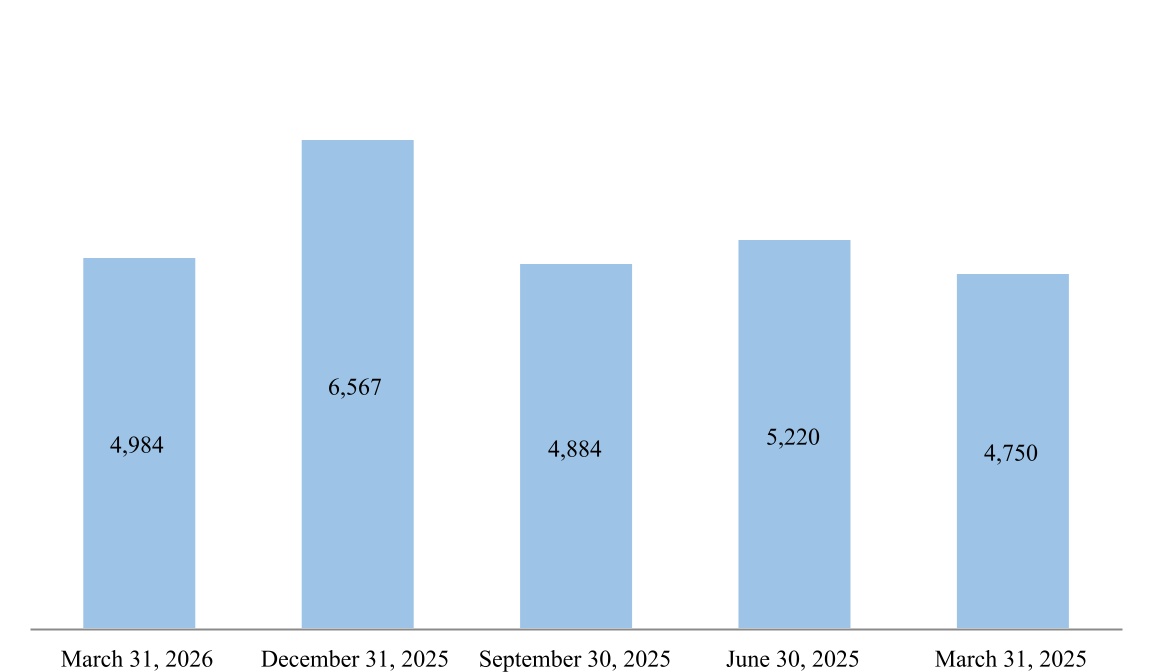
For the three months ended
Units fulfilled increased by 234 units, or 4.9%, for the three months ended March 31, 2026 compared to the three months ended March 31, 2025. The increase was driven by higher probe sales volume in our international distributor and veterinary sales channels, with veterinary sales positively impacted by the launch of our iQ3 Vet probe in the United States and some international markets in the fourth quarter of 2025.
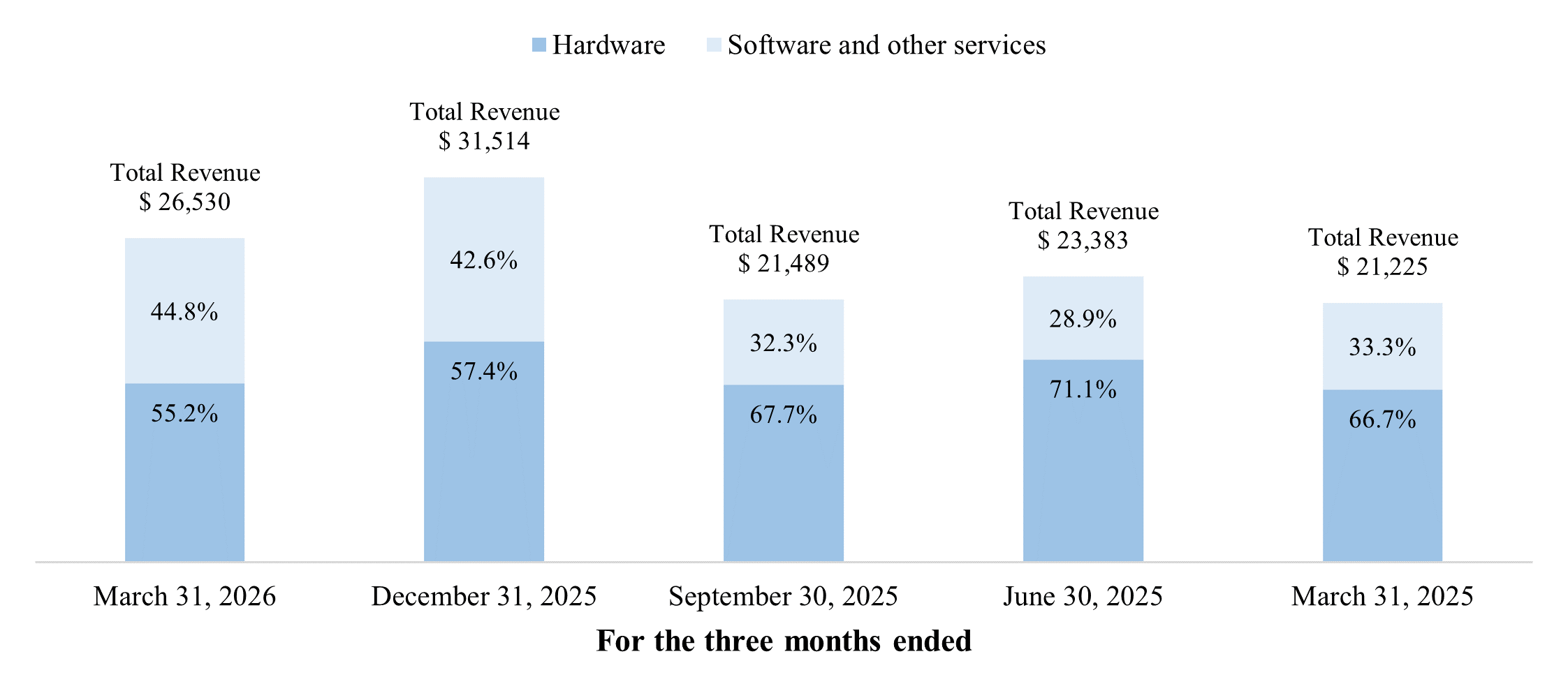
Software and other services mix
We define software and other services mix as a percentage of our total revenue recognized in a reporting period that is based on software subscriptions and other related services, consisting primarily of our software as a service ("SaaS") offering. We view software and other services mix as a key indicator of the profitability of our business, and thus we believe that this measure is useful to investors.
Software and other services mix increased by 11.5 percentage points, to 44.8%, for the three months ended March 31, 2026 compared to the three months ended March 31, 2025. This increase was primarily driven by increases in software and other services revenue generated by our Embedded partnerships.
Description of Certain Components of Financial Data
Revenue
Product revenue consists of revenue from the sale of products, such as medical devices, accessories, and semiconductor chips. Our software and other services revenue consists of revenue from the sale of SaaS subscriptions, extended warranties, services related to our Embedded partnerships, implementation and integration services, and software development kits ("SDKs"), which may be perpetual or term-based. SaaS subscriptions include licenses for teams and individuals as well as enterprise-level subscriptions. Services related to our Embedded partnerships include out-licensing arrangements and related research and development services.
For sales of products and perpetual SDKs, revenue is recognized at a point in time upon transfer of control to the customer. Sales of SaaS subscriptions, extended warranties, and term-based SDKs are generally related to stand-ready obligations or continued provision of access, and the revenue for those offerings is recognized ratably over time. For sales of services related to our Embedded partnerships and implementation and integration services, revenue is recognized over time using input methods to determine a measure of progress.
Over time, as adoption of our devices increases through further market penetration, as practitioners in the Butterfly network continue to use our devices, and as our Embedded collaborations continue to grow and develop, we expect our annual revenue mix to shift more toward software and other services. The quarterly revenue mix may be impacted by the timing of device sales.
To date, we have invested in building out our commercial footprint, with the ultimate goal of growing adoption at large-scale healthcare systems and driving awareness of the usability of ultrasound. As we expand our healthcare system software offerings and develop relationships with larger healthcare systems, we continue to expect a higher proportion of our sales in healthcare systems compared to eCommerce.
Cost of revenue
Cost of product revenue includes manufacturing costs, personnel costs and benefits, inbound freight, packaging, warranty replacement costs, royalty fees for licensed intellectual property, payment processing fees, and inventory obsolescence and write-offs. We expect our cost of product revenue to fluctuate over time due to the level of units fulfilled in any given period and to fluctuate as a percentage of product revenue over time as our focus on operational efficiencies in our supply chain may be offset by increased prices of certain inventory components.
Cost of software and other services revenue includes personnel costs, cloud hosting costs, and payment processing fees. Because the costs and associated expenses to deliver our software and other service offerings are less than the costs and associated expenses of manufacturing and selling our products, we anticipate an improvement in profitability and margin expansion over time as our revenue mix shifts increasingly towards software and other services. We plan to continue to invest additional resources to expand and further develop our SaaS and other service offerings which will be reflected in cost of revenue as amortization expense.
Research and development
Research and development expenses primarily consist of personnel costs and benefits, professional services, facilities-related expenses and depreciation, fabrication services, and software costs. Most of our research and development expenses are related to developing new products and services that have not reached the point of commercialization and improving our products and services that have been commercialized. Fabrication services include certain third-party engineering costs, product testing, and test boards. Research and development expenses are expensed as incurred. We expect to continue to make substantial investments in our product and software development, clinical, and regulatory capabilities.
Sales and marketing
Sales and marketing expenses primarily consist of personnel costs and benefits, advertising, conferences and events, facilities-related expenses, and software costs. We expect to increase our investments in our commercial capabilities.
General and administrative
General and administrative expenses primarily consist of personnel costs and benefits, insurance, patent fees, software costs, facilities-related expenses, and outside services. Outside services consist of professional services, legal fees and other professional fees.
Other
Operating expenses classified as other are expenses which we do not consider representative of our ongoing operations. These other expenses primarily consist of employee severance and benefits costs related to reductions in force, litigation costs, loss contingencies and related loss recoveries related to ongoing litigation, and legal settlements.
Results of Operations
We operate as a single reportable segment to reflect the way our CODM reviews and assesses the performance of the business. The accounting policies are described in Note 2 "Summary of Significant Accounting Policies" in our condensed consolidated financial statements included in this Quarterly Report on Form 10-Q.
| | | | | | | | | | | | | | | | | | | | | | | | | | | | | | | | | | |
| | Three months ended March 31, | | |
| | 2026 | | 2025 | | | | |
| (in thousands) | | Dollars | | % of
revenue | | Dollars | | % of
revenue | | | | | | | | |
| Revenue: | | | | | | | | | | | | | | | | |
| Product | | $ | 14,653 | | | 55.2 | % | | $ | 14,164 | | | 66.7 | % | | | | | | | | |
| Software and other services | | 11,877 | | | 44.8 | | | 7,061 | | | 33.3 | | | | | | | | | |
| Total revenue | | 26,530 | | | 100.0 | | | 21,225 | | | 100.0 | | | | | | | | | |
| Cost of revenue: | | | | | | | | | | | | | | | | |
| Product | | 6,355 | | | 24.0 | | | 5,824 | | | 27.4 | | | | | | | | | |
| Software and other services | | 1,890 | | | 7.1 | | | 2,021 | | | 9.5 | | | | | | | | | |
| Total cost of revenue | | 8,245 | | | 31.1 | | | 7,845 | | | 37.0 | | | | | | | | | |
| Gross profit | | 18,285 | | | 68.9 | | | 13,380 | | | 63.0 | | | | | | | | | |
| Operating expenses: | | | | | | | | | | | | | | | | |
| Research and development | | 9,538 | | | 36.0 | | | 9,924 | | | 46.8 | | | | | | | | | |
| Sales and marketing | | 11,417 | | | 43.0 | | | 11,620 | | | 54.7 | | | | | | | | | |
| General and administrative | | 10,818 | | | 40.8 | | | 9,600 | | | 45.2 | | | | | | | | | |
| Other | | 385 | | | 1.5 | | | 704 | | | 3.3 | | | | | | | | | |
| Total operating expenses | | 32,158 | | | 121.2 | | | 31,848 | | | 150.0 | | | | | | | | | |
| Loss from operations | | (13,873) | | | (52.3) | | | (18,468) | | | (87.0) | | | | | | | | | |
| Interest income | | 1,186 | | | 4.5 | | | 1,651 | | | 7.8 | | | | | | | | | |
| Interest expense | | (279) | | | (1.1) | | | (347) | | | (1.6) | | | | | | | | | |
| Change in fair value of warrant liabilities | | 413 | | | 1.6 | | | 826 | | | 3.9 | | | | | | | | | |
| Other income (expense), net | | (124) | | | (0.5) | | | 2,378 | | | 11.2 | | | | | | | | | |
| Loss before provision for income taxes | | (12,677) | | | (47.8) | | | (13,960) | | | (65.8) | | | | | | | | | |
| Provision for income taxes | | — | | | — | | | 7 | | | — | | | | | | | | | |
| Net loss and comprehensive loss | | $ | (12,677) | | | (47.8) | % | | $ | (13,967) | | | (65.8) | % | | | | | | | | |
Comparison of the three months ended March 31, 2026 and 2025
Revenue
| | | | | | | | | | | | | | | | | | | | | | | | | | |
| | Three months ended March 31, | | | | |
| (in thousands) | | 2026 | | 2025 | | Change | | % Change |
| Product | | $ | 14,653 | | | $ | 14,164 | | | $ | 489 | | | 3.5 | % |
| Software and other services | | 11,877 | | | 7,061 | | | 4,816 | | | 68.2 | |
| | $ | 26,530 | | | $ | 21,225 | | | $ | 5,305 | | | 25.0 | % |
Product revenue increased by $0.5 million, or 3.5%, for the three months ended March 31, 2026 compared to the three months ended March 31, 2025. This increase was driven by higher probe sales volume in our international distributor and veterinary sales channels, with veterinary sales positively impacted by the launch of our iQ3 Vet probe in the United States
and some international markets in the fourth quarter of 2025. We also experienced a favorable shift year-over-year in our product sales mix with a higher proportion of sales of our current-generation iQ3 probes that have a higher selling price than our previous-generation iQ+ probes.
Software and other services revenue increased by $4.8 million, or 68.2%, for the three months ended March 31, 2026 compared to the three months ended March 31, 2025. This increase was primarily driven by increases in software and other services revenue generated by our Embedded partnerships.
Cost of revenue
| | | | | | | | | | | | | | | | | | | | | | | | | | |
| | Three months ended March 31, | | | | |
| (in thousands) | | 2026 | | 2025 | | Change | | % Change |
| Product | | $ | 6,355 | | | $ | 5,824 | | | $ | 531 | | | 9.1 | % |
| Software and other services | | 1,890 | | | 2,021 | | | (131) | | | (6.5) | |
| | $ | 8,245 | | | $ | 7,845 | | | $ | 400 | | | 5.1 | % |
| Percentage of revenue | | 31.1 | % | | 37.0 | % | | | | |
Cost of product revenue increased by $0.5 million, or 9.1%, for the three months ended March 31, 2026 compared to the three months ended March 31, 2025, driven by a $0.5 million increase in cost of devices sold as a result of our higher probe sales volume and a $0.5 million increase in adjustments to our product warranty reserve. These increases were partially offset by a $0.5 million decrease in costs for non-recurring semiconductor chip sales during the prior year period.
Cost of software and other services revenue remained relatively flat for the three months ended March 31, 2026 compared to the three months ended March 31, 2025, decreasing by $0.1 million, or 6.5%. This decrease was primarily driven by a $0.6 million decrease in amortization expense for software development investments that we made in prior years, partially offset by a $0.5 million increase in costs related to providing services to our Embedded partners.
Research and development
| | | | | | | | | | | | | | | | | | | | | | | | | | |
| | Three months ended March 31, | | | | |
| (in thousands) | | 2026 | | 2025 | | Change | | % Change |
| Research and development | | $ | 9,538 | | | $ | 9,924 | | | $ | (386) | | | (3.9) | % |
| Percentage of revenue | | 36.0 | % | | 46.8 | % | | | | |
Research and development expenses decreased by $0.4 million, or 3.9%, for the three months ended March 31, 2026 compared to the three months ended March 31, 2025. This decrease was driven by a $0.7 million reduction in personnel costs as we allocated more of our personnel costs to cost of software and other services revenue for our Embedded program and capitalized more of our personnel costs for the development of internal-use software. This reduction was partially offset by a $0.2 million increase in software costs as we leveraged more third-party AI tools to optimize our employee workflows during the period.
Sales and marketing
| | | | | | | | | | | | | | | | | | | | | | | | | | |
| | Three months ended March 31, | | | | |
| (in thousands) | | 2026 | | 2025 | | Change | | % Change |
| Sales and marketing | | $ | 11,417 | | | $ | 11,620 | | | $ | (203) | | | (1.7) | % |
| Percentage of revenue | | 43.0 | % | | 54.7 | % | | | | |
Sales and marketing expenses remained relatively flat for the three months ended March 31, 2026 compared to the three months ended March 31, 2025, decreasing by $0.2 million, or 1.7%, largely driven by optimization of our marketing investments while delivering higher sales volume and revenue.
General and administrative
| | | | | | | | | | | | | | | | | | | | | | | | | | |
| | Three months ended March 31, | | | | |
| (in thousands) | | 2026 | | 2025 | | Change | | % Change |
| General and administrative | | $ | 10,818 | | | $ | 9,600 | | | $ | 1,218 | | | 12.7 | % |
| Percentage of revenue | | 40.8 | % | | 45.2 | % | | | | |
General and administrative expenses increased by $1.2 million, or 12.7%, for the three months ended March 31, 2026 compared to the three months ended March 31, 2025. This increase was primarily driven by a $0.7 million increase in personnel costs due to increased headcount and a $0.3 million increase in professional service costs for consulting, accounting, and auditing services.
Other
| | | | | | | | | | | | | | | | | | | | | | | | | | |
| | Three months ended March 31, | | | | |
| (in thousands) | | 2026 | | 2025 | | Change | | % Change |
| Other | | $ | 385 | | | $ | 704 | | | $ | (319) | | | (45.3) | % |
| Percentage of revenue | | 1.5 | % | | 3.3 | % | | | | |
Other decreased by $0.3 million, or 45.3%, for the three months ended March 31, 2026 compared to the three months ended March 31, 2025. This decrease was driven by the recognition of a $6.0 million loss recovery for expected insurance recoveries related to our estimated liabilities for loss contingencies. This decrease was partially offset by the recognition of $3.3 million of estimated liabilities for loss contingencies related to ongoing litigation, $2.2 million of higher legal costs due to litigation, and $0.3 million of higher employment-related costs. We believe these costs are not representative of our ongoing operations.
Liquidity and Capital Resources
Since our inception, our primary sources of liquidity are cash flows from operations and proceeds from stock issuances and the Business Combination. Our primary uses of liquidity are operating expenses, working capital requirements, and capital expenditures.
During the three months ended March 31, 2026, the Company utilized $12.5 million of cash and cash equivalents for ongoing operations and the payment of our annual employee and management bonuses. As of March 31, 2026, our cash and cash equivalents balance was $138.0 million. Our future spending will depend on various factors, including our rate of revenue growth and the timing and extent of spending on strategic business initiatives. We expect that our existing cash and cash flows from operations will be sufficient to meet our anticipated liquidity, working capital, and capital expenditure requirements and fund our operations for at least the next 12 months.
As of March 31, 2026, we have restricted cash of $4.0 million to secure a letter of credit for one of our leases, which is expected to be maintained as a security deposit for the duration of the lease.
Our material cash requirements include contractual obligations with third parties for office leases, technology licensing agreements, inventory supply agreements, and outsourced services. Our fixed office lease payment obligations were $23.4 million as of March 31, 2026, with $3.8 million payable within the next 12 months. Our fixed technology license payment obligations were $10.5 million as of March 31, 2026, with $1.5 million payable within the next 12 months. Our fixed purchase obligations for inventory supply agreements, net of vendor advances, were $2.3 million as of March 31, 2026, all of which is payable within the next 12 months. Our fixed outsourced services payment obligations were $3.8 million as of March 31, 2026, with $1.4 million payable within the next 12 months.
As of March 31, 2026, we had no obligations, assets or liabilities, which would be considered off-balance sheet arrangements.
Cash flows
Comparison of the three months ended March 31, 2026 and 2025
The following table summarizes our sources and uses of cash for the three months ended March 31, 2026 and 2025:
| | | | | | | | | | | | | | |
| | Three months ended March 31, |
| (in thousands) | | 2026 | | 2025 |
| Net cash used in operating activities | | $ | (13,894) | | | $ | (11,677) | |
Net cash used in investing activities | | (950) | | | (353) | |
| Net cash provided by financing activities | | 2,309 | | | 78,467 | |
Net increase (decrease) in cash, cash equivalents, and restricted cash | | $ | (12,535) | | | $ | 66,437 | |
Net cash used in operating activities
Net cash used in operating activities represents the cash receipts and disbursements related to our activities other than investing and financing activities. We expect cash provided by historical financing activities will continue to be our primary source of funds to support operating and capital expenditure needs for the foreseeable future.
Net cash used in operating activities increased by $2.2 million, or 19.0%, for the three months ended March 31, 2026 compared to the three months ended March 31, 2025. The increase was comprised of a $2.6 million increase in net working capital cash usage partially offset by a reduction of $0.4 million in net loss adjusted for certain non-cash items. The increase in net working capital cash usage was primarily driven by a $5.4 million increase in cash used for changes in prepaid expenses and other assets and a $3.5 million increase in cash used for changes in deferred revenue. These increases in cash usage were partially offset by a $6.0 million decrease in cash used for changes in accounts payable and accrued expenses and a $0.6 million increase in cash provided by changes in accounts receivable.
Net cash used in investing activities
Net cash used in investing activities increased by $0.6 million, or 169.1%, for the three months ended March 31, 2026 compared to the three months ended March 31, 2025, primarily driven by increased investment in the development of our internal-use software.
Net cash provided by financing activities
Net cash provided by financing activities decreased by $76.2 million for the three months ended March 31, 2026 compared to the three months ended March 31, 2025. This decrease was primarily due to the $81.1 million provided by the net proceeds from our public share offering during the prior year period.
Critical Accounting Policies and Significant Judgments and Estimates
This discussion and analysis of our financial condition and results of operations are based on our condensed consolidated financial statements which have been prepared in accordance with U.S. GAAP. The preparation of these condensed consolidated financial statements requires us to make estimates and assumptions that affect the reported amounts of assets, liabilities, revenue, contingent assets and liabilities, and related disclosures. Our estimates are based on our historical experience and various other factors that we believe are reasonable under the circumstances, and these form the basis for making judgments about items that are not readily apparent from other sources. Actual results may differ from these estimates under different assumptions or conditions.
As of March 31, 2026, we concluded that a revision to our estimated liabilities for loss contingencies related to ongoing litigation and the recognition of a related insurance recovery asset were appropriate. As a result, we recognized an additional $3.3 million estimated loss and a $6.0 million loss recovery in our other operating expenses during the three months ended March 31, 2026. See the "Use of Estimates" subheading in Note 2 "Summary of Significant Accounting Policies" and see Note 12 "Commitments and Contingencies" in the Notes to Condensed Consolidated Financial Statements in Part I, Item 1 "Financial Statements" of this Quarterly Report on Form 10-Q for additional information about our estimated liabilities for loss contingencies and the related insurance recovery asset.
For our condensed consolidated financial statements included in this Quarterly Report on Form 10-Q, there have been no other material changes to the critical accounting policies and estimates disclosed in our 2025 Annual Report on Form 10-K.
Recently Issued Accounting Pronouncements
A description of recently issued accounting pronouncements that may potentially impact our financial position and results of operations is set forth in Note 2 "Summary of Significant Accounting Policies" in the Notes to Condensed Consolidated Financial Statements in Part I, Item 1 "Financial Statements" of this Quarterly Report on Form 10-Q.
Item 3. Quantitative and Qualitative Disclosures About Market Risk
Interest Rate Risk
We did not have any floating rate debt as of March 31, 2026. Our cash and cash equivalents are comprised primarily of bank deposits and money market accounts. The primary objective of our investments is the preservation of capital to fulfill liquidity needs. We do not enter into investments for trading or speculative purposes. Due to the short-term nature and low risk profile of these investments, we do not expect cash flows to be affected to any significant degree by a sudden change in market interest rates, including an immediate change of 100 basis points, or one percentage point. Declines in interest rates, however, would reduce future investment income.
Inflation Risk
We do not believe that inflation has had a material effect on our business, financial condition, or results of operations, other than its impact on the general economy. Nonetheless, to the extent our costs are impacted by general inflationary pressures, including as a result of tariffs, we may not be able to fully offset such higher costs through price increases or manufacturing efficiencies. Our inability or failure to do so could harm our business, financial condition, and results of operations.
Foreign Exchange Risk
We operate our business primarily within the United States and currently execute the majority of our transactions in U.S. dollars. We have not utilized hedging strategies with respect to such foreign exchange exposure. This limited foreign currency translation risk is not expected to have a material impact on our condensed consolidated financial statements.
Item 4. Controls and Procedures
Evaluation of Disclosure Controls and Procedures
Under the supervision and with the participation of our management, including our principal executive officer and principal financial officer, we conducted an evaluation of the effectiveness of the design and operation of our disclosure controls and procedures, as defined in Rules 13a-15(e) and 15d-15(e) under the Exchange Act as of the end of the period covered by this Quarterly Report on Form 10-Q.
Disclosure controls and procedures are designed to ensure that information required to be disclosed in our reports filed or submitted under the Exchange Act is recorded, processed, summarized, and reported within the time periods specified in the SEC’s rules and forms. Disclosure controls and procedures include controls and procedures designed to ensure that information required to be disclosed in our reports filed under the Exchange Act is accumulated and communicated to management, including our Chief Executive Officer and Chief Financial Officer, to allow timely decisions regarding required disclosure. Management recognizes that any controls and procedures, no matter how well designed and operated, can provide only reasonable assurance of achieving the desired control objectives, and management necessarily applies its judgment in evaluating the cost-benefit relationship of possible controls and procedures.
Based on the evaluation of our disclosure controls and procedures, our Chief Executive Officer and Chief Financial Officer concluded that our disclosure controls and procedures were effective as of March 31, 2026.
Changes in Internal Control over Financial Reporting
There were no changes in our internal control over financial reporting identified in connection with the evaluation required by Rules 13a-15(d) and 15d-15(d) of the Exchange Act that occurred during the three months ended March 31, 2026 that have materially affected, or are reasonably likely to materially affect, our internal control over financial reporting.
PART II — OTHER INFORMATION
Item 1. Legal Proceedings
We are currently and may in the future be subject to legal proceedings, claims, and regulatory actions arising in the ordinary course of business. The outcome of any such matters, regardless of the merits, is inherently uncertain.
For more information about our legal proceedings and this item, see Note 12 "Commitments and Contingencies" in the Notes to Condensed Consolidated Financial Statements in Part I, Item 1 "Financial Statements" of this Quarterly Report on Form 10-Q, which is incorporated herein by reference.
Item 1A. Risk Factors
Our business, results of operations, and financial condition are subject to various risks and uncertainties including the risk factors described under the caption "Risk Factors" in our 2025 Annual Report on Form 10-K. There have been no material changes to the risk factors described in the 2025 Annual Report on Form 10-K.
Item 2. Unregistered Sales of Equity Securities and Use of Proceeds
Unregistered Sales of Equity Securities
Not applicable.
Issuer Purchases of Equity Securities
We did not repurchase any of our equity securities during the three months ended March 31, 2026.
Item 5. Other Information
Rule 10b5-1 Trading Arrangements
On March 13, 2026, Dr. Jonathan Rothberg, a member of our board of directors, and entities owned by trusts created for the benefit of Dr. Rothberg's children adopted a "Rule 10b5-1 trading arrangement" (as such term is defined in Item 408 of Regulation S-K), pursuant to which Dr. Rothberg has authorized the sale of up to 2,799,818 shares of our Class A common stock and up to 5,000,000 shares of our Class B common stock during a period beginning on July 14, 2026, and ending on July 14, 2027. This trading plan was entered into in accordance with the Company’s policies regarding transactions in our securities.
During the three months ended March 31, 2026, none of our other directors or officers (as defined in Rule 16a-1(f) of the Exchange Act) of the Company adopted, modified, or terminated a "Rule 10b5-1 trading arrangement" or "non-Rule 10b5-1 trading arrangement", as each term is defined in Item 408 of Regulation S-K.
Item 6. Exhibits
See Exhibit Index.
EXHIBIT INDEX
| | | | | | | | | | | | | | | | | | | | | | | | | | | | | | | | |
| Exhibit Number | | Exhibit Description | | Filed Herewith | | Incorporated by Reference herein from Form or Schedule | | Filing Date | | SEC File/ Reg. Number |
| 3.1 | | | | | | Form 8-K (Exhibit 3.1) | | 6/13/2024 | | 001-39292 |
| 3.2 | | | | | | Form 8-K (Exhibit 3.2) | | 2/16/2021 | | 001-39292 |
| 31.1 | | | | X | | | | | | |
| 31.2 | | | | X | | | | | | |
| 32.1 | | | | X* | | | | | | |
| 101.INS | | Inline XBRL Instance Document - The instance document does not appear in the Interactive Data File because its Inline XBRL tags are embedded within the Inline XBRL document. | | X | | | | | | |
| 101.SCH | | Inline XBRL Taxonomy Extension Schema Document. | | X | | | | | | |
| 101.CAL | | Inline XBRL Taxonomy Extension Calculation Linkbase Document. | | X | | | | | | |
| 101.DEF | | Inline XBRL Taxonomy Extension Definition Linkbase Document. | | X | | | | | | |
| 101.LAB | | Inline XBRL Taxonomy Extension Label Linkbase Document. | | X | | | | | | |
| 101.PRE | | Inline XBRL Taxonomy Extension Presentation Linkbase Document. | | X | | | | | | |
| 104 | | Cover Page Interactive Data File (formatted in Inline XBRL and contained in Exhibit 101) | | X | | | | | | |
* Furnished herewith.
SIGNATURES
Pursuant to the requirements of the Securities Exchange Act of 1934, the registrant has duly caused this report to be signed on its behalf by the undersigned thereunto duly authorized.
| | | | | | | | |
| BUTTERFLY NETWORK, INC. |
| | |
| | |
Date: April 30, 2026 | By: | /s/ John Doherty |
| | John Doherty |
| | Executive Vice President, Chief Financial Officer |