UNITED STATES
SECURITIES AND EXCHANGE COMMISSION
Washington, D.C. 20549
FORM
(Mark One)
| REGISTRATION STATEMENT PURSUANT TO SECTION 12(b) OR (g) OF THE SECURITIES EXCHANGE ACT OF 1934 |
OR
| ANNUAL REPORT PURSUANT TO SECTION 13 OR 15(d) OF THE SECURITIES EXCHANGE ACT OF 1934 For the fiscal year ended |
OR
| TRANSITION REPORT PURSUANT TO SECTION 13 OR 15(d) OF THE SECURITIES EXCHANGE ACT OF 1934 |
OR
| SHELL
COMPANY REPORT PURSUANT TO SECTION 13 OR 15(d) OF THE SECURITIES EXCHANGE ACT OF 1934 Date of event requiring this shell company report For the transition period from to . |
Commission file number:
(Exact name of Registrant as specified in its charter)
N/A
(Translation of Registrant’s name into English)
(Jurisdiction of incorporation or organization)
Funcionários, Belo Horizonte
(Address of principal executive offices)
Chief Executive Officer
Tel.: +
Funcionários, Belo Horizonte,
(Name, Telephone, E-mail and/or Facsimile number and Address of Company Contact Person)
Securities registered or to be registered pursuant to Section 12(b) of the Act:
|
Title of each class |
Trading Symbol(s) |
Name of each exchange on which registered |
Securities registered or to be registered pursuant to Section 12(g) of the Act:
None
Securities for which there is a reporting obligation pursuant to Section 15(d) of the Act:
None
Indicate the number of outstanding shares of each of the issuer’s classes of capital or common stock as of the close of the period covered by the annual report.
The number of outstanding shares as of December 31, 2025 was Class A common shares (including Class A common shares held in treasury) and Class B common shares.
Indicate by check mark if the registrant is a well-known seasoned issuer, as defined in Rule 405 of the Securities Act.
Yes ☐
If this report is an annual or transition report, indicate by check mark if the registrant is not required to file reports pursuant to Section 13 or 15(d) of the Securities Exchange Act of 1934.
Yes ☐
Note — Checking the box above will not relieve any registrant required to file reports pursuant to Section 13 or 15(d) of the Securities Exchange Act of 1934 from their obligations under those Sections.
Indicate by check mark whether the registrant (1) has filed all reports required to be filed by Section 13 or 15(d) of the Securities Exchange Act of 1934 during the preceding 12 months (or for such shorter period that the registrant was required to file such reports), and (2) has been subject to such filing requirements for the past 90 days.
Indicate by check mark whether the registrant has submitted electronically every Interactive Data File required to be submitted pursuant to Rule 405 of Regulation S-T (§232.405 of this chapter) during the preceding 12 months (or for such shorter period that the registrant was required to submit such files).
Indicate by check mark whether the registrant is a large accelerated filer, an accelerated filer, a non-accelerated filer or an emerging growth company. See definition of “large accelerated filer,” “accelerated filer,” and “emerging growth company” in Rule 12b-2 of the Exchange Act. (Check one):
Non-accelerated Filer ☐ Emerging
growth company
If an emerging growth company that prepares its financial statements in accordance with U.S. GAAP, indicate by check mark if the registrant has elected not to use the extended transition period for complying with any new or revised financial accounting standards† provided pursuant to Section 13(a) of the Exchange Act. ☐
† The term “new or revised financial accounting standard” refers to any update issued by the Financial Accounting Standards Board to its Accounting Standards Codification after April 5, 2012.
If securities are registered pursuant to Section 12(b) of the Act,
indicate by check mark whether the financial statements of the registrant included in the filing reflect the correction of an error to
previously issued financial statements.
Indicate by check mark whether any of those error corrections are restatements that required a recovery analysis of incentive-based compensation received by any of the registrant’s executive officers during the relevant recovery period pursuant to § 240.10D-1(b). ☐
Indicate by check mark whether the registrant has filed a report
on and attestation to its management’s assessment of the effectiveness of its internal control over financial reporting under Section
404(b) of the Sarbanes-Oxley Act (15 U.S.C. 7262(b)) by the registered public accounting firm that prepared or issued its audit report.
Indicate by check mark which basis of accounting the registrant has used to prepare the financial statements included in this filing:
☐ U.S. GAAP
☒
☐ Other
If “Other” has been checked in response to the previous question, indicate by check mark which financial statement item the registrant has elected to follow.
☐ Item 17 ☐ Item 18
If this is an annual report, indicate by check mark whether the registrant is a shell company (as defined in Rule 12b-2 of the Exchange Act).
Yes ☐ No
table of contents
Page
| i |
| ii |
PART I
INTRODUCTION
Certain Definitions
Unless otherwise indicated or the context otherwise requires, all references in this annual report to “Afya” or the “Company,” “we,” “our,” “ours,” “us” or similar terms refer to Afya Limited, together with its subsidiaries; all references in this annual report to “Afya Brazil” refer to Afya Participações S.A.; all references in this annual report to “Medcel” refer to Medcel Editora e Eventos S.A. (merged by Afya Brazil in 2024); and all references in this annual report to “IPTAN” refer to IPTAN—Instituto de Ensino Superior Presidente Tancredo de Almeida Neves S.A., “IESVAP” refer to Instituto de Educação Superior do Vale do Parnaíba S.A., “CCSI” refer to Centro de Ciências em Saúde de Itajubá S.A., “IESP” refer to Instituto de Ensino Superior do Piauí S.A., “FADEP” refer to FADEP—Faculdade Educacional de Pato Branco Ltda., “FASA” refer to Instituto Educacional Santo Agostinho S.A., “IPEMED” refer to Instituto de Pesquisa e Ensino Médico do Estado de Minas Gerais Ltda. (merged by Afya Brazil in 2024), “IPEC” refer to Instituto Paraense de Educação e Cultura Ltda., “UniRedentor” refer to Sociedade Universitária Redentor S.A., “UniSL” refer to Centro Universitário São Lucas Ltda., “PEBMED” refer to PEBMED Instituição de Pesquisa Médica e Serviços Tecnológicos da Área da Saúde S.A. (merged by Afya Brazil in 2024), “FESAR” refer to Sociedade de Educação, Cultura e Tecnologia da Amazônia S.A., “MedPhone” refer to MedPhone Tecnologia em Saúde Ltda. (merged by Afya Brazil in 2022), “FCMPB” refer to Centro Superior de Ciências da Saúde Ltda., “UnifipMoc” refer to Sociedade Padrão de Educação Superior Ltda., “iClinic” refer to iClinic Desenvolvimento de Software S.A. (merged by Afya Brazil in 2025), “Medicinae” refer to Medicinae Solutions S.A. (merged by Afya Brazil in 2025), “Medical Harbour” refer to Medical Harbour Aparelhos Médico-Hospitalares e Serviços em Tecnologia Ltda., “Cliquefarma” refer to Cliquefarma Drogarias Online Ltda. (merged by Afya Brazil in 2025), “Shosp” refer to Shosp Tecnologia da Informação Ltda. (merged by Afya Brazil in 2025), “Unigranrio” refer to Companhia Nilza Cordeiro Herdy de Educação e Cultura, “RX PRO” refer to RX PRO Soluções de Tecnologia Ltda. (merged by Afya Brazil in 2025), “Garanhuns” refer to Faculdade ITPAC Garanhuns - Instituto Tocantinense Presidente Antonio Carlos Ltda., “Além da Medicina” refer to BMV Atividades Médicas Ltda. (merged by Afya Brazil in 2024), “CardioPapers” refer to Cardiopapers Soluções Digitais Ltda. (merged by Afya Brazil in 2024), “Glic” refer to Quasar Telemedicina Desenvolvimento de Sistemas Computacionais Ltda. (merged by Afya Brazil in 2025), “DelRey” refer to Sociedade Educacional e Cultural Sergipe DelRey Ltda., “UNIVAÇO” refer União Educacional do Vale do Aço S.A., “ITPAC Araguaína” refer to ITPAC - Instituto Tocantinense Presidente Antônio Carlos S.A., “ITPAC Porto” refer to ITPAC Porto - Instituto Tocantinense Presidente Antônio Carlos Porto S.A., “UEPC” refer to União Educacional do Planalto Central S.A., “Unidom” refer to Unidom Participações S.A. (merged by Afya Brazil in 2025), “IBES” refer to Instituição Baiana de Ensino Superior Ltda., “Sessa” refer to SESSA — Sociedade de Educação Superior do Semi-Árido Ltda., and “FUNIC” refer to Faculdade Masterclass Ltda.
The term “Esteves Family” refers to Nicolau Carvalho Esteves, Rosângela de Oliveira Tavares Esteves, NRE Capital Ventures Ltd. and NRE B Ventures Ltd., collectively, our former controlling shareholders. The term “Bertelsmann” refers to Bertelsmann SE & Co. KGaA and Erste WV Gütersloh GmbH, collectively, our current controlling shareholder.
The term “Brazil” refers to the Federative Republic of Brazil, and the phrase “Brazilian government” refers to the federal government of Brazil. “Central Bank” refers to the Brazilian Central Bank (Banco Central do Brasil). References in the annual report to “real,” “reais” or “R$” refer to the Brazilian real, the official currency of Brazil, and references to “U.S. dollar,” “U.S. dollars” or “US$” refer to U.S. dollars, the official currency of the United States.
Financial Information
Afya is a Cayman Islands exempted company with limited liability duly registered with the Cayman Islands Registrar of Companies and was incorporated on March 22, 2019.
The consolidated financial information of Afya contained in this annual report is derived from our audited consolidated financial statements as of December 31, 2025 and 2024 and for each of the years in the three-year period ended December 31, 2025, together with the notes thereto. All references herein to “our consolidated financial statements” are to Afya’s audited consolidated financial statements included elsewhere in this annual report.
| 1 |
Afya is a holding company, and as such, the primary source of revenue derives from its interest in its operational companies in Brazil. Afya’s functional currency as well as that of its subsidiaries is the Brazilian real. We prepare our consolidated financial statements in accordance with IFRS Accounting Standards as issued by the International Accounting Standards Board (“IFRS Accounting Standards”).
Our fiscal year ends on December 31 of each year, so all references to a particular fiscal year are to the applicable year ended December 31.
Convenience Translation
The reporting currency for our consolidated financial statements is the Brazilian real and, solely for the convenience of the reader, we have provided convenience translations into U.S. dollars using the selling exchange rates published by the Central Bank on its website. Unless otherwise indicated, convenience translations from reais into U.S. dollars in this annual report use the Central Bank offer exchange rate published on December 31, 2025, which was R$5.5024 per US$1.00. No representation is made that the Brazilian reais amounts referred to could have been, or could be, converted into U.S. dollars at any particular rate.
Market Data
This annual report contains data related to economic conditions in the market in which we operate. The information contained in this annual report concerning economic conditions is based on publicly available information from third-party sources that we believe to be reasonable. Market data and certain industry forecast data used in this annual report were obtained from internal reports and studies, where appropriate, as well as estimates, market research, publicly available information (including information available from the United States Securities and Exchange Commission website) and industry publications. We obtained the information included in this annual report relating to the industry in which we operate, as well as the estimates concerning market shares, through internal research, a report by a third-party consulting firm commissioned by us, public information and publications on the industry prepared by official public sources, such as the Central Bank, the Brazilian Institute of Geography and Statistics (Instituto Brasileiro de Geografia e Estatística), or the IBGE, the Organisation for Economic Co-operation and Development, or OECD, the Brazilian Ministry of Education (Ministério da Educação), or MEC, the Anísio Teixeira National Institute of Educational Studies and Research (Instituto Nacional de Estudos e Pesquisas Educacionais Anísio Teixeira), or the INEP, the Institute of Applied Economic Research (Instituto de Pesquisa Econômica Aplicada), or the IPEA, the Brazilian Medical Association (Associação Médica Brasileira), or AMB as well as private sources, such as Bloomberg, consulting and research companies in the Brazilian and international education industry, the Brazilian Economic Institute of Fundação Getulio Vargas (Instituto Brasileiro de Economia da Fundação Getulio Vargas), or FGV/IBRE, the Association of American Medical Colleges, or AAMC among others.
Industry publications, governmental publications and other market sources, including those referred to above, generally state that the information they include has been obtained from sources believed to be reliable, but that the accuracy and completeness of such information is not guaranteed. While we are not aware of any misstatements regarding the market and industry data presented herein, our estimates involve risks and uncertainties and are subject to change based on various factors, including those discussed in the section entitled “Item 3. Key Information—D. Risk Factors.” Except as disclosed in this annual report, none of the publications, reports or other published industry sources referred to in this annual report were commissioned by us or prepared at our request. Except as disclosed in this annual report, we have not sought or obtained the consent of any of these sources to include such market data in this annual report.
Rounding
We have made rounding adjustments to some of the figures included in this annual report. Accordingly, numerical figures shown as totals in some tables may not be an arithmetic aggregation of the figures that preceded them.
| 2 |
Forward-Looking Statements
This annual report on Form 20-F contains information that constitutes forward-looking statements within the meaning of Section 27A of the Securities Act, and Section 21E of the Securities Exchange Act of 1934, as amended, or Exchange Act, that are not based on historical facts and are not assurances of future results. The forward-looking statements contained in this annual report, which address our expected business and financial performance, among other matters, contain words such as “believe,” “expect,” “estimate,” “anticipate,” “intend,” “plan,” “aim,” “will,” “may,” “should,” “could,” “would,” “likely,” “potential” and similar expressions. We have made forward-looking statements that address, among other things, our current expectations, plans, forecasts, projections and strategies about future events and financial trends that affect, or may affect, our business, industry, market share, reputation, financial condition, results of operations, margins, cash flow and/or the market price of our common shares, all of which are subject to known and unknown risks and uncertainties. Our actual results may differ materially from those expressed or implied in the forward-looking statements due to various factors, including, but not limited to, those identified under the section entitled “Item 3. Key Information—D. Risk Factors” in this annual report. These risks and uncertainties include factors relating to:
| · | our ability to implement our business strategy; |
| · | changes in government regulations and legislation applicable to the education industry in Brazil, both in the traditional and distance learning segments, including tax regulations and/or legislation; |
| · | government interventions, including changes in, or termination of, education industry programs such as the Higher Education Student Financing Fund (Fundo de Financiamento ao Estudante do Ensino Superior), or FIES, and/or the University for All Program (Programa Universidade para Todos), or PROUNI, both in the traditional and distance learning segments, that affect the economic or tax regime, the collection of tuition fees or the regulatory framework applicable to educational institutions; |
| · | changes in the financial condition of the students enrolling in our institutions in general and in the competitive conditions in the education industry, both in the traditional and distance learning segments, or changes in the financial condition of our institutions; |
| · | our ability to adapt to technological changes in the educational sector, including in relation to distance learning programs; |
| · | the availability of government authorizations on terms and conditions and within periods acceptable to us; |
| · | developments with respect to actual or potential epidemics, pandemics, outbreaks or other public health crises in Brazil and globally; |
| · | our ability to continue attracting and retaining new students; |
| · | our ability to maintain the academic quality of our programs; |
| · | our ability to compete and conduct our business in the future; |
| · | the success of operating initiatives, including advertising and promotional efforts and new product, service and concept development by us and our competitors; |
| · | changes in consumer demands and preferences and technological advances, and our ability to innovate to respond to such changes; |
| · | the availability of qualified personnel and the ability to retain such personnel; |
| · | our capitalization and level of indebtedness; |
| · | the interests of our controlling shareholder; |
| · | a decline in the number of students enrolled in our programs or the amount of tuition we can charge; |
| 3 |
| · | changes in labor, distribution and other operating costs; |
| · | our compliance with, and changes to, government laws, regulations and tax matters that currently apply to us; |
| · | general economic, financial, political, demographic and business conditions in Brazil, including the impact of the current international economic environment and the macroeconomic conditions in Brazil, the impact of the Brazilian presidential elections to be held in October 2026, as well as any other countries we may serve in the future and their impact on our business; |
| · | the effects of the ongoing conflicts in Europe and the Middle East and related disruptions on the general economic and business conditions in Brazil, Latin America and globally; |
| · | fluctuations in interest, inflation and exchange rates in Brazil and any other countries we may serve in the future; |
| · | other factors that may affect our financial condition, liquidity and results of operations; |
| · | the effectiveness of our risk management policies and procedures, including our internal control over financial reporting; and |
| · | the other factors discussed under the section “Risk Factors” in this annual report on Form 20-F. |
Prospective investors are cautioned that any such forward-looking statements are not guarantees of future performance and involve risks and uncertainties, and that actual results may differ materially from those in the forward-looking statements. The accompanying information contained in this annual report on Form 20-F, including without limitation the information set forth under the heading “Item 5. Operating and Financial Review and Prospects” identifies important factors that could cause such differences. In light of the risks, uncertainties and assumptions associated with forward-looking statements, you should not place undue reliance on any forward-looking statements. Additional risks that we may currently deem immaterial or that are not presently known to us could also cause the forward-looking events discussed in this annual report on Form 20-F not to occur.
Our forward-looking statements speak only as of the date of this annual report on Form 20-F, and we do not undertake any obligation to update them in light of new information or future developments or to release publicly any revisions to these statements in order to reflect later events or circumstances or to reflect the occurrence of unanticipated events.
ITEM 1. IDENTITY OF DIRECTORS, SENIOR MANAGEMENT AND ADVISERS
Not applicable.
ITEM 2. OFFER STATISTICS AND EXPECTED TIMETABLE
Not applicable.
ITEM 3. KEY INFORMATION
A. Reserved
B. Capitalization and Indebtedness
Not applicable.
C. Reasons for the Offer and Use of Proceeds
Not applicable.
| 4 |
D. Risk Factors
Summary of Risk Factors
An investment in our Class A common shares is subject to several risks, including risks relating to our business and industry, risks relating to Brazil and risks relating to our Class A common shares. The following list summarizes some, but not all, of these risks. Please read the information in the section entitled “Risk Factors” for a more thorough description of these and other risks.
Certain Risks Relating to Our Business and Industry
| · | We face significant competition in the provision of our educational services. If our competition increases or if we fail to compete efficiently, we may lose market share, and our profitability may be adversely affected. We compete with various public and private post-secondary education institutions, including distance learning institutions and remote locations. If our competition increases due to lighter regulatory constraints or otherwise, or if we fail to compete effectively, our business, results of operations and financial condition could be materially affected. |
| · | Changes to the rules, judicial interpretations, administrative decisions or delays or suspension of tuition payments made through FIES may adversely affect our cash flows and our business. |
| · | If we lose the benefits of federal tax exemptions provided under the PROUNI program, our business, financial condition and results of operations may be materially adversely affected. We may be disqualified from the PROUNI program and lose our tax exemptions if we do not comply with certain requirements. |
| · | An increase in delays and/or defaults in the payment of tuition fees or license subscription fees of medical practice solutions may adversely affect our income and cash flows. |
| · | We may face challenges in identifying and acquiring new medical higher education institutions, which could hinder our strategic and financial goals. Additionally, difficulties in effectively integrating and managing an increasing number of acquisitions may adversely affect our strategic objectives. We aim to expand our operations by acquiring medical higher education institutions and health tech companies, including potentially significant and strategically relevant acquisitions. However, we cannot guarantee the identification or acquisition of suitable medical education institutions on favorable terms or at all. Additionally, integrating acquired companies may present challenges, such as managing a larger, geographically dispersed workforce, implementing uniform controls, procedures, and policies, and incurring high or unexpected integration costs. |
| · | We may require additional funds to continue our expansion strategy. If we are unable to obtain adequate financing on favorable terms to complete any potential acquisition and implement our expansion plans, our growth strategy may be materially and adversely affected. If adequate funds are unavailable or are not available on acceptable terms, we may be unable to fund our expansion, capitalize on acquisition opportunities, develop or enhance our product and service portfolio, or respond to competitive pressures, which could have a material adverse effect on our business, results of operations and financial condition. |
| · | Our revenues are highly concentrated in the tuition fees we charge for our medical courses. Any adverse economic, market or regulatory factors affecting such medical courses could decrease demand, which could materially adversely affect us. Economic, market or regulatory factors affecting either the amount of tuition fees we are able to charge for the medical courses we offer or the ability of our students to pay such tuition fees could result in significantly decreased demand for our services. |
Certain Risks Relating to Brazil
| · | The Brazilian federal government has exercised, and continues to exercise, significant influence over the Brazilian economy. This involvement as well as Brazil’s political and economic conditions could harm us and the price of our Class A common shares. The Brazilian government’s actions to control inflation and other policies and regulations have often involved increases or decreases in interest rates, changes in fiscal policies, wage and price controls, currency devaluations, capital controls, import and export restrictions, among others. Uncertainty over whether the Brazilian federal government will implement reforms or changes in policy or regulation affecting these or the Brazilian presidential elections scheduled for October 2026 or other factors in the future may affect economic performance and contribute to economic uncertainty in Brazil. |
| 5 |
| · | Economic uncertainty and political instability in Brazil may harm our business and the price of our Class A common shares. Political crises have affected and continue to affect the confidence of investors and the general public, which has historically resulted in economic deceleration and heightened volatility in the securities offered by companies with significant operations in Brazil. |
| · | Exchange rate instability may have adverse effects on the Brazilian economy, us and the price of our Class A common shares. The Brazilian government has implemented various economic plans and used various exchange rate policies, including sudden devaluations, periodic mini devaluations (during which the frequency of adjustments has ranged from daily to monthly), exchange controls, dual exchange rate markets and a floating exchange rate system. In addition, domestic and international reactions to restrictive economic policies could have a negative impact on the Brazilian economy. |
| · | Infrastructure and workforce deficiency in Brazil may impact economic growth and have a material adverse effect on us. Growth is limited by inadequate infrastructure, including potential energy shortages and deficient transportation, logistics and telecommunication sectors, general strikes, the lack of a qualified labor force, and the lack of private and public investments in these areas, which limit productivity and efficiency. |
Certain Risks Relating to Our Class A Common Shares
| · | An active trading market for our Class A common shares may not be sustainable. If an active trading market is not maintained, investors may not be able to resell their shares and our ability to raise capital in the future may be impaired. Although our Class A common shares are listed and being traded on the Nasdaq Global Select Market, an active trading market for our shares may not be maintained. The stock market in general has experienced substantial price and volume fluctuations that have often been unrelated or disproportionate to the operating performance of particular companies affected. |
| · | The concentration of ownership and voting power in Bertelsmann, our controlling shareholder, limits your ability to influence corporate matters. Bertelsmann, our controlling shareholder, owns 88.3% of our outstanding Class B common shares as of the date of this annual report, which, together with its ownership of 51.8% of our outstanding Class A common shares, represent approximately 64.7% of our outstanding share capital and 84.0% of the voting power of our outstanding share capital, and, together with the Esteves Family, controls all matters requiring shareholder approval. This concentration of ownership and voting power limits your ability to influence corporate matters. The decisions of Bertelsmann and the Esteves Family on these matters may be contrary to your expectations or preferences, and they may take actions that could be contrary to your interests. So long as Bertelsmann and the Esteves Family continue to beneficially own a sufficient number of Class B common shares, even if they beneficially own significantly less than 50% of our outstanding share capital, acting together, they will be able to effectively control the outcome of all decisions at our shareholders’ meetings. |
| · | Class A common shares eligible for future sale may cause the market price of our Class A common shares to drop significantly. The market price of our Class A common shares may decline as a result of sales of a large number of our Class A common shares in the market (including Class A common shares issuable upon conversion of Class B common shares) or the perception that these sales may occur, including by our controlling shareholder. |
| · | There can be no assurance that we will not be a passive foreign investment company, or PFIC, for any taxable year, which could subject United States investors in our Class A common shares to significant adverse U.S. federal income tax consequences. Based on the composition of our income and assets and the value of our assets, including goodwill (the implied value of which we estimate based on the price of our Class A common shares), we believe that we were not a PFIC for the taxable year of 2025. However, because we hold a substantial amount of cash (relative to the assets shown on our balance sheet) and because our PFIC status for any taxable year will depend on the composition of our income and assets and the value of our assets from time to time (which may be determined, in part, by reference to the market price of our Class A common shares, which could be volatile), there can be no assurance that we will not be a PFIC for any taxable year. |
| 6 |
Certain Risks Relating to Our Business and Industry
We face significant competition in the provision of our educational services. If our competition increases or if we fail to compete efficiently, we may lose market share, and our profitability may be adversely affected.
We compete with various public and private post-secondary education institutions, including distance learning institutions, and we expect existing competitors and new entrants to revise and improve their business models constantly in response to challenges from competing businesses, including ours. Our competitors may offer programs or courses similar to or better than those offered by us, have access to more funds, be more prestigious or well-regarded within the academic community, have more conveniently located campuses with better infrastructure, introduce new or improved delivery of online education and technology-enabled services that we cannot match or exceed in a timely or cost-effective manner, or charge lower tuition. In any of these cases, our ability to grow our revenue and achieve profitability could be compromised.
Particularly with our Continuing Education segment, we have recently experienced increasing competition from traditional education institutions that previously had been limited to providing undergraduate courses and have since begun to offer graduate programs. Increased competition in the graduate program landscape within our Continuing Education segment may result in pricing pressure for us in terms of the percentage of tuition and fees we are able to negotiate. The competitive landscape may also result in longer and more complex sales cycles with prospective students or a decrease in our market share, any of which could negatively affect our revenue and future operating results and our ability to grow our business.
For our Undergraduate segment, the expansion of medicine courses in Brazil is subject to restrictive requirements under the Mais Médicos program. Among the criteria considered in the authorization process, two relevant aspects are (i) the social need of these new openings in a specified medical region, and (ii) the sufficiency of the current medical infrastructure in both public regional hospitals and in the applicant medical institution in order to obtain government authorization, particularly with respect to the availability of public hospital beds within Brazil’s Unified Health System (Sistema Único de Saúde, or SUS) for medical practice scenarios. MEC has, from time to time, restricted, suspended and revised the authorization of new medical education courses, and the regulatory framework governing the opening of new medical courses has also been subject to constitutional review before the Brazilian Supreme Court, underscoring the evolving and uncertain nature of the applicable regulatory framework.
Although the Brazilian Supreme Court has upheld the core requirements of the Mais Médicos program, certain market participants have challenged these restrictions before Brazilian courts and have sought court orders compelling MEC to receive and administratively review applications for new medical courses and increases in medical school seats. Such applications continue to be considered within a regulatory framework that remains subject to administrative discretion, judicial interpretation and future regulatory change.
In addition, notwithstanding the restrictive federal regulatory framework applicable to the authorization of new medical programs and the expansion of student seats, certain municipal higher education institutions have, in practice, created and expanded medical courses outside of this framework. In particular, some municipal institutions have offered medical programs without complying with the authorization procedures of MEC, including the federal public call process required under applicable law, and have unilaterally determined the number of seats offered. In certain cases, these institutions have also expanded their operations beyond the territorial limits of their founding municipalities and have charged tuition fees, effectively operating in a manner similar to private institutions while remaining subject to a different regulatory regime. This practice has been challenged in Brazilian courts on the grounds that it may undermine the coordinated federal system for medical education and the allocation of healthcare resources under SUS, as well as create competitive distortions in relation to private institutions subject to federal oversight. As a result, these dynamics may allow certain market participants to expand more rapidly or at lower regulatory cost than institutions subject to the federal framework, potentially placing us at a competitive disadvantage in affected regions and segments.
| 7 |
Additionally, with the publication on September 26, 2025 of MEC Notice No. 15/2025 (“Notice 15/2025”), which amended MEC Notice No. 5/2024 and is aimed at the accreditation of higher education institutions maintained by hospital units, hospitals and community based higher education institutions became eligible to apply for accreditation to open medical degree programs under more flexible criteria than those traditionally applicable to private educational institutions, including with respect to medical residency requirements and minimum public health system bed ratios per student seat.
This judicial or regulatory flexibility may result in competitive disparities and give rise to legal challenges based on unequal regulatory treatment in the authorization process for new medical degree programs. While most private institutions remain subject to stringent requirements, hospitals and community-based institutions are subject to more lenient criteria, which may facilitate their entry into and accelerated expansion within the educational market.
As a result, we may face increased competitive pressure, which could directly affect our ability to attract students, maintain operating margins, and sustain our competitive position in the sector. We cannot assure you that we will be able to compete successfully against our current or future competitors. If we are unable to maintain our competitive position or otherwise respond to competitive pressures effectively, we may lose our market share, our profits may decrease and we may be adversely affected. Given that a substantial portion of our revenues derives from tuition fees of medical education programs, increased competition in these programs could materially impact our revenue growth and margins.
For more information, see “Item 4. Information on the Company—Business Overview—Regulatory Overview.”
We may not be able to update, improve or offer our educational content, digital products and services in a timely or cost-effective manner, including in response to rapid technological changes such as the increasing adoption of artificial intelligence, which may materially and adversely affect our ability to attract and retain students, users and customers.
To differentiate ourselves and remain competitive, we must continually update our courses, medical education content, digital platforms and technology-enabled solutions and develop new educational programs, products and services across our Undergraduate, Continuing Education and Medical Practice Solutions segments. This includes incorporating new technologies and delivery models, such as artificial intelligence-enabled tools, digital learning platforms and data-driven clinical solutions.
Technological innovation in education and healthcare, including the rapid development and adoption of artificial intelligence and generative AI technologies, is evolving quickly and may significantly change how medical knowledge is created, accessed, delivered and applied. If we fail to anticipate, adapt to or effectively integrate these technological developments into our offerings, our programs, content, products and services may become less competitive, less relevant or obsolete. In addition, our competitors or new market entrants, including large technology companies or specialized AI providers, may develop or deploy more advanced or cost-effective solutions that diminish the value of our offerings.
Furthermore, artificial intelligence technologies may enable students, physicians and healthcare professionals to obtain educational content, clinical knowledge or professional support through alternative platforms, tools or automated systems that do not rely on our educational programs or digital solutions. As a result, demand for certain of our courses, content libraries, clinical decision tools or other products and services could decline.
Additionally, updates to our current programs or the development of new products and services may not be readily accepted by our students, users or customers, or by the market. If we do not adequately modify our offerings in response to technological developments or evolving market demand, whether due to financial restrictions, unusual technological changes or other factors, or if our target audiences do not respond positively to our innovations, our ability to attract and retain students, users and customers may be impaired, which could materially and adversely affect our business, financial condition, results of operations and prospects.
If we are not able to attract and retain students, users and customers across our ecosystem, or are unable to do so without decreasing our tuition fees or pricing of our products and services, our revenues may decline.
The success of our business depends primarily on our ability to attract, engage and retain learners, users and customers across our ecosystem, including students enrolled in our undergraduate and continuing education programs, as well as physicians and other healthcare professionals who use or subscribe to our medical practice solutions. Our ability to do so depends mainly on the tuition fees we charge for our educational programs, the pricing and perceived value of our digital products and services, the quality and reputation of our offerings, the effectiveness of our technology platforms, and the convenience and accessibility of our physical and digital infrastructure. These factors are affected by, among other things, our ability to (i) respond to increasing competitive pressures, (ii) develop our educational systems and technology platforms to address evolving market trends and the needs of students, physicians and healthcare stakeholders, (iii) develop new programs, content, and digital solutions and enhance existing offerings, (iv) adequately prepare our students for careers in their chosen professional occupations and provide relevant tools and content that support physicians and healthcare professionals in their clinical and professional activities, (v) successfully implement our expansion strategy, (vi) manage our growth while maintaining the quality, reliability and relevance of our products and services, and (vii) effectively market and distribute our offerings to a broader base of prospective students, physicians and institutional partners.
| 8 |
If we are unable to continue to attract new students to enroll in our programs, retain our current students, expand and maintain our base of physician users and subscribers, or sustain demand for our products and services without significantly decreasing tuition fees or pricing, for example as a result of changes in student or user preferences, technological shifts, increased competition, or economic uncertainty or volatility, our revenues and our business may decline and we may be adversely affected.
If we fail to maintain the quality of our educational programs or digital medical solutions, our reputation, student enrollment, user engagement, and financial performance may suffer. The perceived quality of our medical education programs, including residency preparation, specialization test preparation and graduate courses within our Continuing Education segment, as well as the quality, accuracy and usefulness of our medical practice solutions, is critical to attracting and retaining students and physician users. Any decline in academic standards, deficiencies in faculty expertise, ineffective curriculum design, technological limitations, inaccurate or outdated medical content, inadequate infrastructure, or failure to adapt to evolving industry and regulatory requirements could diminish our competitive position. Additionally, as we expand our offerings and delivery methods, including digital and in-person content and technology-enabled solutions for healthcare professionals, ensuring consistency, reliability and effectiveness across platforms is essential. Negative student and user outcomes, such as lower test pass rates or dissatisfaction with educational quality, reduced clinical utility of our digital tools or decreased engagement from physicians and healthcare partners, could also harm our reputation and reduce demand for our offerings. If we are unable to sustain high-quality products and services across our ecosystem, demand may decline, adversely impacting our revenues, growth prospects, and overall business.
We may be adversely affected if the government changes its investment strategy in education.
According to Brazilian Federal Law No. 9,394/1996, as amended, providing education is a duty of the government and of the family, and private education is permitted subject to the terms set forth by the Brazilian Constitution and applicable laws and regulations. Certain public institutions may have certain competitive advantages over us in the admissions process, as they do not charge tuition fees and may be perceived as more prestigious than private institutions. However, the highly limited number of available positions and the intensely competitive nature of the admission process to public institutions significantly restrict student access to these institutions. Nevertheless, the Brazilian government may implement policy changes that heighten the competition by (i) increasing public investment in primary and post-secondary education, expanding the number of federal institutions, expanding available positions and enhancing the quality of education provided by public institutions; and (ii) reallocating resources from centers of excellence and research to public post-secondary education institutions. Additionally, the introduction or expansion of affirmative action admission policies by federal and state institutions, based on socioeconomic status, race or ethnicity, could also further intensify competition in the industry. While, as of the date of this annual report, we are not aware of any enacted legislation or consolidated policy changes that would significantly reduce the competitiveness of private education institutions, discussions regarding public budgets, funding mechanisms and long-term investment plans for the education sector are ongoing and could be implemented in the future. Any significant policy change that increases the level of public investment in education, expands the availability of tuition-free school positions, or otherwise enhances the competitiveness of public education institutions could adversely affect us.
| 9 |
Changes to the rules, judicial interpretations, administrative decisions or delays or suspension of tuition payments made through FIES may adversely affect our cash flows and our business.
Some of our students finance their tuition fees through the Higher Education Student Financing Fund (Fundo de Financiamento ao Estudante do Ensino Superior, or FIES) created by the Brazilian federal government and currently operated by Caixa Econômica Federal, a government controlled financial institution with administrative and operational autonomy, in coordination with the National Fund for Educational Development (Fundo Nacional de Desenvolvimento da Educação, or FNDE), which offers financing to low-income students enrolled in undergraduate programs in private higher education institutions. As of the date of this annual report, we have adhered to FIES as most recently amended by the Brazilian federal government. As revised, FIES provides financial support for low-income students throughout Brazil, in particular in the North, Northeast and Midwest regions. As a result, we have exposure to risks associated with delays in the transfer of monthly tuition payments from the FIES program, and with potential default or nonpayment by the Brazilian federal government.
The financing is provided by federal government funds and contributions from Higher Education Institutions, or HEIs, through the Fundo Garantidor do FIES, or FG-FIES fund. If the FG-FIES fund becomes insufficiently funded, the federal government may implement measures to preserve its solvency, including increasing the retention of tuition receivables from participating institutions, reducing the availability of FIES financing, or limiting the scope or timing of guarantee payments. Any increase in retention levels would reduce our operating cash flows and liquidity, any reduction in FIES availability could limit student enrollment and growth, and any limitations or delays in FG-FIES guarantee payments would increase our exposure to student default, each of which could adversely affect our financial condition and results of operations. Should (i) the Brazilian federal government terminate, suspend, reduce, delay the transfer of monthly payments to our institutions that participate in FIES, or fail to honor its payment obligations under FIES or other public student financing programs, (ii) we fail to meet the requirements for participation in the program, or our students benefiting from FIES fail to meet the requirements for enrollment in the program, (iii) the Brazilian federal government extend the term to make reimbursements under FIES or adversely change its rules, (iv) administrative decisions by Caixa Econômica Federal in the exercise of its operational autonomy result in stricter interpretations, processing delays or changes in operational procedures, or (v) judicial proceedings, court rulings or other judicial interpretations affect the application of FIES rules, eligibility criteria, reimbursement mechanisms or the interpretation of regulatory requirements, our results of operations, cash flow and liquidity may be materially adversely affected. We may also experience a decline in revenues, an increase in accounts receivable, and a reduction in the number of students at our campuses from the FIES program.
Moreover, future changes to the rules to renew FIES contracts, as well as the shutdown of the system to enter into new student financing agreements, adverse judicial or administrative developments relating to the program, or delays and defaults in government payments may negatively affect the number of students enrolled in our courses, the timing and certainty of tuition fee collections, and consequently cause a material reduction in our revenues and cash flow. For more information regarding the changes to FIES contracts, see “Item 4. Information on the Company—Business Overview—Regulatory Overview.”
The taxation system in Brazil may undergo significant changes, including as a result of the upcoming tax reform bill, potentially leading to material changes in the taxation of our products and services that could adversely affect our results of operations and financial condition.
Taxation in Brazil is complex, with a myriad of regulations, exemptions, and amendments, that make it challenging for businesses to navigate and anticipate their tax obligations.
As part of a broad tax reform effort, Constitutional Amendment Proposal No. 45/2020 was approved and subsequently promulgated in Constitutional Amendment No. 132, on December 20, 2023, which proposes a new tax to substitute the Social Contribution Tax on Gross Revenue (Programa de Integração Social, or PIS), and the Social Security Financing Tax on Gross Revenue (Contribuição para o Financiamento da Seguridade Social, or COFINS), (and other state and municipal taxes). In an effort to implement Constitutional Amendment No. 132, the Brazilian government enacted Complementary Law No. 214/2025 on January 16, 2025, sanctioning Complementary Bill No. 68/2024. This law introduced the Goods and Services Tax (Imposto sobre Bens e Serviços, or IBS), the Social Contribution on Goods and Services (Contribuição Social sobre Bens e Serviços, or CBS), and the Selective Tax (Imposto Seletivo, or IS).
| 10 |
The CBS replaces PIS and COFINS as part of a broader tax reform. Notably, the CBS maintains a zero rate for educational institutions participating in the PROUNI program, preserving the related tax benefits.
Additionally, regarding the IBS, which replaces the current Service Tax (ISS), a 60% reduction in the applicable rate for the education sector has been granted. However, the final rate still depends on regulation by the States and Municipalities, with a reference percentage estimated at 17.7%. It is worth noting that the current average ISS rate is 3%, which could impact the institution’s overall tax burden.
Any increase in tax rates could elevate the cost of our products and services, thereby reducing profitability if we could not timely pass these adjustments on to consumers. On the other hand, a decrease in tax rates might positively impact margins, but could also lead to intensified competition as other market players might adjust their own pricing strategies. The effects of these proposed tax reform and any other changes that result from the enactment of additional tax reforms have not been, and cannot be, quantified. However, some of these measures, if enacted, may result in increases in our overall tax burden, which could negatively affect our overall financial performance.
Moreover, Brazil has implemented the OECD Pillar Two global minimum tax regime through the enactment of Law No. 15,079/2024, which became effective in 2025. This regime introduces further uncertainty regarding our future effective tax rate and tax cash outflows. In particular, the treatment of PROUNI-related tax benefits under Pillar Two rules may materially affect us. During 2025, we pursued judicial measures and engaged in discussions with the Brazilian Federal Revenue Service (Receita Federal do Brasil), members of Congress, and relevant parliamentary bodies to support legislative initiatives that would allow PROUNI-related tax benefits to be treated as qualified refundable tax credits for Pillar Two purposes. If these efforts are unsuccessful, we may remain subject to the additional Social Contribution on Net Income Tax (Contribuição Social sobre o Lucro Líquido, or CSLL), which could materially and adversely impact our business, results of operations, and financial condition.
Furthermore, because the Pillar Two regime applies only to multinational enterprise groups that meet certain revenue thresholds and other eligibility criteria under the OECD framework, it does not apply uniformly to all higher education institutions operating in Brazil. As a result, certain institutions, particularly those that are not subject to Pillar Two rules due to their size, ownership structure or tax profile, may continue to benefit from tax incentives, including those related to PROUNI, without being subject to the same minimum tax constraints. Consequently, such institutions may operate with lower effective tax burdens than ours, which may enable them to allocate greater resources to pricing strategies, marketing initiatives, infrastructure expansion or other investments. This regulatory asymmetry could adversely affect our competitive position, margins and ability to invest in growth.
At the end of 2025, Brazil approved changes to its income tax legislation to introduce withholding income tax on dividends distributed by Brazilian companies to individual shareholders and to reinstate taxation on dividends remitted to non-resident entities abroad, in each case effective as of January 1, 2026. A 10% withholding tax will apply to cross-border dividends, regardless of the amount. Although this withholding tax does not currently apply to dividends paid to legal entities in Brazil, the introduction of dividend taxation represents a material change to Brazil’s prior tax framework and may reduce the net returns received by us from our Brazilian subsidiaries and consequently by our shareholders, which could influence corporate distribution practices and capital allocation decisions and may expose us to additional tax burdens or adverse impacts on our financial condition should further changes to the dividend tax regime be enacted.
If we lose the benefits of federal tax exemptions provided under the PROUNI program, our business, financial condition and results of operations may be materially adversely affected.
Some of our students participate in the University for All Program (Programa Universidade para Todos, or PROUNI program). Through the PROUNI program, the Brazilian federal government grants a number of full and partial scholarships to low-income undergraduate students in private higher education institutions. As a result of our participation in the PROUNI program, we benefit from certain federal tax exemptions relating to undergraduate’s and associate’s degree programs, such as (i) income tax, (ii) PIS, (iii) COFINS, and (iv) CSLL, regarding our revenues from undergraduate and associate programs.
We may be disqualified from the PROUNI program and lose our tax exemptions if we do not comply with certain requirements, such as providing total or partial scholarships for low-income students eligible for the program, and submitting to MEC semi-annual records of attendance, achievement and dropout of students receiving scholarships, among others. See “Item 4. Information on the Company—Business Overview—Regulatory Overview.” If we lose our tax exemptions or are unable to comply with other, more stringent requirements that may be introduced in the future, our business, financial condition and results of operations could be materially adversely affected.
| 11 |
There is a risk that additional changes in tax laws may prohibit, interrupt or modify the use of existing tax exemptions, and we cannot assure you that we will fully maintain such tax and other benefits related to PROUNI in the event the tax laws are amended further. Future regulatory developments or additional legislative changes could still impact the tax benefits available to us under the PROUNI program. Any suspension, accelerated default, repayment or inability to renew our tax exemptions may have an adverse effect on our results of operations.
If we lose our tax exemptions, have our tax incentives significantly reduced, become unable to comply with future requirements, or if changes in law limit our ability to maintain these tax benefits, our business, financial condition and results of operations may be significantly and adversely affected.
Any change or review of the tax treatment of our activities, or the loss or reduction in tax benefits on the sale of books (including digital content) may materially adversely affect us.
The Brazilian Federal Constitution, in Article 150, grants tax immunity for activities related to the production, sale, and resale of books. In this sense, this activity performed within our Continuing Education segment is not taxed by the federal VAT (tax on industrial activity, or “IPI”), the state VAT (tax on sale or resale of products, or “ICMS”) and the municipal VAT (tax on services, or “ISS”). According to Brazilian federal law No. 10,865/2004, the Company also benefited from a zero-tax rate on Federal Social Contributions, PIS and COFINS, which are calculated on gross revenue.
The tax reform ensured tax immunity for the taxes provided for in Article 150 of the Federal Constitution, applying exclusively to the IBS. However, no differentiated provisions were established regarding the CBS. Nevertheless, infra-constitutional legislation, particularly Complementary Law No. 214/2025, included the CBS within the scope of the immunity granted by Article 150 of the Federal Constitution, as stated in its Article 9.
If the Brazilian government or tax authority or the Brazilian superior courts decide to change or review the tax treatment for the production or sales of books (including digital books and e-readers), and we are unable to pass any cost increase onto our students, our results may be materially adversely affected.
We may be held liable for extraordinary events that may occur at our campuses, which may have an adverse effect on our image and, consequently, our results of operations.
We may be held liable for the actions or omissions of officers, directors, professors or other employees at our campuses, including allegations of non-compliance with MEC legislation and regulations. Accidents, injuries or other damages, affecting students, professors, other employees, or third parties at our campuses could lead to claims of negligence, inadequate supervision, or other liability. Injuries could be caused by or arise from the actions or negligence of our students, employees, contractors or visitors on our premises, including due to failures in our access control and security systems or infrastructure issues. If any such event occurs, our facilities may be perceived as unsafe, potentially deterring students from enrolling or attending our schools. We may also face claims alleging that officers, directors, professors or other employees committed moral or sexual harassment or other unlawful acts, and we may be subject to legal proceedings by current and/or former employees alleging breaches of applicable labor laws. Even if unsuccessful, these claims may cause negative publicity, reduce enrollment numbers, increase student attrition rates, entail substantial expenses and divert the time and attention of our management, materially adversely affecting our results of operations and financial condition.
Moreover, we operate clinics, outpatient facilities, and laboratories where physicians and students perform procedures. Non-compliance with health and safety standards, regulations, and laws can result in serious consequences, including death or physical injury to physicians, students, patients and other persons on our premises. We cannot assure you that we will be at all times able to comply with all such regulations or guarantee the safety of all persons on our premises, including patients.
Additionally, infrastructure vulnerabilities can lead to adverse events with significant impacts on our reputation to the extent that they may expose students, staff and faculty to physical injury. As of the date of this annual report, we operate a large number of campuses and facilities across multiple regions in Brazil. The operation and maintenance of a geographically dispersed network of physical facilities present ongoing operational challenges. Although we have procedures designed to promote the proper maintenance, conservation and safety of our facilities, and we conduct periodic inspections and maintenance activities, we cannot assure you that all facilities will at all times be maintained in optimal condition or that safety practices will always be fully observed. From time to time, certain facilities or specific areas within our campuses may require repairs, maintenance, temporary closure or other remedial actions to address conservation or safety-related matters. Any failure to adequately maintain our facilities or comply with applicable safety standards could result in operational disruptions, additional costs, regulatory scrutiny, reputational harm or potential liability.
| 12 |
Extraordinary events may also temporarily disrupt the operation of our campuses or limit the availability or use of classrooms, laboratories or other campus infrastructure. Such events may include, for example, structural incidents affecting our facilities, fires, power outages, flooding or other infrastructure failures. If any such events were to occur, we may be required to temporarily close classrooms or campus buildings, reduce our available physical capacity, or reallocate students, classes and academic activities, particularly those requiring in person instruction such as laboratory or practical training. These operational adjustments could disrupt the delivery of our programs and adversely affect our results of operations and financial condition. See also “—Public health outbreaks, epidemics or pandemics have adversely affected and may continue to adversely affect our business.”
Certain of our campuses operate in properties that are shared with or adjacent to facilities operated by independent third parties, including commercial establishments that share common areas or infrastructure with our campuses. In some cases, these third-party operated facilities use names or branding that are associated with our institutions. As a result, incidents, accidents or other adverse events occurring in such facilities, even if not operated or controlled by us, may nevertheless be perceived by students, employees, regulators and the public as being connected to us, which could materially harm our brand and reputation. In addition, engineering assessments relating to properties in which our campuses operate have identified, or may in the future identify, structural risks affecting shared premises or infrastructure. Although we do not control all portions of such properties, any structural failures, safety incidents or disruptions in shared or adjacent facilities could result in operational interruptions, expose individuals to physical injury and adversely affect our reputation.
If any such events were to occur, our reputation could be materially and adversely affected, which could in turn have significant adverse effects on our results of operations and financial condition.
Our insurance coverage may not cover certain indemnifications we may be required to pay, be insufficient to cover these types of claims, or may not cover certain acts or events. We may also not be able to renew our current insurance policies under the same terms. Such liability claims may affect our reputation and harm our financial results. See “Item 4. Information on the Company—Business Overview—Insurance.”
We cannot guarantee that our suppliers will not engage in improper practices, including inappropriate labor practices.
To meet the needs of our students and offer greater comfort and quality in all areas and aspects of our activities, we depend on service providers and suppliers for services such as cleaning, surveillance, telemarketing and security. In the event that our service providers engage in such improper business practices, our customers’ perception of our business may be adversely affected, which may adversely affect our business, results of operations and our reputation. For example, we may be adversely affected if these third-party service providers and suppliers do not meet their obligations under Brazilian labor laws and with the obligations and guidelines established in our Code of Ethics and Conduct and also in our services agreements for providers and suppliers, including with respect to supplying appropriate protective equipment or training to employees that are designated to work on our premises. According to Brazilian labor law, we may be liable to the employees of these service providers and suppliers for labor obligations of these service providers and suppliers to the extent such service providers and suppliers fail to indemnify such employees pursuant to court orders, and we may also be fined by the relevant authorities. This risk is particularly relevant if these suppliers are involved in sensitive labor issues, such as violations of human rights, discriminatory acts, child labor and direct or indirect use of forced labor or modern slavery and for which we may be held liable in civil, labor, criminal and administrative proceedings, including for damages and remediation costs. As a result, we may face difficulties in obtaining or maintaining operating licenses. Any such litigation could impact our customers’ perception of our business, and adverse decisions may compel us to disburse material amounts in connection therewith, which may adversely affect our business, results of operations and our reputation.
| 13 |
We are subject to anti-corruption, anti-bribery and anti-money laundering laws and regulations.
We operate in jurisdictions that have a high risk for corruption and we are subject to various anti-corruption, anti-bribery and anti-money laundering laws and regulations, including the Brazilian Federal Law No. 12,846/2013, also known as the Clean Company Act (and Decree No. 11,129/2022 that regulates the Clean Company Act), Brazilian Federal Law No. 9,613/1998, as amended by Brazilian Federal Law No. 12,683/2012, and Brazilian Federal Law No. 8,429/1992, as amended by Brazilian Federal Law No. 14,230/2022, in addition to the United States Foreign Corrupt Practices Act of 1977, as amended, or the FCPA. Both the Clean Company Act and the FCPA impose liability against companies that engage in bribery of government officials, either directly or through intermediaries.
Anti-corruption laws are interpreted broadly and prohibit us and our collaborators from authorizing, offering, or directly or indirectly providing improper payments or benefits to recipients in the public or private sector. Although we strongly condemn the practice of corruption and bribery by promoting a culture of ethics and through our integrity program as provided for in our Code of Ethics and Conduct and Compliance, Anti-Corruption and Fraud Policy and in the whistleblowing channel, we or our collaborators may have direct and indirect interactions with government agencies and state-affiliated entities and universities in the course of our business. We use third-party collaborators, and strategic partners, law firms, and other representatives for regulatory compliance, patent registration, deregulation advocacy, field testing, and other purposes. We can be held liable for the corrupt or other illegal activities of these third-party collaborators, our employees, representatives, contractors, partners, and agents, even if we do not explicitly authorize such activities.
Anti-money laundering, anti-bribery, anti-corruption and sanctions laws and regulations to which we are subject require us, among other things, to conduct full customer due diligence (including sanctions and politically exposed person screening) and to keep our customer, account and transaction information up to date. We have implemented and are in the process of reviewing our policies and procedures detailing what is required from those responsible, but all such policies may not be completed or may not be fully in effect as of the date of this annual report (in particular, our policies relating to sanctions laws and regulations). In addition, we rely heavily on our employees to assist us by spotting such illegal and improper activities and reporting them, and our employees have varying degrees of experience in recognizing criminal tactics and understanding the level of sophistication of criminal organizations. In addition, we rely upon our relevant counterparties to a large degree to maintain and appropriately apply their own appropriate compliance measures, procedures and internal policies. Accordingly, there can be no assurance that all of our employees, representatives, contractors, partners, or agents will comply with these laws at all times. If we are unable to apply the necessary scrutiny and oversight of employees, third parties to whom we outsource certain tasks and processes or counterparties, we increase the risk of regulatory breach.
Violations of, or even accusations of or associations with violations of, anti-corruption, anti-bribery and anti-money laundering laws and regulations could result in criminal liability, administrative and civil lawsuits, significant fines and penalties (including being added to “blacklists” that would prohibit certain parties from engaging in transactions with us), forfeiture of significant assets and reputational harm. Non-compliance with these laws could subject us to whistleblower complaints, investigations, sanctions, settlements, prosecution, injunctions, suspension and debarment from contracting with certain governments or other persons, the loss of export privileges, reputational harm, adverse media coverage, and other collateral consequences. If any subpoenas or investigations are launched, or governmental or other sanctions are imposed, or if we do not prevail in any possible civil or criminal litigation, our business, results of operations, and financial condition could be materially harmed. Such violations could also constitute an event of default under certain of our financing arrangements, including the loan agreement executed with the International Finance Corporation (IFC) and instruments governing our book-entry commercial notes, which could result in the acceleration of outstanding indebtedness and the obligation to immediately repay such amounts. Any such acceleration could materially and adversely affect our liquidity, financial condition and results of operations. In addition, responding to any action will likely result in a materially significant diversion of management’s attention and resources and significant defense costs and other professional fees. Enforcement actions and sanctions could further harm our reputation, business, results of operations, and financial condition.
If any person in the Cayman Islands knows or suspects, or has reasonable grounds for knowing or suspecting that another person is engaged in criminal conduct or money laundering, or is involved with terrorism or terrorist financing and property, and the information for that knowledge or suspicion came to their attention in the course of business in the regulated sector, or other trade, profession, business or employment, the person will be required to report such knowledge or suspicion to (i) the Financial Reporting Authority (“FRA”) of the Cayman Islands, pursuant to the Proceeds of Crime Act (As Revised) of the Cayman Islands, if the disclosure relates to criminal conduct or money laundering, or (ii) a police officer of the rank of constable or higher, or the FRA, pursuant to the Terrorism Act (As Revised) of the Cayman Islands, if the disclosure relates to involvement with terrorism or terrorist financing and property. Such a report shall not be treated as a breach of confidence or of any restriction upon the disclosure of information imposed by any enactment or otherwise.
| 14 |
We are subject to the Economic Substance Regime in the Cayman Islands.
The Cayman Islands enacted the International Tax Co-operation (Economic Substance) Act (As Revised) (the “Economic Substance Act”). The Economic Substance Act is supplemented by the issuance of related Guidance on Economic Substance for Geographically Mobile Activities, version 3.2 of which was issued in July 2022. We are currently subject to the Economic Substance Act. As we are a Cayman Islands exempted company, compliance obligations include filing annual notifications for us, which need to state whether we are carrying out any relevant activities and, if so, whether we have satisfied economic substance tests to the extent required under the Cayman Economic Substance Act. Given our business activities and operations may change from time to time, it is difficult to predict if we will continue to be subject to the Economic Substance Act and the impact that the Economic Substance Act could have on us and our subsidiaries. For example, compliance with any applicable obligations may create significant additional costs that may be borne by us or otherwise affect our management and operation. We will continue to consider the implications of the Economic Substance Act on our business activities and operations and reserve the right to adopt such arrangements as we deem necessary or desirable to comply with any applicable requirements. Failure to satisfy these requirements may subject us to penalties under the Cayman Economic Substance Act.
We are subject to environmental laws and regulations, which may become more stringent in the future and increase our obligations and capital expenditures with respect to their compliance.
We are subject to several environmental laws and regulations at the municipal, state and federal levels, and noncompliance may result in significant penalties and liabilities. Our operations are subject to extensive environmental laws and regulations enforced by governmental agencies and regulatory bodies, which have the authority to impose administrative, civil and criminal sanctions. Any violations of these laws and regulations could result in the imposition of criminal and administrative sanctions, as well as civil liability, seeking redress for alleged environmental damages and damages to third parties.
Environmental infractions may lead to administrative sanctions, including, among other consequences, fines ranging from R$50 to R$50 million, the revocation of our licenses and authorizations, or the temporary or permanent suspension of our activities. There is no statutory limit to the amount courts may award to cover the costs of remediation in the case of civil liability or, if the environmental damage cannot be repaired, the payment of an indemnity. Additionally, claims for environmental damages are not subject to a statute of limitations. The enactment of more stringent laws and regulations or more stringent interpretations of existing laws and regulations may force us to increase our capital expenditures relating to environmental compliance, therefore diverting funds from previously planned investments. These changes could have a material adverse effect on us. Governmental agencies or other authorities may also significantly delay or deny the issuance of permits and authorizations required for our operations, preventing us from making constructions and improvements at our campuses.
Additionally, we have environmental compliance obligations under the loan agreement executed with the International Finance Corporation (IFC) and under the issuance of book-entry commercial notes. Any failure to comply with these obligations could trigger events of default, which may result in the acceleration of these financial agreements, requiring us to make immediate repayments that could materially impact our financial condition. See “Item 5. Operating and Financial Review and Prospects—B. Liquidity and Capital Resources—Indebtedness.”
In addition, the improper disposal of solid waste, as well as accidents during waste transportation could also result in administrative, civil and criminal penalties. Under the strict and joint environmental liability framework, we may be held responsible for environmental damages caused by third parties hired for waste collection, transportation and final disposal, even if we comply with contractual and regulatory obligations in outsourcing such services.
Furthermore, Brazilian Federal Law No. 8,501, enacted on November 30, 1992, establishes regulations for the use of unclaimed cadavers for educational and scientific purposes by medical institutions. Institutions must comply with the documentation and requirements established by the referred law. Noncompliance with these regulations may result in administrative, civil, and criminal penalties, and reputational damage.
| 15 |
We are subject to supervision by MEC and, consequently, may suffer sanctions as a result of non-compliance with any regulatory requirements.
Brazilian Federal Law No. 10,861/2004, as regulated by Decree No. 9,235/2017 and MEC Ordinance No. 378/2025 (New Regulatory Framework for Higher Education), implemented the activities of supervision of post-secondary education entities and courses in the Brazilian federal education system, including distance learning programs. MEC’s SERES is responsible for the regular and special supervision of the corresponding courses and programs.
Regular supervision derives from complaints and allegations by students, parents and faculty members, as well as by public entities and the press. These complaints and allegations involve specific cases of entities with courses showing evidence of irregularities or deficiencies. We are subject to those complaints and representations. Special supervision, on the other hand, may be commenced by MEC itself, based on its post-secondary education regularity and quality standards, and involves more than one course or entity, grouped according to the criteria chosen for the special supervision.
Following the establishment of the National Medical Education Assessment Examination (Exame Nacional de Avaliação da Formação Médica, or “ENAMED”) by MEC Ordinance No. 330/2025 and its regulation by INEP Ordinance No. 413/2025, the performance of medical degree programs has become subject to monitoring based on students’ results. Medical programs that demonstrate unsatisfactory performance may be subject to special supervision by MEC.
Additionally, we are also subject to special supervision in case of unsatisfactory results in the National Student Performance Exam (Exame Nacional de Desempenho de Estudantes, or ENADE) and the Difference Indicator between Expected and Actual Performance (Indicador de Diferença entre os Desempenhos Observado e Esperado), among other quality indicators, the history of course evaluations by INEP, as well as compliance with specific legal requirements as, for example, the minimum ratio between faculty members with master’s or doctorate degrees or certain mandatory digitization requirements with respect to academic documents for our students under MEC’s recent digital academic collection rules. Administrative irregularities can include, among others: (i) unlicensed or irregular post-secondary courses; (ii) any outsourcing of post-secondary education activities; (iii) the failure to file a re-accreditation or recognition or renewal request with respect to post-secondary education courses within the time periods enacted by MEC pursuant to Decree No. 9,235/2017; (iv) failure to comply with the rules and requirements for maximum occupancy of authorized vacancies approved by MEC; and (v) failure to comply with any penalties imposed by MEC.
If MEC concludes, as part of its supervisory activities, that an irregularity constitutes an imminent risk or threat to students or the public interest, it may impose the following measures on the relevant educational institution for a period to be determined by SERES: (i) suspend the admission of new students; (ii) suspend the offering of undergraduate or graduate lato sensu courses; (iii) suspend the institution’s discretionary ability to, among other things, create new post-secondary courses and establish course curricula, if applicable; (iv) suspend the license to establish new distance learning programs; (v) override any ongoing regulatory requests filed by the institution and prohibit new regulatory requests; (vi) suspend participation in FIES; (vii) suspend participation in PROUNI; and (viii) suspend or restrict participation in other federal education programs. The educational institution can contest MEC’s findings by filing motions with MEC or with Brazilian courts.
Upon completion of the supervisory process and to the extent MEC concludes that there are administrative irregularities, SERES may apply the penalties provided for by Law No. 9,394/1996, namely (i) discontinue courses; (ii) directly intervene in the educational institution; (iii) temporarily suspend the institution’s discretionary ability to, among other things, create new post-secondary courses and establish course curricula, if applicable; (iv) disqualify the institution as an educational institution; (v) reduce the number of student vacancies; (vi) temporarily suspend new student enrollments; or (vii) temporarily suspend courses.
Moreover, we and our subsidiaries face the risk of unintentionally surpassing MEC’s authorized medical or other enrollment limits due to court-mandated student enrollments, which do not count towards our allocated enrollment limit. Inaccurate assessment of these judicial demands, such as misinterpreting obligations like discounts as enrollments under litigation, may result in exceeding our authorized enrollment limits. This breach by us, or by any of the companies that we have acquired or may acquire, could lead to regulatory penalties, reputational harm, and strain our resources, compromising our educational quality.
| 16 |
The post-secondary education sector is highly regulated, and our failure to comply with existing or future laws and regulations could limit our ability to operate medical programs, obtain new authorizations or accreditations, maintain our regulatory approvals, or obtain re-accreditations, which could materially impact our business.
We are subject to various federal laws and extensive government regulations by MEC, Conselho Nacional de Educação (National Education Council, or CNE), INEP, FIES and the National Post-secondary Education Assessment Commission (Comissão Nacional de Avaliação da Educação Superior, or CONAES), among others, including, but not limited to the Mais Médicos Law, which created the Mais Médicos program.
Regulatory requirements applicable to different types of post-secondary education institutions affect our ability to create or expand programs, particularly in medicine and other health sciences, which require prior MEC approval.
All accredited educational institutions require the prior approval of MEC to create campuses outside their headquarters. All post-secondary education programs must be recognized by MEC as a requirement, together with registration of the program, to validate the diplomas issued by them. However, pursuant to Article 101 of Ordinance No. 23/2017 of MEC, issued diplomas may be valid even if the program is not formally recognized by MEC, so long as the educational institution has filed the request with MEC to certify the program, and the request is pending formal review and approval by MEC. As a result, any failure to comply with legal and regulatory requirements by post-secondary education entities may result in the imposition of sanctions by MEC, as well as damage to the program’s reputation.
MEC must authorize our campuses located outside our headquarters before they can start their operations and programs. For further information, see “Item 4. Information on the Company—Business Overview—Regulatory Overview.” Distance learning programs, as well as on-campus learning, are also subject to strict accreditation requirements for their implementation and operation. We must comply with all such requirements in order to obtain and renew all authorizations.
We cannot assure you we will be able to comply with these regulations and maintain the validity of our authorizations, enrollments and accreditations in the future. If we fail to comply with these regulatory requirements, MEC could place limitations on our operations, including cancellation of programs, reduction in the number of positions we offer to students, termination of our ability to issue degrees and certificates and revocation of our accreditation. Given that a substantial portion of our revenues derives from regulated medical programs, any MEC-imposed restriction could materially impact our financial condition and results of operations.
We cannot assure you that we will obtain accreditation or re-accreditation of our post-secondary education institutions, or that our courses will receive authorization or the renewal of prior authorizations as scheduled, or that they will have all of the accreditations, re-accreditations, authorizations and the renewal of prior authorizations required by MEC. The absence of such accreditations and authorizations from MEC or any delays in obtaining them could adversely affect our financial condition and results of operations.
In addition, we may also be adversely affected by any changes in the laws and regulations applicable to post-secondary education institutions, particularly by changes related to: (i) any revocation of accreditation of private educational institutions; (ii) the imposition of controls on monthly tuition payments or restrictions on the profitability of private educational institutions; (iii) faculty credentials; (iv) academic requirements for courses and curricula; (v) infrastructure requirements of campuses, such as libraries, laboratories and administrative support; (vi) the Mais Médicos program; (vii) the imposition of new regulatory controls applicable to postgraduate programs, including the imposition of enrollment caps; and (viii) the promulgation by MEC of new rules and regulations affecting post-secondary education, including with respect to distance learning programs. For example, Technical Note No. 5/2025 issued by MEC in August 2025 restricts the use of remaining or unfilled seats for first-year undergraduate admissions, limiting our ability to offset student attrition through additional freshman enrollment. As a result, we may experience reduced enrollment levels and tuition revenues, which could materially and adversely affect our business, financial condition and results of operations.
| 17 |
We may be materially adversely affected if we are unable to obtain these authorizations, accreditations, course recognitions, or to comply with changes in the laws and regulations in a timely manner, if we cannot introduce new courses as quickly as our competitors, if we are not able to or do not comply with any new rules or regulations promulgated by MEC, or if laws and regulations are passed adverse to the business and operations of post-secondary education institutions.
If we or our students are not able to maintain satisfactory MEC evaluation ratings, we may be adversely affected.
We and our students are regularly evaluated and rated by MEC. If our campuses, programs or students receive unsatisfactory scores in any of their evaluations, including the IGC (Índice Geral de Cursos), the ENADE and the ENAMED, we may be subject not only to a reduction in enrollments and adverse perceptions regarding the quality of our educational services, but also to supervisory measures and progressive regulatory sanctions imposed by MEC and SERES. Such measures may include, among others, restrictions on the expansion of authorized enrollment capacity, limitations on the opening of new courses or campuses, suspension of new FIES contracts, suspension or restriction of participation in the PROUNI program, the reduction in the number of approved seats, as well as suspension or limitation of access to other federal educational programs and incentives. Any of these measures, individually or in the aggregate, could materially and adversely affect our reputation and, consequently, our results of operations and financial condition.
ENAMED results are used as a reference for public policy initiatives and for medical residency selection processes, such as the National Medical Residency Examination (Exame Nacional de Residência, or ENARE). Unsatisfactory performance, defined as scores of 1 or 2 on a scale of 1 to 5, may harm the academic reputation of our medical programs, reduce their attractiveness to prospective students, and adversely affect the placement of our graduates in competitive medical residency programs.
In the event that any of our programs receive unsatisfactory evaluations, the post-secondary education institution offering the programs may be subject to an administrative supervisory proceeding by MEC. Depending on the level of student proficiency and the outcome of such proceedings, precautionary measures may be imposed, including, among others, suspension of new student admissions, reduction in the number of approved seats, prohibition on increasing the number of seats, suspension of participation in FIES and in PROUNI, and additional evaluations under other federal education programs. For example, in the first cycle of the ENAMED, conducted in 2025, certain of our medical programs received a score of 2, which is considered below average under the MEC evaluation scale. The results of this first ENAMED cycle were publicly released by MEC on January 19, 2026, and on March 16, 2026, through SERES, MEC issued administrative orders initiating supervisory proceedings against medical programs that received such scores.
As a result, certain of our medical programs became subject to supervisory proceedings and, in certain cases, precautionary measures. Such measures were implemented after the enrollment period for the first academic semester of 2026, and, therefore, are not expected to have a material impact on our 2026 results. If we are unable to improve the performance of our programs in future ENAMED evaluation cycles or to reverse or mitigate these measures, we may become subject to more severe regulatory sanctions or to the continued application of existing measures, which, in each case, could materially and adversely affect our business, financial condition and results of operations.
Furthermore, negative perceptions regarding the quality of our programs could adversely affect our position in the educational market, reduce enrollment demand, and impair our financial sustainability. The quality of our academic curricula is a key element of the education we provide. We cannot assure you that the academic curricula developed for new programs will meet the standards established by the MEC, and any failure to meet such standards could adversely affect our reputation, student demand, and results of operations.
In addition, legislative initiatives may introduce further performance-based mechanisms affecting medical education providers. For example, Bill No. 2,294/2024, proposes the creation of a mandatory National Medical Proficiency Examination (“PROFIMED”) as a condition for newly graduated physicians to obtain professional registration in Brazil. The bill remains under review by the Brazilian Federal Senate, and its final approval, implementation timeline and regulatory framework remain uncertain. If enacted, the proposed examination would establish a standardized nationwide assessment of medical graduates and could become an additional public metric of academic quality and institutional performance.
| 18 |
If PROFIMED is implemented, institutions whose students demonstrate lower approval rates may experience reputational harm, reduced demand from prospective students, increased attrition, or enhanced regulatory scrutiny. Moreover, lower graduate approval rates could negatively affect perceptions regarding employability and professional readiness, which are key determinants of enrollment decisions. Any of these developments could adversely affect our student enrollment levels, competitive position, results of operations and financial condition.
We may face restrictions and penalties under the Brazilian Consumer Protection Code in the future.
Brazil has a series of strict consumer protection laws, referred to as the Consumer Protection Code (Código de Defesa do Consumidor). These laws apply to all companies in Brazil that supply products or services to Brazilian consumers, including us. They include protection against misleading and deceptive advertising, coercive or unfair business practices and issues in the formation and interpretation of contracts, usually in the form of civil liabilities and administrative penalties for violations.
These penalties are often levied by the Brazilian Consumer Protection Agencies (Fundação de Proteção e Defesa do Consumidor, or PROCONs), which oversee consumer issues on a district-by-district basis. Companies operating across Brazil may face penalties from multiple PROCONs, as well as from the National Secretariat for Consumers (Secretaria Nacional do Consumidor, or SENACON). Companies may settle claims made by consumers via PROCONs by paying compensation for violations directly to consumers and through a conduct adjustment agreement (Termo de Ajustamento de Conduta, or TAC).
Brazilian public prosecutors may also commence investigations of alleged violations of consumer rights and require companies to enter into TACs. Companies that violate TACs face potential enforcement proceedings and other potential penalties such as fines, as set forth in the relevant TAC. Brazilian public prosecutors may also file public civil actions against companies who violate consumer rights or competition rules, seeking strict adherence to consumer protection laws and compensation for any damages to consumers. In certain cases, we may also face investigations and/or sanctions by the CADE, in the event our business practices are found to affect the competitiveness of the markets in which we operate or the consumers in such markets.
We may also be subject to legal proceedings by current and/or former students alleging breaches of rights granted by the Brazilian Consumer Protection Code that, even if unsuccessful, may cause negative publicity, reduce enrollment numbers, increase student attrition rates, entail substantial expenses and divert the time and attention of our management, materially adversely affecting our results of operations and financial condition.
Government agencies, MEC, ANVISA (Brazilian Health Agency), and third parties may conduct inspections, file administrative proceedings or initiate litigation against us.
Because we operate in a highly regulated industry, government agencies, MEC, ANVISA (Brazilian Health Agency) or third parties may conduct inspections, file administrative proceedings or initiate litigation for non-compliance with regulations against us or the institutions we purchase. If the results of these proceedings or litigations are unfavorable to us, or if we are unable to successfully defend our cases, we may be required to pay monetary damages or be subject to fines, limitations, injunctions or other penalties. Even if we adequately address issues raised by an inspection conducted by an agency or successfully defend our case in an administrative proceeding or court action, we may have to set aside significant financial and management resources to settle issues raised by these proceedings or to those lawsuits or claims. Administrative proceedings or court actions brought against us may damage our reputation, even if such lawsuits or claims are without merit.
Failure to obtain or maintain licenses and permits with respect to our real estate or construction projects in a timely manner may result in penalties, including closures of some of our campuses.
The use of all our buildings, including operational and administrative facilities, is contingent upon the successful issuance of an occupancy permit (Habite-se) or an equivalent certificate issued by the municipality where the property is located, certifying that the building was constructed in compliance with applicable zoning and municipal regulations. Additionally, non-residential properties must obtain a use and operations license and/or permit from the relevant municipality, as well as a fire department inspection certificate, issued by the fire department, before regular use.
We are currently in the process of obtaining and/or renewing these licenses for some of the real estate we use. The absence of such licenses may result in penalties ranging from fines to the forced demolition of non-compliant areas or, in the worst-case scenario, the temporary or permanent closure of the campus or branch lacking the licenses and permits. This could occur if the relevant penalties and fines are not paid, and the licenses and permits are not obtained following notifications from the relevant authorities. Any imposed penalties, particularly the forced closure of any of our campuses or branches, could have a material adverse effect on our business. Furthermore, in the event of any accident at our campuses or branches, the lack of such licenses could result in civil and criminal liability, and the cancellation of insurance policies, if any for the respective campus or branch and could damage our reputation.
| 19 |
Additionally, we routinely undertake complex construction, expansion and renovation projects at our campuses, which require additional construction licenses and permits, including environmental licenses for such projects. Failure to obtain or maintain these licenses or permits during these projects may lead to delays to or additional costs (including fines or other penalties imposed by governmental authorities), as well as material adverse effects on our results of operations, financial condition, and reputation.
Failure to provide a high-quality customer experience may adversely affect us.
Customer experience is fundamental to our success. Meeting high-quality standards in both in-person and virtual learning is a constant challenge, as customers’ expectations continue to rise. Failure to deliver a valuable learning experience, whether in physical classrooms or online, can lead to student dissatisfaction, ultimately adversely affecting our reputation and our ability to attract and retain students. Factors such as the perceived quality of teaching, institutional credibility, and overall student support play crucial roles in fostering satisfaction and long-term engagement.
Delivering a consistently valuable experience requires overcoming several obstacles. In in-person programs, maintaining qualified faculty, ensuring well-equipped facilities, and providing satisfactory administrative support are key concerns. Students expect engaging, practical, and hands-on learning, particularly where clinical training and laboratory access are required. Any shortcomings in these areas can lead to frustration and impact the perceived value of our programs.
In virtual programs and digital content, the challenges are different but equally significant. Students depend on user-friendly, reliable digital platforms to access course materials, attend live sessions, and engage with instructors. Technical failures, poor user experience, or insufficient student support can result in disengagement and lower retention rates. Additionally, delivering virtual learning programs with the same depth and effectiveness as face-to-face instruction requires continuous innovation in teaching methodologies.
Brazil’s geographic and economic diversity adds another layer of complexity. While in some regions, students benefit from robust infrastructure and access to resources, others may struggle with unreliable internet connections, limited access to technology, or logistical barriers to attending in-person classes. These disparities make it difficult to provide a uniform student experience across different locations. Any of these factors could materially affect our business, financial condition, and results of operations.
If we continue to grow, we may be unable to effectively manage operational expansion, increased platform complexity, or talent needs, which could adversely affect our business and financial performance.
We are currently experiencing significant expansion and facing numerous related issues, such as the acquisition and retention of experienced and talented personnel, cash flow management, corporate culture and effectiveness of internal controls. These challenges, along with the significant time spent addressing them may divert our management’s attention from other business issues and opportunities. Additionally, our current and planned platform and systems, procedures and controls, personnel and third-party relationships may not be adequate to support our future operations. The strain on management and our operational and financial resources is expected to continue, and failure to manage growth effectively could seriously harm our business, results of operations and financial condition.
We are also dependent upon the ability and experience of key personnel. Failure to retain or attract senior executives, board members (including those with M&A experience related to our industry), or key managers, could have a material adverse effect on our business, financial condition and results of operations. Our teaching faculty, including teachers and professors at our post-secondary education institutions, is essential for maintaining the quality of our programs and the strength of our brand and reputation. We promote training to ensure our faculty attains and maintains the qualifications we require and stays updated on trends and changes in their areas. Due to shortages in the supply of qualified professors, competition for hiring and retaining qualified professionals has increased substantially. We cannot assure you that we will succeed in retaining our current professors or recruiting or training new professors who meet our quality standards, particularly as we continue to expand our operations. In addition, given the regulatory requirements applicable to medical programs, the loss of senior academic leaders or specialized faculty could disrupt our ability to meet accreditation standards or maintain program quality, which could materially affect our business and results of operations.
| 20 |
Our corporate culture and values are critical to our success, and failure to preserve them could harm our ability to recruit, retain and develop personnel and implement our strategic plans effectively. We are advancing culture change through the implementation of diversity, equity and inclusion, or DEI initiatives. For example, in 2021, we undertook a public commitment by signing onto the United Nations Global Compact and committing to achieve gender equity by having women occupy half of our managerial positions by 2030. In addition, in 2024, we made a public commitment aligned with the targets of SDG 3 (Good Health and Well-Being), pledging that by 2030 we will deliver an additional five million free healthcare consultations. Failure to implement these initiatives successfully could adversely impact our ability to recruit, attract and retain talent, and perceived insufficient commitment to DEI or environmental, social, and governance initiatives, which may adversely affect our reputation and, consequently, our results of operations and financial condition.
To successfully compete and grow, we must attract, recruit, retain and develop personnel with the necessary expertise. The competitive market for qualified personnel may hinder our ability to recruit additional personnel or replace key personnel who depart. Our efforts to retain and develop personnel may also result in significant additional expenses, adversely affecting our profitability. We cannot assure you that qualified employees will continue to be employed, that we will manage them successfully, or that, in the future, we will be able to attract qualified personnel with similar skills and expertise at an equivalent cost in the future.
To remain competitive, we must constantly update our software, enhance and improve our billing, transaction and other business systems, and add and train new software designers and engineers, as well as other personnel. This process is time-intensive and expensive and may lead to higher costs in the future. Furthermore, managing multiple commercial relationships with strategic partners, online service providers, and other third parties could lead to execution problems affecting current and future revenues and operating margins.
We may face challenges in identifying and acquiring new medical higher education institutions, which could hinder our strategic and financial goals. Additionally, difficulties in effectively integrating and managing an increasing number of acquisitions may adversely affect our strategic objectives.
We aim to expand our operations by acquiring medical higher education institutions and health tech companies, including potentially significant and strategically relevant acquisitions. However, we cannot guarantee the identification or acquisition of suitable medical education institutions on favorable terms or at all.
Additionally, our previous and any future acquisitions involve several risks and challenges that may have a material adverse effect on our business and results, including the following:
| · | the acquisition may not align with our commercial strategy or institutional image; |
| · | future acquisitions may be subject to approval by Brazil’s Administrative Council for Economic Defense (Conselho Administrativo de Defesa Econômica, or CADE) or other regulatory authorities, which may deny approval, or impose conditions or restrictions; |
| · | we may face contingent and/or successor liabilities (either currently known or unknown to us) related to judicial and administrative proceedings, financial, reputational and technical issues, including regulatory, tax, labor, social security, environmental, intellectual property, accounting practices, financial disclosures, internal controls, anti-corruption, anti-bribery or anti-money laundering issues, which may not be fully indemnifiable under the relevant acquisition agreement; |
| · | the acquisition process may require additional funds and/or may be time-consuming, diverting management’s attention from daily operations; |
| 21 |
| · | our investments in acquisitions may not yield expected returns, and we may mismanage administrative and financial resources during integration; |
| · | the business model of acquired institutions may differ from ours, and we may be unable to adapt them to our business model or do so efficiently; |
| · | we may not be able to integrate efficiently and successfully the operations of the institutions we acquire, including their personnel, financial systems, distribution or operating procedures; |
| · | certain acquisitions may impact our financial reporting obligations and delay the preparation of our consolidated financial statements; |
| · | the acquisitions may generate goodwill, the impairment of which could increase our expenses, negatively affecting our results of operations; |
| · | the transfer of management of the target institution due to a change of control or corporate restructuring must be notified to MEC within 60 days from the consummation of the acquisition, and MEC may impose additional restrictions on its reaccreditation; and |
| · | we may be unable to provide the necessary resources to support the acquired company’s operations and failure to meet any applicable reaccreditation requirements may result in additional restrictions or conditions on the reaccreditation imposed by MEC. |
In addition, we may face significant challenges in the process of integrating the operations of any acquired company with our existing business, such as managing a larger, geographically dispersed workforce, and implementing efficient uniform controls, procedures and policies, along with incurring high or unexpected integration costs. As of the date of this annual report, we have fully integrated the operations of all acquired companies into our existing business, except for Medical Harbour, whose integration is ongoing. The anticipated benefits of the acquisitions we may pursue will not be achieved unless we successfully and efficiently integrate the acquired companies into our operations and effectively manage, market and apply our business strategy to them. Additionally, we may be unable to integrate faculty and personnel with diverse professional experiences and corporate cultures, potentially impairing our relationship with current and new employees, including professors.
Failure to prevent or detect a malicious cyber-attack on our systems and databases could result in a misappropriation of confidential information or access to highly sensitive information.
Cyber-attacks are becoming more sophisticated and pervasive. Across our business, we hold large volumes of personally identifiable information, including that of employees, institutions, customers, students and parents, legal guardians, patients, physicians and clients (B2B and B2C). Individuals have tried and may continue to try to gain unauthorized access to our data in order to misappropriate such information for potentially fraudulent purposes, and our security measures may fail to prevent such unauthorized access. A breach of our systems could result in a devastating impact on our reputation, financial condition or student experience. In addition, if we were unable to prove that our systems are properly designed to detect an intrusion, we could be subject to severe penalties and loss of existing or future business.
In particular, data protection and privacy laws are developing rapidly to take into account the changes in cultural and consumer attitudes towards the protection of personal data. In operating our business and selling our products and services to customers, we and our subsidiaries collect, use, store, transmit and otherwise process employee and customer data, including sensitive personal data. As a result, we and our subsidiaries are subject to a variety of laws and regulations in Brazil, as well as contractual obligations, regarding data privacy, security and protection. In many cases, these laws and regulations apply not only to third-party transactions, but also to transfers of information between or among us, our subsidiaries and other parties with which we have commercial relationships. We also engage third-party service providers that process certain data on our behalf, and although we have processes designed to promote compliance with applicable data protection and privacy laws, we cannot assure you that such third parties will comply with all applicable legal requirements or that their processing activities will not result in data breaches or other violations, which could subject us to regulatory scrutiny, liability and reputational harm and materially adversely affect our business, financial condition and results of operations.
| 22 |
Privacy, information security, and data protection are significant issues globally. The regulatory framework governing the collection, processing, storage, use and sharing of certain information, particularly financial and other personal data, is rapidly evolving and is likely to continue to be subject to uncertainty and varying interpretations. The occurrence of unanticipated events and the development of evolving technologies often rapidly drive the adoption of legislation or regulation affecting the use, collection or other processing of data and the manner in which we conduct our business. Any failure or perceived failure by us to comply with our privacy policies or any applicable privacy, security or data protection, information security or consumer protection-related laws, regulations, orders or industry standards in one or more jurisdictions could expose us to costly litigation, significant awards, fines or judgments, civil and criminal penalties or negative publicity, and could materially and adversely affect our business, financial condition and results of operations.
Our success depends on our ability to monitor and adapt to technological changes and maintain a technological infrastructure that works adequately and without interruption.
Information technology is an essential factor for our growth. Our information technology systems and tools may become obsolete or insufficient, or we may have difficulties in following and adapting to technological changes in the education sector, particularly in the distance learning segment where the technological needs and expectations of our customers and market standards change rapidly, especially with the increasing adoption of AI technologies, and we must quickly adapt to new distance learning technology, practices and standards. Moreover, our competitors may introduce better products or service platforms. Our success depends on our ability to efficiently improve our current products while developing and introducing new products that are accepted in the marketplace. Additionally, a failure to upgrade our technology, features, content, security infrastructure, network infrastructure, or other infrastructure associated with our platform could harm our business. Adverse consequences could include unanticipated disruptions, slower response times, bugs, degradation in levels of customer support, impaired quality of users’ experiences of our educational platform and delays in reporting accurate financial information.
The efficient operation of our business depends on our information technology systems, particularly our Continuing Education and Medical Practice Solutions segments. If our information technology systems fail to operate as anticipated and without interruptions or do not perform as specified, our services may be interrupted, patient care may be affected, and we may be subject to legal claims, regulatory compliance issues and our reputation may be harmed. Several problems regarding our information technology structure, such as viruses, hackers, system interruptions and technical difficulties regarding our transmissions of data, sound and image, may have a material adverse effect on us and our business. Our information technology systems are also vulnerable to damage or interruption including from fires, floods and other natural disasters; terrorist attacks and attacks by computer viruses or hackers; power losses; and computer systems, or Internet, telecommunications or data network failures and our disaster recovery plans may not be effective. The failure of our information technology systems to perform as we anticipate or our failure to effectively implement new systems could disrupt our entire operation and could result in decreased sales, increased overhead costs, legal and regulatory liability and reputational harm, all of which could have a material adverse effect on our reputation, business, results of operations and financial condition. In addition, we face risks associated with unauthorized access to our systems, including by hackers and due to failures of our security measures. These unauthorized entries into our systems can result in the theft of proprietary or sensitive information, including student information, intellectual property and sensitive data, cause interruptions in the operation of our systems, or hinder our ability to innovate. As a result, we may be forced to incur considerable expenses to protect our systems from security breaches and to mitigate our exposure to technological problems and interruptions.
The Internet Act (Law No. 12,965/2014) applies only to personal data collected through the internet, and establishes other principles and rules with respect to the privacy and protection of the personal and behavioral data of internet users. The Internet Act guarantees, among others, the privacy of internet and privately stored communications. Any data processing activity is subject to the data subject’s informed, free and express consent. Decree No. 8,771/2016, which regulates the Internet Act, requires internet app providers to maintain certain security measures in connection with the storage of personal data, including: (i) strict controls on access to personal data; (ii) authentication safeguards; (iii) detailed data inventories (e.g., date, time and duration of access to the data, identity of the employee that accessed the data and the actions taken), and (iv) use of IT solutions to ensure the data is protected (for example, data encryption or other equivalent protective measures). If we fail to comply with the provisions of the Internet Act, we may be subject to sanctions and penalties, including damages, which will be assessed based on the nature and degree of our non-compliance, among other factors.
| 23 |
We rely upon a third-party data center service provider to host certain aspects of our platform and content and any disruption to, or interference with, our unauthorized or improper use of such services could impair our ability to deliver our platform, resulting in customer dissatisfaction, damaging our reputation, and harming our business.
We utilize data center hosting facilities from a global third-party service provider to make certain content available on our platform. Our operations depend, in part, on our provider’s ability to protect its facilities against damage or interruption from natural disasters, power or telecommunications failures, criminal acts and similar events. The occurrence of spikes in user volume, traffic, natural disasters, acts of terrorism, vandalism or sabotage, or a decision to close a facility without adequate notice, or other unanticipated problems at our provider’s facilities could result in lengthy interruptions in the availability of our platform, which would adversely affect our business. Some of our systems are not fully redundant, and our disaster recovery planning cannot account for all eventualities. Any problems at our data centers could result in lengthy interruptions in our service. In addition, our products and services are highly technical and complex and may contain errors or vulnerabilities, which could result in interruptions in our services or the failure of our systems.
Failure to comply with data privacy regulations could result in reputational damage to our brands and adversely affect our business, financial condition and results of operations.
Any perceived or actual unauthorized disclosure of personally identifiable information, whether through a breach of our network by an unauthorized party, employee theft, misuse or error or otherwise, could harm our reputation, impair our ability to attract and retain our customers, or subject us to claims or litigation arising from damages suffered by individuals. Failure to adequately protect personally identifiable information could potentially lead to penalties, significant remediation costs, reputational damage, the cancellation of existing contracts and difficulty in competing for future business. In addition, we could incur significant costs in complying with relevant laws and regulations regarding the unauthorized disclosure of personal information, which may be affected by any changes to data privacy legislation at both the federal and state levels.
In particular, on August 14, 2018, the President of Brazil approved the General Personal Data Protection Law (Lei Geral de Proteção de Dados Pessoais, “LGPD”), which came completely into force on August 1, 2021. The LGPD is a comprehensive data protection law establishing general principles and obligations that apply across multiple economic sectors and contractual relationships. The LGPD applies to individuals or legal, private or government entities, that process personal data in Brazil or collect personal data in Brazil or, further, when the processing activities have the purpose of offering or supplying goods or services to data subjects located in Brazil. The LGPD establishes detailed rules for the collection, use, processing, storage and any operation carried out with personal data (including personal data of clients, suppliers, employees and patients of our medical schools), and affects all economic sectors, including the relationship between customers and suppliers of goods and services, employees and employers and other relationships in which personal data is collected, whether in a digital or physical environment.
Specifically, the LGPD establishes, among other things, data subjects’ rights, the legal basis for personal data protection, requirements for obtaining consent from data owners, obligations and requirements related to security incidents, data leaks and international data transfers, as well as the creation of the National Data Protection Authority (Agência Nacional de Proteção de Dados, “ANPD”), for the purposes of monitoring, implementing and supervising compliance with the LGPD in Brazil. In the event of non-compliance with the LGPD, we may be subject to penalties, including (1) warnings, with the impositions of a deadline for the adoption of corrective measures; (2) a one-time fine for each violation of up to 2% (subject to an upper limit of R$50,000,000) of our revenue; (3) a daily fine (subject to an upper limit of R$50,000,000); (4) public disclosure of the violation after due investigation and confirmation of its occurrence; (5) the restriction of access to the personal data to which the violation relates, until corrective measures are implemented; (6) deletion of the personal data to which the violation relates; (7) partial suspension of the databases to which the violation relates for up to six months, which can be extended for an equal period until corrective measures are implemented; (8) suspension of the personal data processing activities to which the violation relates for up to 12 months; and (9) partial or full prohibition on personal data processing activities. In addition, the LGPD creates a private cause of action, which means we are subject to both class-based and individual claims for violations of the LGPD. The application of sanctions by the ANPD has been further regulated by the Regulations on the Application of Administrative Sanctions, dated February 27, 2023, as a result of which the ANPD will now be able to apply administrative sanctions based on clearer and more established guidelines and requirements.
| 24 |
Data protection is an important issue for us. We consider the LGPD as an opportunity to further develop and continuously improve our data protection processes. Since 2021, we have been offering training on the LGPD on our e-learning platform to teach our employees the principles of data protection. This training is mandatory for all employees, including our management. As part of this development and improvement process, we have also introduced governance models and technical improvements to comply with legal requirements, reduce the risk of data breaches and guarantee the rights of stakeholders with regard to their data security and privacy.
Although we have substantially implemented systems and processes designed to comply with the LGPD across our operations, and have integrated such a framework within the Company and most of its subsidiaries, our data protection compliance efforts remain an ongoing and evolving process. We cannot assure you that our LGPD compliance efforts will be deemed appropriate or sufficient by regulatory authorities, in particular ANPD, or by courts, such as the Brazilian Public Prosecution Office (Ministério Público). Moreover, as the LGPD requires further regulation from the ANPD regarding several aspects of the law, which are yet unknown, we may have difficulty adapting our systems and processes to the new legislation due to the legislation’s complexity. The changes have impacted, and could further adversely impact, our business by increasing our operational and compliance costs.
Any additional privacy laws, rules or regulations enacted or approved in Brazil or in other jurisdictions in which we operate could cause us to incur costs to correct the breaches or failures, expose us to uninsured liability, increase our risk of regulatory scrutiny, subject us to lawsuits and administrative procedures, and result in the imposition of material penalties and fines under state and federal laws or regulations, which could seriously harm our business, financial condition or results of operations. Any failure, real or perceived, by us to comply with our privacy policies or with any regulatory requirements or orders or other local, state, federal or international privacy or consumer protection-related laws and regulations could cause customers to reduce their purchases of our products and services and could materially and adversely affect our business.
We face risks relating to our Medical Practice Solutions segment.
We may face risks relating to the expansion, including through acquisitions, of our Medical Practice Solutions segment, which provides clinical decisions software, practice management tools and electronic medical records, doctor-patient relationship, telemedicine and digital prescriptions. We are subject to significant execution risk since we are providing new digital features and developing a new market, where the technological needs, the expectations of our customers and market standards change rapidly, especially with the increasing adoption of AI technologies. The increasing use of generative AI tools as a primary source of information, rather than traditional search engines and digital platforms such as Google, may also adversely affect our customer acquisition strategies, visibility and digital positioning, requiring us to continually reassess how we reach, engage and retain users. Our competitors may offer solutions that are similar to or better than those offered by us, have access to more funds, and be more prestigious or well-regarded within the medical community. As such, we may have to quickly modify our products and services to adapt to new digital education technologies, practices and standards. In addition, an error in the design, programming or validation of clinical decisions software could lead to inappropriate assignment or dosing of patients, which could give rise to patient safety issues and/or liability claims against us, amongst other things, any of which could have a material adverse effect on our financial condition, results of operations and reputation. See also “—Our success depends on our ability to monitor and adapt to technological changes and maintain a technological infrastructure that works adequately and without interruption.”
In addition, the success of our digital solutions depends on the general population having easy and affordable access to the internet, as well as on other technological factors that are outside of our control. If the internet becomes inaccessible or access costs increase to levels higher than current prices, we may be unable to successfully implement our digital solutions strategy, which would have an adverse effect on our growth strategy.
Additionally, we may face regulatory risks related to the approval, certification, and compliance requirements applicable to our Medical Practice Solutions segment. Failure to comply with healthcare, medical device, or digital health regulations, including ANVISA requirements, or to timely adapt to changes in the regulatory environment or new or evolving regulatory requirements, could limit our ability to offer certain products, require modifications to our products or business practices, increase compliance costs, or result in sanctions, fines, or other penalties, any of which could adversely affect our operations and reputation.
Finally, we also face operational risks relating to the integration of any acquired companies to build our ecosystem, including userbase and platform integration risks, among other risks. As a result, any acquisition we may make in this segment involve several uncertainties, risks and challenges that may have a material adverse effect on our business and results of operations, and result in the risk of impairment. See also “—We may face challenges in identifying and acquiring new medical higher education institutions, which could hinder our strategic and financial goals. Additionally, difficulties in effectively integrating and managing an increasing number of acquisitions may adversely affect our strategic objectives.”
| 25 |
Our business depends on the continued success of the brands of each of our institutions, as well as the “Afya” brand, and if we fail to maintain and enhance the recognition of our brands, we may face difficulty enrolling new students and selling educational content and medical practice solutions to new clients, and our reputation and operating results may be harmed.
We believe that market awareness of our brands has contributed significantly to the success of our business. Maintaining and enhancing our brands is critical to our efforts to increase student enrollments and expand the selling of educational content and medical practice solutions for new clients. In addition, we have licensed the brand “Afya” to Instituto Afya, which is an independent non-profit organization that aims to promote solutions to chronic non-communicable conditions (CNCCs) through research, cross-sector collaboration, and engagement with diverse segments of society. Any failure by us or by any licensee, including Instituto Afya, to maintain and enhance our brand recognition could have a material and adverse effect on our business, operating results and financial condition. We have devoted significant resources to our brand promotion, but we cannot assure you that these efforts will be successful. If we are unable to further enhance our brand recognition, or if we incur excessive marketing and promotion expenses, or if our brand image is negatively impacted by any negative publicity, our business and results of operations may be materially and adversely affected.
If we are unable to maintain effective disclosure controls and procedures and internal controls over financial reporting, we may be unable to accurately report our results of operations, meet our reporting obligations or prevent fraud.
Disclosure controls and procedures are designed to provide reasonable assurance that information required to be disclosed by us under the Exchange Act is recorded, processed, summarized and reported within the time periods specified in the SEC’s rules and forms, and that such information is accumulated and communicated to management as appropriate to allow timely decisions regarding required disclosure. Internal control over financial reporting is designed to provide reasonable assurance regarding the reliability of financial reporting and the preparation of financial statements in accordance with IFRS Accounting Standards. For details of the controls mentioned above, see the section of this annual report entitled “Item 15. Controls and Procedures—B. Management’s Annual Report on Internal Control Over Financial Reporting.”
However, these controls have inherent limitations, including the possibility of human error, faulty judgments, and circumvention or unauthorized override. In addition, as we complete acquisitions, we may not be able to integrate the acquired entities’ control environment and procedures on a timely basis. As a result, misstatements due to error or fraud may occur and may not be detected on a timely basis. We cannot assure you that significant deficiencies or material weaknesses in our internal control over financial reporting will not be identified in the future. If we fail to maintain an effective control environment, we could suffer material misstatements, fail to meet our reporting obligations, or become subject to regulatory scrutiny, which could adversely affect investor confidence and the trading price of our Class A common shares.
Any decrease in the number of students, learners, users or customers across our education programs and medical practice solutions may adversely affect our results of operations.
We believe that our attrition rates and engagement levels are primarily influenced by the personal motivation and financial circumstances of our current and prospective customers, as well as by socioeconomic conditions in Brazil. Significant changes in future attrition rates or engagement levels, failure to re-enroll, re-engage, or renew subscriptions may reduce the number of new and returning customers, particularly in the context of economic uncertainty or volatility, and may have a material adverse effect on our revenues and our results of operations.
| 26 |
An increase in delays and/or defaults in the payment of tuition fees or license subscription fees of medical practice solutions may adversely affect our income and cash flows.
We depend on the full and timely payment of (i) the tuition we charge our students, including tuition payments we receive through FIES; and (ii) the subscription fees we charge our clients. Adverse changes in the macroeconomic environment and the earnings capacity of our customers, may lead to an increase in payment delinquency or default and negatively impact our ability to collect our accounts receivable. An increase in payment delinquency or default by our customers may have a material adverse effect on our cash flows and our business, including our ability to meet our obligations. Our allowance for expected credit losses expenses as a percentage of our revenue was 1.5%, 1.8% and 2.6% for the years ended December 31, 2025, 2024 and 2023, respectively. There is no guarantee that our allowance for expected credit losses expenses will not increase in the following years. Our inability to collect our accounts receivable on a timely basis, if at all, could cause our allowance for expected credit losses expenses to increase in the future, and materially and adversely affect our financial condition, liquidity and results of operations.
Unfavorable decisions in our legal, arbitration or administrative proceedings may result in financial losses, reputational harm, or operational restrictions that could adversely affect our business and the trading price of our Class A common shares.
We are, and we, our controlling shareholder, directors or officers may be in the future, party to legal, arbitration and administrative investigations, inspections and proceedings arising from the ordinary course of our business or from nonrecurring corporate, tax, criminal or regulatory events, involving our suppliers, students, staff, faculty members, as well as environmental, competition and tax authorities, especially with respect to civil, tax, criminal and labor claims. We cannot guarantee that the results of these proceedings will be favorable to us or that we have made sufficient provisions for liabilities that may arise as a result of these or other proceedings. Adverse decisions on material legal, arbitration or administrative proceedings may damage our reputation and may adversely affect our results of operations and the price of our Class A common shares.
Difficulties in identifying, opening and efficiently managing new campuses or in obtaining regulatory authorizations and accreditations on a timely basis as part of our organic growth strategy may adversely affect our business.
Our organic growth strategy includes expanding by opening new campuses and integrating them into our educational network. This growth plan presents significant challenges in terms of maintaining our teaching quality and culture due to the complexity and difficulty of effectively managing a greater number of campuses and programs. If we are unable to maintain our current quality standards, we may lose market share and be adversely affected.
Establishing new campuses poses significant challenges and requires substantial investments in infrastructure, marketing, personnel and other pre-operational expenses, primarily in identifying new sites for lease or purchase. We prioritize identifying strategic sites, negotiating the purchase or lease of properties, building or refurbishing facilities (including libraries, laboratories and classrooms), obtaining local permits, hiring and training faculty and staff, and investing in administration and support. We cannot assure you that we will succeed in identifying facilities with adequate infrastructure for our new campuses, develop adequate infrastructure in properties we acquire, or have enough resources to continue expanding through acquisitions or development of new projects.
We are also required to register our new campuses with MEC, before opening and operating them, as well as having our new programs accredited by MEC in order to issue official degrees and certificates to our students. If we do not succeed in identifying and establishing our campuses in a cost-effective manner or in obtaining such authorizations or accreditations on a timely basis, or if MEC imposes restrictions or conditions on our accreditation requests for new campuses, our business may be adversely affected.
If we fail to develop adequate infrastructure for new programs that meet the requirements imposed by MEC or the standards set forth in our business plan, our ability to offer such programs and expand our business may be limited and our financial condition and results of operations may be adversely impacted.
| 27 |
We may not be successful in meeting our environmental, social and corporate governance, or ESG, commitments, which may have a material adverse effect on our business, financial condition, reputation and results of operations.
The market is increasingly concerned with how companies assess and manage ESG risks to protect themselves and create opportunities to generate value. As part of this trend, we have made certain ESG commitments, and we strive to maintain socially responsible business practices, including fostering social investments and structuring programs to generate a positive social impact in areas related to our business, such as access to medical care and improvement of health indicators in surrounding communities, employability, education and culture. Failure to meet our ESG commitments or to pursue these socially responsible business practices, partially or at all, may have a material adverse effect on our business, reputation, financial condition and results of operations.
There has been an increase in ESG rules and regulations applicable to our business. Given the pace of legislative developments in this area, although we make efforts to follow the best practices, we may not be able to comply with the new regulations in their totality. We are also exposed to the risk that future ESG rules and regulations may adversely affect our ability to conduct our business by requiring us to reduce the value of our assets or reduce their useful life, face increased compliance costs or take other actions that may be adverse to us.
Our activities may also impact the lives and socioeconomic dynamics of communities, especially those neighboring our campuses. These impacts may include truck, vehicle and pedestrian traffic, construction, noise and waste generation, and the effects of lower-quality, free services that we may provide to such communities. As a result, there may be stoppages in our operations due to demonstrations in surrounding communities, as well. If we do not establish effective communication channels with such communities, we may face challenges in the operation of educational institutions and project execution, which could jeopardize our reputation and impede the attainment of our strategic objectives.
Our holding company structure makes us dependent on the operations of our subsidiaries. We depend on dividend distributions by our subsidiaries, and we may be adversely affected if the performance of our subsidiaries is not positive.
We are a Cayman Islands exempted company with limited liability. Our material assets are our direct and indirect equity interests in our subsidiaries. We control a number of subsidiary companies that carry out the business activities of our corporate group. Our ability to comply with our financial obligations and to pay dividends to our shareholders depends on our ability to receive distributions from the companies we control, which in turn depends on the cash flow and profits of those companies. There is no guarantee that the cash flow and profits of our controlled companies will be sufficient for us to comply with our financial obligations and pay dividends to our shareholders. Furthermore, exchange rate fluctuation will affect the U.S. dollar value of any distributions our subsidiaries make with respect to our equity interests in those subsidiaries.
In addition, at the end of 2025, the Brazilian government approved changes to its income tax legislation to introduce withholding income tax on dividends distributed by Brazilian companies to individual shareholders and to reinstate taxation on dividends remitted to non-resident entities abroad, in each case effective as of January 1, 2026. Under the new rules, a 10% withholding tax applies to the portion of dividends exceeding R$50,000 received in a calendar year by the same individual shareholder from the same distributing entity, and a 10% withholding tax will apply to cross-border dividends, regardless of the amount. Although this withholding tax does not currently apply to dividends paid to legal entities in Brazil, the introduction of dividend taxation represents a material change to Brazil’s prior tax framework and may reduce the net returns received by us from our Brazilian subsidiaries and consequently by our shareholders, which could influence corporate distribution practices and capital allocation decisions and may expose us to additional tax burdens or adverse impacts on our financial condition should further changes to the dividend tax regime be enacted.
In this context, in December 2025, we approved the distribution of accumulated profit reserves by certain of our Brazilian subsidiaries, with payments expected to be made to us through 2028. This decision was made in light of the changes in Brazilian tax legislation and to mitigate the risk of additional tax burdens should further changes to the dividend tax regime be introduced. The distribution was intended to allow for the orderly repatriation of profits generated under the prior tax framework, while preserving flexibility in our capital allocation planning.
| 28 |
Any additional taxation on the distribution of dividends and any increase in applicable taxes on the payment of interest on shareholders’ equity may adversely affect us and our financial condition to distribute dividends
Failure to protect or enforce our intellectual property and other proprietary rights could adversely affect our business and financial condition and results of operations.
We rely and expect to continue to rely on a combination of trademark, copyright, patent and trade secret protection laws, as well as confidentiality and license agreements with our employees, consultants and third parties with whom we have relationships to protect our intellectual property and proprietary rights.
From time to time, we expect to file patent, copyright and trademark applications in Brazil and abroad. Nevertheless, these applications may not be approved or otherwise provide the full protection we seek. Any dismissal of our trademark applications may impact our business. Third parties may challenge any patents, copyrights, trademarks and other intellectual property and proprietary rights owned or held by us. Third parties may knowingly or unknowingly infringe, misappropriate or otherwise violate our patents, copyrights, trademarks and other proprietary rights, and we may not be able to prevent infringement, misappropriation or other violation without substantial expense to us.
Furthermore, we cannot guarantee that:
| · | our intellectual property and proprietary rights will provide competitive advantages to us; |
| · | our competitors or others will not design around our intellectual property or proprietary rights; |
| · | our ability to assert or enforce our intellectual property or proprietary rights against potential competitors or to settle current or future disputes will not be limited by our agreements with third parties; |
| · | our intellectual property and proprietary rights will be enforced in jurisdictions where competition may be intense or where legal protection may be weak; |
| · | any of the patents, trademarks, copyrights, trade secrets or other intellectual property or proprietary rights that we presently employ in our business will not lapse or be invalidated, circumvented, challenged or abandoned; or |
| · | we will not lose the ability to assert or enforce our intellectual property or proprietary rights against or to license our intellectual property or proprietary rights to others and collect royalties or other payments. |
If we pursue litigation to assert or enforce our intellectual property or proprietary rights, an adverse decision in any of these legal actions could limit our ability to assert our intellectual property or proprietary rights, limit the value of our intellectual property or proprietary rights or otherwise negatively impact our business, financial condition and results of operations. If the protection of our intellectual property and proprietary rights is inadequate to prevent use or misappropriation by third parties, the value of our brand and other intangible assets may be diminished, competitors may be able to more effectively mimic our service and methods of operations, the perception of our business and service to customers and potential customers may become confused in the marketplace and our ability to attract customers may be adversely affected.
We may in the future be subject to intellectual property claims, which are costly to defend and, if we do not succeed in defending such claims, could harm our business, financial condition and operating results.
From time to time, third parties may allege in the future that we or our business infringes, misappropriates or otherwise violates their intellectual property or proprietary rights, including with respect to our publications. Many companies, including various “non-practicing entities” or “patent trolls,” are devoting significant resources to developing or acquiring patents that could potentially affect many aspects of our business. We have not exhaustively searched patents related to our technology. In addition, the publishing industry has been, and we expect in the future will continue to be, the target of counterfeiting and piracy. We may implement measures in an effort to protect against these potential liabilities that could require us to spend substantial resources. Any costs incurred as a result of liability or asserted liability relating to sales of unauthorized or counterfeit educational materials could harm our business, reputation and financial condition.
| 29 |
Third parties may initiate litigation against us without warning. Others may send us letters or other communications that make allegations without initiating litigation. We may in the future receive such communications, which we assess on a case-by-case basis. We may elect not to respond to the communication if we believe it is without merit or we may attempt to resolve disputes out of court by electing to pay royalties or other fees for licenses. If we are forced to defend ourselves against intellectual property claims, whether they are with or without merit or are determined in our favor, we may face costly litigation, diversion of technical and management personnel, inability to use our current website or inability to market our service or merchandise our products. As a result of a dispute, we may have to develop non-infringing technology, including partially or fully revising any publication that infringes intellectual property rights, enter into licensing agreements, adjust our merchandising or marketing activities or take other action to resolve the claims. These actions, if required, may be unavailable on terms acceptable to us or may be costly or unavailable. If we are unable to obtain sufficient rights or develop non-infringing intellectual property or otherwise alter our business practices, as appropriate, on a timely basis, our reputation or brand, our business and our competitive position may be affected adversely and we may be subject to an injunction or be required to pay or incur substantial damages and/or fees and/or royalties.
Some of our services are provided using proprietary software and our software is mainly developed by our employees, who assign to us their copyrights over the software. In this regard, though applicable law establishes that employers shall have full title over rights relating to software developed by their employees, we could be subject to lawsuits by former employees claiming ownership of such software. As a result, we may be required to obtain licenses of such software, incurring costs relating to payments of royalties and/or damages and we may be forced to cease the use of such software. If we are unable to use certain of our proprietary software as a result of any of the foregoing or otherwise, this could have a material adverse effect on our business, financial condition and results of operations.
In addition, we use open source software in connection with certain of our products and services. Companies that incorporate open source software into their products have, from time to time, faced claims challenging the ownership of open source software and/or compliance with open source license terms. As a result, we could be subject to suits by parties claiming ownership of what we believe to be open source software or non-compliance with open source licensing terms. Some open source software licenses require users who distribute or use open source software as part of their software to publicly disclose all or part of the source code to such software and/or make available any derivative works of the open source code on unfavorable terms or at no cost. Any requirement to disclose our proprietary source code or pay damages for breach of contract could have a material adverse effect on our business, financial condition and results of operations.
Some of the properties that we occupy are owned by companies controlled by one of our significant shareholders. Therefore, we are exposed to conflicts of interest, since the administration of such properties may conflict with our interests, those of such significant shareholder and those of our other shareholders.
Some of the properties we occupy, including properties where some of our campuses are located, are owned by companies controlled by one of our significant shareholders. Therefore, the interests of our significant shareholder in the administration of such property may conflict with our interests and those of our other shareholders. For further information, see “Item 7. Major Shareholders and Related Party Transactions—Related Party Transactions” and note 7 to our consolidated financial statements.
We could be adversely affected if we are unable to pass on increases in our costs and expenses to our students, users and customers by adjusting our monthly tuition fees or the pricing of our products and services.
Our primary source of income is the monthly tuition payments we charge to our students enrolled in our undergraduate and continuing education programs, as well as revenues derived from the pricing of our digital products and services used by physicians and other healthcare professionals. Our payroll costs and expenses account for the majority of the costs of services and selling, general and administrative expenses, or 56.5%, 55.6% and 56.1% of such costs and expenses for the years ended December 31, 2025, 2024 and 2023, respectively. Our faculty and administrative employees are represented by labor unions in the higher education sector and are covered by collective bargaining agreements or similar arrangements determining the number of working hours, minimum compensation, vacations and fringe benefits, among other terms. These agreements are subject to annual renegotiation and may be so modified. We could also be adversely affected if we fail to achieve and maintain cooperative relationships with our professors’ or administrative employees’ unions or face strikes, stoppages or other labor disruptions by our professors or employees, or if we are unable to pass on any increase in costs arising from the renegotiation of collective bargaining agreements through adjustments to the monthly tuition fees paid by students or the pricing of our products and services, which may have a material adverse effect on our business.
| 30 |
In addition, our maintenance expenses and utilities expenses (comprised mainly of water, electricity and telephone expenses) represent 6.5%, 6.8% and 6.2% of our costs of services and selling, general and administrative expenses for the years ended December 31, 2025, 2024 and 2023, respectively. Personnel costs and expenses, lease values and the cost of electricity are adjusted regularly using indices that reflect changes in inflation levels. If we are not able to transfer any increases in our costs and expenses to students, users or customers by increasing the amounts of their monthly tuition fees or the pricing of our products and services, for example as a result of ongoing political and economic instability in Brazil or globally, our operating results may be adversely affected.
Climate change can create transition risks, physical risks and other risks that could adversely affect us.
Climate risk is a transversal risk that can be an aggravating factor for the types of traditional risks that we manage in the ordinary course of business, including, without limitation, the risks described in this “Risk Factors” section. Based on the classifications used by the Taskforce on Climate-Related Financial Disclosures, we consider that there are two primary sources of climate change-related financial risks: physical and transition.
Physical risks resulting from climate change can be event-driven (acute) or long-term shifts (chronic) in climate patterns:
| · | Acute physical risks include increased severity of extreme weather events, such as drought, hurricanes, or floods; |
| · | Chronic physical risks include changes in precipitation patterns and extreme variability in weather patterns, rising mean temperatures, chronic heat waves or rising sea levels; |
The main physical risks that can impact us are acute physical risks that can disrupt our supply chain, affect the operation of our campuses, clinics or other facilities, or otherwise impair the availability or reliability of our physical or digital infrastructure.
Transition risks refer to actions to address mitigation and adaptation requirements related to climate change, and they can fall into various categories such as market and technology changes:
| · | Market risk may manifest through shifts in supply and demand for certain commodities, products, and services, as climate-related risks and opportunities are increasingly considered. |
| · | Technology risk arises from improvements or innovations to support the transition to a lower-carbon, energy-efficient economic system that can have a significant impact on companies to the extent that new technology displaces old systems and disrupts some parts of the existing economic system. One of our strategies to minimize our carbon footprint is to reduce the number of physical pages we print as part of our printed educational materials by making those educational materials available to students digitally on our online platform. |
Policy actions generally fall into two categories: those that attempt to constrain actions that contribute to the adverse effects of climate change and those that seek to promote adaptation to climate change. The risk associated with, and the financial impact of policy changes depends on the nature and timing of the policy change.
Our campuses, operations and digital infrastructure may be adversely affected by increased regulatory requirements or policy developments relating to environmental and climate related matters as their importance continues to grow. These and other changes in regulations in Brazil and international markets may expose us to increased compliance costs, require investments in facilities, operations or technology, limit our ability to pursue certain business opportunities or provide certain educational programs, digital products and services, or otherwise affect how we operate across our ecosystem. Any such developments could adversely affect our business, financial condition and results of operations.
| 31 |
The interests of our management team may be focused on the short-term market price of our Class A common shares, which may not align with your interests. Additionally, our shareholders may experience dilution of their interests in our share capital and in the value of their investments due to the issuance of new shares for settlement of our share-based incentive plans.
Our directors and officers, among others, own shares issued by us and are beneficiaries under our share-based incentive plans. Our current stock option plan for our managers and employees, approved in August 2019 (and amended in July 2020, July 2022, July 2023 and October 2025), authorizes up to 4.0% of our common shares at any time (excluding treasury shares) for issuance under this equity incentive plan. In addition, on July 8, 2022, we established a restricted stock units (RSUs) program, authorizing up to 1.2% of our common shares (excluding treasury shares) at any time for issuance under this plan.
Due to the issuance of stock options or RSUs, to members of our management team, a significant portion of their compensation is closely tied to our results of operations and, more specifically to the trading price of our Class A common shares. This may lead such individuals to direct our business and conduct our activities with an emphasis on short-term profit generation. Consequently, the interests of our management team may not align with the interests of our other shareholders that have longer-term investment objectives.
Once options have been exercised by the participants and/or the common shares to be issued under the RSUs program have vested, our board of directors will determine whether our share capital should be increased through the issuance of new shares to be subscribed by participants, or if they will be settled through shares held in treasury. If settlement occurs through the issuance of new shares, our shareholders will experience dilution, of their interests in our share capital and in the value of their investments, up to a maximum of 5.2% of our common shares at any time. Should new stock options or RSUs be granted, whether under existing plans or new plans, our shareholders will be subject to additional dilution.
For additional information on our share-based incentive plans, see “Item 6. Directors, Senior Management and Employees—B. Compensation—Long-Term Incentive Plans.”
We may not be able to maintain or renew our existing leases.
We lease substantially all of the properties in which we conduct our operations. According to Brazilian lease laws, a lessee has the right to request judicial renewal of existing non-residential leases for subsequent terms equal to the original term of the lease. In order for a lessee to enforce this right, the following criteria must be met (i) the non-residential lease agreement must have a fixed term equal to or greater than five consecutive years, or, in the event there is more than one agreement or amendment thereto regarding the same real estate, the aggregate term in such agreement or amendment must be greater than five consecutive years (ii) the lessee must have been using the property for the same purpose for a minimum and continuous period of three years and (iii) the lessee must claim the right to judicial renewal at least one year and at most six months prior to the end of the term of the lease agreement.
Lease agreements with terms lasting less than five years are not entitled to a right of compulsory renewal and, as a result, the lessor has the right to refuse renewal of the lease upon expiration of its term. Even for lease agreements with terms of five years or more, renewal is not automatic and depends on compliance with the legal requirements for judicial renewal. The lease agreements relating to our campuses generally have terms lasting from five to 30 years and are renewable in accordance with applicable Brazilian lease laws. If we are forced to close any of our campuses due to the termination of a lease agreement and our inability to renew the lease, our business and results of operations may be adversely affected.
In addition, most of our lease agreements are not registered with the relevant real estate registries. Although we have a statutory right of first refusal under Brazilian lease laws, the absence of registration prevents us from enforcing this right against third parties. A subsequent purchaser who was not formally notified of our lease and consequent right of first refusal may require that we vacate the property.
Our success depends on our ability to operate in strategically located property that is easily accessible by public transportation.
We believe that urban mobility, inadequate public transportation systems and high transportation costs in many Brazilian cities make the location and accessibility of campuses a decisive factor for students choosing an educational institution. Therefore, a key component of the success of our business consists in finding, renting and/or buying strategically located property that meets the needs of our students. We cannot guarantee that we will be able to keep our current property or acquire new property that is strategically located in the future. In addition, acquisition costs, costs associated with improvements, construction, and repairs of existing properties, and rental values for the properties we use might increase in the future and could have a material adverse effect on our business. Finally, due to demographic and socioeconomic changes in the regions in which we operate, we cannot guarantee that the location of our campuses will continue to be attractive and convenient to students.
| 32 |
Our operations and projects are exposed to occupational health and safety and accident risks.
We are subject to laws and regulations governing health and safety matters, protecting both members of the public and their employees and contractors. Some of the tasks undertaken by our employees and contractors, including our maintenance employees, can be inherently dangerous and have the potential to result in serious injury or death. Moreover, in the ordinary course of our business, we undertake complex construction, expansion and renovation projects that may subject our employees or contractors to the risk of harm. Any breach of these obligations, or serious accidents involving our employees, contractors or members of the public could expose us to adverse regulatory consequences, including the forfeit or suspension of operating licenses, potential litigation, claims for material financial compensation, reputational damage, fines or other legislative sanction, all of which have the potential to impact the results of our operating entities and our ability to make distributions. In addition, any insurance coverage that we may have obtained with respect to such obligations may not cover certain indemnifications we may be required to pay, be insufficient to cover these types of claims, or may not cover certain acts or events.
We may require additional funds to continue our expansion strategy. If we are unable to obtain adequate financing on favorable terms to complete any potential acquisition and implement our expansion plans, our growth strategy may be materially and adversely affected.
In the future, we may need to raise additional capital to fund our expansion (organically or through strategic acquisitions), obtain new licenses, develop or enhance products and services, or respond to competitive pressures. Our ability to raise additional funds will depend on financial, economic and other factors, many of which are beyond our control. For example, financial markets can be negatively impacted by macroeconomic trends, including high interest rates and rising inflation. Adequate funding may not be available on favorable terms to us or at all, particularly under these conditions. If adequate funds are unavailable or are not available on acceptable terms, we may be unable to fund our expansion, capitalize on acquisition opportunities, develop or enhance our product and service portfolio, or respond to competitive pressures, which could have a material adverse effect on our business, results of operations and financial condition.
Raising additional funds through the issuance of equity or convertible debt securities may dilute our shareholders’ interests, and the issued securities may have rights, preferences and privileges senior to those of our shares. Additionally, debt financing may impose restrictive covenants that limit our operational and financial flexibility, including by imposing restrictions on our ability to incur additional indebtedness, create liens, make acquisitions, dispose of assets and make restricted payments, among others. Such indebtedness may also require us to maintain certain financial ratios, potentially limiting our ability to secure future financing, withstand future economic downturns, or conduct necessary corporate activities. A breach of any such covenant would likely result in a default, leading to acceleration of the outstanding indebtedness if not waived. For more information, see “Item 5. Operating and Financial Review and Prospects—B. Liquidity and Capital Resources—Indebtedness.”
Our revenues are highly concentrated in the tuition fees we charge for our medical courses. Any adverse economic, market or regulatory factors affecting such medical courses could decrease demand, which could materially adversely affect us.
A significant portion of our revenue relating to our Undergraduate segment is currently concentrated in the tuition fees we charge for our medical courses across our network. For the years ended December 31, 2025, 2024 and 2023, 85.7%, 85.6% and 85.5%, respectively, of our Undergraduate segment revenue were derived from undergraduate tuition fees we or our subsidiaries charged for medical courses. Therefore, economic, market or regulatory factors affecting either the amount of tuition fees we are able to charge for the medical courses we offer or the ability of our students to pay such tuition fees could result in significantly decreased demand for our services, which could materially adversely affect us.
| 33 |
We may not be able to successfully expand our presence and performance in the distance learning business.
We may face difficulties in successfully operating and expanding our distance learning program, as well as in implementing and investing in the necessary technologies. The technological needs, the customer expectations and market standards in this sector change rapidly. We must quickly modify our products and services to adapt to new distance learning technologies, practices, rules and regulatory standards. Our competitive position may be adversely affected if current or future competitors introduce superior products or service platforms, or if our resources are insufficient to develop our technological capabilities and adapt them to regulatory standards swiftly enough to maintain our competitive position.
Additionally, the success of our distance learning programs depends on the general population having easy and affordable access to the internet, as well as on other technological factors that are beyond our control. If internet access becomes unavailable, access costs increase to levels significantly higher than current prices, or if the number of students interested in distance learning educational methods does not increase, we may be unable to successfully implement our distance learning strategy, which would adversely affect our growth strategy.
Acquisitions of educational institutions, in certain circumstances, must be approved by the Administrative Council for Economic Defense.
Brazilian legislation provides that acquisitions of educational institutions meeting certain requirements must be approved by Brazil’s Administrative Council for Economic Defense (Conselho Administrativo de Defesa Econômica, or CADE) prior to the completion of the acquisition if one of the companies or group of companies involved has gross annual revenues in Brazil of at least R$750.0 million in the year immediately prior to the acquisition and any other party or group of companies involved has gross income of at least R$75.0 million in that same period. As part of this process, CADE analyzes whether the transaction may substantially lessen competition in the relevant market, create or strengthen a dominant position, or result in the elimination of a significant portion of competition. If CADE determines that the transaction raises competitive concerns, it may impose structural or behavioral remedies, such as requiring the divestiture of assets, imposing restrictions on certain commercial practices, or setting conditions for market access. Failure to obtain approval for future acquisitions or to comply with any remedies imposed as a condition for approval may result in fines or the annulment of the transaction which could adversely affect our results of operations and financial condition. As a result of our growth strategy through acquisitions of new entities, we may need additional funds to implement our strategy. Therefore, if we cannot obtain adequate financing to conclude any potential acquisition and implement our expansion plans, our growth strategy will be affected. See “—We may require additional funds to continue our expansion strategy. If we are unable to obtain adequate financing on favorable terms to complete any potential acquisition and implement our expansion plans, our growth strategy may be materially and adversely affected.”
Our Continuing Education segment is subject to seasonal fluctuations, which may cause our operating results to fluctuate from quarter-to-quarter and adversely impact our working capital and liquidity throughout the year, adversely affecting our business, financial condition and results of operations.
Continuing Education revenues are mostly related to: (i) monthly intakes and tuition fees on medical education and (ii) revenue derived from the sales of e-books which are recognized at the point in time when control is transferred to the customer, which is generally concentrated in the first and last quarter of the year due to the period of enrollments.
Accordingly, we expect quarterly fluctuations in our revenues and operating results may continue to occur. These fluctuations could result in volatility and adversely affect our liquidity and cash flows. As our business grows, these seasonal fluctuations may become more relevant. As a result, we believe that sequential quarterly comparisons of our financial results may not provide an accurate assessment of our financial position.
Additionally, the overall macroeconomic environment in Brazil has undergone significant volatility as a result of adverse political and economic pressures. Adverse macroeconomic conditions have led to a contraction in the disposable income of both existing and potential clientele within our Continuing Education segment, prompting a deferral of their intentions to pursue residency and graduate endeavors. Consequently, this resulted in diminished demand for our residency preparatory courses and medical graduate courses during that timeframe and may result in the risk of reduced financial results and the impairment of goodwill recorded from the acquired companies in our Continuing Education segment.
| 34 |
Recent developments in artificial intelligence regulation in Brazil may impose additional compliance costs and operational challenges that could adversely affect our business.
In December 2024, the Brazilian Senate approved the regulatory framework for artificial intelligence (AI), known as the “Marco Regulatório da Inteligência Artificial,” which is currently under consideration by the Brazilian House of Representatives. This proposed legislation, if definitively approved, would establish comprehensive rules for the development and use of AI systems across various sectors, including education and healthcare.
If enacted, the new regulations may require us to implement additional compliance measures, such as conducting AI impact assessments, enhancing data security and privacy protocols, and strengthening corporate risk management frameworks in accordance with regulatory guidelines. Given our reliance on technology-driven solutions for medical education and digital healthcare services, increased regulatory scrutiny on AI applications could impact our ability to develop, deploy, or improve AI-based tools.
Compliance with evolving AI regulations may lead to higher operational costs, delays in innovation, and potential restrictions on certain AI-driven functionalities, which could adversely affect our business, financial condition, and results of operations.
Disruption or volatility in global financial and credit markets could adversely affect the financial and economic environment in Brazil, which could materially and adversely affect our business, financial condition and results of operations.
Our operations are closely tied to the performance of the Brazilian economy. Volatility in global financial and credit markets, driven by geopolitical conflicts, inflationary pressures, rising interest rates, and protectionist trade policies, can affect investor confidence, capital flows, commodity prices, and exchange rates. These dynamics influence Brazil’s economic stability and, in turn, the financial condition of our customers and counterparties.
Geopolitical instability, including the ongoing conflict between Russia and Ukraine, the uncertainty following the ceasefire in the Gaza Strip, the recent U.S. and Israeli airstrikes in Iran, increasing tensions among Middle Eastern countries, the instability in Venezuela after the arrest of President Nicolas Maduro by United States forces, and tensions between China and the United States, has led to increased volatility in global financial and commodity markets. These conflicts have contributed to higher fuel and energy and food prices, increased maritime shipping costs, and disrupted global supply chains. Such developments place inflationary pressure on the Brazilian economy, raise import costs, and may compel monetary authorities to adopt tighter policies, which could slow economic growth. In addition, the resulting macroeconomic uncertainty may reduce investor appetite for emerging markets, leading to currency depreciation, lower levels of foreign direct investment, and diminished access to international capital markets for Brazilian companies, including us.
Further contributing to global economic uncertainty, growing protectionism and trade tensions could intensify and negatively impact the Brazilian economy. The U.S. presidential administration has increased tariffs, and the possibility of new or higher trade tariffs remains. Certain U.S. trading partners have announced retaliatory actions, including tariffs, in response. The continuation, pause or escalation of tariffs and other trade restrictions, the continued depreciation of the U.S. dollar and other non-trade-related measures or policies of the U.S. presidential administration, including immigration reforms, could further transform international trade relations, investment flows and supply chains significantly, resulting in continued market volatility and lower global growth, intensifying concerns over the global macroeconomic environment, inflation and the potential for a recession. Any of the foregoing could have a material adverse effect on our business, results of operations, financial condition and prospects.
These external pressures may reduce liquidity and increase the cost of funding for Brazilian issuers and borrowers, including us. A deterioration in economic conditions could also impair the financial capacity of our students and adversely affect demand for our programs, products and services. Reduced access to capital may limit our ability to pursue growth initiatives or respond effectively to changing market conditions, which could negatively affect our results of operations.
| 35 |
Public health outbreaks, epidemics or pandemics have adversely affected and may continue to adversely affect our business.
Public health outbreaks, epidemics or pandemics could materially adversely impact our business. Such public health crises may negatively impact the global economy, disrupt supply chains, and create significant volatility in global financial markets. They could also lead to interruptions of our on-campus activities to varying degrees, especially affecting our practical educational activities. The ultimate extent of any such epidemics, pandemics, outbreaks or other public health crises on our business, financial condition and results of operations would depend on future developments, which are highly uncertain and cannot be predicted with any certainty. Such developments could therefore have a material adverse effect on our business, financial condition and results of operations, and it may also have the effect of heightening many of the other risks described in this “Risk Factors” section.
Our business continuity and disaster recovery plans may not adequately protect us from a serious disaster.
Failure to maintain effective business continuity and disaster recovery plans could materially disrupt our operations and negatively impact our financial performance, reputation, and stakeholder relationships. Our ability to deliver high-quality educational and medical services across our core segments—Undergraduate, Continuing Education, and Medical Practice Services—relies on uninterrupted operations. Unexpected events, such as natural disasters, wildfires, public health crises, cyberattacks, technology failures, power outages, or other emergencies, could impair our ability to offer courses, delay student progression and graduation, and lead to financial losses. The continuity of our Undergraduate and Continuing Education programs is critical to preserving student trust and academic partnerships, while any disruption to our Medical Practice Services could directly affect patient care, physician engagement, and relationships with B2B clients, including pharmaceutical companies. If we fail to effectively mitigate or recover from such disruptions, we could face legal liabilities, financial setbacks, and reputational harm that adversely impact our business and growth prospects.
Certain Risks Relating to Brazil
The Brazilian federal government has exercised, and continues to exercise, significant influence over the Brazilian economy. This involvement as well as Brazil’s political and economic conditions could harm us and the price of our Class A common shares.
The Brazilian federal government frequently exercises significant influence over the Brazilian economy and occasionally makes significant changes in policy and regulations. The Brazilian government’s actions to control inflation and other policies and regulations have often involved, among other measures, increases or decreases in interest rates, changes in fiscal policies, wage and price controls, foreign exchange rate controls, blocking access to bank accounts, currency devaluations, capital controls and import and export restrictions. We have no control over and cannot predict what measures or policies the Brazilian government may take in the future. We and the market price of our securities may be harmed by changes in Brazilian government policies, as well as general economic factors, including, without limitation:
| · | growth or downturn of the Brazilian economy; |
| · | interest rates and monetary policies; |
| · | exchange rates and currency fluctuations; |
| · | inflation; |
| · | liquidity of the domestic capital and lending markets; |
| · | import and export controls; |
| · | exchange controls and restrictions on remittances abroad and payments of dividends; |
| · | modifications to laws and regulations according to political, social and economic interests; |
| · | fiscal policy and changes in tax laws; |
| 36 |
| · | economic, political and social instability, including general strikes and mass demonstrations; |
| · | the regulatory framework governing the educational industry; |
| · | labor and social security regulations; |
| · | energy and water shortages and rationing; |
| · | commodity prices; |
| · | changes in demographics, in particular declining birth rates, which will result in a decrease in the number of enrolled students in education in the future; and |
| · | other political, diplomatic, social and economic developments in or affecting Brazil. |
Uncertainty over whether the Brazilian federal government will implement reforms or changes in policy or regulation affecting these or other factors in the future may affect economic performance and contribute to economic uncertainty in Brazil, which may have an adverse effect on our activities and consequently our operating results, and may also adversely affect the trading price of our Class A common shares. Recent economic and political instability has led to a negative perception of the Brazilian economy and higher volatility in the Brazilian securities markets, which also may adversely affect us and our Class A common shares. See “Item 5. Operating and Financial Review and Prospects—Significant Factors Affecting Our Results of Operations—Brazilian Macroeconomic Environment.”
Economic uncertainty and political instability in Brazil may harm our business and the price of our Class A common shares.
Brazil’s political environment has historically influenced, and continues to influence, the performance of the country’s economy. Periods of political instability and uncertainty have affected, and may continue to affect, investor and consumer confidence, which has historically resulted in economic deceleration and heightened volatility in the securities of companies with significant operations in Brazil, including our securities. Recent economic instability has contributed to reduced market confidence in the Brazilian economy and a challenging political environment.
Between 2014 and 2021, the federal government recorded consecutive fiscal deficits. Although a temporary budget surplus was achieved in 2022, supported in part by rising commodity prices and higher inflation, fiscal deficits returned in 2023 and 2024 as revenues weakened and expenditures continued to expand, despite ad hoc fiscal measures enacted at the end of 2023. In 2025, weaker demand and the diminishing effects of prior fiscal stimulus contributed to slower economic growth. Inflation remained moderate but above target, while fiscal accounts again reflected a primary deficit driven by rising mandatory expenditures and limited revenue growth. Brazil’s state governments also continue to face fiscal pressures due to high debt levels, declining revenues, rigid expenditure structures and extensive federal economic relief programs.
As Brazil approaches presidential elections scheduled for October 2026, uncertainty regarding the outcome of the elections and the direction of future economic, fiscal and regulatory policies may further exacerbate political and economic uncertainty. This uncertainty could increase volatility in the Brazilian financial markets and in the market price of securities issued by Brazilian companies, including our Class A common shares, and may adversely affect our business, financial condition and results of operations.
Although Brazil’s tax reform related to consumption-based taxes was approved by the Brazilian Congress in 2023, its full implementation remains subject to additional complementary legislation, regulatory guidance and administrative measures through 2026. Uncertainty regarding the scope, timing and practical application of this reform, together with potential changes to monetary, fiscal and social security policies and related legislation, may further contribute to economic uncertainty and volatility in Brazil, adversely affecting business confidence, investment levels and overall economic stability.
These uncertainties and policy developments may increase volatility in the Brazilian capital markets. A failure by the Brazilian government to implement necessary reforms, or perceptions of fiscal deterioration or policy instability, could weaken confidence in Brazil’s fiscal outlook, lead to downgrades of Brazil’s sovereign foreign credit ratings, further depreciation of the real and increases in inflation and interest rates, any of which could materially and adversely affect our business and the trading price of our Class A common shares.
| 37 |
Inflation and certain measures by the Brazilian government to curb inflation have historically harmed the Brazilian economy and Brazilian capital markets, and high levels of inflation in the future would harm our business and the price of our Class A common shares.
In the past, Brazil has experienced extremely high rates of inflation. Inflation and some of the measures taken by the Brazilian government in an attempt to curb inflation have had significant negative effects on the Brazilian economy generally. Inflation, policies adopted to curb inflationary pressures and uncertainties regarding possible future governmental intervention have contributed to economic uncertainty and heightened volatility in the Brazilian capital markets.
According to the National Consumer Price Index (Índice Nacional de Preços ao Consumidor Amplo, or IPCA), which is published by the Brazilian Institute for Geography and Statistics (Instituto Brasileiro de Geografia e Estatística, or IBGE), Brazilian inflation rates were 4.3%, 4.8% and 4.6% as of December 31, 2025, 2024 and 2023, respectively. Brazil may experience high levels of inflation in the future and inflationary pressures may lead to the Brazilian government intervening in the economy and introducing policies that could harm our business and the trading price of our Class A common shares. In the past, the Brazilian government’s interventions included the maintenance of a restrictive monetary policy with high interest rates that restricted credit availability and reduced economic growth, causing volatility in interest rates. For example, the Monetary Policy Committee (Comitê de Política Monetária do Banco Central do Brasil), or COPOM, started raising the official base interest rate (Sistema Especial de Liquidação e Custódia) or the SELIC rate, in mid-March 2021, ultimately reaching 9.25% by the end of 2021. Following successive tightening and easing cycles in response to evolving inflationary and fiscal conditions, the SELIC rate varied significantly over this period and reached 15% by June 2025. As of the date of this annual report, the SELIC rate stands at 15% per annum, reflecting the challenges of controlling inflation amid a strong economy, historically low unemployment levels, and fiscal imbalances requiring tighter monetary policy to maintain economic stability.
Exchange rate instability may have adverse effects on the Brazilian economy, us and the price of our Class A common shares.
The Brazilian currency has been historically volatile and has been devalued frequently over the past three decades. Throughout this period, the Brazilian government has implemented various economic plans and used various exchange rate policies, including sudden devaluations, periodic mini devaluations (during which the frequency of adjustments has ranged from daily to monthly), exchange controls, dual exchange rate markets and a floating exchange rate system. Although long-term depreciation of the real is generally linked to the rate of inflation in Brazil, depreciation of the real occurring over shorter periods of time has resulted in significant variations in the exchange rate between the real, the U.S. dollar and other currencies.
The real/U.S. dollar exchange rate reported by the Central Bank was R$4.8413 per US$1.00 on December 31, 2023, which reflected a 7.2% appreciation in the real against the U.S. dollar during 2023. The real/U.S. dollar exchange rate reported by the Central Bank was R$6.1923 per US$1.00 on December 31, 2024, which reflected a 27.9% depreciation in the real against the U.S. dollar during 2024. The real/U.S. dollar exchange rate reported by the Central Bank was R$5.5024 per US$1.00 on December 31, 2025, which reflected a 11.1% appreciation in the real against the U.S. dollar during 2025. As of March 23, 2026, the exchange rate for the sale of U.S. dollars as reported by the Central Bank was R$5.2440 per US$1.00, which reflected an appreciation of 4.7% in the real against the U.S. dollar since December 31, 2025. There can be no assurance that the real will not again depreciate or appreciate against the U.S. dollar or other currencies in the future.
A devaluation of the real relative to the U.S. dollar could create inflationary pressures in Brazil and cause the Brazilian government to, among other measures, increase interest rates. Any depreciation of the real may generally restrict access to the international capital markets. It would also reduce the U.S. dollar value of our results of operations. Restrictive macroeconomic policies could reduce the stability of the Brazilian economy and harm our results of operations and profitability. In addition, domestic and international reactions to restrictive economic policies could have a negative impact on the Brazilian economy. These policies and any reactions to them may harm us by curtailing access to foreign financial markets and prompting further government intervention. A devaluation of the real relative to the U.S. dollar may also, as in the context of the current economic slowdown, decrease consumer spending, increase deflationary pressures and reduce economic growth.
| 38 |
On the other hand, an appreciation of the real relative to the U.S. dollar and other foreign currencies may deteriorate the Brazilian foreign exchange current accounts. Depending on the circumstances, either devaluation or appreciation of the real relative to the U.S. dollar and other foreign currencies could restrict the growth of the Brazilian economy, as well as our business, results of operations and profitability.
Infrastructure and workforce deficiency in Brazil may impact economic growth and have a material adverse effect on us.
Our performance depends on the overall health and growth of the Brazilian economy. Brazilian GDP growth has fluctuated over the past few years, notwithstanding a growth of 2.9% in 2023, a growth of 3.4% in 2024, and a growth of 2.3% in 2025. Growth is limited by inadequate infrastructure, including potential energy shortages and deficient transportation, logistics and telecommunication sectors, general strikes, the lack of a qualified labor force, and the lack of private and public investments in these areas, which limit productivity and efficiency. Any of these factors could lead to labor market volatility and generally impact income, purchasing power and consumption levels, which could limit growth and ultimately have a material adverse effect on us.
Developments and the perceptions of risks in other countries, including other emerging markets, the United States and Europe, may harm the Brazilian economy and the price of our Class A common shares.
The market for securities offered by companies with significant operations in Brazil is influenced by economic and market conditions in Brazil and, to varying degrees, market conditions in other Latin American and emerging markets, as well as the United States, Europe and other countries. There have been concerns over conflicts, unrest and terrorist threats in the Middle East, Europe and Africa, which have resulted in volatility in oil and other markets. Furthermore, since returning to office, President Trump’s administration been implementing protectionist policies, including the expansion of tariffs on a range of goods from key trading partners such as China, the European Union and Brazil. Among others, in 2025, the U.S. government announced an increase in tariffs on Brazilian imports, including industrial goods, commodities and agricultural products, which took effect, subject to certain exceptions. Subsequently, on February 20, 2026, the U.S. Supreme Court ruled that certain broad tariffs imposed under the International Emergency Economic Power Act (IEEPA) were unlawful for lack of presidential authority. However, other tariff measures remain in effect and may be subject to further policy developments. Increased tariffs and the potential for further trade restrictions may lead to a slowdown in global trade and economic activity, with disproportionate effects on emerging markets like Brazil. Such developments could result in greater currency volatility, reduced foreign investment flows, higher inflation, and increased interest rates in affected jurisdictions, including Brazil, all of which can negatively impact our business, financial condition and results of operations.
To the extent the conditions of the global markets or economy deteriorate, the business of companies with significant operations in Brazil may be harmed. The weakness in the global economy has been marked by, among other adverse factors, lower levels of consumer and corporate confidence, decreased business investment and consumer spending, increased unemployment, reduced income and asset values in many areas, currency volatility and limited availability of credit and access to capital. Developments or economic conditions in other emerging market countries have at times significantly affected the availability of credit to companies with significant operations in Brazil and resulted in considerable outflows of funds from Brazil, decreasing the amount of foreign investments in Brazil. These developments, as well as potential crises and forms of political instability arising therefrom or any other as of yet unforeseen development, may harm our business and the price of our Class A common shares.
Any further downgrading of Brazil’s credit rating could reduce the trading price of our Class A common shares.
We and the trading price of our Class A common shares may be harmed by investors’ perceptions of risks related to Brazil’s sovereign debt credit rating. Rating agencies regularly evaluate Brazil and its sovereign credit ratings, which are based on a number of factors, including macroeconomic trends, fiscal and budgetary conditions, indebtedness metrics and the perspective of changes in any of these factors.
| 39 |
Beginning in 2015, rating agencies initiated a series of reviews of Brazil’s sovereign credit rating, which resulted in the loss of Brazil’s investment grade status and multiple downgrades across the major agencies. Since then, Brazil’s sovereign credit ratings have remained below investment grade, despite periods of stabilization and selective upgrades that reflected, among other factors, Brazil’s external position, monetary policy credibility and expectations of gradual fiscal adjustment:
| · | Standard & Poor’s downgraded Brazil to below investment grade beginning in 2015. The agency has since taken rating actions reflecting changes in macroeconomic and fiscal conditions, and as of June 5, 2025, Brazil was rated BB with a stable outlook. |
| · | Moody’s downgraded Brazil to below investment grade beginning in 2015. While Moody’s has implemented rating and outlook actions over time, Brazil remains below investment grade and, as of May 30, 2025, Brazil was rated Ba1 with a stable outlook. |
| · | Fitch downgraded Brazil to below investment grade beginning in 2015, reflecting in part fiscal and macroeconomic conditions. Fitch has since taken actions reflecting changes in economic and policy conditions, and as of June 25, 2025, Brazil was rated BB with a stable outlook. |
Brazil’s sovereign credit rating is currently rated below investment grade by the three main credit rating agencies. Consequently, the prices of securities offered by companies with significant operations in Brazil have been negatively affected. A prolongation or worsening of the challenging economic conditions currently facing Brazil, along with continued political uncertainty, among other factors, could lead to further ratings downgrades. Any further downgrade of Brazil’s sovereign foreign credit ratings could heighten investors’ perception of risk and, as a result, cause the trading price of our Class A common shares to decline.
Certain Risks Relating to Our Class A Common Shares
An active trading market for our Class A common shares may not be sustainable. If an active trading market is not maintained, investors may not be able to resell their shares and our ability to raise capital in the future may be impaired.
Although our Class A common shares are listed and being traded on the Nasdaq Global Select Market, an active trading market for our shares may not be maintained. The existence of our dual-class share structure could also result in less liquidity for our Class A common shares than if there were only one class of our common shares. If an active market for our Class A common shares is not maintained, it may be difficult for you to sell shares without depressing the market price for the shares or at all. An inactive trading market may also impair our ability to raise capital to continue to fund operations by selling shares and may impair our ability to acquire other companies or technologies by using our shares as consideration. In addition to the risks described above, the market price of our Class A common shares may be influenced by many factors, some of which are beyond our control, including:
| · | announcements by us or our competitors of significant contracts or acquisitions; |
| · | technological innovations by us or competitors; |
| · | the failure of financial analysts to cover our Class A common shares or changes in financial estimates by analysts; |
| · | actual or anticipated variations in our operating results; |
| · | changes in financial estimates by financial analysts, or any failure by us to meet or exceed any of these estimates, or changes in the recommendations of any financial analysts that elect to follow our Class A common shares or the shares of our competitors; |
| · | future sales of our shares; and |
| · | investor perceptions of us and the industries in which we operate. |
In addition, the stock market in general has experienced substantial price and volume fluctuations that have often been unrelated or disproportionate to the operating performance of particular companies affected. These broad market and industry factors may materially harm the market price of our Class A common shares, regardless of our operating performance. In the past, following periods of volatility in the market price of certain companies’ securities, securities class action litigation has been instituted against these companies. This litigation, if instituted against us, could adversely affect our financial condition or results of operations. If a market is not maintained, the liquidity and price of our Class A common shares could be seriously harmed.
| 40 |
The concentration of ownership and voting power in Bertelsmann, our controlling shareholder, limits your ability to influence corporate matters.
Bertelsmann, our controlling shareholder, owns 88.3% of our outstanding Class B common shares, which, together with its ownership of 51.8% of our outstanding Class A common shares, represent approximately 64.7% of our outstanding share capital and 84.0% of the voting power of our outstanding share capital, and, together with the Esteves Family, controls all matters requiring shareholder approval. Our Class B common shares are entitled to 10 votes per share and our Class A common shares, which are the common shares trading on the Nasdaq, are entitled to one vote per share. Our Class B common shares are convertible into an equivalent number of Class A common shares and generally convert into Class A common shares upon transfer subject to limited exceptions. As a result, Bertelsmann and the Esteves Family will control the outcome of all of our decisions at our shareholders’ meetings, and Bertelsmann alone is able to elect a majority of the members of our board of directors. The decisions of Bertelsmann and the Esteves Family on these matters may be contrary to your expectations or preferences, and they may take actions that could be contrary to your interests. They are able to prevent any other shareholders, including you, from blocking these actions. For further information regarding shareholdings in our company, see “Item 7. Major Shareholders and Related Party Transactions—A. Major Shareholders.”
So long as Bertelsmann and the Esteves Family continue to beneficially own a sufficient number of Class B common shares, even if they beneficially own significantly less than 50% of our outstanding share capital, acting together, they will be able to effectively control the outcome of all decisions at our shareholders’ meetings. For example, if our Class B common shares amounted to 15% of our outstanding common shares, beneficial owners of our Class B common shares (consisting of the Esteves Family and Bertelsmann), would collectively control 63.8% of the voting power of our outstanding common shares. If Bertelsmann sells or transfers any of its Class B common shares, they will generally convert automatically into Class A common shares, subject to limited exceptions, such as transfers to affiliates, to trustees for the holder or its affiliates and certain transfers to U.S. tax exempt organizations. The fact that any Class B common shares convert into Class A common shares if Bertelsmann sells or transfers them means that Bertelsmann will in many situations continue to control a majority of the combined voting power of our outstanding share capital, due to the voting rights of any Class B common shares that it will retain. However, if our Class B common shares at any time represent less than 10% of the total number of shares in the capital of the Company outstanding, the Class B common shares then outstanding will automatically convert into Class A common shares. For a description of our dual class equity structure, see “Item 10. Additional Information—B. Memorandum and Articles of Association—Description of Share Capital.”
Class A common shares eligible for future sale may cause the market price of our Class A common shares to drop significantly.
The market price of our Class A common shares may decline as a result of sales of a large number of our Class A common shares in the market (including Class A common shares issuable upon conversion of Class B common shares) or the perception that these sales may occur. These sales, or the possibility that these sales may occur, also might make it more difficult for us to sell equity securities in the future at a time and at a price that we deem appropriate.
The number of total shares as of December 31, 2025 was 55,148,697 Class A common shares and 38,574,134 Class B common shares, which, except as set forth below, are freely tradable without restriction or further registration under the Securities Act by persons other than our affiliates within the meaning of Rule 144 of the Securities Act.
Our shareholders or entities controlled by them or their permitted transferees will be able to sell their shares in the public market from time to time without registering them, subject to certain limitations on the timing, amount and method of those sales imposed by regulations promulgated by the SEC.
| 41 |
If any of our shareholders, the affiliated entities controlled by them or their respective permitted transferees were to sell a large number of their shares, the market price of our Class A common shares may decline significantly. In addition, the perception in the public markets that sales by them might occur may also adversely affect the market price of our Class A common shares.
Our Articles of Association contain anti-takeover provisions that may discourage a third party from acquiring us and adversely affect the rights of holders of our Class A common shares.
Our Articles of Association contain certain provisions that could limit the ability of others to acquire our control, including a provision that grants authority to our board of directors to establish and issue from time to time one or more series of preferred shares without action by our shareholders and to determine, with respect to any series of preferred shares, the terms and rights of that series. These provisions could have the effect of depriving our shareholders of the opportunity to sell their shares at a premium over the prevailing market price by discouraging third parties from seeking to obtain our control in a tender offer or similar transactions.
If securities or industry analysts publish inaccurate or unfavorable research, about our business, the price of our Class A common shares and our trading volume could decline.
The trading market for our Class A common shares will depend in part on the research and reports that securities or industry analysts publish about us, our business, our market or our competitors. In the event one or more of the analysts who cover us downgrades us or releases negative publicity about our Class A common shares, our share price would likely decline.
Further, as we are not required to publish quarterly financial information, if we cease to publish that information, any analysts covering us may not have enough information to compare us to our peers on a regular basis and may choose to cease coverage. If one or more of these analysts ceases to cover us or fails to regularly publish reports on us, interest in our Class A common shares may decrease, which may cause our share price or trading volume to decline.
There can be no assurance that we will continue to declare dividends.
On March 12, 2026, our Board of Directors approved dividend distribution in the amount of R$307.4 million, payable in U.S. dollars on April 6, 2026, to the shareholders on record as of the close of business on March 25, 2026. For additional information, see “Item 8. Financial Information—A. Consolidated Statements and Other Financial Information—Dividends and Dividend Policy.”
The payment of any dividends in the future is subject to continued capital availability, market conditions, applicable laws and agreements, and our board of directors continuing to determine that the declaration of dividends is in the best interests of the Company. The declaration and payment of any dividend may be re-evaluated at any time, and there can be no assurance that we will declare dividends in the future in any particular amounts, or at all.
Our dual class equity structure means our shares will not be included in certain indices. We cannot predict the impact this may have on our share price.
In 2017, FTSE Russell, S&P Dow Jones and MSCI announced changes to their eligibility criteria for inclusion of shares of public companies on certain indices to exclude companies with multiple classes of shares of common stock from being added to such indices. FTSE Russell announced plans to require new constituents of its indices to have at least five percent of their voting rights in the hands of public stockholders, whereas S&P Dow Jones announced that companies with multiple share classes, such as ours, will not be eligible for inclusion in the S&P 500, S&P MidCap 400 and S&P SmallCap 600, which together make up the S&P Composite 1500. MSCI also opened public consultations on their treatment of no-vote and multi-class structures and temporarily barred new multi-class listings from its ACWI Investable Market Index and U.S. Investable Market 2500 Index; however, in October 2018, MSCI announced its decision to include equity securities “with unequal voting structures” in its indices and to launch a new index that specifically includes voting rights in its eligibility criteria.
We cannot assure you that other stock indices will not take a similar approach to FTSE Russell, S&P Dow Jones and MSCI in the future. Under the announced policies, our dual class equity structure would make us ineligible for inclusion in any of these indices and, as a result, mutual funds, exchange-traded funds and other investment vehicles that attempt to passively track these indices will not invest in our stock. It continues to be somewhat unclear what effect, if any, these policies will have on the valuations of publicly traded companies excluded from the indices, but in certain situations they may depress these valuations compared to those of other similar companies that are included. Exclusion from indices could make our Class A common shares less attractive to investors and, as a result, the market price of our Class A common shares could be adversely affected.
| 42 |
Our dual class equity structure concentrates voting control with the holders of our Class B common shares, which may limit your ability to influence corporate matters.
Each Class A common share entitles its holder to one vote per share, and each Class B common share entitles its holder to 10 votes per share. Due to the 10-to-one voting ratio between our Class B and Class A common shares, the beneficial owners of our Class B common shares (composed of the Esteves Family and Bertelsmann) collectively will continue to control a majority of the combined voting power of our common shares and therefore be able to control all matters submitted to our shareholders so long as the total number of the issued and outstanding Class B common shares is at least 16.67% of the total number of shares outstanding. However, if our Class B common shares at any time represent less than 10% of the total number of shares in the capital of the Company outstanding, the Class B common shares then outstanding will automatically convert into Class A common shares.
In addition, our Articles of Association provide that at any time when there are Class A common shares in issue, additional Class B common shares may only be issued pursuant to (1) a share split, subdivision of shares or similar transaction or where a dividend or other distribution is paid by the issue of shares or rights to acquire shares or following capitalization of profits, (2) a merger, consolidation, or other business combination involving the issuance of Class B common shares as full or partial consideration, or (3) an issuance of Class A common shares, whereby holders of the Class B common shares are entitled to purchase a number of Class B common shares that would allow them to maintain their proportional ownership interests in Afya (following an offer by us to each holder of Class B common shares to issue to such holder, upon the same economic terms and at the same price, such number of Class B common shares as would ensure such holder may maintain a proportional ownership interest in Afya pursuant to our Articles of Association).
Future transfers by holders of Class B common shares will generally result in those shares converting to Class A common shares, subject to limited exceptions, such as certain transfers effected to permitted transferees or for estate planning or charitable purposes. The conversion of Class B common shares to Class A common shares will have the effect, over time, of increasing the relative voting power of those holders of Class B common shares who retain their shares in the long term.
In light of the above provisions relating to the issuance of additional Class B common shares, the fact that future transfers by holders of Class B common shares will generally result in those shares converting to Class A common shares, subject to limited exceptions as provided in the Articles of Association; as well as the 10-to-one voting ratio of our Class B common shares and Class A common shares, holders of our Class B common shares will in many situations continue to maintain control of all matters requiring shareholder approval. This concentrated control will limit or preclude your ability to influence corporate matters for the foreseeable future. For a description of our dual class equity structure, see “Item 10. Additional Information—B. Memorandum and Articles of Association—Description of Share Capital—Voting Rights.”
We are a Cayman Islands exempted company with limited liability. The rights of our shareholders, including with respect to fiduciary duties and corporate opportunities, may be different from the rights of shareholders governed by the laws of U.S. jurisdictions.
We are a Cayman Islands exempted company with limited liability. Our corporate affairs are governed by our Articles of Association and by the laws of the Cayman Islands. The rights of shareholders and the responsibilities of members of our board of directors may be different from the rights of shareholders and responsibilities of directors in companies governed by the laws of U.S. jurisdictions. In particular, as a matter of Cayman Islands law, directors of a Cayman Islands company owe fiduciary duties to the company and separately a duty of care, diligence and skill to the company.
Under Cayman Islands law, directors and officers owe the following fiduciary duties: (i) duty to act in good faith in what the director or officer believes to be in the best interests of the company as a whole; (ii) duty to exercise powers for the purposes for which those powers were conferred and not for a collateral purpose; (iii) directors should not improperly fetter the exercise of future discretion; (iv) duty to exercise powers fairly as between different sections of shareholders; (v) duty to exercise independent judgment; and (vi) duty not to put themselves in a position in which there is a conflict between their duty to the company and their personal interests. Our Articles of Association have varied this last obligation by providing that a director must disclose the nature and extent of his or her interest in any contract or arrangement, and following such disclosure and subject to any separate requirement under applicable law or the listing rules of the Nasdaq, and unless disqualified by the chairman of the relevant meeting, such director may vote in respect of any transaction or arrangement in which he or she is interested and may be counted in the quorum at the meeting. Conversely, under Delaware corporate law, a director has a fiduciary duty to the corporation and its stockholders (made up of two components) and the director’s duties prohibit self-dealing by a director and mandate that the best interest of the corporation and its shareholders take precedence over any interest possessed by a director, officer or controlling shareholder and not shared by the shareholders generally. See “Item 10. Additional Information—B. Memorandum and Articles of Association—Description of Share Capital—Principal Differences between Cayman Islands and U.S. Corporate Law.”
| 43 |
We may need to raise additional capital in the future by issuing securities, use our Class A common shares as acquisition consideration or enter into corporate transactions with an effect similar to a merger, which may dilute your interest in our share capital and affect the trading price of our Class A common shares.
We may need to raise additional funds to grow our business and implement our growth strategy going forward through public or private issuances of common shares or securities convertible into, or exchangeable for, our common shares, which may dilute your interest in our share capital or result in a decrease in the market price of our common shares. In addition, we may also use our Class A common shares as acquisition consideration or enter into mergers or other similar transactions in the future, which may dilute your interest in our share capital or result in a decrease in the market price of our Class A common shares. Any fundraising through the issuance of shares or securities convertible into or exchangeable for shares, the use of our Class A common shares as acquisition consideration, or the participation in corporate transactions with an effect similar to a merger, may dilute your interest in our share capital or result in a decrease in the market price of our Class A common shares.
As a foreign private issuer, we have different disclosure and other requirements than U.S. domestic registrants.
As a foreign private issuer, we are subject to different disclosure and other requirements than domestic U.S. registrants. For example, as a foreign private issuer, in the United States, we are not subject to the same disclosure requirements as a domestic U.S. registrant under the Exchange Act, including the requirements to prepare and issue quarterly reports on Form 10-Q or to file current reports on Form 8-K upon the occurrence of specified significant events, the proxy rules applicable to domestic U.S. registrants under Section 14 of the Exchange Act or the insider reporting and short-swing profit rules applicable to domestic U.S. registrants under Section 16 of the Exchange Act. In addition, we rely on exemptions from certain U.S. rules which permit us to follow Cayman Islands legal requirements rather than certain of the requirements that are applicable to U.S. domestic registrants.
We follow Cayman Islands laws and regulations that are applicable to Cayman Islands companies. However, Cayman Islands laws and regulations applicable to Cayman Islands companies do not contain any provisions comparable to the U.S. proxy rules, the U.S. rules relating to the filing of reports on Form 10-Q or 8-K or the U.S. rules relating to liability for insiders who profit from trades made in a short period of time, as referred to above.
Furthermore, foreign private issuers are required to file their annual report on Form 20-F within 120 days after the end of each fiscal year, while U.S. domestic issuers that are accelerated filers are required to file their annual report on Form 10-K within 75 days after the end of each fiscal year. Foreign private issuers are also exempt from Regulation Fair Disclosure, aimed at preventing issuers from making selective disclosures of material information, although we will be subject to Cayman Islands laws and regulations having substantially the same effect as Regulation Fair Disclosure. As a result of the above, even though we are required to file reports on Form 6-K disclosing the limited information which we have made or are required to make public pursuant to Cayman Islands law, or are required to distribute to shareholders generally, and that is material to us, you may not receive information of the same type or amount that is required to be disclosed to shareholders of a U.S. company.
| 44 |
As a foreign private issuer, we rely on permitted exemptions from certain Nasdaq corporate governance standards applicable to U.S. issuers, including the requirement that a majority of an issuer’s directors consist of independent directors. This may afford less protection to holders of our Class A common shares.
Section 5605 of the Nasdaq equity rules requires listed companies to have, among other things, a majority of their board members be independent, and to have independent director oversight of executive compensation, nomination of directors and corporate governance matters. As a foreign private issuer, however, we are permitted to, and we have, and will continue to, follow home country practice in lieu of the above requirements. See “Item 10. Additional Information—B. Memorandum and Articles of Association—Description of Share Capital—Principal Differences between Cayman Islands and U.S. Corporate Law.”
We may lose our foreign private issuer status, which would then require us to comply with the Exchange Act’s domestic reporting regime and cause us to incur significant legal, accounting and other expenses.
In order to maintain our current status as a foreign private issuer, either (a) more than 50% of our Class A common shares must be either directly or indirectly owned of record by non-residents of the United States or (b)(i) a majority of our executive officers or directors may not be U.S. citizens or residents, (ii) more than 50% of our assets cannot be located in the United States and (iii) our business must be administered principally outside the United States. If we lose this status, we would be required to comply with the Exchange Act reporting and other requirements applicable to U.S. domestic issuers, which are more detailed and extensive than the requirements for foreign private issuers. We may also be required to make changes in our corporate governance practices in accordance with various SEC and Nasdaq rules. The regulatory and compliance costs to us under U.S. securities laws if we are required to comply with the reporting requirements applicable to a U.S. domestic issuer may be significantly higher than the costs we will incur as a foreign private issuer.
Our shareholders may face difficulties in protecting their interests because we are a Cayman Islands exempted company.
Our corporate affairs are governed by our Articles of Association, by the Companies Act (As Revised) of the Cayman Islands and the common law of the Cayman Islands. The rights of shareholders to take action against the directors, actions by minority shareholders and the fiduciary responsibilities of our directors to us under Cayman Islands law are to a large extent governed by the common law of the Cayman Islands. The common law of the Cayman Islands is derived in part from comparatively limited judicial precedent in the Cayman Islands as well as that from English common law, which has persuasive, but not binding, authority on a court in the Cayman Islands. The rights of our shareholders and the fiduciary responsibilities of our directors under Cayman Islands law are different from what they would be under statutes or judicial precedent in some jurisdictions in the United States. In particular, the Cayman Islands has a less exhaustive body of securities laws than the United States. In addition, some U.S. states, such as Delaware, have more fully developed and judicially interpreted bodies of corporate law.
As a result of all of the above, public shareholders may have more difficulty in protecting their interests in the face of actions taken by management, members of the board of directors or controlling shareholder than they would as shareholders of a corporation incorporated in a jurisdiction in the United States.
While Cayman Islands law allows a dissenting shareholder to express the shareholder’s view that a court-sanctioned reorganization by way of a scheme of arrangement of a Cayman Islands company would not provide fair value for the shareholder’s shares, Cayman Islands statutory law does not specifically provide for shareholder appraisal rights in connection with a court sanctioned reorganization by way of a scheme of arrangement. This may make it more difficult for you to assess the value of any consideration you may receive in a merger or consolidation by way of a scheme of arrangement or to require that the acquirer gives you additional consideration if you believe the consideration offered is insufficient. However, Cayman Islands statutory law provides a mechanism for a dissenting shareholder in a statutory merger or consolidation to apply to the Grand Court of the Cayman Islands for a determination of the fair value of the dissenter’s shares if it is not possible for the company and the dissenter to agree on a fair price within the time limits prescribed.
Shareholders of Cayman Islands exempted companies (such as us) have no general rights under Cayman Islands law to inspect corporate records and accounts or to obtain copies of lists of shareholders. Our directors have discretion under our Articles of Association to determine whether or not, and under what conditions, our corporate records may be inspected by our shareholders, but are not obliged to make them available to our shareholders. This may make it more difficult for you to obtain information needed to establish any facts necessary for a shareholder motion or to solicit proxies from other shareholders in connection with a proxy contest.
| 45 |
United States civil liabilities and certain judgments obtained against us by our shareholders may not be enforceable.
We are a Cayman Islands exempted company and substantially all of our assets are located outside of the United States. In addition, the majority of our directors and officers are nationals and residents of countries other than the United States. A substantial portion of the assets of these persons is located outside of the United States. As a result, it may be difficult to effect service of process within the United States upon these persons. It may also be difficult to enforce in U.S. courts judgments obtained in U.S. courts based on the civil liability provisions of the U.S. federal securities laws against us and our officers and directors who are not resident in the United States and the substantial majority of whose assets are located outside of the United States.
Further, it is unclear if original actions predicated on civil liabilities based solely upon U.S. federal securities laws are enforceable in courts outside the United States, including in the Cayman Islands and Brazil. Courts of the Cayman Islands are unlikely (i) to recognize or enforce against us judgments of courts of the United States predicated upon the civil liability provisions of the federal securities laws of the United States or any state; and (ii) in original actions brought in the Cayman Islands, to impose liabilities against us predicated upon the civil liability provisions of the federal securities laws of the United States or any state, so far as the liabilities imposed by those provisions are penal in nature. In those circumstances, although there is no statutory enforcement in the Cayman Islands of judgments obtained in the United States, the courts of the Cayman Islands will recognize and enforce a foreign money judgment of a foreign court of competent jurisdiction without retrial on the merits based on the principle that a judgment of a competent foreign court imposes upon the judgment debtor an obligation to pay the sum for which judgment has been given provided certain conditions are met. For a foreign judgment to be enforced in the Cayman Islands, such judgment must be final and conclusive and for a liquidated sum, and must not be in respect of taxes or a fine or penalty, inconsistent with a Cayman Islands judgment in respect of the same matter, impeachable on the grounds of fraud or obtained in a manner, or be of a kind the enforcement of which is, contrary to natural justice or the public policy of the Cayman Islands (awards of punitive or multiple damages may well be held to be contrary to public policy). A Cayman Islands Court may stay enforcement proceedings if concurrent proceedings are being brought elsewhere.
Judgments of Brazilian courts to enforce our obligations with respect to our Class A common shares may be payable only in reais.
Most of our assets are located in Brazil. If proceedings are brought in the courts of Brazil seeking to enforce our obligations in respect of our Class A common shares, we may not be required to discharge our obligations in a currency other than the real. Under Brazilian exchange control laws, an obligation in Brazil to pay amounts denominated in a currency other than the real may only be satisfied in Brazilian currency at the exchange rate, as determined by the Central Bank, in effect on the date the judgment is obtained, and such amounts are then adjusted to reflect exchange rate variations through the effective payment date. The then-prevailing exchange rate may not afford non-Brazilian investors with full compensation for any claim arising out of or related to our obligations under the Class A common shares.
Our Class A common shares may not be a suitable investment for all investors, as an investment in our Class A common shares presents risks and the possibility of financial losses.
The investment in our Class A common shares is subject to risks. Investors who wish to invest in our Class A common shares are thus subject to asset losses, including loss of the entire value of their investment, as well as other risks, including those related to our Class A common shares, us, the sector in which we operate, our shareholders and the general macroeconomic environment in Brazil, among other risks.
Each potential investor in our Class A common shares must therefore determine the suitability of that investment in light of its own circumstances. In particular, each potential investor should:
| · | have sufficient knowledge and experience to make a meaningful evaluation of our Class A common shares, the merits and risks of investing in our Class A common shares and the information contained in this annual report; |
| 46 |
| · | have access to, and knowledge of, appropriate analytical tools to evaluate, in the context of its particular financial situation, an investment in our Class A common shares and the impact our Class A common shares will have on its overall investment portfolio; |
| · | have sufficient financial resources and liquidity to bear all of the risks of an investment in our Class A common shares; |
| · | understand thoroughly the terms of our Class A common shares and be familiar with the behavior of any relevant indices and financial markets; and |
| · | be able to evaluate (either alone or with the help of a financial adviser) possible scenarios for economic, interest rate and other factors that may affect its investment and its ability to bear the applicable risks. |
There can be no assurance that we will not be a passive foreign investment company, or PFIC, for any taxable year, which could subject United States investors in our Class A common shares to significant adverse U.S. federal income tax consequences.
Under the Internal Revenue Code of 1986, as amended (the “Code”), we will be a PFIC for any taxable year in which, after the application of certain look-through rules with respect to subsidiaries, either (i) 75% or more of our gross income consists of “passive income,” or (ii) 50% or more of the average quarterly value of our assets consists of assets that produce, or are held for the production of, “passive income.” Passive income generally includes dividends, interest, certain non-active rents and royalties, and capital gains. Cash is generally a passive asset for these purposes. Goodwill is an active asset to the extent attributable to activities that produce active income.
Based on the composition of our income and assets and the value of our assets, including goodwill (the implied value of which we estimate based on the price of our Class A common shares), we believe that we were not a PFIC for the taxable year of 2025. However, because we hold a substantial amount of cash (relative to the assets shown on our balance sheet) and because our PFIC status for any taxable year will depend on the composition of our income and assets and the value of our assets from time to time (which may be determined, in part, by reference to the market price of our Class A common shares, which could be volatile), there can be no assurance that we will not be a PFIC for any taxable year. If our Class A common share price declines while we continue to hold a substantial amount of cash for any taxable year, our risk of being or becoming a PFIC will increase. In addition, as we continue to expand our business through acquisitions and organically, our risk of becoming a PFIC will increase if we engage in activities that generate substantial passive income. Moreover, the extent to which our goodwill will be treated as an active asset is not entirely clear. If we are a PFIC for any taxable year during which a U.S. investor holds Class A common shares, we generally will continue to be treated as a PFIC with respect to that U.S. investor for all succeeding years during which the U.S. investor holds Class A common shares, even if we ceased to meet the threshold requirement for PFIC status. Such a U.S. investor may be subject to certain adverse U.S. federal income tax consequences. See “Item 10. Additional Information—10.E. Taxation—U.S. Federal Income Tax Considerations—Passive Foreign Investment Company Rules.”
ITEM 4. INFORMATION ON THE COMPANY
A. History and Development of the Company
Afya Limited is a publicly held company listed on the Nasdaq since July 2019, and therefore subject to certain reporting requirements of the Exchange Act.
We were incorporated on March 22, 2019, as a Cayman Islands exempted company with limited liability duly registered with the Cayman Islands Registrar of Companies. Our corporate purposes are unrestricted, and we have the authority to carry out any object not prohibited by law as provided by Section 7(4) of the Companies Act (As Revised) of the Cayman Islands, or the Companies Act.
Our affairs are governed principally by (i) our Amended and Restated Memorandum and Articles of Association; (ii) the Companies Act; and (iii) the common law of the Cayman Islands. As provided in our Amended and Restated Memorandum and Articles of Association, subject to Cayman Islands law, we have full capacity to carry on or undertake any business or activity, do any act or enter into any transaction, and, for such purposes, full rights, powers and privileges. Our registered office is c/o Maples Corporate Services Limited, P.O. Box 309, Ugland House, Grand Cayman, KY1-1104, Cayman Islands.
| 47 |
The SEC maintains an internet site (http://www.sec.gov) that contains reports, proxy and information statements, and other information regarding issuers that file electronically with the SEC.
Our internet address is https://ir.afya.com.br/.
Our History
Afya Brazil was established with the objective of offering medical education programs supported by a standardized academic and operational model. In order to achieve that, we have assembled institutions that collectively will help us fulfill our mission. The combination of Afya Brazil, the largest medical education group in Brazil on a per-seat basis, according to MEC, and Medcel, one of the leaders in residency exams preparatory courses, was the first step toward achieving our goal.
Afya benefits from over 26 years of medical education experience through Afya Brazil and Medcel, both of which were founded and managed by physicians, with a focus on academic excellence and deep roots in technology and innovation.
We were founded in 1999 with the opening of our first medical school, Centro Universitário ITPAC, by the Esteves Family, a family of medical professionals with a passion for medical education. Since its inception, our focus has been on medical and related health courses.
Medcel was founded by Dr. Atilio Barbosa in 2004, a pioneer in online medical preparatory courses. In 2007, Medcel launched a proprietary platform to broadcast online classes. Over the years, Medcel evolved from its online platform into an adaptive digital learning environment where students can access digital media, watch medical case studies, listen to podcasts and answer personalized quizzes. In 2018, Medcel began offering its high-quality tech-enabled content in different formats and to other academic institutions.
In 2016, the private equity group Crescera Investimentos (formerly Bozano Investimentos) joined forces with Afya Brazil and Medcel, laying out the foundations for the creation of the largest medical education group in Brazil. Crescera has since sold its interest in Afya to Bertelsmann in 2021. See “— Acquisition of Crescera Shares by Bertelsmann” below. Medcel was merged into Afya Brazil in 2024.
The industry expertise of our founders combined with the governance and financial support of Crescera Investimentos allowed the group to dive deeper into its mission as a thematic educational service provider focused on the lifelong learning career of physicians in Brazil. We achieve this through the production and distribution of high-quality content through technology.
As of December 31, 2025, 26,313 physicians had graduated with us since the founding of our predecessor companies. Over the last decade, Afya Brazil grew into a large medical education group, with several campuses and as of December 31, 2025, had 86,025 undergraduate students, of which 52,101 were health-related students and 33,924 were non-health-related students. We also had 55,039 students in the Continuing Education segment and 195,504 active payers in the Medical Practice Solutions segment.
In order to achieve our goals, we have laid the foundations of Afya focusing on a four-step process:
| 48 |
Management Professionalization
Our highly skilled and experienced management team has extensive experience in the education industry and was hired from some of the best health, education and technology institutions in Brazil. Our management team is part of a company-wide strategy to attract and retain the best talent. Our CEO, Virgilio Deloy Capobianco Gibbon, has over 17 years of experience in education. Our CFO, Luis André Blanco, has over 16 years of experience as CFO, and Lélio de Souza Junior, our Vice President of Medical Practice Solutions, has more than 26 years of experience in technology companies.
Integration of Processes & Services
In order to create synergies, we have developed several initiatives to improve operational efficiency and to integrate processes across all our campuses and operations. A central element of this strategy is our high standard Shared Services Center, which centralizes a wide range of administrative and operational functions, including finance, accounting, procurement, human resources and other back-office activities, allowing our academic institutions to focus primarily on educational and clinical excellence. These initiatives are designed to support scale and operational efficiency, contributing to lower marginal costs as we expand our academic footprint.
Our Shared Services Center operates in conjunction with our integrated technology infrastructure, which includes our Enterprise Resource Planning (ERP), Academic System and Learning Management System (LMS). These systems were implemented in the beginning in 2017, and provide a unified technological environment that supports the integration and standardization of administrative, financial and academic processes across our operations, and of the educational curriculum across our undergraduate medical programs. New entrants, including those at acquired institutions, are enrolled under Afya’s standardized curricular matrix and, since the second half of 2019, have had access to our fully integrated Educational Curriculum.
Continuing Innovation
We take a blended approach to our methodology, integrating in-person teaching with digital learning tools and features. By integrating face-to-face and online features through data collection and analysis, we are able to individualize the student experience at all times. Through seven key initiatives, we create a 100% student-centric ecosystem. These initiatives include: (i) medical content mapping, (ii) proprietary methodological assembly, (iii) significant learning experiences, (iv) comprehensive adaptive learning, (v) daily learning process evaluation, (vi) practical learning and (vii) knowledge development.
In recent years, we have also expanded the use of artificial intelligence across our ecosystem to enhance both our digital products and our internal operations. We incorporate artificial intelligence capabilities into certain of our healthcare technology platforms, including clinical decision support and workflow tools embedded in products such as Afya iClinic and Afya Whitebook. These solutions support physicians and medical students in their daily clinical practice by facilitating access to medical content, assisting with documentation and enabling real-time information capture and analysis.
We are also implementing artificial intelligence tools within our Shared Services Center and corporate functions to improve operational efficiency, automate processes and enhance internal decision-making. We believe that the responsible adoption of artificial intelligence across our ecosystem strengthens our ability to deliver innovative educational experiences, support physicians in clinical practice and improve the scalability and efficiency of our operations.
Organic Growth
In 2018, MEC awarded new licenses to Afya Brazil, allowing it, subject to the verification by MEC of the satisfactory implementation of all regulatory requirements, to operate seven new medical schools through the Mais Médicos II program, with an aggregate amount of 350 new medical school seats per year. As of December 31, 2025, six of these campuses are already operating, as described below. The remaining campus, Afya Cametá, is approved but non-operating and will not become operational, as it is located within the same federally designated healthcare planning region as Afya Abaetetuba, allowing, under applicable regulatory rules, the authorization of additional medical school seats at Afya Abaetetuba.
| 49 |
On October 2, 2020, MEC authorized Afya to operate the undergraduate medicine course in Santa Inês, in the State of Maranhão, under the Mais Médicos II program. This was the first of Afya’s seven Mais Médicos II campuses to receive authorization, and Afya was the education group awarded the largest number of licenses under the program. This campus contributed 50 seats to our operating seat base and has been operational since October 2020.
On December 30, 2020, MEC authorized Afya to operate the undergraduate medicine course in Cruzeiro do Sul, in the State of Acre, under the Mais Médicos II program. This campus contributed 50 seats to our operating seat base and has been operational since the first semester of 2021.
On November 5, 2021, MEC authorized Afya to operate the undergraduate medicine course in Garanhuns, in the State of Pernambuco, under the Mais Médicos II program. This campus contributed 120 seats to our operating seat base and has been operational since the second semester of 2022.
On February 23, 2022, MEC authorized Afya to operate the undergraduate medicine courses at Afya Abaetetuba, in the State of Pará, and in Itacoatiara, in the State of Amazonas, both under the Mais Médicos II program. Each campus contributed 50 seats to our operating seat base and has been operational since February 2022.
On March 16, 2022, MEC authorized Afya to operate the undergraduate medicine courses in Bragança, in the State of Pará, and in Manacapuru, in the State of Amazonas, both under the Mais Médicos II program. Each campus contributed 50 seats to our operating seat base and has been operational since March 2022.
On March 18, 2022, MEC authorized 28 additional medical school seats at Centro Universitário São Lucas Ji-Paraná, in the city of Ji-Paraná, in the State of Rondônia. Under the terms of the UniSL acquisition, the authorization of these additional seats triggered an earn-out payment to the sellers in the amount of R$800,000 per seat, adjusted by the Brazilian interbank interest rate (“CDI”) from the closing until the payment date, of which 50% was paid in April 2022, and the remaining amount was paid in March 2024. These additional seats became operational in June 2022.
On December 29, 2022, MEC authorized an increase of 64 medical school seats at Faculdade Santo Agostinho, in the city of Itabuna, in the State of Bahia, with no additional financial commitment required. These additional seats became operational in the first semester of 2023.
On January 24, 2024, MEC authorized an increase of 40 medical school seats at Faculdades Integradas Padrão (FIP Guanambi), in the city of Guanambi, in the State of Bahia, resulting in an additional payment of R$49.6 million in February 2024. With this authorization, the campus reached 100 medical school seats.
On July 12, 2024, MEC authorized an increase of 80 medical school seats at Centro Universitário Tiradentes Alagoas (UNIMA), in the city of Maceió, in the State of Alagoas, resulting in an additional payment of R$107.6 million in August 2024 under the DelRey acquisition. With this authorization, the campus reached 220 medical school seats.
On September 6, 2024, following the conclusion of an administrative procedure, MEC granted the request for reconsideration submitted by Unigranrio, reestablishing 10 medical school seats in the city of Rio de Janeiro. With this authorization, Unigranrio reached 318 medical school seats across both of its campuses.
On November 7, 2025, MEC authorized an increase of 100 medical school seats at ITPAC Porto, in the city of Bragança, in the State of Pará. With this authorization, the campus reached 150 medical school seats, and Afya reached 3,753 total approved medical school seats.
On December 19, 2025, MEC authorized an increase of 2 medical school seats at Afya Pato Branco, in the city of Pato Branco, in the State of Paraná. With this authorization, the campus reached 112 medical school seats, and Afya reached 3,755 total approved medical school seats.
On February 6, 2026, MEC authorized an increase of 63 medical school seats for Afya Abaetetuba (ITPAC – Instituto Tocantinense Presidente Antonio Carlos Porto S.A.), in the city of Abaetetuba, in the State of Pará. Because Afya Cametá and Afya Abaetetuba are located within the same federally designated healthcare planning region, Afya Cametá will not become operational, which allowed the authorization of these 63 additional seats at Afya Abaetetuba.
| 50 |
With this authorization, the campus reached 113 medical school seats, and, as of the date of this annual report, Afya has a total of 3,768 approved medical school seats across its portfolio, including 175 seats from Unidom which are subject to a final conclusion of the court proceedings. The continued operation of certain of these campuses was subject to the verification by MEC of the satisfactory implementation by Afya Brazil of all regulatory requirements. See “Item 4. Information on the Company—Business Overview—Our Geographic Presence.”
Initial Public Offering and Equity Follow-on Offering
In July 2019, we completed our initial public offering, in which we sold an aggregate of 15,805,841 of our Class A common shares at a public offering price of US$19.00 per common share. We received approximately US$242.7 million of net proceeds from our initial public offering (i.e., after deducting underwriting discounts, commissions and offering expenses). Our shares began trading on the Nasdaq Global Select Market on July 19, 2019, under the symbol “AFYA.”
In February 2020, we completed an equity follow-on offering, in which we sold an aggregate of 3,260,480 of our Class A common shares at a public offering price of US$27.50 per common share. We received approximately US$86.6 million of net proceeds from our follow-on offering (i.e., after deducting underwriting discounts, commissions and offering expenses).
SoftBank Investment
In April 2021, we issued R$822 million (equivalent to US$150 million) of Series A perpetual convertible preferred shares to SBLA Holdco LLC, an affiliate of Softbank. On November 3, 2025, we repurchased all outstanding Series A perpetual convertible preferred shares from SoftBank for an aggregate purchase price of R$831.6 million, and such shares were subsequently cancelled. In connection with the repurchase, Maria Tereza Azevedo resigned from our board of directors, effective December 31, 2025.
Acquisition of Crescera Shares by Bertelsmann
On June 7, 2021, an affiliate of Bertelsmann acquired the entirety of the 23,074,134 Class B Afya’s common shares held by the private equity group Crescera Investimentos through Crescera Educacional II Fundo de Investimento em Participações Multiestrategia, or “Crescera Educacional,” pursuant to a provision in Afya’s amended and restated memorandum and articles of association then in effect and in the shareholders’ agreement between certain members of the Esteves family and Crescera Educacional, which granted Bertelsmann the right to acquire Crescera Educacional’s Class B common shares and become a party to the shareholders’ agreement.
Bertelsmann is a media, services and education company that operates in about 50 countries around the world. It includes the entertainment group RTL Group, the trade book publisher Penguin Random House, the music company BMG, the service provider Arvato, the Bertelsmann Printing Group, the Bertelsmann Education Group and Bertelsmann Investments, an international network of funds. Since Afya’s inception, Bertelsmann has indirectly held a stake in Afya through its investment in Crescera Educacional. In connection with and following such transaction, Bertelsmann appointed Kay Krafft, Shobhna Mohn, Christina Krebs and Benedikt Dalkmann as members of our board of directors. Shobhna Mohn later resigned from our board of directors, effective as of June 30, 2024. For more information, see “Item 6. Directors, Senior Management and Employees”.
Acquisition of Our Corporate Control by Bertelsmann
On May 4, 2022, Bertelsmann acquired 6,000,000 of our Class B common shares from the Esteves Family at a purchase price of US$26.90 per share. As a result of the closing of the transaction, Bertelsmann came to beneficially own approximately a 57.5% voting interest in Afya. We also entered into a new CEO executive employment agreement with Virgilio Deloy Capobianco Gibbon, extending its period through May 2027. The extension was made in connection with the increase of Bertelsmann’s stake in Afya to continue to execute the expansion in the medical education business and the deployment of our digital health services strategy.
| 51 |
B. Business Overview
We are a medical education and technology company in Brazil focused on supporting physicians throughout their professional lifecycle, from medical school enrollment through residency preparation, graduate and specialization programs and continuing medical education, or CME, as well as throughout their clinical practice. Based on the number of medical school seats approved by MEC, we have the largest medical education footprint in Brazil.
Our Scale in Brazil
| · | Largest medical education footprint in Brazil based on MEC-approved medical school seats |
| · | Presence across 21 Brazilian states through our undergraduate and graduate campuses |
| · | 62 undergraduate and graduate medical school campuses |
| · | 3,768 operating medical school seats, as of the date of this annual report. |
| · | 300,646 users positively impacted by Afya across our education ecosystem |
Our operations combine traditional medical education with digital solutions designed to support physicians throughout their careers. Through this integrated platform, we aim to deliver an end-to-end physician-centric ecosystem that serves and empowers students and physicians from the moment they enter medical school through residency preparation, graduate and specialization programs and continuing medical education, enabling them to engage in lifelong medical learning throughout their professional careers.
We operate our business through three segments: Undergraduate, Continuing Education and Medical Practice Solutions. These segments reflect our strategy of supporting physicians throughout their professional lifecycle, from medical education through clinical practice. For additional information regarding the performance of these segments, see “Item 5. Operating and Financial Review and Prospects.”
Undergraduate
Our Undergraduate segment which provides educational services through undergraduate courses related to medical school, undergraduate health science and other ex-health undergraduate programs. These programs are delivered through our network of higher education institutions located across Brazil and are regulated by the MEC.
In addition to health sciences courses, which include medicine, dentistry, nursing, radiology, psychology, pharmacy, physical education, physiotherapy, nutrition, and biomedicine, we also offer degree programs and courses in other disciplines across several of our campuses. These include undergraduate and graduate programs in business administration, accounting, law, civil engineering, industrial engineering and pedagogy. These non-health courses are not part of our core business, although the number of non-health sciences courses we offer has increased as a consequence of our strategic acquisitions of multi-disciplinary schools with strong health sciences programs, which are the primary focus of our acquisition strategy. Although non-health courses are not part of our long-term growth strategy, we expect to continue offering them to the extent they generate local demand.
Continuing Education
Our Continuing Education segment, which provides medical education (including residency preparation programs, specialization test preparation and other medical capabilities), specialization and graduate courses in medicine, delivered through digital and in-person content, designed primarily for physicians and medical students who seek professional development beyond undergraduate medical education.
We operate a portfolio of digital platforms that provide technical medical content, professional development tools and specialized training resources for physicians and medical students. These platforms offer a broad range of educational materials, including structured courses, mentoring programs for medical residency preparation, specialty training programs and professional development content. Our platforms also include educational resources designed to support physicians’ broader professional development, including soft skills training and educational materials covering financial literacy, accounting and investment fundamentals tailored for physicians.
| 52 |
Our educational content spans multiple medical specialties and includes courses, books and technical materials developed by physicians and medical experts. These resources cover a variety of medical disciplines, including cardiology, endocrinology, dermatology, gynecology and obstetrics, pediatrics and psychiatry, among others. Our platforms provide continuing education opportunities through medical update courses, specialization preparation programs and technical training modules designed to support physicians in maintaining and expanding their clinical knowledge.
In addition, we provide interactive digital learning tools designed to support medical education and professional training, including solutions focused on anatomy education and medical imaging. These platforms enable physicians, professors and medical students to explore anatomical structures and medical imaging through advanced digital visualization technologies. For example, our digital anatomy platform allows users to interact with photorealistic representations of the human body through virtual dissection and anatomy modules, providing an alternative educational resource for anatomy training. We also provide medical imaging solutions that allow physicians to visualize, manipulate, store and share diagnostic imaging data, supporting radiology and teleradiology workflows.
Through this segment, we seek to provide physicians with continuous access to educational content, specialized medical knowledge and digital learning tools that support their ongoing professional development throughout their careers.
Medical Practice Solutions
Our Medical Practice Solutions segment provides clinical decision, clinical management and doctor-patient relationships for physicians and provides access, demand and efficiency for the healthcare players.
Our Medical Practice Solutions portfolio includes four main categories of products and services: (i) Clinical Decision Support Platforms, (ii) Medical Practice Management Software, (iii) Healthcare Financial Services, and (iv) Digital Healthcare Ecosystem Solutions.
Clinical Decision Support Platforms.
We offer mobile and web-based applications that provide physicians and healthcare professionals with access to clinical references, treatment protocols, medical guidelines and other evidence-based resources used in daily clinical decision-making. Our platforms also provide medical content, expert commentary and scientific updates related to clinical practice.
Medical Practice Management Software.
We provide physician-focused software solutions designed to help healthcare professionals manage and operate their medical practices. These include electronic medical record systems delivered through a software-as-a-service (SaaS) model, clinical management platforms that support appointment scheduling, patient management and financial administration, telemedicine solutions for remote consultations and digital platforms that enable patients to identify physicians and schedule medical consultations online.
Healthcare Financial Services.
We also provide financial technology solutions designed to support physicians and healthcare providers in managing receivables and financial operations. Our platform enables healthcare professionals to manage receivable flows through financial structures such as FIDC (Receivables Investment Funds), helping address challenges associated with healthcare payment cycles.
Digital Healthcare Ecosystem Solutions.
Our technology portfolio also includes digital platforms that support electronic prescription workflows, provide information related to pharmaceutical products and pricing, facilitate communication between physicians and pharmaceutical companies and connect physicians, patients and healthcare devices through digital disease management and monitoring tools.
| 53 |
Together with our Undergraduate and Continuing Education segments, our Medical Practice Solutions segment completes our end-to-end, physician-centric ecosystem, supporting lifelong medical learning and enabling us to offer a broad portfolio of education, technology and professional solutions, while creating cross-selling and upselling opportunities across our physician user base.
Operating Scale and Capacity
As of December 31, 2025, we had 86,025 enrolled students, compared to 76,988 enrolled students as of December 31, 2024, representing an increase of 11.7% in 2025, and 66,034 enrolled students as of December 31, 2023, representing an increase of 16.6% in 2024.
Based on our number of MEC’s approved medical seats, as compared to our main competitors, we have the largest medical education footprint in Brazil. Our undergraduate and graduate campuses are spread across 21 Brazilian states, and our digital medical platform is available nationwide.
As of December 31, 2025, our network of 62 undergraduate and graduate medical school campuses consisted of 25 graduate facilities, 37 undergraduate operating units (i.e., units that have been approved by MEC and that have commenced operations) and 1 approved unit (i.e., a unit that has been approved by MEC but that has not yet commenced operations), compared to 57 campuses as of December 31, 2024 and 32 campuses as of December 31, 2023.
As of December 31, 2025, our network of medical school seats consisted of 3,705 operating seats (seats that have been approved by MEC and that have commenced operations), compared to 3,543 operating seats as of December 31, 2024 and 3,113 operating seats as of December 31, 2023.
Our business model is characterized by high revenue visibility and operating leverage. For the years ended December 31, 2025, 2024 and 2023, 95.7%, 95.4% and 95.5%, respectively, of our revenue was generated by our Undergraduate and Continuing Education segment, which are primarily driven by the monthly tuition fees charged to enrolled students.
The average monthly net ticket for medical school tuition fees was R$9,060 for the year ended December 31, 2025, which represented an increase of 2.8% from R$8,809 for the year ended December 31, 2024, which, in turn, represented an increase of 4.1% from R$8,460 for the year ended December 31, 2023.
Our strategy of combining organic expansion and selective acquisitions has supported consistent growth and profitability over recent years, as further discussed in “Item 5. Operating and Financial Review and Prospects.”
Recent Developments
On February 10, 2026, MEC formally cancelled the public call relating to the Mais Médicos III program, The program provided for the potential opening of up to approximately 5,700 new undergraduate seats, to be distributed across 95 cities with a limit of 60 seats per institution. As a result of the cancellation, our expected allocation of new medical school seats under this program will no longer occur under the previously announced timeline, potentially limiting near-term opportunities for organic expansion through the opening of new medical school seats.
The cancellation may also affect industry growth dynamics by slowing the pace of new seat additions, which could impact future revenue expansion prospects for operators seeking to grow through new authorizations. In this context, education groups may increasingly pursue alternative expansion strategies, including acquisitions of existing medical schools or approved seats, which could intensify competition for M&A opportunities and influence asset valuations, while also affecting the pace of market saturation in certain regions.
Our Recent Acquisitions
The entry point to a medical career begins in undergraduate institutions, so part of our mission is to consolidate this market. Accordingly, expanding our operations through acquisitions has been a key component of our growth strategy. We have been able to apply our operating business model to our acquisitions, allowing us to add quality, value and increase profitability.
| 54 |
In addition, we have equipped ourselves through key initiatives for strategic and relevant acquisitions to our portfolio, including: the creation of our Shared Services Center dedicated to serving our business units and running our integration processes, the centralization of content creation and the creation of a dedicated sales team for each market we operate in.
Our recent acquisitions, which were all made through Afya Brazil, include:
DelRey
On January 2, 2023, we acquired 100% of the total share capital of DelRey, which acquisition encompasses the operations of Centro Universitário Tiradentes Alagoas, or UNIMA, and Faculdade Tiradentes Jaboatão dos Guararapes, or FCM Jaboatão. The transaction does not include the “UNIMA” and “FCM Jaboatão” trademarks, which were licensed to Afya during the first year of operation. The aggregate purchase price of R$816.2 million is comprised of: (i) R$575.0 million paid in cash on the transaction’s closing date; and (ii) R$234.0 million to be paid in three annual installments of R$134.0 million in January 2024, R$50.0 million in January 2025 and R$50.0 million in January 2026, as adjusted by the SELIC rate, none of which remains outstanding. The aggregate purchase also includes R$7.2 million estimated at fair value as of the date of acquisition relating to an offer of our digital solutions free of charge until December 31, 2030 for medical students of universities owned by the sellers but which were not a part of this transaction. On July 12, 2024, MEC authorized the increase of 80 medical school seats of UNIMA, which resulted in an additional payment of R$107.6 million to the former shareholders of UNIMA.
Unidom
On July 1, 2024, we acquired 100% of the total share capital of Unidom Participações S.A., which acquisition encompasses the operations of Unidompedro and Faculdade Dom Luiz, or “Unidom,” Instituição Baiana de Ensino Superior Ltda., or “IBES,” and SESSA — Sociedade de Educação Superior do Semi-Árido Ltda., or “Sessa.” The aggregate purchase price of R$620.8 million is comprised of: (i) R$340.8 million paid in cash on the transaction’s closing date; and (ii) R$280.0 million to be paid in ten annual installments, adjusted by the CDI rate, and it is conditioned upon the maintenance of the authorization of the 175 medical school seats in each year immediately before payment. The remaining balance will be accelerated if a final and non-appealable ruling of certain court proceedings confirms the authorization for all 175 medical school seats. In turn, if a final ruling does not confirm the authorization for such 175 medical school seats, the outstanding balance will no longer be due.
FUNIC
On May 7, 2025, we closed the acquisition 100% of the total share capital of Faculdade Masterclass Ltda., or “FUNIC,” which has added 60 medical school seats to Afya in Contagem, a city in the metropolitan area of Belo Horizonte, the capital of the state of Minas Gerais. The aggregate purchase price was R$100 million, of which R$60 million was paid in cash on the closing date, and R$40 million will be paid in three annual installments adjusted by the CDI rate. Additionally, the acquisition includes a potential additional payment for up to 60 medical school seats. If approved by MEC within 36 months of the closing date, we will be required to make an additional payment of R$1 million per approved seat, up to a maximum of 60 medical school seats. We do not have a legal or constructive obligation at the acquisition date and as of December 31, 2025. For more information, see note 1 in our audited financial statements included elsewhere in this annual report.
Our Competitive Strengths
Continuous focus on disrupting traditional medical education
| · | We have an in-depth understanding of medical education and the related issues faced by students in Brazil. As the largest medical education group in Brazil on a per-seat basis, according to MEC, we are able to identify trends and adapt our services accordingly; |
| · | We have developed a methodological approach to learning that incorporates individualization and technology in both digital and physical format; |
| · | We currently produce content that is centralized, continuously updated and available to all our institutions and students; |
| 55 |
| · | We believe we have the largest end-to-end physician-centric ecosystem in medical education in Brazil, with 62 undergraduate and graduate medical school campuses, and 300,646 users in Afya’s ecosystem; |
| · | We believe we have developed the first instructional medical web series created globally, and we have completed two seasons; |
| · | We believe we are the first education group in Brazil to offer a fully digital and customized service for medical residency exam preparation; |
| · | We believe we are the first player to offer supplemental medical education content to third-party institutions through a business-to-business model; and |
| · | We started offering content and clinical tools for healthcare professionals, including mobile and web apps. |
High-quality standards
Quality is a cornerstone of our value proposition. Our operating infrastructure and innovative methodological approach have achieved high levels of satisfaction across our medical schools. Through our digital platforms, we monitor our students’ learning experience using several criteria and variables. Our NPS, a widely known survey methodology that measures the willingness of customers to recommend a company’s products and services, showed a consistent improvement across all groups of medical students in 2025 compared to 2024. Among students from the 1st to the 4th semester, the NPS decreased from 46 in 2024 to 43 in 2025. For those in the 5th to the 10th semester, it increased from 29 to 35. Finally, among students in the last two semesters of the program, the score went up from 31 to 38. This gradual improvement in our NPS score shows our continuing commitment to high-quality education and the medical careers of our students. Additionally, according to the latest results released by the Brazilian government in 2023, our average General Course Index, which is measured and published by MEC, and is based on certain institutional planning and development, academic and management criteria, was 2.60 on a scale of 1 to 5, in line with the Brazilian average of 2.62. See “Item 4. Information on the Company—Business Overview—Regulatory Overview—Regulatory Processes of Post-secondary Education Institutions—Accreditation of Post-secondary Education Institutions and Authorization and Recognition of Courses” for further information on the General Course Index.
In addition, through our online medical education platform that offers distance learning residency preparatory courses, we are able to monitor our students’ learning experience using several criteria and variables, including the educational materials they access and use, frequently asked questions, their study hours and schedule, and their attendance record. Furthermore, as a result of the quality of the content and methodology and the differentiated services we offer, third-party medical schools proactively contact us seeking to adopt our medical education content to improve their medical students’ learning experience and academic scores. As of December 31, 2025, 14 third-party schools had adopted our medical education content compared to 17 as of December 31, 2024.
The nature of our business model
Attractive financial model: We have a strong combination of significantly low customer acquisition costs, calculated as the sum of sales and marketing and personnel expenses divided by student additions, which were approximately R$1,190, R$1,576 and R$1,415 per student as of December 31, 2025, 2024 and 2023, respectively, high occupancy rates of approximately 100% of medical school seats in our medical schools as of December 31, 2025, 2024 and 2023, strong net cash flows from operating activities which was R$1,531.6 million, R$1,432.7 million and R$1,043.6 million for the years ended December 31, 2025, 2024 and 2023, respectively, and Operating Cash Conversion Ratio which was 93.7%, 102.2% and 97.1% as of December 31, 2025, 2024 and 2023, respectively. As of December 31, 2025, our Lifetime Value (LTV) was R$488,020, calculated as the gross profit per student of R$81,337 divided by 17% (to account for one-sixth of the student base graduating every year). As of December 31, 2024, our LTV was R$447,647, calculated as the gross profit per student of R$74,602 divided by 17%. As of December 31, 2023, our LTV was R$423,308, calculated as the gross profit per student of R$70,551 divided by 17%.
Contracted growth: We have contracted growth visibility into medical schools that are in the initial six years of operations as a result of the six-year maturation cycle of our medical school seats. This cycle begins when a medical school becomes operational, with a first-year medical school class that progresses through the required six years as the next classes begin behind it, and ends when the medical school has six school years of medical students and has therefore reached capacity at maturation (i.e., the maximum number of approved seats). Since the maximum number of medical seats per medical school is set by regulation, the only way to grow our medical school seats, and thus our numbers of enrollments, is through acquisitions or starting new medical schools. As of December 31, 2025, we had 3,755 approved medical school seats, including 175 seats from Unidom which are subject to a final conclusion of the court proceedings, out of an expected total capacity of 27,036 medical school enrollments by 2031, which gives us visibility as to the growth potential of our revenues over the period. See “Item 5. Operating and Financial Review and Prospects—Medical School Regulatory Capacity and Capacity at Maturation.”
| 56 |
End-to-end ecosystem: Successfully integrating the businesses we invest in or acquire, allows us to offer an end-to-end physician-centric ecosystem. The point of entry of one business unit is the point of exit from another, which increases cross-selling and upselling opportunities.
Difficult to replicate: We believe the combination of regulatory barriers, demand and supply imbalance and our end-to-end physician-centric ecosystem are difficult to replicate and that it would take a significant amount of time for competitors to reach the scale of our operation.
Self-reinforcing network effects of our education cycle: As we aim to be the trusted content and knowledge partner for lifelong medical learners in Brazil, we have created and have been nurturing an education cycle that entails differentiation, talented stakeholders and recognition. Our continuous focus on implementing all stages of our cycle has allowed us to continuously expand our footprint.
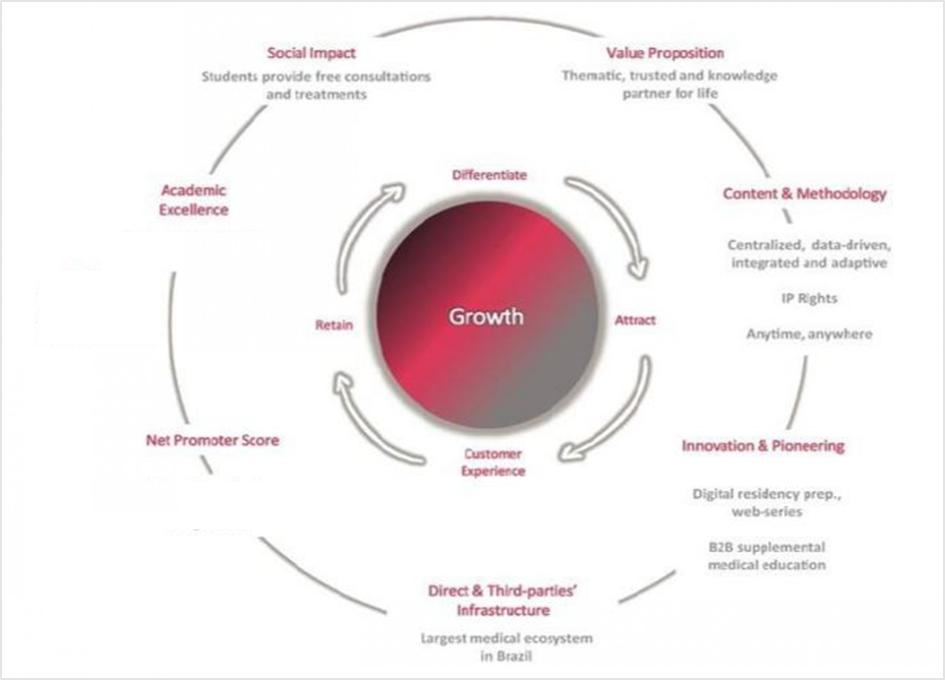
Extensive M&A track record
We have extensive capabilities in, and a strong track record of, identifying, negotiating and successfully integrating acquisitions. We have developed an integration model, operated by a dedicated team responsible for analyzing, mapping and integrating the systems of our acquired businesses, that we believe enables us to fully integrate the businesses we acquire in an efficient manner and usually within 12 months of their acquisition.
| 57 |
Our integration model is composed of four stages:
| · | Stage 1 (Preliminary Analysis): Preliminary analysis of the available infrastructure, organizational structure and teaching model of the acquired business to identify potential integration issues. |
| · | Stage 2 (Detailed Mapping): Detailed migration diagnosis and mapping of the systems, processes and teaching model of the acquired business to be integrated into our centralized shared-services center and academic model. |
| · | Stage 3 (Integration/Migration): Centralization and migration of the systems and processes into our shared services center and standardization of the teaching model of the acquired business. |
| · | Stage 4 (Ongoing Support): Post migration/integration remote and on-site support and monitoring to stabilize the integrated operations of the acquired business. |
Our consolidated operating history and our recent acquisitions entail a number of challenges, such as effectively integrating the operations of any acquired company with our existing business and managing a growing number of campuses. See “Item 3. Key Information—D. Risk Factors—Certain Risks Relating to Our Business and Industry—We may face challenges in identifying and acquiring new medical higher education institutions, which could hinder our strategic and financial goals. Additionally, difficulties in effectively integrating and managing an increasing number of acquisitions may adversely affect our strategic objectives.”
Purpose driven culture
Medical education requires a core human value: compassion. As we endeavor to revolutionize medical education in Brazil, we believe that by training and educating better physicians we are helping people and their communities across Brazil. This mission has united families and entrepreneurs, executives and sponsors with over 20 years of know-how and expertise in the education sector. Our internal satisfaction survey conducted in 2025 showed employee satisfaction levels of 90 out of a possible 100, based on several criteria, such as trust in, and a commitment to, our values, leadership satisfaction, work satisfaction, learning and development, and active participation in our activities, reinforcing our strong commitment to our mission and purpose.
Instituto Afya
On October 31, 2025 Afya Brazil and Unigranrio established a partnership and incorporated the Instituto Afya, which is an independent non-profit organization that aims to promote solutions to chronic non-communicable conditions (CNCCs) through research, cross-sector collaboration, and engagement with diverse segments of society. Its activities are aimed at improving the quality of life of the Brazilian population through research, innovation, stakeholder engagement, and cross-sector collaboration. The Institute operates through partnerships with public and private sector entities to generate knowledge and develop initiatives designed to expand access to healthcare, with an emphasis on prevention and care delivery. Its activities are intended to support the development of sustainable solutions that contribute to a more efficient and inclusive healthcare system.
Our Growth Strategies
We aim to continue to grow organically and through acquisitions and to generate greater shareholder value by implementing the following strategic initiatives:
Maturation of current number of authorized medical school seats
We benefit from contracted growth visibility in our medical schools that are in the initial six years of operations, which we derive the six-year maturation cycle of our medical school seats, which begins when a medical school becomes operational, with a first year medical school class which progresses through the required six years as the next classes begin behind it, and which ends when the medical school has six school years of medical students and has therefore reached capacity at maturation (i.e., the maximum number of approved seats).
Since the maximum number of medical seats per medical school is set by applicable regulations, the only way to grow our medical school seats, and thus our number of enrollments, is through acquisitions or starting new medical schools. As of the date of this annual report, assuming full compliance with applicable regulations and that our campuses mature as expected, we estimate reaching a total medical student base of 27,130 students by 2031. See “Item 5. Operating and Financial Review and Prospects—Medical School Regulatory Capacity and Capacity at Maturation” and “Item 3. Key Information—D. Risk Factors— Certain Risks Relating to Our Business and Industry—The post-secondary education sector is highly regulated, and our failure to comply with existing or future laws and regulations could limit our ability to operate medical programs, obtain new authorizations or accreditations, maintain our regulatory approvals, or obtain re-accreditations, which could materially impact our business.”
| 58 |
Expand our medical residency preparation enrollments base
We expect that competition for medical residencies will increase as the number of graduating physicians grows and the number of available residency seats remains static. We plan to continue to grow our medical residency exam preparation student enrollments, leveraging the academic outcome, scalability and learning experience of our digital platform.
Expand our graduate programs enrollments base
Due to the shortage of medical residency seats and the growing demand for medical undergraduate courses, we believe we will be able to expand our current offering in the Undergraduate segment.
We intend to continue developing our business-to-business strategy by increasing the number of partners and student enrollments through increased marketing and sales efforts.
Cross-sell across our existing medical student base
Because our solutions target the lifelong education journey of medical students, we have identified an opportunity to increase student enrollments at a low marginal cost driven by cross-selling opportunities, such as increasing the number of former undergraduate students subscribing to our medical residency exam solutions and the number of former undergraduate and/or medical residency students applying to our graduate and/or other continuing medical education offerings, such as hard and soft skills courses.
Expand our B2B capabilities
B2B contracts are effective customer entry points to our products and services. Students are familiar with our platforms, increasing our brand equity and helping us attract more physicians to enroll in preparatory courses, graduate programs, hard and soft skills courses.
Expand our distribution channels
We plan to continuously expand our distribution network by increasing our presence in direct and third-party channels, launching graduate courses or CME for third-party continuing medical education hubs (including, but not limited to, hospitals, clinics and other medical schools) to grow our graduate medical footprint, through partnerships with such third-party continuing medical education hubs.
Leverage infrastructure and extract synergies from acquisitions
We believe we have been able to successfully integrate our acquisitions into our ecosystem. We plan to implement several measures to improve the profitability of recent acquisitions, including but not limited to:
| · | Streamlining fee discounts and scholarship policies; |
| · | Integrating operations with our shared-services center; |
| · | Streamlining faculty training in line with our career plan; and |
| · | Integrating teaching models into our academic model. |
| 59 |
Continue to selectively pursue M&A opportunities
Our acquisition strategy is primarily focused on expanding our medical school footprint by adding new institutions to our existing portfolio, which we believe supports our long-term growth and reinforces our position as a leading medical education provider in Brazil.
We also plan to selectively pursue acquisitions that will complement our current medical education services offering and/or enhance our product portfolio, such as digital content platforms, continuing medical education institutions and other medical certification companies, among others. We are currently evaluating possible acquisition opportunities and submit non-binding proposals from time to time.
We believe that we have developed a strong capability and track record of acquisitions. In 2025, we acquired FUNIC, which increased our number of approved medical school seats by 60 approved seats. In 2024, we acquired Unidom, which increased our number of approved medical school seats by 300 seats authorized, of which 125 are final and 175 are subject to a final conclusion of the court proceedings. In 2023, we acquired DelRey, which encompasses the operations of UNIMA and FCM Jaboatão. Our acquisition strategy is mainly focused on expanding our medical school footprint by adding new institutions to our existing portfolio.
Enter into new markets
We believe our end-to-end physician-centric ecosystem is equipped to serve medical students in complementary segments where our innovative, methodological, data-driven approach can continue to disrupt traditional vendors and legacy business models. We believe opportunities exist in new sectors and regions of Brazil. In the future, we intend to focus on expanding further into continuing medical education. We may also seek to grow our business by selectively expanding into international markets with similar fundamentals.
Develop new products
We plan to continuously evolve our platform and offer solutions that keep up with the growing demands of our students. We have a planned pipeline of new products, including new medical web-series seasons, corporate medical training, new extension health programs, a tutoring suite, a peer-to-peer suite and a virtual reality product.
Our Geographic Presence
Our headquarters and most of our shared services operations are located in Belo Horizonte in the State of Minas Gerais. Our content creation and dedicated sales team is located in São Paulo, in the State of São Paulo.
As of December 31, 2025, our network consisted of a total of 62 undergraduate and graduate campuses: (i) 37 undergraduate campuses, out of which 32 offer a medical course and (ii) 25 graduate campuses that offer medicine- and health-related courses.
The chart and table below illustrate our current footprint of undergraduate medical schools, as of the date of this annual report.
| 60 |
|
Campus |
State |
Brand |
Year of Acquisition |
Approved Medical School Seats(1) |
Semester(2) |
| Porto | TO | ITPAC Porto | Before 2018 | 120 | 02.04 |
| Pato Branco | PR | FADEP | 2018 | 50 | 02.17 |
| Pato Branco | PR | FADEP | 2018 | 60 | 02.19 |
| Pato Branco | PR | FADEP | 2018 | 2 | 01.26 |
| Itajubá | MG | CCSI | 2018 | 87 | 01.68 |
| Parnaíba | PI | IESVAP | 2018 | 80 | 02.15 |
| Palmas | TO | ITPAC | 2018 | 120 | 02.17 |
| Teresina | PI | IESP | 2018 | 110 | 02.04 |
| Teresina | PI | IESP | 2018 | 61 | 02.17 |
| São João Del Rei | MG | IPTAN | 2018 | 38 | 02.15 |
| São João Del Rei | MG | IPTAN | 2018 | 11 | 02.16 |
| Araguaína | TO | UNITPAC | 2018 | 80 | 02.06 |
| Ipatinga | MG | UNIVAÇO | 2018 | 100 | 01.99 |
| Marabá | PA | FACIMPA | 2019 | 120 | 02.19 |
| Vitória da Conquista | BA | FASA | 2019 | 100 | 01.15 |
| Itabuna | BA | FASA | 2019 | 85 | 02.18 |
| Itabuna | BA | FASA | 2019 | 64 | 01.23 |
| Cruzeiro do Sul | AC | ITPAC - Mais Médicos | 2019 | 50 | 01.21 |
| Santa Inês | MA | ITPAC - Mais Médicos | 2019 | 50 | 02.20 |
| Manacapuru | AM | ITPAC - Mais Médicos | 2019 | 50 | 02.22 |
| Itacoatiara | AM | ITPAC - Mais Médicos | 2019 | 50 | 02.22 |
| Abaetetuba | PA | ITPAC - Mais Médicos | 2019 | 50 | 02.22 |
| Abaetetuba | PA | ITPAC - Mais Médicos | 2019 | 63 | 01.26 |
| Bragança | PA | ITPAC - Mais Médicos | 2019 | 50 | 02.22 |
| Bragança | PA | ITPAC - Mais Médicos | 2019 | 100 | 01.26 |
| Itaperuna | RJ | UniRedentor | 2019 | 112 | 02.15 |
| João Pessoa | PB | FCMPB | 2020 | 24 | 02.17 |
| João Pessoa | PB | FCMPB | 2020 | 33 | 02.18 |
| João Pessoa | PB | FCMPB | 2020 | 80 | 02.16 |
| João Pessoa | PB | FCMPB | 2020 | 20 | 02.18 |
| Redenção | PA | FESAR | 2020 | 120 | 02.18 |
| Porto Velho | RO | UniSL | 2020 | 52 | 02.19 |
| Porto Velho | RO | UniSL | 2020 | 130 | 02.05 |
| Ji-Paraná | RO | UniSL | 2020 | 28 | 02.21 |
| Guanambi | BA | FIP Guanambi | 2021 | 60 | 02.18 |
| Guanambi | BA | FIP Guanambi | 2021 | 40 | 01.24 |
| Garanhuns | PE | ITPAC | 2021 | 120 | 02.21 |
| Montes Claros | MG | UNIFIPMOC | 2021 | 100 | 02.07 |
| Duque de Caxias | RJ | UNIGRANRIO | 2021 | 110 | 01.97 |
| Duque de Caxias | RJ | UNIGRANRIO | 2021 | 88 | 02.17 |
| Rio de Janeiro | RJ | UNIGRANRIO | 2021 | 110 | 02.04 |
| Rio de Janeiro | RJ | UNIGRANRIO | 2021 | 10 | 02.24 |
| Alagoas | AL | UNIMA | 2023 | 100 | 02.14 |
| Alagoas | AL | UNIMA | 2023 | 40 | 02.16 |
| Alagoas | AL | UNIMA | 2023 | 80 | 02.24 |
| Jaboatão | PE | FCM Jaboatão | 2023 | 100 | 01.18 |
| Jaboatão | PE | FCM Jaboatão | 2023 | 100 | 01.19 |
| Unidompedro (3) | BA | UNIDOM | 2024 | 300 | 01.21 |
| FCM Contagem | MG | FUNIC | 2025 | 60 | 02.25 |
| (1) | Number of medical school seats presented are estimated. |
| (2) | Schools with six or more years of operations are considered fully matured. |
| (3) | 300 seats authorized, of which 125 are final and 175 are subject to a final conclusion of court proceedings. |
Industry Overview
Introduction to Brazil’s Education Environment
Brazil’s education environment has become increasingly open to private capital. At the same time, the government has continued to play an important role through the municipalities, states, and federal government.
Post-Secondary Education
Higher education in Brazil differs significantly from pre-secondary education. According to the most recent data from the Censo da Educação Superior published by the INEP, the vast majority of higher education schools are under private management. As of the 2024 census, Brazil had approximately 2,561 higher education institutions, of which 2,244 were private and 317 were public, meaning that approximately 87.6% of all higher education institutions were privately operated.
| 61 |
Higher education institutions are divided into three categories depending on the number of courses they offer, seniority of the teaching staff, and amount of research they conduct: they can be classified as colleges, university centers or universities. Typical post-secondary programs take between four to six years to complete. While some courses in these programs only occur during a certain period of the day (i.e., morning, afternoon, or evening), others are offered as full day courses. Tuition is paid on a monthly basis, primarily out of pocket by students and their families. Government financing is available, but not easily accessible. The main programs are FIES and PROUNI, which have historically represented a relevant source of student financing in Brazil, according to Sinopse Estatística da Educação Superior.
Introduction to Brazil’s Medical Education Industry
In Brazil, aspiring physicians apply to medical school following graduation from secondary education. Medical school in Brazil is a six-year undergraduate program. Upon graduation, medical students gain a license and can start working as generalist physicians. At this point, they usually consider alternatives to gain a certification for one or more medical specialties.
The first and most common path to obtaining a medical specialty certification is through a medical residency program. Candidates seeking admission to a residency program must pass a competitive entrance examination administered by the institution offering the program. Once admitted, physicians begin their residency training and generally receive a government-funded stipend during the specialization period. If the physician wants to pursue a subspecialty, he or she will need additional years of study, which may require a separate competitive admission process.
Medical professionals who do not pursue or are not admitted to a residency program may still obtain a medical specialty certification through alternative pathways. In Brazil, specialty titles are generally granted by medical specialty societies affiliated with the AMB, and typically require candidates to meet certain eligibility criteria and pass a certification examination. These criteria may include a minimum period of professional practice, supervised clinical experience, or completion of recognized postgraduate training programs, among other requirements. Depending on the specialty and the candidate’s professional experience, it may take several years for a generalist to meet the criteria and, in this context, graduate courses can be a shorter path to reach eligibility sooner.
As medical science continues to evolve very rapidly, physicians must seek ways to stay up to date on those developments. For that purpose, physicians and other medical professionals tend to use numerous sources of continuing medical education, or CME, including short-term programs, scientific paper digests, and medical congresses, among others.
Regulatory Overview and Mais Médicos Program
Medical education in Brazil is subject to regulatory terms that aim to guide the geographic distribution and expansion of medical school seats across the country. Since 2013, the Brazilian government has implemented initiatives to increase the number of annual medical school and residency positions, including the Mais Médicos program, a strategic initiative designed to expand access to primary healthcare services in underserved municipalities, strengthen healthcare infrastructure, and promote a more balanced distribution of medical professionals nationwide.
The legal framework for this initiative was established by the Mais Médicos Law, which set forth rules governing the authorization of new medical courses in Brazil and introduced regulatory criteria to guide the expansion and geographic allocation of medical school seats across the country. Among the criteria considered in the authorization process, two relevant aspects are (i) the importance of these new openings in a specified region and (ii) the sufficiency of the current medical infrastructure in both public regional hospitals and in the applicant medical institution in order to obtain government authorization, particularly with respect to the availability of public hospital beds within Brazil’s Unified Health System (SUS) for medical practice scenarios.
From its creation in 2013 until the date of this annual report, MEC, through SERES, has announced three public calls for the selection of proposals for the authorization of medical courses on a national scale, although the most recent public call was subsequently cancelled: the Mais Médicos I program in 2013, the Mais Médicos II program in 2018, and the Mais Médicos III program in 2023, although the most recent public call was subsequently cancelled.
| 62 |
Mais Médicos I and Mais Médicos II jointly authorized the opening of 58 new medicine courses and, initially, 4,971 new seats in medical schools, which may be increased by up to 100 seats each in accordance with the Mais Médicos regulation. Following the increase in annual offerings through Mais Médicos, on April 5, 2018, MEC announced that the government had decided to freeze the new offering of medical school seats for a period of five years pursuant to Ordinance No. 328/2018. The decision was based on the need to evaluate the impact of opening new medicine courses in Brazil. On April 5, 2023, MEC issued Ordinance No. 650/2023, which revoked the suspension under Ordinance No. 328/2018 and set new rules for the opening of new medicine courses.
Following the issuance of Ordinance No. 650/2023, on October 4, 2023, MEC, through SERES, announced a public call for the selection of proposals for the authorization of medical courses on a national scale under the Mais Médicos III program. The rules for the program set forth the criteria for new undergraduate medical school seats and provided for the potential opening of up to approximately 5,700 new undergraduate seats, to be distributed across 95 cities with a limit of 60 seats per institution. However, on February 10, 2026, MEC formally cancelled the public call relating to the Mais Médicos III program, with immediate effect. As a result, the authorization process contemplated under that public call was discontinued.
Although the Mais Médicos program requires a public call prior to the authorization of a new medicine course, some educational institutions have been judicially challenging this restriction before Brazilian courts to compel MEC to receive and review requests for new medicine courses outside the Mais Médicos program rules, alleging that these rules constitute an undue restriction on freedom of competition. Certain courts may ultimately compel MEC to receive and review these requests. For more information, see “Item 3. Key Information—D. Risk Factors—Certain Risks Relating to Our Business and Industry—We face significant competition in the provision of our educational services. If our competition increases or if we fail to compete efficiently, we may lose market share, and our profitability may be adversely affected.”
In addition, the increase in medical school seats in existing undergraduate courses is regulated by specific rules, including, but not limiting to Ordinance No. 1,771, dated September 1, 2023, which allowed educational institutions that already operate authorized undergraduate medical programs to request an increase in medical school seats by submitting a request to MEC and is subject to compliance with applicable regulatory criteria, including academic quality indicators, limits on the percentage of seat expansion permitted for each program, and the availability of adequate healthcare infrastructure and clinical training capacity within SUS.
Brazilian Medical Education Quantitative Assessment
Given the national regulatory framework, expanding medical school seats depends mostly on quality attributes and the need for additional doctors in the given geography. While the number of medical school seats remained approximately unchanged between 2005 and 2012, the federal government introduced public policy initiatives aimed at addressing the shortage of physicians, including the Mais Médicos program, which accelerated the expansion of medical education capacity beginning in 2013.
Mais Médicos I and Mais Médicos II jointly authorized the opening of 58 new medicine courses and, initially, 4,971 new seats in medical schools, which may be subject to an increase of up to 100 seats, each in accordance with the Mais Médicos regulation.
According to the Demografia Médica do Brasil report—which is co-produced by the Brazilian Medical Association (Associação Médica Brasileira, or AMB) and the University of São Paulo, Brazil, or Demografia Médica—the number of physicians in Brazil increased from 310,800 to 635,706 from 2010 to 2025, representing an 104.5% increase. With that demand in place, a supply of new healthcare professionals is expected to keep growing to keep up with the increased demand for public and private health services.
By 2025, the total number of physicians in Brazil increased to 635,706 professionals, implying 2.98 doctors per 1,000 inhabitants.
| 63 |
Projection of the Number of Physicians in Brazil (2023 to 2035)
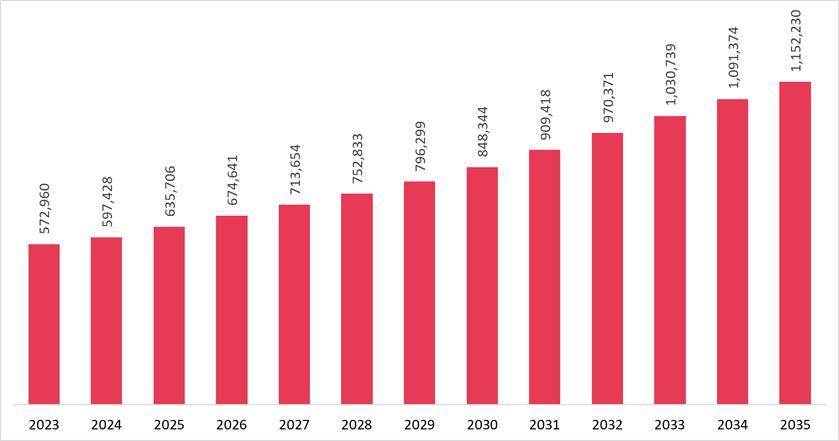
Source: Demografia Médica, 2025. 2024-2035 figures are projections
Fundamentals of Medical Education in Brazil
The medical education market in Brazil is supported mainly by the higher demand for medical courses than the actual seats offering, the low and uneven medical density when compared to the Organization of Economic Cooperation and Development, or OECD average, Brazil’s fast aging population, and compelling financial rewards for those seeking to pursue a medical career.
Brazil’s Aging Population
Brazil’s aging population is expected to drive an increase in demand for physicians and other healthcare service providers. Although Brazil currently has a younger population than most developed countries, demographic projections indicate that the country will experience a rapid aging process in the coming decades. The share of the population aged 65 and over is projected to increase significantly, reaching nearly 22% by 2050, according to projections from the Organisation for Economic Co-operation and Development, Health at a Glance 2025: OECD Indicators (OECD Publishing, 2025). Compared to 1995, life expectancy at birth is up from 66 years to 76 years in 2023, according to the Instituto Brasileiro de Geografia e Estatística, or IBGE, driven primarily by medical and health improvements.
By 2030, 13.5% of the Brazilian population is expected to be older than 65 years, compared to 7.3% in 2010. Furthermore, in 2060, the percentage of the population of 60 years and older is expected to exceed the number of people 19 years and under, according to the Instituto Brasileiro de Geografia e Estatística, or IBGE.
| 64 |
Population Distribution by Age Group—Brazil
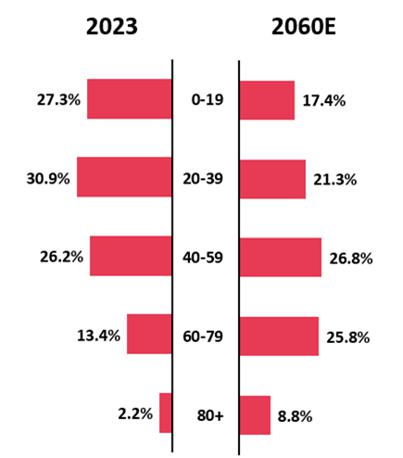
Source: IBGE, 2024.
Increase in Medical Services Demand
The long-suppressed demand for health services in Brazil is expected to continue to increase given demographic changes in Brazil as well as a larger portion of the population being able to access private healthcare services. As of December 31, 2025, Private Health Insurance penetration in Brazil reached 24.4%, according to data from ANS. This level is lower than that observed in other countries. Even with the expected increase in medical graduation, the demand for healthcare services is expected to surpass the current supply of physicians by medical schools creating a continued demand for medical courses and graduate education.
According to Demografia Médica, Brazil had 2.98 doctors per 1,000 inhabitants in 2023, which is considerably below the international average and the average of developed countries, which have been through the demographic changes that are expected to happen in Brazil. For example, according to Demografia Médica, Italy had an average of 4.24 doctors per 1,000 inhabitants in 2023. Considering the projections of a total of 635,706 physicians in 2025 versus Brazil’s population growth over the same period, Brazil would still have approximately 2.98 doctors per 1,000 inhabitants, which is still below the OECD average.
| 65 |
Doctors per Thousand Inhabitants, According to Selected OECD Countries (2023).
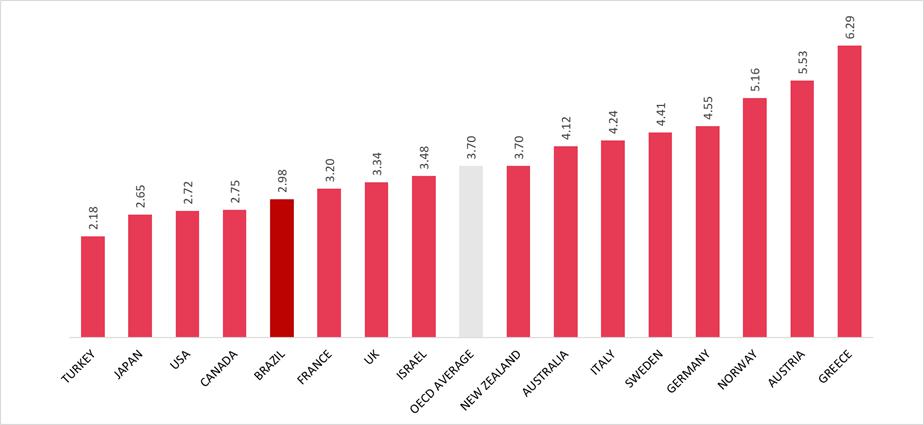
Source: OECD, 2023.
| 66 |
Shortage and Distribution of Medical Professionals in Brazil
Brazil’s low medical density and inequality in physician distribution is illustrated in the figure below. As of 2024, São Paulo and Rio de Janeiro had 3.8 and 4.2 doctors per 1,000 inhabitants, respectively, while the states of Maranhão and Pará had 1.3 and 1.4 doctors per inhabitant, respectively. The north and northeast regions are Brazil’s most underserved areas and have been the focus of governmental physician assignment programs.
Distribution of Doctors According to Brazilian States—2024
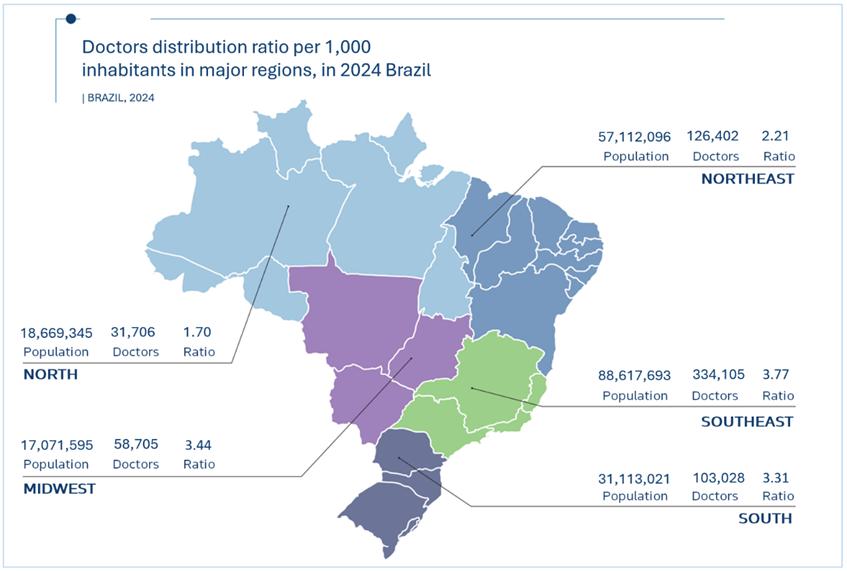
Source: Demografia Médica, 2024
Compelling Financial Rewards for Pursuing a Medical Career
One of the notable arguments for pursuing a medical career in Brazil is the potential financial outcome for the future physician, with higher salaries and fast payback. The main points of view that support the increasing demand for medical education analysis are: (i) a reported employability rate of approximately 92% for medical school graduates in Brazil, based on available data from Instituto Semesp, 2024; (ii) salaries for medical school graduates that are significantly higher than those of graduates from other fields, and (iii) its above-average income after graduation results in a relatively short payback period compared to other undergraduate programs, even when accounting for the comparatively high tuition associated with the six-year medical undergraduate program.
| 67 |
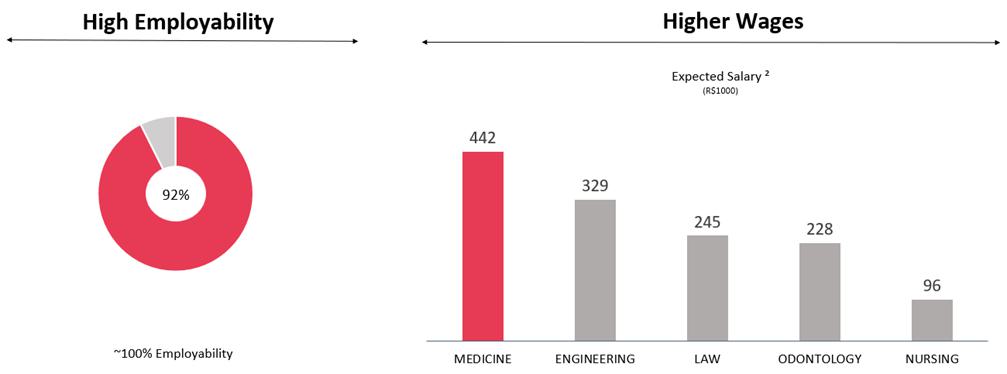
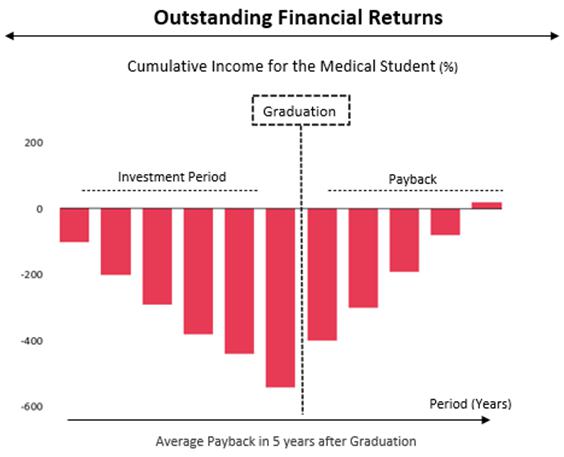
Source:
(1) Instituto Semesp, 2024
(2) Demografia Médica 2025,
(3) Afya’s Research Center,
Expansion in Graduate Programs and CME
The number of public and private medical graduate courses is not measured by any institution, as it is developing and growing as residency slots become increasingly restricted. Typically, educational institutions partner with hospitals to provide an adequate infrastructure for teaching students. Unlike residencies, students pay out-of-pocket monthly tuition of around R$4,000, according to a third-party consulting firm. These are usually one to two-year courses and there is currently no government student financing for this segment.
Underlying Trends of Medical Education in Brazil
In addition to a large and underpenetrated total addressable market, we have identified other trends that contribute to the strength of the markets we serve:
| 68 |
| · | Increased life expectancy and demand for medical services: The Brazilian population is aging at the fastest rate in its recent history. Average life expectancy is currently 76.2 years, and the number of people over 65 should double from 7% of the total population in 2012 to 14% of the total population in 2033. This has led to, and is expected to continue to drive, increased demand for healthcare professionals. In addition, private healthcare spending and public healthcare spending in Brazil grew at a CAGR of 14.0% and 11.8%, respectively, from 2010 to 2015, primarily due to an increase in demand for medical services as a result of an aging population and an increase in average household income. These trends have continued since 2015 to date. |
| · | Shortage of medical professionals in Brazil: There is a shortage of medical professionals in Brazil, primarily due to the uneven socio-economic environment. On average, Brazilian cities with less than 50,000 inhabitants, which corresponds to approximately 90% of all cities in Brazil, have less than one physician per 1,000 residents. Brazil is expected to have an average of 3.07 physicians per 1,000 inhabitants by 2028, below the average of 3.4 for 2018 Organization for Economic Cooperation and Development, or OECD, countries. |
| · | Attractive financial incentives: The medical profession is lucrative. Medical professionals are highly employable, with salaries that are on average more than three times higher than the average salary for other professions such as engineering, nursing and law, and 1.9 to 3.8 times higher than the net present value of engineering, nursing or law programs in Brazil. |
| · | Supply and demand imbalance for medical education: The number of available medical course seats in Brazil is controlled by MEC, which has limited medical school intakes to current levels until 2023, resulting in a significant imbalance between supply and demand. In the last three years, medical schools have on average received five applications per available medical course seat, and four applications per available residency program vacancy, and the number of applications are expected to increase. We believe that graduate courses will gradually become a more popular, high-demand destination for physicians that are not admitted into residency programs. |
| · | CME expansion: The growing number of physicians in Brazil and the demand for ongoing education on new medical procedures, drugs, technologies and developments will continue to drive demand for CME. |
| · | Technological innovation is driving medical education: The current generation of medical students and professionals requires instantly accessible digital content. Over 600,000 biomedical articles have been published globally every year since 2005, and it is critical for lifelong learners to be able to access information and learning methodologies regardless of location and physical availability. |
| · | Limited scope of existing product offerings: By generally limiting their focus on individual aspects of a student’s education cycle, traditional education providers have struggled to build comprehensive student track records and profile databases. Consequently, there is a general lack of integrated platforms that apply accumulated student information to efficiently tailor experiences to, or produce bespoke materials for, the particular needs of each student. |
We believe we are well-positioned to take advantage of this market and its trends, bringing a more effective, personal and diversified service to our students, which will enable us to continue to grow our market share.
Our Competition
We believe we are the only company in Brazil with a focus on the entire learning career of a physician. However, several companies provide solutions that compete in some of the markets in which we operate.
We compete directly or indirectly with other post-secondary institutions that offer medical courses or any of the other higher education courses in our portfolio. This market is very fragmented and currently, there are more than 300 other institutions that offer medical courses in Brazil. The following table sets forth our main competitors and the number of approved medical school seats they had as of December 31, 2025:
| 69 |
|
Number of Approved Medical School Seats | |
|
Company |
As of |
| Afya Brazil | 3,755 |
| Player 1 | 2,060 |
| Player 2 | 1,867 |
| Player 3 | 1,069 |
| Player 4 | 1,001 |
The market for graduate medical courses has been growing rapidly and we have recently experienced increasing competition from traditional education institutions that previously had been limited to providing undergraduate courses and have since begun to offer graduate programs.
Our Products and Services
We report our results of operations for each of the following three operating segments:
| · | Undergraduate, which provides educational services through undergraduate courses related to medical school, undergraduate health science and other ex-health undergraduate programs; |
| · | Continuing Education, which provides medical education (including residency preparation programs, specialization test preparation and other medical capabilities), specialization and graduate courses in medicine, delivered through digital and in-person content; and |
| · | Medical Practice Solutions, which provides clinical decision, clinical management and doctor-patient relationships for physicians and provide access, demand and efficiency for the healthcare players. |
We offer the following educational products and services to lifelong medical learners enrolled across our evolving distribution network, as well as to third-party medical schools.
Undergraduate
Medical Schools
| · | A fully integrated core curriculum is offered to our medical school students across all our campuses. |
| · | All our medical students have access to our supplemental instructional platforms as part of the internship module of their medical course, which we implemented for all incoming medical students of the fifth and sixth academic year. |
Other Programs
| · | Other national core curriculum is offered to all students across all of our undergraduate campuses: healthcare degrees and a subset of non-healthcare degrees, including business and engineering degrees offered by the companies we invested in or acquired. |
Continuing Education
Residency Journey
| · | Instructional content in digital format is offered to medical students and newly graduated physicians to prepare them for medical residency exams. |
| · | Supplementary instructional content in digital format is offered to third-party medical schools that adopt our services. |
| · | As of December 31, 2025, 2024 and 2023, we had 12,990, 16,381 and 12,170, respectively, enrolled students in our medical residency preparatory courses. |
| 70 |
Graduate Journey
| · | We offer a wide array of options for doctors pursuing specialization, whether through graduate medical courses or preparatory programs for specialist title exams. These students also have access to some of our supplemental instructional platforms. |
| · | Supplemental instructional content for different medical specializations is offered to individual lifelong medical learners in our graduate courses. |
| · | As of December 31, 2025, 2024 and 2023, we had 10,234, 8,527 and 7,722 enrolled students in our graduate courses, respectively. |
Other Courses — B2P and Business to Business Offerings
| · | We provide courses that extend beyond medical practice, focusing on lifelong learning and the development of both technical and interpersonal skills essential for well-rounded medical professionals. |
| · | These programs cater to physicians seeking to stay current throughout their careers while enhancing their technical expertise. |
| · | As of December 31, 2025, 2024 and 2023, we had 31,815, 25,613 and 27,188 enrolled students in our other courses, respectively. |
Medical Practice Solutions
| · | Subscription-based mobile app and website portal focused on assisting health professionals and students with clinical decision-making for 30 medical specializations through tools such as medical calculators, charts and updated content, including prescriptions, clinical scores, medical procedures and laboratory exams, among others. |
| · | Free instructional content we offer to physicians, healthcare professionals and students. |
| · | As of December 31, 2025, we had approximately 195,504 active paying users, consisting of approximately 156,598 in Clinical Decision and 38,906 in Clinical Management. As of December 31, 2024, we had approximately 195,018 active paying users, consisting of approximately 161,283 in Clinical Decision and 33,735 in Clinical Management. As of December 31, 2023, we had approximately 183,602 active paying users, consisting of approximately 153,541 in Clinical Decision and 30,061 in Clinical Management. |
The following chart sets forth our market share by career aging cohort as of December 31, 2025:
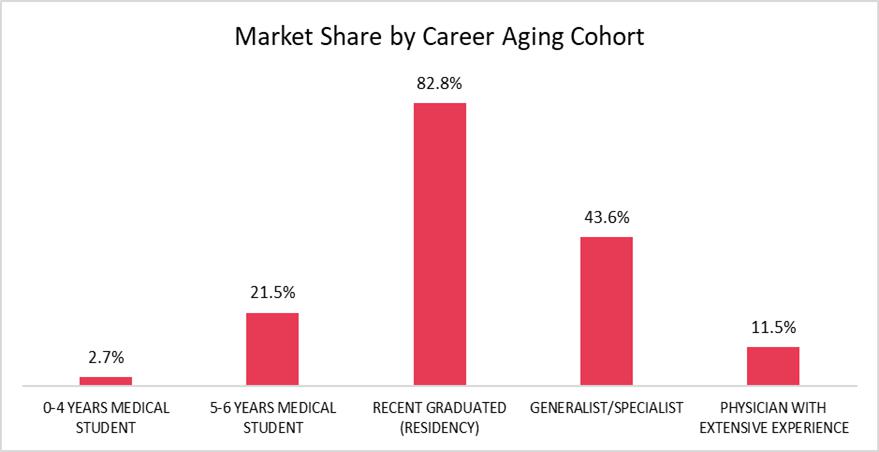
| 71 |
Our Lifelong Medical Learner Clients
As of December 31, 2025, we had a total of 141,064 students across all our segments, including 25,556 enrolled in our undergraduate medical programs, 12,990 enrolled students in our medical residency preparatory courses, 10,234 enrolled students in our medical graduate courses, and 31,815 enrolled students using our other B2B and B2P offerings.
In addition to health sciences courses, which comprise medicine, dentistry, nursing, radiology, psychology, pharmacy, physical education, physiotherapy, nutrition and biomedicine, we also offer degree programs and courses in other non-health sciences subjects and disciplines across several of our campuses, including undergraduate and graduate courses in business administration, accounting, law, civil engineering, industrial engineering and pedagogy. These non-health sciences courses are not part of our core business—the number we offer has increased as a consequence of our strategic acquisitions of multi-disciplinary schools with strong health sciences programs, which are our principal focus. Although non-health courses are not part of our growth strategy, we expect to continue to offer them to the extent they generate local demand. These non-health sciences programs represented 6.3%, 6.3% and 6.5% of the total revenues of our Undergraduate segment in 2025, 2024 and 2023, respectively.
The attractive dynamics for medical education in Brazil, including high demand for medical services and low medical density, combined with the exceptional rewards a physician receives (e.g., high wages, fast payback), create the perfect environment for us, with high demand for health sciences programs throughout the entire medical career. This scenario enables us to target a unique student profile during our selection process, capturing the most capable individuals in Brazil.
Student Financing and Incentive Programs
Student Financing Program—Fundo de Financiamento Estudantil (“FIES”)
FIES is a MEC program created by Law No. 10,260/2001 to provide financing to undergraduate students who are unable to finance their own education. After going through several reforms from 2015 onwards, as of the date of this annual report, the FIES program is provided in the following categories:
| · | Public FIES (2018)—Extended to persons with a per capita income of up to three minimum wages, with zero interest rate, with the credit risk being divided between the government and the private Higher Education Institutions, or HEIs; |
| · | Private FIES (2018)—Extended to persons with a per capital income of up to five minimum wages, with low interest rates. Regional funds and private financial institutions, provide the financing; and |
| · | Social FIES (2024)—Reserves at least 50% of FIES vacancies in each selection process for students with a per capita family income of up to half a minimum wage, with zero interest rate. |
Under the Public FIES and the Social FIES modalities, financing is provided by federal government resources and contributions from Higher Education Institutions, or HEIs through the Fundo Garantidor do FIES, the FG-FIES fund. Under this framework, participating HEIs contribute to the fund through the retention of a percentage of financed tuition receivables, which is allocated to the FG-FIES to form a reserve designed to mitigate the risk of default in FIES financing operations. This structure supports the operation of the FIES program by providing a credit risk mitigation mechanism for participating institutions and financial agents. With respect to this fund, on November 1, 2023, Law No. 14,719 was enacted and set a maximum contribution limit to the FG-FIES at 27.5%. This limit applies to contributions made by maintaining entities voluntarily joining the program after the fifth year of their participation. In addition, as part of the conditions and rules of the FIES program, private higher education institutions that apply for the program can immediately increase up to 10% of their authorized vacancies annually.
For more information, see “Item 3. Key Information—D. Risk Factors—Certain Risks Relating to Our Business and Industry— Changes to the rules, judicial interpretations, administrative decisions or delays or suspension of tuition payments made through FIES may adversely affect our cash flows and our business” for further information.
| 72 |
Incentive Program—Programa Universidade Para Todos
Programa Universidade Para Todos, or PROUNI, was established in 2005 through Law No. 10,096/2005, which offers full and partial scholarships (50%), in private HEIs for undergraduate and subsequent courses of specific training, to Brazilian students without a higher education diploma. Additionally, the Government offers federal tax exemptions to higher education institutions adhering to PROUNI.
Private higher education institutions, whether for profit or not, may join PROUNI by signing a term of adhesion (valid for 10 years), and at least (i) offer a full scholarship for every 10.7 students who pay a regular monthly fee and are regularly enrolled at the end of the previous school year; or (ii) an integral scholarship for every 22 students who pay the regular monthly tuition fees in specific undergraduate and subsequent courses, provided they also offer scholarships of 50%, in amounts necessary so that the sum of the benefits granted is equivalent to 8.5% of its annual revenue.
The tax exemptions (in whole or in part) for HEIs that participate in this program are the following:
| · | IRPJ (income tax) and CSLL (social contribution), with respect to the portion of net income in proportion to revenues from traditional and technology undergraduate programs; and |
| · | COFINS (Contribution for the Financing of Social Security) and PIS (Program of Social Integration), concerning revenues from traditional and technology undergraduate programs. |
In addition, as part of the conditions and rules of the PROUNI program, private higher education institutions that apply for the program can immediately increase up to 10% of their authorized vacancies annually, except for law and medicine courses, which are subject to annual approvals by MEC.
Other Private Financing Program
In addition to PROUNI and FIES, Afya participates in private financing programs through external partners (Pravaler, Bradesco, Sicoob, CashMe, BNB, Emcash and Alume) for undergraduate students. Moreover, in 2024 we launched our own financing program for some of its units to support medical students who were not eligible for other types of financing.
Key Benefits for Our Lifelong Medical Learners
We believe the end-to-end physician-centric ecosystem we have been developing for our students sets us apart from our peers, as we deliver content and learning activities that are tailored to each student’s needs. This contributes to a more interactive and enjoyable learning process for our students, breaking away from a teaching system that we perceive as presenting students with an overwhelming amount of content, unengaging classes and scattered information. We achieve this based on three main pillars: innovative data-oriented methodology, a cutting-edge platform and state-of-the-art operating environment.
| 73 |
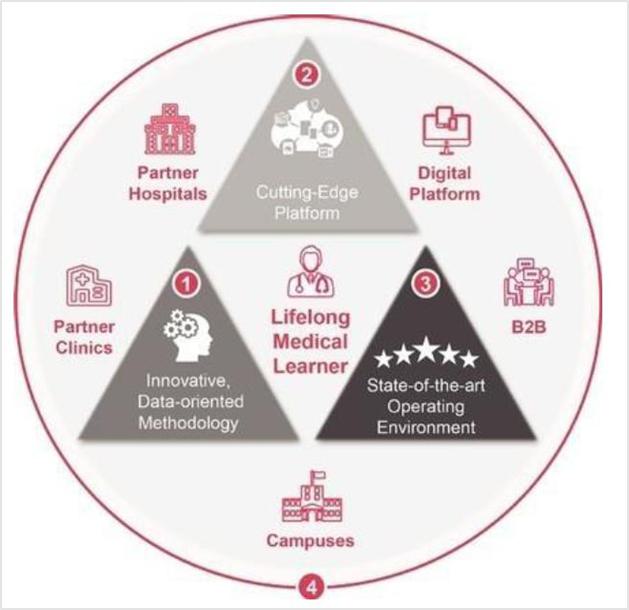
Innovative, Data-oriented Methodology
Our proprietary methodology to support our students’ lifelong medical education is based on the following concepts:
Standardized medical curricula: The organization of our medical curricula around interdisciplinary macro-medical topics to guide the development of in-person teaching plans and online learning tools, offering a scalable solution for schools through weekly synchronized content;
Active learning: Educational strategy to foster independent, critical and creative student thinking, as well as encourage effective teamwork through case-based problem-solving exercises, debates and small-group discussions;
Blended learning: Balanced in-person teaching with technology-assisted activities to improve student and teacher efficiency and results; and
Adaptive learning: A personalized instruction and assessment tool that provides training and content tailor-made to each student’s individual profile. Students can access real-time feedback on areas in which they can improve, effective learning methods and teaching/study plans that are most suitable for them.
Cutting-Edge Digital Platform
We believe we deliver modern, bespoke verbal and practical teaching. We continuously invest in creating innovative, technology-enabled activities and features to enhance our platform. We offer our medical school students doing internships or studying for residency exams the following features through our digital platform:
Web portal and in-app communication: Online platform combining supplementary instructional content and a personalized communication tool for students, through which they can also access our content offline;
Assessment tool: Broad database suite composed of quizzes and problem-solving activities, through which students can choose the subjects they would like to focus on, with additional teacher-led instructional content;
| 74 |
Tutoring/mentoring platform: An online monitoring and support platform for both undergraduate and graduate medical students. The platform allows tutors to interact with students through emails, video calls, voice calls and push notifications, and keeps records of such interactions. It also allows students to ask the tutors questions and schedule appointments. The platform also tracks individual student performance and progress; and
Digital health services platform: A combination of mobile and web applications focused on helping physicians, nurses, healthcare professionals and medical students in their clinical decision-making and providing medical references and updates for the medical community.
State-of-the-Art Operating Environment
For us, individualized learning should be used not just when offering content or technology-supported activities, but also during in-person encounters. Our professors can use our resources to approach lessons more objectively, focusing on each student’s needs:
Modern teaching facilities: We have designed our classrooms to engage students in active learning. We rely on cutting-edge didactical equipment and simulation labs and state-of-the-art realistic simulation technologies;
Medical specializations centers: Our campuses offer simulation centers and clinics where students can practice primary and secondary care, leveraging the learning process and providing medical assistance to the local population; and
Practical learning network: Throughout the internship cycle, our students can access over 596 partner teaching hospitals and clinics, the largest network of any education group in Brazil.
Evolving Distribution Network
We believe that an effective end-to-end physician-centric ecosystem goes beyond offering the largest and most complete operating infrastructure to the students enrolled at our campuses and with access to our digital platforms. Through our evolving distribution model, we also expect to empower lifelong medical learners across our growing network of diversified partner teaching hospitals, clinics and third-party medical schools by increasing our products and services offerings as we continue to expand our business-to-business, or B2B capabilities.
Seasonality of Operations
Undergraduate segment revenues are related to the intake process and monthly tuition fees charged to students, and do not significantly fluctuate from quarter to quarter. Continuing Education revenues are mostly related to: (i) monthly intakes and tuition fees on medical education, which generally do not experience significant fluctuations resulting from seasonality and (ii) revenue derived from the sales of e-books which are recognized at the point in time when control is transferred to the customer, which is generally concentrated in the first and last quarter of the year due to the period of enrollments. Consequently, the Continuing Education segment generally has higher revenues and results of operations in the first and last quarters of the fiscal year than in the second and third quarters of the fiscal year. Medical Practice Solutions revenues derive mainly from Whitebook and iClinic, which do not experience significant fluctuations resulting from seasonality.
Marketing and Sales
Our marketing strategy is designed to efficiently identify, qualify and convert prospective students and physicians into enrollments and product adoption across our educational and digital solutions portfolio, while maximizing lifetime value within our physician ecosystem.
We execute this strategy through three integrated and continuously optimized stages:
| · | Identification: We deploy a diversified mix of digital and offline channels, amplified by our owned media and social platforms, to distribute relevant, educational content tailored to each stage of the physician journey, from undergraduate students to practicing physicians. This approach supports continuous engagement with our solutions across both academic and professional milestones, including our educational programs, mobile applications, and practice management software. |
| 75 |
| · | Qualification: Upon lead capture, we segment and nurture prospective students and physicians through personalized content aligned with their academic stage, clinical practice needs, and professional goals. Concurrently, we apply data-driven scoring models to prioritize high-intent leads, improving resource allocation and increasing downstream conversion efficiency across both educational offerings and digital products. |
| · | Conversion: Sales-qualified leads are routed to dedicated commercial teams that execute structured, performance-driven campaigns. Conversion is actively managed through rigorous monitoring of funnel metrics, enabling continuous optimization of both sales productivity and customer experience, across enrollments as well as adoption of our digital solutions. |
Given our end-to-end and physician-centric model, we support learners and professionals throughout their entire lifecycle. As a result, our funnels are dynamically calibrated based on supply-demand dynamics across segments (including undergraduate medical education, preparatory courses, postgraduate programs, and digital practice solutions), competitive intensity, and broader market conditions.
Our primary strategic focus is attracting and enrolling top-tier students into our medical schools. In preparatory and postgraduate segments, as well as in our digital solutions for physicians, we emphasize clear communication of learning outcomes, clinical and operational value, and overall cost-benefit proposition, reinforcing a strong value proposition that drives both enrollment and product adoption.
Our marketing and sales operations are supported by a robust technology stack, including Salesforce, Marketing Cloud, Insider, Braze, ActiveCampaign, HubSpot, and advanced analytics and performance measurement tools, enabling end-to-end tracking, personalization, and optimization across the full physician lifecycle.
We believe that our vertically integrated business model, combined with the extensive and effective use of CRM and data analytics capabilities, provides us with a significant competitive advantage—namely, the ability to identify, engage, and offer tailored educational and digital solutions, including applications and practice management software, to a substantial share of medical students and physicians across Brazil.
Technology and Intellectual Property
Technology
We have implemented several initiatives to improve operational efficiency and to integrate processes across several campuses and operations. We plan to continue this process in the future to fully consolidate Afya Brazil’s integrated systems with those of our recent acquisitions.
Shared Services Center
We have invested in a modern Shared Services Center, or SSC, to process back-office and non-student-facing transactions. The SSC centralizes a broad range of administrative functions, including finance, accounting, procurement and human resources, and operates with standardized processes and dedicated teams. It currently has idle capacity and is expected to enable student-base growth with low marginal costs.
Integrated Systems
We have adopted third-party systems to handle our internal systems in a fully integrated manner:
| · | Enterprise Resource Planning, or ERP: TOTVS ERP RM is the leading solution in the Education Industry in Brazil and delivers a flexible systemic solution that fits our companies’ processes to improve management and organization. At the same time, it allows high governance of the processes, with complete control of all back-office activities, preventing operational errors and allowing efficient tax-related calculations and control of government obligations. Salesforce optimizes our sales and customer relationship management processes, facilitating streamlined lead management, sales forecasting, and customer engagement. Its robust analytics capabilities offer valuable insights into sales performance and customer behavior, enabling data-driven decision-making and strategic planning. Additionally, ServiceNow enhances internal workflows and IT service management, empowering teams to efficiently handle incidents, changes, and service requests. Its intuitive interface and automation bolster productivity and customer satisfaction. Moreover, ServiceNow’s robust reporting and analytics offer valuable insights, facilitating data-driven decision-making and continuous improvement. |
| 76 |
| · | Academic System: TOTVS RM Educacional is a mature platform that allows the configuration of the student payment plan attached to the disciplines enrolled and processes preventing manual financial transactions and making the process more flexible and efficient. This system includes both Student and Faculty Portals, with features that allow mobile frequency monitoring and provide payment solutions to students and also manages the faculties’ timesheet and payroll. |
| · | Learning Management System, or LMS: Canvas LMS is a cloud-native, highly scalable system that connects all digital learning tools and evaluation resources accessed nationally by our faculties and students. |
As of the date of this annual report, Medical Harbour, independently operates its own ERP system and has not yet migrated to the TOTVS RM platform. Its operations are conducted in coordination with our standards and are integrated into the Canvas LMS ecosystem. We are working to migrate the systems from Medical Harbour in order to fully incorporate it into our integrated systems.
Intellectual Property
We rely on a combination of copyright, trademark and trade secret laws, as well as employee and third-party non-disclosure, confidentiality and other types of contractual arrangements to establish, maintain and enforce our intellectual property rights, including with respect to our proprietary rights related to our products and services. In addition, we license technology from third parties.
As of the date of this annual report, we had no issued patents and one patent application pending in Brazil. As of December 31, 2025, we owned 415 trademark registrations in Brazil and 8 abroad, and we have also sought to register other trademarks in the United States, in the European Union, Portugal, Mexico, China and Colombia. As of the date of this annual report, we have 405 pending trademark applications in Brazil and unregistered trademarks that we use to promote our brand, and also own 381 registered domain names in Brazil and 60 registered international domain names, and have registered four software programs in Brazil.
Insurance
We have insurance policies with reputable insurers in amounts considered sufficient by our management to cover potential losses arising from indemnities that we may have to pay to third parties as a result of our operations. The policies for our operating units have an aggregate coverage limit of up to approximately R$395.4 million. The Company and its subsidiaries have a risk management program with the purpose of delimiting the risks, seeking coverage compatible with its size and operations in the market. We seek coverage against risks that are compatible with our scale and type of operations, considering the nature of our activities, the risks we are exposed to, market practices in our industry, and the advice of our insurance consultants.
While we believe our insurance contracts reflect standard market practices, there are certain types of risks that may not be covered by the policies (such as war, terrorism, acts of God and force majeure, liability for certain harm or interruption of certain activities). Therefore, if any of these uncovered events occur, we may be obliged to incur additional costs to remedy the situation, reconstitute our assets and/or indemnify our customers, which may adversely affect us. Furthermore, even in the event that we incur a loss that is covered by our policies, we cannot assure that damages awarded by our insurers will be sufficient to cover the losses arising from the insured event. See “Item 3. Key Information—D. Risk Factors—Certain Risks Relating to Our Business and Industry—We may be held liable for extraordinary events that may occur at our campuses, which may have an adverse effect on our image and, consequently, our results of operations.”
Regulatory Overview
The Brazilian Constitution establishes education as a right for all citizens and a duty of the State and the family. Accordingly, the government is required to provide all Brazilian citizens with access to free primary education with compulsory attendance. Private investment in education is permitted as long as entities providing education services comply with the applicable rules and regulations.
| 77 |
The Brazilian education system is organized under a cooperative management among federal, state and municipal governments. The federal branch is required to organize and coordinate the federal educational system in order to guarantee equal opportunity and quality of education throughout Brazil. The states and the Federal District are required to focus on secondary education, while municipalities are responsible for providing pre-primary school and primary education.
Private Higher Education Institutions are part of the federal educational system and their activities are regulated by the federal government, and universities have didactic, scientific and administrative autonomy as provided by the Brazilian Constitution.
Additionally, Law No. 9,394 of December 20, 1996, named by National Education Guidelines Law (Lei de Diretrizes e Bases da Educação, or LDB) provides the guidelines for the provision of educational services in Brazil and sets forth the federal government’s duty to, among others: (i) coordinate the national education system; (ii) prepare the National Education Plan; (iii) provide technical and financial assistance to the states, the Federal District and municipalities; and (iv) define, in cooperation with other federal entities, the responsibilities and guidelines for primary and secondary education, with the federal government’s priority in post-secondary education, issuing rules and regulations regarding undergraduate and graduate programs, and carrying out the activities relating to the accreditation of institutions, authorization and recognition of courses and monitoring and evaluation of the educational system as a whole.
In addition, the Brazilian federal government has historically established decennial National Education Plans (Plano Nacional de Educação, or “PNE”) to define strategic guidelines for the education sector. The first PNE was enacted by Law No. 10,172, of January 9, 2001, followed by a subsequent plan for the 2014–2024 period, instituted by Law No. 13,005, of June 25, 2014.
In 2026, a new PNE was approved by the National Congress and is pending presidential sanction. Once enacted, it is expected to establish a ten-year framework (2026–2036) focused on expanding access to education, improving learning outcomes and reducing regional and socioeconomic disparities, with increased emphasis on territorial equity and alignment with labor market needs.
With respect to higher education, the proposed framework is expected to support enrollment growth, particularly in underserved and underpenetrated regions, and to promote the expansion of education beyond major urban centers. The plan also includes initiatives aimed at improving educational infrastructure and connectivity, which may enhance operating conditions and support scalable and technology-enabled learning models.
In addition, the increased emphasis on quality, employability and alignment with essential public services, including healthcare, is expected to favor institutions with strong academic standards, governance and focus on professional training, while supporting the continued development and consolidation of the sector.
The goals and strategies set forth in the proposed PNE are expected to apply across all federative entities and to serve as a key policy reference for both public and private education institutions operating in Brazil.
Finally, each of the federal, state and municipal governments are required to prepare a 10-year education plan and to establish policies, guidelines and objectives applicable to the segment of the Brazilian education system over which it has responsibility.
Post-Secondary Education
The post-secondary education sector is subject to comprehensive government regulation. Its purpose is to ensure the quality of educational services, through evaluations of the ability of educational institutions to meet minimum standards established by CNE and approved by MEC. This evaluation includes the analysis of pedagogical projects, the infrastructure of Higher Educational Institutions, or HEIs, and their academic staff, and the results of such evaluations are considered in the proceedings for opening new units and new courses.
Therefore, activities and courses offered by HEIs in Brazil depend on authorizations and are subject to ongoing regulation, guided by the results of quality assessments. The federal responsibility to regulate, monitor and evaluate post-secondary education institutions and programs is exercised by MEC, CNE, INEP and CONAES.
| 78 |
Ministry of Education
The Ministry of Education, or MEC, is the highest authority for post-secondary education within the Brazilian national education system, whose competence consists, among other prerogatives, of the following: (1) confirming CNE’s accreditation decisions for post-secondary education institutions; (2) confirming evaluation systems and criteria adopted by the INEP; (3) confirming opinions and regulation proposals from CNE; (4) issuing rules and instructions for compliance with laws, decrees and regulations pertaining to education issues; and (5) regulating and monitoring the post-secondary education system through its secretariats.
National Education Council
The National Education Council, or CNE, is a consulting and decision-making body monitored by MEC, collectively comprised of the Chamber of Primary and Secondary Education, or CEB, and the Chamber of Post-secondary Education, or CES, each composed of 12 members appointed by the President of Brazil.
CNE is required, among other responsibilities, to: (i) issue regulations to implement MEC’s guidelines, as well as advise and support MEC in its activities and decisions; (ii) decide on accreditation applications and renewals from post-secondary education institutions engaged in distance learning, based on the opinion of the relevant secretariats; (iii) propose guidelines and deliberate on the preparation of the evaluation instruments for accreditation and re-accreditation of institutions to be elaborated by INEP; (iv) issue guidelines to be observed by SERES for accreditation and re-accreditation of universities, university centers and colleges; (v) determine, through CES, the inclusion and exclusion of course designation from the catalog of advanced technology courses; (vi) rule on appeals of decisions issued by SERES, CEB or CES; and (vii) analyze and propose questions regarding the application of post-secondary education legislation to MEC.
Anísio Teixeira National Institute for Educational Research
The Anísio Teixeira National Institute for Educational Research, or INEP, is a federal body linked to MEC whose main responsibilities are, among others, to: (i) design, plan, coordinate and operationalize actions for the evaluation of HEIs, undergraduate courses and government schools, as well as the National Student Performance Examination, or ENADE, the examinations and assessments of undergraduate students; (ii) design, plan, coordinate, operationalize and evaluate indicators related to post-secondary education resulting from examinations and inputs from official databases, the establishment and maintenance of databases of specialized evaluators and collaborators, including the appointment of evaluation committees; (iii) prepare and submit to MEC the instruments for external evaluation (in loco), in accordance with the guidelines proposed by the SERES and by other competent bodies; (iv) design, plan, evaluate and update the indicators for the external evaluation instruments in place, in accordance with the guidelines proposed by CONAES; (v) chair the Technical Committee for Evaluation Monitoring; and (vi) plan, coordinate, operationalize and evaluate the actions necessary to achieve its objectives.
National Higher Education Evaluation Commission
The National Higher Education Evaluation Commission, or CONAES, is a coordination and monitoring body of the National Higher Education Evaluation System, or SINAES, monitored by MEC, composed of a President and 13 members, including one representative of the INEP, one representative of the Fundação de Coordenação de Aperfeiçoamento de Pessoal de Nível Superior (Foundation for the Coordination of Improvement of Post-secondary Education Personnel, or CAPES), three representatives of MEC (one of which must come from the body responsible for the regulation and monitoring of post-secondary education), one representative of the student body of post-secondary education institutions, one representative of the academic staff of post-secondary education institutions, one representative of the administrative body of post-secondary education institutions, and five members appointed by the Minister of Education, with distinguished scientific, philosophic and artistic knowledge and proven expertise in post-secondary evaluation or management.
Among other activities CONAES is required to: (i) propose and evaluate the dynamics, procedures and mechanisms for institutional evaluation, courses and student performance; (ii) establish guidelines for the organization of evaluation committees, analyze reports, prepare opinions and submit recommendations to the competent bodies; (iii) formulate proposals for the development of HEIs, based on the analysis and recommendations produced in the evaluation processes; (iv) communicate with the state educational systems, with the aim to establish common actions and criteria for the evaluation and supervision of post-secondary education; and (v) annually submit for approval by the Minister of Education the list of courses for which students will apply for the ENADE.
| 79 |
Conselho Federal de Medicina (“CFM”)
The Conselho Federal de Medicina, or CFM, is the federal professional regulatory body responsible for overseeing the ethical and professional standards governing the practice of medicine in Brazil. The CFM operates in conjunction with the Regional Medical Councils (Conselhos Regionais de Medicina, or “CRMs”), which together form the Brazilian Medical Councils System. While the CFM establishes general rules, ethical standards and professional guidelines applicable to physicians nationwide, the CRMs are responsible for the registration of physicians and the supervision and enforcement of professional conduct at the state level.
In order to practice medicine in Brazil, physicians must hold a medical degree issued by a higher education institution duly accredited by the MEC and must also obtain registration with the CRM of the jurisdiction in which they intend to practice. The medical councils are also responsible for monitoring compliance with the Medical Code of Ethics and other professional regulations applicable to physicians.
Although the CFM does not regulate higher education institutions or authorize the operation of medical schools, it plays an institutional role in the broader healthcare and medical education environment in Brazil. The CFM frequently participates in public policy discussions and debates relating to the quality of medical education, the expansion of medical school seats and other matters related to the training and qualification of physicians. In this capacity, the CFM may issue technical opinions, studies and public statements that may influence legislative or regulatory initiatives concerning medical education.
Brazilian Health Regulatory Agency (Agência Nacional de Vigilância Sanitária, or “ANVISA”)
The ANVISA is the federal authority responsible for regulating and supervising health-related products and services in Brazil, including healthcare facilities, medical devices and digital health solutions. Although ANVISA does not directly regulate higher education institutions, sanitary regulations may apply to healthcare-related facilities and activities used in practical training for healthcare programs, such as teaching hospitals, clinics and laboratories, as well as to activities and infrastructure associated with our Medical Practice Solutions segment, to the extent they involve regulated healthcare services, medical devices or software qualifying as Software as a Medical Device under applicable Brazilian regulations. Accordingly, we must comply with applicable sanitary regulations, including approval, certification, licensing and inspection requirements. Failure to comply with, or to adapt to evolving regulatory standards may result in operational restrictions, required modifications to our products or services, increased compliance costs or administrative penalties, which could adversely affect our ability to offer certain solutions and impact our operations.
Organization of Post-Secondary Education Institutions
In order to allow post-secondary education institutions to fulfill their objectives, the LDB also provides that post-secondary education includes the following programs:
| · | Undergraduate courses, including traditional and technological undergraduate courses, offering specific training and diplomas to students, open to candidates who have completed high school or equivalent and who have been approved in the respective selection or entrance examinations; |
| · | Graduate courses, including master’s and doctoral degrees, specialization courses, further training courses and others, open to candidates who hold a diploma in an undergraduate course and who meet the requirements laid down by educational institutions; and |
| · | Extension courses, understood as any academic, technical or cultural activity that is not included as an integral and compulsory part of the undergraduate and graduate curriculum, in which the students receive certificates. Such courses are open to candidates who meet the requirements established in each case by educational institutions. |
According to the LDB, post-secondary education can be provided by public or private institutions. A private post-secondary education institution must be controlled, managed and supported by an individual or a legal entity with responsibility for financing its supported entities. Post-secondary education institutions may be supported by for-profit or not-for-profit private institutions, or supporting entities, as follows:
| 80 |
| · | Private in the strict sense: private for-profit institutions created and maintained by one or more private individuals or legal entities; |
| · | Community: incorporated by groups of individuals or by one or more legal entities and that include representatives of the community in their organizational structure; |
| · | Confessional: incorporated by groups of individuals or by one or more legal entities that meet the specific confessional and ideological orientation and that include representatives of the community in their organizational structure; or |
| · | Philanthropic, in the form of the applicable regulations. |
According to their organization and academic prerogatives, post-secondary education institutions can be:
| · | Colleges: colleges are public or private HEIs offering post-secondary programs in one or more areas, maintained by a single supporting entity and with isolated management and direction. Colleges are allowed to offer programs along several levels, namely bachelor’s, associate’s, specialization and graduate programs (master’s and doctorate degrees). Colleges have minimum requirements with regard to the qualification of faculty members and their labor practices, and cannot establish new campuses, courses, or spots without prior authorization from MEC; |
| · | University Centers: university centers are public or private education institutions offering several bachelor’s, associate’s and graduate programs, and are expected to provide appropriate work conditions, education and qualification opportunities for their professors. To be considered a university center, the institution shall comply with such requirements: (i) at least one-fifth of the faculty members of a university center must hold a master’s or doctorate degree; (ii) at least 20% of the faculty members must work on a full-time basis; (iii) at least eight undergraduate courses shall be recognized and have obtained a satisfactory concept in the on-site external evaluation carried out by INEP; (iv) have an institutionalized extension program in the areas of knowledge covered by their undergraduate courses; (v) have a scientific initiation program with a project supervised by doctoral or masters professors, which may include programs of professional or technological initiation and initiation to teaching; (vi) have obtained an Institutional Concept, or CI, greater than or equal to four in the on-site external evaluation performed by INEP; and (vii) have not been penalized as a result of an administrative supervision process in the last two years; or |
| · | Universities: universities are public or private education institutions offering several post-secondary programs, continuing education and research development. Like University Centers, certain requirements for university re-accreditation must be observed, namely: (i) one-third of the academic staff is hired on a full-time basis; (ii) one-third of the faculty members must have a master’s or doctoral degree; (iii) at least 60.0% of the undergraduate courses shall be recognized and have a satisfactory concept obtained in the evaluation proceedings carried out by INEP; (iv) have an institutionalized extension program in the areas of knowledge covered by their undergraduate courses; (v) have a scientific initiation program with a project supervised by master’s or doctoral professors, which may include programs of professional or technological initiation and initiation to teaching; (vi) have obtained CI greater than or equal to four in the external evaluation carried out by INEP; (vii) regularly offer four master’s degree courses and two PhD courses recognized by MEC; and (viii) have not been penalized as a result of an administrative supervision process in the last two years. |
The LDB provides that the following powers are granted to universities and university centers in the exercise of their autonomy, amongst others: (i) to create, organize and discontinue post-secondary education programs on their premises, subject to the applicable regulation; (ii) to establish the curricula for programs, subject to the applicable general guidelines; (iii) to establish plans, programs and projects in connection with scientific research, artistic production and extra-curricular activities; (iv) to establish the number of student offerings available; and (v) to create and change their bylaws in accordance with the applicable general rules, as well as to award degrees, diplomas and other certificates.
| 81 |
Distance Learning
Distance learning in Brazil is regulated by article 80 of the LDB, by Decrees 9,057 and 9,235, both of 2017, by Ordinances No. 11 and 23, both of 2017, and CNE’s Resolution No. 1, of 2016, as amended by Ordinance No. 528 of June 6, 2024, and by Decree No. 12,456 of May 19, 2025.
Distance learning is defined as the educational method in which didactic and pedagogic processes are conducted through information and communication media and technologies, with students and teachers interacting in educational activities while located in different locations or at different times.
Pursuant to the applicable regulations, distance learning is subject to different factors compared to traditional methods, including: (i) reduced transmission costs in commercial channels of sound and audiovisual broadcasting; (ii) concession of channels with exclusive educational purposes; and (iii) minimal time reservation, with no onus on the public authorities, by the concessionaries of commercial channels.
Distance learning can be offered at the following levels and as part of the following educational methods: (i) primary and secondary education, as long as it is used only to supplement learning processes or in emergency situations; (ii) education for young people and adults, according to specific legal criteria; (iii) special education, according to specific legal criteria; (iv) professional education, covering technical programs at the secondary level and technological programs at the post-secondary level; and (v) post-secondary education, covering graduate, master’s programs, specializations, and doctorate studies.
Undergraduate courses (bachelor’s, licentiate and technological) may be offered using distance learning methods whenever a post-secondary institution is regularly accredited by MEC for this purpose.
Pursuant to Decree No. 9,057, 2017, institutional accreditation and reaccreditation, as well as the authorization and recognition of courses and their renewal will be subject to on-site evaluation, with the aim to verify the existence and suitability of the method, infrastructure, technology and personnel that may enable the execution of the activities provided in the Institutional Development Plan or PDI and the Pedagogical Project of the Course, or PPC.
HEIs accredited for the offering of post-secondary education in the distance modality that hold autonomy prerogatives (universities and university centers) do not require authorization for operation of the post-secondary course in the distance modality, but shall inform MEC about the offering of the course within 60 days of the date of creation of such course, for the purposes of supervision, evaluation and recognition. Also, accredited HEIs must inform MEC about the creation of distance learning supporting units and the alteration of their addresses.
Although distance learning is defined by the absence of direct contact between students and teachers, there are activities that must be conducted on-site, such as tutorials, evaluations, internships, professional practice, laboratory and dissertation defense, which are to be provided in the educational and development projects of the institution and the course. Accordingly, distance learning institutions must provide the necessary infrastructure for the students to conduct those activities, using the headquarters of the education institution or smaller supporting units throughout the country. Distance learning supporting units are no longer subject to on-site evaluation or required to obtain prior authorization from MEC in order to be set up or operated. Pursuant to Ordinance No. 11/2017, such units can be created by a unilateral decision of the institution itself. Nevertheless, such units remain subject to MEC’s supervisory authority, including documentary review, monitoring and inspection procedures, in accordance with the post-authorization oversight framework strengthened by Decree No. 12,456/2025.
Distance courses and programs must be projected with the same defined duration as the respective on-site courses. The evaluation of the performance of students for promotion, conclusion of the course and obtainment of diplomas and certificates must be conducted through the conclusion of the programmed activities and on-site exams by the accredited HEIs, following procedures and criteria defined in the respective PPC.
The evaluation of the distance learning courses is performed in a very similar manner as the evaluation of on-site courses, and is conducted within the scope of SINAES. In the event of any irregularity or non-compliance to any of the previously established conditions set by MEC, the competent body may initiate an administrative proceeding that may result in one or more penalties, such as: (i) forfeiture of accreditation or reaccreditation to operate as a distance learning institution; (ii) intervention; (iii) temporary suspension of autonomy prerogatives; (iv) initiate reaccreditation proceedings; (v) reduction of available vacancies within courses; (vi) temporary suspension of new students admissions; and (vii) temporary suspension of courses offered.
| 82 |
Diplomas and certificates for distance learning courses and programs from accredited institutions are valid throughout the national territory and institutions are not entitled to set different criteria for diplomas issued for distance learning courses and those issued for on-site courses.
Distance learning courses may be offered only by HEIs that hold specific accreditations for this purpose. It is MEC’s responsibility to promote the accreditation acts of post-secondary institutions. To act outside the institution’s local geographic reach, the institution shall require an extraterritorial accreditation to MEC.
Distance learning courses or programs require periodic renewal. Also, the accredited institution must initiate the authorized coursework within 24 months from the accreditation, and if the institution does not implement the authorized activities in such time frame, it will be subject to an administrative proceeding that may result in the cancellation of the given authorization.
Pursuant to Decree No. 9,057/2017, post-secondary courses may be offered in the distance learning modality through a partnership between an accredited distance HEI and another company. In this case, applicable regulations establish that educational activities must be conducted in the facilities of the accredited HEI, which will be responsible before MEC for the regularity of the teaching and learning processes. Accordingly, the HEI must inform MEC of its partnerships, describing their purpose and most relevant aspects, in order for MEC to be able to assess eventual irregularities.
Regulatory Processes of Post-Secondary Education Institutions
Accreditation of Post-Secondary Education Institutions and Authorization and Recognition of Courses
A post-secondary education institution is initially accredited as a college. The accreditation as a university or university center is only granted after the institution has operated as a college and met satisfactory quality standards, including positive assessments in the SINAES. In addition, the HEI must fulfill other legal requirements that could vary according to the respective category, such as the requirement that a certain percentage of faculty members meet minimum graduation standards (i.e., a doctorate or master’s degree), and specific types of labor regimes.
The application for qualification of a post-secondary education institution must be supported by various documents, including:
| · | Supporting entity: (i) incorporation documents, duly registered with the competent body, evidencing its existence and legal capacity, in accordance with civil legislation; (ii) proof of registration in the National Taxpayer’s Registry or, CNPJ; (iii) certificates of tax and social security compliance; (iv) proof of ownership of assets capable of supporting the education institution; (v) financial statements; and (vi) consent form executed by the supporting entity’s legal representative, vouching for the veracity and regularity of the provided information and the financial capability of the supporting entity; and |
| · | Post-secondary education institution: (i) proof of payment of the on-site evaluation fee related to the external evaluation to be performed by INEP; (ii) PDI; (iii) bylaws and internal regulations; (iv) identification and qualification of managers, with a description of their academic and administrative experience; (v) receipt of regularity and availability of the teaching facilities; (vi) plan of accessibility assurance, pursuant to the regulation and followed by a technical report by a competent professional or public body; and (vii) compliance with the legal requirements related to the safety of the building, including having an escape route in case of fire, proved by a specific report issued by the competent public body. |
In relation to the accreditation process of a new post-secondary educational institution and linked course authorizations, MEC may issue a temporary accreditation act to expedite the operation, pursuant to Article 24 of Decree No. 9,235/2017, as amended by Decree No. 12,456 of 2025. The granting of such temporary accreditation is conditional upon the supporting entity cumulatively meeting all the following requirements:
| · | all self-supporting post-secondary education institutions have been reaccredited within the previous five years, obtaining an average Institutional Score (Conceito Institucional) equal to or greater than “4”; |
| 83 |
| · | none of the institutions maintained by the supporting entity may have been subject to administrative penalties by MEC within the two years preceding the accreditation request; and |
| · | the courses to be offered by the new post-secondary institution, which are limited to a maximum of five courses, must be equivalent to courses already offered by other institutions supported by the same supporting entity, duly recognized by MEC within the previous five years, with a Program Score (Conceito de Curso) equal to or greater than “4.” |
Following the initial accreditation as a post-secondary education institution, colleges depend on an authorization issued by MEC to offer post-secondary education courses. Within their autonomy, universities and university centers do not depend on authorization by MEC to create the majority of post-secondary education courses and campuses in the same city as its headquarters, except for medicine, dentistry, psychology, nursery and law courses, which necessarily must be previously authorized by MEC. In any other cases, institutions are required to inform MEC about the programs they offer for purposes of monitoring, evaluation and further recognition.
In the authorization for post-secondary on-site courses of the federal education system, the external in loco evaluation can be waived after documentary analysis if the following requirements are met: (i) having an Institutional Score (Conceito Institucional) greater than or equal to “3”; (ii) absence of a supervision process; and (iii) the institution offers other courses in the same area of knowledge which meet the minimum evaluation standards.
Requesting authorization for a course must be supported by the following documents, among others: (i) proof of payment of the on-site evaluation fee; (ii) the PPC, outlining the number of students, classes, description of the program and other relevant academic elements, and describing the facilities, technology and staff for the distance learning support units, if applicable; (iii) list of faculty members, together with the relevant agreements entered into with the education institution, together with their respective titles, working hours and work regime; and (iv) proof of availability of the teaching facilities.
Universities and university centers may also apply for the accreditation of a campus not located in the same city as its headquarters, provided that it is located in the same state. Such campuses and programs must integrate the same set of universities or university centers and will only enjoy autonomous prerogatives if there is compliance with the same headquarters requirements and if a high-quality degree is shown, through an average Institutional Score (Conceito Institucional) greater or equal to “4.” Therefore, even in the case of universities or university centers, prior authorization from MEC is necessary to create any courses on campuses not located in the same city as the university’s headquarters.
Once authorization for a given program has been issued, post-secondary education institutions, including university centers and universities, must also file a request for the recognition of the program as a condition for the national validation of the respective diploma. The requirement must be filed with MEC after the midway point of the term established for the completion of the corresponding program and three-quarters completion of such term, and must include the following documents, among others: (i) PPC, including the number of students, schedules and other pertinent academic information, (ii) list of faculty members, listed in the national registry of instructors, and (iii) proof of availability of the teaching facilities.
Authorization and recognition of courses, as well as accreditation of post-secondary education institutions must have a limited term and be renewed periodically following the regular evaluation process, currently established according to the evaluation cycles of the SINAES.
Our post-secondary education institutions are accredited by MEC and their courses are duly authorized. We also make every effort to comply with all applicable regulations to maintain our institutions and courses compliant with MEC regulations.
Additional Guidance on Admissions Management – Medical Programs
In August 2025, the MEC issued Technical Note No. 5/2025, providing interpretative guidance on certain aspects of admissions management in undergraduate medical programs.
In this context, Technical Note No. 5/2025 clarifies that vacancies arising from student attrition during the course may not be offered as new first-year admission seats, as this could result in cohorts exceeding the originally authorized annual capacity and, consequently, lead to a number of students during the internship phase that exceeds the capacity of the public healthcare facilities available as practical training settings.
| 84 |
According to the Technical Note, such practice may be deemed an administrative irregularity under applicable regulations.
Modification of Supporting Entity
Pursuant to Decree No. 9,235/2017 and Ordinance No. 23/2017, as amended by Decree No. 12,456/2025, a modification of a supporting entity occurs whenever there is a change in the supporting entity itself or in its controlling shareholder, provided that such change affects the institution’s decision-making process. Following the enactment of Decree No. 12,456/2025, the modification of the supporting entity is no longer subject to approval of MEC. However, the educational institution is required to notify MEC within 60 days of the consummation of the relevant event, for purposes of updating its registration in the e-MEC. Such notice must be accompanied by all relevant and duly registered legal documentation evidencing the change, as well as a term of commitment executed by the legal representatives of both the current and new supporting entities.
The new supporting entity or controlling shareholder must meet the requirements necessary for the accreditation of a post-secondary education institution, which will be assessed by MEC in the context of the institution’s reaccreditation proceedings. Additionally, the LDB also provides that educational institutions must inform MEC of any change in their bylaws, which must be registered with competent bodies.
The transfer of programs or courses between HEIs is strictly prohibited and may subject the involved entities to penalties such as: (i) suspension of new students’ admission; (ii) suspension of the offering of undergraduate or graduate lato sensu courses; (iii) suspension of the institution’s autonomy to, among others, create new post-secondary courses and establish course curricula, if applicable; (iv) suspension of the license to establish new distance-learning programs; (v) override any ongoing regulatory requests filed by the institution and prohibit the filing of any new regulatory requests; (vi) suspension of the participation in the FIES; (vii) suspension of the participation in PROUNI; and (viii) suspension or restriction to participate in other federal educational programs.
Financing Alternatives for Students: Incentive Programs
Programs providing public funding to students enrolled in private higher education institutions have been a major public policy to expand access to post-secondary education in Brazil, especially for the low-income segment of the population. The most important programs are the following.
University for All Program, or PROUNI
The University for All Program, or PROUNI is a tax incentive program created through the Provisional Measure No. 213, of September 10, 2004, later converted into Law No. 11,096, of January 13, 2005, that addresses the exemption of certain federal taxes imposed to post-secondary institutions that grant scholarships to low-income students enrolled in undergraduate courses and technology graduate courses. By granting tax incentives to IES, PROUNI has played an important role in inciting growth and private investment in the post-secondary education sector.
Private post-secondary institutions may adhere to PROUNI by the execution of a specific agreement with MEC, valid for 10 years and renewable for the same period. Such agreement must be emended every semester with an additional term establishing the number of scholarships to be offered in each course, unit and class, and what percentage of scholarships shall be granted to indigenous and afro-Brazilians. In order to participate in PROUNI, an educational institution must:
| · | be up to date with its tax obligations; and |
| · | comply with the following requirements: (1) offer at least one full-time scholarship to every 10.7 regularly paying students enrolled at the end of the past school year, excluding the full-time scholarships granted through PROUNI or by the institution; or (2) offer one full-time scholarship to every 22 regularly paying students enrolled in traditional and technological graduation courses, provided that it also offers scholarships (50% of the tuition) with a value equal to 8.5% of the paying students’ annual revenue, available to students enrolled in traditional and technological graduation courses at the school year. |
| 85 |
The ratio between the number of scholarships and the number of regularly paying students must be complied with annually. If the entity does not comply with the ratio during a school year because of the withdrawal of students, the institution must adjust the number of scholarships in a proportionate matter for the subsequent school year.
Pursuant to Normative Ruling No. 1,394, of September 12, 2013, issued by the Brazilian Federal Revenue Office, a post-secondary education institution that has adhered to the PROUNI is exempt, totally or partly, from the following taxes for the duration of the adherence period:
| · | Income Tax (“IRPJ”) and Social Contribution on Net Income (“CSLL”), with respect to the net income proportionate to the revenue derived from the Undergraduate Degree Programs and Extension courses; and |
| · | Contribution for Social Security Financing (“Cofins”) and Contribution to the Social Integration Plan (“PIS”), with respect to the revenue derived from the traditional and technological graduation courses. |
In case a post-secondary education institution requires its exclusion from the PROUNI, its tax incentives will be suspended from the date of the solicitation and will not be applicable for the entire period of the basis of calculation.
The calculation of such tax benefits follows the regulatory criteria established by the Brazilian Federal Revenue Service (Receita Federal do Brasil), including the Proportion of Effective Occupation of the Scholarships, or POEB, which directly affects the amount of the tax exemption.
Student Financing Program, or FIES
The Student Financing Program (Fundo de Financiamento ao Estudante do Ensino Superior, or FIES), created by Law No. 10,260, of July 12, 2001, is a MEC program to finance students who cannot bear the total costs of their education. FIES has been the most important program for the expansion of access to higher education in Brazil during the last decade, and it is currently responsible for a significant part of the revenues of the majority of private higher education institutions.
FIES consists of funding granted by the National Fund for Educational Development, or FNDE to students regularly enrolled in an on-site course of a post-secondary private HEI registered in the FIES that has been positively evaluated by MEC. After a specific selection process, students may be partially or wholly funded by FIES and, in that case, FNDE will be responsible for crediting the corresponding amount due by the student to the private higher education institution.
Payments are made with government bonds whose primary purpose is to compensate tax debts from the private higher education institution. In case there are no debts to be compensated, the institution can resell the bonds to the government by means of a specific proceeding that currently occurs on a monthly basis. The frequency of these proceedings could vary according to public financial constraints and the discretion of FNDE.
FIES has been substantially reshaped by Law No 13,530, dated December 7, 2017, and currently the program is not as broad as it used to be. According to applicable regulations, in order to enroll students who have been selected by FIES, private higher education institutions are required to contribute to the fund 13% of the amount due by the student to the institution as consideration for the educational services rendered in the first year of studies. This amount is subject to change in the following years and could vary between 10% and 25% of the consideration due, depending on specific circumstances.
On March 1, 2024, MEC issued Ordinance No. 167/2024, establishing the Social FIES program. This program reserves at least 50% of FIES vacancies in each selection process for students with a per capita family income of up to half a minimum wage, registered in the Central Registry of Social Programs of the Federal Government (CadÚnico). These eligible students can receive 100% financing for tuition fees at universities, subject to the availability of the FIES budget.
National Higher Education Evaluation System
The National Higher Education Evaluation System, or SINAES was created by Law No. 10,861 of April 14, 2004, with the purpose of evaluating post-secondary education institutions, undergraduate courses and measuring student academic performance. The main objective of this evaluation system is to assess the quality of education in the country, providing guidelines for MEC to decide upon institutional reaccreditation, recognition and renewal of recognition of courses. Additionally, SINAES is responsible for improving the quality of post-secondary education in Brazil given that MEC can identify deficiencies and establish specific conditions for institutions to remedy their issues and resume their operations.
| 86 |
The SINAES is monitored and coordinated by the CONAES and INEP has a very important role in all processes. The results of the evaluation of post-secondary education institutions and their programs are public and represented on a five-level scale as follows:
| · | Level 5 indicates excellent conditions; |
| · | Level 4 indicates more than satisfactory conditions; |
| · | Level 3 indicates satisfactory conditions; and |
| · | Levels 1 and 2 indicate unsatisfactory conditions. |
Pursuant to applicable regulations, evaluation processes consist of a preliminary assessment of several conditions relating to the institution and its courses, such as infrastructure, titles of faculty members, work schedule of faculty members and student performance. Every year INEP establishes a method to evaluate those elements and for them to correspond to a number in the five level scale.
The preliminary assessment is a complex process based on quality indicators as follows:
| (a) | National Student Performance Examination |
The National Student Performance Examination, or ENADE, is a test applied to a number of students that are completing courses. It evaluates students’ knowledge regarding the content provided in the curricular guidelines of the respective undergraduate course, their skills and competencies. ENADE’s results are considered in the composition of quality indexes for courses and institutions.
Since 2025, ENAMED, a modality of ENADE applicable to medical programs, has been implemented pursuant to MEC Ordinance No. 330/2025 and further regulated by INEP Ordinance No. 413/2025. ENAMED is a mandatory annual examination for students in the final year of the program (internship), and participation is required for the student’s academic regularity and for institutional evaluation purposes. As of 2026, ENAMED has also been extended to students in the fourth year (pre-internship) to monitor the progression of academic training. ENAMED assigns a concept rating on a scale from 1 to 5 to each medical program, and its results are incorporated into the calculation of quality indicators for such programs and their respective institutions in the same manner as ENADE.
| (b) | Preliminary Course Concept |
The Preliminary Course Concept, or CPC, is a compound of the ENADE score, the Difference Indicator between Observed and Expected Performance, or IDD, and factors that include teacher titles, the work schedule of faculty staff and infrastructure of the institution. It is an indicator of the state of undergraduate courses in the country. CPC 1 and 2 courses are automatically included in the INEP examiner’s visit schedule for on-site verification of teaching conditions. Courses with a concept equal to or greater than 3 can choose not to receive the visit of the evaluators and, thus, transform the CPC into a permanent concept (the Course Concept). The CPC is released every year for a specific group of courses along with the results of ENADE.
| (c) | General Course Index |
The General Course Index, or IGC, of the institution summarizes in a single indicator the results of CPC and the evaluation of master’s and doctorate courses of each educational institution. With regard to undergraduate courses, CAPES indexes are used and adapted to the scale according to a methodology provided by INEP, given that they are organized in a different manner. IGC also goes from 1 to 5 and is published by INEP/MEC, after the release of the results of ENADE and CPC. The IGC is a criterion in the accreditation and re-accreditation processes of institutions and also in the authorization process for new courses: institutions with IGCs less than 3, for example, may have their applications for new courses rejected by MEC. Similarly, the indicator is used to guide the expansion of quality education: institutions with good performance are exempted from the authorization of MEC to open courses.
| 87 |
| (d) | Indicator of Difference Between Observed and Expected Performance |
The Indicator of Difference Between Observed and Expected Performance, or IDD, is aimed at providing a reference of the contribution of the course to the learning of each student. For that purpose, it compares the results of the ENADE with the performance of the same student in the ENEM. The indicator has a scale of 1 to 5.
Following preliminary assessments, all institutions are typically subject to an on-site evaluation to confirm the results. However, given the size of the system, MEC gives institutions the option to convert the results of the preliminary assessments into final results and, therefore, forgo on-site evaluations. For institutions that obtain unsatisfactory levels, MEC on-site evaluations are mandatory.
Even before the on-site evaluation, MEC is entitled to apply precautionary measures when preliminary assessments of the institution or course are not considered satisfactory, such as: (i) suspension of new enrollments within the respective course or the entire institution; (ii) reduction of vacancies; and (iii) suspension of all regulatory proceedings for institutional reaccreditation, new authorizations, recognitions or renewals of recognitions.
Should the level be confirmed as less than three by the on-site evaluation, MEC may propose a term of commitment to the institution, in order for it to correct the unsatisfactory conditions within a specific deadline. Failure to uphold, in full or in part, the conditions established in the term of commitment may result in one or more penalties to be applied by MEC, such as: (i) temporary suspension of the opening of a selection process of graduation courses; (ii) disqualification from the operating authorization of the higher education institution or recognition of courses offered; and (iii) warning, suspension or cancellation of the mandate of the officer responsible for the action not executed, in the case of public HEI.
After the on-site evaluations, institutions and courses obtain definitive quality concepts, as follows:
(a) Institutional Concept, which is the result of the on-site evaluation of the institution performed by INEP; and
(b) Course Concept, which is the result of the on-site evaluation of the course performed by INEP.
Accreditation for Graduate Programs
Lato Sensu
Post-secondary HEIs accredited for offering undergraduate courses and that have at least one regular undergraduate course or a stricto sensu graduate course can offer lato sensu graduate courses in the subjects in which they are accredited, either on-site or through distance learning.
The offering of graduate programs does not require an authorization to operate, even if it is offered by a college. However, it must be notified to MEC, through MEC’s system (e-MEC), within 60 days of the date of creation of such course.
The lato sensu graduate courses are aimed at students who hold a diploma in an undergraduate course and satisfy the criteria of the institution that is offering the graduate course. The graduate courses must meet the following requirements: (i) curriculum with a minimum study load of 360 hours; and (ii) a teaching staff composed of at least 50% masters- or doctorate-level graduates of stricto sensu graduate courses.
Stricto Sensu
The authorization and recognition of stricto sensu graduate courses (masters and doctorates) must be evaluated by CAPES, submitted to CNE’s deliberation and approved by MEC.
The HEIs can only initiate masters and doctorate courses activities following the publication of the homologation of CNE’s favorable opinion by MEC in the Official Gazette.
As part of its analysis, CAPES must consider the general requirements and the specific parameters of the subject area to which each course is linked. The general requirements are: (i) alignment of the proposal with the graduate planning of the institution; (ii) suitability and justification of the proposal for the regional or national development and its economic and social importance; (iii) clarity and consistency of the proposal with detailed information on its objectives, area of concentration, lines of research, curricular structure, discipline and bibliographic references; (iv) clarity of the criteria adopted to select the students, justifications for the profile of the aimed formation and profile of the egress; (v) proof that the teaching staff has academic, didactic, technical and scientific competence and qualifications related to the purpose of the course; (vi) a permanent teaching staff to ensure the regularity and quality of teaching, research and orientation activities; (vii) indication of up to five intellectual productions of each permanent teacher; and (viii) physical and technological infrastructure of teaching and research adequate for the development of the proposed activities.
| 88 |
Authorizations of new stricto sensu graduate courses must be requested at specific dates, as defined by CAPES and published in the Official Gazette.
The Mais Médicos Program
The Mais Médicos Law established the Mais Médicos program, an initiative designed to address medical professional shortages in certain municipalities and underserved regions of Brazil and improve healthcare infrastructure and services, implementing short- and long-term measures to improve the Brazilian medical training system in both quantitative and qualitative ways. This law establishes specific regulations for medical courses, including criteria for approving the creation of new courses in Brazil involving the definition of its location, the mandatory contribution to the public health infrastructure according to the specific categories established by Ordinance No. 16/2014 issued by MEC (i.e., training of health professionals, building or reforming of health service structure, purchasing of medical equipment and supplies and study grant to the medical residency program) and also the conditions for public-private partnerships to implement the course.
Within the Mais Médicos program, supporting entities are no longer able to choose the location of their courses or establish all conditions of supply, which have been transferred to MEC. The proceedings to implement a medical course, therefore, are more bureaucratic and time-consuming. MEC publishes a public auction notice to select municipalities that will receive medical courses. After this selection, it issues another public auction notice with the criteria for private higher institutions to compete for the right to implement courses in the municipalities previously selected.
From its creation in 2013 until the date of this annual report, MEC, through SERES, has announced three public calls for the selection of proposals for the authorization of medical courses on a national scale, although the most recent public call was subsequently cancelled: the Mais Médicos I program in 2013, the Mais Médicos II program in 2018, and the Mais Médicos III program in 2023.
Mais Médicos I and Mais Médicos II jointly authorized the opening of 58 new medicine courses and, initially, 4,971 new seats in medical schools, which may be increased by up to 100 seats each in accordance with the Mais Médicos regulation. Following the increase in annual offerings through Mais Médicos, on April 5, 2018, MEC announced that the government had decided to freeze the new offering of medical school seats for a period of five years pursuant to Ordinance No. 328/2018. The decision was based on the need to evaluate the impact of opening new medicine courses in Brazil. On April 5, 2023, MEC issued Ordinance No. 650/2023, which revoked the suspension under Ordinance No. 328/2018 and set new rules for the opening of new medicine courses.
Following the issuance of Ordinance No. 650/2023, on October 4, 2023, MEC, through SERES, announced a public call for the selection of proposals for the authorization of medical courses on a national scale under the Mais Médicos III program. The rules for the program set forth the criteria for new undergraduate medical school seats and provided for the potential opening of up to approximately 5,700 new undergraduate seats, to be distributed across 95 cities with a limit of 60 seats per institution. However, on February 10, 2026, MEC formally cancelled the public call relating to the Mais Médicos III program, with immediate effect. As a result, the authorization process contemplated under that public call was discontinued.
C. Organizational Structure
All of our subsidiaries are incorporated in Brazil. The following is a chart of our current corporate structure as of the date of this annual report:
| 89 |
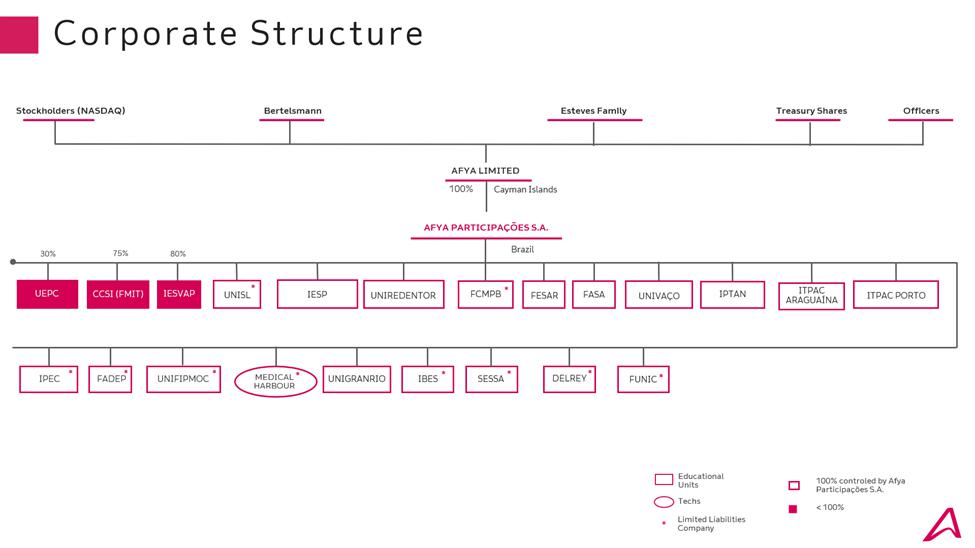
Medcel, IPEMED, PEBMED, CardioPapers and Além da Medicina were merged into Afya Brazil in 2024 and Unidom, iClinic, Medicinae, Cliquefarma, Shosp, RX PRO and Glic were merged into Afya Brazil in 2025 and therefore they do not appear in our current corporate structure chart.
D. Property, Plant and Equipment
As of the date of this annual report, our corporate headquarters are located in Belo Horizonte, State of Minas Gerais. We also have branches of the headquarters located in Belo Horizonte, State of Minas Gerais, São Paulo, State of São Paulo and Rio de Janeiro, State of Rio de Janeiro. All of the corporate headquarters are under lease agreements.
In addition to our corporate headquarters and as of December 31, 2025, we leased almost all of our operational, sales, and administrative facilities. We believe that our facilities are suitable and adequate for our business as presently conducted, however, we periodically review our facility requirements and may acquire new space to meet the needs of our business or consolidate and dispose of facilities that are no longer required.
ITEM 4A. UNRESOLVED STAFF COMMENTS
None.
ITEM 5. OPERATING AND FINANCIAL REVIEW AND PROSPECTS
A. Operating Results
Overview
We are the largest medical education group in Brazil on a per-seat basis, according to MEC, delivering an end-to-end physician-centric ecosystem that serves and empowers students to be lifelong medical learners from the moment they join us as medical students through their medical residency preparation, graduation program, and CME.
| 90 |
Our innovative methodological approach combines integrated content, interactive learning, and an adaptive experience for lifelong medical learners. Through our educational content and technology-enabled activities, we focus on effective, personalized learning that mirrors one-on-one tutoring.
As of December 31, 2025, we had 86,025 enrolled students, compared to 76,988 enrolled students as of December 31, 2024, representing an increase of 11.7% in 2025, and compared to 66,034 enrolled students as of December 31, 2023, representing an increase of 16.6% in 2024.
Our Growth
Our revenue growth and increased profitability have been driven by:
| · | Maturation of current number of authorized medical school seats — Anticipated and contracted growth visibility until 2031 from new medical school seats awarded to our schools, that are in the process of maturing, and new seats from our awarded campuses in connection with the Mais Médicos program and which became operational in 2022; |
| · | Expansion of medical residency preparation and graduate programs enrollments — Increase in the number of students adopting our digital platform, as well as partners and students enrolling in our medical graduate courses; |
| · | Deepening of relationships across lifelong medical learners base — Cross-selling opportunities such as increasing the number of former undergraduate students subscribing to our medical residency preparation solutions and the number of former undergraduate and/or medical residency preparation students applying to our graduate and CME courses; |
| · | M&A — Business combinations and asset acquisitions or investment in businesses that complement our medical education services offering. In 2025, we acquired FUNIC. In 2024, we acquired Unidom. In 2023, we acquired DelRey, which encompasses the operations of UNIMA and FCM Jaboatão and an additional 15% of CCSI, consolidating our ownership of 75% of its total share capital; and |
| · | Synergies extraction — Successful implementation of several measures to improve the profitability of recent acquisitions, such as streamlining fee discounts and scholarship policies, integrating operations with our shared-services center; and aligning newly acquired faculty teams with our career plan. |
Key Business Metrics
We review the following key metrics to evaluate our business, measure our performance, identify trends affecting our business, formulate business plans and make strategic decisions:
Medicine as a Percentage of Our Total Undergraduate Segment Revenue
We believe the metric that best demonstrates our focus on medical education and its relevance to our products and services offering is the contribution of undergraduate medical school programs (“Medicine”) to our total Undergraduate segment revenue.
For the years ended December 31, 2025, 2024 and 2023, revenue from Medicine was 85.7%, 85.6% and 85.5% respectively, of our total Undergraduate segment revenue. The following table sets forth the detailed information of our revenue derived from the different programs within our Undergraduate segment:
|
2025 |
2025 |
2024 |
2023 | |
| (in US$ millions (1)) | (in R$ millions) | |||
| (except percentages) | ||||
| Medicine | 506.9 | 2,789.2 | 2,477.9 | 2,147.4 |
| Other undergraduate health sciences programs | 47.6 | 261.7 | 236.8 | 200.6 |
| Other undergraduate programs(2) |
37.2 |
204.5 |
181.0 |
163.0 |
| Undergraduate segment revenue |
591.6 |
3,255.4 |
2,895.7 |
2,511.0 |
| Medical School programs % (3) | 85.7% | 85.7% | 85.6% | 85.5% |
| (1) | For convenience purposes only, amounts in reais for the year ended December 31, 2025 have been translated to U.S. dollars using an exchange rate of R$5.5024 to US$1.00, the commercial selling rate for U.S. dollars as of December 31, 2025, as reported by the Central Bank. These translations should not be considered representations that any such amounts have been, could have been or could be converted at that or any other exchange rate. |
| (2) | Represents all non-health sciences undergraduate programs. |
| (3) | Calculated as Medical School programs divided by the Undergraduate segment revenue. |
| 91 |
Medical School Regulatory Capacity and Capacity at Maturation
Medical school regulatory capacity and capacity at maturation are operating metrics that provide visibility into our medical school enrollments contracted growth given the supply and demand imbalance in the medical school market and the fact that our medical schools have historically operated very close to their regulatory capacity. Accordingly, the gradual increase in our capacity helps explain the increase in our medical school enrollments, which in turn helps explain our medical school enrollments contracted growth. Contracted growth refers only to schools that are in the initial six years of operation. In addition, since the maximum number of medical seats per medical school is set by applicable regulations, the only way to grow our medical school seats, and therefore our number of enrollments, is through acquisitions or starting new medical schools.
Medical school regulatory capacity is defined by the number of medical school seats available per year awarded by MEC plus the additional seats associated with PROUNI and FIES, multiplied by the number of years of operations since the seats were awarded, up to the sixth year of operations (maturation). Capacity at maturation represents the maximum number of approved seats at a medical school six years after becoming operational. Our medical schools have a six-year maturation cycle because medical school programs in Brazil are for a duration of six years. A maturation cycle represents the period starting when a medical school commences its operations with a first year medical school class of students which progresses through the required six years as the next classes begin behind it, and ends when the medical school has six school years of medical students and has therefore reached capacity at maturation (i.e., the maximum number of approved seats).
For illustration, a medical school that is awarded 100 seats from MEC has the opportunity to add up to 20 additional seats:
| · | 10 more seats by adhering to PROUNI (one seat for every 10.7 seats awarded by MEC); and |
| · | 10 more seats by adhering to FIES (10% of the seats awarded by MEC). |
Illustrative Evolution of Regulatory Capacity per Medical School
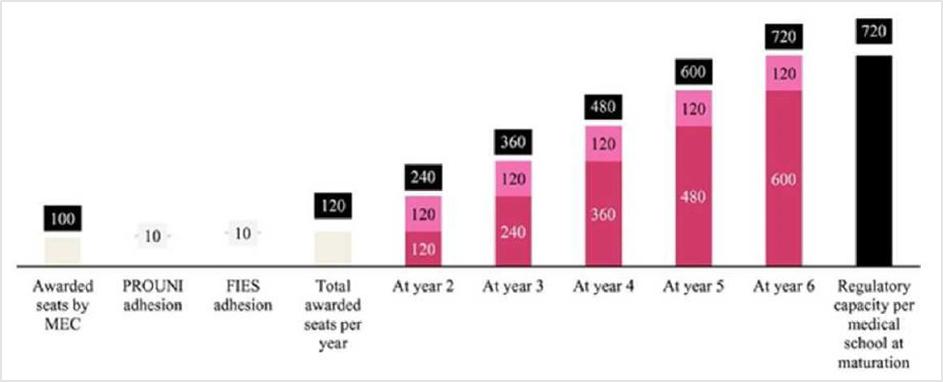
| 92 |
Our medical school regulatory capacity by seats was 3,755, 3,593 and 3,163 seats and our capacity at maturation was 27,036, 25,870 and 22,774, as of December 31, 2025, 2024 and 2023, respectively. Assuming our medical schools continue to operate at full capacity, we estimate reaching a total medical student base of 27,130 students by 2031.
Medical School Occupancy Rate
The occupancy rate of our medical schools is the ratio of the number of students effectively enrolled divided by the regulatory capacity in a given period. While we believe retention rates are an important measure of quality and customer satisfaction, we believe that occupancy rate is a more meaningful metric as it captures not only our ability to retain students but also to find new students to compensate for eventual dropouts. Our management does not separately measure retention rates to make decisions about our business.
The following table sets forth our medical seats occupancy rate as of the dates indicated.
|
As of December 31, | |||
|
2025 |
2024 |
2023 | |
| Occupancy rate | ~100.0% | ~100.0% | ~100.0% |
Non-GAAP Financial Measures
This annual report presents our Revenue (ex-Acquisitions), Adjusted EBITDA and Operating Cash Conversion Ratio information for the convenience of investors, which are non-GAAP financial measures. A non-GAAP financial measure is generally defined as one that purports to measure financial performance but excludes or includes amounts that would not be so adjusted in the most comparable GAAP measure. Although Revenue (ex-Acquisitions), Adjusted EBITDA and Operating Cash Conversion Ratio may be used by the Company’s management, investors and securities analysts in their evaluation of companies, these measures have limitations as analytical tools, and you should not consider them in isolation or as substitutes for the IFRS Accounting Standards measures of earnings. Additionally, our calculations of Revenue (ex-Acquisitions), Adjusted EBITDA and Operating Cash Conversion Ratio may be different from the calculations used by other companies, including our competitors in the education services industry, and therefore, our measures may not be comparable to those of other companies.
We present Revenue (ex-Acquisitions) because we believe this measure provides investors with a supplemental measure of the financial performance of our operations without the impact of the acquisition occurred in the last fiscal year, which facilitates comparisons with the previous periods presented considering the organizational structure as of the beginning of the year ended December 31, 2025. We calculate our Revenue (ex-Acquisitions) as revenue less the revenue recognized by our acquired companies after the date of their acquisition, i.e. for a period of less than 12 months. The comparability of our Revenue (ex-Acquisitions) between periods was impacted by acquisitions of FUNIC in 2025 and Unidom in 2024 described under “Item 4B Business Overview—Our Recent Acquisitions” above.
We present Adjusted EBITDA because we believe this measure provides investors with a supplemental measure of the financial performance of our operations that facilitates period-to-period comparisons on a consistent basis. We calculate our Adjusted EBITDA as net income plus/minus finance result plus income taxes expense plus depreciation and amortization plus interest earned (interest received on late payments of monthly tuition fees), minus share of profit of equity-accounted investee, net of tax, plus share-based compensation expense plus/minus the following items, as applicable: (i) integration of new companies, (ii) M&A advisory and due diligence, (iii) gain on tax amnesty, (iv) expansion projects, (v) restructuring expenses, and (vi) mandatory discounts in tuition fees.
We also present Operating Cash Conversion Ratio because we believe this measure provides investors with a measure of how efficiently we convert our operating results into cash. We calculate our Operating Cash Conversion Ratio as (i) net cash flows from operating activities, adjusted to exclude income taxes paid, divided by (ii) Adjusted EBITDA, excluding certain items that are included in the calculation of Adjusted EBITDA but whose cash effects are reflected in operating cash flows. For purposes of this measure, we exclude from Adjusted EBITDA the add-backs related to (i) integration of new companies, (ii) M&A advisory and due diligence, (iii) gain on tax amnesty, (iv) expansion projects, (v) restructuring expenses, and (vi) mandatory discounts in tuition fees. Although such items are added back in the calculation of Adjusted EBITDA, their cash effects are reflected in operating cash flows. Excluding these items from Adjusted EBITDA for purposes of this ratio is intended to improve comparability between the numerator and denominator and to provide a more meaningful measure of cash conversion.
| 93 |
The following tables set forth the reconciliations between (i) Revenue (ex-Acquisition) to our revenue, (ii) Adjusted EBITDA to our net income and (iii) Operating Cash Conversion Ratio to our cash flow from operations for the years ended December 31, 2025, 2024 and 2023, in each case, our most recent directly comparable financial measures calculated and presented in accordance with IFRS Accounting Standards.
Reconciliation between Revenue and Revenue (ex-Acquisition)
|
For the Year Ended December 31, |
||||
|
2025 |
2025 |
2024 |
2023 | |
| (in US$ millions (1)) | (in R$ millions) | |||
| Revenue | 671.9 | 3,697.3 | 3,304.3 | 2,875.9 |
| Acquired companies’ revenue after acquisition |
16.3 |
89.7 |
– |
– |
| Revenue (ex-Acquisition)(2) |
655.6 |
3,607.5 |
3,304.3 |
2,875.9 |
| (1) | For convenience purposes only, amounts in reais for the year ended December 31, 2025 have been translated to U.S. dollars using an exchange rate of R$5.5024 to US$1.00, the commercial selling rate for U.S. dollars as of December 31, 2025, as reported by the Central Bank. These translations should not be considered representations that any such amounts have been, could have been or could be converted at that or any other exchange rate. See “—Exchange Rates” for further information about recent fluctuations in exchange rates. |
| (2) | “Ex-Acquisitions” figures account for revenue recorded by our acquired companies in the last financial period presented (i.e., December 31, 2025) after the date of their acquisitions. For the year ended December 31, 2025, “ex-Acquisitions” excludes revenues from FUNIC, (May to December 2025) which was acquired on May 7, 2025 and Unidom (January to June 2025) which was acquired on July 1, 2024. |
Reconciliation between Net Income and Adjusted EBITDA
|
For the Year Ended December 31, | ||||
|
2025 |
2025 |
2024 |
2023 | |
| (in US$ millions (1)) | (in R$ millions) | |||
| Net income | 139.7 | 768.4 | 648.9 | 405.4 |
| Net finance result | 66.5 | 366.1 | 347.5 | 347.0 |
| Income taxes expense | 16.8 | 92.5 | 27.5 | 24.2 |
| Depreciation and amortization | 67.9 | 373.3 | 333.3 | 289.5 |
| Interest earned(2) | 9.0 | 49.5 | 43.4 | 33.5 |
| Share of profit of equity-accounted investee, net of tax | (2.5) | (13.9) | (11.7) | (9.5) |
| Share-based compensation expense | 2.8 | 15.3 | 32.4 | 31.5 |
| Integration of new companies(3)(9) | 4.6 | 25.4 | 25.7 | 28.1 |
| M&A advisory and due diligence(4)(9) | 0.1 | 0.6 | 3.6 | 12.6 |
| Gain on tax amnesty(5)(9) | – | – | – | (16.8) |
| Expansion projects(6)(9) | 0.4 | 0.7 | 3.0 | 4.4 |
| Restructuring expenses(7)(9) | 0.1 | 2.2 | 2.1 | 12.0 |
| Mandatory discounts in tuition fees(8)(9) |
– |
– |
– |
3.8 |
| Adjusted EBITDA |
305.4 |
1,680.3 |
1,455.6 |
1,165.7 |
| (1) | For convenience purposes only, amounts in reais for the year ended December 31, 2025 have been translated to U.S. dollars using an exchange rate of R$5.5024 to US$1.00, the commercial selling rate for U.S. dollars as of December 31, 2025, as reported by the Central Bank. These translations should not be considered representations that any such amounts have been, could have been or could be converted at that or any other exchange rate. See “—Exchange Rates” for further information about recent fluctuations in exchange rates. |
| (2) | Consists of interest received on late payments of monthly tuition fees. |
| (3) | Consists of expenses related to the integration of recently acquired companies, such as expenses with personnel and third-party consulting firms. |
| (4) | Consists of expenses related to professional and consultant fees in connection with due diligence services for our M&A transactions. |
| (5) | On August 10, 2023, Unigranrio entered into a tax amnesty program on interest and penalties to settle a tax proceeding with respect to ISS (tax on services) with the municipality of Rio de Janeiro, which resulted in a payment of R$14.9 million to settle the claim. The selling shareholders of Unigranrio agreed to pay R$5.4 million regarding this matter. We had a provision of R$53.3 million and an indemnification asset from the selling shareholders of R$20.0 million (in light of the indemnification clauses as defined at the acquisition of Unigranrio), with respect to such tax proceeding. The difference between the provision, indemnification asset and the actual paid amount was recorded in Other income on the consolidated statement of income and comprehensive income. |
| (6) | Consists of expenses related to professional and consultant fees in connection with the opening of new campuses. |
| (7) | Consists of expenses related to employee redundancies in connection with the organizational restructuring of our acquired companies. |
| (8) | Consists of mandatory discounts in tuition fees granted by state decrees and individual/collective legal proceedings and public civil proceedings due to COVID-19 on-site class restriction, and excludes any recovery of these discounts that were invoiced based on a decision by the Brazilian Supreme Court with respect to this matter that deemed such discounts to be unconstitutional. |
| (9) | We believe these adjustments are appropriate to provide investors with additional information about certain expenses that we do not expect to continue at the same level in the future. |
| 94 |
Reconciliation between Cash Flow from Operations and Operating Cash Conversion Ratio
|
For the Year Ended December 31, | ||||
|
2025 |
2025 |
2024 |
2023 | |
| (in US$ millions (1)) | (in R$ millions) | |||
| (except percentages) | ||||
| Net cash flows from operating activities | 278.3 | 1,531.6 | 1,432.7 | 1,043.6 |
| Income taxes paid | 2.9 | 16.0 | 20.5 | 45.1 |
| Net cash flows from operating activities, before income taxes paid (A) | 281.3 | 1,547.6 | 1,453.2 | 1,088.8 |
| Adjusted EBITDA(2) | 305.4 | 1,680.3 | 1,455.6 | 1,165.7 |
| Integration of new companies(3)(9) | 4.6 | 25.4 | 25.7 | 28.1 |
| M&A advisory and due diligence(4)(9) | 0.1 | 0.6 | 3.6 | 12.6 |
| Gain on tax amnesty(5)(9) | — | — | — | (16.8) |
| Expansion projects(6)(9) | 0.1 | 0.7 | 3.0 | 4.4 |
| Restructuring expenses(7)(9) | 0.4 | 2.2 | 2.1 | 12.0 |
| Mandatory discounts in tuition fees(8)(9) | — | — | — | 3.8 |
| Adjusted EBITDA ex cash effects reflected in operating cash flows (B) |
300.1 |
1,651.3 |
1,421.3 |
1,121.6 |
| Operating Cash Conversion Ratio (A/B) |
93.7% |
93.7% |
102.2% |
97.1% |
| (1) | For convenience purposes only, amounts in reais for the year ended December 31, 2025 have been translated to U.S. dollars using an exchange rate of R$5.5024 to US$1.00, the commercial selling rate for U.S. dollars as of December 31, 2025, as reported by the Central Bank. These translations should not be considered representations that any such amounts have been, could have been or could be converted at that or any other exchange rate. See “—Exchange Rates” for further information about recent fluctuations in exchange rates. |
| (2) | See “—Reconciliation between Net Income and Adjusted EBITDA” above. |
| (3) | Consists of expenses related to the integration of recently acquired companies, such as expenses with personnel and third-party consulting firms. |
| (4) | Consists of expenses related to professional and consultant fees in connection with due diligence services for our M&A transactions. |
| (5) | On August 10, 2023, Unigranrio entered into a tax amnesty program on interest and penalties to settle a tax proceeding with respect to ISS (tax on services) with the municipality of Rio de Janeiro, which resulted in a payment of R$14.9 million to settle the claim. The selling shareholders of Unigranrio agreed to pay R$5.4 million regarding this matter. We had a provision of R$53.3 million and an indemnification asset from the selling shareholders of R$20.0 million (in light of the indemnification clauses as defined at the acquisition of Unigranrio), with respect to such tax proceeding. The difference between the provision, indemnification asset and the actual paid amount was recorded in Other income on the consolidated statement of income and comprehensive income. |
| (6) | Consists of expenses related to professional and consultant fees in connection with the opening of new campuses. |
| (7) | Consists of expenses related to employee redundancies in connection with the organizational restructuring of our acquired companies. |
| (8) | Consists of mandatory discounts in tuition fees granted by state decrees and individual/collective legal proceedings and public civil proceedings due to COVID-19 on-site class restriction, and excludes any recovery of these discounts that were invoiced based on a decision by the Brazilian Supreme Court with respect to this matter that deemed such discounts to be unconstitutional. |
| (9) | We believe these adjustments are appropriate to provide investors with additional information about certain expenses that we do not expect to continue at the same level in the future |
| 95 |
Operating Data
Key Revenue Drivers –– Undergraduate Segment
|
As of and
For the Year Ended | |||
|
2025 |
2024 |
2023 | |
| UNDERGRADUATE PROGRAMS | |||
| Medical School | |||
| Approved Seats | 3,755 | 3,593 | 3,163 |
| Operating Seats | 3,705 | 3,543 | 3,113 |
| Total Students (end of period) | 25,556 | 24,255 | 21,446 |
| Average Total Students | 25,719 | 23,440 | 21,154 |
| Average Total Students (ex-Acquisitions)(1) | 24,881 | 23,440 | 21,154 |
| Revenue (Total) (in R$ thousands) |
2,789,170 |
2,477,906 |
2,147,448 |
| Revenue (ex-Acquisitions) (in R$ thousands)(1) |
2,705,045 |
2,477,906 |
2,147,448 |
| Medical School Net Avg. Ticket (ex-Acquisitions) (R$/month)(1)(2) |
9,060 |
8,809 |
8,460 |
| Undergraduate Health Science | |||
| Total Students (end of period) | 26,545 | 25,570 | 21,117 |
| Average Total Students | 26,344 | 25,154 | 21,365 |
| Average Total Students (ex-Acquisitions)(1) | 25,954 | 25,154 | 21,365 |
| Revenue (Total) (in R$ thousands) |
261,724 |
236,791 |
200,613 |
| Revenue (ex-Acquisitions) (in R$ thousands)(1) |
257,075 |
236,791 |
200,613 |
| Other Ex-Health Undergraduate | |||
| Total Students (end of period) | 33,924 | 27,163 | 23,471 |
| Average Total Students | 34,271 | 27,542 | 24,336 |
| Average Total Students (ex-Acquisitions)(1) | 33,538 | 27,542 | 24,336 |
| Revenue (Total)(in R$ thousands) |
204,533 |
180,994 |
162,957 |
| Revenue (ex-Acquisitions) (in R$ thousands)(1) |
203,600 |
180,994 |
162,957 |
| Revenue | |||
| Undergraduate Segment Revenue (Total) (in R$ thousands) |
3,255,426 |
2,895,692 |
2,511,018 |
| Undergraduate Segment Revenue (ex-Acquisitions) (in R$ thousands)(1) |
3,165,720 |
2,895,692 |
2,511,018 |
| (1) | “Ex-Acquisitions” figures account for revenue recorded by our acquired companies in the last financial period presented (i.e., December 31, 2025) after the date of their acquisitions. For the year ended December 31, 2025, “ex-Acquisitions” excludes revenues from FUNIC (May to December 2025) which was acquired on May 7, 2025 and Unidom (January to June 2025) which was acquired on July 1, 2024. For more information See “—Non-GAAP Financial Measures.” |
| (2) | Medical School Net Average Ticket (ex-Acquisitions) is calculated as Revenue (ex-Acquisitions) divided by the Average Total Students (ex-Acquisitions), divided by the number of months in a given period. |
| 96 |
Key Revenue Drivers — Continuing Education Segment
|
As of and For the Year Ended December 31, | |||
|
2025 |
2024 |
2023 | |
| CONTINUING EDUCATION | |||
| Total Students (end of period) | |||
| Residency Journey - Business to Physicians B2P | 12,990 | 16,381 | 12,170 |
| Graduate Journey - Business to Physicians B2P | 10,234 | 8,527 | 7,722 |
| Other Courses - B2P and Business to Business Offerings |
31,815 |
25,613 |
27,188 |
| Total Students |
55,039 |
50,521 |
47,080 |
| Revenue | |||
| Business to Physician - B2P (in R$ thousands) | 257,706 | 237,379 | 215,504 |
| Business to Business - B2B (in R$ thousands) |
26,765 |
18,060 |
20,325 |
| Continuing Education Segment Revenue (Total) (in R$ thousands) |
284,471 |
255,438 |
235,830 |
Key Revenue Drivers — Medical Practice Solutions Segment
|
As of and For the Year Ended December 31, | |||
|
2025 |
2024 |
2023 | |
| MEDICAL PRACTICE SOLUTIONS(1) | |||
| Active Paying Users (end of period) | |||
| Clinical Decision | 156,598 | 161,283 | 153,541 |
| Clinical Management |
38,906 |
33,735 |
30,061 |
| Total Active Paying Users (end of period) |
195,504 |
195,018 |
183,602 |
| Monthly Active Users (MAU) | |||
| Total Monthly Active Users (MaU) - Medical Practice Solutions (1) |
220,051 |
238,343 |
247,702 |
| Revenue - B2P (in R$ thousands) | 152,643 | 139,534 | 122,983 |
| Revenue - B2B (in R$ thousands) |
18,680 |
22,252 |
17,299 |
| Medical Practice Solutions Segment Revenue (Total) (in R$ thousands) (2) |
171,323 |
161,787 |
140,282 |
| (1) | “Monthly Active Users (MaU)” represents the number of unique individuals that consumed digital services content in each one of our products in the last 30 days of a specific period. |
| (2) | Revenue from Shosp, our clinical management software, was reclassified from B2B to B2P in 2025 and was applied retroactively for comparative purposes. |
| 97 |
Revenue and Revenue (ex-Acquisitions)
|
For the Year Ended December 31, | |||||
|
2025 |
2025 Ex-Acquisitions(1) |
2024 |
% Change |
% Change Ex-Acquisitions(1) | |
| (in R$ millions) | |||||
| Revenue | |||||
| Undergraduate | 3,255.4 | 3,165.7 | 2,895.7 | 12.4% | 9.3% |
| Continuing Education | 284.5 | 284.5 | 255.4 | 11.4% | 11.4% |
| Medical Practice Solutions | 171.3 | 171.3 | 161.8 | 5.9% | 5.9% |
| Inter-segment eliminations |
(14.0) |
(14.0) |
(8.6) |
62.6% | 62.6% |
| Total |
3,697.3 |
3,607.5 |
3,304.3 |
11.9% |
9.2% |
| (1) | For the year ended December 31, 2025, “ex-Acquisitions” excludes revenues from FUNIC, (May to December 2025) which was acquired on May 7, 2025 and Unidom (January to June 2025) which was acquired on July 1, 2024. For more information See “—Non-GAAP Financial Measures.” |
The comparability of our revenues between periods was impacted by the acquisitions of Unidom in 2024 and FUNIC in 2025 described under “Item 4B Business Overview—Our Recent Acquisitions.”
Exchange Rates
The Brazilian foreign exchange system allows the purchase and sale of foreign currency and the international transfer of reais by any person or legal entity, regardless of the amount, subject to certain regulatory procedures.
The real/U.S. dollar exchange rate reported by the Central Bank was R$4.8413 per US$1.00 on December 31, 2023, which reflected a 7.2% appreciation in the real against the U.S. dollar during 2023. On December 31, 2024, the exchange rate for the sale of U.S. dollars reported by the Central Bank was R$6.1923 per US$1.00, which reflected a 27.9% depreciation in the real against the U.S. dollar during 2024. On December 31, 2025, the exchange rate for the sale of U.S. dollars reported by the Central Bank was R$$5.5024 per US$1.00, which reflected a 11.1% appreciation in the real against the U.S. dollar during 2025. As of March 23, 2026, the exchange rate for the sale of U.S. dollars as reported by the Central Bank was R$5.2440 per US$1.00, which reflected an appreciation of 4.7% in the real against the U.S. dollar since December 31, 2025. There can be no assurance that the real will not again depreciate or appreciate against the U.S. dollar or other currencies in the future.
The Central Bank has intervened occasionally in the foreign exchange market to attempt to control instability in foreign exchange rates. We cannot predict whether the Central Bank or the Brazilian government will continue to allow the real to float freely or will intervene in the exchange rate market by re-implementing a currency band system or otherwise. The real may depreciate or appreciate substantially against the U.S. dollar in the future. Furthermore, Brazilian law provides that, whenever there is a serious imbalance in Brazil’s balance of payments or there are serious reasons to foresee a serious imbalance, temporary restrictions may be imposed on remittances of foreign capital abroad. We cannot assure you that the Brazilian government will not place restrictions on remittances of foreign capital abroad in the future.
The following table sets forth, for the periods indicated, the high, low, average and period-end exchange rates for the purchase of U.S. dollars expressed in Brazilian reais per U.S. dollar. The monthly and annual average rates are calculated by using the average of reported exchange rates by the Central Bank on each day during a monthly period and on the last day of each month during an annual period, respectively.
| 98 |
|
Year |
Period-End |
Average(1) |
Low(2) |
High(3) |
| 2021 | 5.580 | 5.395 | 4.920 | 5.839 |
| 2022 | 5.218 | 5.165 | 4.618 | 5.704 |
| 2023 | 4.841 | 4.995 | 4.720 | 5.446 |
| 2024 | 6.192 | 5.392 | 4.854 | 6.199 |
| 2025 | 5.502 | 5.586 | 5.273 | 6.209 |
Source: Central Bank.
| (1) | Represents the average of the exchange rates on the closing of each day during the year. |
| (2) | Represents the minimum of the exchange rates on the closing of each day during the year. |
| (3) | Represents the maximum of the exchange rates on the closing of each day during the year. |
|
Month |
Period-end |
Average(1) |
Low(2) |
High(3) |
| September 2025 | 5.3186 | 5.3674 | 5.3010 | 5.4680 |
| October 2025 | 5.3843 | 5.3855 | 5.3208 | 5.4982 |
| November 2025 | 5.3338 | 5.3409 | 5.2729 | 5.3948 |
| December 2025 | 5.5024 | 5.4531 | 5.2952 | 5.5739 |
| January 2026 | 5.2301 | 5.3380 | 5.1838 | 5.4372 |
| February 2026 | 5.1495 | 5.2006 | 5.1382 | 5.2587 |
| March 2026 (through March 23, 2026) | 5.2440 | 5.2303 | 5.1596 | 5.2878 |
Source: Central Bank.
| (1) | Represents the average of the exchange rates on the closing of each day during the month. |
| (2) | Represents the minimum of the exchange rates on the closing of each day during the month. |
| (3) | Represents the maximum of the exchange rates on the closing of each day during the month. |
Significant Factors Affecting Our Results of Operations
We believe that our results of operations and financial performance will be driven by the following trends and factors:
Regulatory Environment and Mais Médicos Program
Our business is significantly influenced by the regulatory environment of the educational industry in Brazil. We are subject to various federal laws and extensive government regulations by MEC, CNE, INEP, FIES and CONAES, among others. In particular, medical education in Brazil is subject to regulations that aim to control the supply of medical school seats across Brazil and their geographic allocation including, but not limited to the Mais Médicos Law, which created the Mais Médicos program, whose main objectives include addressing the provision of doctors for primary care in municipalities, strengthen health care infrastructure and allocate medical workforce to vulnerable areas.
With the increase in annual offerings through Mais Médicos, on April 5, 2018, MEC issued Ordinance No. 328/2018, pursuant to which, among other measures, MEC imposed a five-year suspension on the granting of authorizations for the creation of new medical education courses. However, on April 5, 2023, MEC issued Ordinance No. 650/2023, which revoked the suspension under Ordinance No. 328/18 and set new rules for the opening of new medicine courses. In particular, MEC will be required to conduct a public call for new courses, i.e., through the Mais Médicos program pursuant to the Mais Médicos Law.
In this context, on October 4, 2023, MEC, through SERES, exercising its legal powers and based on Article 3 of the Mais Médicos Law, announced a public call for the selection of proposals for the authorization of new undergraduate medical courses nationwide under the Mais Médicos III program. The public call established the rules, procedures, decision-making standards and timeline applicable to the selection process and contemplated the potential creation of new medical school seats across several municipalities in Brazil. However, on February 10, 2026, MEC formally cancelled the public call relating to the Mais Médicos III program, with immediate effect, and the authorization process contemplated under that public call was discontinued. Although the cancellation eliminated the specific expansion process initiated in 2023, future regulatory initiatives or public calls for the authorization of new medical courses may increase the number of medical school seats in Brazil and, consequently, intensify competition in the sector. If competition increases, we may be required to reduce our tuition fees or increase our operating expenses (including our costs per student) in order to retain or attract students or to pursue new market opportunities and reduce our ability to fill all our medical school seats capacity.
| 99 |
For further information, see “Item 4. Information on the Company—Business Overview—Regulatory Overview,” “Item 3. Key Information—D. Risk Factors—Certain Risks Relating to Our Business and Industry— The post-secondary education sector is highly regulated, and our failure to comply with existing or future laws and regulations could limit our ability to operate medical programs, obtain new authorizations or accreditations, maintain our regulatory approvals, or obtain re-accreditations, which could materially impact our business,” “Item 3. Key Information—D. Risk Factors—Certain Risks Relating to Our Business and Industry—We are subject to supervision by MEC and, consequently, may suffer sanctions as a result of non-compliance with any regulatory requirements” and “Item 3. Key Information—D. Risk Factors—We face significant competition in the provision of our educational services. If our competition increases or if we fail to compete efficiently, we may lose market share, and our profitability may be adversely affected.”
Scholarships, Student Financing and Tax Benefits
A large number of our students fund their tuition fees through financing from FIES. In addition, we participate in the PROUNI scholarship program, and we benefit from tax benefits in return. For more information on our students enrolled in these programs, see “Item 4. Information on the Company—Business Overview—Regulatory Overview—Financing Alternatives for Students: Incentive Programs—University for All Program” “Regulatory Overview—Financing Alternatives for Students: Incentive Programs—Student Financing Program (FIES),” “Item 3. Key Information—D. Risk Factors—Certain Risks Relating to Our Business and Industry— Changes to the rules, judicial interpretations, administrative decisions or delays or suspension of tuition payments made through FIES may adversely affect our cash flows and our business,” and “Item 3. Key Information—D. Risk Factors—Certain Risks Relating to Our Business and Industry—If we lose the benefits of federal tax exemptions provided under the PROUNI program, our business, financial condition and results of operations may be materially adversely affected.” In addition to PROUNI and FIES, we participate in private financing programs through external partners (Pravaler, Bradesco, BNB, Sicoob, CashMe, Alume and Emcash) for undergraduate students.
Brazilian Macroeconomic Environment
All of our operations are located in Brazil. As a result, our revenues and profitability are affected by political and economic developments in Brazil and the effect that these factors have on the availability of credit, disposable income, employment rates and average wages in Brazil. Our operations, and the industry in general, may be affected changes in economic conditions.
Brazil is the largest economy in Latin America, as measured by gross domestic product, or GDP. The following table shows data for real GDP, inflation and interest rates in Brazil and the U.S. dollar/real exchange rate at the dates and for the periods indicated.
|
For the Year Ended December 31, | |||
|
2025 |
2024 |
2023 | |
| Real growth (contraction) in gross domestic product | 2.3% | 3.4% | 2.9% |
| Inflation (IGP-M)(1) | (1.1)% | 6.5% | (3.2)% |
| Inflation (IPCA)(2) | 4.3% | 4.8% | 4.6% |
| Long-term interest rates—TJLP (average)(3) | 9.1% | 7.4% | 5.7% |
| CDI rate(4) | 14.9% | 12.15% | 13.2% |
| Period-end exchange rate—reais per US$1.00 | 5.502 | 6.192 | 4.841 |
| Average exchange rate—reais per US$1.00(5) | 5.586 | 5.392 | 4.995 |
| Appreciation (depreciation) of the real vs. US$ in the period(6) | 11.1% | (27.9)% | 7.2% |
| Unemployment rate(7) | 5.1% | 6.2% | 7.4% |
Source: FGV, IBGE, Central Bank and Bloomberg.
| (1) | Inflation (IGP-M) is the general market price index measured by the FGV. |
| (2) | Inflation (IPCA) is a broad consumer price index measured by the IBGE. |
| (3) | TJLP is the Brazilian long-term interest rate (average of monthly rates for the period). |
| (4) | The CDI rate (Certificado de Depósito Interbancário) interest rate is an average of interbank overnight rates in Brazil. |
| (5) | Average of the exchange rate on each business day of the year. |
| (6) | Comparing the US$ closing selling exchange rate as reported by the Central Bank at the end of the period’s last day with the day immediately prior to the first day of the period discussed. |
| (7) | Average unemployment rate for the year as measured by the IBGE. |
| 100 |
Inflation directly affects our current operating costs and expenses, adjusted by reference to indexes that reflect the inflation rate such as the IGP-M or IPCA, primarily as a result of annual adjustments to faculty member and employee salaries. Historically, inflation has been more than offset by the tuition fees we charge our students.
Our financial performance is also marginally tied to fluctuations in interest rates, such as the CDI rate, because such fluctuations affect the value of our financial investments. We are also exposed to fluctuations in interest rates on our accounts payable to selling shareholders and loans and financing which are indexed to the CDI, IPCA and SELIC.
Pillar Two Global Minimum Tax
On December 27, 2024, Law 15,079/2024 was enacted, establishing the implementation of the OECD’s Pillar Two global minimum tax in Brazil, effective as of January 1, 2025.
Law 15,079/2024 aligns the Brazilian tax legislation to the OECD’s Global Anti-Base Erosion (GloBE) rules by introducing a minimum effective taxation of 15% through an additional Social Contribution tax on Net Profit (Contribuição Social sobre o Lucro Líquido, or “CSLL”). This regulation applies to multinational groups within the scope of the OECD’s GloBE rules, specifically those whose ultimate parent entity reported annual consolidated revenues of at least €750 million in at least two of the four fiscal years immediately preceding the year under review.
The rules are designed to ensure that the additional CSLL qualifies as a Qualified Domestic Minimum Top-up Tax (QDMTT) under the OECD Inclusive Framework, subjecting Brazilian entities to a minimum tax rate of 15%.
On March 28, 2025, we filed a writ of mandamus with the Brazilian Federal Court challenging the enforceability of the newly enacted additional CSLL. The legal proceeding is grounded on constitutional and statutory arguments, and is waiting for court decision to prevent the collection of the additional CSLL, which is scheduled to be disbursed in 2026 with respect to the 2025 fiscal year. As of the date of this annual report, no favorable preliminary relief has been granted, and the judicial discussion remains pending.
As no court decision has been issued to date, we have recorded a provision based on the amounts calculated in accordance with the applicable legislation. For the year ended December 31, 2025, the additional income tax expense arising from Law No. 15,079/2024 totaled R$109.5 million and was recognized as income taxes payable within current liabilities. We have applied the exception to the recognition and disclosure of deferred tax assets and liabilities related to Pillar Two income taxes.
In parallel with the judicial proceedings, we continue to evaluate and pursue additional strategies to mitigate the potential impacts of the application of the Pillar Two rules to our operations, including the assessment of further judicial measures and ongoing engagement with members of the Brazilian Congress and relevant parliamentary bodies in connection with legislative initiatives aimed at allowing such PROUNI-related tax benefits to be treated as qualified refundable tax credits for purposes of the Pillar Two global minimum tax rules.
Acquisitions
We may face significant challenges in the process of integrating the operations of our acquired companies. If we are not able to manage these integrations effectively, our results of operations may be affected. See “Item 3. Key Information—D. Risk Factors—Certain Risks Relating to Our Business and Industry—We may face challenges in identifying and acquiring new medical higher education institutions, which could hinder our strategic and financial goals. Additionally, difficulties in effectively integrating and managing an increasing number of acquisitions may adversely affect our strategic objectives” and “Item 4. Information on the Company—B. Business Overview—Our Recent Acquisitions.”
| 101 |
Business Segments
Our three operating segments are as follows:
| · | Undergraduate, which provides educational services through undergraduate courses related to medical school, undergraduate health science and other ex-health undergraduate programs; |
| · | Continuing Education, which provides medical education (including residency preparation programs, specialization test preparation and other medical capabilities), specialization and graduate courses in medicine, delivered through digital and in-person content; and |
| · | Medical Practice Solutions, which provides clinical decision, clinical management and doctor-patient relationships for physicians and provide access, demand and efficiency for the healthcare players. |
Segment information is presented consistently with the internal reports provided to our chief executive officer, who is our chief operating decision maker (CODM) and is responsible for allocating resources, assessing the performance of our operating segments, and making our strategic decisions.
No operating segments have been aggregated to form the above reportable operating segments. There is only one geographic region and the results are monitored and evaluated based on the three reportable segments.
Description of Principal Line Items
Revenue
Our revenue consists primarily of tuition fees charged for medical courses. We also generate revenue from tuition fees for other undergraduate and graduate courses, student fees, certain education-related activities, digital education content and subscription of digital services.
Cost of Services
Cost of services includes expenses related to payroll, rent, hospital agreements, utilities and depreciation and amortization. Cost of services amounted to 35.5%, 36.8% and 38.6% of our revenue in the years ended December 31, 2025, 2024 and 2023, respectively.
Selling, General and Administrative Expenses and Other Expenses
Our operating expenses includes expenses for personnel, general and administrative, management and officer compensation, marketing and other income and expenses.
Personnel. Personnel expenses consist of wages, overtime, benefits (meal vouchers, transportation vouchers and medical and dental insurance, among others), profit sharing, social contribution and payroll taxes. In Brazil, social contribution and payroll taxes consist of the Brazilian Social Security Institute (Instituto Nacional do Seguro Social) contribution, or INSS, and the Brazilian Unemployment Severance Fund (Fundo de Garantia do Tempo de Serviço) contribution, or FGTS.
Selling, general and administrative. Selling, general and administrative expenses mainly consist of: (i) building infrastructure expenses, such as leases and property maintenance; (ii) utilities expenses; (iii) expenses for computer system maintenance and office automation, such as software licenses, as well as for integrated accounting, treasury, financial planning and cost management systems; (iv) sales and marketing expenses; and (v) amounts paid for professional services, such as consultants, auditors and outside counsel.
Other income and expenses. Other income and expenses, consists mainly of miscellaneous income and/or expense items.
| 102 |
Finance Result
Our finance result includes finance income and finance expenses. Our finance income consists mainly of income from interest earned on financial investments and interest received on late payments from students. Our finance expenses consist mainly of interest expenses from accounts payable to selling shareholders, loans and financing and lease liabilities.
We also have cash and cash equivalents denominated in U.S. dollars, and accordingly, we have foreign exchange gain or losses from the changes in U.S. dollars against the Brazilian real.
Income Taxes Expenses
Income taxes expenses includes current income taxes and social contribution.
Consolidated Results of Operations
Year Ended December 31, 2025 Compared to the Year Ended December 31, 2024
The following table sets forth our consolidated income statement data for the years ended December 31, 2025 and 2024:
|
For the Year Ended December 31, | |||
|
2025 |
2024 |
Change (%) | |
| (in R$ millions, except for percentages) | |||
| Revenue | 3,697.3 | 3,304.3 | 11.9% |
| Cost of services |
(1,313.9) |
(1,215.6) |
8.1% |
| Gross profit |
2,383.4 |
2,088.7 |
14.1% |
| Selling, general and administrative expenses | (1,113.1) | (1,008.4) | 10.4% |
| Allowance for expected credit losses | (57.1) | (60.9) | (6.2%) |
| Other income | 18.8 | 13.3 | 41.4% |
| Other expenses |
(18.9) |
(20.6) |
(8.3%) |
| Operating income |
1,213.1 |
1,012.1 |
19.9% |
| Finance income | 194.9 | 111.3 | 75.1% |
| Finance expenses |
(561.0) |
(458.7) |
22.3% |
| Net Finance Result |
(366.1) |
(347.5) |
5.4% |
| Share of profit of equity-accounted investee, net of tax |
13.9 |
11.7 |
18.8% |
| Income before income taxes |
860.9 |
676.4 |
27.3% |
| Income taxes expenses | |||
| Current | (133.3) | (24.2) | n.m. |
| Deferred |
40.8 |
(3.2) |
n.m. |
| Net income |
768.4 |
648.9 |
18.4% |
n.m. = not meaningful
Revenue
Revenue for the year ended December 31, 2025 was R$3,697.3 million, an increase of R$393.0 million, or 11.9%, from R$3,304.3 million for the year ended December 31, 2024. The increase in our revenue was primarily affected by the following:
| · | In our Undergraduate segment, revenue for the year ended December 31, 2025 was R$3,255.4 million, an increase of 12.4%, or R$359.7 million, from R$2,895.7 million for the year ended December 31, 2024. This increase was primarily attributable to: (i) organic revenue growth from the maturation of medical school seats and an increase of medical school net average ticket from an average ticket per month of R$8,809 in 2024 to R$9,060 in 2025, resulting in an increase of R$173.0 million in our Undergraduate segment’s net revenue; and (ii) consolidation of the results of operations of Unidom beginning in July 2024, resulting in an increase of R$109.1 million in our Undergraduate segment’s net revenue; |
| 103 |
| · | In our Continuing Education segment, revenue for the year ended December 31, 2025 was R$284.5 million, an increase of 11.4%, or R$29.1 million, from R$255.4 million for the year ended December 31, 2024. This increase was primarily attributable to a 8.9% increase in average total students from 50,521 paying students in 2024 to 55,039 paying students in 2025; and |
| · | In our Medical Practice Solutions segment, revenue for the year ended December 31, 2025 was R$171.3 million, an increase of 5.9%, or R$9.5 million, from R$161.8 million for the year ended December 31, 2024. This increase was primarily attributable to an increase of total active paying users from 195,018 active paying users in 2024 to 195,504 active paying users in 2025, and as a result of price adjustments. |
Cost of Services
Cost of services for the year ended December 31, 2025 was R$1,313.9 million, an increase of R$98.3 million, or 8.1%, from R$1,215.6 million for the year ended December 31, 2024. As a percentage of revenue, our cost of services decreased to 35.5% for the year ended December 31, 2025, compared to 36.8% for the year ended December 31, 2024. The increase in our cost of services was primarily affected by the following:
| · | In our Undergraduate segment, cost of services for the year ended December 31, 2025 was R$1,176.8 million, an increase of R$90.7 million, or 8.4%, from R$1,086.1 million for the year ended December 31, 2024. This increase was primarily attributable to an increase of R$87.5 million applied to salaries and wages, both related to an increase in the number of personnel and yearly readjustment of wages; |
| · | In our Continuing Education segment, cost of services for the year ended December 31, 2025 was R$96.4 million, an increase of R$0.2 million, or 0.2%, from R$96.2 million for the year ended December 31, 2024. This increase was primarily attributable to a general increase in costs with salaries across our operating units as a result of annual readjustment of wages; |
| · | In our Medical Practice Solutions segment, cost of services for the year ended December 31, 2025 was R$54.7 million, an increase of R$12.8 million, or 30.5%, from R$41.9 million for the year ended December 31, 2024. This increase was primarily to a general increase in costs with salaries across our operating units as a result of an increase in the number of personnel and annual readjustment of wages. |
Gross Profit
As a result of the foregoing, gross profit for the year ended December 31, 2025 was R$2,383.4 million, an increase of R$294.7 million, or 14.1%, from R$2,088.7 million for the year ended December 31, 2024. Our gross profit by segment was the following:
| · | In our Undergraduate segment, gross profit for the year ended December 31, 2025 was R$2,078.6 million, an increase of R$269.0 million, or 14.9%, from R$1,809.6 million for the year ended December 31, 2024; |
| · | In our Continuing Education segment, gross profit for the year ended December 31, 2025 was R$188.1 million, an increase of R$28.8 million, or 18.1%, from R$159.3 million for the year ended December 31, 2024; and |
| · | In our Medical Practice Solutions segment, gross profit for the year ended December 31, 2025 was R$116.6 million, a decrease of R$3.3 million, or 2.7%, from R$119.9 million for the year ended December 31, 2024. |
Selling, General and Administrative Expenses
Selling, general and administrative expenses for the year ended December 31, 2025 was R$1,113.1 million, an increase of R$104.7 million, or 10.4%, from R$1,008.4 million for the year ended December 31, 2024. This increase was primarily attributable to: (i) an increase of R$46.2 million in payroll expenses as a result of an increase in the total number of personnel and yearly readjustment of wages, (ii) an increase of R$29.9 million in sales and marketing expenses, mostly related to rebranding efforts, marketing campaigns and advertising expenses; and (iii) an increase of R$22.7 million in depreciation and amortization expenses as a result of capital expenditures in 2025.
| 104 |
Operating Income
For the reasons discussed above, operating income for the year ended December 31, 2025 was R$1,213.1 million, an increase of R$201.0 million, or 19.9%, from R$1,012.1 million for the year ended December 31, 2024.
Net Finance Result
Net Finance result for the year ended December 31, 2025 was an expense of R$366.1 million, compared to an expense of R$347.5 million for the year ended December 31, 2024, for the reasons described below.
Finance income. Finance income for the year ended December 31, 2025 was R$194.9 million, an increase of R$83.6 million, or 75.1%, from R$111.3 million for the year ended December 31, 2024. This increase was primarily attributable to an increase in financial income from cash equivalents due to: (i) a higher amount in cash equivalents during 2025 when compared to 2024; and (ii) a higher average interest on these investments (101.2% of the CDI rate for 2025 compared to 99.1% of the CDI rate for 2024).
Finance expenses. Finance expenses for the year ended December 31, 2025 was R$561.0 million, an increase of R$102.3 million, or 22.3%, from R$458.7 million for the year ended December 31, 2024. This increase was primarily attributable to: (i) higher interest expense, which increased by R$62.0 million year-over-year; (ii) higher financial discounts, which increased by R$21.0 million; (iii) higher interest expense on lease liabilities, which increased by R$11.1 million.
Income before Income Taxes
As a result of the foregoing, income before income taxes for the year ended December 31, 2025 was R$860.9 million, an increase of R$184.5 million, or 27.3%, from R$676.4 million for the year ended December 31, 2024.
Income Taxes Expenses
Current income taxes expenses for the year ended December 31, 2025 was R$133.3 million, an increase of R$83.6 million, or 75.1%, from R$24.2 million for the year ended December 31, 2024. Deferred income taxes for the year ended December 31, 2025 was a benefit of R$40.8 million, a change of R$44.0 million from an expense of R$3.2 million for the year ended December 31, 2024. The effective tax rate increased to 10.7% for the year ended December 31, 2025 from 4.1% for the year ended December 31, 2024. This increase in our effective tax rate was primarily attributable to the effects of Pillar Two - for more information refer to ‘Pillar Two Global Minimum Tax’ topic.
Net Income
As a result of the foregoing, our net income for the year ended December 31, 2025 was R$768.4 million, an increase of R$119.5 million, or 18.4%, from R$648.9 million for the year ended December 31, 2024.
Year Ended December 31, 2024 Compared to the Year Ended December 31, 2023
The following table sets forth our consolidated income statement data for the years ended December 31, 2024 and 2023:
|
For the Year Ended December 31, | |||
|
2024 |
2023 |
Change (%) | |
| (in R$ millions, except for percentages) | |||
| Revenue | 3,304.3 | 2,875.9 | 14.9% |
| Cost of services |
(1,215.6) |
(1,109.8) |
9.5% |
| Gross profit |
2,088.7 |
1,766.1 |
18.3% |
| Selling, general and administrative expenses | (1,008.4) | (940.1) | 7.3% |
| Allowance for expected credit losses | (60.9) | (74.5) | (18.3%) |
| Other income | 13.3 | 53.2 | (75.0%) |
| Other expenses |
(20.6) |
(37.6) |
(45.2%) |
| Operating income |
1,012.1 |
767.1 |
31.9% |
| Finance income | 111.3 | 110.6 | 0.6% |
| Finance expenses |
(458.7) |
(457.6) |
0.2% |
| Finance result |
(347.5) |
(347.0) |
0.1% |
| Share of income of associate |
11.7 |
9.5 |
23.5% |
| Income before income taxes |
676.4 |
429.6 |
57.4% |
| Income taxes expenses |
(27.5) |
(24.2) |
13.6% |
| Net income |
648.9 |
405.4 |
60.1% |
| 105 |
Revenue
Revenue for the year ended December 31, 2024 was R$3,304.3 million, an increase of R$428.4 million, or 14.9%, from R$2,875.9 million for the year ended December 31, 2023. The increase in our revenue was primarily affected by the following:
| · | In our Undergraduate segment, revenue for the year ended December 31, 2024 was R$2,895.7 million, an increase of 15.3%, or R$384.7 million, from R$2,511.0 million for the year ended December 31, 2023. This increase was primarily attributable to: (i) an increase of 13.8% in our total number of operating seats, from 3,113 seats in 2023 to 3,543 seats in 2024, as a result of the Unidom acquisition; and (ii) increase of 4.1% in the medical school net average ticket, from an average ticket of R$8,460 in 2023 to R$8,809 in 2024; |
| · | In our Continuing Education segment, revenue for the year ended December 31, 2024 was R$255.4 million, an increase of 8.3%, or R$19.6 million, from R$235.8 million for the year ended December 31, 2023. This increase was primarily attributable to a 7.3% increase in average total students from 47,080 paying students in 2023 to 50,521 paying students in 2024; and |
| · | In our Medical Practice Solutions segment, revenue for the year ended December 31, 2024 was R$161.8 million, an increase of 15.3%, or R$21.5 million, from R$140.3 million for the year ended December 31, 2023. This increase was primarily attributable to an increase of 6.2% in Medical Practice Solutions total active paying users from 183,602 active paying users in 2023 to 195,018 active paying users in 2024, and as a result of price adjustments. |
Cost of services
Cost of services for the year ended December 31, 2024 was R$1,215.6 million, an increase of R$105.8 million, or 9.5%, from R$1,109.8 million for the year ended December 31, 2023. As a percentage of revenue, our cost of services decreased to 36.8% for the year ended December 31, 2024, compared to 38.6% for the year ended December 31, 2023. The increase in our cost of services was primarily affected by the following:
| · | In our Undergraduate segment, cost of services for the year ended December 31, 2024 was R$1,086.1 million, an increase of R$88.1 million, or 8.8%, from R$998.0 million for the year ended December 31, 2023. This increase was primarily attributable to: (i) the consolidation of the results of operations for the year ended December 31, 2024 of Unidom in 2024, resulting in an increase of R$16 million in our Undergraduate segment’s cost of services; (ii) an increase of R$6.8 million applied to salaries and wages, both related to increase in the number of personnel and yearly readjustment of wages; and (iii) other cost-related effects, such as an increase in costs from hospital and medical agreements and facilities and utilities; |
| · | In our Continuing Education segment, cost of services for the year ended December 31, 2024 was R$96.2 million, an increase of R$4.3 million, or 4.6%, from R$91.9 million for the year ended December 31, 2023. This increase was primarily attributable to (i) an increase in costs associated with the opening of new IPEMED units in 2024, and (ii) a general increase in expenses with salaries across our operating units as a result of an increase in the number of personnel and annual readjustment of wages; and |
| 106 |
| · | In our Medical Practice Solutions segment, cost of services for the year ended December 31, 2024 was R$41.9 million, an increase of R$10.8 million, or 34.6%, from R$31.1 million for the year ended December 31, 2023. This increase was primarily attributable to an increase in costs with consultancy and third-party services in the amount of R$7.8 million, mostly as a result of the hiring of consultancy services for projects aiming to increase the efficiency of operations of companies in our Medical Practice Solutions segment. |
Gross profit
As a result of the foregoing, gross profit for the year ended December 31, 2024 was R$2,088.7 million, an increase of R$322.6 million, or 18.3%, from R$1,766.1 million for the year ended December 31, 2023. Our gross profit by segment was the following:
| · | In our Undergraduate segment, gross profit for the year ended December 31, 2024 was R$1,809.6 million, an increase of R$296.6 million, or 19.6%, from R$1,513.0 million for the year ended December 31, 2023; |
| · | In our Continuing Education segment, gross profit for the year ended December 31, 2024 was R$159.3 million, an increase of R$15.3 million, or 10.7%, from R$143.9 million for the year ended December 31, 2023; and |
| · | In our Medical Practice Solutions segment, gross profit for the year ended December 31, 2024 was R$119.9 million, an increase of R$10.7 million, or 9.8%, from R$109.1 million for the year ended December 31, 2023. |
Selling, general and administrative expenses
Selling, general and administrative expenses for the year ended December 31, 2024 was R$1,008.4 million, an increase of R$68.3 million, or 7.3%, from R$940.1 million for the year ended December 31, 2023. This increase was primarily attributable to: (i) an increase of R$28.5 million in payroll expenses as a result of an increase in the total number of personnel and yearly readjustment of wages, (ii) an increase of R$23.6 million in maintenance expenses, mostly related to periodic conservation procedures on equipment and furniture of educational institutions, and (iii) an increase of R$13.7 million in sales and marketing expenses, mostly related to rebranding efforts, marketing campaigns and advertising expenses, which was partially offset by a reduction of R$16.6 million in consulting fees.
Other income and other expenses
Other income for the year ended December 31, 2024 was R$13.3 million, a reduction of R$39.9 million from R$53.2 million in the year ended December 31, 2023, which was primarily due to the settlement in 2023 of Unigranrio’s tax proceeding in respect to ISS (tax on services) with the municipality of Rio de Janeiro.
Other expenses for the year ended December 31, 2024 was R$20.6 million, a reduction of R$17.0 million from R$37.6 million in the year ended December 31, 2023, which was primarily due to FIES charges in 2023 in the amount of R$18.7 million.
Operating income
For the reasons discussed above, operating income for the year ended December 31, 2024 was R$1,012.1 million, an increase of R$245.0 million, or 31.9%, from R$767.1 million for the year ended December 31, 2023.
Finance result
Finance result for the year ended December 31, 2024 was a net finance expense of R$347.5 million, compared to a net finance expense of R$347.0 million for the year ended December 31, 2023, for the reasons described below.
Finance income. Finance income for the year ended December 31, 2024 was R$111.3 million, remaining stable year over year when compared to R$110.6 million for the year ended December 31, 2023.
| 107 |
Finance expenses. Finance expenses for the year ended December 31, 2024 was R$458.7 million, remaining stable year over year when compared to R$457.6 million for the year ended December 31, 2023.
Income before income taxes
As a result of the foregoing, income before income taxes for the year ended December 31, 2024 was R$676.4 million, an increase of R$246.8 million, or 57.4%, from R$429.6 million for the year ended December 31, 2023.
Income taxes expenses
Income taxes expenses for the year ended December 31, 2024 was R$27.5 million, remaining stable year over year when compared to R$24.2 million for the year ended December 31, 2023, and the effective tax rate decreased from 5.62% for the year ended December 31, 2023, to 4.10% for the year ended December 31, 2024. This decrease in our effective tax rate was primarily attributable to the effects of: (i) an increase in the amount of PROUNI fiscal incentives received, from R$310.0 million in 2023 to R$379.7 million in 2024.
Net income
As a result of the foregoing, our net income for the year ended December 31, 2024 was R$648.9 million, an increase of R$243.5 million, or 60.1%, from R$405.4 million for the year ended December 31, 2023.
Critical Accounting Estimates and Assumptions
Our consolidated financial statements are prepared in conformity with IFRS Accounting Standards. In preparing our consolidated financial statements, we make assumptions, judgments and estimates that can have a significant impact on amounts reported in our consolidated financial statements. We base our assumptions, judgments and estimates on historical experience and various other factors that we believe to be reasonable under the circumstances. Actual results could differ materially from these estimates under different assumptions or conditions. We regularly reevaluate our assumptions, judgments and estimates. Our material accounting policies are described in note 2 and our critical accounting estimates and assumptions are described in note 2.5 to our consolidated financial statements included elsewhere in this annual report.
Recent Accounting Pronouncements
The new and amended standards and interpretations that were applied for the first time in 2025 did not have a significant impact on our consolidated financial statements. We have not adopted new and amended standards and interpretations that are not yet effective.
B. Liquidity and Capital Resources
The following table shows the cash flows for the years ended December 31, 2025, 2024 and 2023:
|
For the Year Ended December 31, | |||
|
2025 |
2024 |
2023 | |
| (in R$ millions) | |||
| Cash Flow Data | |||
| Net cash flows from operating activities | 1,531.6 | 1,432.7 | 1,043.6 |
| Net cash flows used in investing activities | (507.1) | (1,091.6) | (1,143.0) |
| Net cash flows from (used in) financing activities | (808.3) | 24.0 | (439.9) |
Operating Activities
We had net cash flows from operating activities of R$1,531.6 million in 2025 as compared to R$1,432.7 million in 2024 (an increase of R$98.9 million, or 6.9%). The increase primarily reflects higher operating profitability, with an increase in our income before income taxes of R$184.5 million in 2025 compared to 2024. This was mainly driven by an increase in trade receivables which showed an increase in the cash outflow of R$80.2 million in 2025 compared to 2024, and the recoverable taxes, which showed an increase in the cash outflow of R$28.8 million in 2025 compared to 2024.
| 108 |
Investing Activities
We had net cash flows used in investing activities of R$507.1 million in 2025, as compared to net cash flows used in investing activities of R$1,091.6 million in 2024 mainly as a result of a decrease of R$483.5 million in the acquisition of assets and subsidiaries, net of cash acquired, from R$627.6 million in 2024 to R$144.1 million in 2025.
Financing Activities
We had net cash flows used in financing activities of R$808.3 million in 2025, as compared to a net cash from financing activities of R$24.0 million in 2024, mainly as a result of: (i) an increase of R$1,496.2 million in the payments of principal of loans and financing, due to the repurchase of all outstanding Series A perpetual convertible preferred shares from Softbank and the repayment of debentures on the fourth quarter of 2025, which was partially offset by, an increase of R$1,003.3 million in the proceeds from loans and financing; (ii) an amount of R$77.0 million in treasury shares repurchased; and (iii) dividends payment in the amount of R$128.5 million.
For a discussion of changes in our consolidated cash flows in the year ended December 31, 2024 compared to the year ended December 31, 2023, see our annual report on Form 20-F for the fiscal year ended December 31, 2024, filed with the SEC on April 29, 2025.
Liquidity
Our primary sources of liquidity consist of (i) cash and cash equivalents, (ii) cash generated from our operations and (iii) borrowings under financing arrangements with financial institutions and proceeds from the issuance of debt securities. We have historically generated significant cash flows from operating activities, which represent our main source of liquidity.
We believe that our current available cash and cash equivalents and the cash flows from our operating activities will be sufficient to meet our working capital requirements and capital expenditures in the ordinary course of business for the next 12 months, including our material cash requirements, which consist primarily of working capital needs, capital expenditures, acquisitions, payments related to business combinations, including contingent consideration and deferred payments, lease liabilities, interest and principal payments on our total loans and financing and other contractual commitments. These requirements are expected to be funded primarily through cash generated from operations, existing cash balances and available financing sources.
As of December 31, 2025, our financial liabilities consisted primarily of loans and financing, lease liabilities and accounts payable to selling shareholders related to prior acquisitions, in addition to trade payables. Our indebtedness includes obligations with financial institutions and debt securities, with a maturity profile that extends over multiple years. We also have obligations arising from contingent consideration arrangements and deferred payments in connection with business combinations, which represent a recurring use of liquidity as part of our growth strategy.
We actively manage our liquidity and capital structure by monitoring our cash position, level of indebtedness, cost of funding and maturity profile of our obligations. Our management regularly reviews projected and actual cash flows, taking into account our operating performance, planned capital expenditures, acquisition pipeline, debt servicing requirements, covenant compliance and internal liquidity targets. We may access capital markets or alternative sources of financing as needed to support our operations and strategic initiatives.
Cash generated from operations is driven primarily by tuition payments from our undergraduate and continuing education programs, as well as revenues from our digital products and services offered to physicians and healthcare professionals. Our ability to generate operating cash flows depends on, among other factors, enrollment levels, pricing of our programs and solutions, operating performance, cost structure and working capital management.
As of December 31, 2025, we had cash and cash equivalents of R$1,125.4 million, compared to R$911.0 million as of December 31, 2024. As of December 31, 2025, we had working capital, defined as total current assets less total current liabilities, of R$ 1,058.1 million, compared to working capital of R$ 449.6 million as of December 31, 2024.
| 109 |
Indebtedness
As of December 31, 2025, we had outstanding debt, comprised of our loans and financings, in the aggregate amount of R$2,054.3 million. The following table summarizes our loans and financings as of December 31, 2025 and 2024:
|
Financial institution |
Currency |
Interest rate |
Maturity |
2025 |
2024 |
|
(in R$ thousands) | |||||
| Banco Itaú Unibanco S.A. (a) | Brazilian real | CDI + 1.90% p.y. | October 2025 | - | 309,496 |
| FINEP (b) | Brazilian real | TJLP p.y. | July 2027 | 5,262 | 8,209 |
| Softbank (c) | Brazilian real | 6.5% p.y. | April 2026 | - | 845,492 |
| Debentures (d) | Brazilian real | CDI + 1.80% p.y. | January 2028 | - | 526,946 |
| IFC (e) | Brazilian real | CDI + 1.05% p.y. | April 2030 | 510,672 | 505,018 |
| Commercial notes (f) | Brazilian real | CDI + 0.70% p.y. | October 2028 | 512,678 | - |
| Commercial notes (f) | Brazilian real | CDI + 0.85% p.y. | October 2030 |
1,025,655 |
- |
| Total Loans and Financing |
2,054,267 |
2,195,161 | |||
| Current | 60,668 | 363,554 | |||
| Non-current | 1,993,599 | 1,831,607 | |||
| (a) | On October 1, 2020, Afya Brazil entered into a loan with Banco Itaú Unibanco S.A. in the amount of R$500.0 million, bearing interest at the CDI rate plus 1.62% per year, originally repayable in three installments in October 2022, April 2023 and October 2023. On September 28, 2022, Afya Brazil amended the agreement to extend its debt profile, postponing the original repayment dates to 2023, 2024 and 2025, with the spread over the CDI rate increasing from 1.62% to 1.90% per year. The aggregate outstanding amount was fully repaid on September 30, 2025. |
| (b) | On July 23, 2019, Medcel entered into a loan of R$16.2 million with Financiadora de Estudos e Projetos (“FINEP”), a governmental agency focused on financing investments in research and development, bearing interest at a rate based on the TJLP (Long-Term Interest Rate), with maturity in 2027. The first tranche of R$6.7 million and the second tranche of R$4.1 million were drawn down in October 2019 and December 2020, respectively, to develop the Medical web series and other digital content. Additional tranches totaling R$5.3 million were drawn down in March and June 2023. The agreement contains no financial covenants, and the total loan balance is guaranteed by a bank warranty. |
| (c) | In April 2021, we issued R$822 million (equivalent to US$150 million) of Series A perpetual convertible preferred shares to SBLA Holdco LLC, an affiliate of Softbank. On November 3, 2025, we repurchased all outstanding Series A perpetual convertible preferred shares from Softbank for an aggregate purchase price of R$831.6 million, and such shares were subsequently cancelled. |
| (d) | On December 16, 2022, Afya Brazil issued 500,000 simple, non-convertible, unsecured debentures in a single series, each with a par value of R$1.00, totaling an aggregate amount of R$500.0 million, in a public distribution with restricted placement efforts in the Brazilian market, under the terms of the Brazilian Securities Commission (Comissão de Valores Mobiliários) Rule No. 476. The proceeds of the offering were intended for general corporate purposes, strengthening our cash position and extending our debt maturity profile. The debentures were issued with a maturity date of January 15, 2028, with the principal to be amortized in two equal installments payable on January 15, 2027 and January 15, 2028, corresponding to the fourth and fifth years of the transaction, respectively. The debentures bear interest at 100% of the CDI rate plus 1.80% per year, payable semi-annually on January 15 and July 15 of each year until the maturity date. The aggregate outstanding amount was fully repaid on October 22, 2025. |
| (e) | On August 7, 2024, Afya Brazil and certain other guarantors party thereto, including Afya Limited, as Parent Company Guarantor, entered into a loan agreement with International Finance Corporation (“IFC”) in the principal amount of R$500.0 million to support its expansion program through acquisitions. This financing represented IFC’s first sustainability-linked loan based on social targets in the education sector, providing for a potential interest rate reduction as Afya Brazil meets predefined performance targets in selected social key performance indicators (“Sustainability Performance Targets”). The loan bears interest at the CDI rate plus a spread of 1.20% per year, which may be reduced by up to 0.15% per year if the Sustainability Performance Targets are achieved, and is repayable in seven equal semi-annual installments beginning in April 2027. |
| 110 |
The Sustainability Performance Targets are defined based on two key performance indicators, each capable of reducing the applicable spread by 0.075% per year if met. The first relates to the number of free medical consultations delivered by students, reinforcing Afya Brazil’s commitment to expanding access to healthcare in underserved communities. The second is linked to the academic quality of Afya Brazil’s medical courses and is measured by the percentage of courses that achieve a quality grade of 4 or 5 in Brazil’s Ministry of Education evaluation system.
Pursuant to this agreement, Afya Brazil, as borrower, and the Company, in its capacity as Parent Company Guarantor, are subject to certain financial covenants under this agreement, including a requirement to:
(i) maintain an Adjusted Net Debt to EBITDA ratio of no more than 3.0x, on a consolidated basis at the level of the Company, as of the last day of each quarter until maturity. For purposes of this agreement, Adjusted Net Debt means, as of any date of calculation, (a) the aggregate amount of the Company’s consolidated financial debt (whether classified as current or non-current liabilities), including accounts payable with respect to acquisitions in which the seller finances a portion of the sale price, excluding lease liabilities and, without double counting, any financial debt with affiliates, minus (b) the Company’s cash and cash equivalents (including earnings thereon) and the aggregate outstanding balance of the Series A perpetual convertible preferred shares, calculated on the basis of the most recently available quarterly financial statements. For purposes of this agreement, “EBITDA” means, for the relevant calculation period and for any person or specified group of persons, net income for such period, plus, without duplication, (i) income tax expenses, (ii) net financial result (excluding interest expenses on lease liabilities), (iii) depreciation and amortization expenses (excluding depreciation of right-of-use assets), (iv) share-based compensation expenses, (v) share of income of associates from equity method investments, (vi) interest and fines received on past-due student tuition fees paid to schools and educational systems and (vii) non-recurring expenses, in each case, of such person or specified group of persons, determined on a consolidated basis (unless otherwise specified); and
(ii) ensure that, as of June 30 and December 31 of each financial year, the Aggregate EBITDA Amount for the relevant period is at least equal to 60% of the Company’s consolidated EBITDA. For purposes of this agreement, Aggregate EBITDA Amount means the sum of (a) Afya Brazil’s unconsolidated EBITDA for the relevant period, plus (b) the unconsolidated EBITDA of each of the guarantors under the agreement for the relevant period, plus (c) any cash received by Afya Brazil during the relevant period as a cash dividend or capital reduction from any entity other than the guarantors.
| (f) | On October 15, 2025, Afya Brazil issued commercial notes for private placement (“Commercial Notes”), sold to Opea Securitizadora S.A. (“Opea”), a Brazilian securitization corporation pursuant to Section 45 of Brazilian Law No. 14,195/2021, as amended. Opea issued a debenture backed by the Commercial Notes on the same terms and conditions. |
The aggregate principal amount of the Commercial Notes is R$1,500 million, divided into two series, the first in the aggregate amount of R$500 million (“First Series”) and the second in the aggregate amount of R$1,000 million (“Second Series”). The First Series will mature on October 15, 2028 and the Second Series will mature on October 15, 2030. The interest rate applicable to the First Series and Second Series is equal to the CDI rate plus a spread of 0.70% and 0.85% per year, respectively, based on 252 business days.
Afya Brazil is subject to certain obligations including financial covenants, and the Company shall maintain Net Debt (excluding lease liabilities) to Adjusted EBITDA ratio below or equal to 3.0x, at the end of each fiscal year, until maturity date, applicable from December 31, 2025 and thereafter. For purposes of this agreement, Adjusted EBITDA means, based on the consolidated financial statements of the Company for the twelve-month period immediately preceding each calculation date, net income for such period, plus (i) income taxes expenses, (ii) net financial result (excluding interest expenses on lease liabilities), (iii) depreciation and amortization expenses (excluding right-of-use assets depreciation expenses), (iv) share-based compensation expenses, (v) share of income of associate, (vi) interest received and (vii) non-recurring expenses.
| 111 |
Share Buyback Program
For further information on our share buyback program, see note 15 to the consolidated financial statements, included elsewhere in this annual report, Exhibit 2.1, “Description of Securities Registered Under Section 12 of the Exchange Act - Share Repurchases” and “Item 16E. Purchases Of Equity Securities By The Issuer And Affiliated Purchasers.”
Tabular Disclosure of Contractual Obligations
The following is a summary of our contractual obligations, based on contractual undiscounted amounts, as of December 31, 2025:
|
Payments Due by Period as of December 31, 2025 | |||||
|
Less than |
1 — 3 years |
3 — 5 years |
More than |
Total | |
| (in R$ thousands) | |||||
| Trade payables | 123,581 | – | – | – | 123,581 |
| Loans and financing | 308,292 | 1,360,411 | 1,473,733 | – | 3,142,436 |
| Lease liabilities | 178,638 | 347,847 | 331,019 | 1,342,713 | 2,200,217 |
| Accounts payable to selling shareholders |
126,307 |
131,446 |
185,821 |
502,355 |
945,929 |
| Total |
736,818 |
1,839,704 |
1,990,573 |
1,845,068 |
6,412,163 |
Future cash needs in the short and long term will be funded by our operating cash flows and from proceeds raised in the debt or equity capital markets.
As of December 31, 2025, we did not have any off-balance sheet arrangements.
Principal Capital Expenditures
We made capital expenditures (consisting of the acquisition of property and equipment and intangible assets) of R$364.0 million, R$392.6 million and R$218.4 million in 2025, 2024 and 2023, respectively. During these years, our capital expenditures mainly included expenditures related to: (i) R$100.0 million regarding the FUNIC’s acquisition, mostly from Licenses with indefinite useful life; (ii) the expansion and maintenance of our campuses and headquarters, including leasehold improvements; (iii) the expansion and maintenance of our shared services center; and (iv) the development of new solutions in the Medical Practice Solutions segment.
For 2026, we have budgeted capital expenditures of R$360.8 million, mostly to support the growth in our business and operations. We expect to meet our capital expenditure needs for the foreseeable future from our operating cash flow and our existing cash and cash equivalents. Our future capital requirements may be adjusted from time to time as they depend on several factors, including our growth rate, the expansion of our research and development efforts, employee headcount, marketing and sales activities, the introduction of new features to our existing products, the continued market acceptance of our products.
C. Research and Development, Patents and Licenses
As of December 31, 2025, we owned 415 trademark registrations in Brazil and 8 trademark registrations abroad. We have also filed 6 international trademark applications, covering a total of 7 classes. Out of these, three applications are still under examination — namely, the Afya application in the United States, the BioAtlas applications in the United States and the Whitebook application in Mexico.
We have two pending registration requests for the Afya trademark in the United States. We have registered the BioAtlas trademark (a Medical Harbour product) in the European Union and have a pending registration application for such trademark in the United States. We have registered the Whitebook trademark (a PEBMED product) in Mexico and Colombia, and a variation of the Whitebook trademark in Portugal. We also have a pending registration application for the Whitebook trademark in Mexico.
| 112 |
As of the date of this annual report, we have 405 pending trademark applications in Brazil and unregistered trademarks that we use to promote our brand, and also own 381 registered domain names in Brazil and 60 registered international domain names, and have registered four software programs in Brazil.
See “Item 4. Information on the Company—Technology and Intellectual Property.”
D. Trend Information
Other than as disclosed elsewhere in this annual report, we are not aware of any other trends, uncertainties, demands, commitments or events for the year ended December 31, 2025 that are reasonably likely to have a material and adverse effect on our revenues, income, profitability, liquidity or capital resources, or that would cause the disclosed financial information to be not necessarily indicative of future results of operations or financial conditions.
E. Critical Accounting Estimates
Our consolidated financial statements have been prepared in accordance with IFRS Accounting Standards. In preparing our consolidated financial statements, we make assumptions, judgments and estimates that can have a significant impact on amounts reported in our consolidated financial statements. We base our assumptions, judgments and estimates on historical experience and various other factors that we believe to be reasonable under the circumstances. Actual results could differ materially from these estimates under different assumptions or conditions. We regularly reevaluate our assumptions, judgments and estimates, presenting our critical accounting estimates in note 2.5 of our consolidated financial statements included elsewhere in this annual report.
ITEM 6. DIRECTORS, SENIOR MANAGEMENT AND EMPLOYEES
A. Directors and Senior Management
We are managed by our board of directors and by our senior management, pursuant to our Amended and Restated Memorandum and Articles of Association and the Cayman Islands Companies Act (As Revised).
Board of Directors
Our board of directors is currently composed of 9 members. Each of our directors shall hold office for a two (2) year term and are eligible for re-election. Under our Amended and Restated Memorandum and Articles of Association: (i) Bertelsmann, for so long as it holds a number of our Class B common shares in excess of 10% of the total number of outstanding Class B common shares (referred to herein as the “Ownership Threshold”), shall be entitled to appoint, at its sole discretion, up to seven of our directors, and shall be entitled at any time to remove, substitute or replace any of its appointed directors for any reason in its sole discretion; (ii) the Esteves Family, for so long as it holds our Class B common shares in excess of the Ownership Threshold, shall be entitled to appoint, at its sole discretion, up to two of our directors, and shall be entitled at any time to remove, substitute or replace any of its appointed directors for any reason in its sole discretion; and (iii) Bertelsmann and the Esteves Family, for so long as they hold our Class B common shares in excess of the Ownership Threshold shall be entitled to jointly appoint, at their sole discretion, up to one (1) director and shall be entitled at any time to remove, substitute or replace their appointed director for any reason in their sole discretion (provided that if only one of Bertelsmann and the Esteves Family holds Class B common shares in excess of the Ownership Threshold, then only Bertelsmann or the Esteves Family, as applicable, shall have these rights). Directors appointed by the board of directors hold office until the next annual general meeting. Our directors do not have a retirement age requirement under our Articles of Association. Subject to the foregoing, the directors shall be elected by an ordinary resolution of our shareholders, which requires the affirmative vote of a simple majority of the votes cast on the resolution by the shareholders entitled to vote who are present, in person or by proxy, at the meeting.
The following table lists the current members of our board of directors:
|
Name |
Age |
Position |
| Kay Krafft | 55 | Co-Chairman |
| Nicolau Carvalho Esteves | 73 | Co-Chairman |
| Benedikt Dalkmann | 41 | Director |
| Christina Krebs | 52 | Director |
| Renato Tavares Esteves | 38 | Director |
| João Paulo Seibel de Faria | 50 | Independent Director* |
| Vanessa Claro Lopes | 50 | Independent Director* |
| Miguel Filisbino Pereira de Paula | 64 | Independent Director* |
| Marcelo Ken Suhara | 52 | Independent Director* |
| * | Member of our Audit Committee. At our annual shareholders’ meeting held on June 24, 2025, João Paulo Seibel de Faria, Vanessa Claro Lopes, Miguel Filisbino Pereira de Paula, and Marcelo Ken Suhara were re-elected as independent directors of the Company, each to serve for a two-year term. |
| 113 |
The following is a brief summary of the business experience of our directors. Unless otherwise indicated, the current business addresses for our directors is Rua Paraiba, No. 330, 17th floor, Funcionários, Belo Horizonte, Minas Gerais, Brazil.
Kay Krafft. Kay Krafft is co-chairman of our board of directors, a position he has held since May 2022 after having held the position of director since August 2021. He is the founding CEO of Bertelsmann Education Group. Until 2014, he was an Executive Board member of the of music rights management company BMG. Before joining BMG, he served as EVP and global head of M&A at Bertelsmann while implementing major portfolio adjustments during this time. Prior to joining Bertelsmann, Kay Krafft was a partner at professional services firm Deloitte.
Nicolau Carvalho Esteves. Nicolau Carvalho Esteves is co-chairman of our board of directors, a position he has held since May 2022 after having held the position of chairman since July 2019. He is a qualified orthopedist and has over 25 years of experience in the education industry. He was the chairman of the board of directors of Afya Brazil from August 2016 to December 2019, when the board of directors of Afya Brazil was extinguished. He is the founding shareholder of the following companies, for which he served as Chief Executive Officer for the periods indicated (i) ITPAC—Instituto Tocantinense Presidente Antônio Carlos S.A. (1999-2016); (ii) ITPAC Porto—Instituto Tocantinense Presidente Antônio Carlos Porto S.A. (2008-2016); (iii) IPTAN—Instituto de Ensino Superior Presidente Tancredo de Almeida Neves S.A. (2003-2016) and (iv) Instituto de Educação Superior do Vale do Parnaíba S.A. (2016-2018). He is also a member of the board of directors of Emive Participações S.A, a position he has held since January 2024. He holds a Medicine degree from Faculdade de Medicina de Barbacena, a master’s degree in business administration from FGV, a master’s degree in Corporate Finance from Fundação Dom Cabral, a master’s degree in business administration from FEAD and a Business Administration degree from AIEC.
Benedikt Dalkmann. Benedikt Dalkmann is a member of our board of directors, a position he has held since May 2022, in addition to being Chief Financial Officer of Bertelsmann Education Group. He has played a formative role in developing the Group since its foundation in 2015, including the expansion of Relias into a major player in U.S. healthcare education through acquisitions, as well as the establishment of an international presence. Before joining the Education Group, Benedikt worked as Director of Strategy & Investments at Bertelsmann Group. Other experiences include a period in Venture Capital at Holtzbrinck, and in management consulting.
Christina Krebs. Christina Krebs is a member of our board of directors, a position she has held since December 2022, in addition to being the Chief People Officer of Bertelsmann Education Group and the Chief People Officer at Relias, a Bertelsmann Education Group company. Prior to 2020, Christina held multiple roles at Relias including VP, Client Care and VP, Integration, where she helped integrate multiple healthcare technology companies into the Relias portfolio. Before joining Relias, Christina was a partner at the professional services firm, ScottMadden Management Consultants.
Renato Tavares Esteves. Renato Tavares Esteves is a member of our board of directors, a position he has held since July 2019. He was a member of the board of directors of Afya Brazil from August 2016 to December 2019, when the board of directors of Afya Brazil was extinguished. He served as executive officer of the following companies: Instituto de Educação Superior do Vale do Parnaíba S.A., UNIVAÇO—União Educacional do Vale do Aço S.A., IPTAN—Instituto de Ensino Superior Presidente Tancredo de Almeida Neves S.A., ITPAC—Instituto Tocantinense Presidente Antônio Carlos S.A., and Instituto de Ensino Superior do Piauí S.A.—IESP. He is also a member of the board of directors of Emive Participações S.A., a position he has held since January 2024. He holds a degree in medicine from Faculdade de Medicina de Barbacena, and a master’s degree in business administration and Corporate Finance from FGV.
| 114 |
João Paulo Seibel de Faria. João Paulo Seibel de Faria is a member of our board of directors and an independent member of our audit, risks and ethics committee, positions he has held since August 2020. He is currently the CFO of Ericsson Latin America since 2024. He has 30 years of experience in companies like Arthur Andersen S/C, Ericsson Telecomunicações, Microsoft, Didi Chuxing, OLX and Patria Investments. He spent 18 years at Microsoft in different leadership roles in Latin America and the U.S. in sales, marketing and in finance, including his last role as chief financial officer in Brazil. Mr. Faria holds a bachelor’s degree in business management from FAAP and an Executive MBA from Insper (both in São Paulo). Additionally, he holds several executive sessions in leadership, strategy and global business environment from Fundação Dom Cabral, INSEAD and Devry.
Vanessa Claro Lopes. Vanessa Claro Lopes is a member of our board of directors and an independent member of our audit, risks and ethics committee, positions she has held since July 2019. She currently serves as an independent member of the board of directors and chair of both the audit committee and the related parties committee at Rumo S.A. Additionally, Ms. Lopes is an independent director and chair of the audit committee at Americanas S.A., where she also serves as a member of the nominating committee. Her current governance portfolio includes serving as chair of the audit committee at Tegma Gestão Logística S.A., and as a member of the audit and ethics committee at AXIA Energia (Eletrobras Group). Prior to her current roles, Ms. Lopes served on the audit, risks, and ethics Committee of Embraer S.A. and chaired the fiscal council of Via Varejo S.A. Her extensive background in oversight includes memberships on the fiscal councils of prominent organizations such as Gerdau S.A., Terra Santa Agro S.A., Estácio Participações S.A., Renova Energia S.A., Cosan S.A., Cosan S.A., Logística S.A. and Comgás S.A. With over 30 years of experience in corporate governance, internal controls and auditing, Ms. Lopes held key executive positions earlier in her career, including Head of Internal Audit at TAM S.A. and Globex Utilidades S.A. (Grupo Pão de Açúcar), and Audit Manager at Grupo Telefônica. She began her professional trajectory at PricewaterhouseCoopers (PwC) in 1995, where she spearheaded the creation of the revenue assurance department for the Telecommunications sector in Brazil. Ms. Lopes holds an MBA from EAESP/FGV, a master’s degree in management systems from Universidade Federal Fluminense (UFF), and a Postgraduate Diploma in Computer Networks from Universidade São Judas. She also earned degrees in accounting from Universidade Federal Fluminense (UFF) and systems analysis from FATEC/BS.
Miguel Filisbino Pereira de Paula. Miguel Filisbino Pereira de Paula is a member of our board of directors and an independent member of our audit, risks and ethics committee and People & ESG Committee, which positions he has held since August 2020. He has over 30 years’ experience in C-level positions and serving on the advisory boards and boards of directors of large companies, such as Gerdau S.A., Votorantim Cimentos S.A., Yduqs S.A. and Companhia Brasileira de Distribuição GPA. Miguel is an expert in the education industry, where he was Vice President of People, Management, and Services for nine years at the education company Estácio Participações S.A. and he also serves as an operating partner of People Management and Governance areas for private equity funds, including portfolio companies of Crescera Capital and EB Capital and was also appointed as independent member of advisory boards and boards of directors of these mentioned companies. Currently, Miguel is a member of the Board of Directors of Gurgel Mix (Loja do Mecânico), Salus Group and Hospital CARE as observer of the Board. During his executive career, he has led major turnaround projects in companies and/or business units of these groups, always focusing on processes, people, new organizational concepts and governance models, and he has been directly and/or indirectly responsible for hiring and developing many executives for management positions in these organizations. He holds a degree in business administration from Universidade Luterana do Brasil, an MBA in retail management from the University of São Paulo and an MBA in human resources management from Pontifícia Universidade Católica do Rio Grande do Sul. He completed several courses in leadership and business management in Brazil, at the Kellogg School of Management: in the United States and at the Union of Japanese Scientists and Engineers (JUSE).
Marcelo Ken Suhara. Marcelo Ken Suhara is a member of our board of directors and an independent member of our audit, risks and ethics committee which positions he has held since June 2023. He has a combined 26 years of experience in initial public offering advisory services, financial reporting, accounting and audit. He was a partner in the capital markets center at Ernst & Young in São Paulo from 2011 to March 2022. He also worked in the capital markets group at PricewaterhouseCoopers from 2001 to 2010, and in audit at Arthur Andersen from 1998 to 2000 and Coopers & Lybrand from 1996 to 1998. He has extensive experience in initial public offerings, equity and debt offerings in the Brazilian and international capital markets, and advised companies on financial reporting and regulatory matters on capital markets transactions, and on SEC rules and regulations. He holds a bachelor’s degree in business management from Pontificia Universidade Católica and a bachelor’s degree in accounting from Universidade Paulista and is a Brazilian Certified Accountant registered at CRC — Conselho Regional de Contabilidade (Brazilian Regional Accounting Council).
| 115 |
Executive Officers
Our executive officers are responsible for the management and representation of our company. We have a strong centralized team led by Virgilio Deloy Capobianco Gibbon, our CEO, with broad experience in the education industry.
The following table lists our current executive officers.
|
Name |
Age |
Position |
| Virgilio Deloy Capobianco Gibbon | 51 | Chief Executive Officer |
| Luis André Carpintero Blanco | 52 | Chief Financial Officer |
| Lélio de Souza Junior | 52 | Vice President of Medical Practice Solutions |
The following is a brief summary of the business experience of our executive officers. Unless otherwise indicated, the current business addresses for our executive officers is Rua Paraiba, No 330, 17th Floor, Funcionários, Belo Horizonte, Minas Gerais, Brazil.
Virgilio Deloy Capobianco Gibbon. Virgilio Deloy Capobianco Gibbon serves as the Chief Executive Officer of Afya, a position he has held since 2016. Under his leadership, Afya successfully executed its Initial Public Offering on the Nasdaq in 2019. Since our IPO, Afya has experienced significant growth, expanding its operations and solidifying its position as a leader in medical education in Brazil. In recognition of his contributions to sustainable development, Virgilio was honored by the United Nations as an Impact Leader for the Sustainable Development Goals (SDGs). In 2023, he was named the Best Executive in the Education Sector in Brazil by Valor 1000. Prior to his tenure at Afya, Virgilio held several key positions such as Chief Operating Officer at YDUQS (formerly Estácio Participações S.A.) from March 2010 to March 2012, Chief Financial Officer at YDUQS from March 2012 to June 2016, Executive Director of Business Consulting and Education Industry at TOTVS from October 2007 to December 2009 and Senior Manager of Business Consulting at Accenture from 2000 to 2007. Virgilio holds a degree in Economics from Pontifícia Universidade Católica do Rio de Janeiro (PUC-RJ) and has completed executive management programs at Fundação Getulio Vargas (FGV), Stanford University, and Harvard University.
Luis André Blanco. Luis André Blanco is our Chief Financial Officer, a position he has held since May 2020. Prior to joining us, he served as CFO for OdontoPrev for 10 years, where he oversaw corporate finance — treasury, financial planning, M&A, tax and accounting operations, legal and compliance. Prior to that, Luis served as a Financial Officer at Vivo S.A. from 2003 to 2009 and also as CFO at Tele Centro — Oeste Celular Participações from 2000 to 2003. Luis holds a bachelor’s degree in engineering from the Federal University of Rio de Janeiro and an executive program degree from University of Westminster, London, England.
Lélio de Souza Junior. Lélio de Souza Junior is our Vice President of Medical Practice Solutions, a position he has held since January 2022. Prior to joining us, he served as CEO for Intelie for five years, where he had the chance to support the internationalization of the company, the acquisition process by RigNet (later on acquired by Viasat, NASDAQ: VSAT) and to experience a very well succeeded growth history. Prior to that, Lelio served as a Corporate Officer at TOTVS from 2008 — 2016 and also as Senior Manager in Accenture from 2000-2008. Lelio holds a bachelor’s degree in Mechanical Engineering from the Federal University of Minas Gerais (UFMG) and executive programs degrees from University of Wharton, Pennsylvania, USA and Insper, São Paulo, Brazil.
Family Relationships
Nicolau Carvalho Esteves, the co-chairman of our board of directors, is the father of Renato Tavares Esteves, one of our directors.
B. Compensation
Under Cayman Islands law, we are not required to disclose compensation paid to our senior management on an individual basis and we have not otherwise publicly disclosed this information elsewhere.
| 116 |
Our executive officers, directors and management receive fixed and variable compensation. They also receive benefits in line with market practice in Brazil. The fixed component of their compensation is set on market terms and adjusted annually.
The variable component consists of cash bonuses and awards of shares (or the cash equivalent). Cash bonuses or paid to executive officers and members of our management based on previously agreed targets for the business. Shares (or the cash equivalent) are awarded under our share-based long-term incentive plans, as discussed below.
The following table sets forth the fixed and variable compensation of our key management personnel for the periods indicated:
|
For the Year Ended December 31, | |||
|
2025 |
2024 |
2023 | |
| (in R$ millions) | |||
| Short-term employee benefits | 27.2 | 21.2 | 17.0 |
| Share-based compensation plans |
16.2 |
19.9 |
21.4 |
| Total compensation |
43.4 |
41.1 |
38.4 |
Long-Term Incentive Plans
Afya Stock Options Plan
On August 30, 2019, our board of directors approved the establishment of the new equity incentive plan, or the stock option plan, as amended, with the purpose of advancing the interests of our shareholders by enhancing our ability to attract, retain and motivate individuals to perform at the highest level.
The stock option plan and the applicable option agreement to be entered into between us and the beneficiary, or the Option Agreement, governs the issuance of equity incentive awards with respect to our Class A common shares, or the Options. The calculation of the strike price of the Option will be set forth in the applicable Option Agreement, as approved by the board of directors, upon the granting of the Option to the beneficiary. If a beneficiary is dismissed by us, resigns, retires or dies, the portion of his or her Options under the stock option plan that has vested at that date will be satisfied, but the non-vested portion will be canceled. If a beneficiary is terminated for cause, all of his or her Options under the stock option plan will be canceled. The maximum aggregate number of shares that can be issued to beneficiaries under the stock option plan may not exceed 4% of our share capital at any time, excluding treasury shares.
In 2025 and 2024, we granted 752,000 and 113,900 stock options to our executives, respectively. As of December 31, 2025, a total of 1,843,369 stock options were outstanding under the stock option plan. For further information about vesting periods and strike price, see note 14.b.1 to our consolidated financial statements.
Restricted Stock Units Program
On July 8, 2022, our board of directors approved our restricted stock units program, or the RSU program, for employees. The participant’s right to effectively receive ownership of RSUs will be conditioned on the participant’s continuance as an employee or director in the business group from the grant date until vesting. Employees will be entitled to these shares in a proportion of 10%, 20%, 30% and 40% each year. The maximum aggregate number of shares that can be issued to beneficiaries under the RSU program may not exceed 1.2% of our share capital at any time, excluding treasury shares. In 2025 and 2024, we granted 381,000 and 44,500 RSUs to our executives, respectively. As of December 31, 2025, a total of 719,718 restricted shares were outstanding under the RSU program. For further information about vesting periods and our RSU program, see note 14.b.2 to our consolidated financial statements.
C. Board Practices
Duties of Directors
Under Cayman Islands law, directors of a Cayman Islands company are considered fiduciaries of the company. As such, directors owe fiduciary duties to the company, which include acting in the best interests of the company, exercising their powers for the purposes for which they were conferred, and avoiding situations where their personal interests may conflict with their duty to the company. Consequently, a director has a duty not to profit from their position as director, unless the company expressly permits such profits. Additionally, a director must not place themselves in a position where their personal interests or obligations to third parties conflict with the interests of the company. However, a company’s articles of association may allow a director to vote on a matter in which they have a personal interest, provided the nature of the interest is disclosed to the board of directors. Our Articles of Association require that a director disclose the nature and extent of any material interests in any contract or arrangement. Furthermore, a director may vote on any resolution concerning an interested matter, provided the director has disclosed the nature of their interest, subject to any separate requirement under applicable law or the listing rules of the Nasdaq and unless such director has been disqualified by the chairman.
| 117 |
A director of a Cayman Islands company is also obligated to exercise independent judgment in performing their duties and to act with reasonable skill, care and diligence. This standard of care has both objective and subjective components. Recent Cayman Islands case law confirmed that directors must exercise the care, skill and diligence that would be expected of a reasonably diligent person with the general knowledge, skill and experience typically possessed by someone acting as a director. Additionally, a director is required to apply the knowledge, skill and experience they actually possesses in carrying out their functions.
Risk Management
Afya’s integrated Risk Management is aligned with Bertelsmann’s Risk Management and Internal Controls Policy, which defines the methodologies, guidelines, response strategy, governance and responsibilities to guide the processes of identifying, assessing, treating, monitoring and communicating risks distributed across of the following categories: Operational, financial, compliance and strategic including ESG (environmental, social and governance), aligned with industry best practices.
Our integrated risk governance practice is founded on the lines of defense model and based on globally recognized standards for risk management, including ISO 31000 and COSO-ERM:
| · | First Line: This comprises risk owners who are responsible for executing processes, identifying risks, and implementing action plans. Working closely with the Risk and Controls department, they proactively identify potential risks in their operations. |
| · | Second Line: Risk Management, Internal Controls and other specialized areas that collaborate with risk owners to monitor risks and action plans. The Risk and Controls department coordinates progress and action plans in partnership with the internal audit teams and other Afya units. They report their findings to the executive officers, the Audit, Risk and Ethics Committee and the board of directors. |
| · | Third Line: Represented by the Internal Audit team, this line conducts independent evaluations for management. They perform substantive tests of internal controls to detect operational and financial deviations resulting from failures or fraudulent activities. |
Whistleblowing Channel
Afya provides to internal and external public a whistleblowing channel hosted outside Afya’s systems and managed by a third party named ICTS Global do Brasil - Aliant, that is an independent, confidential and impartial tool for reporting of accusations or evidence of illicit conducts that violates Afya’s Code of Ethics and also its integrity program and the current legislation. For more information regarding the whistleblowing channel please enter www.canaldeetica.com.br/afya.
Governance
Below, we list our main structures with a role in Risk Governance. For more information, see “Item 6. Directors, Senior Management and Employees—A. Directors and Senior Management—Board of Directors.”
| · | Board of Directors: Responsible for overseeing the company’s risk management, through regular reports from our executive officers together with the support of the audit, risks and ethics committee, ensuring that it is aligned with our strategic objectives and values. |
| 118 |
| · | Audit, Risks and Ethics Committee: Comprised by independent members of our board of directors, it is in charge of monitoring and reviewing the company’s main risks, as well as supervising that mitigating actions are being effectively implemented. |
| · | People and ESG Committee: Responsible for having decision-making power, by delegation of our board of directors, with respect to executives’ compensation, management succession, compensation plans and policies, director and committee member compensation and sustainability and social responsibility matters. |
| · | Executive Officers: Propose methodologies, guidelines, risk response strategies, governance, and responsibilities to guide the process, as well as ensure the proper allocation of resources for risk mitigation. Evaluate the robustness of risk management through periodic reports, discussing and validating the risk matrix, considering the impact and probability assessments from the responsible areas, and defining the risk control panel, forwarding it for the audit, risks and ethics committee and the board of directors’ approval. |
Election and Terms of Directors
See “Item 10. Additional Information.—B. Memorandum and Articles of Association—Appointment, Disqualification and Removal of Directors.”
Board Committees
Our board of directors has established an audit, risks and ethics committee and a people and ESG committee. In the future, our board of directors may establish other committees, as it deems appropriate, to assist with its responsibilities.
Audit, Risks and Ethics Committee
The audit, risks and ethics committee, or the audit committee, which consists of Vanessa Claro Lopes (elected to the committee on July 8, 2019), João Paulo Seibel de Faria (elected to the committee on August 26, 2020), Miguel Filisbino Pereira de Paula (elected to the committee on August 26, 2020), and Marcelo Ken Suhara (elected to the committee on June 22, 2023) assists our board of directors in overseeing our accounting and financial reporting processes and the audits of our consolidated financial statements. In addition, the audit committee is directly responsible for the recommendation for approval by the board of directors of the appointment and compensation of our independent registered public accounting firm. João Paulo Seibel de Faria serves as chairman of the audit committee. The audit committee consists exclusively of members of our board of directors who are financially literate, and Marcelo Ken Suhara is considered an “audit committee financial expert” as defined by the SEC. Our board of directors has determined that Vanessa Claro Lopes, João Paulo Seibel de Faria, Miguel Filisbino Pereira de Paula, and Marcelo Ken Suhara satisfy the “independence” requirements set forth in Rule 10A-3 under the Exchange Act.
The audit committee complies with applicable SEC and Nasdaq rules. Notwithstanding anything to the contrary established in the audit committee charter, the audit committee is responsible for, among other things:
| · | give its opinion in the selection, hiring, monitoring and removal of the independent registered public accounting firm, for the preparation of an external audit or for any other service; pre-approval of the audit services and non-audit services to be provided by our independent registered public accounting firm before the auditor is engaged to render such services; |
| · | discuss with the independent registered public accounting firm its responsibilities under PCAOB auditing standards, review and approve the planned scope and timing of the annual audit plan(s) and discuss significant findings from the audit; |
| · | become aware and evaluate the report from the independent registered public accounting firm describing all relationships between the independent registered public accounting firm and the Company consistent with the applicable PCAOB requirements regarding the independent registered public accounting firm’s communications with the audit committee concerning independence; |
| · | confirming and evaluating the rotation of the audit partners on the audit engagement team as required by law; |
| 119 |
| · | review with management and the independent registered public accounting firm, in separate meetings whenever the audit committee deems appropriate, any analyses or other written communications prepared by the management and/or the independent registered public accounting firm setting forth significant financial reporting issues and judgments made in connection with the preparation of the financial statements, including analyses of the effects of alternative IFRS Accounting Standards methods on the financial statements; and other critical accounting policies and practices of the Company; |
| · | review, in conjunction with the Chief Executive Officer and Chief Financial Officer of the Company, the Company’s disclosure controls and procedures and internal control over financial reporting; |
| · | establish procedures for the receipt, retention and treatment of complaints received by the Company regarding accounting, internal accounting controls or auditing matters, and the confidential, anonymous submission by employees of the Company of concerns regarding questionable accounting or auditing matters; |
| · | monitor the processes implemented by the executives regarding related person transactions (as defined in our related person transaction policy) in accordance with our related person transaction policy; |
| · | overseeing the effectiveness of our cybersecurity program; and |
| · | periodically monitor the prevention, detection, mitigation, and remediation of general risks, cybersecurity threats and incidents and report its findings to our board of directors. |
The audit committee meets as often as it determines is appropriate to carry out its responsibilities, but in any event, pursuant to its charter, the audit committee ordinarily meets at least six times per year.
Information contained on our website shall not constitute, or be deemed incorporated as, a part of this annual report.
In addition, our audit committee monitors ongoing compliance with our code of ethics and related compliance policies.
People and ESG Committee
The People and ESG Committee assists our board of directors in reviewing and approving the compensation structure, including all forms of compensation relating to our directors and executive officers. As permitted by the listing requirements of Nasdaq, we have opted out of Nasdaq Listing Rule 5605(d), which requires that a compensation committee consist entirely of independent directors.
The People and ESG Committee has authority over key decisions related to compensation, succession, organizational development, and sustainability. Its responsibilities include setting and reviewing our overall compensation policies, including for directors, executive officers, and committee members; evaluating executive performance and incentive plans; overseeing succession planning for key roles; and approving material employment or termination agreements and non-standard compensation arrangements.
The People and ESG Committee also monitors leadership development, organizational culture, and performance evaluation outcomes, and is responsible for managing our stock option plan. On the ESG front, it advises the board on the integration of sustainability into our long-term strategy, evaluates progress toward ESG goals, and reviews our ESG disclosures and participation in relevant external frameworks and commitments.
Executives may be invited to provide information to the People and ESG Committee but do not participate in discussions regarding their own compensation.
As of the date of this annual report, our People and ESG Committee consists of Rafael Munerato de Almeida, Renato Tavares Esteves, Miguel Filisbino Pereira de Paula, Kay Krafft and Christina Krebs. Miguel Filisbino Pereira de Paula serves as chairman of the People and ESG Committee.
See “Item 6. Directors, Senior Management and Employees—F. Disclosure of a Registrant’s Action to Recover Erroneously Awarded Compensation.”
| 120 |
Controlled Company Exception
Bertelsmann beneficially owns the majority of our Class B common shares, representing 84.0% of the voting power of our outstanding share capital. As a result, we are a “controlled company” within the meaning of the corporate governance standards of the Nasdaq corporate governance rules. Under these rules, a company of which more than 50% of the voting power in the election of directors is held by an individual, group or another company is a “controlled company” and may elect not to comply with certain corporate governance requirements.
As a “controlled company,” we may elect not to comply with certain corporate governance standards, including the requirements (1) that a majority of our board of directors consist of independent directors; (2) that our board of directors have a compensation committee that is comprised entirely of independent directors with a written charter addressing the committee’s purpose and responsibilities; and (3) that our board of directors have a nominating and corporate governance committee that is comprised entirely of independent directors with a written charter addressing the committee’s purpose and responsibilities. For so long as we qualify as a controlled company, we may take advantage of these exemptions. Accordingly, our shareholders may not have the same protections afforded to shareholders of companies that are subject to all of these corporate governance requirements. In the event that we cease to be a “controlled company” and our common shares continue to be listed on the Nasdaq, we will be required to comply with the corporate governance standards within the applicable transition periods.
Board Diversity Matrix
|
Board Diversity Matrix (as of December 31, 2025) | ||||
| Country of Principal Executive Offices: | Brazil | |||
| Foreign Private Issuer: | Yes (the Cayman Islands) | |||
| Disclosure Prohibited under Home Country Law: | No | |||
| Total Number of Directors: | 9 | |||
|
Female |
Male |
Non-Binary |
Did Not Disclose Gender | |
| Part I: Gender Identity | ||||
| Directors: | 2 | 7 | — | — |
| Part II: Demographic Background | ||||
| Underrepresented Individual in Home Country Jurisdiction: | 2 | |||
| LGBTQ+: | — | |||
| Did not Disclose Demographic Background: | 7 | |||
D. Employees
As of December 31, 2025, we had 9,395 employees, 9% of whom were based in our offices in Belo Horizonte and 91% of whom were based in other cities elsewhere in Brazil. We also engage temporary employees and consultants as needed to support our operations.
The table below breaks down our full-time personnel by function as of December 31, 2025:
|
Function |
Number of Employees |
% of Total |
| Management | 54 | 0.6% |
| Shared Services Center and IT, Sales and Marketing | 1,081 | 11.5% |
| Faculties | 1,066 | 43.3% |
| General and Administrative |
4,194 |
44.6% |
| Total |
9,395 |
100.0% |
Our employees in Brazil are represented by the labor unions of independent sales agents and of consulting, information, research and accounting firms for the geographic area in which they render services. We believe we have a constructive relationship with these unions, as we have never experienced strikes, work stoppages or disputes leading to any form of downtime.
| 121 |
E. Share Ownership
For information regarding the share ownership of our directors and senior management, see “Item 7. Major Shareholders and Related Party Transactions—A. Major Shareholders.” For information as to stock options or RSUs granted to our directors, executive officers and other employees, see “Item 6. Directors, Senior Management and Employees—B. Compensation—Long-Term Incentive Plans.”
F. Disclosure of a Registrant’s Action to Recover Erroneously Awarded Compensation
We have adopted a compensation recoupment policy on November 30, 2023. See Exhibit 97.1 incorporated by reference to this annual report.
We have not been required to prepare an accounting restatement at any time during or after our last completed fiscal year and no recovery of awarded compensation is required pursuant to our compensation recoupment policy.
ITEM 7. MAJOR SHAREHOLDERS AND RELATED PARTY TRANSACTIONS
A. Major Shareholders
The following table and accompanying footnotes presents information relating to the beneficial ownership of our Class A common shares and our Class B common shares as of the date of this annual report:
| · | each person or group of affiliated persons, known by us to own beneficially 5% or more of our outstanding shares; |
| · | each of our executive officers and directors individually; and |
| · | all executive officers and directors as a group. |
The number of common shares beneficially owned by each entity, person, executive officer or director is determined in accordance with the rules of the SEC, and the information is not necessarily indicative of beneficial ownership for any other purpose. Under such rules, beneficial ownership includes any shares over which the individual has sole or shared voting power or investment power as well as any shares that the individual has the right to acquire within 60 days through the exercise of any option, warrant or other right. Except as otherwise indicated, and subject to applicable community property laws, the persons named in the table have sole voting and investment power with respect to all common shares held by that person.
Unless otherwise indicated below, the business address for each beneficial owner is c/o Afya, Rua Paraiba, No. 330, 17th floor, Funcionários, Belo Horizonte, Minas Gerais, Brazil.
| 122 |
|
Shares Beneficially Owned |
% of Total Voting Power(2) | ||||
|
Common Shares | |||||
|
Class A |
Class B | ||||
|
Shareholders (1) |
Shares |
% |
Shares |
% |
% |
| 5% Shareholders Party to our Shareholders’ Agreement | |||||
| Bertelsmann SE & Co. KGaA (3) |
26,576,579 | 51.8% | 34,074,134 | 88.3% | 84.0% |
| Nicolau Carvalho Esteves (4) | 5,335,295 | 10.4% | 4,500,000 | 11.7% | 11.5% |
| Rosângela de Oliveira Tavares Esteves (5) | 5,321,379 | 10.4% | 4,500,000 | 11.7% | 11.5% |
| Renato Tavares Esteves (6) | 1,263,613 | 2.5% | — | — | 0.3% |
| Vanessa Tavares Esteves (7) | 1,435,440 | 2.8% | — | — | 0.3% |
| Lílian Tavares Esteves de Carvalho (8) | 1,531,909 | 3.0% | — | — | 0.4% |
| Other 5% Shareholders | |||||
| FMR LLC (9) | 2,734,455 | 5.3% | — | — | 0.6% |
| Other Executive Officers and Directors (10) | |||||
| Kay Krafft (11) | — | — | — | — | — |
| Benedikt Dalkmann(12) | — | — | — | — | — |
| Christina Krebs(13) | — | — | — | — | — |
| João Paulo Seibel de Faria | — | — | — | — | — |
| Miguel Filisbino Pereira de Paula | — | — | — | — | — |
| Vanessa Claro Lopes | 1,315 | * | — | — | * |
| Marcelo Ken Suhara | — | — | — | — | — |
| Lélio de Souza Junior(14) | 211,232 | 0.4% | — | — | * |
| Luis André Carpintero Blanco(15) | 122,103 | 0.2% | — | — | * |
| Virgilio Deloy Capobianco Gibbon(16) | 496,938 | 1.0% | — | — | 0.1% |
| * | Represents beneficial ownership of less than 0.1% of the respective class of our outstanding shares. |
| (1) | As of the date of this annual report, we have 51,293,547 outstanding Class A common shares (55,148,697 total Class A common shares, of which 3,855,150, as of December 31, 2025, are common shares held in treasury) and 38,574,134 Class B common shares of our authorized share capital issued and outstanding. |
| (2) | Percentage of total voting power represents voting power with respect to all of our Class A common shares and Class B common shares, as a single class. Holders of our Class B common shares are entitled to 10 votes per share, whereas holders of our Class A common shares are entitled to one vote per share. For more information about the voting rights of our Class A common shares and Class B common shares, see “Item 10. Additional Information—B. Memorandum and Articles of Association—Description of Share Capital.” |
| (3) | Based on a statement by Bertelsmann SE & Co. KGaA and Erste WV Gütersloh GmbH on Schedule 13D/A filed on March 4, 2025. Such person’s business address is at Carl-Bertelsmann-Strasse 270, 33311 Gütersloh, Germany. |
| (4) | Based on a statement by Nicolau Carvalho Esteves on Form 3 filed on March 18, 2026, as amended by Form 3/A filed on March 23, 2026. Nicolau Carvalho Esteves is a member of our board of directors. Includes 5,321,379 Class A common shares and 4,500,000 Class B common shares held of record by NRE Capital Ventures Limited, a company controlled by Nicolau Carvalho Esteves and his wife, Rosângela de Oliveira Tavares Esteves, who hold 100% of the shares in joint tenancy, and 13,916 Class A common shares held of record by Nicolau Carvalho Esteves. |
| (5) | Based on a statement by Nicolau Carvalho Esteves on Form 3 filed on March 18, 2026, as amended by Form 3/A filed on March 23, 2026. Nicolau Carvalho Esteves is a member of our board of directors. Includes 5,321,379 Class A common shares and 4,500,000 Class B common shares held of record by NRE Capital Ventures Limited, a company controlled by Nicolau Carvalho Esteves and his wife, Rosângela de Oliveira Tavares Esteves, who hold 100% of the shares in joint tenancy. |
| (6) | Based on a statement by Renato Tavares Esteves on Form 3 filed on March 18, 2026. Renato Tavares Esteves is a member of our board of directors. Consists of 1,263,613 Class A common shares held of record by RTE B Ventures Ltd., which is solely owned and controlled by Renato Tavares Esteves. |
| (7) | Based on a statement by Vanessa Tavares Esteves, VTE Capital Ventures Ltd. and VTE B Ventures Ltd. on Schedule 13G/A filed on November 14, 2024. Consists of 1,435,440 Class A common shares held of record by VTE B Ventures Ltd., which is wholly-owned by VTE Capital Ventures Ltd which is, in turn, wholly-owned by Vanessa Tavares Esteves. |
| (8) | Based on a statement by Lilian Tavares Esteves de Carvalho, LTE Capital Ventures Ltd. and LTE B Ventures Ltd. on Schedule 13G/A filed on November 14, 2024. Consists of 1,848 Class A common shares held of record by Lílian Tavares Esteves de Carvalho and 1,530,061 Class A common shares held of record by LTE B Ventures Ltd., which is wholly-owned by LTE Capital Ventures Ltd. |
| 123 |
| (9) | Based on a statement on Schedule 13-F filed on February 17, 2026, by FMR LLC. Such person’s business address is 245 Summer Street, Boston, MA 02210. |
| (10) | Disclosure regarding the equity interest held by Messrs. Nicolau Carvalho Esteves and Renato Tavares Esteves, both members of our board of directors, in us, is above. |
| (11) | Mr. Kay Krafft, a member of our board of directors, is the founding CEO of Bertelsmann Education Group. Mr. Krafft disclaims beneficial ownership of the shares held by Bertelsmann except to the extent, if any, of his pecuniary interest therein. |
| (12) | Mr. Benedikt Dalkmann, a member of our board of directors, is the Chief Financial Officer at Bertelsmann Education Group. Mr. Dalkmann disclaims beneficial ownership of the shares held by Bertelsmann except to the extent, if any, of his pecuniary interest therein. |
(13) Ms. Christina Krebs, a member of our board of directors, is the Chief People Officer at Bertelsmann Investments. Ms. Krebs disclaims beneficial ownership of the shares held by Bertelsmann except to the extent, if any, of her pecuniary interest therein.
| (14) | Based on a statement by Lélio de Souza Junior on Form 3 filed on March 18, 2026. Includes 43,032 Class A common shares held of record by Lélio de Souza Junior, 16,200 RSUs vesting within 60 days from the date of this annual report and 152,000 stock options exercisable within 60 days from the date of this annual report. |
| (15) | Based on a statement by Luis André Carpintero Blanco on Form 3 filed on March 18, 2026. Includes 61,103 Class A common shares held of record by Luis André Carpintero Blanco, 23,500 RSUs vesting within 60 days from the date of this annual report and 37,500 stock options exercisable within 60 days from the date of this annual report. |
| (16) | Based on a statements by Virgilio Deloy Capobianco Gibbon on Form 3 filed on March 18, 2026 and on Form 4 filed on March 31, 2026. Includes 151,938 Class A common shares held of record by Virgilio Deloy Capobianco Gibbon and 200,000 Class A common shares held of record by Gibboat Overseas Ltd, which is solely owned and controlled by Virgilio Deloy Capobianco Gibbon, as well as 59,000 RSUs vesting within 60 days from the date of this annual report and 86,000 stock options exercisable within 60 days from the date of this annual report. |
The holders of our Class A common shares and Class B common shares have identical rights, except that the Esteves Family and Bertelsmann as holders of Class B common shares (i) are entitled to 10 votes per share, whereas holders of our Class A common shares are entitled to one vote per share, (ii) have certain conversion rights and (iii) are entitled to maintain a proportional ownership interest by purchasing additional Class B common shares in the event that additional Class A common shares are issued. For more information see “Item 10. Additional Information—B. Memorandum and Articles of Association—Description of Share Capital—Preemptive or Similar Rights” and “Item 10. Additional Information—B. Memorandum and Articles of Association—Description of Share Capital—Conversion.” Each Class B common share is convertible into one Class A common share.
We are not aware of any other shareholder that beneficially owns more than 5% of our common shares nor of any arrangements the operation of which may at a subsequent date result in a change of control of the company.
Shareholders’ Agreement
On June 7, 2021, in connection with the acquisition by Bertelsmann of all Afya shares held by Crescera as of such date pursuant to a share purchase agreement also entered into on such date, certain members of the Esteves family and Bertelsmann determined to enter into an amended and restated shareholders’ agreement, or the A&R Shareholders’ Agreement.
The A&R Shareholders’ Agreement provides that the parties shall cooperate to ensure that Afya enters into a customary registration rights agreement with the parties. Further, (i) while Bertelsmann holds an interest in Afya, or (ii) for a period of five years from the moment the Original Shareholder ceases to hold an interest in the Company (whichever occurs earlier), certain members of the Esteves family are bound by a non-compete obligation preventing them from directly or indirectly carrying on a competing business that is in direct competition with us, subject to certain limited exceptions.
| 124 |
B. Related Party Transactions
In addition to the compensation arrangements with directors and executive officers described under “Item 6. Directors, Senior Management and Employees—B. Compensation” and certain other rights of certain of the holders of our common shares as described under “—A. Major Shareholders—Shareholders’ Agreement,” the following is a description of material transactions since January 1, 2025 and each currently proposed transaction in which the amount involved in the transactions is material to us and any related party.
Lease Agreements
Lease Agreements with RVL Esteves Gestão Imobiliária S.A.
Afya Brazil and its subsidiaries have entered into lease agreements with RVL Esteves Gestão Imobiliária S.A. (“RVL”), an entity controlled by the shareholder Nicolau Carvalho Esteves and of which Mr. Renato Tavares Esteves is an executive officer. The main lease agreements with RVL are described below:
On June 21, 2016, RVL entered into lease agreements, as amended on April 26, 2018, with ITPAC Araguaína and ITPAC Porto, pursuant to which RVL agreed to lease campuses to those entities in the cities of Araguaína and Porto Nacional, both located in the State of Tocantins. The lease agreements are adjustable in accordance with the provisions of each lease agreement. The lease agreements are for an initial term of 20 years and are renewable for an additional 20 years subject to the provisions of each lease agreement. The balance of lease liabilities as of December 31, 2025 was R$84.0 million (December 31, 2024: R$84.1 million) and the amount paid during the year ended December 31, 2025 was R$13.9 million (2024 and 2023: R$13.5 million and R$13.3 million, respectively).
On September 6, 2018, RVL entered into a lease agreement with ITPAC Araguaína, pursuant to which RVL agreed to lease to ITPAC Araguaína the new campus built by RVL in the city of Palmas, State of Tocantins. The lease agreement is for an amount equal to 7.5% of the monthly revenue of ITPAC until July 2024. From August 2024, the monthly amount should be equal to the amount paid in the first semester of 2024 and thereafter adjusted annually by the inflation rate (IGP M). The lease agreement is for an initial term of 20 years and is renewable for an additional 20 years. The balance of lease liabilities as of December 31, 2025 was R$65.3 million (December 31, 2024: R$64.0 million) and the amount paid during the year ended December 31, 2025 was R$8.9 million (2024 and 2023: R$8.6 million and R$7.6 million, respectively).
On October 30, 2019, RVL entered into a lease agreement with IPTAN, pursuant to which RVL agreed to lease to IPTAN the medical campus in the city of Santa Inês, State of Maranhão. The lease agreement, as amended on February 27, 2025, is for a monthly amount adjusted in accordance with the provisions of the lease agreement of: (i) R$12.0 thousand until December 2020; (ii) from January 2021 to December 2025, 6.5% of the monthly revenue of IPTAN during the prior semester; (iii) from January 2026, the monthly amount should be equal to the amount paid in the second semester of 2025; and (iv) from January 2027 thereon, the monthly amount should be adjusted annually by the inflation rate (IPCA). The lease agreement is for a term of 20 years and is renewable for an additional 20 years. The balance of lease liabilities as of December 31, 2025 was R$16.0 million (December 31, 2024: R$9.7 million) and the amount paid during the year ended December 31, 2025 was R$2.1 million (2024 and 2023: R$1.3 million and R$1.1 million, respectively).
On August 2, 2021, RVL entered into a lease agreement with ITPAC Araguaína, pursuant to which RVL agreed to lease to ITPAC the new ITPAC Garanhuns medical campus, in the city of Garanhuns, State of Pernambuco. The lease agreement is for a monthly amount equal to: (i) up to June 2022, R$40.0 thousand; (ii) from July 2022 until December 2028, 6.5% of the monthly revenue of ITPAC Garanhuns during the prior semester, adjusted in accordance with the provisions of the lease agreement; and (iii) from January 2029 on, the monthly amount should be adjusted annually by the inflation rate (IPCA). The lease agreement is for a term of 20 years. The balance of lease liabilities as of December 31, 2025 was R$26.3 million (December 31, 2024: R$17.6 million) and the amount paid during the year ended December 31, 2025 was R$3.7 million (2024 and 2023: R$2.2 million and R$1.2 million, respectively).
On May 2, 2024, RVL entered into a rent agreement with IPTAN, pursuant to which RVL agreed to rent to IPTAN a property for the campus in the city of São João del Rei, State of Minas Gerais. The rent agreement is for a monthly amount payable equal to R$4.0 thousand, adjusted annually by the inflation rate (IGP M). The rent agreement is for a term of one year and is renewable for an additional term of three years.
| 125 |
On June 14, 2024, RVL entered into a lease agreement with DelRey, pursuant to which RVL agreed to lease to DelRey a property for the campus in the city of Jaboatão dos Guararapes, State of Pernambuco. The lease agreement is for a monthly amount payable equal to R$0.1 million, with a grace period of 12 months, extended by an additional six months. The monthly amount payable should be adjusted annually by the inflation rate (IPCA). The lease agreement is for a term of 20 years. The balance of lease liabilities as of December 31, 2025 was R$10.9 million (December 31, 2024: R$9.4 million) and, due to the grace period, no payments were made during the years ended December 31, 2025 and 2024.
Lease Agreement with UNIVAÇO Patrimonial Ltda.
On July 14, 2016, UNIVAÇO Patrimonial Ltda., an entity controlled by the shareholder Nicolau Carvalho Esteves and of which Ms. Rosângela de Oliveira Tavares Esteves is the chief executive officer, entered into a lease agreement with UNIVAÇO, a subsidiary of Afya Brazil, pursuant to which UNIVAÇO Patrimonial Ltda. agreed to lease UNIVAÇO’s campus to UNIVAÇO, located in the city of Ipatinga, State of Minas Gerais. The lease agreement is adjustable in accordance with the provisions of the lease agreement. The lease agreement is for an initial term of 20 years and is renewable for an additional 20 years subject to the provisions of the lease agreement. The balance of lease liabilities as of December 31, 2025 was R$22.8 million (December 31, 2024: R$22.8 million) and the amount paid during the year ended December 31, 2025 was R$3.8 million (2024 and 2023: R$3.6 million and R$3.6 million, respectively).
Lease Agreement with IESVAP Patrimonial Ltda.
On April 25, 2018, IESVAP Patrimonial Ltda., an entity controlled by the shareholder Nicolau Carvalho Esteves and of which Mr. Renato Tavares Esteves is an executive officer, entered into a lease agreement with IESVAP, a subsidiary of Afya Brazil, pursuant to which IESVAP Patrimonial Ltda. agreed to lease IESVAP’s campus to IESVAP located in the city of Parnaíba, State of Piauí. The lease agreement is for an amount equal to 7.5% of the monthly revenue of IESVAP until June 2021. From July 2021, the monthly amount should be equal to the amount paid in the first semester of 2021 and thereafter adjusted annually by the inflation rate (IGP-M). The lease agreement is for an initial term of 20 years and is renewable for an additional 20 years subject to the provisions of the lease agreement. The balance of lease liabilities as of December 31, 2025 was R$35.5 million (December 31, 2024: R$35.1 million) and the amount paid during the year ended December 31, 2025 was R$5.4 million (2024 and 2023: R$5.2 million and R$5.2 million, respectively).
Security-Related Arrangements
Afya Brazil has incurred expenses with EMIVE Patrulha 24 Horas Ltda., a company in which one of our principal shareholders has significant influence, in connection with security-related services and/or products provided to certain of our facilities. The amounts expensed in connection with these arrangements totaled R$7 thousand, R$7 thousand, and R$6 thousand in 2025, 2024, and 2023, respectively. The agreement governing these arrangements sets forth the terms and conditions, including specifications, service locations, and payment terms.
Sales of Educational Content
Afya Brazil has generated revenue from the sale of educational content to UEPC, a company in which Afya Brazil has a minority interest of 30%. These transactions relate to the provision of specialized academic materials and digital content used in their educational programs. The revenue recognized in connection with these arrangements totaled R$0.5 million each year in 2025, 2024 and 2023. The agreements governing these sales establish the specific delivery terms, intellectual property rights, and payment conditions.
For more information, see note 7 to our consolidated financial statements.
Related Person Transaction Policy
On January 29, 2021, our board of directors approved the related party transactions and conflicts of interest policy that set forth our guidelines and procedures regarding agreements with related parties. On December 19, 2022, our board of directors approved an amendment to our policy in order to reflect certain revised approval thresholds.
| 126 |
Our related person transaction policy states that related person transactions must be approved or ratified by our executive officers and board of directors. In determining whether to approve or ratify a transaction with a related person, our executive officers or board of directors will consider all relevant facts and circumstances, including without limitation the commercial reasonableness of the terms, of the transaction the benefit and perceived benefit, or lack thereof, to us, opportunity costs of alternate transaction, the materiality and character of the related person’s direct or indirect interest and the actual or apparent conflict of interest of the related person.
Pursuant to the related transaction policy, our executive officers or board of directors will not approve or ratify a related person transaction unless it has determined that, upon consideration of all relevant information, such transaction is in, or not inconsistent with, our best interests and the best interests of our shareholders.
Indemnification Agreements
We have executed indemnification agreements with our directors and executive officers. The indemnification agreements and our Articles of Association require us to indemnify our directors and executive officers to the fullest extent permitted by law.
Employment Agreements
Virgilio Deloy Capobianco Gibbon, Lélio de Souza Junior and Luis André Carpintero Blanco entered into employment agreements with the Company. The independent directors have also entered into service agreements with the Company.
For a description of the compensation paid to our directors and executive officers, see “Item 6. Directors, Senior Management and Employees—B. Compensation.”
Long-Term Incentive Plans
See “Item 6. Directors, Senior Management and Employees—B. Compensation—Long-Term Incentive Plans.”
C. Interests of Experts and Counsel
Not applicable.
ITEM 8. FINANCIAL INFORMATION
A. Consolidated Statements and Other Financial Information
See Exhibits.
Legal and Administrative Proceedings
From time to time, we are involved in disputes that arise in the ordinary course of our business. Any claims against us, whether meritorious or not, can be time consuming, result in costly litigation, require significant management time and result in the diversion of significant operational resources.
We and our subsidiaries are subject to a number of judicial and administrative proceedings in the Brazilian court systems, including civil, labor and tax law and social security claims and other proceedings, which we believe are common and incidental to business operations in Brazil, in general. We recognize provisions for legal proceedings in our consolidated financial statements, when we are advised by independent outside counsel that (i) it is probable that an outflow of resources will be required to settle the obligation, and (ii) a reliable estimate can be made of the amount of the obligation. The assessment of the likelihood of loss includes analysis by outside counsel of available evidence, the hierarchy of laws, available case law, recent court rulings and their relevance in the legal system. Our provisions for probable losses arising from these matters are estimated and periodically adjusted by management. In making these adjustments our management relies on the opinions of our external legal advisors.
As of December 31, 2025, we had provisions recorded in our consolidated financial statements in connection with legal proceedings for which we believe a loss is probable, in an aggregate amount of R$ 128.2 million, and had made judicial deposits in an aggregate amount of R$19.3 million. However, legal proceedings are inherently unpredictable and subject to significant uncertainties. If one or more cases were to result in a judgment against us in any reporting period for amounts that exceeded our management's expectations, the impact on our operating results or financial condition for that reporting period could be material.
| 127 |
In addition, under the terms of the share purchase and sale agreements between us and the selling shareholders of certain subsidiaries acquired by us, such selling shareholders are exclusively responsible for any liabilities (including labor, tax and civil liabilities), which are or will be the subject of a claim by any third party, arising from an act or fact that occurred, whether by action or inaction, prior to or on the closing dates of the respective acquisitions, and such selling shareholders have agreed to indemnify us and our subsidiaries in the event of any losses relating to any such contingent liabilities. Accordingly, the provisions in respect to such contingent liabilities are recorded as non-current liabilities, with a corresponding amount recorded as non-current other assets; as of December 31, 2025, we have recorded R$80.4 million as other non-current assets with respect to provisioned amounts relating to such contingent liabilities.
Civil Matters
As of December 31, 2025, we and our subsidiaries were party to approximately 10,672 civil proceedings, including 5,021 collection proceedings in which we are plaintiffs and 5,651 other judicial proceedings. In addition, we were subject to 448 administrative proceedings. The civil claims to which we are a party generally relate to consumer claims, including those related to student complaints. We believe these proceedings are unlikely to have a material adverse impact, individually, or in the aggregate, on our results of operations or financial condition.
On October 9, 2012, a civil suit was filed by Marly Luzia Bernardes Rocha against ITPAC Porto and others, alleging (i) that Municipal Law No. 1780/03 in connection with the creation of the Instituto de Ensino Superior de Porto Nacional (IESPEN) is unconstitutional, and therefore that IESPEN’s dissolution and assignment of all its contingencies to ITPAC Porto should be voided; (ii) that ITPAC Porto acted in bad faith and failed in its duties to pay for corresponding material damages, loss of profits, loss of opportunity and moral damages; (iii) that Maria Aurora Pinto Leite e Silva and Celso Eduardo Avelar Freire, shareholders of IESPEN, did not pay up corporate capital; and (iv) that ITPAC Porto should compensate the plaintiffs for alleged illicit enrichment in connection with the dissolution. On January 12, 2014, ITPAC Porto filed its defense. On November 13, 2016, the lower court froze 8% of ITPAC Porto’s monthly revenues in favor of the plaintiffs, and the freeze order was overturned on January 12, 2017. On October 20, 2025, the lower court rendered a decision partially granting the plaintiff’s claims. The court declared the nullity of certain shareholders’ meeting resolutions and converted the plaintiff’s alleged rights into losses and damages, condemning ITPAC Porto, jointly with other defendants, to pay material damages, loss of profits and loss of opportunity, to be determined in liquidation of judgment, as well as moral damages in the amount of R$30,000.00, subject to monetary adjustment and interest. Motions for clarification have been filed, and the decision has not yet become final. As of the date of this annual report, we intend to file an appeal. We estimate the amount of any claim for damages that may be imposed on us as a result of these proceedings to be approximately R$27.9 million, with the likelihood of loss is possible.
In 2008, two public civil proceedings were filed by the Brazilian federal government and the federal public prosecutor for the suspension of the activities of the Garanhuns Greenfield unit, claiming that the status of the Garanhuns Greenfield unit with MEC was irregular. The suspension was judicially granted. Despite the suspension, Afya Brazil initiated an administrative proceeding requesting that MEC reconsider its previous decision, which had denied a request to transfer the administrative proceeding related to the authorization of the medical program—originally submitted in 2011—from the state education system to the federal education system, in accordance with applicable regulations. On September 2, 2020, MEC published Ordinance No. 722/2020 recognizing the right of ITPAC and determining the review of the regularization request formulated in 2011 by the institution. On November 5, 2021, the instruction authorizing the start of educational activities was published. As of the date of this annual report, the first public civil proceeding has reached a final decision and is pending enforcement by the Federal Public Prosecutor’s Office and the other remains pending, awaiting a decision on appeal.
On November 30, 2019, a public proceeding was filed by Domingos Borges da Silva against Centro de Ensino São Lucas, other educational institutions and the city hall of Porto Velho, alleging (i) that the defendants were purportedly not granting all the full scholarships to undergraduate students from “Programa de Inclusão Social Universidade Para Todos — Faculdade da Prefeitura,” provided by Municipal Law No. 1,887/10 and modified by Municipal Law No. 2,284/16; (ii) that due to the lack of full scholarships, the Treasury was being jeopardized because the agreement was for tax waive in exchange to the full scholarships for the beneficiary from the referred Program; (iii) therefore, the plaintiff requires to be awarded a preliminary injunction to revoke Municipal Laws Nos. 1,887/10 and 2,284/16 and the suspension of the adhesion contracts to the Program signed by the defendants; and (iv) that the defendants should be liable for alleged material damages and loss of profits. On January 13, 2020, the lower court denied the preliminary injunction. On March 3, 2020, UniSL was served. On August 22, 2025, the court rendered a final decision dismissing the claims. The decision denying the mandatory appellate review was published on December 5, 2025. As of the date of this annual report, this proceeding is complete and is awaiting final certification. Based on this decision, the likelihood of loss is considered remote, and no material adverse impact is expected.
| 128 |
The provisions related to civil proceedings whose likelihood of loss is assessed as probable are R$28.0 million as of December 31, 2025. There are other civil proceedings assessed by management and our legal counsels as having a possible risk of loss, for which no provisions are recognized, in the amount of R$59.1 million as of December 31, 2025.
Labor Matters
As of December 31, 2025, we and our subsidiaries were party to approximately 397 labor proceedings, 320 of which are judicial proceedings and 77 of which are administrative proceedings. The principal labor proceedings to which we are a party were filed by former employees or service providers seeking enforcement of labor rights allegedly not provided by us. The judicial proceedings relate to employment bonds (judicial proceedings filed by former service providers), overtime, premiums for hazardous workplace conditions, statutory severance, fines for severance payment delays, and compensation for workplace-related accidents. The administrative proceedings relate to the alleged failure by us to comply with certain labor laws, including with respect to working hours, the registration of employment agreements, disabled workers’ hiring quotas and the protection of underage workers and apprentices.
The provisions related to labor proceedings whose likelihood of loss is assessed as probable are R$43.7 million as of December 31, 2025. There are other labor proceedings assessed by management and our legal counsels as having a possible risk of loss, for which no provisions are recognized, in the amount of R$36.8 million as of December 31, 2025.
Tax and Social Security Matters
As of December 31, 2025, certain of our subsidiaries were party to 149 tax and social security proceedings, 84 of which are judicial proceedings and 65 of which are administrative proceedings, for which we did not record any provisions based on the advice of our external legal counsel that the likelihood of loss is possible. The tax claims to which these subsidiaries are party are mostly tax foreclosures filed by Brazilian federal and municipal tax authorities.
ITPAC Porto is party to a tax enforcement proceeding filed by the Brazilian federal government on July 12, 2010, seeking the collection of social security contributions on payroll, in the total historical amount of R$ 1.5 million. In 2016, the enforcement proceeding was redirected to ITPAC Porto based on allegations of corporate succession, which are contested by us. The debt is fully secured by a bank guarantee letter accepted by the federal government. We filed objections to the tax enforcement, which were dismissed at the first instance, and an appeal is currently pending before the Brazilian Federal Regional Court of the 1st Region. Based on the assessment of our external legal counsel, the likelihood of loss is possible, and therefore no provision has been recorded. As of the date of this annual report, the amount involved in this proceeding is approximately R$ 3.6 million.
UniSL is party to an administrative tax proceeding initiated by the Municipality of Porto Velho in July 2017, arising from a tax assessment alleging insufficient payment of ISS (service tax) on tuition fees and other revenues, in the total historical amount of R$ 6.0 million. In March 2023, a first-instance administrative decision rejected the defense presented by us and reduced the applicable penalty from 150% to 80%, following the enactment of more favorable legislation. We filed an administrative appeal, which is currently under review by the Municipal Tax Appeals Council of Porto Velho. The reporting judge has issued a vote to uphold the challenged decision, and the proceeding is currently suspended due to a request for review by another council member. Based on the assessment of our external legal counsel, the likelihood of loss is possible. As of the date of this annual report, the amount involved in this proceeding is approximately R$ 8.2 million.
| 129 |
In 2021, Unigranrio filed a lawsuit seeking the annulment of three tax assessments related to the imposition of ISS (a municipal tax on services), based on the alleged applicability of tax immunity. On August 10, 2023, Unigranrio joined a tax amnesty program established by the Municipality of Rio de Janeiro, which aimed to address interest and penalties related to a tax proceeding concerning ISS (city tax on services) with the municipality of Rio de Janeiro. As a result, Unigranrio made a payment of R$14.9 million to settle the claim. Following this payment, the merits of the case were deemed resolved. However, the dispute regarding the attorneys’ fees awarded to the Municipal Attorney’s Office remains pending, as it is still under evaluation whether such amounts were encompassed within the settlement made under the amnesty program. Based on the assessment of our external legal counsel, the likelihood of loss related exclusively to this residual matter is possible. As of the date of this annual report, the amount still under dispute is approximately R$ 2.5 million.
FCMPB is a party to an administrative tax proceeding initiated in September 2024, related to the assessment of potential ISS liability on revenues derived from student tuition, involving an estimated historical amount of R$ 10.8 million. We filed an administrative challenge, and the proceeding remains pending judgment. Based on the assessment of our external legal counsel, the likelihood of loss is possible. As of the date of this annual report, the amount involved in this proceeding is approximately R$12.2 million.
The provisions related to tax proceedings whose likelihood of loss is assessed as probable are R$56.4 million as of December 31, 2025. There are other tax proceedings assessed by management and our legal counsels as having a possible risk of loss, for which no provisions are recognized, in the amount of R$30.5 million as of December 31, 2025.
Mais Médicos Proceedings
On January 31, 2019, Brasil Educação S.A., or BR Educação, filed legal proceedings against SERES before the 2nd Federal Court of the Federal District seeking judicial review of SERES’s decision to disqualify the BR Educação’s bid to open a medical school in the city of Abaetetuba, in the State of Pará, as part of the public call for the Mais Médicos II program, and to authorize ITPAC Porto to operate the new undergraduate medical program. ITPAC Porto joined these proceedings as a co-defendant. The lower court granted a preventive injunction in favor of BR Educação, suspending SERES’s award of the medical school to ITPAC Porto. This injunction was subsequently repealed by the Federal Court of Appeals upon preliminary review. The Federal Court of Appeals granted ITPAC Porto’s request for a stay, thereby suspending the effects of the lower court’s preliminary injunction. BR Educação subsequently filed an interlocutory appeal against this decision. As of the date of this annual report, there was no final ruling on the interlocutory appeal that suspended the effects of the lower court’s preliminary injunction, nor on the merits of the lawsuit by the lower court, and the likelihood of loss in this proceeding is considered to be possible.
Dividends and Dividend Policy
Prior to 2025, we had never declared or paid any dividend on our common shares.
On March 12, 2025, our board of directors approved our first ever distribution of dividend. This dividend of R$129.8 million, equivalent to R$1.348923 per share was paid on April 4, 2025 to all shareholders of record as of the close of business on March 26, 2025. The payment was made in U.S. dollars at the exchange rate (PTAX) published on March 13, 2025 by the Brazilian Central Bank, which was R$/USD5.8131.
On March 12, 2026, our board of directors approved a dividend distribution in the amount of R$307.4 million, representing 40% of our consolidated net income for the year ended December 31, 2025 and a dividend per share of R$3.446838, payable in U.S. dollars on April 6, 2026, to the shareholders on record as of the close of business on March 25, 2026. The payment will be made at the exchange rate (PTAX) published by the Brazilian Central Bank on March 13, 2026, which was R$/USD5.2541.
The payment of future dividends is subject to future declaration by our board of directors, which will be based in part on continued capital availability, market conditions, applicable laws and agreements, and our board of directors continuing to determine that the declaration of dividends is in the best interests of our shareholders.
We may also make any future determination to pay dividends based on an ordinary shareholder resolution, but no dividend may exceed the amount recommended by our board of directors. Even if our board of directors recommends a dividend payment, the form, frequency and amount will depend on a number of factors, including our future operations and earnings, our capital requirements and surplus, our general financial condition, impositions of restrictions on conversions and remittances of funds abroad in the jurisdictions where we operate, contractual restrictions and other factors that the board of directors may deem relevant. Dividends on our common shares, if any, will be paid in U.S. dollars.
| 130 |
We are a holding company incorporated in the Cayman Islands. We rely on dividends and distributions from our subsidiaries in Brazil for our cash requirements, including funds to pay our operating expenses, service any debt we may incur and pay dividends and other cash distributions to our shareholders. Also, payments of dividends from Afya Brazil to Afya Limited may be made according to cash requirements. Our holding company structure makes us dependent on the operations of our subsidiaries and therefore, any determination to pay dividends in the future will depend on our ability to receive distributions from them. See “Item 3. Key Information—D. Risk Factors—Certain Risks Relating to Our Business and Industry—Our holding company structure makes us dependent on the operations of our subsidiaries. We depend on dividend distributions by our subsidiaries, and we may be adversely affected if the performance of our subsidiaries is not positive.”
Certain Cayman Islands Legal Requirements Related to Dividends
Under the Companies Act and our Articles of Association, a Cayman Islands company may pay a dividend out of either its profit or share premium account, but a dividend may not be paid if this would result in the company being unable to pay its debts as they fall due in the ordinary course of business. According to our Articles of Association, dividends can be declared and paid out of funds lawfully available to us, which include the share premium account. Dividends, if any, would be paid in proportion to the number of common shares a shareholder holds. For further information, see “Item 10. Additional Information—E. Taxation—Cayman Islands Tax Considerations.”
Certain Brazilian Legal Requirements Related to Dividends
Our ability to pay dividends is directly related to positive and distributable net results from our Brazilian subsidiaries. See “Item 3. Key Information—D. Risk Factors—Certain Risks Relating to Our Business and Industry—Our holding company structure makes us dependent on the operations of our subsidiaries. We depend on dividend distributions by our subsidiaries, and we may be adversely affected if the performance of our subsidiaries is not positive.” Our Brazilian subsidiaries are required under Federal Law No. 6,404 dated December 15, 1976, as amended, to distribute a mandatory minimum dividend to shareholders each year, which cannot be lower than 50% of their income for the prior year, unless a lower mandatory minimum dividend is provided for in such subsidiary by-laws or such distribution is suspended by a decision of such subsidiary’s shareholders at its annual shareholders’ meeting based on a report by its board of directors that such distribution would be incompatible with its financial condition at that time.
In addition, if, for any legal reasons due to new laws or bilateral agreements between countries, our Brazilian subsidiaries are unable to pay dividends to Cayman Islands companies, or if a Cayman Islands company becomes incapable of receiving them, we may not be able to make any dividend payments in the future.
As of the date of this annual report, Afya Brazil and certain of our subsidiaries are required by their respective bylaws to distribute the following minimum dividends to shareholders: (i) Afya Brazil, ITPAC Araguaína, ITPAC Porto, IESP, IPTAN, UEPC, FASA, UniRedentor, FESAR, IESVAP, UNIVAÇO, and Unigranrio—at least 25% of adjusted net profit in each fiscal year; and (ii) CCSI—at least 2% of net profit in each fiscal year. FADEP, IPEC, UniSL, FCMPB, Medical Harbour, IBES, SESSA, DelRey and FUNIC are limited liability companies and their articles of association do not stipulate a mandatory minimum dividend.
B. Significant Changes
Except as disclosed elsewhere in this annual report, we have not experienced any significant changes since the date of our consolidated financial statements included in this annual report.
ITEM 9. THE OFFER AND LISTING
A. Offer and Listing Details
On July 19, 2019, we completed our initial public offering. On February 7, 2020, we completed a follow-on offering. Our common shares have been listed on the Nasdaq since July 19, 2019 under the symbol “AFYA.” Prior to that date, there was no public trading market for our common shares. In Brazil, Brazilian Depositary Receipts, or BDRs, representing our common shares are traded on the B3 S.A. – Brasil, Bolsa, Balcão under the symbol “A2FY34.”
| 131 |
B. Plan of Distribution
Not applicable.
C. Markets
See “—A. Offer and Listing Details” above.
D. Selling Shareholders
Not applicable.
E. Dilution
Not applicable.
F. Expenses of the Issue
Not applicable.
ITEM 10. ADDITIONAL INFORMATION
A. Share Capital
Not applicable.
B. Memorandum and Articles of Association
Description of Share Capital
We were incorporated on March 22, 2019, as a Cayman Islands exempted company with limited liability duly registered with the Cayman Islands Registrar of Companies. Our corporate purposes are unrestricted, and we have the authority to carry out any object not prohibited by law as provided by Section 7(4) of the Companies Act.
Our affairs are governed principally by (i) our Amended and Restated Memorandum and Articles of Association; (ii) the Companies Act; and (iii) the common law of the Cayman Islands. As provided in our Amended and Restated Memorandum and Articles of Association, subject to Cayman Islands law, we have full capacity to carry on or undertake any business or activity, do any act or enter into any transaction, and, for such purposes, full rights, powers and privileges. Our registered office is c/o Maples Corporate Services Limited, P.O. Box 309, Ugland House, Grand Cayman, KY1-1104, Cayman Islands.
Our Articles of Association authorize the issuance of share capital of up to 1,000,000,000 shares of a nominal or par value of US$0.00005 each, which, at the date of this annual report, comprise 500,000,000 Class A common shares, 250,000,000 Class B common shares (which may be converted into Class A common shares in the manner contemplated in our Articles of Association), and 250,000,000 shares of such class or classes (howsoever designated) and having the rights that our board of directors may determine. As of the date of this annual report, we have 55,148,697 Class A common shares (including 3,855,150 Class A common shares held in treasury) and 38,574,134 Class B common shares of our authorized share capital issued and outstanding.
The following is a summary of the material provisions of our authorized share capital and our Articles of Association.
Share Capital
The Amended and Restated Memorandum and Articles of Association currently authorize two classes of common shares: Class A common shares, which are entitled to one (1) vote per share, and Class B common shares, which are entitled to ten (10) votes per share and to maintain a proportional ownership interest in the event that additional Class A common shares, or any other class of share designated as a common share are issued. Any holder of Class B common shares may convert his or her shares at any time into Class A common shares on a share-for-share basis. The rights of the two classes of common shares are otherwise identical, except as described in our Amended and Restated Memorandum and Articles of Association. The implementation of this dual class equity structure was required by the Esteves Family and Crescera, our principal shareholders in the year of 2019, as a condition of undertaking the initial public offering of our common shares. See “—Anti-Takeover Provisions in Our Articles of Association—Two Classes of Common Shares.”
| 132 |
As of December 31, 2025, our total authorized share capital was US$50,000, divided into 1,000,000,000 shares par value US$0.00005 each, of which:
| · | 500,000,000 shares are designated as Class A common shares; |
| · | 250,000,000 shares are designated as Class B common shares; and |
| · | 250,000,000 shares of such class or classes (howsoever designated) and having the rights as the Board may determine. |
As of December 31, 2025, the Company’s share capital was R$17,000 represented by 93,722,831 shares comprised by 55,148,697 Class A common shares and 38,574,134 class B common shares.
Treasury Shares
As of December 31, 2025, Afya had 3,855,150 common shares in treasury.
Issuance of Shares
Except as expressly provided in our Articles of Association, our board of directors has general and unconditional authority to allot, grant options over, offer or otherwise deal with or dispose of any unissued shares in the company’s capital without the approval of our shareholders (whether forming part of the original or any increased share capital), either at a premium or at par, with or without preferred, deferred or other special rights or restrictions, whether in regard to dividend, voting, return of capital or otherwise and to such persons, on such terms and conditions, and at such times as the directors may decide, but so that no share shall be issued at a discount, except in accordance with the provisions of the Companies Act. In accordance with its Articles of Association, Afya shall not issue bearer shares or warrants.
Our Articles of Association provide that at any time that there are Class A common shares in issue, additional Class B common shares may only be issued pursuant to (i) a share split, subdivision of shares or similar transaction or where a dividend or other distribution is effected through the issue of shares, debentures, or rights to acquire shares, or through the capitalization of profits, ensuring proportional allocation and class consistency, (ii) a merger, consolidation, or other business combination, or (iii) an issuance of shares including Class A common shares or any other class of share designated as a common share pursuant to the Articles of Association, whereby each holder of the Class B common shares is entitled to purchase a number of Class B common shares that would allow such holder to maintain its proportional ownership interests in Afya.
Under our Articles of Association, we may not issue Common Shares and/or preferred shares to any person on any terms unless we first offer each holder of Class B common shares the opportunity to subscribe for such number of Class B common shares, on the same economic terms and at the same price, as would allow such holder to maintain its proportional ownership interest in Afya. In light of: (a) the above provisions; (b) the fact that future transfers of Class B common shares will generally result in their conversion into Class A common shares, subject to limited exceptions set forth in our Articles of Association; and (c) the ten-to-one voting ratio between our Class B common shares and Class A common shares, holders of our Class B common shares will, in many circumstances, continue to maintain control of all matters requiring shareholder approval.
This concentration of ownership and voting power will limit or preclude your ability to influence corporate matters for the foreseeable future.
| 133 |
Our Articles of Association also provide that the issuance of non-voting common shares requires the affirmative vote of a majority of the then-outstanding Class A common shares, approval by ordinary resolution of our shareholders, which requires the affirmative vote of a simple majority of the votes cast on the resolution by the shareholders entitled to vote who are present, in person or by proxy, at the meeting and the prior written consent of a Bertelsmann Director and Esteves Family Director as set out below in “—Proceedings of the Board of Directors.”
Fiscal Year
Our fiscal year begins on January 1 of each year and ends on December 31 of the same year.
Voting Rights
The holders of the Class A common shares and Class B common shares have identical rights, except that (i) the holder of Class B common shares is entitled to ten (10) votes per share, whereas holders of Class A common shares are entitled to one (1) vote per share, (ii) Class B common shares have certain conversion rights, and (iii) the holders of Class B common shares are entitled to maintain their proportional ownership interest in the event that common shares and/or preferred shares are proposed to be issued. For more information see below “—Preemptive or Similar Rights” and “—Conversion.”
The holders of Class A common shares and Class B common shares vote together as a single class on all matters (including the election of directors) submitted to a vote of shareholders, except as provided below and as otherwise required by law.
Our Articles of Association provide as follows regarding the respective rights of holders of Class A common shares and Class B common shares:
| (i) | Class consents from the holders of Class A common shares or Class B common shares, as applicable, shall be required for any variation to the rights attached to their respective class of shares, however, the directors may treat any two or more classes of shares as forming one class if they consider that all such classes would be affected in the same way by the proposal; |
| (ii) | The rights conferred on holders of Class A common shares shall not be deemed to be varied by the creation or issue of further Class B common shares and vice versa; and |
| (iii) | The rights attaching to the Class A common shares and the Class B common shares shall not be deemed to be varied by the creation or issue of further shares ranking pari passu therewith, the redemption or purchase of any shares of any class by the Company, the cancellation of authorized but unissued shares of that class or the creation or issue of shares with preferred or other rights, including, without limitation, shares with enhanced or weighted voting rights. |
As set forth in the Articles of Association, the holders of Class A common shares and Class B common shares, respectively, do not have the right to vote separately if the number of authorized shares of such class is increased or decreased. Rather, the number of authorized Class A common shares and Class B common shares may be increased or decreased (but not below the number of shares of such class then outstanding) by the affirmative vote of the holders of a majority of the voting power of the issued and outstanding Class A common shares and Class B common shares, voting together in a general meeting.
Preemptive or Similar Rights
The Class A common shares and Class B common shares are not entitled to preemptive rights upon transfer and are not subject to conversion (except as described below under “—Conversion”), redemption or sinking fund provisions.
The Class B common shares are entitled to maintain a proportional ownership interest in the event that additional common and/or preferred shares are issued. As such, if Afya issues common and/or preferred shares, it must first make an offer to each holder of Class B common shares to issue to such holder on the same economic terms such number of Class B common shares as would ensure such holder may maintain a proportional ownership interest in Afya. This right to maintain a proportional ownership interest may be waived by all of the holders of Class B common shares, such waiver to remain effective until the date specified therein or twelve (12) months from the date of the waiver. For more information see “— Issuance of Shares.”
| 134 |
Conversion
The outstanding Class B common shares are convertible into Class A Common Shares, on a share-to-share basis, at any time after issue and without payment of any additional sum, as follows: (i) at the discretion of a holder of Class B common shares, a Class B common share may be converted into one Class A common share, or (ii) upon the request of the holders of all the then issued and outstanding Class B common shares, all outstanding Class B common shares may be converted into a like number of Class A common shares. In addition, each Class B common share will convert automatically into one Class A common share upon any transfer, whether or not for value, except for certain transfers described in the Articles of Association, including transfers to holders of Class B common shares, to affiliates, to and between the Esteves Family, Bertelsmann, their family members and their respective children, heirs and successors, trusts solely for the benefit of the shareholder or their affiliates, and to partnerships, corporations and other entities exclusively owned or controlled by the Class B shareholder or their affiliates and certain transfers to organizations that are exempt from taxation under Section 501(c)(3) of the Internal Revenue Code of 1986, as amended. Furthermore, each Class B common share will convert automatically into one Class A common share and no Class B common shares will be issued thereafter if, at any time, the total number of the issued and outstanding Class B common shares is less than 10% of the total number of shares outstanding. To the extent that Bertelsmann or the Esteves Family cease to be a Class B common shareholder, the rights nominally vested to each shall vest in their permitted transferee within the meaning of our Articles of Association.
No class of our common shares may be subdivided or combined unless the other class of common shares is concurrently subdivided or combined in the same proportion and in the same manner.
Equal Status
Except as expressly provided in our Articles of Association, Class A common shares and Class B common shares have the same rights and privileges and rank equally, share ratably and are identical in all respects as to all matters.
In the event of any merger, consolidation, scheme, arrangement or other business combination requiring the approval of our shareholders entitled to vote thereon (whether or not Afya is the surviving entity), the holders of Class A common shares shall have the right to receive, or the right to elect to receive, the same form of consideration as the holders of Class B common shares, and the holders of Class A common shares shall have the right to receive, or the right to elect to receive, at least the same amount of consideration on a per share basis as the holders of Class B common shares. In the event of any (i) tender or exchange offer to acquire any Class A common shares or Class B common shares by any third-party pursuant to an agreement to which Afya is a party, or (ii) any tender or exchange offer by Afya to acquire any Class A common shares or Class B common shares, the holders of Class A common shares shall have the right to receive, or the right to elect to receive, the same form of consideration as the holders of Class B common shares, and the holders of Class A common shares shall have the right to receive, or the right to elect to receive, at least the same amount of consideration on a per share basis as the holders of Class B common shares.
Record Dates
For the purpose of determining shareholders entitled to notice of, or to vote at any general meeting of shareholders or any adjournment thereof, or shareholders entitled to receive dividend or other distribution payments, or in order to make a determination of shareholders for any other purpose, Our board of directors may set a record date which shall not exceed 40 clear days prior to the date where the determination will be made.
General Meetings of Shareholders
As a condition of admission to a shareholders’ meeting, a shareholder must be duly registered as a shareholder of Afya at the applicable record date for that meeting and, in order to vote, all calls or installments then payable by such shareholder to Afya in respect of the shares that such shareholder holds must have been paid.
Subject to any special rights or restrictions as to voting then attached to any shares, at any general meeting every shareholder who is present in person or by proxy (or, in the case of a shareholder being a corporation, by its duly authorized representative not being himself or herself a shareholder entitled to vote) shall have one vote per Class A common share and 10 votes per Class B common share.
| 135 |
As a Cayman Islands exempted company, Afya is not obliged by the Companies Act to call annual general meetings; however, the Articles of Association provide that in each year the company will hold an annual general meeting of shareholders, at a time determined by the board of directors. For the annual general meeting of shareholders the agenda will include, among other things, the presentation of the annual accounts and the report of the directors (if any). In addition, the agenda for an annual general meeting of shareholders will only include such items as have been included therein by the board of directors. Also, Afya may, but is not required to (unless required by the laws of the Cayman Islands), hold other extraordinary general meetings during the year.
General meetings of shareholders are generally expected to take place in Belo Horizonte, Brazil, but may be held elsewhere if the directors so decide.
The Companies Act provides shareholders a limited right to request a general meeting and does not provide shareholders with any right to put any proposal before a general meeting in default of a company’s Articles of Association. However, these rights may be provided in a company’s Articles of Association. Our Articles of Association provide that upon the requisition of one or more shareholders representing not less than one-third of the voting rights entitled to vote at general meetings, the board will convene an extraordinary general meeting and put the resolutions so requisitioned to a vote at such meeting. The Articles of Association provide no other right to put any proposals before annual general meetings or extraordinary general meetings.
Subject to regulatory requirements, the annual general meeting and any extraordinary general meetings must be called with at least ten (10) clear calendar days’ notice prior to the relevant shareholders meeting and convened by a notice discussed below. Alternatively, upon the prior consent of all holders entitled to receive notice, with regards to the annual general meeting, and upon the prior consent of a majority in number of the members (which shall include Bertelsmann and the Esteves Family) together holding at least 95% in par value of the shares entitled to attend and vote, with regards to an extraordinary general meeting, that meeting may be convened by a shorter notice and in a manner deemed appropriate by those holders.
Afya will give notice of each general meeting of shareholders by publication on its website and in any other manner that it may be required to follow in order to comply with Cayman Islands law, Nasdaq and SEC requirements. The holders of registered shares may be given notice of a shareholders’ meeting by means of letters sent to the addresses of those shareholders as registered in our shareholders’ register, or, subject to certain statutory requirements, by electronic means.
Holders whose shares are registered in the name of DTC or its nominee, which we expect will be the case for all holders of Class A common shares, will not be a shareholder or member of the company and must rely on the procedures of DTC regarding notice of shareholders’ meetings and the exercise of rights of a holder of the Class A common shares.
A quorum for a general meeting consists of any one or more persons holding or representing by proxy not less than one-third of the aggregate voting power of all shares in issue and entitled to vote upon the business to be transacted.
A resolution put to a vote at a general meeting shall be decided on a poll. An ordinary resolution to be passed by the shareholders at a general meeting requires the affirmative vote of a simple majority of the votes cast by, or on behalf of, the shareholders entitled to vote, present in person or by proxy and voting at the meeting. A special resolution requires the affirmative vote on a poll of no less than two-thirds of the votes cast by the shareholders entitled to vote who are present in person or by proxy at a general meeting. Both ordinary resolutions and special resolutions may also be passed by a unanimous written resolution signed by all the shareholders of our Company, as permitted by the Companies Act and our Articles of Association.
Pursuant to our Articles of Association, general meetings of shareholders are to be chaired by the co-chairman of our board of directors appointed by Bertelsmann or in his absence, the co-chairman of the board of directors appointed by the Esteves Family. If both such co-chairmen are absent, the directors present at the meeting shall appoint one of them to be chairman of the general meeting. If neither the chairmen nor another director is present at the general meeting within 15 minutes after the time appointed for holding the meeting, the shareholders present in person or by proxy and entitled to vote may elect any one of the shareholders to be chairman. The order of business at each meeting shall be determined by the chairman of the meeting and he or she shall have the right and authority to prescribe such rules, regulations and procedures and to do all such acts and things as are necessary or desirable for the proper conduct of the meeting, including, without limitation, the establishment of procedures for the maintenance of order and safety, limitations on the time allotted to questions or comments on the affairs of the Company, restrictions on entry to such meeting after the time prescribed for the commencement thereof, and the opening and closing of the polls. The chairman shall not have the right to vote in his capacity as chairman and shall not have a casting vote.
| 136 |
Liquidation Rights
If Afya is voluntarily wound up, the liquidator shall, after taking into account and giving effect to:
| (i) | the rights of preferred and secured creditors and to |
| (ii) | any agreement between Afya and any creditors that the claims of such creditors shall be subordinated or otherwise deferred to the claims of any other creditors and to |
| (iii) | any contractual rights of set-off or netting of claims between Afya and any person or persons (including without limitation any bilateral or any multi-lateral set-off or netting arrangements between the company and any person or persons) and subject to |
| (iv) | any agreement between Afya and any person or persons to waive or limit the same, |
apply our property in satisfaction of its liabilities pari passu. Any remaining assets shall then be distributed among shareholders in accordance with their rights and interests in Afya.
Special Matters
Afya may not without the prior written consent of (i) Bertelsmann for so long as it holds Class B common shares in excess of the Ownership Threshold and (ii) the Esteves Family for so long as it holds Class B common shares in excess of the Ownership Threshold: change the number of directors; amend its Memorandum and Articles of Association; vary the rights attaching to shares; approve the winding-up, liquidation or dissolution of Afya; or take certain actions in respect of its share capital as set out in the Articles of Association; register as an exempted limited duration company; or approve the transfer by way of continuation of Afya to a jurisdiction outside the Cayman Islands.
Anti-Corruption and Anti-Money Laundering
Our Articles of Association contain stringent anti-corruption, anti-money laundering and certain other related measures applicable to us, our officers and directors, and service providers. The Articles of Association provide that if one of our shareholders is found to have been involved in an act of corruption, money laundering or other related irregular act, the directors shall convene a meeting to consider the circumstances of such incident, and establish a course of action to be taken against such shareholder. The actions range from (i) suspending such shareholder from his/her duties as a director, officer and/or employee (if applicable) of the Company; (ii) terminating such duties; (iii) directing such shareholder to transfer the entirety of his/her shareholding in the Company to his/her children and/or heirs; or (iv) if such transfer is not possible, resolve that the shares in the Company owned by such shareholder be mandatorily redeemed by us. Further, our Articles of Association provide that we shall not engage the services of any provider that has been found to violate applicable anti-corruption laws, and further provide that we and our shareholders shall not violate applicable anti-corruption laws or laws related to acts or improbity.
Changes to Capital
Subject to the restrictions contained in the Articles of Association and summarized above in “—Special Matters,” Afya may from time to time by ordinary resolution:
| · | increase its share capital by such sum, to be divided into shares of such amount, as the resolution shall prescribe; |
| 137 |
| · | consolidate and divide all or any of its share capital into shares of a larger amount than its existing shares; |
| · | convert all or any of its paid-up shares into stock and reconvert that stock into paid up shares of any denomination; |
| · | subdivide its existing shares or any of them into shares of a smaller amount, provided that in the subdivision the proportion between the amount paid and the amount, if any, unpaid on each reduced share shall be the same as it was in the case of the share from which the reduced share is derived; or |
| · | cancel any shares which, at the date of the passing of the resolution, have not been taken or agreed to be taken by any person and diminish the amount of its share capital by the amount of the shares so canceled. |
Our shareholders may by special resolution, subject to confirmation by the Grand Court of the Cayman Islands on an application by the Company for an order confirming such reduction, reduce its share capital or any capital redemption reserve in any manner permitted by law.
In addition, subject to the provisions of the Companies Act and our Articles of Association, Afya may:
| · | issue shares on terms that they are to be redeemed or are liable to be redeemed; |
| · | purchase its own shares (including any redeemable shares); and |
| · | make a payment in respect of the redemption or purchase of its own shares in any manner authorized by the Companies Act, including out of its own capital. |
Transfer of Shares
Subject to any applicable restrictions set forth in the Articles of Association, any shareholder of Afya may transfer all or any of his or her common shares by an instrument of transfer in the usual or common form or in the form prescribed by the Nasdaq or any other form approved by the Company’s board of directors.
The Class A common shares are traded on the Nasdaq in book-entry form and may be transferred in accordance with our Articles of Association and Nasdaq’s rules and regulations.
However, our board of directors may, in its absolute discretion, decline to register any transfer of any common share which is either not fully paid up to a person of whom it does not approve or is issued under any share incentive scheme for employees which contains a transfer restriction that is still applicable to such common share. The board of directors may also decline to register any transfer of any common share unless:
| · | the instrument of transfer is lodged with Afya, accompanied by the certificate (if any) for the common shares to which it relates and such other evidence as our board of directors may reasonably require to show the right of the transferor to make the transfer; |
| · | the instrument of transfer is in respect of only one class of shares; |
| · | the instrument of transfer is properly stamped, if required; |
| · | the common shares transferred are free of any lien in favor of Afya; and |
| · | in the case of a transfer to joint holders, the transfer is not to more than four joint holders. |
If the directors refuse to register a transfer they are required, within 15 business days after the date on which the instrument of transfer was lodged, to send to the transferee notice of such refusal.
Share Repurchases
The Companies Act and the Articles of Association permit Afya to purchase its own shares, subject to certain restrictions. The board of directors may only exercise this power on behalf of Afya, and subject to the Companies Act, the Articles of Association and to any applicable requirements imposed from time to time by the SEC, the Nasdaq, or by any recognized stock exchange on which our securities are listed. Set forth below is a description of our share repurchase programs.
| 138 |
1st Share Repurchase Program. Our Board of Directors approved a share buyback program on December 23, 2020. Under the share buyback program, Afya may repurchase up to 1,015,844 of its outstanding Class A common shares in the open market, based on prevailing market prices, or in privately negotiated transactions, over a period beginning on December 24, 2020 continuing until the earlier of the completion of the repurchase or December 31, 2021, depending upon market conditions. We repurchased the shares to execute the stock option program for the executives of the Company and utilized our existing funds to fund repurchases made under this program. Our Board of Directors also authorized management to appoint BofA Securities, Inc. as our agent to purchase the shares on our behalf in the open market. It is our intention such purchases benefit from the safe harbor provided by Rule 10b-18 (“Rule 10b-18”) promulgated by the SEC under the Exchange Act. Accordingly, we shall not take, nor permit any person or entity under its control to take, any action that could jeopardize the availability of Rule 10b-18 for purchases of our common shares under the program. The share buyback program was completed on October 21, 2021, upon the completion of the purchase of the full amount of Class A common shares permitted under the program.
2nd Share Repurchase Program. After the completion of our first share repurchase program on October 21, 2021 that resulted in the purchase of 1,015,844 Class A common shares, our Board of Directors approved a new share repurchase program on October 27, 2021, or the second share repurchase program. Under the second share repurchase program, Afya may repurchase up to 1,383,108 of its outstanding Class A common shares in the open market, based on prevailing market prices, or in privately negotiated transactions, beginning on October 28, 2021 until the earlier of the completion of the repurchase or December 31, 2022, depending upon market conditions. We repurchased the shares to execute the stock option program for the executives of the Company and utilized our existing funds to fund repurchases made under this program. The Board of Directors of Afya also authorized management to appoint BofA Securities, Inc. as its agent to purchase the shares on its behalf in the open market. It is Afya’s intention that such purchases benefit from the safe harbor provided by Rule 10b-18 promulgated by the SEC under the Exchange Act. Accordingly, Afya shall not take, nor permit any person or entity under its control to take, any action that could jeopardize the availability of Rule 10b-18 for purchases under the program. The second share repurchase program was completed on January 14, 2022, upon the purchase of the full amount of Class A common shares permitted under the second share repurchase program.
3rd Share Repurchase Program. After the completion of our second share repurchase program, which resulted in the purchase of 1,383,108 Class A common shares, our Board of Directors approved a new share repurchase program on January 27, 2022, or the third share repurchase program. Under the third share repurchase program, Afya may repurchase up to 1,874,457 of its outstanding Class A common shares which represents 4% of its free float, in the open market, based on prevailing market prices, or in privately negotiated transactions, beginning on January 27, 2022, until the earlier of the completion of the repurchase or December 31, 2022, depending upon market conditions. We repurchased the shares for use in our stock option program, as consideration in business combination transactions and for general corporate purposes and utilized our existing funds and dividends received from Afya Brazil to fund repurchases made under this program. The Board of Directors of Afya also authorized management to appoint BofA Securities, Inc. as its agent to purchase the shares on its behalf in the open market. It is Afya’s intention that such purchases benefit from the safe harbor provided by Rule 10b-18 promulgated by the SEC under the Exchange Act. Accordingly, Afya shall not take, nor permit any person or entity under its control to take, any action that could jeopardize the availability of Rule 10b-18 for purchases under the program. The third share repurchase program was completed on May 4, 2022, upon the purchase of the full amount of Class A common shares permitted under the third share repurchase program.
4th Share Repurchase Program. After the completion of our third share repurchase program, which resulted in the purchase of 1,874,457 Class A common shares, our board of directors approved a new share repurchase program on March 24, 2023, or the fourth share repurchase program. Under the fourth share repurchase program, Afya may repurchase up to 2,000,000 of its outstanding Class A common shares, in the open market, based on prevailing market prices, or in privately negotiated transactions, beginning on March 24, 2023 until the earlier of the completion of the repurchase or December 31, 2024, depending upon market conditions.
5th Share Repurchase Program. After the completion of our fourth share repurchase program, which resulted in the purchase of 216,339 Class A common shares, our board of directors approved a new share repurchase program on August 13, 2025, or the fifth share repurchase program. Under the fifth share repurchase program, Afya may repurchase up to 4,000,000 of its outstanding Class A common shares, in the open market, based on prevailing market prices, or in privately negotiated transactions, beginning on August 15, 2025 until the earlier of the completion of the repurchase or December 31, 2026, depending upon market conditions.
| 139 |
For the year ended December 31, 2024, there were no Class A common shares repurchased by us. For the year ended December 31, 2025, we repurchased 966,541 Class A common shares.
The share repurchases may be made from time to time through open market transactions and are subject to market and business conditions, levels of available liquidity, cash requirements for other purposes, regulatory, and other relevant factors. Afya intends to repurchase the shares for use in its stock option and RSU programs, as consideration in future business combination transactions and for general corporate purposes. Afya expects to utilize its existing funds and future dividends to be received from Afya Brazil and/or strike price funds to be received in connection with any option exercises under its stock option program, to fund repurchases made under this program. Afya’s Board of Directors will review the share repurchase program periodically and may authorize adjustments to its terms and size or suspend or discontinue the program.
The Board of Directors of Afya also authorized management to appoint BofA Securities, Inc. as its agent to purchase the shares on its behalf in the open market. It is Afya’s intention that such purchases benefit from the safe harbors provided by Rules 10b-18 and 10b5-1 promulgated by the SEC under the Exchange Act. Accordingly, Afya shall not take, nor permit any person or entity under its control to take, any action that could jeopardize the availability of Rules 10b-18 or 10b5-1 for purchases under the program.
Dividends and Capitalization of Profits
We have not adopted a dividend policy with respect to payments of any future dividends by Afya. Subject to the Companies Act, our shareholders may, by resolution passed by a simple majority of the voting rights entitled to vote at a general meeting, declare dividends (including interim dividends) to be paid to shareholders but no dividend shall be declared in excess of the amount recommended by the board of directors. The board of directors may also declare dividends. Dividends may be declared and paid out of funds lawfully available to Afya. Except as otherwise provided by the rights attached to shares and the Articles of Association of Afya, all dividends shall be paid in proportion to the number of Class A common shares or Class B common shares a shareholder holds at the date the dividend is declared (or such other date as may be set as a record date); but, (i) if any share is issued on terms providing that it shall rank for dividend as from a particular date, that share shall rank for dividend accordingly, and (ii) where we have shares in issue which are not fully paid up (as to par value) we may pay dividends in proportion to the amounts paid up on each share.
The holders of Class A common shares and Class B common shares shall be entitled to share equally in any dividends that may be declared in respect of our common shares from time to time. In the event that a dividend is paid in the form of Class A common shares or Class B common shares, or rights to acquire Class A common shares or Class B common shares, (i) the holders of Class A common shares shall receive Class A common shares, or rights to acquire Class A common shares, as the case may be; and (ii) the holders of Class B common shares shall receive Class B common shares, or rights to acquire Class B common shares, as the case may be.
Appointment, Disqualification and Removal of Directors
Afya is managed by its board of directors. The Articles of Association provide that, unless otherwise determined by a special resolution of shareholders, the board of directors will be composed of four to 14 directors, with the number being determined by a majority of the directors then in office. There are no provisions relating to the retirement of directors upon reaching any age limit. The Articles of Association also provide that, while our shares are admitted to trading on Nasdaq, the board of directors must always comply with the residency and citizenship requirements of the U.S. securities laws applicable to foreign private issuers. Bertelsmann for so long as it holds Class B common shares in excess of the Ownership Threshold may appoint up to seven directors at its discretion (and is entitled at any time to remove substitute or replace such directors) (“Bertelsmann Directors”), and the Esteves Family for so long as it holds Class B common shares in excess of the Ownership Threshold may appoint up to two directors at its discretion (and is entitled at any time to remove substitute or replace such directors) (“Esteves Family Directors”). In addition for so long as both hold Class B common shares in excess of the Ownership Threshold, they may appoint a further director (the “Joint Director”) and are entitled at any time to remove, substitute or replace the Joint Director (provided that if only one of Bertelsmann and the Esteves Family holds Class B Common Shares in excess of the Ownership Threshold, then only Bertelsmann or the Esteves Family, as applicable, shall have such right). The Board of Directors shall have one (1) co-chairman appointed by Bertelsmann, for so long as it holds Class B Common Shares in excess of the Ownership Threshold and one (1) co-chairman appointed by the Esteves Family, for so long as it holds Class B Common Shares in excess of the Ownership Threshold, thereafter, the chairman of the Board of Directors shall be appointed by a majority of the Directors then in office.
| 140 |
Subject to the foregoing, the Articles of Association provide that directors shall be elected by an ordinary resolution of our shareholders, which requires the affirmative vote of a simple majority of the votes cast on the resolution by the shareholders entitled to vote who are present, in person or by proxy, at the meeting. Each director shall be appointed and elected for a two-year term or until his or her death, resignation or removal, and is eligible for re-election.
For the names of our directors, see “Item 6. Directors, Senior Management and Employees—A. Directors and Senior Management—Board of Directors.”
Any vacancies on the board of directors that arise other than in respect of the Bertelsmann and/or Esteves Family director appointments set out above or upon the removal of a director by resolution passed at a general meeting can be filled by the remaining directors (notwithstanding that they may constitute less than a quorum). Any such appointment shall be as an interim director to fill such vacancy until the next annual general meeting of shareholders.
Subject to the foregoing, additions to the existing board (within the limits set pursuant to the Articles of Association) may be made by ordinary resolution of the shareholders.
Our board of directors has an audit committee in place. See “Item 6. Directors, Senior Management and Employees—A. Directors and Senior Management—Audit Committee.”
Grounds for Removing a Director
A director may be removed with or without cause by ordinary resolution, save that each Bertelsmann Director may only be removed by Bertelsmann at its discretion and each Esteves Family Director may only be removed by the Esteves Family at its discretion.
The notice of general meeting must contain a statement of the intention to remove the director and must be served on the director not less than 10 calendar days before the meeting. The director is entitled to attend the meeting and be heard on the motion for his removal.
The office of a director will be vacated automatically if he or she (i) becomes prohibited by law from being a director, (ii) becomes bankrupt or makes an arrangement or composition with his creditors, (iii) dies or is in the opinion of all his co-directors, incapable by reason of mental disorder of discharging his duties as director, (iv) resigns his office by notice to us or (v) has for more than six months been absent without permission of the directors from meetings of the board of directors held during that period, and the remaining directors resolve that his or her office be vacated. Further, the Directors may remove a Director as set out above in “—Anti-Corruption and Anti-Money Laundering.”
Proceedings of the Board of Directors
The Articles of Association provide that our business is to be managed and conducted by the board of directors, save that Afya may not without (i) the consent of a Bertelsmann Director while there is a Bertelsmann Director and (ii) the consent of an Esteves Family Director while there is an Esteves Family Director: create new classes of shares, issue new shares, options, warrants or convertible securities of similar nature conferring the right upon the holders thereof to subscribe for purchase or receive any class of shares or securities in the capital of Afya; repurchase or redeem any shares; execute and/or terminate any shareholders’ agreement, quotaholders’ agreement, or any other agreements related to our interest in any subsidiary; approve our consolidated financial statements; effect any follow-on offerings of Afya; approve the listing and/or the delisting of our securities with any designated stock exchange; conduct, negotiate, terminate and/or amend any business, agreement, or transaction between Afya and any related party valued in excess of R$0.5 million; approve any sale or encumbrance, for the benefit of a person of shares issued by any subsidiary, or the admission of any new partner or shareholder in such subsidiaries; carry out any investments outside the scope of the core business of Afya (as set out in the Articles of Association); incorporate any entity; appoint or terminate the engagement of any auditor that is not an Authorized Auditor as set out in the Articles of Association; provide any guarantee in respect of any person or related person of any of our shareholders, director and/or officers inter alia; or take actions in connection with the Company’s Anti-Corruption measures, provided that if the Anti-Corruption measures relate to either Bertelsmann or the Esteves Family, then the consent of the Esteves Family Director or the Bertelsmann Director respectively shall not be required.
| 141 |
The quorum necessary for the board meeting shall be a simple majority of the directors then in office (subject to there being a minimum of two directors present), and business at any meeting shall be decided by a majority of votes. None of the Bertelsmann Chairman, the Esteves Family Chairman and the chairman of the meeting will have a second or casting vote; provided that if the votes are evenly split, a Bertelsmann Director (or Bertelsmann Chairman) shall have a casting vote.
Subject to the foregoing and the provisions of the Articles of Association, the board of directors may regulate its proceedings as they determine it is appropriate. Board meetings shall be held bi-monthly and shall take place either in Belo Horizonte, Brazil, or at such other place as the directors may determine.
Subject to the provisions of the Articles of Association, to any directions given by ordinary resolution of the shareholders and the listing rules of the Nasdaq, the board of directors may from time to time at its discretion exercise all powers of Afya, including, subject to the Companies Act, the power to issue debentures, bonds and other securities of the company, whether outright or as collateral security for any debt, liability or obligation of our company or of any third-party.
Inspection of Books and Records
Holders of Afya shares have no general right under Cayman Islands law to inspect or obtain copies of the list of shareholders or corporate records of the Company. However, the board of directors may determine from time to time whether and to what extent our accounting records and books shall be open to inspection by shareholders who are not members of the board of directors. Notwithstanding the above, the Articles of Association provide shareholders with the right to receive annual financial statements and upon request agreements executed by the Company and its Related Parties (as defined in the Articles of Association), shareholder agreements to which the Company is a party and details of any incentive plan. Such right to receive annual financial statements may be satisfied by publishing the same on the company’s website or filing such annual reports as we are required to file with the SEC.
Register of Shareholders
The Class A common shares are held through DTC, and DTC or Cede & Co., as nominee for DTC, and recorded in the shareholders’ register as the holder of our Class A common shares.
Under Cayman Islands law, Afya must keep a register of shareholders that includes:
| · | the names and addresses of the shareholders, a statement of the shares held by each member and of the amount paid or agreed to be considered as paid, on the shares of each member; |
| · | whether voting rights attach to the shares in issue; |
| · | the date on which the name of any person was entered on the register as a member; and |
| · | the date on which any person ceased to be a member. |
Under Cayman Islands law, the register of shareholders of Afya is prima facie evidence of the matters set out therein (i.e., the register of shareholders will raise a presumption of fact on the matters referred to above unless rebutted) and a shareholder registered in the register of shareholders is deemed as a matter of Cayman Islands law to have prima facie legal title to the shares as set against his or her name in the register of shareholders.
However, there are certain limited circumstances where an application may be made to a Cayman Islands court for a determination on whether the register of members reflects the correct legal position. Further, the Cayman Islands court has the power to order that the register of members maintained by a company should be rectified where it considers that the register of members does not reflect the correct legal position. If an application for an order for rectification of the register of members were made in respect of our ordinary shares, then the validity of such shares may be subject to re-examination by a Cayman Islands court.
| 142 |
Exempted Company
Afya is an exempted company with limited liability under the Companies Act. The Companies Act distinguishes between ordinary resident companies and exempted companies. Any company that is registered in the Cayman Islands but conducts business mainly outside of the Cayman Islands may apply to be registered as an exempted company. The requirements for an exempted company are essentially the same as for an ordinary company except for the exemptions and privileges listed below:
| · | an exempted company does not have to file an annual return of its shareholders with the Registrar of Companies; |
| · | an exempted company’s register of shareholders is not open to inspection; |
| · | an exempted company does not have to hold an annual general meeting; |
| · | an exempted company may issue shares with no par value; |
| · | an exempted company may obtain an undertaking against the imposition of any future taxation (such undertakings are usually given for 20 years in the first instance); |
| · | an exempted company may register by way of continuation in another jurisdiction and be deregistered in the Cayman Islands; |
| · | an exempted company may register as a limited duration company; and |
| · | an exempted company may register as a segregated portfolio company. |
“Limited liability” means that the liability of each shareholder is limited to the amount unpaid by the shareholder on the shares of the company (except in exceptional circumstances, such as involving fraud, the establishment of an agency relationship or an illegal or improper purpose or other circumstances in which a court may be prepared to pierce or lift the corporate veil).
We are subject to reporting and other informational requirements of the Exchange Act, as applicable to foreign private issuers. Except as otherwise disclosed in this annual report, we comply with the Nasdaq rules in lieu of following home country practice.
Anti-Takeover Provisions in Our Articles of Association
Some provisions of the Articles of Association may discourage, delay or prevent a change in control of Afya or management that shareholders may consider favorable. In particular, the capital structure of Afya concentrates ownership of voting rights in the hands of the Esteves Family and Bertelsmann. These provisions, which are summarized below, are expected to discourage coercive takeover practices and inadequate takeover bids. These provisions are also designed to encourage persons seeking to acquire control of Afya to first negotiate with the board of directors. However, these provisions could also have the effect of discouraging others from attempting hostile takeovers and, as a consequence, they may also inhibit temporary fluctuations in the market price of the Class A common shares that often result from actual or rumored hostile takeover attempts. These provisions may also have the effect of preventing changes in the management of Afya. It is possible that these provisions could make it more difficult to accomplish transactions that shareholders may otherwise deem to be in their best interests.
Two Classes of Common Shares
The Class B common shares of Afya are entitled to 10 votes per share, while the Class A common shares are entitled to one vote per share. Since they own of all of the Class B common shares of Afya, the Esteves Family and Bertelsmann currently have the ability to elect all directors and to determine the outcome of all matters submitted for a vote of shareholders. This concentrated voting control could discourage others from initiating any potential merger, takeover, or other change of control transaction that other shareholders may view as beneficial.
| 143 |
So long as the Esteves Family and Bertelsmann have the ability to determine the outcome of all matters submitted to a vote of shareholders, third parties may be deterred in their willingness to make an unsolicited merger, takeover, or other change of control proposal, or to engage in a proxy contest for the election of directors. As a result, the fact that Afya has two classes of common shares may have the effect of depriving you as a holder of Class A common shares of an opportunity to sell your Class A common shares at a premium over prevailing market prices and make it more difficult to replace the directors and management of Afya.
Preferred Shares
Our board of directors is given wide powers to issue one or more classes or series of shares with preferred rights. Such preferences may include, for example, dividend rights, conversion rights, redemption privileges, enhanced voting powers and liquidation preferences.
Despite the anti-takeover provisions described above, under Cayman Islands law, our board of directors may only exercise the rights and powers granted to them under the Articles of Association, for what they believe in good faith to be in the best interests of Afya and for a proper corporate purpose.
Protection of Non-Controlling Shareholders
The Grand Court of the Cayman Islands may, on the application of shareholders holding not less than one fifth of the shares of Afya in issue, appoint an inspector to examine the Company’s affairs and report thereon in a manner as the Grand Court shall direct.
Subject to the provisions of the Companies Act, any shareholder may petition the Grand Court of the Cayman Islands which may make a winding up order, if the court is of the opinion that this winding up is just and equitable.
Notwithstanding the U.S. securities laws and regulations that are applicable to Afya, general corporate claims against Afya by its shareholders must, as a general rule, be based on the general laws of contract or tort applicable in the Cayman Islands or their individual rights as shareholders as established by our Articles of Association.
The Cayman Islands courts ordinarily would be expected to follow English case law precedents, which permit a minority shareholder to commence a representative action against Afya, or derivative actions in our name, to challenge (i) an act which is ultra vires or illegal, (ii) an act which constitutes a fraud against the minority and the wrongdoers themselves control Afya, and (iii) an irregularity in the passing of a resolution that requires a qualified (or special) majority.
Registration Rights and Restricted Shares
Although no shareholders of Afya have formal registration rights, they or entities controlled by them or their permitted transferees will be able to sell their shares in the public market from time to time without registering them, subject to certain limitations on the timing, amount and method of those sales imposed by regulations promulgated by the SEC.
Principal Differences between Cayman Islands and U.S. Corporate Law
The Companies Act was modeled originally after similar laws in England and Wales but does not follow subsequent statutory enactments in England and Wales. In addition, the Companies Act differs from laws applicable to U.S. corporations and their shareholders. Set forth below is a summary of the significant differences between the provisions of the Companies Act applicable to Afya and the laws applicable to companies incorporated in the United States and their shareholders.
Mergers and Similar Arrangements
The Companies Act permits mergers or consolidations between two Cayman Islands companies, or between a Cayman Islands company and a company incorporated in another jurisdiction (provided that is facilitated by the laws of that other jurisdiction).
Where the merger or consolidation is between two Cayman Islands companies the directors of each company must approve a written plan of merger or consolidation, which must then be authorized by (a) a special resolution (usually a majority of 66 2/3 % in value) of the shareholders of each company; and (b) such other authorization, if any, as may be specified in such constituent company’s articles of association. No shareholder resolution is required for a merger between a parent company (i.e., a company that owns at least 90% of the issued shares of each class in a subsidiary company) and its subsidiary company. The consent of each holder of a fixed or floating security interest of a constituent company must be obtained, unless the court waives such requirement. If the Cayman Islands Registrar of Companies is satisfied that the requirements of the Companies Act (which includes certain other formalities) have been complied with, the Registrar of Companies will register the plan of merger or consolidation. Where the merger or consolidation involves a foreign company, the procedure is similar, save that with respect to the foreign company, the director of the Cayman Islands company is required to make a declaration to the effect that, having made due enquiry, he is of the opinion that the requirements set out below have been met: (i) that the merger or consolidation is permitted or not prohibited by the constitutional documents of the foreign company and by the laws of the jurisdiction in which the foreign company is incorporated, and that those laws and any requirements of those constitutional documents have been or will be complied with; (ii) that no petition or other similar proceeding has been filed and remains outstanding or order made or resolution adopted to wind up or liquidate the company in any foreign jurisdictions; (iii) that no receiver, trustee, administrator or other similar person has been appointed in any jurisdiction and is acting in respect of the foreign company, its affairs or property or any part thereof; (iv) that no scheme, order, compromise or similar arrangement has been entered into or made in any jurisdiction whereby the rights of creditors of the foreign company are and continue to be suspended or restricted.
| 144 |
Moreover, Cayman Islands law also has separate statutory provisions that facilitate the reconstruction or amalgamation of companies, in certain circumstances, which will generally be more suited for complex mergers or other transactions involving widely held companies, commonly referred to in the Cayman Islands as a “scheme of arrangement” which may be tantamount to a merger. In the event that a merger was sought pursuant to a scheme of arrangement (the procedure of which are more rigorous and take longer to complete than the procedures typically required to consummate a merger in the United States), the arrangement in question must be approved by, if a shareholder scheme, shareholders representing three-fourths in value of each class of shareholders with whom the arrangement is to be made or, if a creditor scheme, a majority in number of each class of creditors with whom the arrangement is to be made, and who must in addition represent three-fourths in value of each such class of creditors, as the case may be, that are present and voting either in person or by proxy at a meeting or meetings summoned for that purpose. The convening of the meetings and subsequently the terms of the arrangement must be sanctioned by the Grand Court of the Cayman Islands. While a dissenting shareholder would have the right to express to the court the view that the transaction should not be approved, the court can be expected to approve the arrangement if it satisfies itself that:
| · | Afya is not proposing to act illegally or beyond the scope of its corporate authority and the statutory provisions as to majority vote have been complied with; |
| · | the shareholders have been fairly represented at the meeting in question; |
| · | the arrangement is such as a businessman would reasonably approve; and |
| · | the arrangement is not one that would more properly be sanctioned under some other provision of the Companies Act or that would amount to a “fraud on the minority.” |
If a scheme of arrangement or takeover offer (as described below) is approved, any dissenting shareholder would have no rights comparable to appraisal rights, which would otherwise ordinarily be available to dissenting shareholders of United States corporations, providing rights to receive payment in cash for the judicially determined value of the shares.
Squeeze-out Provisions
When a takeover offer is made and accepted by holders of 90.0% of the shares to whom the offer is made within four months, the offeror may, within a two-month period, require the holders of the remaining shares to transfer such shares on the terms of the offer. An objection may be made to the Grand Court of the Cayman Islands but is unlikely to succeed unless there is evidence of fraud, bad faith, collusion or inequitable treatment of the shareholders.
| 145 |
Further, transactions similar to a merger, reconstruction and/or an amalgamation may in some circumstances be achieved through other means to these statutory provisions, such as a share capital exchange, asset acquisition or control, through contractual arrangements, of an operating business.
Shareholders’ Suits
Maples and Calder (Cayman) LLP, our Cayman Islands counsel is not aware of any reported class action having been brought in a Cayman Islands court. Derivative actions have been brought in the Cayman Islands courts, and the Cayman Islands courts have confirmed the availability for such actions. In most cases, we will be the proper plaintiff in any claim based on a breach of duty owed to us, and a claim against (for example) our officers or directors usually may not be brought by a shareholder. However, based on English authorities, which would in all likelihood be of persuasive authority and be applied by a court in the Cayman Islands, exceptions to the foregoing principle apply in circumstances in which:
| · | a company is acting or proposing to act illegally or beyond the scope of its authority; |
| · | the act complained of, although not beyond the scope of the authority, could be effected if duly authorized by more than the number of votes which have actually been obtained; and |
| · | those who control the company are perpetrating a “fraud on the minority.” |
A shareholder may have a direct right of action against us where the individual rights of that shareholder have been infringed or are about to be infringed.
Borrowing Powers
Subject to the provisions of the Articles of Association, our directors may exercise all the powers of Afya to borrow money and to mortgage or charge its undertaking, property and assets (present and future) and uncalled capital or any part thereof and to issue debentures, debenture stock, mortgages, bonds and other such securities whether outright or as security for any debt, liability or obligation of Afya or of any third party. Such powers may be varied by a special resolution of shareholders (requiring a two-thirds majority vote).
Indemnification of Directors and Executive Officers and Limitation of Liability
The Companies Act does not limit the extent to which a company’s articles of association may provide for indemnification of directors and officers, except to the extent that it may be held by the Cayman Islands courts to be contrary to public policy, such as to provide indemnification against civil fraud or the consequences of committing a crime. Our Articles of Association provide that we shall indemnify and hold harmless our directors and officers against all actions, proceedings, costs, charges, expenses, losses, damages, liabilities, judgments, fines, settlements and other amounts incurred or sustained by such directors or officers, other than by reason of such person’s dishonesty, willful default or fraud, in or about the conduct of our company’s business or affairs (including as a result of any mistake of judgment) or in the execution or discharge of his duties, powers, authorities or discretions, including without prejudice to the generality of the foregoing, any costs, expenses, losses or liabilities incurred by such director or officer in defending (whether successfully or otherwise) any civil, criminal or other proceedings concerning Afya or our affairs in any court whether in the Cayman Islands or elsewhere. This standard of conduct is generally the same as permitted under the Delaware General Corporation Law for a Delaware corporation.
Insofar as indemnification for liabilities arising under the Securities Act may be permitted to Our directors, officers or persons controlling the Company under the foregoing provisions, we have been informed that, in the opinion of the SEC, this indemnification is against public policy as expressed in the Securities Act and is therefore unenforceable.
Directors’ and Controlling Shareholders’ Fiduciary Duties
As a matter of Cayman Islands law, a director of a Cayman Islands company is in the position of a fiduciary with respect to the company. Accordingly, directors and officers owe the following fiduciary duties: (1) duty to act in good faith in what the director or officer believes to be in the best interests of the company as a whole; (2) duty to exercise powers for the purposes for which those powers were conferred and not for a collateral purpose; (3) directors should not improperly fetter the exercise of future discretion; (4) duty to exercise powers fairly as between different sections of shareholders; (5) duty to exercise independent judgment; and (6) duty not to put themselves in a position in which there is a conflict between their duty to the company and their personal interests. However, this obligation may be varied by the company’s articles of association, which may permit a director to vote on a matter in which he has a personal interest provided that he has disclosed that nature of his interest to the board of directors. With respect to the duty of directors to avoid conflicts of interest, our Articles of Association vary from the applicable provisions of Cayman Islands law mentioned above by providing that a director must disclose the nature and extent of his or her interest in any contract or arrangement, and following such disclosure and subject to any separate requirement under applicable law or the listing rules of the Nasdaq, and unless disqualified by the chairman of the relevant meeting, such director may vote in respect of any transaction or arrangement in which he or she is interested and may be counted in the quorum at the meeting.
| 146 |
A director of a Cayman Islands company also owes to the company duties to exercise independent judgment in carrying out his functions and to exercise reasonable skill, care and diligence, which has both objective and subjective elements. Recent Cayman Islands case law confirmed that directors must exercise the care, skill and diligence that would be exercised by a reasonably diligent person having the general knowledge, skill and experience reasonably to be expected of a person acting as a director.
Additionally, a director must exercise the knowledge, skill and experience which he or she actually possesses.
A general notice may be given to the board of directors to the effect that (i) the director is a member or officer of a specified company or firm and is to be regarded as interested in any contract or arrangement which may after the date of the notice be made with that company or firm; or (ii) he or she is to be regarded as interested in any contract or arrangement which may after the date of the notice to the board of directors be made with a specified person who is connected with him or her, will be deemed sufficient declaration of interest. This notice shall specify the nature of the interest in question. Following the disclosure being made pursuant to our Articles of Association and subject to any separate requirement under applicable law or the listing rules of the Nasdaq, and unless disqualified by the chairman of the relevant meeting, a director may vote in respect of any transaction or arrangement in which he or she is interested and may be counted in the quorum at the meeting.
In comparison, under Delaware corporate law, a director of a Delaware corporation has a fiduciary duty to the corporation and its shareholders. This duty has two components: the duty of care and the duty of loyalty. The duty of care requires that a director act in good faith, with the care that an ordinarily prudent person would exercise under similar circumstances. Under this duty, a director must inform himself or herself of, and disclose to shareholders, all material information reasonably available regarding a significant transaction. The duty of loyalty requires that a director act in a manner he or she reasonably believes to be in the best interests of the corporation. He or she must not use his or her corporate position for personal gain or advantage. This duty prohibits self-dealing by a director and mandates that the best interest of the corporation and its shareholders take precedence over any interest possessed by a director, officer or controlling shareholder and not shared by the shareholders generally. In general, actions of a director are presumed to have been made on an informed basis, in good faith and in the honest belief that the action taken was in the best interests of the corporation. However, this presumption may be rebutted by evidence of a breach of one of the fiduciary duties. Should such evidence be presented concerning a transaction by a director, a director must prove the procedural fairness of the transaction, and that the transaction was of fair value to the corporation.
Furthermore, as a matter of Cayman Islands law and in contrast to the position under Delaware corporate law, controlling shareholders of Cayman Islands companies do not owe fiduciary duties to those companies, other than the limited duty that applies to all shareholders to exercise their votes to amend a company’s articles of association in good faith in the interests of the company. The absence of this minority shareholder protection might impact the ability of minority shareholders to protect their interests.
Shareholder Proposals
Under the Delaware General Corporation Law, a shareholder has the right to put any proposal before the annual meeting of shareholders, provided it complies with the notice provisions in the governing documents. The Delaware General Corporation Law does not provide shareholders an express right to put any proposal before the annual meeting of shareholders, but Delaware corporations generally afford shareholders an opportunity to make proposals and nominations provided that they comply with the notice provisions in the certificate of incorporation or bylaws. A special meeting may be called by the board of directors or any other person authorized to do so in the governing documents, but shareholders may be precluded from calling special meetings.
| 147 |
The Companies Act provides shareholders with only limited rights to requisition a general meeting and does not provide shareholders with any right to put any proposal before a general meeting. However, these rights may be provided in a company’s articles of association. Our Articles of Association provide that upon the requisition of one or more shareholders representing not less than one-third of the voting rights entitled to vote at general meetings, the board will convene an extraordinary general meeting and put the resolutions so requisitioned to a vote at such meeting. The Articles of Association provide no other right to put any proposals before annual general meetings or extraordinary general meetings.
Cumulative Voting
Under the Delaware General Corporation Law, cumulative voting for elections of directors is not permitted unless the corporation’s certificate of incorporation specifically provides for it.
Cumulative voting potentially facilitates the representation of minority shareholders on a board of directors since it permits the minority shareholder to cast all the votes to which the shareholder is entitled on a single director, which increases the shareholder’s voting power with respect to electing such director. As permitted under Cayman Islands law, our Articles of Association do not provide for cumulative voting. As a result, the shareholders of Afya are not afforded any less protections or rights on this issue than shareholders of a Delaware corporation.
Removal of Directors
The office of a director shall be vacated automatically if, among other things, he or she (i) becomes prohibited by law from being a director, (ii) becomes bankrupt or makes an arrangement or composition with his creditors, (iii) dies or is in the opinion of all his co-directors, incapable by reason of mental disorder of discharging his duties as director, (iv) resigns his office by notice to us or (v) has for more than six months been absent without permission of the directors from meetings of the board of directors held during that period, and the remaining directors resolve that his/her office be vacated.
Transaction with Interested Shareholders
The Delaware General Corporation Law provides that, unless the corporation has specifically elected not to be governed by this statute, it is prohibited from engaging in certain business combinations with an “interested shareholder” for three years following the date that this person becomes an interested shareholder. An interested shareholder generally is a person or a group who or which owns or owned 15% or more of the target’s outstanding voting shares or who or which is an affiliate or associate of the corporation and owned 15% or more of the corporation’s outstanding voting shares within the past three years. This has the effect of limiting the ability of a potential acquirer to make a two-tiered bid for the target in which all shareholders would not be treated equally. The statute does not apply if, among other things, prior to the date on which the shareholder becomes an interested shareholder, the board of directors approves either the business combination or the transaction which resulted in the person becoming an interested shareholder. This encourages any potential acquirer of a Delaware corporation to negotiate the terms of any acquisition transaction with the target’s board of directors.
Cayman Islands law has no comparable statute. As a result, Afya cannot avail itself of the types of protections afforded by the Delaware business combination statute. However, although Cayman Islands law does not regulate transactions between a company and its significant shareholders, it does provide that the board of directors owe duties to ensure that these transactions are entered into bona fide in the best interests of the company and for a proper corporate purpose and, as noted above, a transaction may be subject to challenge if it has the effect of constituting a fraud on the minority shareholders.
Dissolution; Winding Up
Under the Delaware General Corporation Law, unless the board of directors approves the proposal to dissolve, dissolution must be approved by shareholders holding 100% of the total voting power of the corporation. If the dissolution is initiated by the board of directors it may be approved by a simple majority of the corporation’s outstanding shares. Delaware law allows a Delaware corporation to include in its certificate of incorporation a supermajority voting requirement in connection with dissolutions initiated by the board. Under Cayman Islands law, a company may be wound up by either an order of the courts of the Cayman Islands or by a special resolution of its members or, if the company resolves by ordinary resolution that it be wound up because it is unable to pay its debts as they fall due. The court has authority to order winding up in a number of specified circumstances including where it is, in the opinion of the court, just and equitable to do so.
| 148 |
Under the Companies Act, Afya may be dissolved, liquidated or wound up by a special resolution of shareholders (requiring a two-thirds majority vote). Our Articles of Association also give its board of directors authority to petition the Cayman Islands Court to wind up Afya.
Variation of Rights of Shares
Under the Delaware General Corporation Law, a corporation may vary the rights of a class of shares with the approval of a majority of the outstanding shares of that class, unless the certificate of incorporation provides otherwise. Under our Articles of Association, if the share capital is divided into more than one class of shares, the rights attached to any class may only be varied with the written consent of the holders of two-thirds of the shares of that class or the sanction of a special resolution passed at a separate meeting of the holders of the shares of that class.
Also, except with respect to share capital (as described above), alterations to our Articles of Association may only be made by special resolution of shareholders (requiring a two-thirds majority vote).
Amendment of Governing Documents
Under the Delaware General Corporation Law, a corporation’s certificate of incorporation may be amended only if adopted and declared advisable by the board of directors and approved by a majority of the outstanding shares entitled to vote, and the bylaws may be amended with the approval of a majority of the outstanding shares entitled to vote and may, if so provided in the certificate of incorporation, also be amended by the board of directors. Under Cayman Islands law, our Articles of Association generally (and save for certain amendments to share capital described in this section) may only be amended by special resolution of shareholders (requiring a two-thirds majority vote).
Rights of Non-Resident or Foreign Shareholders
There are no limitations imposed by our Articles of Association on the rights of non-resident or foreign shareholders to hold or exercise voting rights on our shares. In addition, there are no provisions in the Articles of Association governing the ownership threshold above which shareholder ownership must be disclosed.
C. Material Contracts
For information concerning certain contracts important to our business, see “Item 5. Operating and Financial Review and Prospects—B. Liquidity and Capital Resources” and “Item 4. Information on the Company— Our Recent Acquisitions.”
Except as otherwise described in this annual report on Form 20-F, we have not entered into any material contracts other than in the ordinary course of business.
D. Exchange Controls
The Cayman Islands currently has no exchange control restrictions.
E. Taxation
Cayman Islands Tax Considerations
The Cayman Islands laws currently levy no taxes on individuals or corporations based upon profits, income, gains or appreciation and there is no taxation in the nature of inheritance tax or estate duty or withholding tax applicable to us or to any holder of Class A common shares. There are no other taxes likely to be material to us levied by the government of the Cayman Islands except for stamp duties which may be applicable on instruments executed in, or after execution brought within the jurisdiction of the Cayman Islands. No stamp duty is payable in the Cayman Islands on transfers of shares of Cayman Islands companies except those which hold interests in land in the Cayman Islands. The Cayman Islands is not party to any double tax treaties which are applicable to any payments made by or to our company. There are no exchange control regulations or currency restrictions in the Cayman Islands.
| 149 |
As a Cayman Islands exempted company with limited liability, we have applied for and received an undertaking as to tax concessions pursuant to Section 6 of the Tax Concessions Act (As Revised). This undertaking provides that, for a period of 20 years from the date of issue of the undertaking, no law thereafter enacted in the Cayman Islands imposing any taxes to be levied on profits, income, gains or appreciation will apply to us or our operations.
Payments of dividends and capital in respect of our Class A common shares will not be subject to taxation in the Cayman Islands and no withholding will be required on the payment of a dividend or capital to any holder of our Class A common shares, nor will gains derived from the disposal of our Class A common shares be subject to Cayman Islands income or corporation tax.
There is no income tax treaty or convention currently in effect between the United States and the Cayman Islands.
U.S. Federal Income Tax Considerations
The following is a description of the material U.S. federal income tax consequences to the U.S. Holders described below of owning and disposing of Class A common shares, but it does not purport to be a comprehensive description of all tax considerations that may be relevant to a particular person’s decision to own the securities. This discussion applies to you only if you hold Class A common shares as capital assets for U.S. federal income tax purposes. In addition, it does not describe any state, local or non-U.S. tax consequences or all of the tax consequences that may be relevant in light of your particular circumstances, including any minimum tax consequences, the potential application of the provisions of the Code known as the Medicare contribution tax and differing tax consequences applicable to you if you are subject to special rules, such as:
| · | one of certain financial institutions; |
| · | a dealer or trader in securities who uses a mark-to-market method of tax accounting; |
| · | a person holding a Class A common share as part of a straddle, wash sale, conversion transaction or integrated transaction or entering into a constructive sale with respect to a Class A common share; |
| · | a person whose functional currency for U.S. federal income tax purposes is not the U.S. dollar; |
| · | an entity or arrangement classified as a partnership for U.S. federal income tax purposes; |
| · | a tax-exempt entity, an “individual retirement account” or a “Roth IRA”; |
| · | a person who acquired our Class A common shares pursuant to the exercise of an employee stock option or otherwise as compensation; |
| · | a U.S. expatriate or certain former citizen of the United States; |
| · | a person that owns or is deemed to own ten percent or more of our stock (by vote or value); or |
| · | a person holding shares in connection with a trade or business conducted outside of the United States. |
If you are an entity or arrangement classified as a partnership for U.S. federal income tax purposes, the U.S. federal income tax treatment of a partner will generally depend on the status of the partner and your activities. Partnerships holding Class A common shares and partners in such partnerships should consult their tax advisers as to the particular U.S. federal income tax consequences of holding and disposing of the Class A common shares.
This discussion is based on the Internal Revenue Code of 1986, as amended (the “Code”), administrative pronouncements, judicial decisions, and final, temporary and proposed Treasury regulations all as of the date hereof, any of which is subject to change, possibly with retroactive effect.
| 150 |
You are a “U.S. Holder” if for U.S. federal income tax purposes you are a beneficial owner of Class A common shares and:
| · | a citizen or individual resident of the United States; |
| · | a corporation created or organized in or under the laws of the United States, any state therein or the District of Columbia; or |
| · | an estate or trust the income of which is subject to U.S. federal income taxation regardless of its source. |
Taxation of Distributions
The following is subject to the discussion in “—Passive Foreign Investment Company Rules” below.
Distributions paid on our Class A common shares, other than certain pro rata distributions of Class A common shares, will be treated as dividends for U.S. federal income tax purposes to the extent paid out of our current or accumulated earnings and profits (as determined under U.S. federal income tax principles). Because we do not maintain calculations of our earnings and profits under U.S. federal income tax principles, it is expected that distributions generally will be reported to you as dividends. Subject to applicable limitations, dividends paid to certain non-corporate U.S. Holders may be eligible for taxation as “qualified dividend income” and therefore may be taxable at rates applicable to long-term capital gains, provided the Class A common shares are treated as readily tradeable on an established securities market in the United States. You should consult your tax adviser regarding the availability of the reduced tax rate on dividends in your particular circumstances. The amount of any dividend will be treated as foreign-source dividend income and will not be eligible for the dividends-received deduction generally available to U.S. corporations under the Code. Dividends will be included in your income on the date of receipt.
As discussed in “—Cayman Islands Tax Considerations,” there are currently no applicable withholding taxes under Cayman Island law. However, if any non-U.S. income taxes were withheld from distributions on your Class A common shares, the amount of the withheld tax would be includible in your income as a dividend. Subject to applicable limitations, some of which vary depending upon your circumstances, the non-U.S. withholding tax may be potentially creditable against your U.S. federal income tax liability. Certain Treasury regulations impose additional requirements for non-U.S. taxes to be eligible for foreign tax credit, which applicability are further modified by notices from the IRS, and we cannot assure you that any non-U.S. income taxes would be creditable against your U.S. federal income tax liability. Subject to generally applicable limitations under U.S. law, you may be able to elect to deduct otherwise creditable withholding taxes. Even if the non-U.S. withholding taxes are not creditable, you may be entitled to deduct such taxes, subject to applicable limitations under the Code. The rules governing foreign tax credits are complex, and you should consult your tax adviser regarding the creditability or deductibility of non-U.S. taxes, if any, in your particular circumstances (including any applicable limitations).
Sale or Other Disposition of Class A Common Shares
The following is subject to the discussion in “—Passive Foreign Investment Company Rules” below.
For U.S. federal income tax purposes, gain or loss realized on the sale or other disposition of a Class A common share will be capital gain or loss, and will be long-term capital gain or loss if you have held the Class A common share for more than one year. The amount of the gain or loss will equal the difference between your tax basis in the Class A common share disposed of and the amount realized on the disposition, in each case as determined in U.S. dollars. This gain or loss will generally be U.S.-source gain or loss for foreign tax credit purposes. Long-term capital gains of non-corporate U.S. Holders are eligible for reduced rates of taxation. The deductibility of capital losses is subject to limitations. If any non-U.S. taxes were imposed on gains from dispositions of the Class A common shares, it is expected that those taxes would not be creditable against your U.S. federal income tax liability. You should consult your tax adviser regarding the U.S. federal income tax consequences if any non-U.S. income taxes were imposed on disposition gains.
Passive Foreign Investment Company Rules
Under the Code, we will be a PFIC for any taxable year in which, after the application of certain “look-through” rules with respect to subsidiaries, either (i) 75% or more of our gross income consists of “passive income,” or (ii) 50% or more of the average quarterly value of our assets consists of assets that produce, or are held for the production of, “passive income.” For purposes of the above calculations, we will be treated as if we hold our proportionate share of the assets of, and receive directly our proportionate share of the income of, any other corporation in which we directly or indirectly own at least 25%, by value, of the shares of such corporation. Passive income generally includes dividends, interest, certain non-active rents or royalties and investment gains. Cash is generally a passive asset for these purposes. Goodwill is an active asset to the extent attributable to activities that produce active income.
| 151 |
Based on the composition of our income and assets and the value of our assets, including goodwill (the implied value of which we estimate based on the price of our Class A common shares), we believe that we were not a PFIC for the taxable year of 2025. However, because we hold a substantial amount of cash (relative to the assets shown on our balance sheet) and because our PFIC status for any taxable year will depend on the composition of our income and assets and the value of our assets from time to time (which may be determined, in part, by reference to the market price of our Class A common shares, which could be volatile), there can be no assurance that we will not be a PFIC for any taxable year. If our Class A common share price declines while we continue to hold a substantial amount of cash for any taxable year, our risk of being or becoming a PFIC will increase. In addition, as we continue to expand our business through acquisitions and organically, our risk of becoming a PFIC will increase if we engage in activities that generate substantial passive income. Moreover, the extent to which our goodwill will be treated as an active asset is not entirely clear. If we were a PFIC for any taxable year during which you hold Class A common shares, we generally would continue to be treated as a PFIC with respect to you for all succeeding years during which you hold Class A common shares, even if we ceased to meet the threshold requirements for PFIC status.
If we were a PFIC for any taxable year and any of our subsidiaries or other companies in which we owned or were treated as owning equity interests were also a PFIC (any such entity, a “Lower-tier PFIC”), you would be deemed to own a proportionate amount (by value) of the shares of each Lower-tier PFIC and would be subject to U.S. federal income tax according to the rules described in the subsequent paragraph on (i) certain distributions by a Lower-tier PFIC and (ii) dispositions of shares of Lower-tier PFICs, in each case as if you held such shares directly, even though you would not receive the proceeds of those distributions or dispositions.
If we were a PFIC for any taxable year during which you held any of our Class A common shares, you could be subject to adverse tax consequences. Generally, gain recognized upon a disposition (including, under certain circumstances, a pledge) of Class A common shares would be allocated ratably over your holding period for the shares. The amounts allocated to the taxable year of disposition and to years before we became a PFIC would be taxed as ordinary income. The amount allocated to each other taxable year would be subject to tax at the highest rate in effect for that taxable year for individuals or corporations, as appropriate, and an interest charge would be imposed on the tax on such amount. Further, to the extent that distributions received on your Class A common shares in a taxable year exceeded 125% of the average of the annual distributions on those shares during the preceding three taxable years or your holding period, whichever was shorter, the excess distributions would be subject to taxation in the same manner as gain, described immediately above.
Alternatively, if we were a PFIC and if the Class A common shares were “regularly traded” on a “qualified exchange,” you could be eligible to make a mark-to-market election that would result in tax treatment different from the general tax treatment for PFICs described above. The Class A common shares would be treated as “regularly traded” in any calendar year in which more than a de minimis quantity of the Class A common shares were traded on a qualified exchange on at least 15 days during each calendar quarter. The Nasdaq, on which the Class A common shares are listed, is a qualified exchange for this purpose. Once made, the election cannot be revoked without the consent of the IRS unless the shares cease to be marketable.
If you make the mark-to-market election, you generally will recognize as ordinary income any excess of the fair market value of your Class A common shares at the end of each taxable year over their adjusted tax basis, and will recognize an ordinary loss in respect of any excess of the adjusted tax basis of the Class A common shares over their fair market value at the end of the taxable year (but only to the extent of the net amount of income previously included as a result of the mark-to-market election). If you make the election, your tax basis in your Class A common shares will be adjusted to reflect these income or loss amounts. Any gain recognized on the sale or other disposition of Class A common shares in a year when we are a PFIC will be treated as ordinary income and any loss will be treated as an ordinary loss (but only to the extent of the net amount of income previously included as a result of the mark-to-market election, with any excess treated as a capital loss). This election cannot be made with respect to any of our subsidiaries the shares of which are not regularly traded. Accordingly, you may continue to be subject to tax under the PFIC excess distribution regime with respect to any lower-tier PFICs notwithstanding your mark-to-market election for the Class A common shares.
| 152 |
We do not intend to provide information necessary for you to make a qualifying electing fund election which would result in alternative treatment.
In addition, if we were a PFIC for any taxable year in which we paid a dividend or for the prior taxable year, the preferential dividend rates discussed above with respect to dividends paid to certain non-corporate U.S. Holders would not apply.
If you own Class A common shares during any year in which we are a PFIC, you generally must file annual reports on IRS Form 8621 (or any successor form) with respect to us, generally with your federal income tax return for that year. A failure to file one or more of these forms as required may toll the running of the statute of limitations in respect of each of your taxable years for which such form is required to be filed. As a result, the taxable years with respect to which you fail to file the form may remain open to assessment by the IRS.
You should consult your tax adviser regarding whether we are a PFIC and the potential application of the PFIC rules.
Information Reporting and Backup Withholding
Payments of dividends and sales proceeds that are made within the United States or through certain U.S.-related financial intermediaries generally are subject to information reporting, and may be subject to backup withholding, unless (i) you are a corporation or other exempt recipient or (ii) in the case of backup withholding, you provide a correct taxpayer identification number and certify that you are not subject to backup withholding.
Backup withholding is not an additional tax. The amount of any backup withholding from a payment to you will be allowed as a refund or credit against your U.S. federal income tax liability and may entitle you to a refund, provided that the required information is timely furnished to the IRS.
Foreign Financial Asset Reporting
Certain U.S. Holders who are individuals (and certain specified entities) may be required to report information relating to their ownership of Class A common shares, or non-U.S. accounts through which Class A common shares are held. You should consult your tax adviser regarding your reporting obligations with respect to the Class A common shares.
F. Dividends and Paying Agents
Not applicable.
G. Statement by Experts
Not applicable.
H. Documents on Display
We are subject to the informational requirements of the Exchange Act applicable to foreign private issuers. Accordingly, we are required to file reports and other information with the SEC, including annual reports on Form 20-F within four months from the end of each of our fiscal years, and reports on Form 6-K. You can read our SEC filings over the Internet at the SEC’s website at www.sec.gov. You may also read and copy any document we file with the SEC at its public reference room at 100 F. Street, N.E., Washington, D.C. 20549. You may obtain copies of these documents upon the payment of the fees prescribed by the SEC. Please call the SEC at 1-800-SEC-0330 for further information about the public reference room.
I. Subsidiary Information
See note 2.2 to our consolidated financial statements for a description of the Company’s subsidiaries.
| 153 |
J. Annual Report to Security Holders
If we are required to provide an annual report to security holders in response to the requirements of Form 6-K, we will submit the annual report to security holders in electronic format in accordance with the EDGAR Filer Manual.
ITEM 11. QUANTITATIVE AND QUALITATIVE DISCLOSURES ABOUT MARKET RISK
We are exposed to market risks in the ordinary course of our business, including the effects of interest rate changes and foreign currency fluctuations. We monitor market, credit and operational risks in line with the objectives in capital management, supported by the oversight of our Board of Directors, in decisions related to capital management and to ensure their consistency with our objectives and assessment of risks. Information relating to quantitative and qualitative disclosures about these market risks is described below.
Interest Rate Risk
Interest rate risk is the risk that the fair value or future cash flows of a financial instrument will fluctuate because of changes in market interest rates. Our exposure to the risk of changes in market interest rates relates primarily to cash equivalents, loans and financing and accounts payable to selling shareholders with floating interest rates.
The following table demonstrates the sensitivity to a reasonably possible change in the current interest rates on cash equivalents, loans and financing and accounts payable to selling shareholders. With all variables held constant, our income before income taxes is affected through the impact on floating interest rate, as follows:
|
Balance as of December 31, 2025 |
Index |
Base rate | |
| (amounts in R$ thousands, unless otherwise stated) | |||
| Cash equivalents | 1,086,489 | CDI | 163,781 |
| Loans and financing | (2,049,005) | CDI | (323,480) |
| Loans and financing | (5,262) | TJLP | (477) |
| Accounts payable to selling shareholders | (365,656) | CDI | (54,483) |
| Accounts payable to selling shareholders | (71,604) | SELIC |
(10,669) |
| Net exposure |
(225,328) | ||
|
Increase in basis points | ||
|
+75 |
+150 | |
| (amounts in R$ thousands, unless otherwise stated) | ||
| Net effect on profit before tax | (10,538) | (21,076) |
For further information, see note 12.4.1 to our consolidated financial statements included elsewhere in this annual report.
Foreign Currency Risk
Foreign currency risk is the risk that the fair value or future cash flows of an exposure will fluctuate because of changes in foreign exchange rates. Our exposure to the risk of changes in foreign exchange rates relates to cash and cash equivalents denominated in U.S. dollars in the amount of R$23.4 million as of December 31, 2025. See note 12.4.1 to our consolidated financial statements for a sensitivity analysis of the impact of a hypothetical 10% change in the exchange rate variation on our cash and cash equivalents as of December 31, 2025.
Credit Risk
Credit risk is the risk that a counterparty will not meet its obligations under a financial instrument or customer contract, leading to a financial loss. We are exposed to credit risk from its operating activities (primarily trade receivables) and from its financing activities, including cash and cash equivalents.
| 154 |
Customer credit risk is managed by us based on the established policy, procedures and control relating to customer credit risk management. Outstanding customer receivables are regularly monitored.
Credit risk from balances with banks and financial institutions is managed by the treasury department in accordance with our policy. Investments of surplus funds are made only with approved counterparties and within limits assigned to each counterparty.
The carrying amounts of financial assets are the maximum exposure to credit risk for the components of the statements of financial position on December 31, 2025 and 2024.
Liquidity Risk
Our Management has responsibility for monitoring liquidity risk. In order to achieve our objective, Management regularly reviews the risk and maintains appropriate reserves, including bank credit facilities with first tier financial institutions. Management also continuously monitors projected and actual cash flows and the combination of the maturity profiles of the financial assets and liabilities.
The main requirements for financial resources used by us arise from the need to make payments for suppliers, operating expenses, labor and social obligations, loans and financing and accounts payable to selling shareholders.
For more information, see “Item 5. Operating and Financial Review and Prospects—B. Tabular Disclosure of Contractual Obligations.”
ITEM 12. DESCRIPTION OF SECURITIES OTHER THAN EQUITY SECURITIES
A. Debt Securities
Not applicable.
B. Warrants and Rights
Not applicable.
C. Other Securities
Not applicable.
D. American Depositary Shares
Not applicable.
| 155 |
PART II
ITEM 13. DEFAULTS, DIVIDEND ARREARAGES AND DELINQUENCIES
A. Defaults
No matters to report.
B. Arrears and delinquencies
No matters to report.
ITEM 14. MATERIAL MODIFICATIONS TO THE RIGHTS OF SECURITY HOLDERS AND USE OF PROCEEDS
A. Material modifications to instruments
No matters to report.
B. Material modifications to rights
No matters to report.
C. Withdrawal or substitution of assets
No matters to report.
D. Change in trustees or paying agents
No matters to report.
E. Use of proceeds
No matters to report.
ITEM 15. CONTROLS AND PROCEDURES
A. Disclosure Controls and Procedures
We have evaluated, with the participation of our Chief Executive Officer and Chief Financial Officer, the effectiveness of our “disclosure controls and procedures,” as such term is defined in Rule 13a-15(e) and 15d-15(e) of the Exchange Act, as of December 31, 2025. There are inherent limitations to the effectiveness of any system of disclosure controls and procedures, including the possibility of human error and the circumvention or overriding of the controls and procedures. Accordingly, even effective disclosure controls and procedures can only provide reasonable assurance of achieving their control objectives. Based upon our evaluation, our Chief Executive Officer and Chief Financial Officer concluded that our disclosure controls and procedures were effective as of December 31, 2025 to provide reasonable assurance that information required to be disclosed by us in the reports that we file or submit under the Exchange Act is recorded, processed, summarized and reported, within the time periods specified in the applicable rules and forms, and that it is accumulated and communicated to our management, including our Chief Executive Officer and Chief Financial Officer, as appropriate to allow timely decisions regarding required disclosure.
B. Management’s Annual Report on Internal Control Over Financial Reporting
Our management is responsible for establishing and maintaining effective internal control over financial reporting as defined in Rule 13a-15(f) of the Exchange Act. Our internal control over financial reporting is designed to provide reasonable assurance to our management and board of directors regarding the preparation and fair presentation of published financial statements. Because of its inherent limitations, internal control over financial reporting may not prevent or detect misstatements. Also, projections of any evaluation of effectiveness to future periods are subject to the risk that controls may become inadequate because of changes in conditions, or that the degree of compliance with the policies or procedures may deteriorate.
| 156 |
Our management, with the participation of the Chief Executive Officer and Chief Financial Officer, under the oversight of our board of directors, evaluated the effectiveness of the Company’s internal control over financial reporting as of December 31, 2025. In making this assessment, management used the criteria set forth by the Committee of Sponsoring Organizations of the Treadway Commission in Internal Control — Integrated Framework (2013), or COSO 2013. Based on this assessment, management believes that, as of December 31, 2025, our internal control over financial reporting was effective, based on those criteria.
C. Attestation Report of the Registered Public Accounting Firm
The effectiveness of internal control over financial reporting as of December 31, 2025 has been audited by KPMG Auditores Independentes Ltda., or “KPMG,”, the independent registered public accounting firm that also audited our consolidated financial statements as of and for the year then ended December 31, 2025. The report dated March 31, 2026, issued by KPMG regarding effectiveness of the internal control over financial reporting as of December 31, 2025, is included herein.
D. Changes in Internal Control Over Financial Reporting
There were no significant changes in our internal control over financial reporting that occurred during the year ended December 31, 2025 that materially affected or are reasonably likely to materially affect our internal control over financial reporting.
ITEM 16. RESERVED
ITEM 16A. AUDIT COMMITTEE FINANCIAL EXPERT
The audit committee, which currently consists of Vanessa Claro Lopes, João Paulo Seibel de Faria, Miguel Filisbino Pereira de Paula and Marcelo Ken Suhara, assists our board of directors in overseeing our accounting and financial reporting processes and the audits of our consolidated financial statements. In addition, the audit committee is directly responsible for the recommendation for approval by the board of directors of the appointment and compensation, of our independent registered public accounting firm. João Paulo Seibel de Faria serves as Chair of the audit committee. The audit committee consists exclusively of members of our board of directors who are financially literate, and Marcelo Ken Suhara qualifies as “audit committee financial expert” as defined in Item 16A of Form 20-F. Our board of directors has determined that Vanessa Claro Lopes, João Paulo Seibel de Faria, Miguel Filisbino Pereira de Paula and Marcelo Ken Suhara satisfy the “independence” requirements set forth in Rule 10A-3 under the Exchange Act. For more information, see “Item 6. Directors, Senior Management and Employees—C. Board Practices—Board Committees—Audit Committee.”
ITEM 16B. CODE OF ETHICS
Our activities are subject to a code of ethics, which is applicable to all our members and entities, including our directors, officers, managers, teachers and other staff (including interns). Our code of ethics is also applicable to relevant third parties involved in our activities, such as suppliers, consultants and other service providers. Our code of ethics describes our mission, vision and values and provides the relevant conduct standards that must be followed by our members and entities. It regulates our interactions with our suppliers, students, clients, competitors and governmental entities and agents. Our code of ethics also sets forth fundamental rules of conduct related to the safeguarding of our financial books and records, conflict of interest situations, the protection of our confidential information and assets and our compliance with applicable laws as well as relevant information on whistleblowing procedures. All reports are assessed by the Company’s internal compliance bodies in accordance with its internal compliance policies, and their conclusions are evaluated by the Internal Ethics and Conduct Commission, which decides on the actions to be adopted. The Code of Ethics is included as an exhibit to this annual report. We have also posted a copy of our code of business conduct and ethics on our website at https://ir.afya.com.br/corporate-governance/governance-structure-documents/.
| 157 |
ITEM 16C. PRINCIPAL ACCOUNTANT FEES AND SERVICES
Audit and Non-Audit Fees
Our independent registered public accounting firm was KPMG for the year ended December 31, 2025 and our independent registered public accounting firm was Ernst & Young Auditores Independentes S/S Ltda., or EY, for the year ended December 31, 2024. The following table sets forth the aggregate fees by categories specified below in connection with certain professional services rendered by KPMG or EY, our principal accountants, for the periods indicated.
|
Year Ended December 31, | ||
|
2025 |
2024 | |
| (in R$ millions) | ||
| Audit fees (1) | 5.3 | 8.7 |
| Tax fees (2) | 0.5 | 0.4 |
| All other fees (3) |
0.3 |
- |
| Total fees |
6.1 |
9.1 |
| (1) | Audit fees include fees of R$4.2 million for the audit of our consolidated financial statements; audit of the internal control over financial reporting, audit of statutory financial statements of subsidiaries; review of our interim financial statements, and, when applicable, audit of financial statements of acquired businesses. From the total amount, R$1.1 million relates to predecessor auditor. |
| (2) | Tax fees consist of fees for services rendered in connection with the review of our ECF (Escrituração Contábil Fiscal) Brazilian tax reporting performed by the predecessor auditor. |
| (3) | Consists of fees of R$0.3 million related to limited assurance services rendered in connection with the review of our sustainability annual report, performed in accordance with ISAE 3000. |
The policy of our audit committee is to pre-approve all audit and non-audit services provided by our independent registered public accounting firm, including audit services, audit-related services, tax services and other services as described above, other than those for de minimus services that are approved by the audit committee prior to the completion of the audit.
ITEM 16D. EXEMPTIONS FROM THE LISTING STANDARDS FOR AUDIT COMMITTEES
The Company does not rely on any exemptions from the listing standards for audit committees. See “Item 6. Directors, Senior Management and Employees—A. Directors and Senior Management—Audit Committee” for details regarding our board of directors and audit committee.
ITEM 16E. PURCHASES OF EQUITY SECURITIES BY THE ISSUER AND AFFILIATED PURCHASERS
Set forth below, in tabular format, is disclosure on the repurchase of our Class A common shares by us or on our behalf, or by or on behalf of an “affiliated purchaser” (as defined under Rule 10b-18(a)(3) under the Exchange Act), for the year ended December 31, 2025:
Shares Purchased by the Company
|
Period |
Total Number of Shares Purchased(1) |
Average Price Paid per Share (2) |
Total Number of Shares Purchased as Part of Publicly Announced Plans or Programs (3) |
Maximum Number (or Approximate Dollar Value) of Shares that May Yet Be Purchased under the Plans or Programs (2) |
| January 1 to January 31, 2025 | – | – | – | – |
| February 1 to February 28, 2025 | – | – | – | – |
| March 1 to March 31, 2025 | – | – | – | – |
| April 1 to April 30, 2025 | – | – | – | – |
| May 1 to May 31, 2025 | – | – | – | – |
| June 1 to June 30, 2025 | – | – | – | – |
| July 1 to July 31, 2025 | – | – | – | – |
| August 1 to August 31, 2025 | 83,824 | R$ 81.46 | 83,824 | R$ 3,916,176 |
| September 1 to September 30, 2025 | 52,683 | R$ 81.35 | 52,683 | R$ 3,863,493 |
| October 1 to October 31, 2025 | 267,198 | R$ 80.10 | 267,198 | R$ 3,596,295 |
| November 1 to November 30, 2025 | 207,595 | R$ 79.05 | 207,595 | R$ 3,388,700 |
| December 1 to December 31, 2025 |
355,241 |
R$ 80.19 |
355,241 |
R$ 3,033,459 |
| Total |
966,541 |
R$ 80.09 |
966,541 |
| (1) | For more information on our share repurchase programs, see “Item 10. Additional Information—B. Memorandum and Articles of Association—Share Repurchases.” |
| (2) | For convenience purposes only, amounts in reais in this column have been converted from U.S. dollars using an exchange rate of R$5.5024 to US$1.00, the commercial selling rate for U.S. dollars as of December 31, 2025, as reported by the Central Bank. These translations should not be considered representations that any such amounts have been, could have been or could be converted at that or any other exchange rate. |
| (3) | Our board of directors has approved our fifth share repurchase program on August 13, 2025. Under the fifth share repurchase program, Afya may repurchase up to 4,000,000 of its outstanding Class A common shares, in the open market, based on prevailing market prices, or in privately negotiated transactions, beginning on August 15, 2025 until the earlier of the completion of the repurchase or December 31, 2026, depending upon market conditions. |
| 158 |
Shares Purchased by Bertelsmann
|
Period |
Total Number of Shares Purchased |
Average Price Paid per Share (1) |
Total Number of Shares Purchased as Part of Publicly Announced Plans or Programs (2) |
Maximum Number (or Approximate Dollar Value) of Shares that May Yet Be Purchased under the Plans or Programs (1) |
| January 1 to January 31, 2025 | 308,414 | R$ 86.99 | 308,414 | R$ 15,365,193.09 |
| February 1 to February 28, 2025 | 412,952 | R$ 93.57 | 412,952 | R$ 8,342,442.87 |
| March 1 to March 31, 2025 | – | – | – | – |
| April 1 to April 30, 2025 | – | – | – | – |
| May 1 to May 31, 2025 | – | – | – | – |
| June 1 to June 30, 2025 | – | – | – | – |
| July 1 to July 31, 2025 | – | – | – | – |
| August 1 to August 31, 2025 | – | – | – | – |
| September 1 to September 30, 2025 | – | – | – | – |
| October 1 to October 31, 2025 | – | – | – | – |
| November 1 to November 30, 2025 | – | – | – | – |
| December 1 to December 31, 2025 |
– |
– |
– |
– |
| Total |
721,366 |
R$90.28 |
721,366 |
| (1) | For convenience purposes only, amounts in reais in this column have been converted from U.S. dollars using an exchange rate of R$5.5024 to US$1.00, the commercial selling rate for U.S. dollars as of December 31, 2025, as reported by the Central Bank. These translations should not be considered representations that any such amounts have been, could have been or could be converted at that or any other exchange rate. |
| (2) | On May 26, 2022, Bertelsmann entered into a trading plan pursuant to Rule 10b5-1 under the Exchange Act with an unaffiliated third-party broker (the “Bertelsmann Existing Trading Plan”), which was publicly announced on May 27, 2022. Under the Bertelsmann Existing Trading Plan, the broker is authorized and directed to purchase Class A common shares of the Company in open market transactions on behalf of Bertelsmann, subject to certain conditions, with an aggregate purchase price of up to US$129.0 million, beginning on June 27, 2022, until the earlier of the completion of the repurchase or September 25, 2023, unless terminated earlier in accordance with its terms. See Amendment No. 6 to the report on Schedule 13D filed by Bertelsmann with the SEC on May 27, 2022. On December 15, 2022, Bertelsmann entered into an amendment to the Bertelsmann Existing Trading Plan (the “Bertelsmann Trading Plan Amendment”), which was publicly announced on December 16, 2022. Under the Bertelsmann Trading Plan Amendment, the broker is authorized and directed to purchase an additional number of Class A common shares of the Company in open market transactions on behalf of Bertelsmann, subject to certain conditions, with an aggregate purchase price of up to US$200.0 million. Such additional purchases may only commence once the purchases under the Bertelsmann Existing Trading Plan have been completed but in no event before January 16, 2023. In addition, the Bertelsmann Trading Plan Amendment extended the term of the Bertelsmann Existing Trading Plan to May 31, 2024, unless terminated earlier in accordance with its terms. See Amendment No. 13 to the report on Schedule 13D filed by Bertelsmann with the SEC on December 16, 2022. On May 21, 2024, Bertelsmann entered into an amendment to the Trading Plan (the “Trading Plan Amendment”). Under the Trading Plan Amendment, the term of the Existing Trading Plan was extended until May 31, 2026 (unless terminated earlier in accordance with its terms), and in addition the purchasing guidelines for the Broker for purchases under the Existing Trading Plan were modified. Purchases under the Trading Plan Amendment may only commence thirty days after the date of the Trading Plan Amendment. There can be no certainty that any Class A common shares will be purchased under the Trading Plan Amendment. |
| 159 |
ITEM 16F. CHANGE IN REGISTRANT’S CERTIFYING ACCOUNTANT
EY was appointed to act as our independent registered public accounting firm to audit our consolidated financial statements as of and for the years ended December 31, 2024 and 2023. On June 2, 2025, our board of directors, following the recommendation of our audit committee, approved the engagement of KPMG to provide independent auditing services for the Company, replacing EY as our independent registered public accounting firm.
EY’s reports on our consolidated financial statements for the years ended December 31, 2024 and 2023 did not contain an adverse opinion or disclaimer of opinion, nor was any report qualified or modified as to uncertainty, audit scope or accounting principles.
During the Company’s fiscal years ended December 31, 2024 and 2023 and the subsequent interim period through June 2, 2025, there were no disagreements with EY, whether or not resolved, on any matter of accounting principles or practices, financial statement disclosure or auditing scope or procedures, which disagreement, if not resolved to the satisfaction of EY, would have caused EY to make a reference to the subject matter of the disagreement in connection with any reports it would have issued, and there were no “reportable events” as that term is defined in Item 16F(a)(1)(v) of Form 20-F.
We have provided EY with a copy of the foregoing disclosure, and we have requested that it furnish us with a letter addressed to the SEC stating whether or not it agrees with the above disclosures. A copy of this letter is filed as Exhibit 16.1 to this Form 20-F.
We did not consult KPMG during the Company’s fiscal years ended December 31, 2024 and 2023 and the subsequent interim period through June 2, 2025 regarding the application of accounting principles to a specific transaction, either completed or proposed, or regarding the type of audit opinion that might be rendered by KPMG on our consolidated financial statements. Furthermore, KPMG did not provide any written report or oral advice that KPMG concluded was an important factor considered by us in reaching a decision as to any such accounting, auditing or financial reporting.
ITEM 16G. CORPORATE GOVERNANCE
Cayman Islands law restricts transactions between a company and its directors unless there are provisions in the Articles of Association which provide a mechanism to alleviate possible conflicts of interest. Additionally, Cayman Islands law imposes on directors’ duties of care and skill and fiduciary duties to the companies which they serve. Under our Articles of Association, a director must disclose the nature and extent of his interest in any contract or arrangement, and following such disclosure and subject to any separate requirement under applicable law or the listing rules of the Nasdaq, and unless disqualified by the chairman of the relevant meeting, the interested director may vote in respect of any transaction or arrangement in which he or she is interested. The interested director shall be counted in the quorum at such meeting and the resolution may be passed by a majority of the directors present at the meeting.
| 160 |
Foreign Private Issuer Status
Subject to the foregoing and our Articles of Association, our directors may exercise all the powers of Afya to vote compensation to themselves or any member of their body in the absence of an independent quorum. Our Articles of Association provide that, in the event a Compensation Committee is established, it shall be made up of such number of independent directors as is required from time to time by the Nasdaq rules (or as otherwise may be required by law). We currently have no intention to establish a Compensation Committee.
As a foreign private issuer, we are permitted to follow home country practice in lieu of certain Nasdaq corporate governance rules, subject to certain requirements. We currently rely, and will continue to rely, on the foreign private issuer exemption with respect to the following rules:
| · | Nasdaq Rule 5605(b), which requires that independent directors comprise a majority of a company’s board of directors. As allowed by the laws of the Cayman Islands, independent directors do not comprise a majority of our board of directors. |
| · | Nasdaq Rule 5605(e)(1), which requires that a company have a nominations committee comprised solely of “independent directors” as defined by Nasdaq. As allowed by the laws of the Cayman Islands, we do not have a nominations committee nor do we have any current intention to establish one. |
| · | Nasdaq Rule 5605(d) & (e), which require that compensation for our executive officers and selection of our director nominees be determined by a majority of independent directors. As allowed by the laws of the Cayman Islands, we do not have a nomination and corporate governance committee or remuneration committee nor do we have any current intention to establish either. |
| · | Nasdaq Rule 5635, which requires an issuer to obtain shareholder approval prior to an issuance of securities (in certain circumstances) in connection with certain events, including: (i) the acquisition of the stock or assets of another company; (ii) equity-based compensation of officers, directors, employees or consultants; (iii) a change of control; and (iv) private placements. Cayman Islands law does not require shareholder approval prior to an issuance of securities to the extent the securities are authorized. |
| · | Nasdaq Rule 5250(b)(3) and Rule 5250(d), which require certain disclosures of third party director and nominee compensation and distribution of annual and interim reports, respectively. As allowed by the laws of the Cayman Islands, we are not required to disclose such compensation or distribute reports in the manner specified by such rule. |
ITEM 16H. MINE SAFETY DISCLOSURE
Not applicable.
ITEM 16I. DISCLOSURE REGARDING FOREIGN JURISDICTIONS THAT PREVENT INSPECTIONS
Not applicable.
ITEM 16J. INSIDER TRADING POLICIES
We maintain
| 161 |
ITEM 16K. CYBERSECURITY
Overview
The Company has policies and procedures in place to address information technology and cybersecurity risks as part of its corporate risk management process. These processes are integrated into Afya’s enterprise risk management (ERM) framework to ensure alignment with our overall approach to corporate risk. This includes activities such as risk identification, classification, and mitigation, as well as the development of action plans aligned with industry best practices.
Cybersecurity initiatives at Afya are overseen by our Chief Information Security Office, or CISO. The CISO’s responsibilities include defining and aligning action plans with Afya’s corporate risk management team. Additionally, the CISO serves as the Data Protection Officer, handling privacy and data protection matters and defining cybersecurity strategies for the entire company. This includes ensuring effective monitoring, threat detection, response to events and incidents, and overall cybersecurity management. Cybersecurity monitoring with respect to our newly acquired companies is managed from the outset by our IT technical team. Exposure to risk during this period is naturally greater as such acquired company is not always mature in terms of cybersecurity risk management, but we seek to mitigate these risks by making adjustments to their practices and applying our policies.
Risk Management and Strategy
Afya has comprehensive policies, procedures, and a dedicated risk management team responsible for addressing corporate risks across various themes, including strategic, operational, financial, and compliance areas. Within each theme, Afya identifies and manages risks related to quality, procurement, cybersecurity, privacy and data protection, financial reporting, legal compliance, regulatory matters, as well as risks related to ESG.
The Company follows a structured approach, including
a risk matrix with defined risk levels and criticality, which guides the need for risk treatment and the development of action plans.
Within the further detailed governance scheme, the Company has established the audit, risk, and ethics committee to oversee risk management guidelines through a structured approach known as the three lines of defense:
| · | First Line of Defense: This comprises risk owners who are responsible for executing processes, identifying risks, and implementing action plans. Working closely with the risk and controls department, they proactively identify potential risks within their operations, including financial, operational, and cybersecurity aspects. This includes analyzing activities and relationships with suppliers and third parties. |
| · | Second Line of Defense: The compliance, corporate risks, and internal controls area collaborates with risk owners to monitor risks and action plans. The risk and controls department coordinates progress and action plans in partnership with internal audit teams and other Afya units such as the technology team, the information security team, and the privacy team. They report their findings to the audit, risk, and ethics committee. |
| · | Third Line of Defense: Represented by the internal audit team, this line conducts independent evaluations for management. They perform substantive tests of internal controls to detect operational and financial deviations resulting from failures or fraudulent activities. |
For the monitoring and response to cyber incidents, Afya has teams responsible for detecting and monitoring the Company’s environment, performing threat intelligence analysis, conducting intrusion testing, and verifying the coverage and effectiveness of its detection and monitoring tools.
| 162 |
Afya places significant emphasis on cybersecurity within
its information technology area, covering areas such as incident management, information technology governance, privacy and data protection,
cybersecurity, infrastructure, and systems management.
Afya’s privacy team is responsible for addressing risks and controls related to personal data. They adhere to industry best practices such as ISO27000, LGPD, GDPR, and the NIST Cybersecurity Framework, leveraging governance, risk management and compliance solutions to support their risk management processes.
According to processes and controls established by
Afya, as of December 31, 2025,
For more information about these risks, please see “Item 3. Key Information—D. Risk Factors—Risks Relating to Our Business and Industry— Failure to prevent or detect a malicious cyber-attack on our systems and databases could result in a misappropriation of confidential information or access to highly sensitive information” and “—Our success depends on our ability to monitor and adapt to technological changes and maintain a technological infrastructure that works adequately and without interruption” in this annual report.
| 163 |
PART III
ITEM 17. FINANCIAL STATEMENTS
We have responded to Item 18 in lieu of this item.
ITEM 18. FINANCIAL STATEMENTS
See our consolidated financial statements beginning on page F-1.
ITEM 19. EXHIBITS
| * | Filed herewith. |
| † | Certain provisions, exhibits and schedules have been omitted pursuant to Item 601(b)(2) of Regulation S-K. |
| 164 |
SIGNATURES
The registrant hereby certifies that it meets all of the requirements for filing on Form 20-F and that it has duly caused and authorized the undersigned to sign this annual report on Form 20-F on its behalf.
| AFYA LIMITED | ||
| By: | /s/ Virgilio Deloy Capobianco Gibbon | |
| Name: Virgilio Deloy Capobianco Gibbon | ||
| Title: Chief Executive Officer | ||
| By: | /s/ Luis André Carpintero Blanco | |
| Name: Luis André Carpintero Blanco | ||
| Title: Chief Financial Officer | ||
Date: March 31 2026
| 165 |
Index to Financial Statements
Audited Consolidated Statements—Afya Limited
Page
| 166 |
Afya Limited
Consolidated financial statements
as of December 31, 2025 and 2024 and
for the years ended December 31, 2025, 2024 and 2023
Report of Independent Registered Public Accounting Firm
To the Stockholders and Board of Directors
Afya Limited
Opinion on the Consolidated Financial Statements
We have audited the accompanying consolidated statement of financial position of Afya Limited. and subsidiaries (the Company) as of December 31, 2025, the related consolidated statements of income and other comprehensive income, changes in equity, and cash flows for the year ended December 31, 2025, and the related notes (collectively, the consolidated financial statements). In our opinion, the consolidated financial statements present fairly, in all material respects, the financial position of the Company as of December 31, 2025, and the results of its operations and its cash flows for the year ended December 31, 2025, in conformity with IFRS Accounting Standards as issued by the International Accounting Standards Boards (“IFRS Accounting Standards”).
We also have audited, in accordance with the standards of the Public Company Accounting Oversight Board (United States) (PCAOB), the Company’s internal control over financial reporting as of December 31, 2025, based on criteria established in Internal Control – Integrated Framework (2013) issued by the Committee of Sponsoring Organizations of the Treadway Commission, and our report dated March 31, 2026 expressed an unqualified opinion on the effectiveness of the Company’s internal control over financial reporting .
Basis for Opinion
These consolidated financial statements are the responsibility of the Company’s management. Our responsibility is to express an opinion on these consolidated financial statements based on our audits. We are a public accounting firm registered with the PCAOB and are required to be independent with respect to the Company in accordance with the U.S. federal securities laws and the applicable rules and regulations of the Securities and Exchange Commission and the PCAOB.
We conducted our audits in accordance with the standards of the PCAOB. Those standards require that we plan and perform the audit to obtain reasonable assurance about whether the consolidated financial statements are free of material misstatement, whether due to error or fraud. Our audits included performing procedures to assess the risks of material misstatement of the consolidated financial statements, whether due to error or fraud, and performing procedures that respond to those risks. Such procedures included examining, on a test basis, evidence regarding the amounts and disclosures in the consolidated financial statements. Our audits also included evaluating the accounting principles used and significant estimates made by management, as well as evaluating the overall presentation of the consolidated financial statements. We believe that our audits provide a reasonable basis for our opinion.
| F-1 |
Critical Audit Matters
The critical audit matters communicated below are matters arising from the current period audit of the consolidated financial statements that were communicated or required to be communicated to the audit committee and that: (1) relate to accounts or disclosures that are material to the consolidated financial statements and (2) involved our especially challenging, subjective, or complex judgments. The communication of critical audit matters does not alter in any way our opinion on the consolidated financial statements, taken as a whole, and we are not, by communicating the critical audit matters below, providing separate opinions on the critical audit matters or on the accounts or disclosures to which they relate.
Evaluation of goodwill and licenses with indefinite useful lives for impairment
As discussed in Notes 2.5 and 11 to the consolidated financial statements, the Company’s goodwill and licenses with indefinite useful lives as of December 31, 2025, were R$1,526,733 thousand and R$3,460,415 thousand, respectively. Goodwill and intangible assets with indefinite useful lives are tested for impairment annually and when circumstances indicate that the carrying amount may be impaired. Impairment is determined for goodwill and intangible assets with indefinite useful lives by assessing the recoverable amount of each CGU to which the goodwill and intangible assets with indefinite useful lives relate. The recoverable amount for each CGU is the higher of the CGU’s fair value less costs of disposal and its value in use (VIU). In assessing VIU, the estimated future cash flows are discounted to their present value using a pre-tax discount rate. When the carrying amount of a CGU exceeds its recoverable amount, the CGU is considered impaired and the goodwill and intangible assets with indefinite useful lives are written down to their recoverable amounts. The VIU was calculated using the discounted cash flow model for each CGU. Based on these assessments, no impairment loss was recognized as of December 31, 2025.
We identified the evaluation of goodwill and licenses with indefinite useful lives associated with certain CGUs for impairment as a critical audit matter. Challenging auditor judgment was required to evaluate key assumptions used to determine the VIU of certain CGUs. Key assumptions included the forecasted revenue growth rates, the forecasted EBITDA growth rates, the long-term growth rates, and the discount rates. Minor changes in these key assumptions could have had a significant effect on the VIU of certain CGUs. In addition, the audit effort associated with the VIU estimate for certain CGUs required specialized skills and knowledge.
The following are the primary audit procedures we performed to address this critical audit matter. We evaluated the design and tested the operating effectiveness of certain internal controls related to the Company’s impairment evaluation of goodwill and licenses with indefinite useful lives. This included controls related to the Company’s development of the key assumptions used in estimating the VIU for certain CGUs. We evaluated the Company’s forecasted revenue growth rates and forecasted EBITDA growth rates for certain CGUs by comparing them to historical revenue growth rates and historical EBITDA growth rates performance for the respective CGUs. For certain CGUs, we compared the Company’s historical revenue and EBITDA growth rates to actual results to assess the Company’s ability to accurately forecast. In addition, we involved valuation professionals with specialized skills and knowledge, who assisted in:
| · | evaluating the reasonableness of the discount rates for certain CGUs by comparing the inputs used by the Company to develop the discount rates to publicly available market data for comparable entities; |
| · | evaluating the forecasted revenue growth rates and forecasted EBITDA growth rates for certain CGUs by comparing them to revenue growth rates and margin outcomes for comparable companies. |
| · | evaluating the long-term growth rate for certain CGUs by comparing them to economic growth expectations using publicly available market data. |
/s/
We have served as the Company’s auditor since 2025.
March 31, 2026
| F-2 |
Report of Independent Registered Public Accounting Firm
To the Stockholders and Board of Directors
Afya Limited
Opinion on Internal Control Over Financial Reporting
We have audited Afya Limited and subsidiaries (the Company) internal control over financial reporting as of December 31, 2025, based on criteria established in Internal Control – Integrated Framework (2013) issued by the Committee of Sponsoring Organizations of the Treadway Commission. In our opinion, the Company maintained, in all material respects, effective internal control over financial reporting as of December 31, 2025, based on criteria established in Internal Control – Integrated Framework (2013) issued by the Committee of Sponsoring Organizations of the Treadway Commission.
We also have audited, in accordance with the standards of the Public Company Accounting Oversight Board (United States) (PCAOB), the consolidated statements of financial position of the Company as of December 31, 2025, the consolidated statements of income and other comprehensive income, changes in equity, and cash flows for the year ended December 31, 2025 and the related notes (collectively, the consolidated financial statements), and our report dated March 31, 2026 expressed an unqualified opinion on those consolidated financial statements.
Basis for Opinion
The Company’s management is responsible for maintaining effective internal control over financial reporting and for its assessment of the effectiveness of internal control over financial reporting, included in the accompanying Management’s Annual Report on Internal Control Over Financial Reporting. Our responsibility is to express an opinion on the Company’s internal control over financial reporting based on our audit. We are a public accounting firm registered with the PCAOB and are required to be independent with respect to the Company in accordance with the U.S. federal securities laws and the applicable rules and regulations of the Securities and Exchange Commission and the PCAOB.
We conducted our audit in accordance with the standards of the PCAOB. Those standards require that we plan and perform the audit to obtain reasonable assurance about whether effective internal control over financial reporting was maintained in all material respects. Our audit of internal control over financial reporting included obtaining an understanding of internal control over financial reporting, assessing the risk that a material weakness exists, and testing and evaluating the design and operating effectiveness of internal control based on the assessed risk. Our audit also included performing such other procedures as we considered necessary in the circumstances. We believe that our audit provides a reasonable basis for our opinion.
Definition and Limitations of Internal Control Over Financial Reporting
A company’s internal control over financial reporting is a process designed to provide reasonable assurance regarding the reliability of financial reporting and the preparation of financial statements for external purposes in accordance with generally accepted accounting principles. A company’s internal control over financial reporting includes those policies and procedures that (1) pertain to the maintenance of records that, in reasonable detail, accurately and fairly reflect the transactions and dispositions of the assets of the company; (2) provide reasonable assurance that transactions are recorded as necessary to permit preparation of financial statements in accordance with generally accepted accounting principles, and that receipts and expenditures of the company are being made only in accordance with authorizations of management and directors of the company; and (3) provide reasonable assurance regarding prevention or timely detection of unauthorized acquisition, use, or disposition of the company’s assets that could have a material effect on the financial statements.
Because of its inherent limitations, internal control over financial reporting may not prevent or detect misstatements. Also, projections of any evaluation of effectiveness to future periods are subject to the risk that controls may become inadequate because of changes in conditions, or that the degree of compliance with the policies or procedures may deteriorate.
/s/ KPMG Auditores Independentes Ltda.
Belo Horizonte- Minas Gerais, Brazil
March 31, 2026
| F-3 |
Report of Independent Registered Public Accounting Firm
To the Shareholders and the Board of Directors of
Afya Limited
Opinion on the Financial Statements
We have audited the accompanying consolidated statement of financial position of Afya Limited (the Company) as of December 31, 2024, the related consolidated statements of income and other comprehensive income, changes in equity and cash flows for each of the two years in the period ended December 31, 2024, and the related notes (collectively referred to as the “consolidated financial statements”). In our opinion, the consolidated financial statements present fairly, in all material respects, the financial position of the Company at December 31, 2024, and the results of its operations and its cash flows for each of the two years in the period ended December 31, 2024, in conformity with IFRS Accounting Standards as issued by the International Accounting Standards Board (IASB).
Basis for Opinion
These financial statements are the responsibility of the Company's management. Our responsibility is to express an opinion on the Company’s financial statements based on our audits. We are a public accounting firm registered with the Public Company Accounting Oversight Board (United States) (PCAOB) and are required to be independent with respect to the Company in accordance with the U.S. federal securities laws and the applicable rules and regulations of the Securities and Exchange Commission and the PCAOB.
We conducted our audits in accordance with the standards of the PCAOB. Those standards require that we plan and perform the audit to obtain reasonable assurance about whether the financial statements are free of material misstatement, whether due to error or fraud. Our audits included performing procedures to assess the risks of material misstatement of the financial statements, whether due to error or fraud, and performing procedures that respond to those risks. Such procedures included examining, on a test basis, evidence regarding the amounts and disclosures in the financial statements. Our audits also included evaluating the accounting principles used and significant estimates made by management, as well as evaluating the overall presentation of the financial statements. We believe that our audits provide a reasonable basis for our opinion.
/s/ ERNST & YOUNG
Auditores Independentes S/S Ltda.
We have served as the Company's auditor from 2016 to 2025.
Belo Horizonte, Brazil
March 13, 2025
| F-4 |
Afya Limited
Consolidated statement of financial position
As of December 31, 2025 and 2024
(In thousands of Brazilian reais)
| Notes | 2025 | 2024 | ||
| Assets | ||||
| Current assets | ||||
| Cash and cash equivalents | 5 | |||
| Trade receivables | 6 | |||
| Recoverable taxes | ||||
| Income taxes recoverable | ||||
| Other assets | 8 | |||
| Total current assets | ||||
| Non-current assets | ||||
| Trade receivables | 6 | |||
| Deferred tax assets | 20 | |||
| Other assets | 8 | |||
| Investment in associate | 9 | |||
| Property and equipment | 10 | |||
| Right-of-use assets | 12.2.2 | |||
| Intangible assets | 11 | |||
| Total non-current assets | ||||
| Total assets | ||||
| Liabilities | ||||
| Current liabilities | ||||
| Trade payables | ||||
| Loans and financing | 12.2.1 | |||
| Lease liabilities | 12.2.2 | |||
| Accounts payable to selling shareholders | 12.2.3 | |||
| Advances from customers | ||||
| Dividends payable | 15 | |||
| Labor and social obligations | ||||
| Taxes payable | ||||
| Income taxes payable | ||||
| Other liabilities | ||||
| Total current liabilities | ||||
| Non-current liabilities | ||||
| Loans and financing | 12.2.1 | |||
| Lease liabilities | 12.2.2 | |||
| Accounts payable to selling shareholders | 12.2.3 | |||
| Taxes payable | ||||
| Deferred tax liabilities | 20 | |||
| Provision for legal proceedings | 21 | |||
| Other liabilities | ||||
| Total non-current liabilities | ||||
| Total liabilities | ||||
| Equity | 15 | |||
| Share capital | ||||
| Additional paid-in capital | ||||
| Treasury shares | ( |
( | ||
| Share-based compensation reserve | ||||
| Retained earnings | ||||
| Equity attributable to the owners of the Company | ||||
| Non-controlling interests | ||||
| Total equity | ||||
| Total liabilities and equity |
The accompanying notes are an integral part of these consolidated financial statements.
| F-5 |
Afya Limited
Consolidated statement of income and other comprehensive income
For the years ended December 31, 2025, 2024 and 2023
(In thousands of Brazilian reais, except for earnings per share information)
| Notes | 2025 | 2024 | 2023 | |||
| Revenue | 17 | |||||
| Cost of services | 18 | ( |
( |
( | ||
| Gross profit | ||||||
| Selling, general and administrative expenses | 18 | ( |
( |
( | ||
| Allowance for expected credit losses | 18 | ( |
( |
( | ||
| Other income | ||||||
| Other expenses | ( |
( |
( | |||
| Operating income | ||||||
| Finance income | 19 | |||||
| Finance expenses | 19 | ( |
( |
( | ||
| Net finance result | ( |
( |
( | |||
| Share of profit of equity-accounted investee, net of tax | 9 | |||||
| Income before income taxes | ||||||
| Income taxes expenses | 20 | |||||
| Current | ( |
( |
( | |||
| Deferred | ( |
|||||
| Net income | ||||||
| Other comprehensive income | ||||||
| Total comprehensive income | ||||||
| Net income / total comprehensive income attributable to: | ||||||
| Owners of the Company | ||||||
| Non-controlling interests | ||||||
| Total comprehensive income | ||||||
| Basic earnings per common share | 16 | |||||
| Diluted earnings per common share | 16 |
The accompanying notes are an integral part of these consolidated financial statements.
| F-6 |
Afya Limited
Consolidated statement of changes in equity
For the years ended December 31, 2025, 2024 and 2023
(In thousands of Brazilian reais)
| Equity attributable to the owners of the Company | |||||||||
| Notes | Share capital | Additional paid-in capital | Treasury shares | Share-based compensation reserve | Retained earnings | Total | Non-controlling interests | Total equity | |
| Balances at January 1, 2023 | ( |
||||||||
| Net income | |||||||||
| Total comprehensive income | |||||||||
| Share-based compensation | 18 | ||||||||
| Treasury shares repurchase | 15 | ( |
( |
( | |||||
| Acquisition of non-controlling interests | ( |
( |
( |
( | |||||
| Restricted stock units transferred under the share-based compensation plan | ( |
( |
( | ||||||
| Treasury shares transferred to executives from exercise of stock options | ( |
||||||||
| Dividends declared | 15 | ( |
( | ||||||
| Balances at December 31, 2023 | ( |
||||||||
| Net income | |||||||||
| Total comprehensive income | |||||||||
| Share-based compensation | 18 | ||||||||
| Restricted stock units transferred under the share-based compensation plan | ( |
( |
( | ||||||
| Treasury shares transferred to executives from exercise of stock options | ( |
||||||||
| Dividends declared | 15 | ( |
( | ||||||
| Balances at December 31, 2024 | ( |
||||||||
| Net income | |||||||||
| Total comprehensive income | |||||||||
| Share-based compensation | 18 | ||||||||
| Treasury shares repurchase | 15 | ( |
( |
( | |||||
| Restricted stock units transferred under the share-based compensation plan | ( |
( |
( | ||||||
| Treasury shares transferred to executives from exercise of stock options | ( |
||||||||
| Dividends declared | 15 | ( |
( |
( |
( | ||||
| Balances at December 31, 2025 | ( |
||||||||
The accompanying notes are an integral part of these consolidated financial statements.
| F-7 |
Afya Limited
Consolidated statement of cash flows
For the years ended December 31, 2025, 2024 and 2023
(In thousands of Brazilian reais)
| Notes | 2025 | 2024 | 2023 | |||
| Operating activities | ||||||
| Income before income taxes | ||||||
| Adjustments to reconcile income before income taxes | ||||||
| Depreciation and amortization expenses | 18 | |||||
| Write-off of property and equipment | 10 | |||||
| Write-off of intangible assets | 11 | |||||
| Allowance for expected credit losses | 6, 18 | |||||
| Share-based compensation expense | 18 | |||||
| Net foreign exchange differences | ||||||
| Accrued interest | 19 | |||||
| Accrued interest on lease liabilities | 12.2.2, 12.5, 19 | |||||
| Share of profit of equity-accounted investee, net of tax | 9 | ( |
( |
( | ||
| Provision (reversal) for legal proceedings | ( | |||||
| Changes in assets and liabilities | ||||||
| Trade receivables | 6 | ( |
( |
( | ||
| Recoverable taxes | ( |
( | ||||
| Other assets | 8 | ( |
||||
| Trade payables | ( |
|||||
| Taxes payable | ( |
( |
||||
| Advances from customers | ( |
( | ||||
| Labor and social obligations | ||||||
| Payments of legal proceedings | 21 | ( |
( |
( | ||
| Other liabilities | ( | |||||
| Net cash flows from operating activities before income taxes | ||||||
| Income taxes paid | ( |
( |
( | |||
| Net cash flows from operating activities | ||||||
| Investing activities | ||||||
| Acquisition of property and equipment | 10 | ( |
( |
( | ||
| Acquisition of intangibles assets | 11 | ( |
( |
( | ||
| Dividends received | 9 | |||||
| Acquisition of non-controlling interest | ( | |||||
| Acquisition of assets and subsidiaries, net of cash acquired | 12.2.3 | ( |
( |
( | ||
| Payments of interest | ( |
( |
( | |||
| Net cash flows used in investing activities | ( |
( |
( | |||
| Financing activities | ||||||
| Payments of principal of loans and financing | 12.5 | ( |
( |
( | ||
| Payments of interest | ( |
( |
( | |||
| Proceeds from loans and financing | 12.5 | |||||
| Payments of principal of lease liabilities | 12.2.2, 12.5 | ( |
( |
( | ||
| Payments of interest of lease liabilities | 12.2.2, 12.5 | ( |
( |
( | ||
| Treasury shares repurchase | 15 | ( |
( | |||
| Proceeds from exercise of stock options | ||||||
| Dividends paid | 12.5, 15 | ( |
( |
( | ||
| Net cash flows from (used in) financing activities | ( |
( | ||||
| Net foreign exchange differences | ( |
( |
( | |||
| Net increase (decrease) in cash and cash equivalents | ( | |||||
| Cash and cash equivalents at the beginning of the year | 5 | |||||
| Cash and cash equivalents at the end of the year | 5 |
The accompanying notes are an integral part of these consolidated financial statements.
| F-8 |
Afya Limited Notes to the consolidated financial statements Expressed in thousands of Brazilian reais, unless otherwise stated
|
| 1 | Corporate information |
Afya Limited (“Afya”), collectively with its subsidiaries referred to as the “Company”, is a holding company incorporated under the laws of the Cayman Islands on March 22, 2019. Afya completed its initial public offering (IPO) on July 19, 2019, and its shares are listed on the Nasdaq under the symbol “AFYA”. The Company’s ultimate parent company is Bertelsmann SE& Co. KGaA (“Bertelsmann”).
The Company is formed by a network of higher education and post-graduate institutions, focused on medical schools, under the regulations of the Ministry of Education (“MEC”). The Company also provides other educational services that comprise the development and sale of electronically distributed educational courses on medicine science and soft skills educational content. The Company also offers solutions to empower the physicians in their daily routine including supporting clinic decisions through mobile app subscription, delivering practice management tools through a SaaS (Software as a Service) model and supporting the patient-physician relationship.
Acquisition in 2025
On May 7, 2025, Afya Participações S.A. (“Afya Brazil”) acquired
The acquisition includes a potential additional payment for up to 60 medical school seats, contingent upon regulatory approval. If approved by MEC within 36 months from the closing date, an additional payment of R$ per approved seat will become payable. Afya Brazil does not have a legal or constructive obligation at the acquisition date or at any reporting date. Upon approval, the additional seats will give rise to additional licenses, which will be recognized and measured at that time, together with the recognition of the related liability.
Management assessed the aspects of such transaction in accordance with IFRS 3 - Business Combinations and applied the optional ‘concentration test’, designed to simplify the evaluation of whether an acquired set of activities and assets is not a business. Since substantially all of the fair value of the gross assets acquired is concentrated in a single identifiable asset, Management concluded that the transaction does not fall under the definition of a business, but an acquisition of assets, which were measured on initial recognition at cost allocated to identifiable assets and liabilities on a relative fair value basis.
| F-9 |
Afya Limited Notes to the consolidated financial statements Expressed in thousands of Brazilian reais, unless otherwise stated
|
| Assets | |
| Cash and cash equivalents | |
| Property and equipment | |
| Intangible assets - Licenses with indefinite useful life | |
| Liabilities | |
| Trade payables | |
| Loans and financing | |
| Total net assets |
The valuation techniques used to licenses with indefinite useful life, which is the most representative asset acquired, were the With-and-without method, which consists of estimating the fair value of an asset by the difference between the value of this asset in two scenarios: a scenario considering the existence of the asset in question and another considering its non-existence.
Acquisition in 2024
On July 1, 2024, Afya Brazil acquired Unidom Participações S.A. (“Unidom”). Unidom is a post-secondary education institution with governmental authorization to offer on-campus, undergraduate degrees and graduate programs in medicine and health, as well as other courses. It encompasses “Unidompedro” and “Faculdade Dom Luiz”, both located in the State of Bahia with operations in the cities of Salvador, Luis Eduardo Magalhães, Barreiras and Ribeira do Pombal. See Note 4.
| 2 | Material accounting policies |
2.1 Basis of preparation
These consolidated financial statements have been prepared in accordance with IFRS Accounting Standards as issued by the International Accounting Standards Board (IFRS Accounting Standards).
In preparing these consolidated financial statements, Management has assessed the Company’s ability to continue as a going concern and concluded that the going concern basis of accounting is appropriate.
These consolidated financial statements have been prepared on a historical cost basis, except for the following items measured at fair value: (i) certain financial instruments - including the contingent consideration payable to selling shareholders - measured at fair value through profit or loss (Notes 2.3(b) and 12.2.3); (ii) the initial recognition of identifiable assets and liabilities acquired in business combinations, which are measured at fair value at the acquisition date (Note 4); and (iii) equity-settled share-based payment awards, which are measured at grant-date fair value (Note 14). Disclosures about fair value hierarchy and valuation techniques for recurring measurements are provided in Note 2.3(b).
Substantially all operations are conducted in Brazil. Accordingly, Management determined the functional currency of the Company to be the Brazilian real (“R$”). These consolidated financial statements are presented in R$, and amounts are rounded to the nearest thousand, unless otherwise stated.
The Company improved the presentation of some items in the consolidated statement of income and other comprehensive income for the current year, by segregating the ‘Allowance for expected credit losses’ expenses from the ‘Selling, general and administrative expenses’ and the ‘Other income’ and ‘Other expenses’ from the ‘Other income (expenses), net’. To ensure comparability, the Company reflected these changes in the previous years.
These consolidated financial statements were authorized for issue by the Board of Directors on March 12, 2026.
2.2 Basis of consolidation
The table below presents a list of the Company’s subsidiaries and associate:
| F-10 |
Afya Limited Notes to the consolidated financial statements Expressed in thousands of Brazilian reais, unless otherwise stated
|
| Direct and indirect interest | |||||
| Name | Main activities | Location | Investment type | December 31, 2025 | December 31, 2024 |
| Afya Participações S.A. (“Afya Brazil”) | |||||
| Instituto Tocantinense Presidente Antônio Carlos Porto S.A. - (“ITPAC Porto”) | |||||
| Instituto Tocantinense Presidente Antônio Carlos S.A. - (“ITPAC Araguaína”) | |||||
| União Educacional do Vale do Aço S.A. - (“UNIVAÇO”) | |||||
| IPTAN - Instituto de Ensino Superior Presidente Tancredo de Almeida Neves S.A. (“IPTAN”) | |||||
| Instituto de Educação Superior do Vale do Parnaíba S.A. (“IESVAP”) | |||||
| Centro de Ciências em Saúde de Itajubá S.A. (“CCSI”) | |||||
| Instituto de Ensino Superior do Piauí S.A. (“IESP”) | |||||
| FADEP - Faculdade Educacional de Pato Branco Ltda. (“FADEP”) | |||||
| Instituto Educacional Santo Agostinho S.A. (“FASA”) | |||||
| Instituto Paraense de Educação e Cultura Ltda. (“IPEC”) | |||||
| Sociedade Universitária Redentor S.A. (“UniRedentor”) | |||||
| Centro de Ensino São Lucas Ltda. (“UniSL”) | |||||
| Sociedade de Educação, Cultura e Tecnologia da Amazônia S.A. - (“FESAR”) | |||||
| Centro Superior de Ciências da Saúde Ltda. (“FCMPB”) | |||||
| iClinic Desenvolvimento de Software Ltda. (“iClinic”) (ii) | - | ||||
| Medicinae Solutions S.A. (“Medicinae”) (ii) | - | ||||
| Medical Harbour Aparelhos Médico Hospitalares e Serviços em Tecnologia Ltda. (“Medical Harbour”) | |||||
| Cliquefarma Drogarias Online Ltda. (“Cliquefarma”) (ii) | - | ||||
| Shosp Tecnologia da Informação Ltda. (“Shosp”) (ii) | - | ||||
| Sociedade Padrão de Educação Superior Ltda. (“UnifipMoc”) | |||||
| Companhia Nilza Cordeiro Herdy de Educação e Cultura (“Unigranrio”) | |||||
| RX PRO Soluções de Tecnologia Ltda. (“RX PRO”) (ii) | - | ||||
| Quasar Telemedicina Desenvolvimento de Sistemas Computacionais Ltda. (“Glic”) (ii) | - | ||||
| Sociedade Educacional e Cultural Sergipe DelRey Ltda. (“DelRey”) | |||||
| Unidom Participações S.A. (“Unidom”) (i) | - | ||||
| Instituição Baiana de Ensino Superior Ltda. (“IBES”) (i) | |||||
| SESSA - Sociedade de Educação Superior do Semi-Árido Ltda. (“SESSA”) (i) | |||||
| Faculdade Masterclass Ltda. (“FUNIC”) (iii) | - | ||||
| União Educacional do Planalto Central S.A. (“UEPC”) | |||||
| (i) | Unidom was merged with Afya Brazil on January 1, 2025. As a result, from this date on, Afya Brazil directly controls the Unidom’s subsidiaries IBES and SESSA. |
| (ii) | Cliquefarma, RX PRO and Glic were merged with Afya Brazil in August 2025; iClinic, Medicinae and Shosp were merged with Afya Brazil in October 2025. |
| (iii) | See Note 1. |
The financial information of the subsidiaries acquired is included in the Company’s consolidated financial statements beginning on the respective acquisition dates.
The Company consolidates the financial information for all entities it controls. Control is achieved when the Company is exposed to, or has rights, to variable returns from its involvement with the investee and has the ability to affect those returns through its power over the investee.
| F-11 |
Afya Limited Notes to the consolidated financial statements Expressed in thousands of Brazilian reais, unless otherwise stated
|
Consolidation of a subsidiary begins when the Company obtains control over the subsidiary and it ceases when the Company loses control of the subsidiary. Assets, liabilities, income and expenses of a subsidiary acquired or disposed of during the year are included in the consolidated financial statements from the date the Company gains control until the date the Company ceases to control the subsidiary.
All intra-group assets and liabilities, equity, income, expenses and cash flows relating to transactions are eliminated in full on consolidation.
A change in the ownership interest of a subsidiary, without a change of control, is accounted for as an equity transaction. If the Company loses control over a subsidiary, it derecognizes the related assets (including goodwill), liabilities, non-controlling interest and other components of equity, while any resulting gain or loss is recognized in the consolidated statement of income and other comprehensive income.
Non-controlling interests in the results and equity of subsidiaries are shown separately in the consolidated statement of financial position, consolidated statement of income and other comprehensive income and consolidated statement of changes in equity.
2.3 Summary of material accounting policies
This note provides a description of the material accounting policies adopted in the preparation of these consolidated financial statements in addition to other policies that have been disclosed in other notes to these consolidated financial statements. These policies have been consistently applied to all periods presented.
The accounting policies have been consistently applied to all consolidated companies.
a) Business combinations and goodwill
Business combinations are accounted for using the acquisition method. The cost of an acquisition is measured as the aggregate of the consideration transferred, which is measured at acquisition date fair value, and the amount of any non-controlling interests in the acquiree. For each business combination, the Company elects whether to measure the non-controlling interests in the acquiree at fair value or at the proportionate share of the acquiree’s identifiable net assets. Acquisition-related costs are expensed as incurred and included in selling, general and administrative expenses.
The Company determines that it has acquired a business when the acquired set of activities and assets include an input and a substantive process that together significantly contribute to the ability to create outputs. The acquired process is considered substantive if it is critical to the ability to continue producing outputs, and the inputs acquired include an organized workforce with the necessary skills, knowledge, or experience to perform that process or it significantly contributes to the ability to continue producing outputs and is considered unique or scarce or cannot be replaced without significant cost, effort, or delay in the ability to continue producing outputs.
Any contingent consideration to be transferred by the acquirer will be recognized at fair value at the acquisition date. Contingent consideration classified as equity is not remeasured and its subsequent settlement is accounted for within equity. Contingent consideration classified as an asset or liability that is a financial instrument is measured at fair value with the changes in fair value recognized in the consolidated statement of income and other comprehensive income.
Goodwill is initially measured at cost (being the excess of the aggregate of the consideration transferred and the amount recognized for non-controlling interests and any previous interest held over the net identifiable assets acquired and liabilities assumed). If the fair value of the net assets acquired is in excess of the aggregate consideration transferred, the Company re-assesses whether it has correctly identified all of the assets acquired and all of the liabilities assumed and reviews the procedures used to measure the amounts to be recognized at the acquisition date. If the reassessment still results in an excess of the fair value of net assets acquired over the aggregate consideration transferred, then the gain is recognized in the consolidated statement of income and other comprehensive income.
| F-12 |
Afya Limited Notes to the consolidated financial statements Expressed in thousands of Brazilian reais, unless otherwise stated
|
After initial recognition, goodwill is measured at cost less any accumulated impairment losses. For the purpose of impairment testing, goodwill acquired in a business combination is, from the acquisition date, allocated to each of the Company’s cash-generating units that are expected to benefit from the combination.
Where goodwill has been allocated to a cash-generating unit (“CGU”) and part of the operation within that unit is disposed of, the goodwill associated with the disposed operation is included in the carrying amount of the operation when determining the gain or loss on disposal. Goodwill disposed in these circumstances is measured based on the relative values of the disposed operation and the portion of the cash-generating unit retained.
| F-13 |
Afya Limited Notes to the consolidated financial statements Expressed in thousands of Brazilian reais, unless otherwise stated
|
b) Fair value measurement
Fair value is the price that would be received to sell an asset or paid to transfer a liability in an orderly transaction between market participants at the measurement date. The fair value measurement is based on the presumption that the transaction to sell the asset or transfer the liability takes place either: (i) in the principal market for the asset or liability; or (ii) in the absence of a principal market, in the most advantageous market for the asset or liability.
The principal or the most advantageous market must be accessible by the Company.
The fair value of an asset or a liability is measured using the assumptions that market participants would use when pricing the asset or liability, assuming that market participants act in their economic best interest.
A fair value measurement of a non-financial asset takes into account a market participant's ability to generate economic benefits by using the asset in its highest and best use or by selling it to another market participant that would use the asset in its highest and best use.
The Company uses valuation techniques that are appropriate in the circumstances and for which sufficient data are available to measure fair value, maximizing the use of relevant observable inputs and minimizing the use of unobservable inputs.
All assets and liabilities for which fair value is measured or disclosed in these consolidated financial statements are categorized within the fair value hierarchy, described as follows, based on the lowest level input that is significant to the fair value measurement as a whole:
| · | Level 1 - Quoted (unadjusted) market prices in active markets for identical assets or liabilities. |
| · | Level 2 - Valuation techniques for which the lowest level input that is significant to the fair value measurement is directly or indirectly observable. |
| · | Level 3 - Valuation techniques for which the lowest level input that is significant to the fair value measurement is unobservable. |
The following table shows the evaluation techniques used in measuring fair values for financial instruments classified at level 2 and 3, as well as the significant unobservable inputs used.
| Type | Valuation technique | Significant unobservable inputs | Inter-relationship between significant unobservable inputs and fair value measurement |
| Level 2 - Stock options and Restricted stock units (Note 14) | • Expected volatility (December 31, 2025: % to %; December 31, 2024: % to %). |
would increase (decrease) if the expected volatility were higher (lower). | |
| Level 3 - Contingent consideration (Accounts payable to selling shareholders - Note 12.2.3) |
• Expected cash flows (December 31, 2025: R$ • Probability of disbursement (December 31, 2025 and
2024: |
• the expected cash flows were higher (lower); or • the probability rate were lower (higher). |
The valuation model for other financial liabilities not measured at fair value considers the present value of expected payments, discounted using a risk-adjusted discount rate.
For assets and liabilities that are recognized in these consolidated financial statements at fair value on a recurring basis, the Company determines whether transfers have occurred between levels in the hierarchy by re-assessing categorization (based on the lowest level input that is significant to the fair value measurement as a whole) at the end of each reporting period.
At each reporting date, the Company analyzes the movements in the values of assets and liabilities which are required to be remeasured or reassessed as per the Company’s accounting policies. For this analysis, the Company verifies the major inputs applied in the latest valuation by agreeing the information in the valuation computation to contracts and other relevant documents.
| F-14 |
Afya Limited Notes to the consolidated financial statements Expressed in thousands of Brazilian reais, unless otherwise stated
|
The Company also compares the change in the fair value of each asset and liability with relevant external sources to determine whether the change is reasonable.
For the purpose of fair value disclosures, the Company has determined classes of assets and liabilities on the basis of the nature, characteristics and risks of the asset or liability and the level of the fair value hierarchy, as explained above.
c) Financial instruments - initial recognition and measurement
Recognition and initial measurement
Financial assets and financial liabilities are initially recognized when the Company becomes a party to the contractual provisions of the instrument.
A financial asset (unless it is a trade receivable without a significant financing component) or financial liability is initially measured at fair value plus or minus, for an item not at fair value through profit or loss (“FVTPL”), transaction costs that are directly attributable to its acquisition or issue. A trade receivable without a significant financing component is initially measured at the transaction price. However, if the Company has an unconditional right to an amount that differs from the transaction price (e.g. due to the Company's refund policy), the trade receivable will be initially measured at the amount of that unconditional right.
| i) | Financial assets |
Classification and subsequent measurement
On initial recognition, a financial asset is classified as subsequently measured at: amortized cost; FVOCI - debt investment; FVOCI - equity investment; or FVTPL.
Financial assets are not reclassified subsequent to their initial recognition unless the Company changes its business model for managing financial assets, in which case all affected financial assets are reclassified on the first day of the first reporting period following the change in the business model.
A financial asset is measured at amortized cost if it meets both of the following conditions and is not designated as at FVTPL:
| · | it is held within a business model whose objective is to hold assets to collect contractual cash flows; and |
| · | its contractual terms give rise on specified dates to cash flows that are solely payments of principal and interest (“SPPI”) on the principal amount outstanding. |
A debt investment is measured at FVOCI if it meets both of the following conditions and is not designated as at FVTPL:
| · | it is held within a business model whose objective is achieved by both collecting contractual cash flows and selling financial assets; and |
| · | its contractual terms give rise on specified dates to cash flows that are SPPI on the principal amount outstanding. |
On initial recognition of certain equity investments that are not held for trading, the Company has made an irrevocable election to present subsequent changes in the investment's fair value in OCI.
This election is made on an investment-by-investment basis.
All financial assets not measured at amortized cost or FVOCI as described above (e.g. financial assets held for trading and those that are managed and whose performance is evaluated on a fair value basis) are measured at FVTPL.
| F-15 |
Afya Limited Notes to the consolidated financial statements Expressed in thousands of Brazilian reais, unless otherwise stated
|
Business model assessment
The Company makes an assessment of the objective of the business model in which a financial asset is held at a portfolio level because this best reflects the way the business is managed and information is provided to management.
Transfers of financial assets to third parties in transactions that do not qualify for derecognition are not considered sales for this purpose, consistent with the Company's continuing recognition of the assets.
Assessment whether contractual cash flows are SPPI
In assessing whether the contractual cash flows are SPPI, the Company considers the contractual terms of the instrument. This includes assessing whether the financial asset contains a contractual term that could change the timing or amount of contractual cash flows such that it would not meet this condition. In making this assessment, the Company considers:
· contingent events that would change the amount or timing of cash flows;
· terms that may adjust the contractual coupon rate, including variable-rate features;
· prepayment and extension features; and
· terms that limit the Company’s claim to cash flows from specified assets (e.g. non-recourse features).
A prepayment feature is consistent with the SPPI criterion if the prepayment amount substantially represents unpaid amounts of principal and interest on the principal amount outstanding, which may include reasonable compensation for early termination of the contract. Additionally, for a financial asset acquired at a discount or premium to its contractual per amount, a feature that permits or requires prepayment at an amount that substantially represents the contractual par amount plus accrued (but unpaid) contractual interest (which may also include reasonable compensation for early termination) is treated as consistent with this criterion if the fair value of the prepayment feature is insignificant on initial recognition. The Company had no financial assets held outside trading business models that failed the SPPI assessment.
Subsequent measurement and gains and losses
|
Financial assets at FVTPL |
|
|
Financial assets at amortized cost |
|
|
Debt investments at FVOCI |
|
|
Equity investments at FVOCI |
Impairment of financial assets
Further disclosures relating to impairment of financial assets are also provided in the following notes:
• Significant accounting judgments, estimates and assumptions - Note 2.5
• Trade receivables - Note 6
The Company recognizes an allowance for expected credit losses (ECLs) for all debt instruments not held at fair value through profit or loss. ECLs are based on the difference between the contractual cash flows due in accordance with the contract and the cash flows the Company expects to receive, discounted at an approximation of the original effective interest rate. The expected cash flows will include cash flows from the sale of collateral held or other credit enhancements that are integral to the contractual terms.
For trade receivables, the Company applies a simplified approach in calculating ECLs. Therefore, the Company does not track changes in credit risk, but instead recognizes an allowance for credit losses based on both quantitative and qualitative information and analysis on the Company’s historical experience and informed credit assessment, at each reporting date.
| F-16 |
Afya Limited Notes to the consolidated financial statements Expressed in thousands of Brazilian reais, unless otherwise stated
|
The Company considers a financial asset to be in default when internal or external information indicates that the Company is unlikely to receive the outstanding contractual amounts in full before considering any credit enhancements held by the Company. Interest accrual is suspended once a financial asset meets the criteria for default. A financial asset is written off when there is no reasonable expectation of recovering the contractual cash flows.
ii) Financial liabilities
Classification, subsequent measurement and gain and losses
Financial liabilities are measured at amortized cost or FVTPL. A financial liability is measured at FVTPL if it is classified as held-for-trading, it is a derivative or it is designated as such on initial recognition. Financial liabilities at FVTPL are measured at fair value and net gains and losses, including any interest expense, are recognized in profit or loss. Other financial liabilities are subsequently measured at amortized cost under the effective interest method. Interest expense and foreign exchange gains and losses are recognized in profit or loss.
The Company’s financial liabilities include trade payables, loans and financing, lease liabilities, accounts payable to selling shareholders and dividends payable.
d) Cash and cash equivalents
Cash and cash equivalents in the statement of financial position comprise cash at banks and on hand, and short-term financial investments with an original maturity of three months or less from the date of purchase, held for the purpose of meeting short-term cash commitments, readily convertible to a known amount of cash and subject to an insignificant risk of changes in value.
For the purpose of the consolidated statement of cash flows, cash and cash equivalents consist of cash and short-term financial investments, as they are considered an integral part of the Company’s cash management.
e) Property and equipment
Property and equipment are stated at cost, net of accumulated depreciation and accumulated impairment losses, if any.
Subsequent expenditures are capitalized only if it is probable that the future economic benefits associated with the expenditure will flow to the Company.
Depreciation is calculated on a straight-line basis over the estimated useful lives of the assets, except for leasehold improvements, which are depreciated over the shorter of their estimated useful lives or the lease terms.
| Building | |
| Machinery and equipment | |
| Vehicles | |
| Furniture and fixtures | |
| IT equipment | |
| Library books | |
| Leasehold improvements |
An item of property and equipment and any significant part initially recognized is derecognized upon disposal or when no future economic benefit is expected from its use. Any gain or loss arising on the derecognition of the asset (calculated as the difference between the net disposal proceeds and the carrying amount of the asset) is included in the consolidated statement of income and other comprehensive income when the asset is derecognized.
The residual values, useful lives and methods of depreciation of property and equipment are reviewed at each financial year end and adjusted prospectively, if appropriate.
| F-17 |
Afya Limited Notes to the consolidated financial statements Expressed in thousands of Brazilian reais, unless otherwise stated
|
f) Leases
The Company assesses at contract inception whether an arrangement is, or contains, a lease. That is, if the arrangement conveys the right to control the use of an identified asset for a period of time in exchange for consideration.
Company as a lessee
The Company applies a single recognition and measurement approach for all leases, except for short-term leases and leases of low-value assets. The Company recognizes lease liabilities to make lease payments and right-of-use assets representing the right to use the underlying assets.
Right-of-use assets
The Company recognizes right-of-use assets at the commencement date of the lease (i.e., the date the underlying asset is available for use). Right-of-use assets are measured at cost, less any accumulated depreciation and impairment losses, and adjusted for any remeasurement of lease liabilities. The cost of right-of-use assets includes the amount of lease liabilities recognized, initial direct costs incurred, and lease payments made at or before the commencement date less any lease incentives received.
Right-of-use assets are depreciated on a straight-line basis over the shorter of its estimated useful life and the lease term. The lease term of the contracts for properties range between five and 30 years. Right-of-use assets are subject to impairment. Refer to the accounting policies in ‘Impairment of non-financial assets’.
Lease liabilities
At the commencement date of the lease, the Company recognizes lease liabilities measured at the present value of lease payments to be made over the lease term. The lease payments include fixed payments (including in-substance fixed payments) less any lease incentives receivable, variable lease payments that depend on an index or a rate, and amounts expected to be paid under residual value guarantees. The lease payments also include the exercise price of a purchase option reasonably certain to be exercised by the Company and payments of penalties for terminating a lease, if the lease term reflects the Company exercising the option to terminate. The variable lease payments that do not depend on an index or a rate are recognized as expense in the period on which the event or condition that triggers the payment occurs.
In calculating the present value of lease payments, the Company uses the incremental borrowing rate at the lease commencement date if the interest rate implicit in the lease is not readily determinable. After the commencement date, the amount of lease liabilities is increased to reflect the accretion of interest and reduced for the lease payments made. In addition, the carrying amount of lease liabilities is remeasured if there is a modification, a change in the lease term, a change in the in-substance fixed lease payments or a change in the assessment to purchase the underlying asset.
| F-18 |
Afya Limited Notes to the consolidated financial statements Expressed in thousands of Brazilian reais, unless otherwise stated
|
Short-term leases and leases of low-value assets
The Company applies the short-term lease recognition exemption to its short-term leases of properties (i.e., those leases that have a lease term of 12 months or less from the commencement date and do not contain a purchase option). It also applies the lease of low-value assets recognition exemption to leases that are considered of low value. Lease payments on short-term leases and leases of low-value assets are recognized as expense on a straight-line basis over the lease term.
g) Intangible assets
Intangible assets acquired separately are measured on initial recognition at cost. The cost of intangible assets acquired in a business combination or asset acquisition is their fair value at the date of acquisition. Following initial recognition, intangible assets are carried at cost less any accumulated amortization and accumulated impairment losses. Internally generated intangibles, excluding capitalized development costs, are not capitalized and the related expenditure is reflected in the consolidated statement of income and other comprehensive income in the period in which the expenditure is incurred.
The useful lives of intangible assets are assessed as finite or indefinite.
Intangible assets with finite lives are amortized on a straight-line over the estimated useful lives and assessed for impairment whenever there is an indication that the intangible asset may be impaired. The estimated useful lives of intangible assets are as follows:
| Customer relationships - medicine | years |
| Customer relationships - other courses | |
| Software | |
| Trademarks | |
| Education content, Developed technology and Educational platform |
The amortization period and the amortization method for an intangible asset with a finite useful life are reviewed at least at the end of each reporting period. Changes in the expected useful life or the expected pattern of consumption of future economic benefits embodied in the asset are considered to modify the amortization period or method, as appropriate, and are treated as changes in accounting estimates. The amortization expense on intangible assets with finite lives is recognized in the consolidated statement of income and other comprehensive income in the expense category that is consistent with the function of the intangible assets.
Intangible assets with indefinite useful lives are not amortized, but are tested for impairment annually, either individually or at the cash-generating unit level. The assessment of indefinite life is reviewed annually to determine whether the indefinite life continues to be supportable. If not, the change in useful life from indefinite to finite is made on a prospective basis.
An intangible asset is derecognized upon disposal or when no future economic benefits are expected from its use. Any gain or loss arising upon derecognition of the asset (calculated as the difference between the net disposal proceeds and the carrying amount of the asset) is included in the consolidated statement of income and other comprehensive income.
| F-19 |
Afya Limited Notes to the consolidated financial statements Expressed in thousands of Brazilian reais, unless otherwise stated
|
h) Impairment of non-financial assets
The Company assesses, at each reporting date, whether there is an indication that an asset may be impaired. If any indication exists, or when annual impairment testing for an asset is required, the Company estimates the asset’s recoverable amount. An asset’s recoverable amount is the higher of an asset’s or CGU’s fair value less costs of disposal and its value in use. The recoverable amount is determined for an individual asset, unless the asset does not generate cash inflows that are largely independent of those from other assets or groups of assets. When the carrying amount of an asset or CGU exceeds its recoverable amount, the asset is considered impaired and is written down to its recoverable amount.
In assessing value in use, the estimated future cash flows are discounted to their present value using a pre-tax discount rate that reflects current market assessments of the time value of money and the risks specific to the asset. In determining fair value less costs of disposal, recent market transactions are considered. If no such transactions can be identified, an appropriate valuation model is used. These calculations are corroborated by valuation multiples, quoted share prices for publicly traded companies or other available fair value indicators.
The Company bases its impairment calculation on detailed budgets and forecast calculations, which are prepared separately for each of the Company’s CGUs to which the individual assets are allocated. These budgets and forecast calculations cover a period of five years, considering the companies activities and maturation period of its graduate and undergraduate courses. A long-term growth rate is calculated and applied to project future cash flows after the last projected year.
For impairment testing, goodwill and licenses with indefinite useful lives are allocated to their respective CGUs. The Company defined each of its operating subsidiaries as a CGU, except for the following which combines subsidiaries: (i) “Continuing education” and (ii) “Medical practice solutions”, where the subsidiaries were combined as one CGU following the business strategy and interdependency of cash flow generation.
Whenever applicable, impairment losses of continuing operations are recognized in the consolidated statement of income and other comprehensive income in expense categories consistent with the function of the impaired asset.
For assets excluding goodwill, an assessment is made at each reporting date to determine whether there is an indication that previously recognized impairment losses no longer exist or have decreased. If such indication exists, the Company estimates the asset’s or CGU’s recoverable amount. A previously recognized impairment loss is reversed only if there has been a change in the assumptions used to determine the asset’s recoverable amount since the last impairment loss was recognized. The reversal is limited so that the carrying amount of the asset does not exceed its recoverable amount, nor exceed the carrying amount that would have been determined, net of depreciation, had no impairment loss been recognized for the asset in prior years. Such reversal is recognized in the consolidated statement of income and other comprehensive income.
Goodwill is tested for impairment annually as at December 31 and when circumstances indicate that the carrying amounts may be impaired.
Impairment is determined for goodwill by assessing the recoverable amount of each CGU (or group of CGUs) to which the goodwill relates. When the recoverable amount of the CGU is less than its carrying amount, an impairment loss is recognized. Impairment losses relating to goodwill cannot be reversed in future periods.
Intangible assets with indefinite useful lives are tested for impairment annually as at December 31 at the CGU level, as appropriate, and when circumstances indicate that the carrying amounts may be impaired.
i) Investments in associates
Investments in associates are initially recognized at consideration transferred and adjusted thereafter for the equity method, being increased or reduced from its interest in the investee's income after the acquisition date. An associate is an entity over which the Company has significant influence. Significant influence is the power to participate in the financial and operating policy decisions of the investee, but is not control or joint control over those policies.
The financial statements of the associate are prepared for the same reporting period as the Company. The accounting policies of the associate are aligned with those of the Company.
| F-20 |
Afya Limited Notes to the consolidated financial statements Expressed in thousands of Brazilian reais, unless otherwise stated
|
These amounts represent liabilities related to the acquisitions made by the Company which are not yet due. Accounts payable to selling shareholders are presented as current liabilities unless payment is not due within 12 months after the reporting period. They are recognized initially at their fair value and subsequently measured at amortized cost using the effective interest method, except for Unidom’s contingent consideration, which are measured at fair value through profit or loss.
k) Provisions
Provisions are recognized when the Company has a present obligation (legal or constructive) as a result of a past event, it is probable that an outflow of resources embodying economic benefits will be required to settle the obligation, and a reliable estimate can be made of the amount of the obligation. The expense relating to a provision is presented in the consolidated statement of income and other comprehensive income, net of any reimbursement, when applicable.
l) Dividends
The Company recognizes a liability to pay a dividend when the distribution is authorized and the distribution is no longer at the discretion of the Company.
In respect to the consolidated statement of changes in equity, the amount corresponding to the non-controlling interest over the dividends declared are recognized directly in equity.
m) Labor and social obligations
Labor and social obligations are expensed as the related service is provided. A liability is recognized for the amount expected to be paid if the Company has a present legal or constructive obligation to pay this amount as a result of past service provided by the employee and the obligation can be estimated reliably.
Certain key executives of the Company receive compensation in the form of share-based payments, which includes stock options and restricted stock units (“RSUs”), whereby the executives render services as consideration for equity instruments (equity-settled transactions).
The expense of equity-settled transactions is determined by the fair value at the date when the grant is made using an appropriate valuation model.
That expense is recognized in selling, general and administrative expenses, together with a corresponding increase in equity (Share-based compensation reserve), over the period in which the service (the vesting period) and, where applicable, the performance conditions are fulfilled. The cumulative expense recognized for equity-settled transactions at each reporting date until the vesting date reflects the extent to which the vesting period has expired and the Company’s best estimate of the number of equity instruments that will ultimately vest. The expense or credit in the consolidated statement of income and other comprehensive income for a period represents the movement in cumulative expense recognized as at the beginning and end of that period.
Service and non-market performance conditions are not considered when determining the grant date fair value of awards, but the likelihood of the conditions being met is assessed as part of the Company’s best estimate of the number of equity instruments that will ultimately vest. Market performance conditions are reflected within the grant date fair value. No expense is recognized for awards that do not ultimately vest because non-market performance and/or service conditions have not been met.
When the terms of an equity-settled award are modified, the minimum expense recognized is the grant date fair value of the unmodified award, provided the original vesting terms of the award are met. An additional expense, measured as at the date of modification, is recognized for any modification that increases the total fair value of the share-based payment transaction, or is otherwise beneficial to the employee. Where an award is cancelled by the entity or by the counterparty, any remaining element of the fair value of the award is expensed immediately through the consolidated statement of income and other comprehensive income.
| F-21 |
Afya Limited Notes to the consolidated financial statements Expressed in thousands of Brazilian reais, unless otherwise stated
|
The dilutive effect of outstanding options is reflected as additional share dilution in the computation of diluted earnings per share.
Basic EPS is calculated by dividing net income attributable to the owners of the Company by the weighted average number of common shares outstanding during the year.
Diluted EPS is calculated by dividing net income attributable to the owners of the Company by the weighted average number of common shares outstanding during the year plus the weighted average number of shares that would be issued on conversion of all potential shares with dilutive effects.
Diluted earnings per share are computed including stock options granted to key management using the treasury shares method when the effect is dilutive. The Company has the stock options and RSUs plans in the category of potentially dilutive shares.
p) Revenue from contracts with customers
The Company's revenue consists primarily of tuition fees charged for medical courses. The Company also generates revenue from tuition fees for other undergraduate and graduate courses, administrative and application fees, education content (e-books), subscription of medical practice solutions services (including medical content platforms, clinical decision-making application, among other solutions), electronic medical records and marketing for pharmaceutical industry.
Revenue recognition transferred over time
Revenue from tuitions, subscription of medical practice solutions services and electronic medical records are recognized over time when services are rendered to the customer and the Company satisfies its performance obligation under the contract at an amount that reflects the consideration to which the Company expects to be entitled in exchange for those services. Revenues from tuitions are recognized net of scholarships and other discounts, refunds and taxes.
Revenues are recognized when services are rendered to the customer and the performance obligation is satisfied.
Revenue recognition transferred at point in time
Revenue from sale of education content, online platforms, administrative and application fees and marketing for pharmaceutical industry are recognized at the point in time when control of the asset or services is transferred to the customer. For education content this is generally on delivery of the goods and for e-books this is generally on the permission to access the digital content is granted. The Company considers whether there are other promises in the contract that are separate performance obligations to which a portion of the transaction price needs to be allocated.
The Company concluded that it is the principal in its revenue arrangements.
The Company assesses collectability on a portfolio basis prior to recording revenue. Generally, in respect to undergraduate programs students cannot re-enroll for the next academic session without satisfactory resolution of any past-due amounts. If a student withdraws from an institution, the Company's obligation to issue a refund depends on the refund policy at that institution and the timing of the student's withdrawal. Generally, the refund obligations are reduced over the course of the academic term.
Trade receivables
Trade receivables represent the Company’s right to an amount of consideration that is unconditional (i.e., only the passage of time is required before payment of the consideration is due). Refer to the accounting policies in ‘Financial instruments - initial recognition and measurement’.
| F-22 |
Afya Limited Notes to the consolidated financial statements Expressed in thousands of Brazilian reais, unless otherwise stated
|
Advances from customers
Advances from customers (a contract liability) are the obligation to transfer services to a customer for which the Company has received consideration (or an amount of consideration is due) from the customer, as a result of pre-paid tuition, digital education content and mobile app subscription for digital medical content received from customers and is recognized separately in current liabilities, when the payment is received. Advances from customers are recognized as revenue when the Company performs all obligations related to the contract, over the contract term.
q) Taxes
The Company’s subsidiaries in the undergraduate segment joined the PROUNI (Programa Universidade para Todos - University for All Program) program, which is a federal program that exempts post-secondary institutions of some federal taxes in exchange for providing a certain number of student enrollment for low-income students, and benefits from the exemption of the following federal taxes:
• Income taxes and social contribution
• PIS and COFINS
The regulation of PROUNI defines
that the revenue from traditional and technological graduation activities is exempt from PIS and COFINS. For income from other teaching
activities, PIS and COFINS are charged at rates of
Current income taxes
Current income taxes were calculated based on the criteria established by the Normative Instruction of the Brazilian Internal Revenue Service, specifically regarding the PROUNI program, which allows exemption of these taxes from traditional and technological graduation activities.
Current income tax assets and liabilities are measured at the amount expected to be recovered from or paid to the taxation authorities. The tax rates and tax laws used to compute the amount are those that are enacted or substantively enacted at the reporting date.
Management periodically evaluates positions taken in the tax returns with respect to situations in which applicable tax regulations are subject to interpretation and establishes provisions where appropriate.
Additional social contribution from Organization for Economic Co-operation and Development (“OECD”) Pillar Two global minimum tax
On December 27, 2024, Law 15,079/2024 was enacted, establishing the implementation of the OECD’s Pillar Two global minimum tax in Brazil, effective as of January 1, 2025.
Law 15,079/2024 aligns the Brazilian tax legislation to the OECD’s Global Anti-Base
Erosion (GloBE) rules by introducing a minimum effective taxation of
The rules are designed to ensure that the additional CSLL qualifies as a Qualified Domestic
Minimum Top-up Tax (QDMTT) under the OECD Inclusive Framework, subjecting Brazilian entities to a minimum tax rate of
On March 28, 2025, the Company filed a writ of mandamus with the Brazilian Federal Court challenging the enforceability of the newly enacted additional CSLL. The legal proceeding is grounded on constitutional and statutory arguments, and is waiting for court decision to prevent the collection of the additional CSLL, which is scheduled to be disbursed in 2026 with respect to the 2025 fiscal year.
| F-23 |
Afya Limited Notes to the consolidated financial statements Expressed in thousands of Brazilian reais, unless otherwise stated
|
Considering that there is no court decision to date, the Company has recorded the amount
calculated in accordance with current legislation. The additional income tax expense as a result of Law 15,079/2024 for the year ended
December 31, 2025 was R$
Deferred tax
Deferred tax is provided using the liability method on temporary differences between the tax bases of assets and liabilities and their carrying amounts for financial reporting purposes at the reporting date.
Deferred tax liabilities are recognized for all taxable temporary differences, except:
• When the deferred tax liability arises from the initial recognition of goodwill or an asset or liability in a transaction that is not a business combination and, at the time of the transaction, affects neither the accounting profit nor taxable profit or loss and does not give rise to equal taxable and deductible temporary differences;
• In respect of taxable temporary differences associated with investments in subsidiaries, associates and interests in joint arrangements, when the timing of the reversal of the temporary differences can be controlled and it is probable that the temporary differences will not reverse in the foreseeable future.
Deferred tax assets are recognized to the extent that it is probable that taxable profit will be available against which the deductible temporary differences, and the carry forward of unused tax credits and unused tax losses can be utilized, except when the deferred tax asset relating to the deductible temporary difference arises from the initial recognition of an asset or liability in a transaction that is not a business combination and, at the time of the transaction, affects neither the accounting profit nor taxable profit or loss and does not give rise to equal taxable and deductible temporary differences.
The carrying amount of deferred tax assets is reviewed at each reporting date and reduced to the extent that it is no longer probable that sufficient taxable profit will be available to allow all or part of the deferred tax asset to be utilized. Unrecognized deferred tax assets are re-assessed at each reporting date and are recognized to the extent that it has become probable that future taxable profits will allow the deferred tax asset to be recovered.
The Company offsets deferred tax assets and deferred tax liabilities if and only if it has a legally enforceable right to set off current tax assets and current tax liabilities and the deferred tax assets and deferred tax liabilities relate to income taxes levied by the same taxation authority by the same taxable entity.
Sales tax
Expenses and assets are recognized net of the amount of sales tax, except:
• When the sales tax incurred on a purchase of assets or services is not recoverable from the taxation authority, in which case, the sales tax is recognized as part of the cost of acquisition of the asset or as part of the expense item, as applicable;
• When receivables and payables are stated with the amount of sales tax included.
Own equity instruments that are reacquired (treasury shares) are recognized at cost and deducted from equity. No gain or loss is recognized in profit or loss on the purchase, sale, transfers under the share-based payments, issue or cancellation of the Company’s own equity instruments. Any difference between the carrying amount and the consideration, if reissued, is recognized in the share premium.
2.4 Changes in accounting policies and disclosures
New and amended standards and interpretations
The following standards and amendments, which are effective for annual periods beginning on or after January 1, 2025, have been issued but are not applicable to the Company’s operations or consolidated financial statements.
| F-24 |
Afya Limited Notes to the consolidated financial statements Expressed in thousands of Brazilian reais, unless otherwise stated
|
| Amendment / standard | Description |
|
The amendments had no impact on the Company’s accounting policies, which remained unchanged in these consolidated financial statements for the year ended December 31, 2025. |
Standards issued but not yet effective
The new and amended standards and interpretations that are issued, but not yet effective, up to the date of issuance of the Company’s consolidated financial statements are presented below. The Company has not early adopted any other standard, interpretation or amendment that has been issued but is not yet effective. The Company intends to adopt these new and amended standards and interpretations, if applicable, when they become effective.
| Amendment / standard | Description |
|
• Clarifies that a financial liability is derecognized on the ‘settlement date’, i.e., when the related obligation is discharged, cancelled, expires or the liability otherwise qualifies for derecognition. It also introduces an accounting policy option to derecognize financial liabilities that are settled through an electronic payment system before settlement date if certain conditions are met • Clarified how to assess the contractual cash flow characteristics of financial assets that include environmental, social and governance (ESG)-linked features and other similar contingent features • Clarifies the treatment of non-recourse assets and contractually linked instruments • Requires additional disclosures in IFRS 7 for financial assets and liabilities with contractual terms that reference a contingent event (including those that are ESG-linked), and equity instruments classified at fair value through other comprehensive income
The amendments will be effective for annual reporting periods beginning on or after January 1, 2026. Entities can early adopt the amendments that relate to the classification of financial assets plus the related disclosures and apply the other amendments later.
The amendments are not expected to have a material impact on the Company’s consolidated financial statements. | |
|
• IFRS 1 First-time Adoption of International Financial Reporting Standards • IFRS 7 Financial Instruments: Disclosures: Gain or Loss on Derecognition • Guidance on implementing IFRS 7 Financial Instruments: Disclosures • IFRS 9 Financial Instruments • IFRS 10 Consolidated Financial Statements • IAS 7 Statement of Cash Flows
These amendments are effective for annual periods beginning on or after January 1, 2026.
The amendments are not expected to have a material impact on the Company’s consolidated financial statements. | |
|
The amendments will be effective for annual reporting periods beginning on or after January 1, 2026. Early adoption is permitted, but will need to be disclosed.
The amendments are not expected to have a material impact on the Company’s consolidated financial statements. |
| F-25 |
Afya Limited Notes to the consolidated financial statements Expressed in thousands of Brazilian reais, unless otherwise stated
|
|
It also requires disclosure of management-defined performance measures, subtotals of income and expenses and includes new requirements for aggregation and disaggregation of financial information based on the identified “roles” of the primary financial statements (PFS) and the notes.
In addition, narrow-scope amendments have been made to IAS 7 Statement of Cash Flows, which include changing the starting point for determining cash flows from operations under the indirect method, from ‘profit or loss’ to ‘operating profit or loss’ and removing the optionality around classification of cash flows from dividends and interest. In addition, there are consequential amendments to several other standards.
IFRS 18, and the amendments to the other standards, is effective for reporting periods beginning on or after January 1, 2027 and must be applied retrospectively. Early adoption is permitted and must be disclosed.
The Company is currently working to identify all IFRS 18 impacts on the consolidated financial statements. |
2.5 Significant accounting judgments, estimates and assumptions
The preparation of the Company’s consolidated financial statements requires management to make judgments, estimates and assumptions that affect the reported amounts of revenues, expenses, assets and liabilities, and the accompanying disclosures. Uncertainty about these assumptions and estimates could result in outcomes that require a material adjustment to the carrying amount of assets or liabilities affected in future periods. Accounting estimates and judgments are continually evaluated and are based on historical experience and other factors, including expectations of future events that are believed to be reasonable under the circumstances. Revisions to estimates are recognized prospectively.
Other disclosures relating to the Company’s exposure to risks and uncertainties include:
• Financial instruments risk management objectives and policies - Note 12.4
• Sensitivity analysis - Note 12.4.1
Estimates and assumptions
The key assumptions about the future and other key sources of estimated uncertainty as of the reporting date that include a significant risk of a material adjustment to the carrying amounts of assets and liabilities within the next financial year, are described below. The Company based its assumptions and estimates on parameters available when the consolidated financial statements were prepared. Existing circumstances and assumptions about future developments, however, may change due to market changes or circumstances that arise and that are beyond the Company’s control. Such changes are reflected in the assumptions when they occur.
Identification and fair-value measurement of assets and liabilities acquired in a business combination
Business combinations are accounted for using the acquisition method. Such method requires recognizing and measuring the identifiable assets acquired, the liabilities assumed and any non-controlling interest in the acquiree. The Company, as the acquirer, must classify or designate the identifiable assets and liabilities assumed on the basis of its own contractual terms, economic conditions, operating and accounting policies and other relevant conditions as at the acquisition date. Moreover, the acquisition method required the fair value measurement of contingent consideration liabilities, when applicable, such as the Unidom consideration conditioned upon the maintenance of the authorization of the 175 operating medical school seats. Such assessments require judgments from the Company on the methods used to determine the fair value of the consideration transferred, including contingent consideration, assets acquired and liabilities assumed, including valuation techniques that may require prospective financial information inputs.
Impairment of non-financial assets
Impairment exists when the carrying amount of an asset or CGU or group of CGUs exceeds its recoverable amount, defined as the higher of its fair value less costs of disposal and its value in use. The fair value less costs of disposal calculation is based on data available from binding sales transactions, conducted at arm’s length, for similar assets or observable market prices less incremental costs of disposing of the asset. The value in use calculation is based on a discounted cash flow model (“DCF” model). The cash flows are derived from the budget for the next five years and do not include restructuring activities to which the Company has not yet committed or significant future investments that will enhance the performance of the assets of the CGU being tested. The recoverable amount is sensitive to the discount rate used for the DCF model as well as to expected future cash-inflows and the growth rate used for extrapolation purposes.
These estimates are most relevant to goodwill and indefinite lived intangible assets recognized by the Company. The key assumptions used to determine the recoverable amount for each CGU, including a sensitivity analysis, are disclosed and further explained in Note 11.
| F-26 |
Afya Limited Notes to the consolidated financial statements Expressed in thousands of Brazilian reais, unless otherwise stated
|
Provision for legal proceedings
Provisions for labor, tax, and civil risks are recorded for all legal proceedings that represent probable losses. The assessment of the probability of loss includes the evaluation of available evidence, such as recent court decisions and the opinion of the Company's internal and external legal counsel, the nature of the proceedings, and past experience.
Provisions are reviewed and adjusted to account for changes in circumstances, such as new matters or court rulings.
Share-based compensation
Estimating fair value for share-based payment transactions requires determination of the most appropriate valuation model, which depends on the terms and conditions of the grant. This estimate also requires determination of the most appropriate inputs to the valuation model including the expected life of the share option, volatility and dividend yield and making assumptions about them. For the measurement of the fair value of equity-settled transactions, the Company uses the Binomial model. The assumptions and models used for estimating fair value for share-based payment transactions are disclosed in Note 14.
Leases - Estimating the incremental borrowing rate
The Company cannot readily determine the interest rate implicit in the lease, therefore, it uses its incremental borrowing rate (IBR) to measure lease liabilities. The IBR is the rate of interest that the Company would have to pay to borrow over a similar term, and with a similar security, the funds necessary to obtain an asset of a similar value to the right-of-use asset in a similar economic environment. The IBR therefore reflects what the Company ‘would have to pay’, which requires estimation when no observable rates are available (such as for subsidiaries that do not enter into financing transactions) or when they need to be adjusted to reflect the terms and conditions of the lease (for example, when leases are not in the subsidiary’s functional currency).
The Company estimates the IBR using observable inputs (such as market interest rates) when available and is required to make certain entity-specific estimates.
| 3 | Segment information |
The Company has three reportable segments as follows:
• Undergraduate, previously denominated Undergrad, which provides educational services through undergraduate courses related to medical school, undergraduate health science and other ex-health undergraduate programs;
• Continuing education, which provides medical education (including residency preparation programs, specialization test preparation and other medical capabilities), specialization and graduate courses in medicine, delivered through digital and in-person content; and
• Medical practice solutions, which provides clinical decision, clinical management and doctor-patient relationships for physicians and provide access, demand and efficiency for the healthcare players.
Segment information is presented consistently with the internal reports provided to the Company's Chief Executive Officer (CEO), which is the Chief Operating Decision Maker (CODM) and is responsible for allocating resources, assessing the performance of the Company's operating segments, and making the Company's strategic decisions.
No operating segments have been aggregated to form the reportable operating segments. There is only one geographic region, and the results are monitored and evaluated based on the three reportable segments.
The tables below present assets and liabilities information for the Company’s operating segments as of December 31, 2025 and 2024:
| F-27 |
Afya Limited Notes to the consolidated financial statements Expressed in thousands of Brazilian reais, unless otherwise stated
|
|
As of December 31, 2025 |
Undergraduate | Continuing education | Medical practice solutions | Total reportable segments | Elimination (inter-segment balances) | Total |
| Total assets | ( |
|||||
| Current assets | ( |
|||||
| Non-current assets | ||||||
| Total liabilities and equity | ( |
|||||
| Current liabilities | ( |
|||||
| Non-current liabilities | ||||||
| Equity | ||||||
| Other disclosures | ||||||
| Investment in associate (i) | ||||||
| Capital expenditures (ii) |
| (i) | Investment in UEPC is included in non-current assets in the statement of financial position. |
| (ii) | Capital expenditures consider the acquisitions of property and equipment and intangible assets. |
| As of December 31, 2024 | Undergraduate | Continuing education | Medical practice solutions | Total reportable segments | Elimination (inter-segment balances) | Total |
| Total assets | ( |
|||||
| Current assets | ( |
|||||
| Non-current assets | ||||||
| Total liabilities and equity | ( |
|||||
| Current liabilities | ( |
|||||
| Non-current liabilities | ||||||
| Equity | ||||||
| Other disclosures | ||||||
| Investment in associate (i) | ||||||
| Capital expenditures (ii) |
| (i) | Investment in UEPC is included in non-current assets in the statement of financial position. |
| (ii) | Capital expenditures consider the acquisitions of property and equipment and intangible assets. |
| F-28 |
Afya Limited Notes to the consolidated financial statements Expressed in thousands of Brazilian reais, unless otherwise stated
|
The tables below present the statements of income for the Company’s operating segments for the years ended December 31, 2025, 2024 and 2023:
|
December 31, 2025 |
Undergraduate | Continuing education | Medical practice solutions | Total reportable segments | Elimination (inter-segment transactions) | Total |
| External customer | ||||||
| Inter-segment | ( |
|||||
| Revenue | ( |
|||||
| Cost of services | ( |
( |
( |
( |
( | |
| Gross profit | ||||||
| SG&A expenses | ( | |||||
| Allowance for expected credit losses | ( | |||||
| Other income | ||||||
| Other expenses | ( | |||||
| Operating income | ||||||
| Finance income | ||||||
| Finance expenses | ( | |||||
| Share of profit of equity-accounted investee, net of tax | ||||||
| Income before income taxes | ||||||
| Income taxes expenses | ( | |||||
| Net income |
| December 31, 2024 | Undergraduate | Continuing education | Medical practice solutions | Total reportable segments | Elimination (inter-segment transactions) | Total |
| External customer | ||||||
| Inter-segment | ( |
|||||
| Revenue | ( |
|||||
| Cost of services | ( |
( |
( |
( |
( | |
| Gross profit | ||||||
| SG&A expenses | ( | |||||
| Allowance for expected credit losses | ( | |||||
| Other income | ||||||
| Other expenses | ( | |||||
| Operating income | ||||||
| Finance income | ||||||
| Finance expenses | ( | |||||
| Share of profit of equity-accounted investee, net of tax | ||||||
| Income before income taxes | ||||||
| Income taxes expenses | ( | |||||
| Net income |
| F-29 |
Afya Limited Notes to the consolidated financial statements Expressed in thousands of Brazilian reais, unless otherwise stated
|
| December 31, 2023 | Undergraduate | Continuing education | Medical practice solutions | Total reportable segments | Elimination (inter-segment transactions) | Total |
| External customer | ||||||
| Inter-segment | ( |
|||||
| Revenue | ( |
|||||
| Cost of services | ( |
( |
( |
( |
( | |
| Gross profit | ||||||
| SG&A expenses | ( | |||||
| Allowance for expected credit losses | ( | |||||
| Other income | ||||||
| Other expenses | ( | |||||
| Operating income | ||||||
| Finance income | ||||||
| Finance expenses | ( | |||||
| Share of profit of equity-accounted investee, net of tax | ||||||
| Income before income taxes | ||||||
| Income taxes expenses | ( | |||||
| Net income |
| 4 | Business combinations |
4.1 Acquisition in 2024 (Unidom)
On July 1, 2024, Afya Brazil acquired 100% of the share capital of Unidom, a post-secondary education institution with governmental authorization to offer on-campus, undergraduate degrees and graduate programs in medicine and health, as well as other courses. The fair values of the identifiable assets acquired and liabilities assumed as of acquisition date were:
| Unidom | |
| Assets | |
| Cash and cash equivalents | |
| Trade receivables | |
| Advances | |
| Recoverable taxes | |
| Other assets | |
| Indemnification assets | |
| Property and equipment | |
| Rights-of-use assets | |
| Intangible assets | |
| Liabilities | |
| Trade payables | |
| Loans and financing | |
| Labor and social obligations | |
| Taxes payable | |
| Other taxes payable (i) | |
| Advances from customers | |
| Lease liabilities | |
| Provision for legal proceedings | |
| Other liabilities | |
| Total identifiable net assets at fair value | |
| Goodwill arising on acquisition | |
| Purchase consideration transferred | |
| Cash paid | |
| Consideration to be transferred | |
| Analysis of cash flows on acquisition | |
| Transaction costs of the acquisition | |
| Cash paid net of cash acquired with the subsidiary | |
| Net of cash flow on acquisition |
| (i) | Refers to deferred tax liabilities arising from transactions prior to Afya’s acquisition of Unidom. |
The acquisition contributed with 300 operational medical school seats to the Undergraduate segment. The authorization request for these 300 medical school seats was made to MEC before the Mais Médicos Law was enacted and MEC concluded its analysis and issued Ordinance 630/2020 ("Ordinance") in 2020 to authorize the operation considering 125 medical school seats. In 2021, as a result of a judicial order, MEC reviewed the Ordinance to authorize the 300 medical school seats initially requested by Unidom. Such decision was confirmed by a federal judge in the State of Bahia in 2023. Currently, Unidom has 300 medical school seats authorized, of which 125 are final and 175 are subject to a final conclusion of the aforementioned court proceedings.
| F-30 |
Afya Limited Notes to the consolidated financial statements Expressed in thousands of Brazilian reais, unless otherwise stated
|
This acquisition was accounted for under IFRS 3 – Business Combinations.
Transaction costs to date amount to R$, which R$ were expensed in the year ended December 31, 2024 (R$ in the year ended December 31, 2023) and are included in selling, general and administrative expenses in the consolidated statement of income and other comprehensive income.
The Company measured the acquired lease liabilities using the present value of the remaining lease payments at the date of acquisition. The right-of-use assets were measured at an amount equal to the lease liabilities.
At the acquisition date, the fair value of the trade receivables acquired is substantially the same as its carrying amount.
The goodwill recognized includes the value of expected synergies arising from the acquisition, which is not separately recognized. Goodwill is allocated entirely to the Undergraduate segment. The goodwill recognized is not expected to be deductible for income taxes purposes.
The Company did not recognize deferred taxes related to the business combination because the tax basis and the accounting basis, including fair value adjustments, were the same at the date of the business combination.
The fair value measurement of separately identified intangible assets acquired are based on income approach, determined using discounted cash flows, which include significant estimates around revenue growth projections, operating profit margins projections and discount rate. The Company engaged an independent valuation specialist to assist Management to assess the fair value of the assets acquired and liabilities assumed at the date of acquisition. The valuation techniques used were as follows:
| Intangible assets acquired | Valuation technique |
| Licenses |
With-and-without method |
| Customer relationships |
Multi-period excess earnings method |
From the date of acquisition, Unidom contributed R$
| 5 | Cash and cash equivalents |
| 2025 | 2024 | |
| Cash and bank deposits | ||
| Cash equivalents | ||
| Cash and cash equivalents |
| F-31 |
Afya Limited Notes to the consolidated financial statements Expressed in thousands of Brazilian reais, unless otherwise stated
|
Cash equivalents correspond to investment funds and Bank Certificates of Deposit (CDB) with highly rated financial institutions, available for immediate use and have an insignificant risk of changes in value.
As of December 31, 2025, the average interest on these investments is equivalent to
| 6 | Trade receivables |
| 2025 | 2024 | |
| Tuition fees | ||
| Educational content (i) | ||
| FIES (ii) | ||
| Educational credits (iii) | ||
| Mobile app subscription (iv) | ||
| Other | ||
| Allowance for expected credit losses | ( |
( |
| Current | ||
| Non-current |
(i) Related to trade receivables from sales of e-books and medical courses through the Continuing education’s platform.
(ii) Related to trade receivables from the FIES program, created by the Brazilian federal government to offer financing to low-income students enrolled in undergraduate programs in private higher education institutions.
(iii) Related to the financing programs offered by the Company’s subsidiaries to its students.
(iv) Related to trade receivables from mobile applications subscriptions for Medical practice solutions.
As of December 31, 2025 and 2024, the aging of trade receivables was as follows:
| 2025 | 2024 | |
| Neither past due nor impaired | ||
| Past due: | ||
| 1 to 30 days | ||
| 31 to 90 days | ||
| 91 to 180 days | ||
| More than 180 days | ||
The changes in the allowance for expected credit losses for the years ended December 31, 2025, 2024 and 2023, were as follows:
| 2025 | 2024 | 2023 | |
| Opening balance | ( |
( |
( |
| Additions | ( |
( |
( |
| Write-offs | |||
| Closing balance | ( |
( |
( |
| 7 | Related parties |
The tables below summarize the balances and transactions with related parties:
| 2025 | 2024 | |
| Assets | ||
| Right-of-use assets | ||
| Trade receivables (i) | ||
| Other assets (ii) | ||
| Current | ||
| Non-current | ||
| Liabilities | ||
| Lease liabilities | ||
| Current | ||
| Non-current |
| F-32 |
Afya Limited Notes to the consolidated financial statements Expressed in thousands of Brazilian reais, unless otherwise stated
|
| 2025 | 2024 | 2023 | |
| Income (expenses) | |||
| UEPC (i) | |||
| EMIVE Patrulha 24 Horas Ltda. (iii) | ( |
( |
( |
| Depreciation - Right-of-use assets | ( |
( |
( |
| Lease liabilities interest | ( |
( |
( |
| ( |
( |
( |
| (i) | Refers to sales of educational content to UEPC. |
| (ii) | Refers to expenses reimbursed by Bertelsmann. |
| (iii) | Refers to amounts of expenses related to security services provided by a company of which one of Afya’s main shareholders has significant influence. |
Lease agreements with RVL Esteves Gestão Imobiliária S.A.
The Company has entered into lease agreements with RVL Esteves Gestão Imobiliária S.A. (“RVL”), an entity controlled by the shareholder Nicolau Carvalho Esteves and of which Mr. Renato Tavares Esteves is an executive officer. The main lease agreements with RVL are described below:
On June 21, 2016, RVL entered into lease agreements, as amended on April 26, 2018, with
ITPAC Araguaína and ITPAC Porto, pursuant to which RVL agreed to lease campuses to those entities in the cities of Araguaína
and Porto Nacional, both located in the State of Tocantins. The lease agreements are adjustable in accordance with the provisions of each
lease agreement. The lease agreements are for an initial term of 20 years and are renewable for an additional
On September 6, 2018, RVL entered into a lease agreement with ITPAC Araguaína, pursuant
to which RVL agreed to lease to ITPAC Araguaína the new campus by RVL in the city of Palmas, State of Tocantins. The lease agreement
is for an amount equal to
On October 30, 2019, RVL entered into a lease agreement with IPTAN, pursuant to which RVL
agreed to lease to IPTAN the medical campus in the city of Santa Inês, State of Maranhão. The lease agreement, as amended
on February 27, 2025 is for a monthly amount adjusted in accordance with the provisions of the lease agreement of:
On August 2, 2021, RVL entered into a lease agreement with ITPAC Araguaína, pursuant
to which RVL agreed to lease to ITPAC the new ITPAC Garanhuns medical campus, in the city of Garanhuns, State of Pernambuco. The lease
agreement is for a monthly amount equal to:
| F-33 |
Afya Limited Notes to the consolidated financial statements Expressed in thousands of Brazilian reais, unless otherwise stated
|
On May 2, 2024, RVL entered into a rent agreement with IPTAN, pursuant to which RVL agreed
to rent to IPTAN a property for the campus in the city of São João del Rei, State of Minas Gerais.
On June 14, 2024, RVL entered into a lease agreement with DelRey, pursuant to which RVL
agreed to lease to DelRey a property for the campus in the city of Jaboatão dos Guararapes, State of Pernambuco.
Lease agreement with UNIVAÇO Patrimonial Ltda.
On July 14, 2016, UNIVAÇO Patrimonial Ltda., an entity controlled by the shareholder
Nicolau Carvalho Esteves and of which Ms. Rosângela de Oliveira Tavares Esteves is the chief executive officer, entered into a lease
agreement with UNIVAÇO, a subsidiary of Afya Brazil, pursuant to which UNIVAÇO Patrimonial Ltda. agreed to lease UNIVAÇO’s
campus to UNIVAÇO, located in the city of Ipatinga, State of Minas Gerais. The lease agreement is adjustable in accordance with
the provisions of the lease agreement. The lease agreement is for an initial term of
Lease agreement with IESVAP Patrimonial Ltda.
On April 25, 2018, IESVAP Patrimonial Ltda., an entity controlled by the shareholder Nicolau
Carvalho Esteves and of which Mr. Renato Tavares Esteves is an executive officer, entered into a lease agreement with IESVAP, a subsidiary
of Afya Brazil, pursuant to which IESVAP Patrimonial Ltda. agreed to lease IESVAP’s campus to IESVAP located in the city of Parnaíba,
State of Piauí.
Other related parties transactions
The commercial notes issued by Afya Brazil on October 15, 2025 are guaranteed by the following
subsidiaries: Unigranrio, IESP and DelRey. See note 12.2.1.
| F-34 |
Afya Limited Notes to the consolidated financial statements Expressed in thousands of Brazilian reais, unless otherwise stated
|
Key management personnel compensation
Key management personnel compensation included in the Company’s consolidated statement of income and other comprehensive income comprised the following:
| 2025 | 2024 | 2023 | |
| Short-term employee benefits | |||
| Share-based compensation plans | |||
Compensation of the Company’s key management includes short-term employee benefits comprised by salaries, labor and social obligations, and other ordinary short-term employee benefits. The amounts disclosed in the table above are the amounts recognized as an expense in selling, general and administrative expenses during the reporting period related to key management personnel. See Note 14 for additional information on the share-based compensation plans.
| 8 | Other assets |
| 2025 | 2024 | |
| Indemnification assets - Note 21 | ||
| Advances | ||
| Judicial deposits | ||
| Prepaid expenses | ||
| Other FIES credits | ||
| Convertible loans from venture capital investments | ||
| Dividends | ||
| Other assets | ||
| Total | ||
| Current | ||
| Non-current |
| 9 | Investment in associate |
The Company holds a 30% interest in UEPC, a medical school located in the Federal District that offers higher education and post-graduate courses, both in person and long-distance learning. The Company’s interest in UEPC is accounted for using the equity method. The tables below summarize the financial information of the Company’s investment in UEPC:
| 2025 | 2024 | |
| Current assets | ||
| Non-current assets | ||
| Current liabilities | ( |
( |
| Non-current liabilities | ( |
( |
| Equity | ||
| Company’s share in equity - 30% | ||
| Goodwill | ||
| Carrying amount of the investment |
| 2025 | 2024 | 2023 | |
| Revenue | |||
| Cost of services | ( |
( |
( |
| Selling, general and administrative expenses | ( |
( |
( |
| Allowance for expected credit losses | ( |
( | |
| Other income | |||
| Other expenses | ( |
( |
( |
| Net finance result | ( |
( |
( |
| Income before income taxes | |||
| Income taxes expenses | ( |
( |
( |
| Net income | |||
| Company’s share of profit, net of tax |
| F-35 |
Afya Limited Notes to the consolidated financial statements Expressed in thousands of Brazilian reais, unless otherwise stated
|
The movements during the years ended December 31, 2025, 2024 and 2023 are shown below:
| 2025 | 2024 | 2023 | |
| Opening balance | |||
| Share of profit, net of tax | |||
| Dividends received | ( |
( |
( |
| Dividends receivable - Other assets | ( |
( |
( |
| Closing balance |
The Company tests the recoverability of the carrying amount of the Company’s investment in UEPC at least annually. As of December 31, 2025 and 2024, no impairment had to be recognized.
| 10 | Property and equipment |
The Company assesses at each reporting date, whether there is an indication that a property and equipment asset may be impaired. If any indication exists, the Company estimates the asset’s recoverable amount. There were no impairment indicatives of property and equipment as of and for the years ended December 31, 2025, 2024 and 2023. The following table shows the balances and movements in property and equipment during the years ended December 31, 2025, 2024 and 2023.
| F-36 |
Afya Limited Notes to the consolidated financial statements Expressed in thousands of Brazilian reais, unless otherwise stated
|
| Building | Machinery and equipment | Lands | Vehicles | Furniture and fixtures | IT equipment | Library books | Leasehold improvements | Construction in progress | Total | |
| Cost | ||||||||||
| As of January 1, 2023 | ||||||||||
| Additions | ||||||||||
| Business combination | ||||||||||
| Write-off (i) | ( |
( |
( |
( |
( |
( |
( | |||
| Transfer | ( |
( |
||||||||
| As of December 31, 2023 | ||||||||||
| Additions | ||||||||||
| Business combination | ||||||||||
| Write-off (i) | ( |
( |
( |
( |
( | |||||
| Transfer | ( |
( |
( |
|||||||
| As of December 31, 2024 | ||||||||||
| Additions | ||||||||||
| Write-off (i) | ( |
( |
( |
( |
( |
( |
( | |||
| Transfer | ( |
( |
||||||||
| As of December 31, 2025 | ||||||||||
| Depreciation | ||||||||||
| As of January 1, 2023 | ( |
( |
( |
( |
( |
( |
( | |||
| Depreciation | ( |
( |
( |
( |
( |
( |
( |
( | ||
| Write-off (i) | ||||||||||
| Transfer | ( |
( |
||||||||
| As of December 31, 2023 | ( |
( |
( |
( |
( |
( |
( | |||
| Depreciation | ( |
( |
( |
( |
( |
( |
( |
( | ||
| Write-off (i) | ||||||||||
| Transfer | ( |
( |
( |
( |
||||||
| As of December 31, 2024 | ( |
( |
( |
( |
( |
( |
( |
( | ||
| Depreciation | ( |
( |
( |
( |
( |
( |
( |
( | ||
| Write-off (i) | ||||||||||
| As of December 31, 2025 | ( |
( |
( |
( |
( |
( |
( |
( | ||
| Net book value | ||||||||||
| As of December 31, 2025 | ||||||||||
| As of December 31, 2024 |
| (i) | Refers to items written-off as result of lack of expectation of future use, in connection
with the Company’s physical inventory procedures. |
| F-37 |
Afya Limited Notes to the consolidated financial statements Expressed in thousands of Brazilian reais, unless otherwise stated
|
| 11 | Intangible assets |
| Goodwill | Licenses with indefinite useful life | Trademarks | Customer relationships | Software | Education content | Developed technology | Educational platform | Intangible in progress | Other | Total | |
| Cost | |||||||||||
| As of January 1, 2023 | |||||||||||
| Additions | - | - | - | - | |||||||
| Business combination | - | - | - | - | - | - | |||||
| Write-off (i) | - | - | - | - | ( |
- | - | ( |
( |
- | ( |
| Remeasurement | - | - | - | - | - | - | - | - | - | ||
| Transfer | - | - | - | - | ( |
( |
- | - | |||
| As of December 31, 2023 | |||||||||||
| Additions | - | - | - | - | |||||||
| Business combination | - | - | - | - | - | - | - | ||||
| Write-off (i) | - | - | - | - | - | ( |
( |
- | ( |
- | ( |
| Transfer | - | - | - | - | ( |
( |
- | - | |||
| As of December 31, 2024 | |||||||||||
| Additions | - | - | - | - | |||||||
| Write-off (i) | - | - | - | - | - | ( |
( |
- | ( |
- | ( |
| Transfer | - | - | - | ( |
- | - | - | ( |
- | - | |
| As of December 31, 2025 | |||||||||||
| Amortization | |||||||||||
| As of January 1, 2023 | ( |
( |
( |
( |
( |
( |
( |
( | |||
| Amortization | ( |
( |
( |
( |
( |
( |
( |
( | |||
| Write-off (i) | - | - | - | - | - | - | - | - | |||
| Transfer | - | - | - | - | - | - | ( |
- | - | - | |
| As of December 31, 2023 | ( |
( |
( |
( |
( |
( |
( |
( | |||
| Amortization | ( |
( |
( |
( |
( |
( |
( |
( | |||
| Write-off (i) | - | - | - | - | - | - | - | - | |||
| Transfer | - | - | - | - | ( |
- | ( |
- | - | - | |
| As of December 31, 2024 | ( |
( |
( |
( |
( |
( |
( |
( | |||
| Amortization | ( |
( |
( |
( |
( |
( |
( |
( | |||
| Transfer | - | - | - | ( |
- | - | - | - | - | - | |
| As of December 31, 2025 | ( |
( |
( |
( |
( |
( |
( |
( | |||
| Net book value | |||||||||||
| As of December 31, 2025 | |||||||||||
| As of December 31, 2024 |
| (i) | Refers to intangible assets written-off as result of lack of expectation of future use. |
| F-38 |
Afya Limited Notes to the consolidated financial statements Expressed in thousands of Brazilian reais, unless otherwise stated
|
Impairment testing of goodwill and intangible assets with indefinite lives
Licenses with indefinite useful life include intangible assets acquired through business combinations and asset acquisitions. The licenses for medicine and other courses granted by MEC have no expiration date and the Company has determined that these assets have indefinite useful lives.
For impairment testing goodwill and licenses with indefinite useful lives are allocated to the respective CGUs.
The Company performed its annual impairment test on December 31, 2025, 2024 and 2023. There was no impairment for goodwill and licenses with indefinite useful lives for the years then ended.
The Company tests at least annually the recoverability of the carrying amount of goodwill and licenses with indefinite useful lives for each CGU. The Company determines the recoverable amount of its CGUs based on the value-in-use. Estimating these values involves the use of assumptions, judgments and estimates of future cash flows that represent the Company's best estimate.
The carrying amounts of goodwill and licenses with indefinite useful life by CGU and their carrying amount as of December 31, 2025 and 2024 were as follows:
| Carrying amount | ||||||
| Goodwill | Licenses with indefinite useful life | CGU | ||||
| 2025 | 2024 | 2025 | 2024 | 2025 | 2024 | |
| IPTAN | ||||||
| IESVAP | ||||||
| CCSI | ||||||
| IESP | ||||||
| FADEP | ||||||
| FASA | ||||||
| IPEC | ||||||
| UniRedentor | ||||||
| UniSL | ||||||
| FESAR | ||||||
| FCMPB | ||||||
| ITPAC Garanhuns | ||||||
| Continuing education (i) | ||||||
| Medical practice solutions (i) | ||||||
| UnifipMoc | ||||||
| Unigranrio | ||||||
| DelRey | ||||||
| Unidom | ||||||
| FUNIC | ||||||
| (i) | For the year ended December 31, 2025, the companies included in former Pillar 1 (Medcel,
Além da Medicina, CardioPapers and Medical Harbour) where grouped together with IPEMED to constitute the Continuing education
CGU. The companies included in former Pillar 2 (PEBMED) and former Pilar 3 (iClinic, Medicinae, Shosp and RX Pro) where grouped together
with Glic and Cliquefarma to constitute the Medical practice solutions CGU. As a result, the prior period was revised for comparative
purposes. The grouping of these companies into a unified CGU reflects the economic reality of their business and is consistent with the
Company’s integrated operational model. This classification also represents how operations are internally monitored. |
| F-39 |
Afya Limited Notes to the consolidated financial statements Expressed in thousands of Brazilian reais, unless otherwise stated
|
The key assumptions used by the Company to determine the value in use of the CGUs were:
| Key assumption | Description | 2025 | 2024 |
| Discount rates | Pre-tax discount rate applied to cash flow projections: between |
Pre-tax discount rate applied to cash flow projections: between | |
| Perpetuity growth rate | From |
From | |
| EBITDA[1] growth rate (annual average for the next five years) |
- Expected revenue growth, driven by increases in both sales volume and pricing. - Expected margin expansion, which reflects operational efficiencies and scale economies as volumes increase, partially offset by projected increases in costs. |
Sensitivity analysis: impacts of possible changes in key assumptions
Impairment testing of other intangible assets
There were
| 12 | Financial assets and liabilities |
| 12.1 | Financial assets |
| 2025 | 2024 | |
| At amortized cost | ||
| Cash and cash equivalents | ||
| Trade receivables | ||
| Other FIES credits - Other assets | ||
| Dividends receivable - Other assets | ||
| Current | ||
| Non-current |
[1] EBITDA refers to Earnings Before Interest, Taxes, Depreciation and Amortization. EBITDA is not a defined performance measure under IFRS Accounting Standards.
| F-40 |
Afya Limited Notes to the consolidated financial statements Expressed in thousands of Brazilian reais, unless otherwise stated
|
| 12.2 | Financial liabilities |
| 2025 | 2024 | |
| At amortized cost | ||
| Trade payables | ||
| Loans and financing | ||
| Lease liabilities | ||
| Accounts payable to selling shareholders | ||
| Dividends payable | ||
| Current | ||
| Non-current |
| 2025 | 2024 | |
| At fair value | ||
| Accounts payable to selling shareholders (earn-outs) | ||
| Accounts payable to selling shareholders (Unidom) | ||
| Current | ||
| Non-current |
| 12.2.1 | Loans and financing |
| Financial institution | Currency | Interest rate | Maturity | 2025 | 2024 |
| Brazilian real | |||||
| Brazilian real | |||||
| Brazilian real | |||||
| Brazilian real | |||||
| Brazilian real | |||||
| Brazilian real | |||||
| Brazilian real | |||||
| Current | |||||
| Non-current |
(a) On October 1, 2020, Afya Brazil entered into a loan with Banco Itaú Unibanco S.A. in the amount of R$500,000 adjusted by the CDI rate plus an interest rate of 1.62% per year and is repayable in three installments in October 2022, April 2023 and October 2023. On September 28, 2022, Afya Brazil signed an amendment with Banco Itaú Unibanco S.A in order to extend its debt profile, postponing the original repayments dates from 2022 and 2023 to 2023, 2024 and 2025. Due to such extension, the spread over the CDI rate increased from 1.62% p.y to 1.90% p.y. The aggregate outstanding amount was fully repaid on September 30, 2025.
(b) On July 23, 2019, Medcel entered into a loan of R$16,153 with Financiadora de Estudos e Projetos (FINEP), a governmental agency focused on financing investments on R&D, which has an interest rate based on TJLP (Long term interest rate), and maturity in 2027. The first and second tranches of R$6,734 and R$4,130, respectively, were drawdown in October 2019 and December 2020, respectively, and additional tranches were drawdown in March and June 2023 totaling R$5,288 in order to develop the Medical web series and other digital content. There is no financial covenant related to this agreement. The total balance is guaranteed by a bank financial guarantee.
(c) On April 26, 2021, the Company issued and sold 150,000 shares of perpetual convertible preferred shares designated as Series A perpetual convertible preferred shares, with a par value of US$0.00005 per share of Afya for US$150,000 thousands, equivalent to R$821,805 on the issuance date. The Series A perpetual convertible preferred shares is a class of equity security that ranks senior to the common shares with respect to dividend rights or rights upon liquidation.
On November 3, 2025, the Company repurchased all 150,000 Series A perpetual convertible preferred shares of a nominal or par value of US$0.00005 each in the capital of the Company for an aggregate purchase price of R$831,600, following the Share Repurchase Agreement with SBLA Holdco LLC, an affiliate of Softbank. All repurchased Series A preferred shares were cancelled by the Company.
| F-41 |
Afya Limited Notes to the consolidated financial statements Expressed in thousands of Brazilian reais, unless otherwise stated
|
(d) On December 16, 2022, Afya Brazil issued 500,000 simple, non-convertible, unsecured debentures in a single series, each with a par value of R$1, totaling an aggregate amount of R$500,000, in a public distribution with restricted placement efforts in the Brazilian market, under the terms of the Brazilian Securities Commission (CVM) Rule No. 476. The debentures were issued with a maturity date of January 15, 2028, with the principal to be amortized in two equal installments payable on January 15, 2027 and January 15, 2028, corresponding to the fourth and fifth years of the transaction, respectively. The debentures bear interest at 100% of the CDI rate plus 1.80% per year, payable semi-annually on January 15 and July 15 of each year, until the maturity date. The aggregate outstanding amount was fully repaid on October 22, 2025.
(e) On August 7, 2024, Afya Brazil entered into a loan agreement with International Finance Corporation ("IFC") to support its expansion program, through acquisitions. The financing is IFC’s first sustainability-linked loan based on social targets in the education sector. The pricing of IFC’s loan will be linked to Afya reaching performance target levels in selected social key performance indicators encompassing free medical consultations for the community and quality of education according to MEC criteria (“Sustainability KPIs” - unaudited).
The aggregate principal amount of the loan is R$
Afya Brazil is subject to certain obligations including financial covenants, and the Company shall maintain, as of the last day of each quarter of each financial year, Net Debt (Loans and financing plus Accounts payable to selling shareholders less Cash and cash equivalents) to Adjusted EBITDA ratio below or equal to 3.0x, at the end of each fiscal year, until the maturity date. Adjusted EBITDA for covenant purposes considers net income plus (i) income taxes expenses, (ii) net financial result (excluding interest expenses on lease liabilities), (iii) depreciation and amortization expenses (excluding right-of-use assets depreciation expenses), (iv) share-based compensation expenses, (v) share of income of associate, (vi) interest received and (vii) non-recurring expenses.
(f) On October 15, 2025, Afya Brazil issued commercial notes for private placement, sold to Opea Securitizadora S.A. ("Opea”), a Brazilian securitization corporation pursuant to Section 45 of Brazilian Law No. 14,195/2021, as amended. Opea issued a debenture backed by the commercial notes on the same terms and conditions.
The aggregate principal amount of the commercial notes is R$
Afya Brazil is subject to certain obligations including financial covenants, and the Company shall maintain Net Debt (excluding lease liabilities) to adjusted EBITDA ratio below or equal to 3.0x, at the end of each fiscal year, until maturity date, applicable from December 31, 2025 and thereafter. Adjusted EBITDA for covenant purposes considers net income plus (i) income taxes expenses, (ii) net financial result (excluding interest expenses on lease liabilities), (iii) depreciation and amortization expenses (excluding right-of-use assets depreciation expenses), (iv) share-based compensation expenses, (v) share of income of associate, (vi) interest received and (vii) non-recurring expenses.
The transaction costs that are directly attributable to the issuance of the commercial
notes were measured at fair value together with the financial liability on initial measurement. The transaction costs totaled R$
As disclosed in Note 7, the commercial notes are guaranteed by the following subsidiaries: Unigranrio, IESP and DelRey.
| 12.2.2 | Leases |
The Company has property lease contracts with maturities between five and
| F-42 |
Afya Limited Notes to the consolidated financial statements Expressed in thousands of Brazilian reais, unless otherwise stated
|
The carrying amounts of right-of-use assets and lease liabilities as of December 31, 2025, 2024 and 2023 and the movements during years ended December 31, 2025, 2024 and 2023 are shown below:
| Right-of-use assets | Lease liabilities | ||||||
| 2025 | 2024 | 2023 | 2025 | 2024 | 2023 | ||
| Opening balance | |||||||
| Additions | |||||||
| Remeasurement | |||||||
| Business combinations | |||||||
| Depreciation expense | ( |
( |
( |
||||
| Interest expense | |||||||
| Payments of principal | ( |
( |
( | ||||
| Payments of interest | ( |
( |
( | ||||
| Write-off (i) | ( |
( |
( |
( |
( |
( | |
| Closing balance | |||||||
| Balances: | 2025 | 2024 | 2023 | 2025 | 2024 | 2023 | |
| Current | |||||||
| Non-current |
| (i) | Refers to early termination of lease contracts. |
The Company recognized lease expense from short-term leases and low-value assets of R$
| 12.2.3 | Accounts payable to selling shareholders |
| Interest rate | 2025 | 2024 | |
| Accounts payable at amortized cost (deferred consideration) | |||
| Unigranrio (a) | |||
| DelRey (b) | |||
| FUNIC (c) | |||
| Accounts payable at fair value (contingent consideration) | |||
| Shosp (d) | - | ||
| Além da Medicina (e) | - | ||
| CardioPapers (f) | - | ||
| Unidom (g) | |||
| Current | |||
| Non-current |
(a) On August 4, 2021, Afya Brazil acquired
(b) On January 2, 2023, Afya Brazil acquired
(c) On May 7, 2025, Afya Brazil acquired
(d) On May 13, 2021, Afya Brazil acquired
(e) On March 4, 2022, Afya Brazil acquired
| F-43 |
Afya Limited Notes to the consolidated financial statements Expressed in thousands of Brazilian reais, unless otherwise stated
|
(f) On April 5, 2022, Afya Brazil acquired
(g) On July 1, 2024, Afya Brazil acquired
The movements during the years ended December 31, 2025, 2024 and 2023 are shown below:
| 2025 | 2024 | 2023 | |
| Opening balance | |||
| Additions | |||
| Payments of principal | ( |
( |
( |
| Payments of interest | ( |
( |
( |
| Interest | |||
| Remeasurement of contingent consideration | |||
| Other | ( | ||
| Closing balance |
| 12.3 | Fair values |
The table below compares the carrying amounts and fair values of the Company’s financial instruments, other than those carrying amounts that are reasonable approximation of fair values:
| 2025 | 2024 | ||||
| Carrying amount | Fair value | Carrying amount | Fair value | ||
| Financial liabilities | |||||
| Loans and financing | |||||
The Company assessed that the fair values of cash and cash equivalents, trade receivables, other assets, trade payables and accounts payable to selling shareholders approximate their carrying amounts.
The financial instruments for which the fair value are disclosed are based on Level 2 fair value measurement hierarchy. There has been no change in fair value hierarchy during the years ended December 31, 2025 and 2024.
| 12.4 | Financial instruments risk management objectives and policies |
The Company’s main financial liabilities comprise loans and financing, lease liabilities, accounts payable to selling shareholders and trade payables. The main purpose of these financial liabilities is to finance the Company’s operations and expansion. The Company’s main financial assets include cash and cash equivalents and trade receivables.
The Company is exposed to market risk, credit risk and liquidity risk. The Company monitors market, credit and liquidity risks in line with the objectives of capital management and counts on the support, monitoring and oversight of the Board of Directors in decisions related to capital management and its alignment with the objectives and risks. The Company’s policy is that no trading of derivatives for speculative purposes may be undertaken. The Board of Directors reviews and agrees with policies for managing each of these risks, which are summarized below.
| F-44 |
Afya Limited Notes to the consolidated financial statements Expressed in thousands of Brazilian reais, unless otherwise stated
|
| 12.4.1 | Market risk |
Market risk is the risk that the fair value or future cash flows of a financial instrument will fluctuate because of changes in market prices. The Company’s exposure to market risk is related to interest rate and foreign currency risk. The sensitivity analysis in the following sections relates to the position as of December 31, 2025.
a) Interest rate risk
Interest rate risk is the risk that the fair value or future cash flows of a financial instrument will fluctuate because of changes in market interest rates. The Company’s exposure to the risk of changes in market interest rates relates primarily to the Company’s cash equivalents, loans and financing and accounts payable to selling shareholders, with floating interest rates.
Sensitivity analysis
The table below demonstrates the sensitivity to a reasonably possible change in interest on cash equivalents, loans and financing and accounts payable to selling shareholders. With all variables held constant, the Company’s income before income taxes is affected through the impact on floating interest rates, as follows:
| 2025 | Index | Base rate | |
| Cash equivalents | |||
| Loans and financing | ( |
( | |
| Loans and financing | ( |
( | |
| Accounts payable to selling shareholders | ( |
( | |
| Accounts payable to selling shareholders | ( |
( | |
| Net exposure | ( |
| Increase in basis points | ||
| +75 | +150 | |
| Net effect on profit before tax | ( |
( |
b) Foreign currency risk
Foreign currency risk is the risk that the fair value or future cash flows of exposure
will fluctuate because of changes in foreign exchange rates. The Company’s exposure to the risk of changes in foreign exchange rates
relates to cash and cash equivalents denominated in U.S. dollars in the amount of R$
Sensitivity analysis
The table below demonstrates the sensitivity in the Company’s income before income
taxes of a
| Exposure | +10% | -10% | |
| Cash equivalents | ( |
| 12.4.2 | Credit risk |
Credit risk is the risk that a counterparty will not meet its obligations under a financial instrument or customer contract, leading to a financial loss. The Company is exposed to credit risk from its operating activities (primarily trade receivables) and from its financing activities, including cash and cash equivalents.
Customer credit risk is managed by the Company based on the established policy, procedures and control relating to customer credit risk management. Outstanding customer receivables are regularly monitored. See Note 6 for additional information on the Company’s trade receivables.
| F-45 |
Afya Limited Notes to the consolidated financial statements Expressed in thousands of Brazilian reais, unless otherwise stated
|
Credit risk from balances with banks and financial institutions is managed by the Company’s treasury department in accordance with the Company’s policy. Investments of surplus funds are made only with approved counterparties and within limits assigned to each counterparty.
The carrying amounts of its financial assets are the Company’s maximum exposure to credit risk for the components of the consolidated statements of financial position on December 31, 2025 and 2024.
| 12.4.3 | Liquidity risk |
The Company’s Management has responsibility for monitoring liquidity risk. In order to achieve the Company’s objective, Management regularly reviews the risk and maintains appropriate reserves, including bank credit facilities with first tier financial institutions. Management also continuously monitors projected and actual cash flows and the combination of the maturity profiles of the financial assets and liabilities.
The main requirements for financial resources used by the Company arise from the need to make payments for suppliers, operating expenses, labor and social obligations, loans and financing and accounts payable to selling shareholders.
The tables below summarize the maturity profile of the Company’s financial liabilities based on contractual undiscounted amounts:
| As of December 31, 2025 | Less than 1 year | 1 to 3 years | 3 to 5 years | More than 5 years | Total |
| Trade payables | |||||
| Loans and financing | |||||
| Lease liabilities | |||||
| Accounts payable to selling shareholders | |||||
| As of December 31, 2024 | Less than 1 year | 1 to 3 years | 3 to 5 years | More than 5 years | Total |
| Trade payables | |||||
| Loans and financing | |||||
| Lease liabilities | |||||
| Accounts payable to selling shareholders | |||||
| F-46 |
Afya Limited Notes to the consolidated financial statements Expressed in thousands of Brazilian reais, unless otherwise stated
|
| 12.5 | Changes in liabilities arising from financing activities |
| January 1, 2025 | Payments of principal | Payments of interest | Additions and remeasurements | Interest | Other | December 31, 2025 | |
| Loans and financing | ( |
( |
|||||
| Lease liabilities | ( |
( |
( |
||||
| Dividends payable | - | ( |
- | - | |||
| ( |
( |
| January 1, 2024 | Payments of principal | Payments of interest | Additions and remeasurements | Interest | Business combination | Other | December 31, 2024 | |
| Loans and financing | ( |
( |
||||||
| Lease liabilities | ( |
( |
( |
|||||
| Dividends payable | - | ( |
- | - | - | - | - | |
| ( |
( |
| January 1, 2023 | Payments of principal | Payments of interest | Additions and remeasurements | Interest | Business combination | Other | December 31, 2023 | |
| Loans and financing | ( |
( |
- | |||||
| Lease liabilities | ( |
( |
( |
|||||
| Dividends payable | - | ( |
- | - | - | - | - | |
| ( |
( |
( |
The changes in equity arising from financing activities are disclosed in the consolidated statement of changes in equity.
| 13 | Capital management |
For the purposes of the Company’s capital management, capital considers total equity. The primary objective of the Company’s capital management is to maximize shareholder value.
In order to achieve its overall objective, the Company’s capital management, among other things, aims to ensure that it meets financial and non-financial covenants under the debentures and other loans and financing. Breaches in meeting the financial covenants would permit the bank to immediately call loans and financing. There have been no breaches of the financial and non-financial covenants of any loans and financing in the current and previous years.
No changes were made in the objectives, policies or processes for managing capital during the year ended December 31, 2025.
| 14 | Labor and social obligations |
a) Variable compensation (bonuses)
The bonuses related to variable compensation of employees
and management of R$, R$ and R$ are recognized in cost of services and selling, general and administrative expenses
in the consolidated statement of income and other comprehensive income for the years ended December 31, 2025, 2024 and 2023, respectively.
| F-47 |
Afya Limited Notes to the consolidated financial statements Expressed in thousands of Brazilian reais, unless otherwise stated
|
b) Afya Limited share-based compensation plans
b.1) Stock options plan
The stock options plan was approved on August 30, 2019 and granted to senior executives and other employees of the Company from that date, with subsequent changes in the exercise price, as approved, on July 29, 2020, July 8, 2022 and July 31, 2023. Such changes were assessed as modifications by the Company and were accounted in accordance with IFRS 2.
During the years ended December 31, 2025, 2024 and 2023 the Company had the following grants of stock options to its executives:
|
November 2025 |
April 2025 |
October 2024 |
December 2023 |
October 2023 |
August 2023 |
April 2023 |
February 2023 | |
| Amount | |
|||||||
| Exercise price at the measurement date | R$ |
R$ |
R$ |
R$ |
R$ |
R$ |
R$ |
R$ |
| Dividend yield (%) | ||||||||
| Expected volatility (%) | -% | -% | -% | -% | -% | -% | -% | -% |
| Risk-free interest rate (%) | -% | -% | -% | -% | -% | -% | -% | % |
| Expected life of stock options (years) | - | - | - | - | - | - | - | - |
| Share price at the measurement date | R$ |
R$ |
R$ |
R$ |
R$ |
R$ |
R$ |
R$ |
| Valuation model | ||||||||
| Weighted average fair value at the measurement date | R$ |
R$ |
R$ |
R$ |
R$ |
R$ |
R$ |
R$ |
The table below presents the number and movements in stock options for the years ended December 31, 2025, 2024 and 2023:
|
Weighted average exercise price (in Brazilian Reais) |
Number of stock options | |||
| 2025 | 2024 | 2023 | ||
| Outstanding at January 1 | ||||
| Granted | ||||
| Exercised | ( |
( |
( | |
| Stock options exchanged to RSUs | ( | |||
| Forfeited | ( |
( |
( | |
| Expired | ( |
( |
( | |
| Outstanding at December 31 | ||||
| Exercisable | ||||
The share-based compensation expense recognized in selling, general and administrative expenses in the consolidated statement of income and other comprehensive income for the year ended December 31, 2025 was R$ (R$ and R$ in 2024 and 2023, respectively).
b.2) Restricted Stock Units (RSU) Program
On July 8, 2022, the Company approved the Restricted Stock Units
program for its employees. The participant's right to effectively receive ownership of the restricted stock units will be conditioned
on the participant's continuance as an employee or director in the business group from the grant date until vesting. The executives will
be entitled to these shares in a proportion of
The Company accounts for the RSU plan as an equity-settled plan, except for the portion of labor and social securities obligations.
During the years ended December 31, 2025, 2024 and 2023 the Company had the following grants of RSUs to its executives:
|
November 2025 |
April 2025 |
October 2024 |
December 2023 |
October 2023 |
August 2023 |
April 2023 |
February 2023 | |
| Amount | ||||||||
| Weighted average fair value at the measurement date | R$ |
R$ |
R$ |
R$ |
R$ |
R$ |
R$ |
R$ |
| Vesting period (years) |
| F-48 |
Afya Limited Notes to the consolidated financial statements Expressed in thousands of Brazilian reais, unless otherwise stated
|
The table below presents the number and movements in RSUs for the years ended December 31, 2025, 2024 and 2023:
| 2025 | 2024 | 2023 | |
| Outstanding at January 1 | |||
| Granted | |||
| Stock options exchanged to RSUs | |||
| Exercised | ( |
( |
( |
| Expired | ( |
( |
( |
| Outstanding at December 31 |
Total RSU expenses recognized in selling, general and administrative expenses in the consolidated
statement of income and other comprehensive income for the year ended December 31, 2025 were R$ (R$ and R$ in 2024 and
2023, respectively). Labor and social obligations expenses were R$
| 15 | Equity |
Share capital
As of December 31, 2025, the Company’s share capital was R$
Dividends
In the year ended December 31, 2025, CCSI and IESVAP approved the payment of dividends
of R$
On March 12, 2025, the Company’s Board of Directors approved the first dividend distribution
in the amount of R$
Treasury shares
On August 13, 2025, the Company’s board of directors approved a new share repurchase
program. Under the share repurchase program, Afya may repurchase up to of its outstanding Class A common shares, in the open
market, based on prevailing market prices, or in privately negotiated transactions, beginning from August 15, 2025 until the earlier of
the completion of the repurchase or December 31, 2026, depending upon market conditions. During the year ended December 31, 2025, the
Company’s cash outflow was R$
The table below illustrates the number and movements in treasury shares during the years ended December 31, 2025, 2024 and 2023:
| F-49 |
Afya Limited Notes to the consolidated financial statements Expressed in thousands of Brazilian reais, unless otherwise stated
|
| Number of treasury shares | Average price (in Brazilian Reais) | |
| Outstanding at January 1, 2023 | ||
| Repurchased | ||
| Delivered under the share-based compensation plans | ( |
|
| Outstanding at December 31, 2023 | ||
| Delivered under the share-based compensation plans | ( |
|
| Outstanding at December 31, 2024 | ||
| Repurchased | ||
| Delivered under the share-based compensation plans | ( |
|
| Outstanding at December 31, 2025 |
| 16 | Earnings per share |
The table below presents the basic and diluted earnings per share calculations:
| 2025 | 2024 | 2023 | |
| Numerator | |||
| Net income attributable to the owners of the Company | |||
| Denominator | |||
| Weighted average number of outstanding shares | |||
| Effects of dilution from stock options and restricted stock units | |||
| Weighted average number of outstanding shares adjusted for the effect of dilution | |||
| Basic earnings per share (R$) | |||
| Diluted earnings per share (R$) |
| F-50 |
Afya Limited Notes to the consolidated financial statements Expressed in thousands of Brazilian reais, unless otherwise stated
|
| 17 | Revenue |
| 2025 | 2024 | 2023 | |
| Tuition fees | |||
| Other | |||
| Deductions | |||
| Discount and scholarships | ( |
( |
( |
| Returns | ( |
( |
( |
| Taxes | ( |
( |
( |
| PROUNI | ( |
( |
( |
| Revenue from contracts with customers | |||
| Timing of revenue recognition | |||
| Transferred over time | |||
| Transferred at a point in time |
The Company’s revenue from contracts with customers are all in Brazil. The Company is not subject to the payment of the contributions Social Integration Program (Programa de Integração Social, or PIS) and the Social Contribution on Revenue (Contribuição para o Financiamento da Seguridade Social, or COFINS) on the revenue from under graduation degrees under the PROUNI program.
The tables below present the revenue for the Company’s operating segments for the years ended December 31, 2025, 2024 and 2023.
| Undergraduate | Continuing education | Medical practice solutions | Elimination (inter-segment transactions) | 2025 | |
| Types of services or goods | ( |
||||
| Tuition fees | |||||
| Other | ( |
||||
| Timing of revenue recognition | ( |
||||
| Transferred over time | ( |
||||
| Transferred at a point in time |
| Undergraduate | Continuing education | Medical practice solutions | Elimination (inter-segment transactions) | 2024 | |
| Types of services or goods | ( |
||||
| Tuition fees | |||||
| Other | ( |
||||
| Timing of revenue recognition | ( |
||||
| Transferred over time | ( |
||||
| Transferred at a point in time |
| F-51 |
Afya Limited Notes to the consolidated financial statements Expressed in thousands of Brazilian reais, unless otherwise stated
|
| Undergraduate | Continuing education | Medical practice solutions | Elimination (inter-segment transactions) | 2023 | |
| Types of services or goods | ( |
||||
| Tuition fees | |||||
| Other | ( |
||||
| Timing of revenue recognition | ( |
||||
| Transferred over time | ( |
||||
| Transferred at a point in time |
| 18 | Costs and expenses by nature |
| 2025 | 2024 | 2023 | |
| Payroll (i) | ( |
( |
( |
| Hospital and medical agreements | ( |
( |
( |
| Depreciation and amortization | ( |
( |
( |
| Lease expenses | ( |
( |
( |
| Utilities | ( |
( |
( |
| Maintenance | ( |
( |
( |
| Share-based compensation | ( |
( |
( |
| Tax expenses | ( |
( |
( |
| Sales and marketing | ( |
( |
( |
| Allowance for expected credit losses | ( |
( |
( |
| Travel expenses | ( |
( |
( |
| Consulting fees | ( |
( |
( |
| Other | ( |
( |
( |
| Total | ( |
( |
( |
| Cost of services | ( |
( |
( |
| Selling, general and administrative expenses | ( |
( |
( |
| Allowance for expected credit losses | ( |
( |
( |
| (i) | Includes the costs of pedagogical services related to the practicing physician who provides practical training and supervision to medical students (preceptors). |
| 19 | Finance result |
| 2025 | 2024 | 2023 | |
| Financial income from cash equivalents | |||
| Interest earned | |||
| Other | |||
| Finance income | |||
| Interest expense | ( |
( |
( |
| Interest expense on lease liabilities | ( |
( |
( |
| Financial discounts | ( |
( |
( |
| Credit card charges | ( |
( |
( |
| Bank fees | ( |
( |
( |
| Exchange variance | ( |
( |
( |
| Other | ( |
( |
( |
| Finance expenses | ( |
( |
( |
| Net finance result | ( |
( |
( |
| F-52 |
Afya Limited Notes to the consolidated financial statements Expressed in thousands of Brazilian reais, unless otherwise stated
|
| 20 | Income taxes |
Income taxes are comprised of taxation over operations in Brazil, related to Corporate Income Tax (IRPJ) and Social Contribution on Net Profit (CSLL). According to Brazilian tax legislation, income taxes and social contribution are assessed and paid by legal entity and not on a consolidated basis, except by the requirements of the Pillar Two global minimum tax.
Income taxes expenses
The Company calculates the income taxes expenses using the tax rate that would be applicable to the expected total annual earnings, including the effects of the OECD’s Pillar Two global minimum tax, which is applicable for the fiscal year ended December 31, 2025.
The table below presents the reconciliation of income tax expense for the years ended December 31, 2025, 2024 and 2023:
| 2025 | 2024 | 2023 | |
| Income before income taxes | |||
| Statutory income taxes rate | |||
| Income taxes at statutory rate | ( |
( |
( |
| Reconciliation adjustments: | |||
| Tax effect on loss from entities not subject to taxation | ( |
( |
( |
| PROUNI - Fiscal incentive (i) | |||
| Unrecognized deferred taxes assets on tax losses | ( |
( |
( |
| Recognized deferred taxes | |||
| Presumed profit income tax regime effect (ii) | ( |
( | |
| Permanent adjustments: | |||
| Management bonuses | ( |
( |
|
| Gifts | ( |
( |
( |
| Sponsorship | ( |
( |
( |
| Other | ( |
( |
( |
| Pillar Two - See Note 2.3(q) | ( |
||
| Other | |||
| Income taxes expense | ( |
( |
( |
| Current | ( |
( |
( |
| Deferred | ( |
||
| Effective rate |
| (i) | The Company adhered to PROUNI, established by Law 11,096/2005, which is a federal program that exempts companies of paying income taxes and social contribution upon compliance with certain requirements required by this Law. |
| (ii) | Brazilian tax law establishes that companies that generate gross revenues of up to R$78,000 in the prior fiscal year may calculate income taxes as a percentage of gross revenue, using the presumed profit tax regime. The effect of the presumed profit of certain subsidiaries represents the difference between the taxation based on this method and the amount that would be due based on the statutory rate applied to the taxable profit of the subsidiaries. |
| F-53 |
Afya Limited Notes to the consolidated financial statements Expressed in thousands of Brazilian reais, unless otherwise stated
|
Deferred income taxes
The table below shows the balances of deferred tax assets and liabilities as of December 31, 2025 and 2024:
| 2024 | Additions (i) | 2025 | |
| Deferred tax assets | |||
| Tax losses carry forward | |||
| Temporary differences: | |||
| Allowance for expected credit losses | |||
| IFRS 16 - Leases: | |||
| Right-of-use assets | |||
| Lease liabilities | ( |
( | |
| Provision for profit sharing | |||
| Provision for legal proceedings and contingencies | |||
| Amortization of intangible assets | |||
| Other | |||
| Deferred tax liabilities | |||
| Tax benefit from tax deductible goodwill | ( |
( | |
| Fair value remeasurements on business combinations | ( |
( | |
| ( |
( |
( | |
| Deferred tax assets (liabilities), net | ( |
| (i) | Recognized in the consolidated statement of income and other comprehensive income. |
The deferred tax assets were limited to the expected amount to be recovered, with the corresponding impact recognized in the consolidated statement of income and other comprehensive income.
As of December 31, 2025, the Company had accumulated unrecognized deferred income tax assets
on temporary differences and tax losses in the amount of R$
| F-54 |
Afya Limited Notes to the consolidated financial statements Expressed in thousands of Brazilian reais, unless otherwise stated
|
| 21 | Legal proceedings and contingencies |
The provisions related to labor, civil and taxes proceedings whose likelihood of loss is assessed as probable are as follows:
| Labor | Civil | Taxes | Total | |
| Balances as of January 1, 2023 | ||||
| Business combination | ||||
| Additions | ||||
| Payments | ( |
( |
( |
( |
| Reversals (i) | ( |
( |
( |
( |
| Balances as of December 31, 2023 | ||||
| Business combination | ||||
| Additions | ||||
| Payments | ( |
( |
( |
( |
| Reversals (i) | ( |
( |
( |
( |
| Balances as of December 31, 2024 | ||||
| Additions | ||||
| Payments | ( |
( |
( | |
| Reversals (i) | ( |
( |
( |
( |
| Balances as of December 31, 2025 |
| (i) | Includes the reversals of provision for legal proceedings with corresponding indemnification asset. |
The major labor proceedings to which the Company is a party were filed by former employees or outsourced service providers seeking enforcement of labor rights allegedly not provided by the Company. The judicial proceedings relate to employment bonds (judicial proceedings filed by former service providers), overtime, premiums for hazardous workplace conditions, statutory severance, fines for severance payment delays, and compensation for workplace-related accidents.
The civil claims to which the Company is a party generally relate to consumer claims, including those related to student complaints.
The tax claims to which the Company is party are mostly tax foreclosures filed by the Brazilian federal and municipal tax authorities.
There are other civil, labor and taxes proceedings assessed by Management and its legal counsels as possible risk of loss, for which no provisions are recognized, as follows:
| 2025 | 2024 | |
| Labor | ||
| Civil | ||
| Taxes | ||
Under the terms of the Share Purchase and Sale Agreements ("Agreements") between the Company and the selling shareholders of the subsidiaries acquired, the Company assesses that the selling shareholders are exclusively responsible for any provisions (including labor, tax and civil), which are or will be the subject of a claim by any third party, arising from the act or fact occurred, by action or omission, prior to or on the closing dates of the acquisitions.
Considering that the provisions for legal proceedings recorded by the Company that result
from causes arising from events occurring prior to the closing dates of the acquisitions, any liability for the amounts to be disbursed,
in case of their effective materialization in loss, belongs exclusively to the selling shareholders. In this context, the Agreements state
that the Company and its subsidiaries are indemnified and therefore exempt from any liability related to said contingent liabilities and,
therefore, the provision amounts related to such contingencies are presented in the non-current liabilities and the correspondent amount
of R$
| F-55 |
Afya Limited Notes to the consolidated financial statements Expressed in thousands of Brazilian reais, unless otherwise stated
|
| 22 | Non-cash transactions |
During the years ended December 31, 2025, 2024 and 2023, the Company carried out non-cash transactions which are not reflected in the consolidated statement of cash flows. The main non-cash transactions are as follows:
| 2025 | 2024 | 2023 | |
| Remeasurement of earn-out of Além da Medicina, CardioPapers and Glic | |||
| Additions and remeasurements of right-of-use assets and lease liabilities | |||
| Additions (reversals) of provision for legal proceedings with corresponding indemnification asset, net | ( |
||
| Additions to intangibles and goodwill through accounts payable to selling shareholders. | |||
| Dividends payable |
| 23 | Subsequent events |
Medical school seats increase in ITPAC Porto
On February 6, 2026, MEC authorized the increase of 63 medical school seats of ITPAC Porto located in the city of Abaetetuba, State of Pará. With this authorization, Afya reached 113 medical school seats on this campus.
Dividend distribution
On March 12, 2026, the Company’s Board of Directors approved a dividend distribution
in the amount of R$
*****
| F-56 |